Our readers keep the lights on and my smoothie glass nicely filled. As an Amazon Associate, I earn from qualifying purchases.
Choosing a 4K video camera today means navigating sensor sizes, bit rates, stabilization systems, and cooling solutions—especially when your shoot extends past the five-minute mark. The wrong pick leaves you with over-heated internals, jittery footage, or a frustrating lack of dynamic range in the edit bay.
I’m Mohammad Maruf — the founder and writer behind WellFizz. I’ve spent the last decade analyzing video hardware, benchmark testing codecs and stabilization systems, and mapping real-world performance across dozens of 4K camera models.
Whether you’re a vlogger, a sports parent, or a professional cinematographer, finding the right 4k video camera comes down to matching a specific sensor and feature set to your actual shooting environment, not just the specs on the box.
How To Choose The Best 4K Video Camera
Three core decisions define whether a camera fits your workflow: sensor size for light handling and depth of field, a stabilization system that matches your shooting style, and a codec/storage ecosystem that doesn’t bottleneck your editing timeline. Below are the critical specs to weigh.
Sensor Size and Low-Light Performance
A 1-inch CMOS sensor (found in the Sony ZV-1 and DJI Osmo Pocket 3) offers a strong balance of portability and image quality, but a Micro Four Thirds, APS-C, or Full-Frame sensor (like the Sony FX3’s 35mm sensor) collects significantly more light for cleaner shadows and greater dynamic range. If you shoot in dim interiors, evening events, or heavily lit indoor sports, prioritize a larger sensor.
Stabilization Type — Gimbal vs. IBIS vs. Optical
Three-axis mechanical gimbal stabilization (like the DJI Pocket 3) delivers walkable footage without needing a gimbal rig but limits lens flexibility. In-body image stabilization (IBIS) on the OM System E-M10 Mark IV keeps the camera compact while smoothing out handheld motion. Optical SteadyShot on the Sony FDR-AX43 uses lens-shift technology for telephoto stability. For run-and-gun work where you can’t rig a gimbal, a camera with strong IBIS or a built-in gimbal is non-negotiable.
Recording Media and Codec Flexibility
Entry-level 4K cameras typically record in standard MP4 or AVCHD, which edits smoothly but compresses color data. Pro-level models like the Blackmagic Pocket Cinema Camera 4K capture in Blackmagic RAW or Apple ProRes, giving you 12-bit color depth and maximum grading flexibility. If your post-production pipeline involves color grading or chroma keying, a camera that records 10-bit 4:2:2 internally will save you hours of band-aid corrections.
Cooling and Recording Limits
Compact 4K cameras are prone to thermal shutdowns during long takes. The Sony ZV-1 can overheat after about 30 minutes of continuous 4K recording, while the Sony FX3 includes an internal cooling fan for uninterrupted 4K 60p. If you film interviews, lectures, or long indoor events, a camera with active cooling or a generous recording limit is essential.
Quick Comparison
On smaller screens, swipe sideways to see the full table.
| Model | Category | Best For | Key Spec | Amazon |
|---|---|---|---|---|
| Sony Alpha FX3 | Cinema Camera | Professional cinematic production | Full-Frame, 4K 120p, internal fan | Amazon |
| Panasonic HC-X2 | Professional Camcorder | News, events, and interviews | 1-inch sensor, 20x optical zoom, SDI output | Amazon |
| Canon XA70 Pro | Pro Camcorder | Documentaries and live events | 1-inch sensor, 15x optical, Dual-Pixel AF | Amazon |
| Canon XA60 Pro | Pro Camcorder | Event filming with XLR audio | 1/2.3-inch, 20x zoom, 2 XLR inputs | Amazon |
| Canon VIXIA HF G70 | Consumer Camcorder | Family events and run-and-gun | 1/2.3-inch, 20x zoom, dual SD slots | Amazon |
| Blackmagic Pocket Cinema Camera 4K | Cinema Camera | Indie filmmaking and color grading | MFT sensor, Blackmagic RAW, 13 stops DR | Amazon |
| Sony FDR-AX43 | Consumer Camcorder | Home videos and outdoor events | 1/2.5-inch, 20x optical, Balanced OIS | Amazon |
| Sony ZV-1 | Vlogger Camera | Vlogging and YouTube content | 1-inch, 24-70mm f/1.8-2.8, built-in mic | Amazon |
| DJI Osmo Pocket 3 Creator Combo | Gimbal Camera | Portable vlogging and travel | 1-inch, 4K/120fps, 3-axis gimbal | Amazon |
| OM SYSTEM E-M10 Mark IV | Mirrorless Camera | Beginner photography and hybrid video | MFT, 4K, 5-axis IBIS, flip screen | Amazon |
| XbotGo Falcon | Action Camera | Team sports auto-tracking | AI dual-lens, 4K, IPX5 dripproof | Amazon |
In‑Depth Reviews
1. Sony Alpha FX3

The Sony FX3 packs a full-frame 35mm sensor with 15+ stops of dynamic range and S-Cinetone color science lifted directly from the VENICE cinema camera, giving you a flat, filmic base that grades beautifully without teal-and-orange crutches. The internal cooling fan allows uninterrupted 4K 60p recording—no thermal shutdowns even on long interview takes—and the 10-bit 4:2:2 capture maintains smooth gradients across skies and skin tones.
At only 715 grams with the cage-free XLR handle, the FX3 is remarkably compact for a cinema camera. The 627-point phase-detection autofocus tracks subjects reliably during slow pulls, though the rolling shutter is noticeable during rapid pans. Dual card slots accept CFexpress Type A and SD media, so you can record high-bitrate 4K 120p slow-motion without buffer drops.
Real-world feedback confirms excellent low-light performance—usable ISO up to 12800 without excessive grain—and the built-in fan lives up to its promise for long-form event work. The main concessions are the premium price of CFexpress cards and the limited photo capability compared to still-oriented Alpha bodies. For run-and-gun documentary or studio production that demands cinematic latitude, the FX3 sets the reference.
Why it’s great
- Full-frame sensor with 15+ stops of dynamic range delivers exceptional grading flexibility
- Internal cooling fan enables unlimited 4K 60p recording time
- Compact body with 1/4-20 mounting points and XLR audio handle for compact rigging
Good to know
- CFexpress Type A cards are expensive and required for full bitrate
- Notable rolling shutter on fast lateral movements
- Still photo capability is mediocre compared to dedicated Alpha stills cameras
2. Panasonic HC-X2

The Panasonic HC-X2 is a professional-grade 4K camcorder built around a 1-inch MOS sensor that captures 4:2:2 10-bit at 60p, with a 24.5mm wide-angle lens and 20x optical zoom that reaches the equivalent of 490mm in telephoto. The 5-axis HYBRID O.I.S. keeps handheld shots steady across the zoom range, and the face-detection AF/AE locks onto subjects quickly during interview setups.
This camcorder supports simultaneous SDI and HDMI output, plus Ethernet tethering for live streaming, making it a natural fit for news, corporate video, and house-of-worship productions. The triple manual ring (focus, zoom, iris) gives you tactile control without diving into menus, and the 13-stop V-Log profile matches Panasonic’s Varicam line for color consistency across multiple cameras.
Owner reports highlight the clean 4K 60p image and the fast auto-tracking, but note that auto white balance can underexpose in strong sunlight—easily fixed by switching to manual shutter or exposure lock. The unit draws power through a rechargeable battery pack, with an AC adapter included for stationary use. It’s a purpose-built tool for professionals who need reliable, long-record work without interchangeable lens complications.
Why it’s great
- Professional codec (4:2:2 10-bit) with HEVC for efficient storage and grading headroom
- Simultaneous SDI/HDMI outputs and ethernet streaming for multicam workflows
- Triple manual ring and V-Log for precise, consistent image control
Good to know
- Auto exposure tends to darken images in bright outdoor conditions
- Battery is not included; separate purchase required
- Lens is fixed—no interchangeable glass option
3. Canon XA70 Pro

The XA70 upgrades Canon’s pro camcorder line with a 1-inch CMOS sensor and 15x optical zoom, delivering a noticeably wider dynamic range than the 1/2.3-inch found in the XA60. The DIGIC DV6 processor supports 4K UHD at 160 Mbps in XF-AVC or MP4 wrappers, and the Dual-Pixel CMOS AF provides smooth, reliable focus pulls even when the subject moves across the frame.
The detachable handle unit includes two XLR inputs with phantom power, a microphone holder, and a lens hood with built-in lens barrier. The 3.5-inch OLED EVF tilts for high- or low-angle shooting, and the USB-C port enables UVC live streaming directly to a computer without a capture card. Dual SD card slots allow relay or simultaneous recording, which is critical for event shoots where card swaps are risky.
Owners praise the 4K image quality and effective infrared mode for low-light scenes, but some flag that the rear LCD monitor has a low resolution that makes focus assessment difficult, and the ND filter implementation may need service if you notice no visible density change between stops. For a compact, shoulder-mountable camcorder with professional audio connectors, the XA70 is a solid step up from consumer models.
Why it’s great
- 1-inch sensor provides noticeably better low-light performance and dynamic range than smaller camcorder sensors
- Dual-Pixel CMOS AF delivers smooth, responsive autofocus for run-and-gun shooting
- USB-C UVC streaming and dual SD card slots for professional workflows
Good to know
- Downward-tilting LCD screen difficult to use for low-angle work
- Onboard LCD has low resolution, making manual focus verification hard
- ND filter may appear non-functional if the mechanism is stuck or defective
4. Canon XA60 Pro

The Canon XA60 Pro packs a 1/2.3-inch CMOS sensor paired with the DIGIC DV6 processor for 4K UHD at 160 Mbps, supported by a 20x optical zoom lens and optical image stabilization. The dual SD card slots support relay recording, which is essential for long-form events where swapping cards mid-roll is not an option.
The detachable handle adds two XLR inputs with phantom power, giving you professional audio capture from boom mics or wireless lavs. The 3.5-inch tiltable OLED EVF and touchscreen LCD let you frame shots from multiple angles, and the USB-C output supports HD live streaming to a computer without additional hardware. Recording formats include XF-AVC and MP4 for compatibility with both professional and consumer editing pipelines.
User reviews highlight excellent 4K image quality, reliable relay recording, and the convenience of feeding line-level audio from an external mixer into the XLR ports. Negative feedback focuses on the onboard microphone, which struggles with musical performances, and the occasional overheating complaint during long sit-down shoots. For event videographers who need built-in XLR audio and a long zoom range, the XA60 is a strong mid-range camcorder.
Why it’s great
- Professional two-channel XLR audio input on detachable handle
- Dual SD card slots with relay mode for uninterrupted event recording
- 20x optical zoom with OIS for stable telephoto shots
Good to know
- Onboard microphone is inadequate for capturing musical performances
- Lower resolution 1/2.3-inch sensor produces more noise in dim conditions
- Some users report occasional overheating during extended use
5. Canon VIXIA HF G70
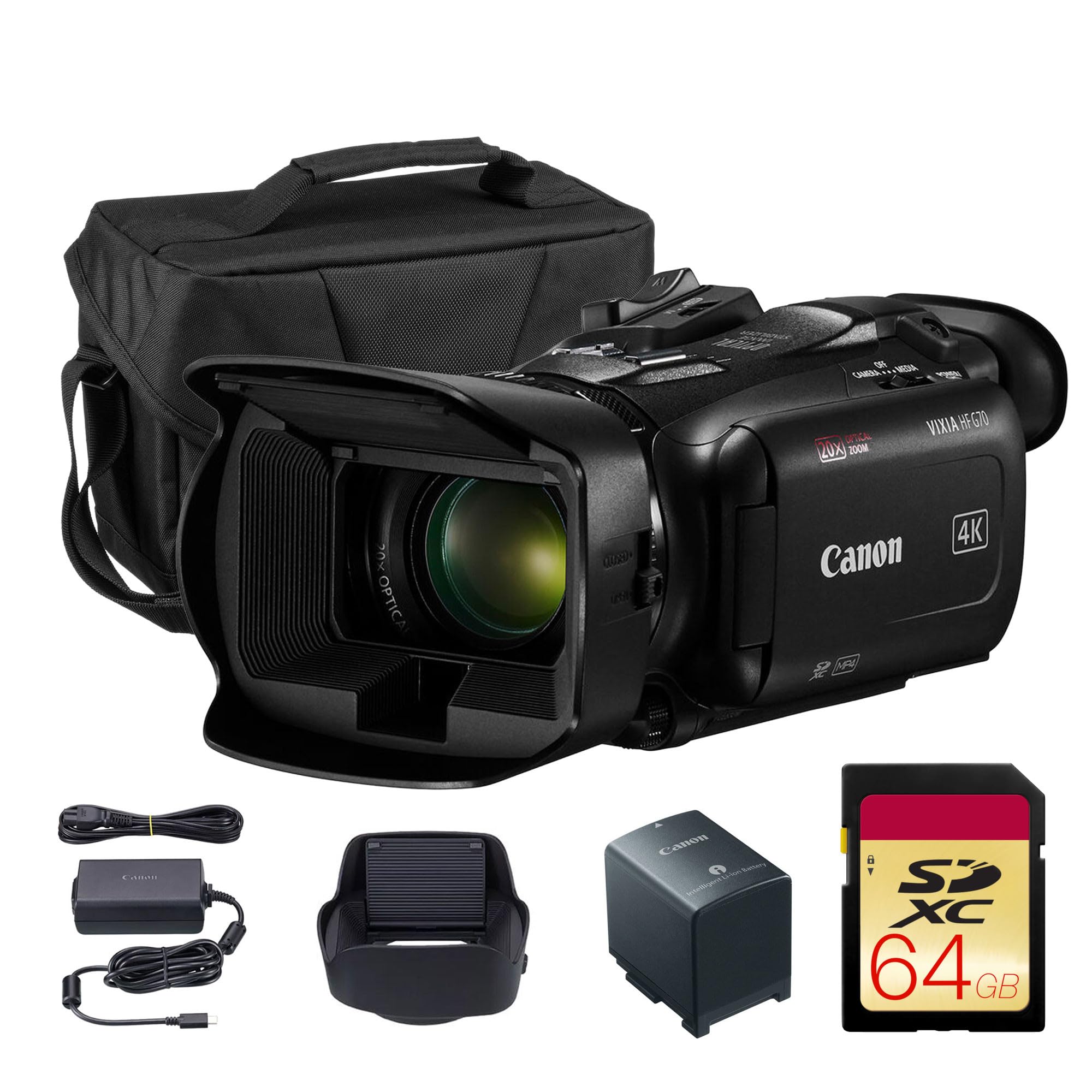
The Canon VIXIA HF G70 is a traditional camcorder design that records true 4K UHD video using the DIGIC DV 6 processor and a 1/2.3-inch sensor. The 20x optical zoom lens captures distant subjects with reasonable sharpness, and the manual control ring gives you direct access to focus, zoom, and iris without menu navigation.
The touchscreen interface is intuitive for quick setting changes, and the dual SD card slots allow relay recording for events longer than a single card can hold. An HDMI output sends clean 4K to an external monitor or recorder for monitoring. The included shoulder bag and 64GB card bundle covers the basics for first-time camcorder buyers.
Customer reviews appreciate the excellent 4K image quality and the build quality typical of Canon’s camcorder line, but multiple users report a 7-8 second startup delay that can miss the opening moments of a scene, and the image stabilization is rated as poor for walking shots. For stationary or tripod-based recording at family gatherings and school events, the G70 produces beautiful footage, but run-and-gun shooters should look elsewhere.
Why it’s great
- Sharp 4K UHD video with Canon’s reliable color science and DIGIC DV6 processing
- Dual SD card slots for relay recording on long shoots
- Manual control ring for direct iris, focus, and zoom adjustments
Good to know
- Long 7-8 second startup delay can cause missed shots
- Image stabilization is weak for walking or handheld telephoto shots
- Smallest sensor in this comparison, affecting low-light performance
6. Blackmagic Pocket Cinema Camera 4K

The Blackmagic Pocket Cinema Camera 4K uses a Micro Four Thirds sensor with a native 4096 x 2160 resolution and 13 stops of dynamic range, recording directly to Blackmagic RAW or Apple ProRes up to 12-bit. This raw workflow means you capture the full sensor data without compression artifacts, giving you maximum latitude to adjust white balance, exposure, and color in post without banding or noise.
The body features an active MFT lens mount, which gives you access to a huge library of lenses, including adapters for full-frame glass. The 5-inch LCD touchscreen doubles as a monitor, so you don’t need an external screen for framing. The USB-C port supports direct recording to external SSDs, reducing card costs and transfer times—one user reports recording over 40 hours of 4K footage to a single SSD without issue.
While the Pocket 4K’s battery life is poor (a standard LP-E6 battery lasts about 30-40 minutes), the bundle includes two extra batteries and a dual charger, and many owners rig an external power solution for sustained use. The camera lacks in-body stabilization and doesn’t ship with a lens, so factor in glass and a stabilization method. For indie filmmakers who prioritize post-production flexibility over all else, this camera’s file structure is unmatched.
Why it’s great
- 12-bit Blackmagic RAW and ProRes recording deliver exceptional grading flexibility
- 13 stops of dynamic range for preserving highlight and shadow detail
- USB-C SSD recording reduces storage costs and speeds up post-production workflow
Good to know
- Very short battery life (~30-40 minutes); external power solution recommended
- No in-body stabilization—requires tripod, gimbal, or stabilized lens
- No lens included in the box; must purchase Micro Four Thirds or adapted glass separately
7. Sony FDR-AX43

The Sony FDR-AX43 is a traditional Handycam with a 1/2.5-inch Exmor R low-light CMOS sensor and Balanced Optical SteadyShot, a lens-shift stabilization system that uses a floating lens element to counteract shake without the bulk of a full gimbal mechanism. The 20x optical zoom extends to 30x Clear Image Zoom in 4K mode and 40x in HD, making it a versatile all-rounder for school events, vacations, and family gatherings.
The camera records 4K UHD video at 3840 x 2160 using Sony’s BIONZ X processor, and the ZEISS Vario-Sonnar T lens covers a wide-angle 26.8mm equivalent to 536mm telephoto. The Fast Intelligent AF tracks subjects during zoom, and the Wi-Fi/NFC connectivity allows remote control via a smartphone for group shots or time-lapses.
Owners consistently praise the true 4K quality, the convenience of zooming without losing resolution, and the ability to power the camera via USB while recording. A common complaint is that the date/time resets quickly after battery removal, and the battery protrudes from the back, making it awkward with a selfie stick. For a cartridge-load-and-shoot camcorder that delivers stable telephoto footage, the AX43 is a solid choice.
Why it’s great
- Balanced Optical SteadyShot provides smooth handheld footage at long zoom ranges
- 20x optical zoom with Clear Image Zoom for lossless 4K zoom
- Wi-Fi remote control and USB power while recording
Good to know
- Date/time settings reset quickly after battery removal
- Large battery protrudes, making camera unbalanced for selfie-stick use
- No internal memory—requires an SD card for recording
8. Sony ZV-1

The Sony ZV-1 is a compact point-and-shoot designed specifically for content creators, featuring a 20.1MP stacked 1-inch Exmor RS sensor with a ZEISS Vario-Sonnar T 24-70mm f/1.8-2.8 lens. The fast Hybrid AF with Real-Time Eye Tracking keeps faces sharp, and the side flip-out touchscreen lets you frame selfie shots easily. The Product Showcase mode shifts focus from face to object in front of the lens—handy for unboxing or review videos.
The camera includes a built-in three-capsule directional microphone with a detachable windscreen, plus a 3.5mm mic jack for external audio. S-Log3 and HLG profiles provide some grading flexibility, though the 8-bit recording limits color correction compared to 10-bit cameras. The USB streaming mode works directly with software like OBS or Zoom, turning the ZV-1 into a high-quality webcam without extra capture hardware.
User feedback highlights exceptional autofocus reliability for vlogging, vibrant skin-tone reproduction, and the convenience of the defocused background bokeh switch. The main drawbacks are a short battery life (roughly 2 hours) and overheating after prolonged 4K recording. For seated talking-head content, mobile vloggers, or hybrid photography/video use, the ZV-1 is a very capable entry-level 4K camera.
Why it’s great
- Fast Hybrid AF with Real-Time Eye Tracking locks onto faces reliably
- Built-in directional mic with windscreen and 3.5mm jack for audio flexibility
- USB streaming function works as a high-quality webcam without a capture card
Good to know
- Battery life is short; a dummy battery is recommended for studio use
- Overheating can interrupt extended 4K recording sessions
- Fixed lens limits wide-angle and telephoto flexibility
9. DJI Osmo Pocket 3 Creator Combo

The DJI Osmo Pocket 3 packs a 1-inch CMOS sensor into a body the size of a lipstick, combined with a 3-axis mechanical gimbal that eliminates the need for an external stabilizer. The 2-inch rotatable touchscreen switches between horizontal and vertical framing instantly, making it ideal for dual-platform content creators who shoot for both YouTube landscape and TikTok portrait.
The camera records 4K at up to 120fps for smooth slow-motion, with an aperture of f/2.0 that captures decent light for its size. ActiveTrack 6.0 locks onto a subject and keeps them centered as you move. The Creator Combo includes the DJI Mic 2 transmitter with a windscreen, a wide-angle lens, a battery handle for extended runtime, and a mini tripod—everything you need for a mobile vlogging setup.
Real-world reviews highlight the exceptional stabilization and sharp 4K quality, with many owners calling it a phone killer for video. The D-Log M and 10-bit color depth provide genuine grading options for a camera this small. The gimbal mechanism is fragile and requires a protective case, and the small sensor cannot match the low-light performance of larger interchangeable-lens cameras. For travel vlogging and family captures, the Pocket 3 is the most packable 4K camera available.
Why it’s great
- Built-in 3-axis mechanical gimbal delivers walkable footage without extra rigging
- 10-bit D-Log M recording enables genuine color grading in a pocket-sized camera
- Creator Combo includes DJI Mic 2, wide-angle lens, and tripod for a complete mobile kit
Good to know
- Gimbal mechanism is fragile and requires care during transport
- Small 1-inch sensor struggles in very low light compared to MFT or Full-Frame cameras
- Fixed lens limits optical zoom capabilities
10. OM SYSTEM E-M10 Mark IV

The OM SYSTEM E-M10 Mark IV is a Micro Four Thirds mirrorless camera with a 20MP Live MOS sensor, 5-axis in-body image stabilization (rated for 4.5 stops), and 4K video recording. The kit lens is the M.Zuiko Digital ED 14-42mm f/3.5-5.6 EZ pancake, which collapses to fit in a jacket pocket. The flip-down monitor automatically triggers a dedicated selfie mode, making it easy for front-facing video.
The camera offers 121 contrast-detect autofocus points, 16 art filters (including Instant Film for a nostalgic look), and built-in Bluetooth for easy image transfer to a smartphone. The stabilization is effective enough to shoot 1-second handheld exposures for stills, which translates to stable video footage when paired with a wide-angle lens. The included BLS-50 battery lasts for several hours of mixed use.
Users love the small size, fun filters, and the ability to upgrade lenses within OM System’s extensive catalog. The camera charges via a separate adapter, not USB-C, which is an inconvenient omission in 2025. The 4K video is limited to 30p and lacks the bitrate needed for professional grading, but for a beginner-content creator hybrid, the E-M10 Mark IV is a capable and affordable entry point.
Why it’s great
- 5-axis IBIS provides stable handheld video and long-exposure stills
- Compact body with kit lens that fits in a jacket pocket
- Flip-down monitor and selfie mode ideal for vlogging beginners
Good to know
- Charges via AC adapter, not USB-C; external charger recommended for convenience
- 4K video limited to 30p with lower bitrate than competitors
- WiFi/app connectivity is noticeably slow for file transfer
11. XbotGo Falcon
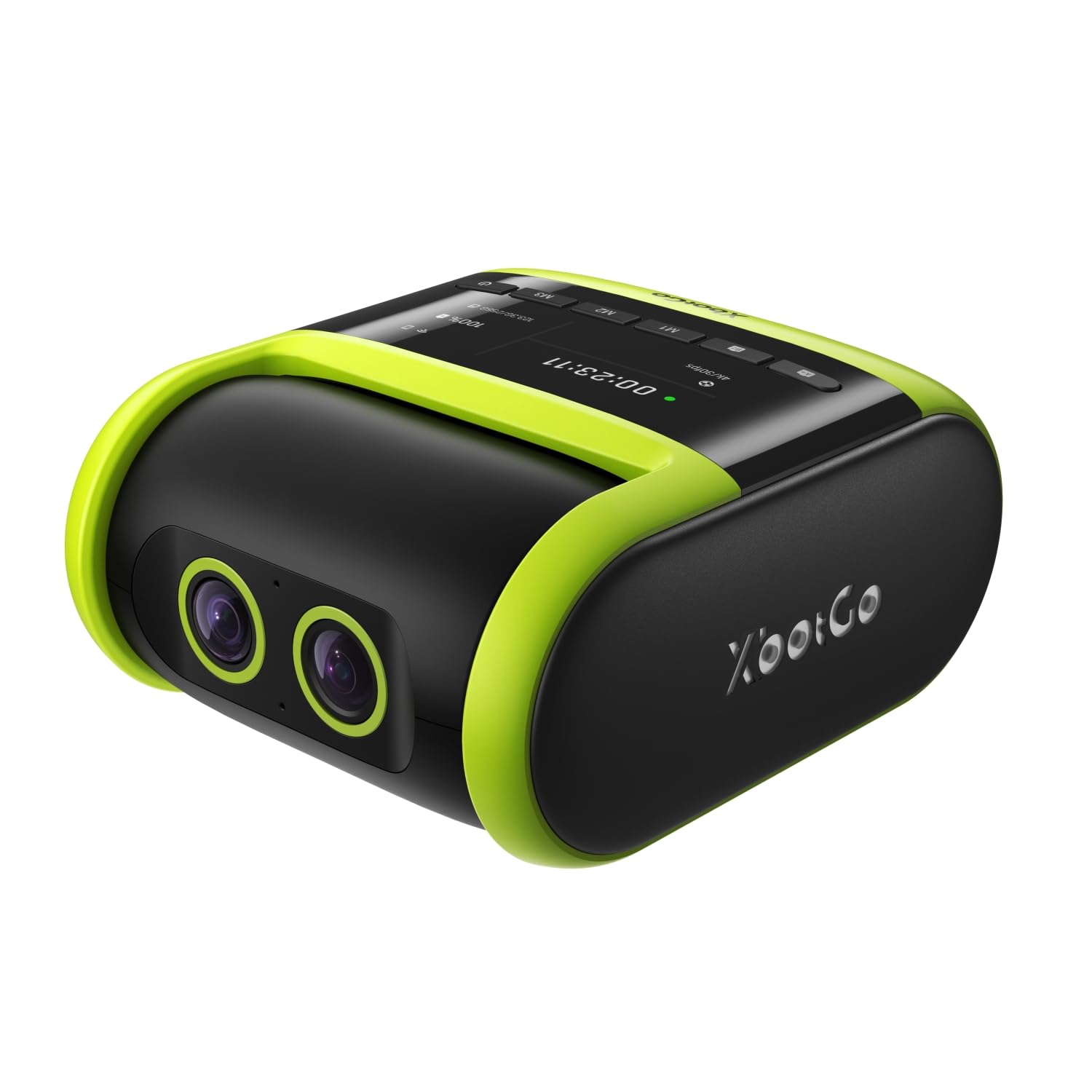
The XbotGo Falcon is a purpose-built AI action camera for team sports, combining a 4K recording lens with an AI-assisted tracking lens that uses 6 TOPS of processing power to automatically follow players and the ball in soccer, basketball, and football. The dual-lens system eliminates the need for a dedicated camera operator—set it on a tripod, and the camera pan-tilts to keep the action centered.
It records 4K video in MP4 format to a microSD card (sold separately), and supports built-in Wi-Fi for live streaming directly to platforms. The IPX5 rating makes it resistant to splashes and sideline conditions, and the 1/4-inch screw mount fits standard tripods. No subscription is required for the tracking or streaming features, which sets it apart from many sports-tracking cameras.
Customer feedback confirms sharp 4K footage for outdoor games and effective auto-tracking during well-lit matches. The battery lasts through a full game, but tracking accuracy drops in dim indoor gyms, and the live stream can be pixelated under poor Wi-Fi. The 1.6x digital zoom is underwhelming for field sports. For parents or coaches who want hands-free game capture without monthly fees, the Falcon is a unique tool.
Why it’s great
- AI auto-tracking follows players hands-free without a subscription
- Dual-lens design provides 4K recording with dedicated tracking lens
- IPX5 water resistance suits outdoor sideline use
Good to know
- Auto-tracking struggles in dim indoor gym lighting
- Digital zoom is limited to 1.6x for 4K, providing minimal reach
- No battery included; microSD card required and sold separately
FAQ
What bit rate do I need for professional 4K video?
Does a larger sensor always mean better low-light video?
Is a built-in fan necessary for long 4K recordings?
Final Thoughts: The Verdict
For most users, the 4k video camera winner is the Sony FX3 because it combines a full-frame sensor with 15+ stops of dynamic range, an internal fan for unlimited recording, and a compact body with professional XLR audio; it’s the most versatile cinema-ready option for serious videographers. If you want unmatched grading flexibility at a lower body cost, grab the Blackmagic Pocket Cinema Camera 4K. And for mobile vlogging and travel where size matters most, nothing beats the DJI Osmo Pocket 3 Creator Combo.

Mo Maruf
I created WellFizz to bridge the gap between vague wellness advice and actionable solutions. My mission is simple: to decode the research and give you practical tools you can actually use.
Beyond the data, I am a passionate traveler. I believe that stepping away from the screen to explore new environments is essential for mental clarity and physical vitality.