Our readers keep the lights on and my smoothie glass nicely filled. As an Amazon Associate, I earn from qualifying purchases.
The frustration is universal: you grab a remote, a flashlight, or a game controller only to find dead cells inside. You dig through drawers for spares, find a few corroded leftovers, then head back to the store for another pack of disposables. A quality battery recharger severs that wasteful loop, turning a one-time purchase into years of free power for every AA and AAA device in your home.
I’m Mohammad Maruf — the founder and writer behind WellFizz. I’ve spent months analyzing the chemistry, charging algorithms, and real-world durability of every major battery recharger system on the market to help you pick the set that truly pays for itself.
Whether you need eight cells for a household of toys and clocks or a professional-grade analyzer for high-drain camera gear, this guide breaks down the specs that actually matter for finding your ideal best battery recharger.
How To Choose The Best Battery Recharger
Not all rechargers are created equal behind the plastic shell. The chipset that controls charge termination, the number of independent slots, and the chemistry compatibility define whether your batteries last 100 cycles or 1600 cycles. Here is what to look for.
Independent Bays vs. Series Charging
Cheaper chargers run batteries in pairs or series, meaning one weak cell prevents the others from reaching full charge. An independent-bay charger treats each slot separately, topping off each cell to its maximum voltage. This is essential if you mix brands or use partially depleted batteries together.
Chemistry: NiMH vs. Lithium-Ion (1.5V Li-ion)
Standard NiMH cells output 1.2V nominal, which works in most low-drain devices but can underpower high-drain items like camera flashes or motorized toys. Modern 1.5V Li-ion rechargeable cells hold a steady voltage until empty, delivering consistent brightness and torque. You need a charger specifically compatible with the chemistry you choose — and preferably one that supports both.
Charge Rate and Capacity Matching
A charger that shoves 500mA+ into a 800mAh AAA cell shortens lifespan with excess heat. Look for pulse-charging or trickle-mode technology — MCU-controlled chargers that adjust current based on cell condition. Paired with the right capacity (2000mAh AA is standard, 2800mAh offers longer runtime at slightly heavier weight), this extends usable cycles well beyond typical warranty claims.
Quick Comparison
On smaller screens, swipe sideways to see the full table.
| Model | Category | Best For | Key Spec | Amazon |
|---|---|---|---|---|
| Panasonic BQ-CC65 | Premium Analyzer | Eneloop Pro diagnostics | LCD voltage & mAh readout | Amazon |
| RayHom 12-Pack Kit | Lithium 12-Slot | Camera flash & camping | 1.5V constant lithium output | Amazon |
| Amazon Basics 8-Bay | NiMH Bundle | Household AA/AAA bulk | 8 AA + 8 AAA included | Amazon |
| imuto Lithium Set | Lithium Compact | Travel & VR controllers | 1600 recharge cycles | Amazon |
| Granicell 8-Pack | Budget NiMH | Remote controls & clocks | 2800mAh NiMH cells | Amazon |
In‑Depth Reviews
1. Panasonic BQ-CC65 Super Advanced eneloop pro Quick Charger

The BQ-CC65 is the definitive charger for anyone serious about battery performance. Its four independent LCD indicators display real-time voltage, charge/discharge time, and mAh discharge levels for each cell individually — data that no other charger in this roundup provides. This analyzer capability lets you spot a failing battery before it ruins a shoot or a gaming session.
Panasonic optimized this unit for its eneloop and eneloop Pro cells, but it works with standard NiMH AA and AAA as well. Two fully drained eneloop Pro AAs reach 90% charge in roughly two hours, while a full bank of four takes about four hours. The built-in refresh/discharge mode cycles old NiMH cells back to life, restoring capacity in batteries you thought were dead.
A USB-A output port (5V/1A) lets you charge a phone or earbuds from the same unit, though the charger itself plugs into a wall outlet via a detachable USB cable. At roughly 225 grams, it is surprisingly light for its feature density. This is the pick for the hobbyist, the photographer, and anyone who treats batteries as precision tools rather than consumables.
Why it’s great
- Independent LCD readout for voltage and capacity per slot
- Refresh mode revives older NiMH cells significantly
- Fast 2-hour charge for two eneloop Pro AAs
Good to know
- Optimized for eneloop/eneloop Pro — compatibility with third-party NiMH varies
- No support for 1.5V Li-ion batteries
2. RayHom 12-Pack Rechargeable Lithium AA Batteries with Charger
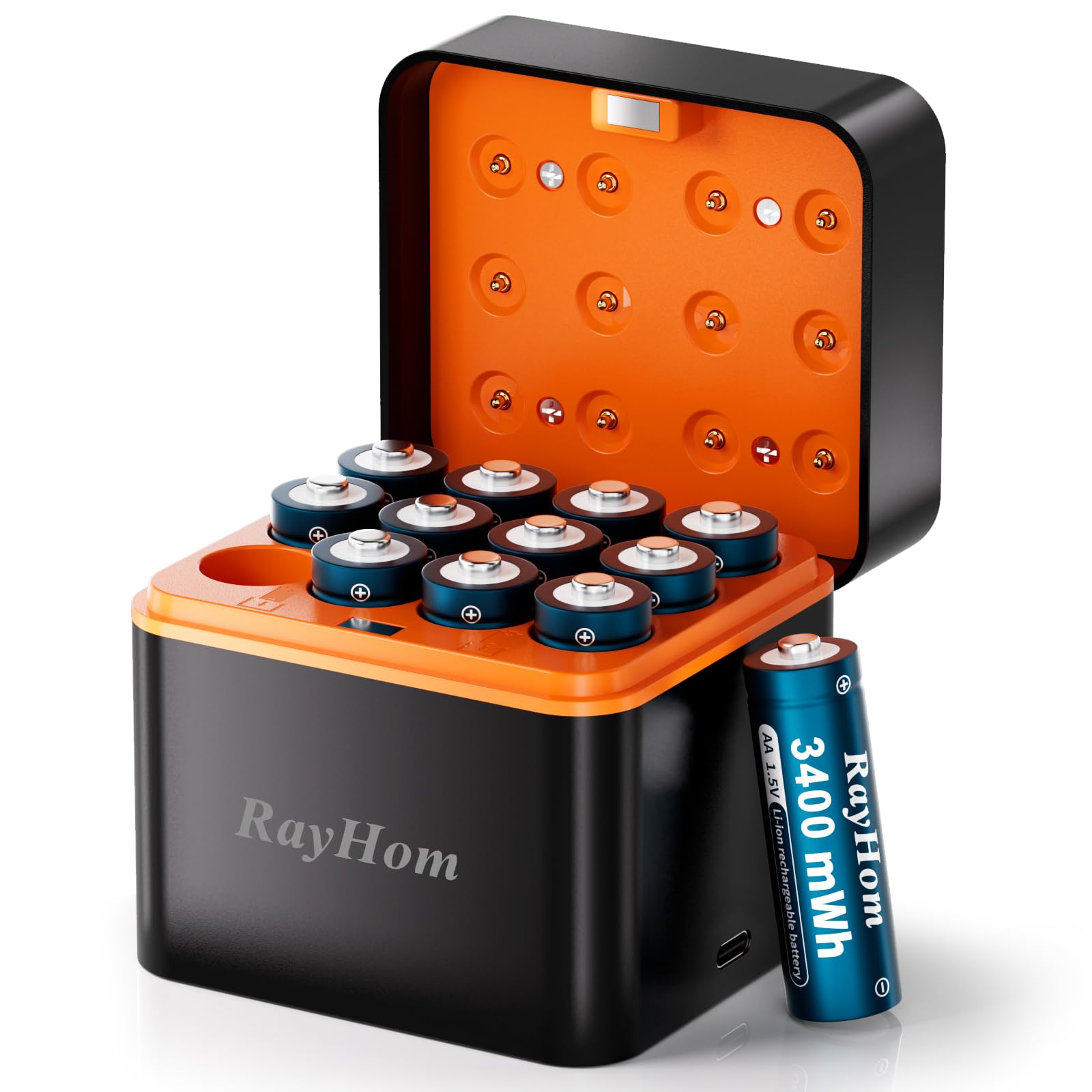
The 1.5V constant-output lithium cell is a genuine engineering advance: it delivers full voltage until the very last drop of energy, unlike NiMH which gradually sags. The RayHom kit includes twelve 3400mWh AA lithium batteries paired with a 12-slot smart charger that uses MCU-controlled 350mA pulse current and △V cutoff technology to prevent overcharging.
Each slot operates independently, so you can charge one cell or all twelve at once. Red LED indicates charging, green signals full, and the charger automatically rejects non-rechargeable or damaged cells. The magnetic-sealed storage case doubles as a dust- and moisture-proof organizer — ideal for camping, holiday decorations, or a household running multiple high-drain devices like camera flashes and game controllers.
Users report that a full charge lasts two to three weeks in moderate drain devices before needing a top-up, which is consistent with lithium chemistry. The USB-C input makes travel charging flexible, though a wall adapter is not included. For homes already running on rechargeable lithium, this is the most complete “open the box and never buy alkalines again” solution available.
Why it’s great
- 1.5V constant output delivers peak performance in high-drain gear
- Independent 12-slot charging with smart safety features
- Storage case protects cells from dust and moisture
Good to know
- Charge holds 2-3 weeks under moderate use, shorter than high-end NiMH idle retention
- Compatible only with 1.5V lithium AA cells, not NiMH
3. Amazon Basics Rechargeable NiMH Battery with 8-Bay Charger
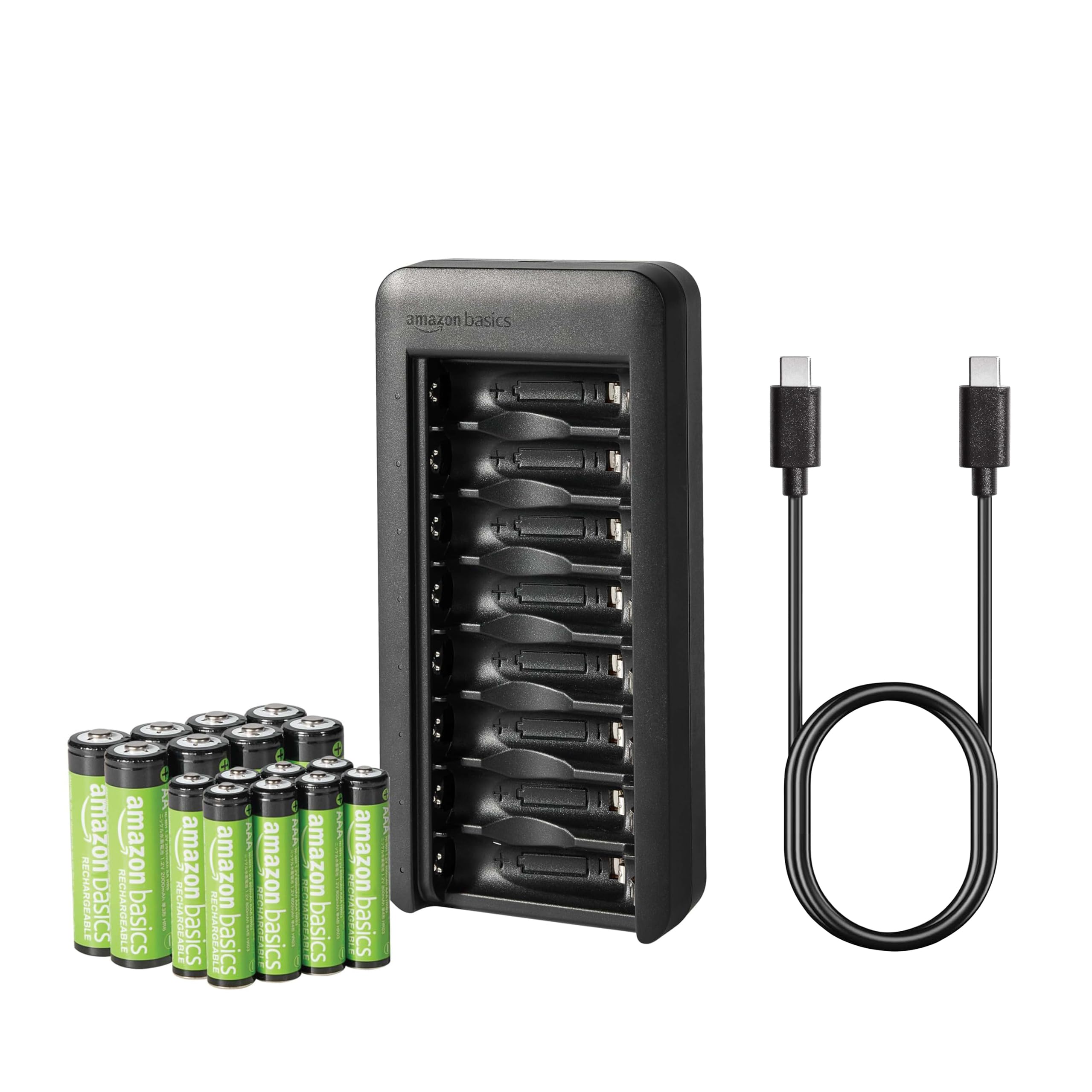
The Amazon Basics bundle delivers the highest cell-per-dollar ratio in this guide: eight AA 2000mAh batteries, eight AAA 800mAh batteries, and an eight-bay smart charger all in one box. The charger uses independent slots and communicates charge status via LED — slow blink for charging, solid for full, fast blink for error (defective or non-rechargeable cells detected).
NiMH low-self-discharge chemistry means these cells retain 80% of their capacity after 12 months of storage, so you can charge them today and pop them into a remote control next quarter without a refresh cycle. The 2000mAh AA capacity is standard, offering reliable runtime for clocks, toys, and wireless peripherals without the weight premium of high-capacity 2800mAh cells.
One engineering quirk: the charger powers via USB-C but ships without an AC adapter, so you must supply your own 5V brick. A few users note that attempting to charge more than two AAs in a specific slot pattern triggers a fault light — sticking to a balanced slot arrangement solves this. For the price of a single pack of premium alkalines, this kit effectively eliminates the category for an entire home.
Why it’s great
- Includes 16 batteries with independent-bay charger, ready to use immediately
- Low self-discharge holds 80% charge for 12 months
- LED diagnostic clearly indicates charging state and errors
Good to know
- Does not include a USB-C power adapter
- Slot arrangement can be picky when charging mixed AA/AAA counts
4. imuto Rechargeable 4 AAA and 4 AA Lithium Batteries with Charger

The imuto system takes a different design philosophy: the charger is the storage case. This all-in-one clamshell charges four AA lithium cells and four AAA lithium cells simultaneously via a Type-C port, then snaps shut to become a dust-proof travel organizer. The contained lithium chemistry boasts up to 1600 charge cycles and a 12-year shelf life, which is exceptional for cells at this tier.
Capacity ratings are 3000mWh for AA and 1300mWh for AAA, and the constant 1.5V output keeps high-drain devices like VR grips and doorbell cameras running at full power until depletion. Users report that the AA cells last notably longer in a Roku remote’s headphone mode compared to standard rechargeables — about 6-8 hours per charge — though one user experienced a single cell failure after roughly five recharges (customer service replaced it).
The charger’s 2-hour full charge claim holds for the included lithium cells, though initial pairing can require a slot swap if the LED indicator flashes red instead of lighting. The compact footprint makes it the easiest of the bunch to pack in a go-bag. For travelers or minimalists who want lithium performance in a self-contained system, this is the logical choice.
Why it’s great
- Integrated storage case keeps all cells organized during travel
- 1600 cycle rating far exceeds typical NiMH lifespan
- 12-year shelf life means negligible idle discharge
Good to know
- Case/charger pairing requires specific slot seating on first use
- One reported cell failure after ~5 cycles, albeit replaced under warranty
5. Granicell Rechargeable AA Batteries with Charger, 8 Pack 2800mAh
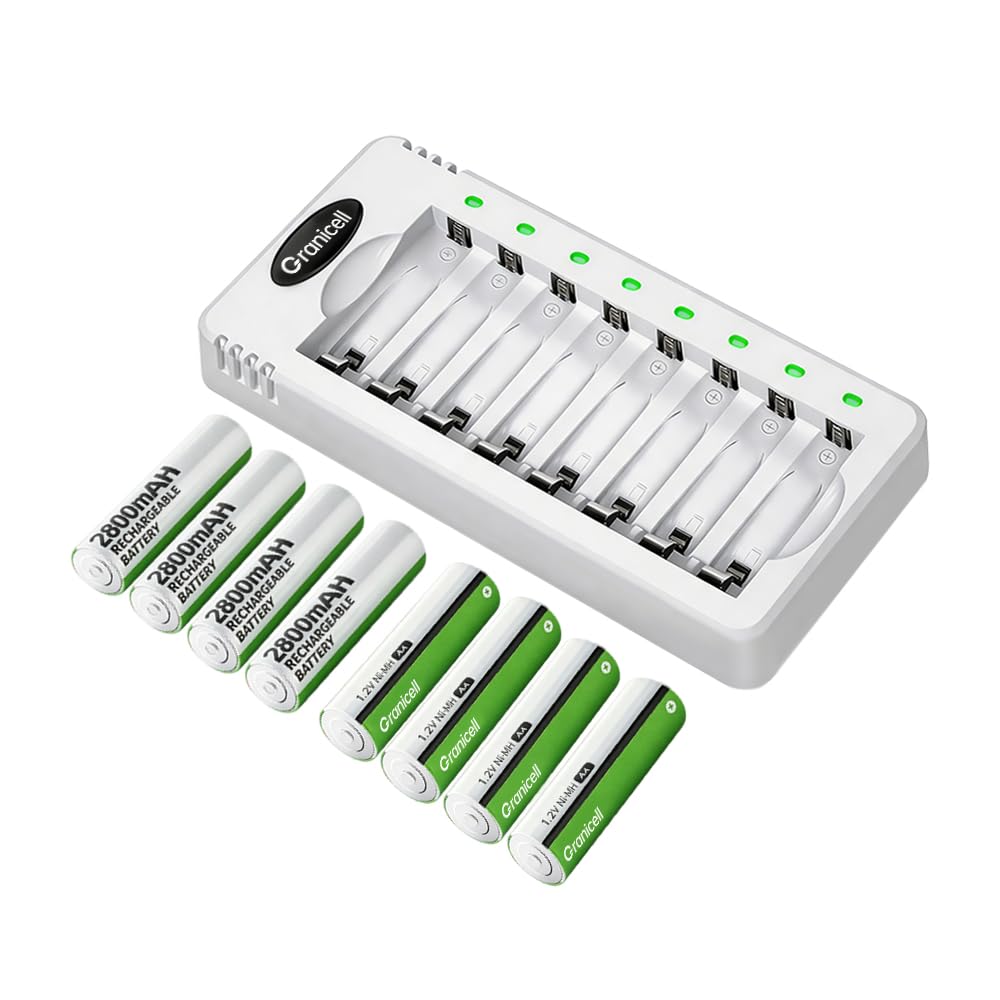
Granicell takes the entry-level position with a simple proposition: eight 2800mAh NiMH AA batteries and an eight-bay smart charger for a minimal upfront investment. The 2800mAh capacity is the highest standard-capacity NiMH cell in this group, offering roughly 40% longer runtime between charges than a typical 2000mAh AA. For devices like digital cameras, electric toothbrushes, and flashlights that burn through energy fast, this extra headroom matters.
The charger uses independent slots, recognizes both AA and AAA NiMH/Ni-Cd cells, and includes an LED indicator that glows red during charging and green when full. Its USB-C input lets you power it from a laptop, car adapter, or power bank — making it suitable for on-the-road charging. Users confirm it works with multiple battery brands, including Eneloop and Amazon Basics, avoiding the “only works with our branded cells” trap that plagues some proprietary sets.
One minor concern: the red LED is bright enough to illuminate a dark room, which can be annoying if you charge batteries in a bedroom overnight. Additionally, a user reported that the charger failed to recognize four of five old Ni-Cd cells, flagging them as bad. For fresh NiMH cells and everyday household use, however, this is the least expensive way to step into the rechargeable ecosystem with high-capacity cells.
Why it’s great
- 2800mAh high-capacity cells provide longer runtime than standard 2000mAh
- Works with any brand AA/AAA NiMH battery, not proprietary
- USB-C input allows charging from virtually any power source
Good to know
- LED indicators are very bright for nighttime use
- Incompatible with older Ni-Cd cells in some cases
FAQ
Can I leave batteries in the charger after they are full?
Why do my rechargeable batteries drain faster in a smoke detector?
What does the refresh or discharge mode on a charger do?
Final Thoughts: The Verdict
For most users, the best battery recharger winner is the Panasonic BQ-CC65 because its LCD analyzer and refresh mode give you full control over battery health, paying for itself in recovered capacity alone. If you want 1.5V constant output for high-drain devices and a full 12-cell rotation, grab the RayHom 12-pack lithium kit. And for the most cell-per-dollar setup that instantly equips an entire house, nothing beats the Amazon Basics 8-bay bundle with 16 batteries.

Mo Maruf
I created WellFizz to bridge the gap between vague wellness advice and actionable solutions. My mission is simple: to decode the research and give you practical tools you can actually use.
Beyond the data, I am a passionate traveler. I believe that stepping away from the screen to explore new environments is essential for mental clarity and physical vitality.