Our readers keep the lights on and my smoothie glass nicely filled. As an Amazon Associate, I earn from qualifying purchases.
Choosing a portable generator that delivers a genuine 4,000 peak watts without sounding like a construction site is the central challenge for anyone preparing for RV travel, home backup, or remote job-site power. The market is flooded with conventional open-frame units that roar at 70 decibels and produce distorted power, while inverter models promise clean sine waves but often come with inflated peak ratings. You need a machine that starts a 15,000 BTU RV air conditioner, runs your refrigerator and lights, and still lets you hold a conversation nearby.
I’m Mohammad Maruf — the founder and writer behind WellFizz. Over years of analyzing portable power equipment, I’ve compared inverter vs. conventional topologies, evaluated total harmonic distortion claims against real-world load tests, and tracked long-term reliability across thousands of owner reviews to separate genuine 4,000-watt performers from overhyped spec sheets.
This guide cuts through the marketing noise to rank the top inverter and dual-fuel options available today, helping you invest in a 4000 watt generator that delivers clean, reliable power for years.
How To Choose The Best 4000 Watt Generator
A 4,000-watt-class generator sits in a sweet spot: it can handle a 15,000 BTU RV air conditioner, a well pump, or a few critical home circuits, but it isn’t so massive that it requires a dedicated shed or a team to move. The following criteria separate a smart investment from a frustrating one.
Inverter Technology vs. Conventional Alternator
Standard generators produce power with significant harmonic distortion that can damage sensitive electronics like laptops, phone chargers, and modern refrigerator control boards. Inverter generators convert the raw AC to DC and then back to a clean sine wave, delivering total harmonic distortion under 3 percent. This cleaner power also allows the engine to idle down when loads are light, improving fuel efficiency and reducing noise. For any unit that will power electronics, an inverter topology is non-negotiable.
Starting vs. Running Wattage
Every motor-driven appliance — air conditioner compressors, well pumps, and refrigerators — requires a surge of 2 to 3 times its running wattage to start. A 13,500 BTU RV AC might draw 1,500 watts running but needs 2,800 starting watts. A generator rated at 4,000 peak watts must deliver that surge reliably without tripping, while its 3,200 to 3,300 rated watts determine how many continuous loads it can carry simultaneously. Always calculate your total starting watts, not just the running load.
Fuel Type: Gasoline vs. Dual Fuel
Straight gasoline generators are simpler, lighter, and cheaper, but gasoline degrades in storage and can gum up carburetors after a few months. Dual-fuel models that also run on propane offer longer fuel shelf life (propane never goes bad), cleaner combustion that reduces oil change frequency, and better performance in cold weather. The trade-off is a roughly 10 percent reduction in output on propane and a slightly higher upfront cost. For emergency backup where fuel stability matters, dual-fuel is the smarter choice.
Noise Level and Portability
A 4,000-watt inverter generator should operate between 52 and 64 dBA from 23 feet — quiet enough for campgrounds with noise restrictions and for neighborhoods where you don’t want to annoy neighbors. Look for fully enclosed designs with ECO mode that reduces engine speed at light loads. Weight below 50 pounds is ideal for a single person to lift into a truck bed, while models with telescoping handles and wheels trade a few extra pounds for easier rolling across a lawn or campsite.
Safety, Outlets, and Parallel Capability
A carbon monoxide (CO) sensor with automatic engine shutoff is no longer optional — it is a life-saving feature required on all new generators. The outlet panel should include a TT-30R RV-ready 30-amp receptacle, a standard 120V duplex, and USB ports. Parallel capability lets you pair two identical inverter generators to double your power output, which is far cheaper and more portable than buying a single 8,000-watt monster.
Quick Comparison
On smaller screens, swipe sideways to see the full table.
| Model | Category | Best For | Key Spec | Amazon |
|---|---|---|---|---|
| Westinghouse iGen4000c | Gasoline Inverter | Super Quiet Home Backup | 52 dBA / Remote Start | Amazon |
| Westinghouse iGen4000DFc | Dual Fuel Inverter | Fuel Flexibility | Gas / Propane / Remote Start | Amazon |
| Champion 4000-Watt | Gasoline Inverter | Lightweight (48 lbs) | 64 dBA / 10-Hour Run Time | Amazon |
| maXpeedingrods MXR4000 | Gasoline Inverter | Bluetooth App Monitoring | 48.5 lbs / RV Adapter | Amazon |
| WEN DF360iX | Dual Fuel Inverter | CO Watchdog Safety | 49 lbs / Propane Ready | Amazon |
| PowerSmart 3800W | Gasoline Inverter | Best Value Inverter | 59 dBA / 52 lbs | Amazon |
| Pulsar PGD40ISCO | Gasoline Inverter | Budget Lightweight Pick | 47.3 lbs / 59 dBA | Amazon |
| Aceup Energy 4000W | Gasoline Inverter | Digital Display / 50 lbs | 149cc / 5-Hour Run Time | Amazon |
| PowerSmart 3600W | Gasoline Inverter | RV 30A Outlet | 50.7 lbs / TT-30R | Amazon |
| WEN 56360i | Gasoline Inverter | Ultra Light (46 lbs) | 2900 Rated Watts / 3-Year Warranty | Amazon |
| BILT HARD Dual Fuel | Dual Fuel Inverter | Propane Efficiency | 58 dBA / CO Sensor | Amazon |
In‑Depth Reviews
1. Westinghouse iGen4000c

This Westinghouse model sets the benchmark for what a 4,000-watt inverter generator should be. The remote electric start with auto choke — controlled by a key fob — lets you fire it up from inside your RV or home, a genuine convenience during a cold-weather outage or rainy camping trip. Rated at 3,300 continuous watts with less than 3% THD, it handles sensitive electronics and a 15,000 BTU RV AC simultaneously without hesitation.
The 1.69-gallon fuel tank delivers up to 7 hours of runtime at 50% load with the ECO mode engaged. At just 52 dBA from 23 feet, it is one of the quietest units in its class — quieter than a normal conversation and well within national park noise limits. The rotating LED display shows fuel level, power output, remaining runtime, voltage, and lifetime hours, giving you precise data at a glance.
Weighing 61.7 pounds, it is not the lightest, but the telescoping handle and wheels make it easy to roll across rough terrain. The CO sensor and automatic low-oil shutdown add essential safety layers. For home backup or high-end RV use where quiet operation and convenience matter most, this is the unit to beat.
Why it’s great
- Remote start with key fob provides unmatched convenience for cold or rainy conditions.
- Operates at 52 dBA, making it one of the quietest 4,000-watt inverters available.
- Rotating digital display offers real-time fuel, power, and run-time data.
Good to know
- At 61.7 pounds, it is heavier than some competitors; the wheels and handle compensate well.
- No dual-fuel option in this model; the iGen4000DFc offers propane capability.
2. Westinghouse iGen4000DFc

The dual-fuel version of Westinghouse’s flagship inverter generator adds propane capability without sacrificing any of the premium features. It delivers 4,000 peak watts on gasoline and 4,000 peak watts on propane, with 3,300 rated watts on gasoline and 3,300 on propane — notably, no derating on propane, which is rare for dual-fuel units. The remote electric start and auto choke work identically on both fuel types.
Propane provides indefinite fuel storage, cleaner combustion with less carbon buildup, and better cold-weather starting. The included propane hose connects with a quarter-turn, and the generator auto-detects the fuel source. Owners report running RV air conditioners, electric heaters, and full appliances for 14 hours on a single 20-pound propane tank in ECO mode.
The CO sensor, telescoping handle, rotating LED display, and 3-year warranty carry over from the gasoline-only version. At 62.8 pounds, it is the heaviest in this roundup, but the wheels make transport manageable. For anyone valuing fuel security and long-term storage, this is the definitive choice.
Why it’s great
- Genuine dual-fuel performance with no power derating on propane.
- Remote start works seamlessly on both gasoline and propane.
- Propane provides indefinite fuel storage ideal for emergency preparedness.
Good to know
- Heaviest unit in the lineup at 62.8 pounds; the telescoping handle is essential.
- Propane consumption is higher than gasoline at the same load level.
3. Champion Power Equipment 4000-Watt Inverter

Champion has engineered one of the lightest 4,000-watt inverters on the market at just 48.1 pounds dry. That weight makes it genuinely portable for a single person to load into a truck bed or carry to a campsite. The 149cc engine produces 4,000 starting watts and 3,000 running watts, with clean power below 3% THD suitable for any sensitive electronics.
Noise output is rated at 64 dBA from 23 feet — noticeable but still quieter than any open-frame generator. The real highlight is runtime: up to 10 hours at 25% load on a full tank, which translates to overnight power for a small RV or a few home essentials without refueling. The CO Shield carbon monoxide auto shutoff system provides critical safety protection.
The outlet panel includes a TT-30R RV receptacle and a 120V duplex, plus parallel outlets for doubling output with a second Champion unit. The 3-year limited warranty and free lifetime technical support from Champion’s experts add long-term confidence. For weight-conscious buyers who need reliable, clean power, this is a top contender.
Why it’s great
- At 48.1 pounds, it is the lightest 4,000-watt inverter in this roundup.
- Up to 10 hours of runtime at partial load reduces refueling frequency.
- CO Shield auto shutoff and 3-year warranty provide strong peace of mind.
Good to know
- 64 dBA is louder than the quietest inverters; still acceptable for most settings.
- Rated output of 3,000 watts is lower than some competitors at the same peak rating.
4. maXpeedingrods MXR4000

The MXR4000 brings modern connectivity to the generator world with its Bluetooth app that displays power output, fuel level, voltage, frequency, and run time in real time. You can also toggle ECO mode from your phone, which is genuinely useful when you want to maximize fuel efficiency without walking back to the unit. The 145cc engine produces 4,000 peak watts and 3,200 rated watts of clean inverter power.
At 48.5 pounds, it is nearly as light as the Champion but includes an NEMA L5-30R RV outlet and an adapter for the TT-30R standard, so you can plug directly into your RV without hunting for adapters. Owners report it starts a 13,500 BTU RV air conditioner with a soft start and runs a full 30-amp travel trailer reliably. The included dust cover, parallel cables, and tool kit add genuine value.
Some users note the Bluetooth app can be finicky and that the inverter cooling fan creates noticeable vibration noise at high loads. The 2-year warranty and lifetime technical assistance provide reasonable support. For tech-minded RVers who want remote monitoring, this is the most feature-rich choice in its class.
Why it’s great
- Bluetooth app provides remote monitoring of power, fuel, and run-time data.
- Lightweight at 48.5 pounds with included RV adapter and parallel cables.
- ECO mode toggle from the phone optimizes fuel efficiency on the fly.
Good to know
- Bluetooth app connectivity can be inconsistent according to some owners.
- Inverter heat sink may produce rattling vibrations at high loads; can be mitigated.
5. WEN DF360iX

WEN’s DF360iX brings dual-fuel capability to a package that emphasizes safety above all else. The integrated Watchdog CO Shutdown Sensor automatically turns off the generator if carbon monoxide levels reach dangerous thresholds, a feature that has become essential for any indoor-adjacent use like garage backup or tailgate setups. On gasoline it delivers 3,600 surge watts and 2,900 rated watts; on propane, 3,500 surge and 2,600 rated.
At 49 pounds, it is among the lighter dual-fuel inverters and includes a fuel shut-off valve that lets the carburetor run dry, preventing ethanol-related gumming during storage. The tool-free LPG quick-connector makes switching between fuel sources effortless. The digital display shows voltage, frequency, runtime, and fuel level, and the ECO mode extends runtime significantly at light loads.
Users note that the 120V outlets can feel slightly loose with some plug shapes — a minor irritant that does not affect performance. The 3-year warranty is among the best in the category. For buyers who prioritize CO safety and fuel flexibility in a lightweight package, this WEN is a solid investment.
Why it’s great
- Watchdog CO Sensor auto-shuts down the generator at unsafe carbon monoxide levels.
- Dual-fuel operation with tool-free LPG quick-connector for easy fuel switching.
- Lightweight at 49 pounds with fuel shut-off for long-term storage health.
Good to know
- Rated wattage on propane drops to 2,600 watts, limiting high-draw applications.
- Some owners report 120V outlet receptacles hold plugs loosely.
6. PowerSmart 3800W Inverter Generator
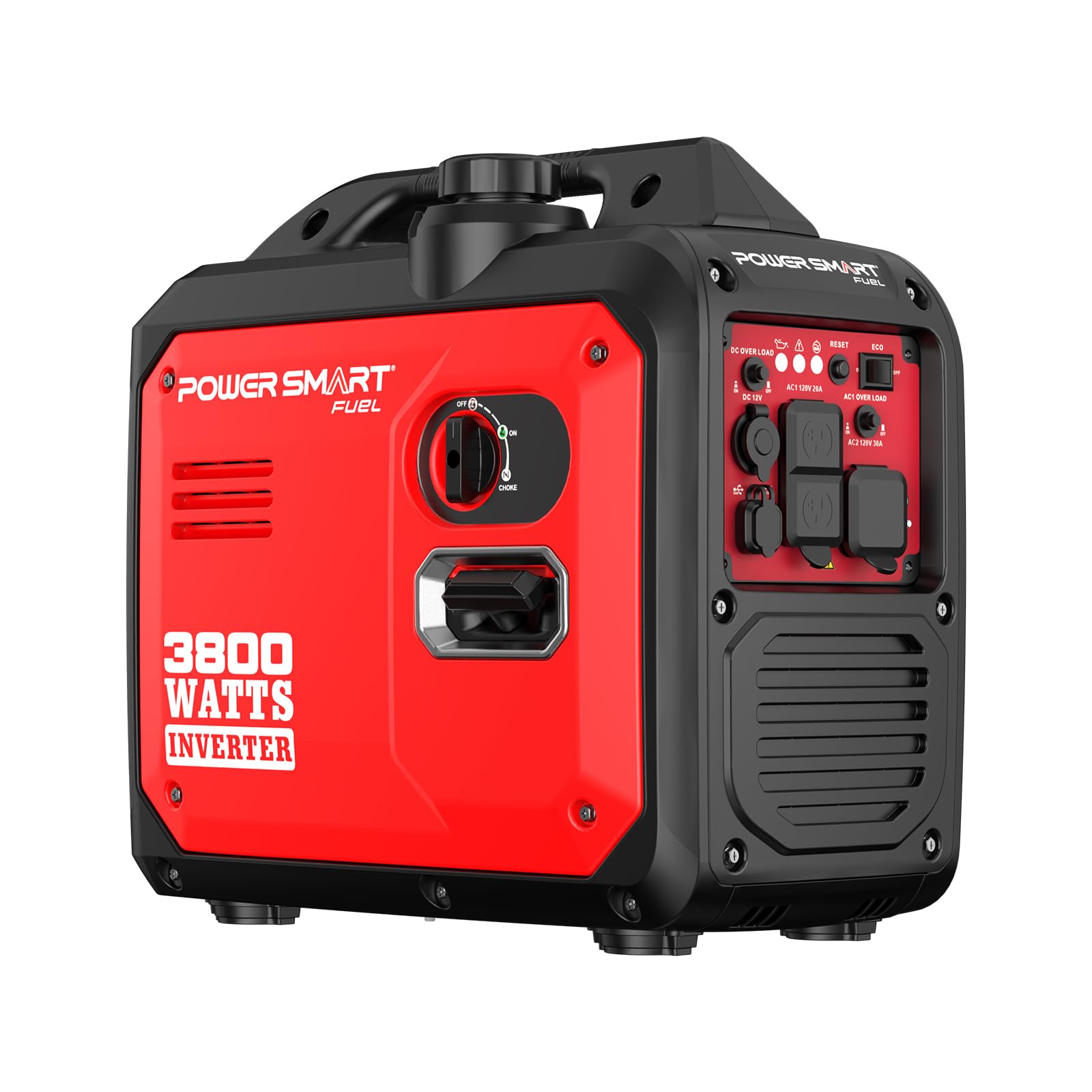
PowerSmart delivers impressive inverter performance at a price point that undercuts most competitors without cutting critical features. The 143cc engine produces 3,800 surge watts and 3,200 rated watts of clean sine wave power with less than 3% THD, making it safe for laptops, phones, and medical devices. The 52-pound weight and ergonomic handle make it easy for one person to move.
Noise output at 59 dBA from 23 feet places it among the quietest inverter generators at this wattage level — quieter than many and well within campground noise limits. The 1.19-gallon fuel tank provides up to 4.5 hours of runtime at 50% load with the ECO mode engaged. Owners consistently report first-pull starts and reliable operation over extended power outages, with one user logging 24-plus hours powering a refrigerator, AC, and multiple electronics.
The parallel-ready ports allow connection to a second PowerSmart unit to double output, and the 2-year warranty provides decent protection. The lack of a digital display and the smaller fuel tank are the main trade-offs for the lower price. For budget-conscious buyers who refuse to compromise on clean power, this is the standout value.
Why it’s great
- Under for a genuine inverter generator with less than 3% THD.
- Operating at 59 dBA, it is quiet enough for noise-sensitive environments.
- Starts easily on the first pull and provides reliable power for home essentials.
Good to know
- No digital display or fuel gauge; runtime monitoring requires external tracking.
- 1.19-gallon tank provides shorter runtime than larger-capacity competitors.
7. Pulsar PGD40ISCO

The Pulsar PGD40ISCO is the lightest in this roundup at 47.3 pounds, making it the easiest unit to lift, carry, and load solo. Its 145cc engine produces 4,000 peak watts and 3,200 rated watts, and the inverter technology delivers clean power suitable for sensitive electronics. The 1-gallon fuel tank provides about 4 hours of runtime at half load, which is on the shorter side but sufficient for camping evenings or short outages.
Noise is rated at 59 dBA, quiet enough for RV parks with strict sound limits. Owners report starting 13,500 BTU RV air conditioners with a soft start and accumulating hundreds of hours of use across multiple summers and elevations from sea level to 8,000 feet. The white color is unique in a market dominated by red, blue, and black, which some buyers appreciate for heat reflection and visibility.
The unit lacks wheels or a telescoping handle, so moving it across rough ground requires lifting. Some users note the fuel cap can vapor-lock in hot weather and suggest cracking it open periodically. The automatic voltage regulation and parallel capability add flexibility. For campers who prioritize raw portability above all else, this Pulsar is an excellent fit.
Why it’s great
- Lightest unit at 47.3 pounds; genuinely solo-lift portable.
- Proven reliability over hundreds of hours across multiple altitudes and climates.
- Inverter technology provides clean power for sensitive electronics.
Good to know
- No wheels or telescoping handle; must be lifted and carried.
- 1-gallon tank limits runtime to about 4 hours at half load.
8. Aceup Energy 4000W Inverter Generator
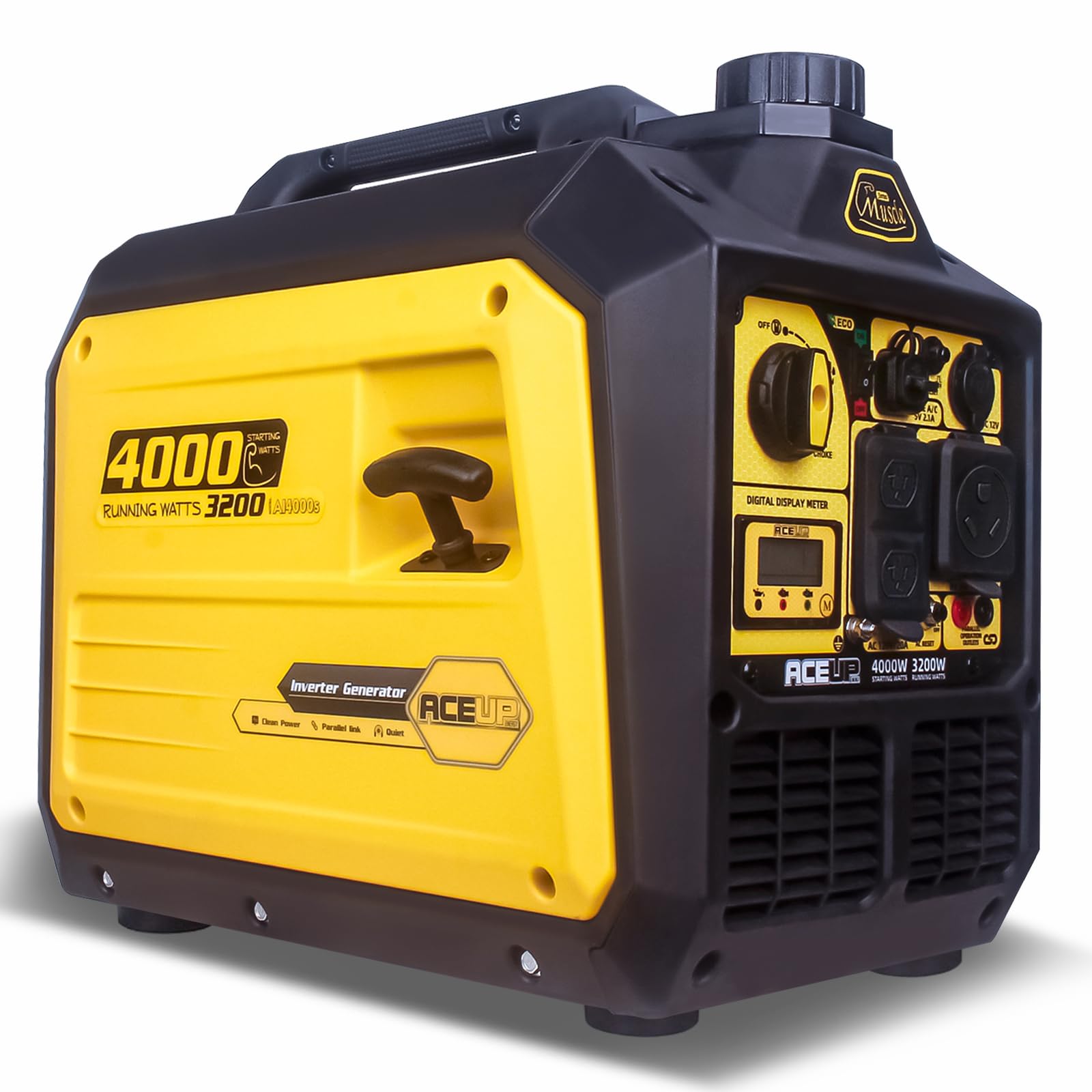
Aceup Energy enters the 4,000-watt arena with a feature-rich inverter generator that punches above its price point. The 149cc engine delivers 4,000 peak watts and 3,200 rated watts, and the intelligent gauge displays voltage, runtime, gasoline level, hertz, and power output simultaneously. The 5-in-1 control knob combines fuel on/off, engine on/off, and choke into a single intuitive dial, simplifying startup and shutdown while eliminating the risk of leaving the fuel valve open.
At 50 pounds, it is competitively light for its output class. The fully enclosed design keeps noise levels very low — owners describe it as conversation-friendly at normal distances. The 1.32-gallon tank provides up to 5 hours of runtime at half load, and the parallel-ready ports offer expansion capability. Included accessories like engine oil, a spark plug wrench, and an oil funnel mean you can run it immediately out of the box.
Some owners have reported a fuel tank collapse issue caused by running with the vent closed during temperature changes — easily avoided by keeping the vent open during operation. The 2-year limited warranty and lifetime technical guidance provide solid support. For buyers who want a digital display and simplified controls in a budget-friendly inverter, this is a strong option.
Why it’s great
- Intelligent digital display shows voltage, runtime, fuel level, hertz, and power output.
- 5-in-1 control knob simplifies startup and prevents fuel valve accidents.
- Includes oil and tools out of the box for immediate use.
Good to know
- Fuel tank vent must be kept open to prevent vapor lock or tank collapse.
- Relatively new brand with less long-term reliability data than established competitors.
9. PowerSmart 3600W Inverter Generator

This PowerSmart model is purpose-built for RV owners who need a direct TT-30R 30-amp outlet without adapters. The 149cc engine produces 3,600 surge watts and 3,200 rated watts — a tight surge-to-rated ratio that prioritizes sustained load capability. The inverter technology keeps THD below 3%, so you can safely run modern RV electronics, televisions, and converter chargers.
At 50.7 pounds with an integrated carry handle, it strikes a good balance between portability and power. The 1.3-gallon fuel tank yields up to 4.75 hours of runtime at 50% load, enough for a full night of RV AC operation. Owners consistently praise its first-pull starting, quiet operation, and ability to power a 15,000 BTU RV air conditioner without bogging down.
The parallel-ready ports allow pairing with a second unit to double capacity. The 2-year warranty is standard for the price tier. The absence of a CO sensor and the slightly lower 3,600 peak watt rating compared to the class standard of 4,000 are important considerations. For RV-specific use where a TT-30R outlet and clean sine wave are non-negotiable, this PowerSmart delivers proven performance.
Why it’s great
- Integrated TT-30R RV outlet provides direct connection without adapters.
- Rated at 3,200 watts, offering strong sustained load capacity for RV AC and appliances.
- Lightweight and easy to start on the first pull every time.
Good to know
- Lacks a carbon monoxide (CO) sensor for automatic shutoff.
- Peak wattage of 3,600 is lower than the 4,000-watt standard.
10. WEN 56360i

The WEN 56360i is the lightest gasoline inverter generator in this review at just 46 pounds, making it the easiest to lift and store. The 149cc engine produces 3,600 surge watts and 2,900 rated watts — the lowest rated output in the roundup, but still sufficient for a 13,000 BTU RV AC, lights, and a fridge. The fuel shut-off feature lets the carburetor run dry before storage, preventing the ethanol gumming that plagues infrequently used generators.
Noise output is remarkably low for its class, and the clean inverter power protects sensitive electronics. The 1-gallon fuel tank provides about 4 hours of runtime at 50% load, which is adequate but unremarkable. Owners report reliable first- or second-pull starts even in cold weather, and the compact size fits under an RV bunk or in a small shed corner.
The outlet panel includes two 120V three-prong receptacles, a TT-30R RV outlet, a 12V DC receptacle, and two 5V USB ports — excellent connectivity for its weight class. The 3-year warranty is among the longest in the category. For campers who prize minimal weight and simple operation above maximum wattage, the WEN 56360i is a carefully engineered choice.
Why it’s great
- At 46 pounds, it is the lightest generator in the roundup for easy solo handling.
- Fuel shut-off extends lifespan by preventing carburetor gumming during storage.
- Includes a TT-30R RV outlet and dual USB ports in a compact footprint.
Good to know
- Rated at only 2,900 watts, limiting simultaneous high-draw appliance use.
- 1-gallon tank requires more frequent refueling than larger-capacity units.
11. BILT HARD Dual Fuel 4500W
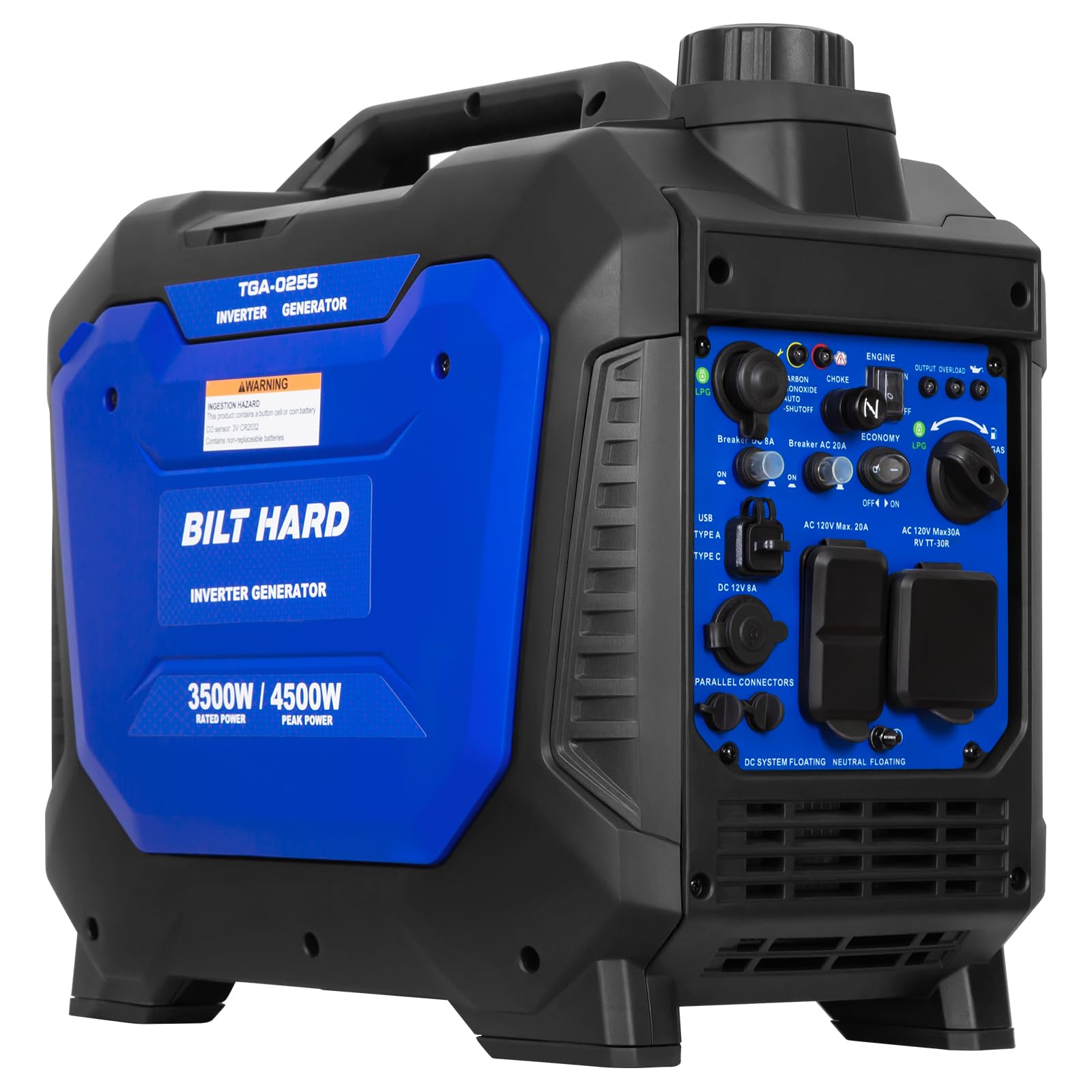
BILT HARD offers the most budget-friendly path to dual-fuel inverter power. The 141cc engine produces 4,500 peak watts and 3,500 rated watts on gasoline, and 4,150 peak watts and 3,200 rated watts on propane — a smaller derating than many competitors. The inverter technology keeps THD under 3%, so sensitive electronics are safe on either fuel.
At 57.7 pounds, it is heavier than most gasoline-only inverters but lighter than premium dual-fuel models. The fully enclosed design yields 58 dBA noise output from 23 feet, making it one of the quietest dual-fuel inverters available. The built-in CO sensor provides automatic engine shutoff, and the parallel-ready ports allow pairing with a second unit. The ECO mode adjusts engine speed to save fuel and reduce sound.
Owners praise its quiet operation, easy setup, and value. The unit is smaller than expected, which aids portability despite the weight. The cryptic setup process and the need for fuel stabilizer and break-in maintenance are standard for the category. For cost-conscious buyers who want propane flexibility without paying a premium, this BILT HARD is the gateway.
Why it’s great
- Dual-fuel capability at a price significantly below other propane-ready inverters.
- 58 dBA operation makes it one of the quietest dual-fuel units tested.
- CO sensor and parallel-ready ports add safety and scalability.
Good to know
- At 57.7 pounds, it is heavier than many single-fuel inverter competitors.
- Propane output is derated to 3,200 watts, which may limit high-draw applications.
FAQ
Can a 4000-watt generator run an RV air conditioner?
What is the difference between an inverter generator and a conventional generator?
How quiet is a 59 dBA generator in real-world use?
Final Thoughts: The Verdict
For most users, the 4000 watt generator winner is the Westinghouse iGen4000c because it combines a quiet 52 dBA operation, a convenient remote electric start, and a rotating digital display in a package that performs reliably under real RV and home backup loads. If you want propane fuel flexibility for long-term storage, grab the Westinghouse iGen4000DFc. And for weight-conscious campers who need the lightest possible unit, nothing beats the WEN 56360i at just 46 pounds.

Mo Maruf
I created WellFizz to bridge the gap between vague wellness advice and actionable solutions. My mission is simple: to decode the research and give you practical tools you can actually use.
Beyond the data, I am a passionate traveler. I believe that stepping away from the screen to explore new environments is essential for mental clarity and physical vitality.