Our readers keep the lights on and my smoothie glass nicely filled. As an Amazon Associate, I earn from qualifying purchases.
Foot pain that originates in the big toe joint can turn a simple walk into a series of micro-shocks. Conditions like hallux rigidus, turf toe, and sesamoiditis share one core mechanical problem: the toe bends when it shouldn’t. Standard cushioned insoles do nothing to stop that painful flexion — they only dampen the sensation. The fix is a rigid plate that physically blocks the joint from moving, and no material does that with less bulk than woven carbon fiber layers.
I’m Mohammad Maruf — the founder and writer behind WellFizz. I evaluate performance footgear and orthotic accessories by analyzing material science, clinical feedback, and real-world durability data rather than surface-level marketing claims.
After sifting through hundreds of verified buyer reports and technical specs, this guide identifies the best carbon fiber insoles for recovery, sports, and daily wear based on measurable rigidity, fit logic, and long-term structural integrity.
How To Choose The Best Carbon Fiber Insoles
A carbon fiber insole is fundamentally different from a gel or foam arch support. Its only job is to eliminate dorsiflexion of the first metatarsophalangeal joint. Choosing the wrong one — too long, too flexible, or the wrong shape — can cause new pain while failing to fix the original problem.
Rigidity Grade and Material Layup
Not all carbon fiber is equal. A 3K twill weave with a true unidirectional layup provides maximum stiffness along the length of the plate. Cheaper alternatives use a lower thread count or mix carbon with polymer binders, which allows micro-flexing under load. For conditions like hallux limitus or stress fractures, the plate must resist bending under full body weight. Look for explicit claims of 100% genuine 3K carbon fiber or aerospace-grade prepreg. If the product page mentions flexibility, it is likely not rigid enough for therapeutic use.
Sizing Logic — The ¼ to ½ Inch Rule
Carbon fiber insoles are non-cuttable. You cannot trim them to fit like foam orthotics. The universal rule is to select a plate that measures ¼ to ½ inch shorter than your original shoe insole. A plate that is too long will jam against the toe box and cause pressure points. A plate that is too short will slide forward or backward, allowing the toe joint to escape the stiff portion. Always measure your insole length before ordering. Half-size between measurements means you size down.
Placement: Under the Insole, Not Against the Foot
A bare carbon fiber plate is ultra-rigid and has a smooth, sometimes glossy surface that can cause blisters or calluses if placed directly under the foot. Every credible product in this category is designed to sit underneath your existing cushioned insole. The foam layer on top absorbs shock and distributes pressure, while the carbon plate below blocks flexion. If your shoes lack removable insoles, these plates are not compatible.
Foot Condition Specificity
A flat Morton’s extension plate works for hallux rigidus, turf toe, sesamoiditis, and fracture recovery because it immobilizes the big toe joint. However, if your primary issue is plantar fasciitis or flat feet without big toe involvement, a rigid forefoot plate adds unnecessary stiffness. Conversely, athletic insoles like the Move Game Day include carbon composite layers in the heel but still allow forefoot flexibility — making them wrong for joint immobilization but right for shock absorption in jumping sports. Match the plate geometry to the exact joint being treated.
Quick Comparison
On smaller screens, swipe sideways to see the full table.
| Model | Category | Best For | Key Spec | Amazon |
|---|---|---|---|---|
| PowerStep Morton’s Extension | Premium Orthotic | Hallux rigidus with arch support needs | Dual-layer cushioning + deep heel cradle | Amazon |
| Tega Design Morton’s Extension Pair | Premium Pair | Golf, hiking, and daily walking | 100% genuine 3K carbon fiber, sold as pair | Amazon |
| Superfeet Carbon Pro Hockey | Sport-Specific | Ice hockey and figure skate performance | Trimmable, deep heel cup, EVOLyte blend | Amazon |
| Superfeet Hike Women’s Support | Trail Specific | Women’s hiking on rough terrain | EVOLyte carbon/polymer blend, trim-to-fit | Amazon |
| EstCarbon Morton’s Extension | Mid-Range Single | Single-foot support for big toe injury | 1.6 mm thick, 3K twill pure carbon | Amazon |
| Freeior Carbon Fiber Flat Plate | Recovery Focused | Fracture and post-surgery immobilization | 0.05″ thin, 0.08 lbs, aerospace grade | Amazon |
| Move Game Day Performance | Athletic Composite | Basketball, volleyball, and running | Composite heel + forefoot molding | Amazon |
In‑Depth Reviews
1. PowerStep Morton’s Extension Carbon Fiber Orthotic Insole

PowerStep bridges the gap between a flat carbon plate and a full orthotic by integrating a contoured arch and deep heel cradle directly into the insole body. The carbon fiber stabilizer runs the full length, blocking big toe dorsiflexion while the dual-layer cushioning absorbs ground impact. This two-in-one design eliminates the need to stack a separate plate under your existing insole, which can cause slippery interfaces and thickness problems.
Buyers with hallux rigidus report being able to resume long, steep walks without the familiar sharp throb at push-off. The arch support also controls mild pronation, reducing stress on the plantar fascia. At 5.29 ounces for the pair, it is heavier than a bare carbon plate, but the trade-off is that you get both immobilization and structured support in a single drop-in unit that fits directly inside the shoe.
Break-in is real — several users noted needing to loosen laces for the first few days as the deep heel cup and firm arch settle. The top fabric wicks moisture and reduces heat build-up, which matters for extended wear. This is not the cheapest entry-level option, but it is the most complete solution for anyone who needs both rigidity and arch support simultaneously.
Why it’s great
- Combines carbon fiber plate with genuine arch support in one unit
- Dual-layer cushioning absorbs shock without reducing rigidity
- Deep heel cradle improves alignment and reduces heel slip
Good to know
- Heavier than standalone carbon plates at 5.3 ounces per pair
- Requires a break-in period of up to one week
2. Tega Design Morton’s Extension Orthotic Carbon Fiber Insole
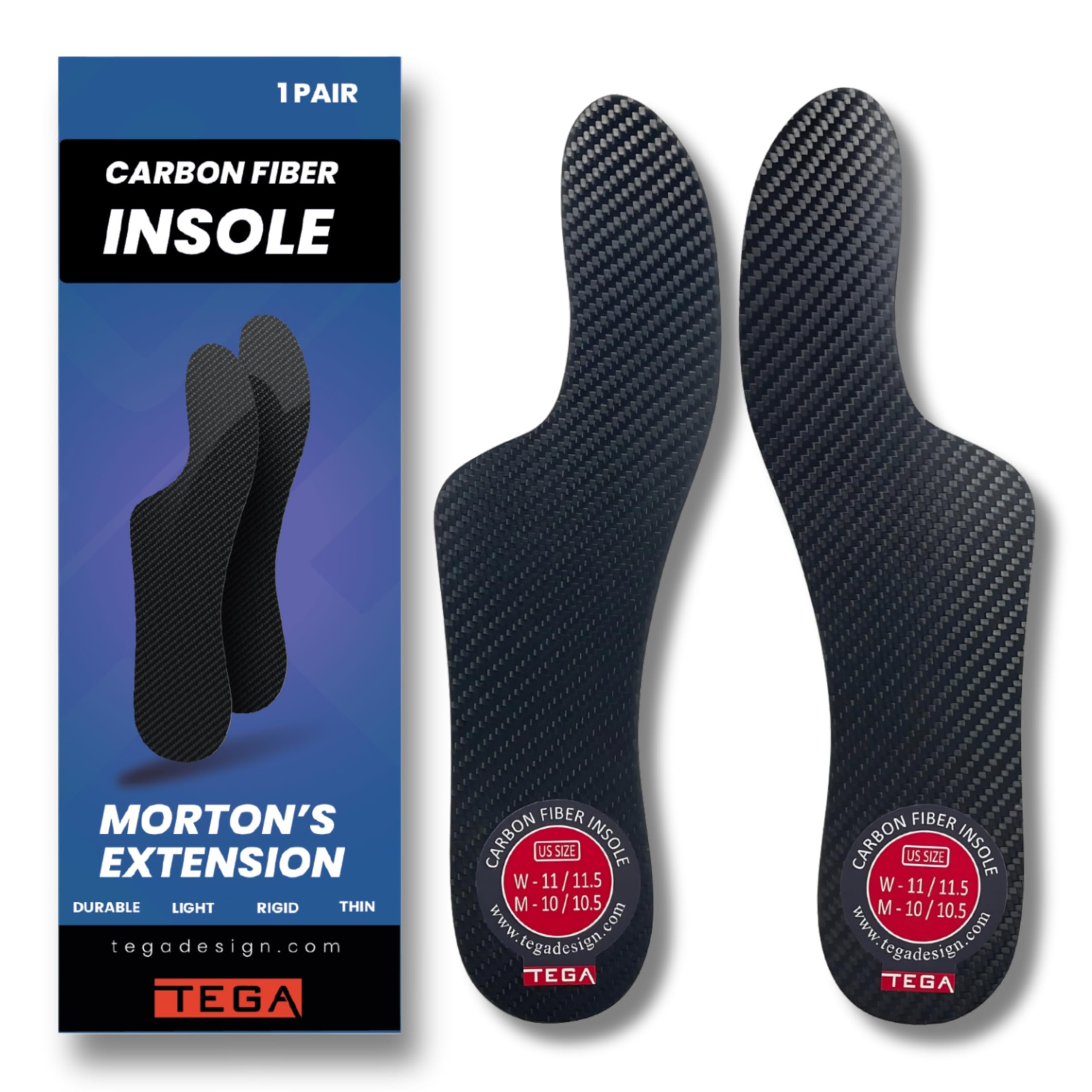
Most carbon fiber insoles in this category are sold as single units because users often only need one plate per shoe. Tega Design breaks that pattern by shipping a dedicated left-and-right pair, which makes sense for bilateral conditions or for users who want spares in multiple shoe pairs. The construction uses 100% genuine 3K carbon fiber with a balanced weave that resists twisting while remaining flat against the footbed.
Customer reports consistently highlight the plate’s ability to reduce hallux limitus pain by over 80% during activities like walking 18 holes of golf. The thin profile (roughly 1.5 mm to 2 mm) fits under most removable insoles without raising the heel height noticeably. Sizing follows the standard ½-inch-shorter rule, and several buyers noted that ordering 0.5 to 1 inch shorter than the original insole provided the best fit in sneakers and hiking boots.
A small minority reported that the plate does not lay completely flat in shoes with built-in rocker soles or raised arches, such as Topo Athletic or certain cycling shoes. In those cases, the edges of the plate can create a pressure ridge under the arch. For standard flat or neutral-footbed shoes, however, this pair delivers consistent, non-slip rigidity that holds up over multiple seasons of walking.
Why it’s great
- Includes two plates for bilateral support or multi-shoe use
- True 3K carbon weave provides predictable stiffness
- Thin enough to fit under factory insoles without bulk
Good to know
- Does not include built-in arch support or cushioning
- May not lay flat in shoes with pronounced arch contours
3. Superfeet Hockey Performance Carbon Fiber Insoles

Ice skates present a unique challenge: the foot sits in a low-profile boot with zero shock absorption and a narrow heel pocket. Superfeet addresses this with a carbon fiber reinforced stabilizer that runs under the midfoot and heel, combined with a deep cup that locks the calcaneus in place. The forefoot area remains flexible for push-off, meaning this is not a true Morton’s extension plate, but rather a stiffened orthotic for lateral stability and energy transfer through the blade.
Hockey players and figure skaters report significant improvements in edge control and heel lock. The reduction in heel lift translates directly to more responsive turns and harder strides. Unlike bare carbon plates, these insoles include a foam top layer that absorbs vibration from the ice surface, reducing foot fatigue during long sessions. Sizing up is a common recommendation because the deep heel cup can shift foot position slightly forward.
The trimmable nature allows you to shape the forefoot to match your skate’s profile, which is critical because skate boots are much narrower than street shoes. A few buyers noted that the rigid arch can feel aggressive for flat-footed skaters, and the transition period may cause midfoot soreness. For recreational skating or casual use, the standard Superfeet Comfort line is a safer choice. This is a performance tool for serious skaters who want maximum power transfer.
Why it’s great
- Dramatically reduces heel lift in low-cut and tight-fitting skates
- Trimmable forefoot for custom width matching
- Carbon stabilizer adds stiffness without full-length rigidity
Good to know
- Not a full-length Morton’s extension — forefoot remains flexible
- Aggressive arch may be uncomfortable for flat-footed users
4. Superfeet Hike Women’s Support Insoles
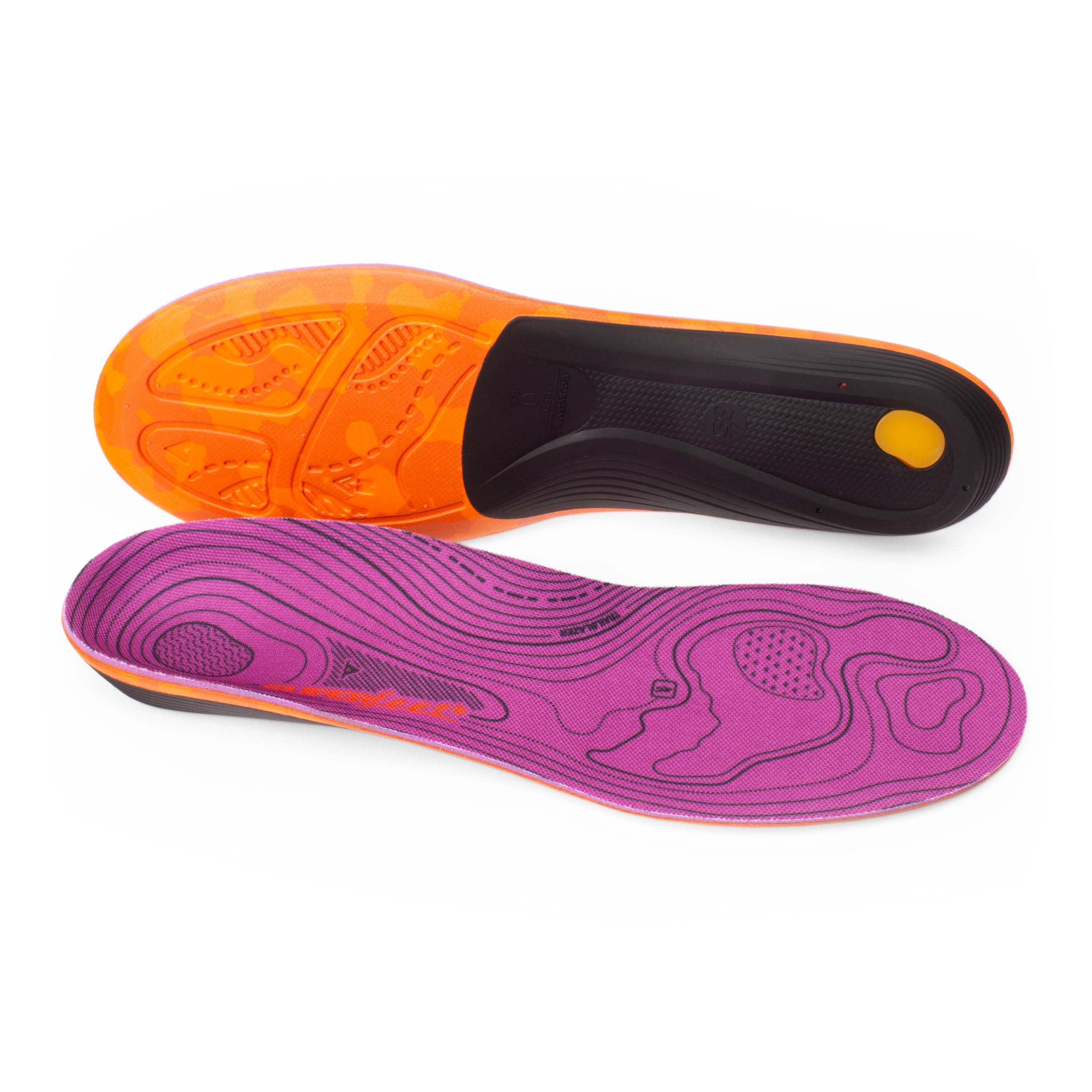
Superfeet’s Hike model is designed explicitly for women’s foot anatomy, which typically has a narrower heel and higher arch relative to men’s lasts of the same length. The carbon fiber element here is an EVOLyte blend — a carbon-and-polymer composite — placed under the midfoot and arch to resist torsional bending on uneven terrain. This is not a stiff forefoot plate for hallux rigidus; it is a stability layer that prevents the foot from rolling on loose rock or angled trail sections.
Multiple repeat buyers mention that these insoles eliminated heel slip on steep descents, a problem that causes toe jamming into the toe box and black toenails. The Moisturewick top cover pulls sweat away from the foot, which is critical for multi-day hikes where dampness leads to blisters. At 4.8 ounces per pair, they add noticeable weight to a trail runner but deliver structure that stock insoles lack entirely.
The medium-to-high arch profile is not neutral — users with flat feet reported that the arch hit their foot in an uncomfortable spot, causing mild soreness during the break-in. For hikers with normal or high arches, the support is transformative. These insoles are trim-to-fit, so you can narrow the forefoot to match narrow trail shoes. They are not designed for big toe immobilization, so if hallux rigidus is your primary issue, look at the full-length plates above.
Why it’s great
- Carbon EVOLyte blend provides trail-specific torsional stability
- Anatomically shaped for women’s heel and arch dimensions
- Moisture-wicking top layer reduces blister risk on long hikes
Good to know
- Not a rigid forefoot plate — does not immobilize the big toe
- Medium-high arch may not suit flat-footed users
5. EstCarbon Morton’s Extension Carbon Fiber Insole

EstCarbon positions itself as the direct alternative to custom podiatric Morton’s extensions at a fraction of the clinic cost. The 1.6 mm thickness hits the sweet spot between structural rigidity and shoe compatibility — thick enough to prevent micro-bending of the big toe joint, thin enough to fit under most cushioned insoles without raising the heel. The 3K twill weave is visually identifiable by its characteristic checkerboard pattern, which indicates a true woven carbon sheet rather than a polymer-infused imitation.
Buyers with hallux rigidus who walk over three miles daily on treadmills report zero big toe pain after switching to these inserts, where previously they could not complete a mile without discomfort. The plate is reversible and marked as suitable for either foot, though a few users mentioned that the squared-off edges can catch on sock fibers inside certain shoes, causing a mild squeaking sound during walking. Placing a thin felt liner or standard insole on top eliminates this noise entirely.
The primary limitation is that this is sold as a single piece. If you need bilateral support, you must buy two packs, which pushes the total cost above competing pair options. Additionally, some users reported that the plate does not lie flat in shoes with curved footbeds — a known issue with flat plates in contoured lasts. For straight-lasted sneakers, work boots, and most athletic shoes with removable insoles, the fit is secure.
Why it’s great
- 1.6 mm genuine 3K twill weave provides reliable rigidity
- Reversible design works for either foot
- Fits under standard insoles without adding noticeable height
Good to know
- Sold as a single unit — bilateral use requires two purchases
- May squeak against insole materials without a liner
6. Freeior Carbon Fiber Flat Plate Insole
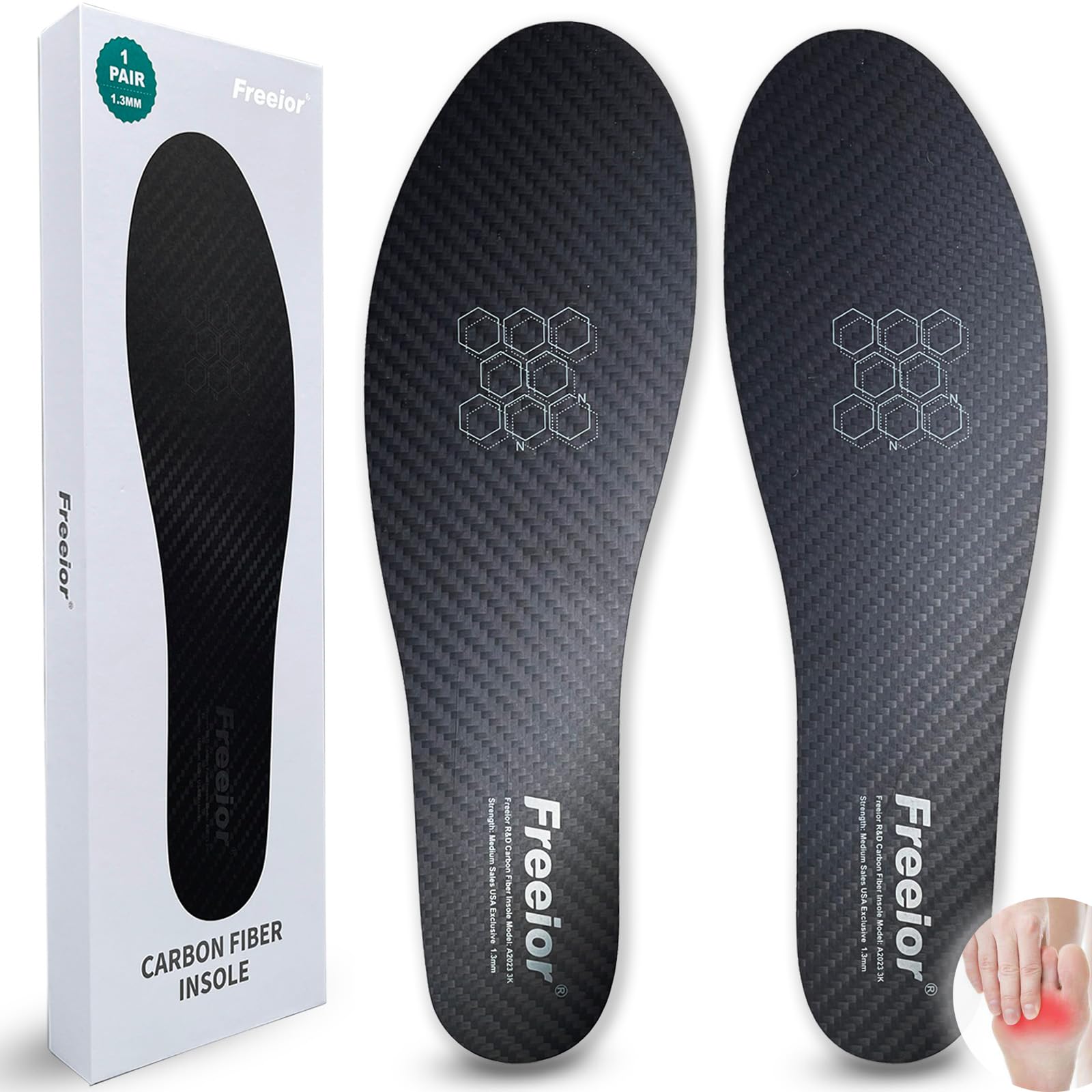
Freeior’s entry is the thinnest plate in this lineup at just 0.05 inches, yet it claims five times the strength of steel. That ratio is possible because aerospace-grade carbon fiber prepreg achieves high tensile modulus in a minimal cross-section. For post-fracture recovery, this ultra-thin profile means the plate fits inside shoes that already have a thick orthotic or cushioned insole without overfilling the volume. It is designed explicitly for conditions where the foot requires absolute immobilization of the metatarsal-phalangeal joint.
Users with stress fractures, Lisfranc injuries, and turf toe report that the plate distributes load across the entire forefoot, eliminating the concentrated stress points that cause sharp pain during push-off. The manufacturer explicitly warns that this is not for users without foot problems — the plate is uncomfortable for normal walking because it provides zero cushioning and forces an artificial gait pattern. Gradual break-in starting at two hours per day is mandatory to avoid developing shin splints from altered biomechanics.
The critical sizing note is that you must select a plate 0.5 inches shorter than your original insole. If you choose too large, it will jam and cause toe pain. Too small, and the plate slips rearward, leaving the big toe joint unsupported. The insoles are sold as a pair and can be flipped to fit either foot. They are not suitable for shoes with fixed, non-removable insoles or for very narrow dress shoes.
Why it’s great
- Extremely thin at 0.05 inches — minimal shoe volume intrusion
- High aerospace-grade stiffness for post-fracture immobilization
- Very lightweight at 0.08 lbs each
Good to know
- Not for users without a diagnosed foot condition requiring immobilization
- Requires gradual break-in over 1-2 weeks to avoid gait issues
7. Move Game Day Performance Insoles

The Move Game Day insole is a composite structure that uses a rigid heel stabilizer and a molded forefoot shape, but it is not a full-length carbon fiber Morton’s extension. The heel component uses a carbon-infused composite to absorb shock and prevent rearfoot collapse during high-impact landings, while the forefoot remains flexible to allow natural push-off. This makes it effective for plantar fasciitis and shin splints but ineffective for big toe joint immobilization.
Co-founded by NBA guard Damian Lillard, the insole has seen genuine adoption among college-level basketball and volleyball players. Verified reviews describe significant reduction in knee pain from repetitive jumping and the elimination of shin splints that had persisted for years. The patented arch support mold replicates the structure of custom orthotics without requiring a podiatrist fitting. The forefoot is molded into a slight cup shape that hugs the metatarsal pads, reducing splay and improving proprioception.
The trade-off is thickness. These insoles add noticeable volume to the shoe, and multiple users recommend going half a size up or removing the factory insole entirely. The composite heel plate adds weight — 5.11 ounces per pair — which some runners noticed during long miles. For its intended audience of basketball and volleyball players who need shock absorption and arch support without forefoot rigidity, the Game Day delivers a well-tuned balance.
Why it’s great
- Composite heel plate absorbs shock from repeated jumping landings
- Molded forefoot reduces metatarsal splay and improves foot feel
- Patented arch support mimics custom orthotic structure
Good to know
- Not a rigid carbon plate — forefoot flexes freely
- Adds noticeable thickness and weight to shoes
FAQ
Can I wear carbon fiber insoles without any foot condition?
Why do carbon fiber insoles need to be ¼ to ½ inch shorter than my shoe?
Can I put carbon fiber insoles directly under my bare foot?
Will carbon fiber insoles set off metal detectors?
How long does a carbon fiber insole typically last?
Final Thoughts: The Verdict
For most users needing both immobilization and arch support, the best carbon fiber insoles winner is the PowerStep Morton’s Extension because it integrates a full-length carbon stabilizer with dual-layer cushioning and a contoured heel cradle in a single drop-in unit. If you want a dedicated pair for bilateral support without arch structure, grab the Tega Design Morton’s Extension Pair. And for post-fracture or post-surgery immobilization where thickness must be absolute minimum, nothing beats the Freeior Carbon Fiber Flat Plate.

Mo Maruf
I created WellFizz to bridge the gap between vague wellness advice and actionable solutions. My mission is simple: to decode the research and give you practical tools you can actually use.
Beyond the data, I am a passionate traveler. I believe that stepping away from the screen to explore new environments is essential for mental clarity and physical vitality.