Our readers keep the lights on and my smoothie glass nicely filled. As an Amazon Associate, I earn from qualifying purchases.
Cramped shoulders and a stiff neck from hunching over a flat tabletop is the single fastest way to kill an afternoon of drawing or painting. A proper angled work surface changes your posture instantly, reducing eye strain and wrist fatigue so you can create for hours without the pain.
I’m Mohammad Maruf — the founder and writer behind WellFizz. I’ve spent over a decade analyzing the ergonomic specs, material quality, and real-world stability of artist furniture, comparing thousands of user reviews to separate the builds that hold true from those that wobble under a heavy hand.
This guide breaks down the critical differences in tilt mechanisms, weight capacity, and surface materials to help you find the best artist desk for your specific studio needs and budget.
How To Choose The Best Artist Desk
The right artist desk is an ergonomic investment, not just a flat surface. Three factors separate a useful drafting station from a standard office table that will leave you uncomfortable. Pay attention to the tilt range, the frame rigidity, and the surface material.
Tilt Range and Locking Mechanism
Look for a tabletop that adjusts from flat (0 degrees) to at least 40 degrees. This range covers everything from wet-media painting (flat) to detailed linework or reading reference material (steep). The most durable desks use a metal ratchet or threaded knob system that locks firmly at each angle—cheaper friction hinges tend to slip under the weight of your forearm.
Frame Stability and Weight Capacity
An artist desk endures constant pressure from leaning, erasing, and cutting. A steel frame with a powder-coated finish offers the highest rigidity-to-weight ratio for the price. Wooden H-frame designs, particularly those using solid beech, provide excellent lateral stability if the cross-supports are substantial. Check the stated max load for the tabletop; 50 pounds is the entry-level baseline, while 250 pounds signals a seriously overbuilt workstation.
Surface Material and Pencil Ledge
Tempered glass is the easiest to clean but can feel cold and reflects overhead light onto your work. Laminate over MDF offers a warm, scratch-resistant surface that works well for most dry and wet media. A built-in pencil ledge that spans the full width of the table is essential to prevent pens, brushes, and rulers from sliding onto your lap when you tilt the surface past 20 degrees.
Quick Comparison
On smaller screens, swipe sideways to see the full table.
| Model | Category | Best For | Key Spec | Amazon |
|---|---|---|---|---|
| MEEDEN Vintage Wooden Drafting Table | Premium Wood | Serious artists wanting solid wood stability | 65° max tilt, Beechwood H-frame | Amazon |
| Stand Up Desk Store Adjustable Drafting Table | Premium Hybrid | Professionals needing BIFMA-certified durability | 45° tilt, 50 lb capacity, steel frame | Amazon |
| MEEDEN Wood Adjustable Drafting Table | Mid-Range Wood | Artists who want real wood on a mid-range budget | 45° max tilt, Solid Beech legs | Amazon |
| Tribesigns Drafting Table with Storage | Mid-Range | Those needing integrated storage and a flat side area | 80° tilt, 250 lb capacity, metal frame | Amazon |
| Yaheetech Drawing Table w/Stool | Value Package | Beginners wanting a complete set with a stool | 40° tilt, Tempered glass top, 88 lb capacity | Amazon |
| Studio Designs 13240 Craft Center | Mid-Range Mobile | Crafters who need mobility with locking casters | 30° tilt, Steel frame, Locking casters | Amazon |
| Yaheetech Drafting Table w/Stool | Value Package | Budget-conscious artists wanting a glass top desk | 40° tilt, Glass top, 265 lb stool capacity | Amazon |
| ErGear Drafting Chair | Seating Essential | Pairing with a tall drafting desk for ergonomic seating | Class 4 gas lift, 300 lb capacity, Foot ring | Amazon |
| HOMCOM Foldable Convertible Desk | Space-Saver | Small-space studios needing a fold-away solution | 110 lb capacity, Chalkboard front, Wall-mount | Amazon |
In‑Depth Reviews
1. MEEDEN Vintage Wooden Drafting Table

This table delivers the widest tilt range in the lineup—from flat all the way to 65 degrees—using a semicircle iron plate and threaded knobs that lock the surface rock-solid. The H-frame is crafted from thickened beechwood, providing exceptional lateral stability that makes it nearly impossible to wobble, even when you lean hard on a heavy sketch. A full-length pencil ledge runs along the front, so brushes and pens stay put at any angle.
Assembly takes roughly an hour with the included tool kit, but the manual is clear and the hardware is pre-sorted in labeled bags. The walnut particle-board top has a smooth satin finish that resists stains from markers and pencil graphite, though it will show scratches if you cut directly on it. The table also comes with a 24-inch T-square ruler with metric and inch markings, a nice bonus for technical drawing.
Customers consistently praise the rock-solid feel and the easy height adjustment (32.5 to 37.5 inches in six steps). A few users note the T-square head could be wider for perfect alignment, and the wood surface requires gentle care to avoid dings during assembly. For serious artists who need a wide tilt range and real wood craftsmanship, this desk is the clear standout.
Why it’s great
- Widest tilt range (0–65°) with firm locking knobs
- Solid beechwood H-frame eliminates wobble completely
- Includes a functional 24-inch T-square ruler
Good to know
- T-square head is somewhat loose and the edge is not perfectly straight
- Wood surface can scratch if used as a cutting mat
2. Stand Up Desk Store Adjustable Drafting Table

The Stand Up Desk Store model is the only BIFMA-certified drafting table in this roundup, meaning it passed rigorous safety and durability testing for commercial use. The steel frame uses a powder-coated silver finish and the top is a solid birch laminate that resists warping. The desktop adjusts in 2-inch height increments from 26.5 to 38.5 inches, and the tilt offers 11 incremental positions from flat to 45 degrees.
Oversized rubber feet keep the entire structure planted on hardwood or carpet, and a full-length pencil tray runs along the lower edge to catch falling tools. At 39.5 by 26 inches, the surface is larger than most competing models, giving you room for a 24×36-inch canvas plus reference materials. The lower crossbar is designed to sit flush with the floor, eliminating the shin-banging hazard common to cheaper drafting stands.
Reviews note that the assembly can require some force due to a few misaligned screw holes, but once built, the unit is exceptionally rigid. The pencil tray is on the smaller side for serious tool storage, and the smooth laminate surface shows fingerprints easily. Backed by a limited lifetime warranty, this desk is built to survive daily professional use without failing.
Why it’s great
- BIFMA-certified for commercial-grade safety and durability
- Large 39.5×26-inch work surface accommodates oversized projects
- Oversized rubber feet provide outstanding floor grip
Good to know
- Some screws may require extra force to align during assembly
- Pencil tray is narrow for extensive tool collections
3. MEEDEN Wood Adjustable Drafting Table

This mid-range MEEDEN model combines the warmth of a natural beechwood frame with a practical 45-degree tilt range, making it a favorite for artists who want real wood without paying vintage-tier prices. The tabletop is a smooth particle-board surface with a clean natural finish, and the built-in pencil ledge spans the full 35.5-inch width. The two side legs and cross-support design eliminate lateral shifting effectively.
Height adjusts from 29.5 to 37.5 inches in discrete positions, though changing it alone is difficult because you must support the heavy top while tightening the knobs. The instructions are clear, and the hardware comes in segregated bags; two people can complete assembly in about 20 minutes. A bonus 24-inch T-square with inch and metric calibrations is included, which is a practical addition for architectural or engineering drafting.
Buyers report that the table solves back pain from hunching over flat surfaces, particularly for diamond painting and large-format sketches. The main drawbacks are the awkward one-person height adjustment and the fact that the knobs require significant tightening to hold the top at steep angles. For a solid wood drafting desk at a reasonable price point, this is an excellent middle-ground choice.
Why it’s great
- Real beechwood legs offer genuine wooden furniture quality
- Fast two-person assembly with pre-sorted hardware
- Includes a functional T-square for technical drawing
Good to know
- Changing height alone is awkward due to the heavy top
- Knobs need strong tightening to hold steep tilt angles
4. Tribesigns Drafting Table with Storage Drawers

The Tribesigns desk stands out with the most aggressive tilt range on this list—up to 80 degrees from flat—across 12 discrete angle settings. This makes it ideal for reading large reference books or doing detailed calligraphy work at a near-vertical surface. The design splits the desktop: the left side adjusts while the right side remains flat, giving you a dedicated space for a laptop, coffee, or supplies without interrupting your drawing zone.
Storage is a strong point. Below the desktop, you get one smooth-gliding box drawer and an open shelf that fits standard files and books. The metal frame is rated for 250 pounds on the main surface, which is more than enough for heavy drafting machines or stacks of bound sketchbooks. The frame is made of 0.6-inch thick particle board with a laminated walnut finish that resists spills.
Assembly takes time—expect about an hour with the included screwdriver—but every piece is labeled, and the instructions are clear. A few users mention that the drawer glide is basic rather than ball-bearing, so it doesn’t slide as smoothly as premium alternatives. For an artist who prioritizes storage and a versatile split-surface design, this desk delivers exceptional utility.
Why it’s great
- 80-degree maximum tilt with 12 locking positions
- 250-pound weight capacity supports heavy equipment
- Split surface leaves room for a laptop or supplies
Good to know
- Drawer glide is basic, not ball-bearing
- Laminated particle board can chip if dropped
5. Yaheetech Drawing Table with Stool

This Yaheetech package bundles a 40-degree tilting glass-top desk with a padded PU leather stool, offering a complete entry point for new artists. The tempered glass surface is incredibly easy to clean—spilled acrylic paint or ink wipes away with a damp cloth in seconds, and the glass resists scratches from X-Acto blades far better than wood. The black powder-coated steel frame feels substantial, and the glass tabletop supports up to 88 pounds.
Storage is handled by two mesh fabric drawers and a slim shelf underneath, plus a slide-off pencil ledge that converts the surface into a flat desktop when needed. The side countertop provides an extra 20-pound-rated surface for a monitor or sketchbook. Height adjusts across six positions ranging from 28 to 36 inches, and the tilt locks in five increments. The stool supports up to 265 pounds and has foam padding, though customers describe it as better for occasional sitting than all-day use.
Assembly requires two people for the heavy components, but the instructions are well-labeled. Some users report that the included stool is challenging to assemble due to misaligned bolt holes. The glass surface can reflect overhead lights, which may be distracting for some artists. If you want a low-maintenance, easy-to-clean desk with a matching stool, this package is a strong value.
Why it’s great
- Tempered glass top wipes clean instantly from paint and ink
- Includes a padded stool rated for 265 pounds
- Removable pencil ledge converts to a flat computer desk
Good to know
- Glass surface can create glare under direct overhead light
- Stool assembly has finicky bolt-hole alignment
6. Studio Designs 13240 Craft Center

The Studio Designs Craft Center is the only rolling artist desk in this lineup, featuring four casters with two locking brakes for mobility. The 31.5×23.5-inch work surface tilts from flat to 30 degrees, which is a narrower range than most competitors but sufficient for general crafting, beading, and diamond painting. The white powder-coated steel frame with a maple top has a clean, studio aesthetic that fits well in a spare room or home classroom.
Two removable side trays clip onto the frame, providing instant access to brushes, scissors, and glue. A 24-inch pencil ledge runs along the back of the tilting surface to keep supplies from sliding off. The included 21-inch padded stool matches the desk’s white finish, though reviews note it is on the small side for taller users. The desk’s relatively compact footprint makes it easy to tuck into a corner when not in use.
Assembly is straightforward with numbered parts, but the instructions recommend avoiding power tools to prevent stripping the bolts. Some customers mention the side trays feel flimsy and detach easily if bumped. The 30-degree tilt is adequate for sketching but not steep enough for reading or technical drafting. For a mobile workstation that can be moved between rooms or stored against a wall, this is a functional choice.
Why it’s great
- Four locking casters let you move the desk easily
- Removable side trays keep tools within arm’s reach
- Compact footprint fits small studio spaces
Good to know
- 30-degree max tilt is less than competing drafting tables
- Side trays can detach if accidentally bumped
7. Yaheetech Drafting Table with Stool

This earlier Yaheetech model shares the same 40-degree tilt and tempered glass top as product 5 but with a slightly different layout: the glass surface is separate from a side MDF countertop, and the base is a powder-coated steel bracket. The main glass tabletop supports up to 88 pounds, while the side tabletop handles 20 pounds—enough for a laptop or reference book. Two basic utility drawers are built into the frame for storing markers and small tools.
The included stool is identical in construction to the one in product 5—PU leather over foam with a 265-pound capacity—and customers similarly note that assembly can be frustrating due to tight bolt alignment. The glass surface is easy to clean and can double as a light table if you place a lamp underneath. The desk adjusts in height from 28 to 36 inches across five positions, and the tilt locks at five angles up to 40 degrees.
Reviewers frequently mention that the desk feels sturdier than expected for the price category, though some find the stool appropriate only for short sessions. For an inexpensive glass-top drafting desk that includes seating and basic storage, this model is a solid entry-level pick.
Why it’s great
- Glass top is stain-resistant and easy to keep clean
- Two storage drawers provide basic organization
- Stool with high 265-pound weight capacity
Good to know
- Glass surface reflects overhead light onto artwork
- Stool assembly requires patience with bolt alignment
8. ErGear Drafting Chair
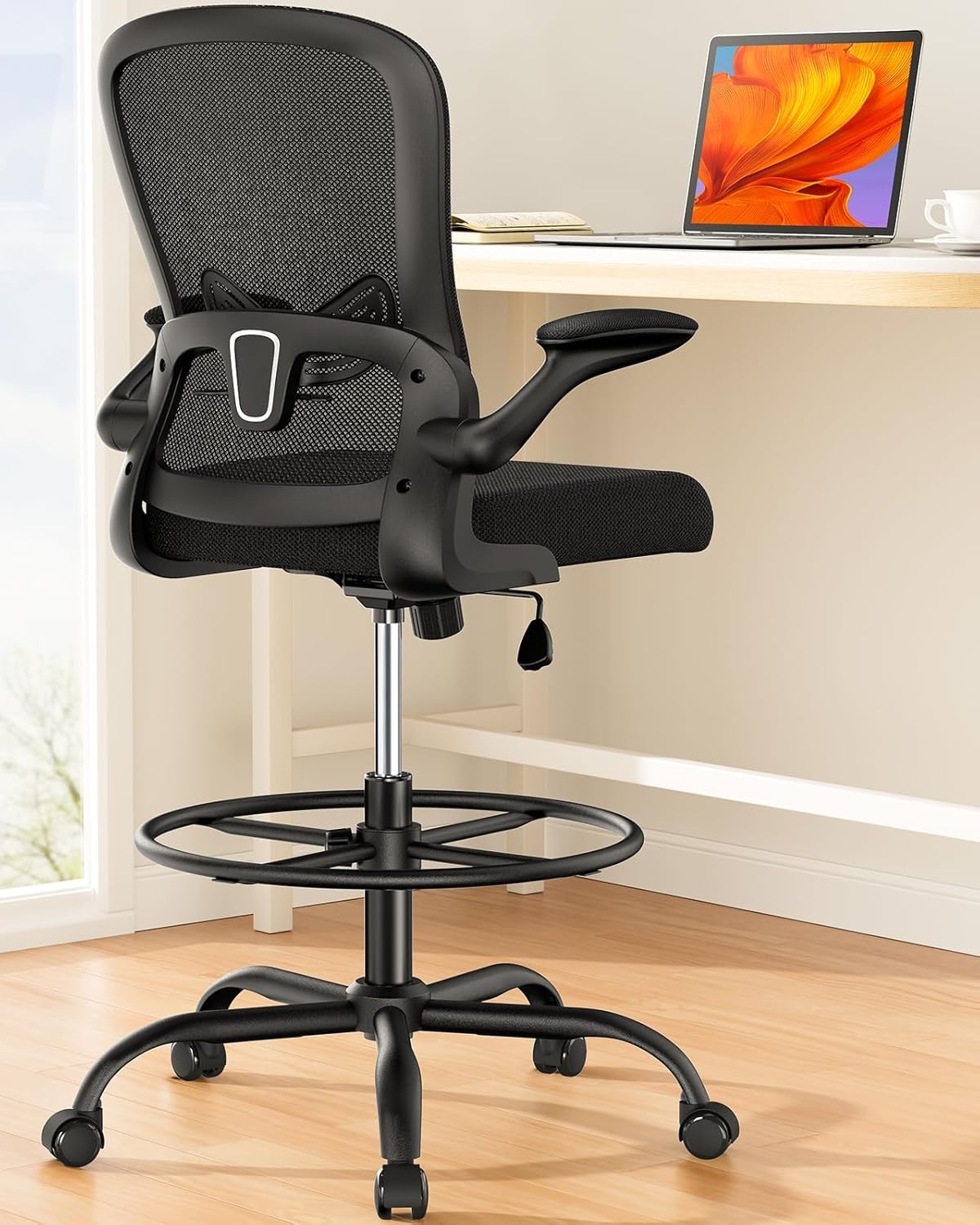
While not a desk itself, the ErGear drafting chair is the correct seating companion for any of the adjustable-height artist desks in this guide. It features a Class 4 gas lift cylinder tested for 120,000 cycles, providing 8 inches of seat height adjustment that pairs perfectly with drafting desks that range from 28 to 38 inches tall. The padded flip-up armrests rotate 90 degrees so you can slide the chair completely under the desk when you want to stand.
The seat cushion is 33 percent thicker than standard drafting chair padding, using high-density foam that resists bottoming out during long painting sessions. A height-adjustable foot ring (19.7 inches wide) gives your feet a stable resting point, reducing lower-back strain during extended work. The mesh backrest allows air circulation and includes 2 inches of lumbar height adjustment to match your spine’s natural curve.
Customers praise the easy assembly and the chair’s ability to accommodate users up to 300 pounds on an extra-large base. The foot ring adjusts without tools, and the caster wheels roll smoothly on both carpet and hard floors. The only common complaint is that the flip-up armrests are not adjustable in width. For anyone using a tall artist desk, this chair completes the ergonomic setup.
Why it’s great
- Class 4 gas lift with 8-inch height range suits drafting desks perfectly
- Thick high-density foam seat prevents hip pressure
- Adjustable foot ring and lumbar support reduce back strain
Good to know
- Flip-up armrests are not adjustable in width
- Foot ring adjustment requires disassembly if height changes frequently
9. HOMCOM Foldable Convertible Writing Table
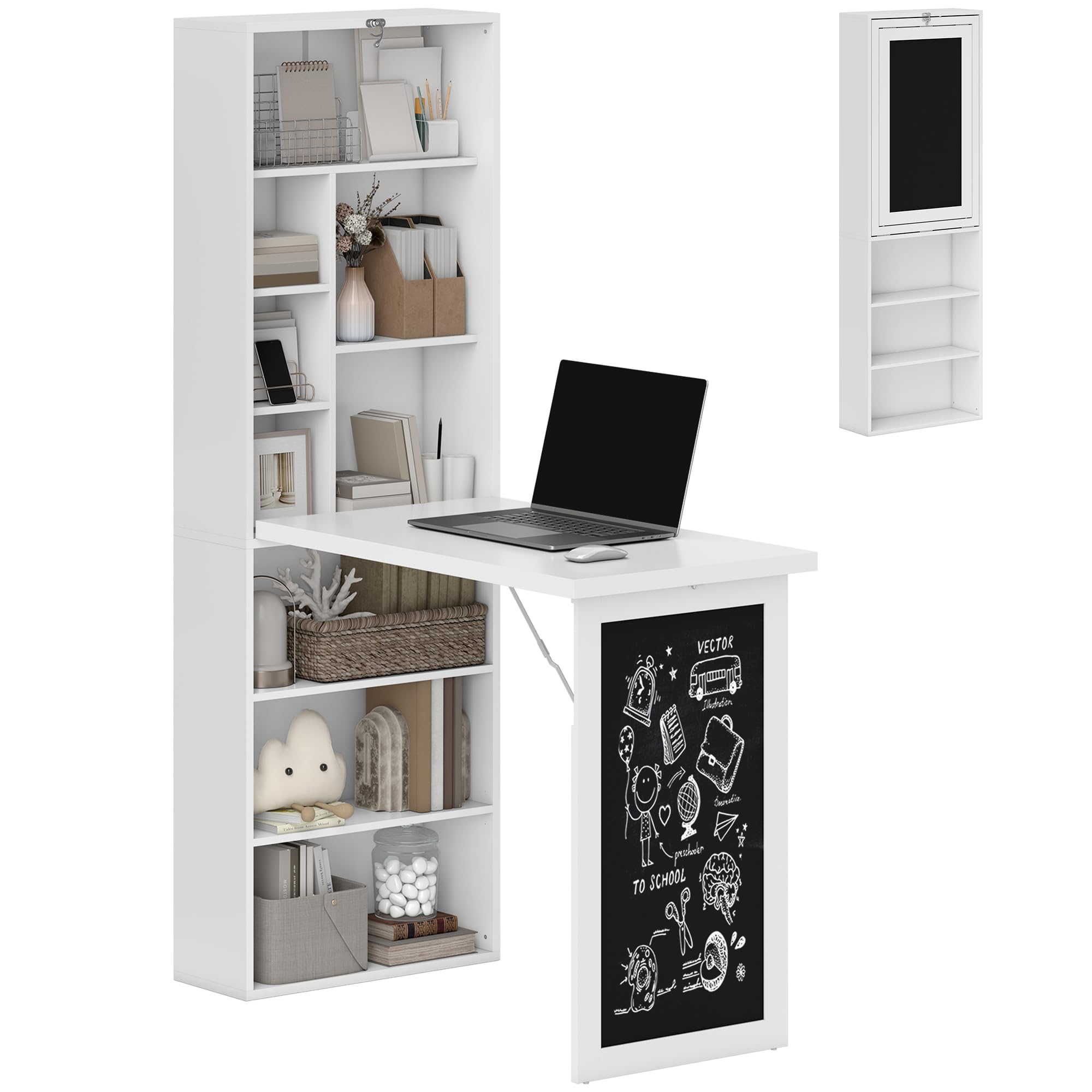
For artists working in extremely tight quarters, the HOMCOM foldable desk transforms from a 7.7-inch-deep closed cabinet to a 20-inch-deep writing surface. The 0.6-inch thick MDF panels support up to 110 pounds, enough for a dual-monitor setup or a small sewing machine. The fold-down surface includes a built-in chalkboard on the front face, letting you sketch ideas or write to-do lists that hide when the desk is closed.
Six upper compartments and three lower shelves provide vertical storage for paint bottles, sketchbooks, and supplies without consuming floor space. The bottom shelf is adjustable to three heights to fit different item sizes. This unit is designed to be wall-mounted for stability, and the anti-tipping hardware is included. When folded, the unit presents as a neat display cabinet that blends into a living room or dorm.
Assembly is involved—plan for an hour or more—and the instructions are not as clear as those of the dedicated drafting tables. The chalkboard surface is functional but small, and it does not have a tilting mechanism, so you are limited to flat-surface drawing only. For a micro-studio or apartment where every square inch counts, this fold-away solution is remarkably practical.
Why it’s great
- Folds to just 7.7 inches deep, reclaiming floor space instantly
- 110-pound weight capacity is exceptional for a fold-down desk
- Integrated chalkboard hides creative mess when closed
Good to know
- No tilting surface; only usable flat for drawing
- Wall-mounting is required for stability during heavy use
FAQ
Is a tilting artist desk really necessary or can I use a regular table?
What tilt angle should I look for as a beginner artist?
Can I use an artist desk for a computer workstation as well?
How much weight can a typical artist desk hold?
Are glass-top artist desks better than wood-top desks?
Final Thoughts: The Verdict
For most users, the best artist desk winner is the MEEDEN Vintage Wooden Drafting Table because it combines solid beechwood rigidity with the widest 65-degree tilt range and a functional T-square, all at a price that justifies the craftsmanship. If you need a large, BIFMA-certified work surface for daily professional use, grab the Stand Up Desk Store Adjustable Drafting Table. And for a complete starter package with a glass top and a matching stool, nothing beats the Yaheetech Drawing Table with Stool.

Mo Maruf
I created WellFizz to bridge the gap between vague wellness advice and actionable solutions. My mission is simple: to decode the research and give you practical tools you can actually use.
Beyond the data, I am a passionate traveler. I believe that stepping away from the screen to explore new environments is essential for mental clarity and physical vitality.