Our readers keep the lights on and my smoothie glass nicely filled. As an Amazon Associate, I earn from qualifying purchases.
The moment a softgel resists coming back up with a wave of fishy vapor defines the entire krill oil experience. Standard fish oil supplements often deliver that unwelcome replay hours after swallowing, but Antarctic krill oil sidesteps the problem entirely thanks to its unique phospholipid structure. This form allows omega-3s to be water-dispersible rather than floating as oil droplets, which means they absorb before they can speak.
I’m Mohammad Maruf — the founder and writer behind WellFizz. My background in supplement market analysis involves comparing fatty acid profiles, phospholipid content, and third-party certifications across dozens of omega-3 products to identify what actually separates one bottle from another.
Finding the purest, most effective supplement means navigating claims about absorption, aftertaste, and sustainability. Spend some time with this guide to the best antarctic krill oil and you will understand exactly which specs matter for joint comfort, heart health, and daily compliance.
How To Choose The Best Antarctic Krill Oil
Krill oil looks like a simple supplement, but the variations in phospholipid content, astaxanthin levels, and third-party verification create massive differences in how your body uses the omega-3s. A bottle that saves you money today may deliver far fewer usable fatty acids per gram than a mid-range competitor.
Phospholipid Delivery vs. Triglyceride Forms
Standard fish oil carries omega-3s as triglycerides that require bile salt emulsification before absorption. Krill oil binds its fatty acids to phospholipids—the same molecules that make up your cell membranes. This structural match allows krill oil omega-3s to be absorbed by the intestinal wall and delivered directly into the bloodstream without the fishy burp issue. Look for labels that specify phospholipid content; 40 percent or higher indicates a properly concentrated extract that will perform better at lower doses.
Astaxanthin Content as a Quality Marker
Astaxanthin is the natural carotenoid that gives krill oil its deep red hue and acts as a potent antioxidant inside the softgel. A high astaxanthin level (1.5 mg per gram or more) protects the EPA and DHA from oxidation during storage—meaning the oil stays fresh longer in the bottle and continues to fight free radicals after you swallow it. Brands that list astaxanthin separately on the supplement facts panel are typically more transparent about their extraction methods.
EPA/DHA Ratios and Sustainability Certification
Most krill oil servings hover around 1,000 mg total oil, but the actual EPA and DHA content varies from 200 mg to 340 mg combined. Higher EPA content (over 140 mg per 1,000 mg serving) benefits joint and inflammatory response, while DHA supports cognitive and cardiovascular function. Also check for Marine Stewardship Council (MSC) certification on the label—krill is a keystone species in the Antarctic ecosystem, and responsible harvesting ensures the food chain remains intact for whales, seals, and penguins.
Quick Comparison
On smaller screens, swipe sideways to see the full table.
| Model | Category | Best For | Key Spec | Amazon |
|---|---|---|---|---|
| BioEmblem Antarctic Krill Oil | Phospholipid-Rich | Absorption & joint support | 340 mg omega-3 per 1,000 mg | Amazon |
| ONNIT Antarctic Krill Oil | MSC Certified | Sustainable sourcing & purity | IGEN Non-GMO verified | Amazon |
| NovaKrill Krill Oil | Burpless Formula | Gentle stomach & no odor | Omega 3, 6, 9 with astaxanthin | Amazon |
| Natures Craft Antarctic Krill Oil | High Count | Long-term supply & value | 240 softgels per bottle | Amazon |
| Nutricost Krill Oil | Potency Focus | Entry-level dosing | 1,000 mg per serving (Superbakrill) | Amazon |
In‑Depth Reviews
1. BioEmblem Antarctic Krill Oil Supplement

BioEmblem hits the sweet spot between omega-3 density and purity verification. Each 1,000 mg serving delivers 340 mg of omega-3 fatty acids with 136 mg EPA and 64 mg DHA, all bound to phospholipids for direct absorption. That ratio is noticeably higher than most competitors at the same serving size, meaning you get more usable fatty acids per softgel without needing to double the dose. The deep red color from natural astaxanthin signals freshness and antioxidant protection.
Customers managing rheumatoid arthritis consistently report reduced joint stiffness and lower LDL cholesterol within weeks of using this formula. The softgels are notably small—about the size of a standard fish oil capsule—making them easy to swallow even for those who gag on larger pills. The facility is NSF-registered and cGMP-certified in California, with each batch filtered for heavy metals, PCBs, and other marine contaminants. There are no stearates, sulfates, or artificial additives in the excipient profile.
Users switching from fish oil mention the complete absence of fishy burps as the standout feature. The phospholipid structure dissolves in stomach acid rather than floating as oil, which eliminates the reflux that plagues triglyceride-based supplements. One reviewer with dry eye symptoms from RA saw measurable improvement in tear production within three weeks. The bottle contains 60 softgels, providing a 30-day supply at two per day, which aligns neatly with the monthly reorder cycle most supplement users prefer.
Why it’s great
- Highest omega-3 density in the comparison (340 mg per 1,000 mg serving)
- Small softgel size improves daily compliance
- Tested for heavy metals and bottled in a cGMP-certified facility
Good to know
- MSC certification is not explicitly printed on the label
- 30-day supply may require monthly reordering for consistent use
2. ONNIT Antarctic Krill Oil Soft Gels

ONNIT positions its krill oil as the choice for buyers who prioritize third-party certification over raw omega-3 mg. The softgels carry Marine Stewardship Council certification for sustainable harvesting and IGEN Non-GMO verification, meaning every capsule is tested for detectable modified genetic material. This double-layer of verification makes it one of the most transparent options for environmentally conscious users who want proof that their supplement doesn’t contribute to overfishing in the Southern Ocean.
Each serving provides omega-3 fatty acids along with astaxanthin and phospholipids that support cell membrane integrity, joint function, and cardiovascular health. The softgel size is standard, and users report no difficulty swallowing the 60-count bottle’s capsules. The formula includes no artificial binders or fillers, and the oil’s natural astaxanthin content gives it a deep red hue that indicates freshness. Customers regularly note that the smell is stronger than some competitors—a characteristic of higher phospholipid content—but the taste never returns after swallowing.
Long-term users mention noticeable reductions in post-workout joint pain, particularly in the shoulders and hips, which aligns with the anti-inflammatory properties of the phospholipid-bound EPA. One reviewer with hypermobility in their joints found it helped stabilize discomfort after strenuous exercise. The bottle costs slightly more per softgel than entry-level options, but the MSC and IGEN certifications justify the difference for anyone who views supplement sourcing as a core part of their purchasing decision.
Why it’s great
- Marine Stewardship Council certified for ethical krill harvesting
- IGEN Non-GMO tested for label transparency
- Phospholipids + astaxanthin support cell membrane and joint health
Good to know
- Oil has a stronger natural scent than some competitors
- Per-softgel cost is higher than mid-range options
3. NovaKrill Krill Oil Omega 3 Supplement

NovaKrill brings a broader fatty acid profile to the table by including omega-6 and omega-9 alongside the standard EPA and DHA. While omega-3 remains the primary draw, the additional fatty acids can support skin barrier function and overall cellular health. Each serving of two softgels delivers 1,000 mg of pure krill oil with astaxanthin as a built-in antioxidant, and the capsules are coated to minimize any residual odor during storage or handling.
The brand specifically markets its product to customers who have struggled with fishy aftertaste from traditional fish oil. The phospholipid-bound structure prevents the oil from separating and rising back up as gas, and users consistently report zero burping or reflux. The softgels are smooth and relatively small, making them easy to incorporate into a morning routine without gagging. The deep red color of the oil is visible through the translucent capsule shell, indicating active astaxanthin content.
Several reviewers mention using NovaKrill to manage cholesterol levels, though the 1,000 mg serving provides a moderate EPA dose (around 100-120 mg) compared to higher-density options. The bottle contains 60 softgels, good for one month at the standard serving size. For someone new to krill oil who wants to test the burpless experience without committing to a premium price point, NovaKrill offers a comfortable entry into the category. The manufacturer, Nova Lucia, focuses on cold-chain processing to preserve oil integrity from harvest to encapsulation.
Why it’s great
- Zero reported fishy burps or reflux after swallowing
- Includes omega-6 and omega-9 for a broader fatty acid profile
- Smooth, easy-to-swallow softgel coating
Good to know
- EPA and DHA amounts per serving are on the lower side
- No MSC certification or third-party purity seal visible on the label
4. Natures Craft Antarctic Krill Oil Softgels

Natures Craft solves the reorder headache by packing 240 softgels into a single bottle—four months of daily servings if you take two per day. Each 500 mg capsule delivers a moderate dose of EPA and DHA along with natural astaxanthin, and the lower per-capsule potency allows for flexible dosing. Someone who wants 1,000 mg per day takes two capsules; someone sensitive to supplements can start with a single capsule and work up. The size of the bottle is more compact than expected for a 240-count, making it feasible to store in a kitchen cabinet or supplement drawer.
The formula is marketed as a heart health support supplement, with the omega-3 fatty acids and astaxanthin working together to maintain healthy cholesterol levels and arterial function. Users over 70 who have taken krill oil for years report maintaining pain-free joints and stable cholesterol readings on this product. The softgels are described as easy to swallow despite their 500 mg size, and the phospholipid structure eliminates the fishy aftertaste that plagued earlier fish oil attempts.
One potential trade-off is the lower EPA and DHA density per capsule compared to 1,000 mg softgels from competitors. To match the omega-3 intake of a higher-density brand, you would need to take four capsules (2,000 mg total) rather than two. That still leaves you with a two-month supply from the 240-count bottle, which is a solid value proposition. The brand, Natures Craft, emphasizes wild-caught sourcing and avoids gluten, GMOs, and artificial additives in the formulation.
Why it’s great
- 240-count bottle covers months of daily use without reordering
- 500 mg capsules allow flexible dosing for sensitive users
- No fishy aftertaste and easy-to-swallow size
Good to know
- EPA and DHA per capsule are lower than many 1,000 mg softgels
- MSC certification is not listed on the product page
5. Nutricost Krill Oil 1000mg
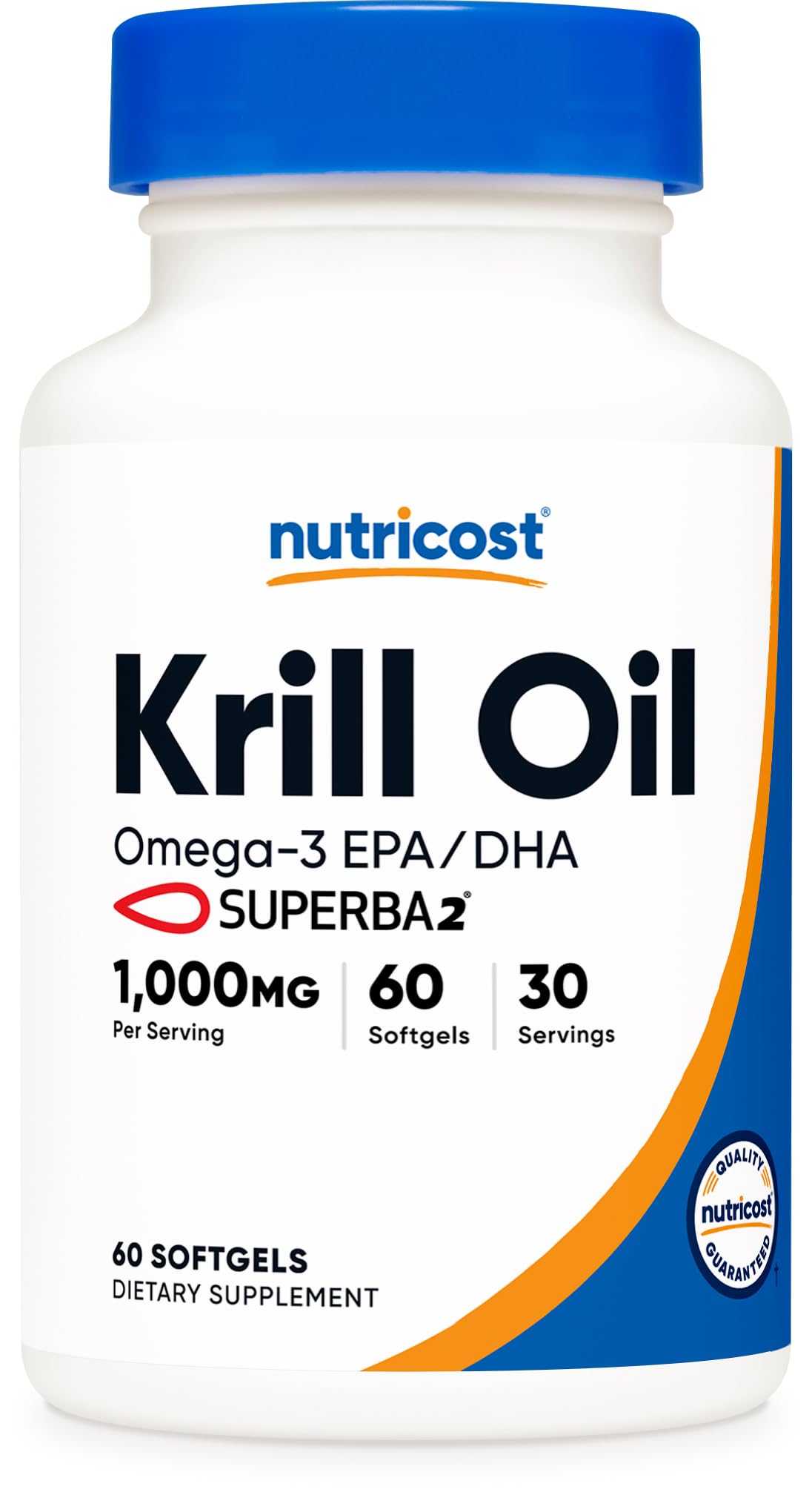
Nutricost uses the Superbakrill branded ingredient—a standardized krill oil extract that provides a baseline level of quality control and traceability. Each serving delivers 1,000 mg of krill oil with EPA and DHA fatty acids, and the softgels are manufactured in a GMP-compliant, FDA-registered facility. For someone entering the krill oil category on a tight budget, this bottle removes the guesswork of choosing between dozens of unbranded white-label supplements.
Customers switching from generic fish oil consistently report tasting the difference—Nutricost’s krill oil lacks the rancid fish flavor that can linger for hours. The softgels are standard size, and the 60-count bottle provides a 30-day supply at two capsules per day. Several reviewers note improvements in elbow and joint pain after a few weeks of use, which is consistent with the anti-inflammatory action of phospholipid-bound EPA. The product has been on the market since 2016, indicating a stable formulation that hasn’t changed formulation over eight years.
Where Nutricost cuts corners is in transparency around astaxanthin content and sustainability sourcing. The label lists EPA and DHA but does not break out astaxanthin levels or phospholipid percentage, making it harder to compare directly with premium options. The company does not highlight MSC certification on the packaging, so eco-conscious buyers may want to look elsewhere. For cost-per-serving, however, this is the most accessible option in the comparison and removes the risk of buying from a fly-by-night manufacturer.
Why it’s great
- Lowest cost per serving in the comparison
- Uses Superbakrill branded ingredient for quality consistency
- Manufactured in an FDA-registered, GMP-compliant facility
Good to know
- Astaxanthin content and phospholipid percentage not listed on the label
- No MSC certification for sustainable sourcing
FAQ
How is Antarctic krill oil different from regular fish oil in terms of absorption?
What does astaxanthin do in a krill oil supplement?
Why do some krill oil bottles smell stronger than others?
How many softgels per day should I take for joint and heart support?
What does MSC certification mean for krill oil sourcing?
Final Thoughts: The Verdict
For most users, the best antarctic krill oil winner is the BioEmblem Antarctic Krill Oil Supplement because it delivers the highest omega-3 density per serving (340 mg) with verified purity testing and a small softgel size that encourages daily compliance. If you want third-party sustainability certification and IGEN Non-GMO verification as non-negotiable features, grab the ONNIT Antarctic Krill Oil Soft Gels. And for stretching a single purchase across multiple months without sacrificing quality, nothing beats the Natures Craft Antarctic Krill Oil Softgels in the 240-count bottle.

Mo Maruf
I created WellFizz to bridge the gap between vague wellness advice and actionable solutions. My mission is simple: to decode the research and give you practical tools you can actually use.
Beyond the data, I am a passionate traveler. I believe that stepping away from the screen to explore new environments is essential for mental clarity and physical vitality.