Our readers keep the lights on and my smoothie glass nicely filled. As an Amazon Associate, I earn from qualifying purchases.
An overlocker turns raw edges into professional-looking, finished seams in a single pass, but the first machine can feel intimidating with its looping threads and multiple needles. The frustration of a jammed lower looper on a Tuesday night is a real barrier, and the wrong choice can turn a promising hobby into an expensive, frustrating paperweight.
I’m Mohammad Maruf — the founder and writer behind WellFizz. My research focuses on how entry-level overlocker specs like stitch-per-minute ratings, differential feed ratios, and frame construction translate into real-world reliability for new sewers.
The goal of this guide is to separate the machines that deliver consistent, tension-balanced seams from those that will have you re-threading every fifteen minutes, so you can confidently find your own best beginner overlocker based on what actually matters when you sit down to sew.
How To Choose The Best Beginner Overlocker
Choosing your first overlocker is less about bells and whistles and more about core construction, ease of threading, and the handful of stitches you will actually use daily. Focus on these three areas before you compare speed ratings or included accessories.
Frame Material: Metal vs. Plastic Internals
The single most reliable predictor of long-term stitch quality in an entry-level overlocker is the frame. A machine with a heavy-duty metal frame dampens vibration at high speed, keeps the needle-to-looper timing stable, and survives the occasional accidental drop during threading. Machines with plastic internal components often allow timing to drift after a few months of regular use, leading to skipped stitches and tension headaches that are difficult to diagnose.
Threading System: Color-Coded Guides and Lay-In Features
Every beginner dreads rethreading the lower looper. Look for an overlocker with color-coded thread paths that match the diagrams on the machine body. Some premium entry-level models now offer a “lay-in” system where you simply drop the thread into a slot instead of fishing it through a tiny eyelet with tweezers. If a machine requires you to thread the lower looper with a tool that feels like dental equipment, consider whether your patience level matches that challenge.
Stitch Capability: 3-Thread vs. 4-Thread and Rolled Hem
A 4-thread overlock stitch is the strongest option for garment construction because it combines a seam and an edge finish in one pass, perfect for woven fabrics that see stress at the shoulder or inseam. A 3-thread stitch is lighter and works well for knits and decorative edges. A built-in rolled hem capability—preferably with a quick-change lever rather than needing to swap a needle plate—adds serious value for finishing napkins, scarves, and lightweight blouses without buying a separate attachment.
Quick Comparison
On smaller screens, swipe sideways to see the full table.
| Model | Category | Best For | Key Spec | Amazon |
|---|---|---|---|---|
| Brother 1034D | Premium Entry-Level | Reliable daily serging | 1,300 SPM, metal frame | Amazon |
| Brother ST4031HD | Heavy-Duty | Thick fabrics, high volume | Extended table, carbon steel blade | Amazon |
| Janome 8002D | Premium Simplicity | Easy threading, basic serging | 1,300 SPM, color-coded paths | Amazon |
| Janome MOD-8933 | Lay-In Threading | Hassle-free setup | Lay-In threading system | Amazon |
| SINGER S0100 | High Speed | Speed and 6 built-in stitches | 1,300 SPM, 6 stitches | Amazon |
| SINGER S14-78 | Mid-Range Value | Versatile beginner serging | Free arm, 1,200 SPM | Amazon |
| Lumina Moda | Feature Rich | Budget-friendly, many features | Free arm, built-in trim trap | Amazon |
| VEVOR Overlocker | Budget Value | Entry-level price point | 1,250 SPM, LED light | Amazon |
| FEIYUE FY505 | Budget Pick | Lowest cost entry | 1,100 SPM, metal frame | Amazon |
In‑Depth Reviews
1. Brother 1034D

The Brother 1034D is the most frequently recommended entry-level overlocker in sewing communities for a reason. Its high-quality metal frame and interior components keep the machine stable at the maximum 1,300 stitches per minute, whether you are running four threads through denim or three threads through a rayon challis. The color-coded upper thread guide and lower looper system make rethreading approachable for a first-time owner, and the included standard, gathering, and blind stitch feet cover the three most common serging tasks right out of the box.
Users consistently report setting up the machine and tensioning it correctly within fifteen minutes by following the color-matched diagrams, which is rare in this price tier. The differential feed handles knit fabrics without wavy seams, and the snap-on metal feet feel substantially better than plastic alternatives that warp over time. The machine also supports rolled hem and flatlock stitching after minor adjustments, adding versatility without pushing the price upward.
On the downside, the 1034D does not offer a dedicated chain stitch or cover-stitch, so you would still need a separate machine for hemming t-shirts with a twin-needle finish. The included instruction manual covers the basics, but many owners find that a dedicated YouTube walkthrough shortens the learning curve for the rolled hem conversion. No machine in this class is perfect, but the 1034D’s build quality and long-term reliability put it ahead of the competition for a beginner who plans to sew regularly.
Why it’s great
- Proven long-term durability with metal frame construction
- Color-coded threading system minimizes frustration for first-time users
- Three snap-on feet included for standard, gathering, and blind stitch
Good to know
- No cover-stitch or chain-stitch capability for professional t-shirt hems
- Rolled hem requires manual plate swap rather than a quick-change lever
2. Brother ST4031HD

The ST4031HD is the Strong & Tough series answer to the standard 1034D, built for sewers who know their first projects will include multiple layers of canvas, denim, or toweling. The extra hard carbon steel blade produces a cleaner cut edge on thick stacks, and the sturdy metal frame keeps vibration low even when you are pushing the machine through a four-layer hem. The included large extension table provides significantly more fabric support when handling quilts or home decor panels.
Owners who have used this machine for daily production sewing report zero timing issues over months of heavy use, which is an exceptional reliability signal for a beginner-tier price. The color-coded thread guides and numbered upper and lower loopers match the layout on the 1034D, so any skills learned on either machine transfer directly. The removable trim trap keeps the workspace tidy, and the ability to disengage the upper knife adds flexibility for decorative techniques.
The trade-off is that the ST4031HD lacks the gathering and blind stitch feet that ship with the 1034D, which may matter if you plan to do a lot of hemming or shirring. The machine is also slightly heavier and larger, so if you need to store it in a closet between sessions, measure your shelf space carefully. If your primary concern is durability against thick materials, this model earns its premium position.
Why it’s great
- Carbon steel blade stays sharp through heavy fabrics like denim and canvas
- Large extension table provides superior fabric support for big projects
- Pre-threaded from the factory for immediate practice sewing
Good to know
- No gathering or blind stitch feet included in the box
- Heavier and bulkier than standard entry-level sergers
3. Janome 8002D

Janome’s 8002D focuses on simplifying the two things that trip up beginners most: threading and tension. The color-coded threading paths are printed clearly on the machine body, and the tension dials are marked with distinct numeric positions so you can return to a known working setting without guesswork. The differential feed system is straightforward to adjust, with a single lever that controls the feed ratio to prevent puckering on lightweight cotton or stretching on ribbed knits.
The machine arrives pre-threaded with four white cone threads, which allows you to sew a test seam immediately and see a perfectly balanced 4-thread stitch on the first try. Experienced users with arthritis or vision limitations consistently mention that the 8002D is notably easier to thread than previous higher-cost machines they have owned. The maximum speed of 1,300 stitches per minute matches the class leaders, and the differential feed range is appropriate for everything from sheer silk to medium-weight fleece.
Where the 8002D falls short is in its lack of a free arm for sewing cuffs and sleeves, a feature that the SINGER S14-78 and Lumina Moda both offer. The included accessories are basic—screwdrivers, tweezers, and a needle pack—so you will need to buy additional feet separately if you want gathering, blind hem, or piping capabilities. For a pure, no-frills serging experience with smooth operation, this Janome is hard to beat.
Why it’s great
- Pre-threaded from the factory, allowing immediate first seam without setup
- Clear color-coded tension dials simplify returning to known settings
- Quieter operation than many equivalent-priced sergers
Good to know
- No free arm for sewing cuffs, sleeves, or pant hems
- Limited accessory set requires separate purchase for specialized feet
4. Janome MOD-8933

The Janome MOD-8933 distinguishes itself with a lay-in threading system for the lower looper, which replaces the frustrating needle-and-tweezers dance with a simple slot you drop the thread into. For any beginner who has spent twenty minutes trying to thread a lower looper by feel alone, this feature alone justifies the price difference. The machine also features an adjustable presser foot pressure dial, which lets you fine-tune how firmly the foot holds the fabric without needing to swap springs.
The differential feed has a separate pretension setting slider that helps manage stretch fabrics more precisely than a simple on-off ratio knob. Owners who have used this model for years describe it as a “tank” that has never needed mechanical service, even with heavy home-sewing use. The quick-change rolled hem is genuinely quick—no plate removal required—so you can switch between standard overlock and rolled hem mid-project without breaking your rhythm.
On the negative side, the MOD-8933 does not include a free arm, and the included dust cover is thinner than ideal. The stitch width is manually adjustable but lacks the numbered detents found on more expensive machines, so setting a repeatable width requires a bit of trial and error. If the lay-in threading system speaks to your patience level, this is a thoughtfully designed machine that focuses on the real pain points of serging.
Why it’s great
- Lay-in threading eliminates the difficult lower looper threading step
- Quick-change rolled hem requires no plate swap
- Adjustable presser foot pressure for precise fabric handling
Good to know
- No free arm for tubular garment sections
- Stitch width lacks numbered detents for repeatable settings
5. SINGER S0100

The SINGER S0100 packs six built-in stitches into a metal-frame chassis that hits 1,300 stitches per minute, making it the fastest and most stitch-diverse option at this price point. Beyond the standard 2, 3, and 4-thread overlock stitches, it offers a narrow rolled hem, a wide rolled hem, and a flatlock stitch, all selectable via a straightforward dial. The color-coded threading guides are printed on the machine, and the front compartment stores the included accessories—tweezers, extra needles, cone adapters—so you are not hunting for a screwdriver mid-project.
The differential feed is adjustable and works well to prevent wavy seams on stretch knits, though some users note that the tension dials are sensitive and require fine-tuning when switching between drastically different fabric weights. The machine comes with a standard foot, but the gathering and blind stitch feet are not included, which is a common omission at this price tier.
The most common criticism is that the threading instructions on the machine face can be confusing due to unclear color differentiation, leading many new users to seek out a YouTube tutorial. The machine also has a tendency to walk on a lightweight table due to its strong motor vibration, so a sturdy sewing cabinet or a non-slip mat underneath is recommended. If you value stitch variety and high speed, the S0100 delivers, but plan for a steeper initial learning curve.
Why it’s great
- Six built-in stitches including multiple rolled hem options
- Metal frame construction for stable high-speed sewing
- Front compartment stores accessories for easy access
Good to know
- Tension dials are sensitive and may require adjustment between fabric types
- Machine vibrates significantly on lightweight tables
6. SINGER S14-78

The SINGER S14-78 strikes a balance between the essential features a beginner needs and the lower 1,200 stitches-per-minute speed that reduces intimidation. Its standout feature is the free arm, which is created by sliding off the extension table to expose a narrow sewing surface perfect for cuffs, sleeves, and pant legs. For garment sewers who plan to make a lot of shirts and children’s clothing, this single feature saves hours of frustration compared to wrestling a full garment around a flatbed machine.
The 2, 3, and 4-thread stitch capability covers the standard range, and the machine converts to rolled and narrow hemming modes with simple adjustments. The differential feed prevents puckering on lightweight fabrics, and the included accessory kit provides a needle set, tweezers, an Allen key, and a two-thread converter so you can run basic edging with just two cones of thread. The lower looper threading is notably easier than older SINGER models, with a more accessible path that does not require contorting your wrist.
Where the S14-78 loses points is in the documentation: there is no printed manual in the box, requiring you to download one from the SINGER website, and some users find that the included online manual lacks clear diagrams for the rolled hem conversion. The machine also does not include a dust cover, which is a minor omission. If you are comfortable sourcing a digital manual and want a free arm at a mid-range price, this is a strong choice.
Why it’s great
- Free arm makes cuff and sleeve serging significantly easier
- Suction cup feet keep the machine stable on smooth surfaces
- Two-thread converter included for light edging projects
Good to know
- No printed instruction manual—requires downloading a PDF
- Lacks a dust cover for storage between uses
7. Lumina Moda

The Lumina Moda packs an impressive feature set for a budget-friendly price, including all the essential functions a first-time overlocker buyer would want: 2, 3, and 4-thread capability, a free arm for tubular sewing, a built-in trim trap, differential feed, and an LED light. The color-coded threading guide is clearly labeled, and the machine includes a carrying handle for portability, making it a viable option if you attend sewing classes or move your setup regularly.
The stitch length and cutting width adjustments are independent, giving you finer control over the seam finish than some single-dial systems. The differential feed does a respectable job on both lightweight knits and medium-weight woven fabrics, though the tension range is narrower than what you would find on a Brother or Janome. The built-in trim trap collects clippings in a removable compartment, saving you from the pile of fabric shreds that tends to accumulate under a serger table.
The biggest concerns with the Lumina Moda revolve around long-term reliability. Several users report motor failure within a few months of purchase, and the warranty coverage is minimal compared to the Brother or Janome options. The manual also lacks detailed instructions for setting up a narrow rolled hem, which may require experimentation or online research. If your budget is tight and you want a free arm plus LED lighting, this machine offers the features, but you are accepting a higher risk of mechanical issues.
Why it’s great
- Free arm and built-in trim trap at a competitive price point
- Color-coded threading system with carrying handle for portability
- Independent stitch length and cutting width adjustments
Good to know
- Higher reported incidence of motor failure than established brands
- Limited warranty coverage compared to Brother or SINGER
8. VEVOR Overlock Machine
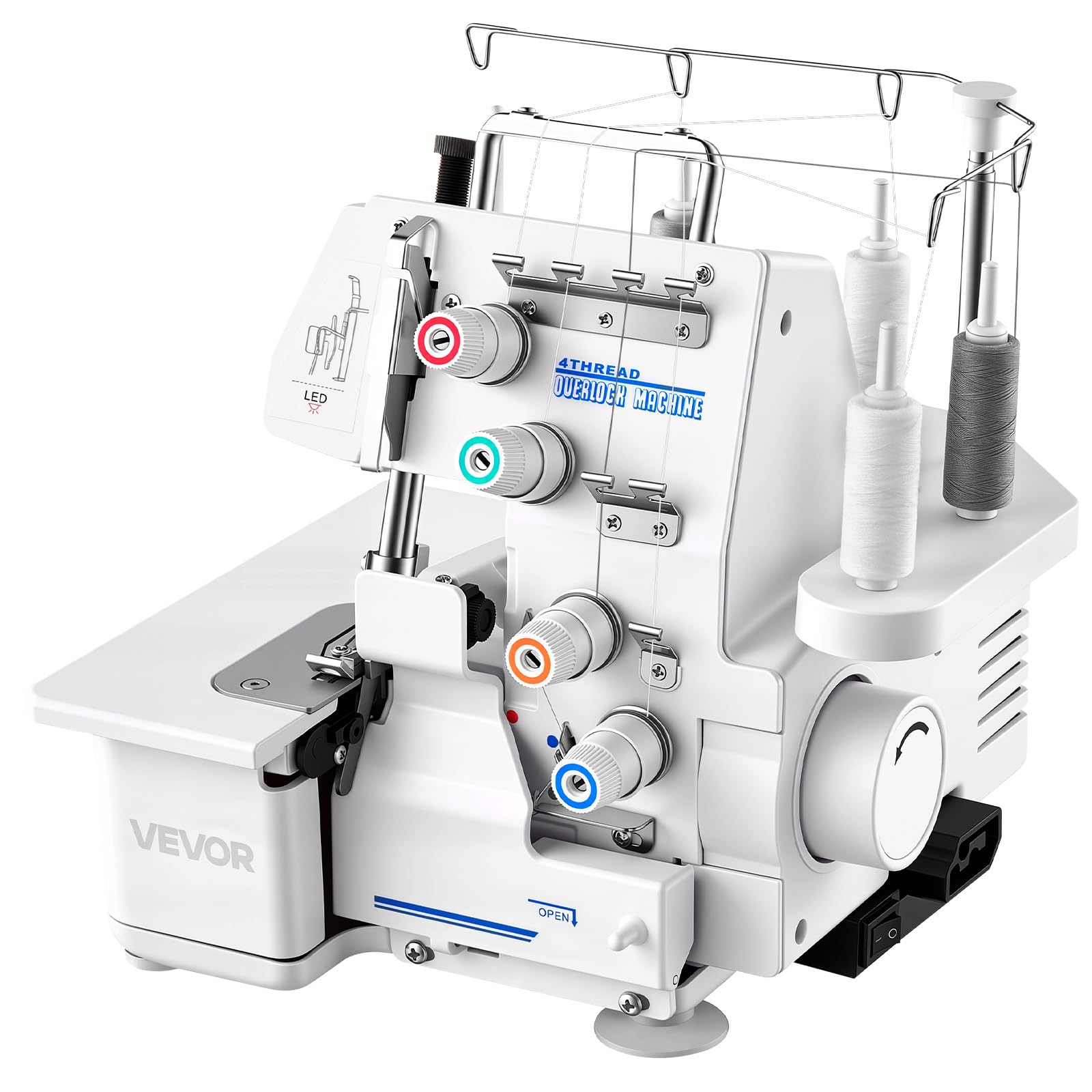
The VEVOR overlock machine offers a 1,250-stitches-per-minute speed and an iron-and-plastic frame at a budget-friendly price, making it one of the lowest-cost ways to get a 3 and 4-thread serger in your home. The strong 112W motor provides enough torque to push through multiple layers of medium-weight fabric without bogging down, and the LED light is genuinely bright—a welcome feature if you sew in less-than-ideal lighting. The adjustable presser foot adds flexibility for different fabric thicknesses.
Setup is straightforward for an absolute beginner, though customers report that the machine arrives “bone dry” and requires manual oiling of all metal contact points before the first use. The supplied thread cones are low quality and tend to fray or break mid-stitch, so budgeting for a set of quality serger thread cones is necessary. The color-coded threading system is present, but the diagram inside the front compartment is smaller and less detailed than those on the Brother or Janome machines.
The most significant risk with the VEVOR is quality control: some units work perfectly out of the box, while others fail within days. The included manual is difficult to follow, with tiny diagrams and poor translations, so you will likely rely on YouTube tutorials for threading and tension adjustments. If you are comfortable with a project-machine that may require some tweaking and an initial oiling, the VEVOR can work, but it is not the “set it and forget it” experience that most beginners want.
Why it’s great
- Powerful 112W motor handles multi-layer fabrics well
- Bright LED light improves visibility during stitching
- Adjustable presser foot accommodates varying material thickness
Good to know
- Arrives without lubrication—must oil all metal parts before first use
- Supplied thread cones are low quality and prone to breaking
9. FEIYUE FY505

The FEIYUE FY505 is the lowest-cost overlocker in this lineup, yet it still includes a durable metal frame and 2, 3, and 4-thread capability. The maximum speed of 1,100 stitches per minute is slower than the other machines here, but that reduced speed can actually be a benefit for a nervous beginner—it gives you more time to guide the fabric and react to any tension issues before a seam is ruined. The carbon steel cutting blade is a tangible upgrade from the basic steel found on some other budget machines, producing a cleaner edge on straight seams.
The color-coded thread guides are present and functional, and some users report that the machine arrived pre-threaded and sewed a balanced stitch immediately. The metal frame provides enough stability to prevent the machine from shaking on a table, which is a legitimate concern with cheaper plastic-heavy designs. The included embroiderer plate is a niche bonus for those who want to try free-motion serging techniques.
The FY505 suffers from inconsistent quality control—some owners receive a perfectly functioning machine, while others report thread breakage, foot pedal issues, and overall frustration. The customer service response has been positive in some cases and absent in others. The threading sequence is also more finicky than the Brother or Janome alternatives, with the narrow thread wall spacing making the lower looper particularly tricky to access. For the lowest possible entry cost, the FY505 is worth considering if you are handy and patient, but the reliability risk is real.
Why it’s great
- Metal frame at the lowest price point in the category
- Carbon steel blade delivers cleaner cuts than basic steel alternatives
- Slower maximum speed can be helpful for learning technique
Good to know
- Inconsistent quality control—some units have threading and pedal issues
- Narrow thread wall spacing makes lower looper difficult to access
FAQ
Can I use regular sewing machine thread in my overlocker?
Why does my overlocker keep breaking the thread on the lower looper?
What is the difference between a 3-thread and 4-thread overlock stitch?
Final Thoughts: The Verdict
For most users, the best beginner overlocker winner is the Brother 1034D because it combines a proven metal frame, approachable color-coded threading, and consistent long-term reliability at a price that does not require a second mortgage. If you want a machine that handles thick fabrics and heavy daily use, grab the Brother ST4031HD. And for a hassle-free threading experience with a quick-change rolled hem, nothing beats the Janome MOD-8933.

Mo Maruf
I created WellFizz to bridge the gap between vague wellness advice and actionable solutions. My mission is simple: to decode the research and give you practical tools you can actually use.
Beyond the data, I am a passionate traveler. I believe that stepping away from the screen to explore new environments is essential for mental clarity and physical vitality.