Our readers keep the lights on and my smoothie glass nicely filled. As an Amazon Associate, I earn from qualifying purchases.
That stubborn patch of poison ivy creeping under the fence, the thicket of blackberry canes swallowing the back forty, or the persistent saplings that return every spring along the fence line—these aren’t lawn weeds you can pluck in an afternoon. They demand a chemical solution engineered for deep root and woody-stem destruction, not just a surface-level wilt.
I’m Mohammad Maruf — the founder and writer behind WellFizz. I’ve spent hundreds of hours cross-referencing herbicide label data, active ingredient concentrations, and real-world application results to separate what actually kills brush from what just browns the leaves.
This analysis focuses on concentrated formulas that deliver measurable results against tough vegetation, helping you find the right best brush and weed killer for your specific property challenges.
How To Choose The Best Brush And Weed Killer
Picking the right brush and weed killer isn’t just about grabbing the strongest bottle. You need to match the active ingredient to your specific vegetation type, the size of the area, and whether you want to keep surrounding grass alive. Skimp on this step, and you’ll waste money on a product that simply won’t translocate into a woody root system.
Active Ingredient Match: Triclopyr vs. Glyphosate vs. 2,4-D
Triclopyr is the gold standard for woody brush, vines, and saplings because it penetrates bark and moves to the root system effectively. Glyphosate is a non-selective brute force option that kills everything green, ideal for spot eradication on driveways and walkways. 2,4-D is often mixed with other ingredients for broadleaf weed control in pastures but is weaker on established brush alone. Many premium brush killers use a triclopyr and 2,4-D combo for broader woody and broadleaf coverage.
Concentration and Coverage Area
Concentrates require measuring and mixing but offer far better value per square foot than ready-to-spray bottles. Check the label for the specific mixing ratio for brush (usually higher than for lawn weeds). A 1-gallon container that treats over 2 acres gives you serious bang for your buck if you’re maintaining fence lines or a large pasture. For small patches around the house, a 32-ounce concentrate might be more practical.
Selectivity: Will It Kill My Grass?
If you are spraying around a lawn or native pasture grass, you need a selective herbicide like Remedy Ultra or Crossbow that targets broadleaf weeds and woody plants without harming established turfgrasses. Non-selective options like high-concentration glyphosate or diquat kill every plant they touch, so you must apply them carefully with a shielded sprayer or wick applicator to avoid brown spots in your lawn.
Quick Comparison
On smaller screens, swipe sideways to see the full table.
| Model | Category | Best For | Key Spec | Amazon |
|---|---|---|---|---|
| Remedy Ultra | Selective Brush | Pastures & fence lines | 1 gallon, triclopyr | Amazon |
| Southern Ag Crossbow | Selective Mix | Broad woody & broadleaf | 1 gallon, triclopyr + 2,4-D | Amazon |
| Hi-Yield Killzall 365 | Non-Selective | Total bare-ground control | 32 oz, glyphosate | Amazon |
| Control Solutions Eraser | Non-Selective | Budget spot eradication | 32 oz, 41% glyphosate | Amazon |
| Spectracide Concentrate | Non-Selective Fast | Quick results on drives | 32 oz, diquat dibromide | Amazon |
In‑Depth Reviews
1. Remedy Ultra Specialty Herbicide
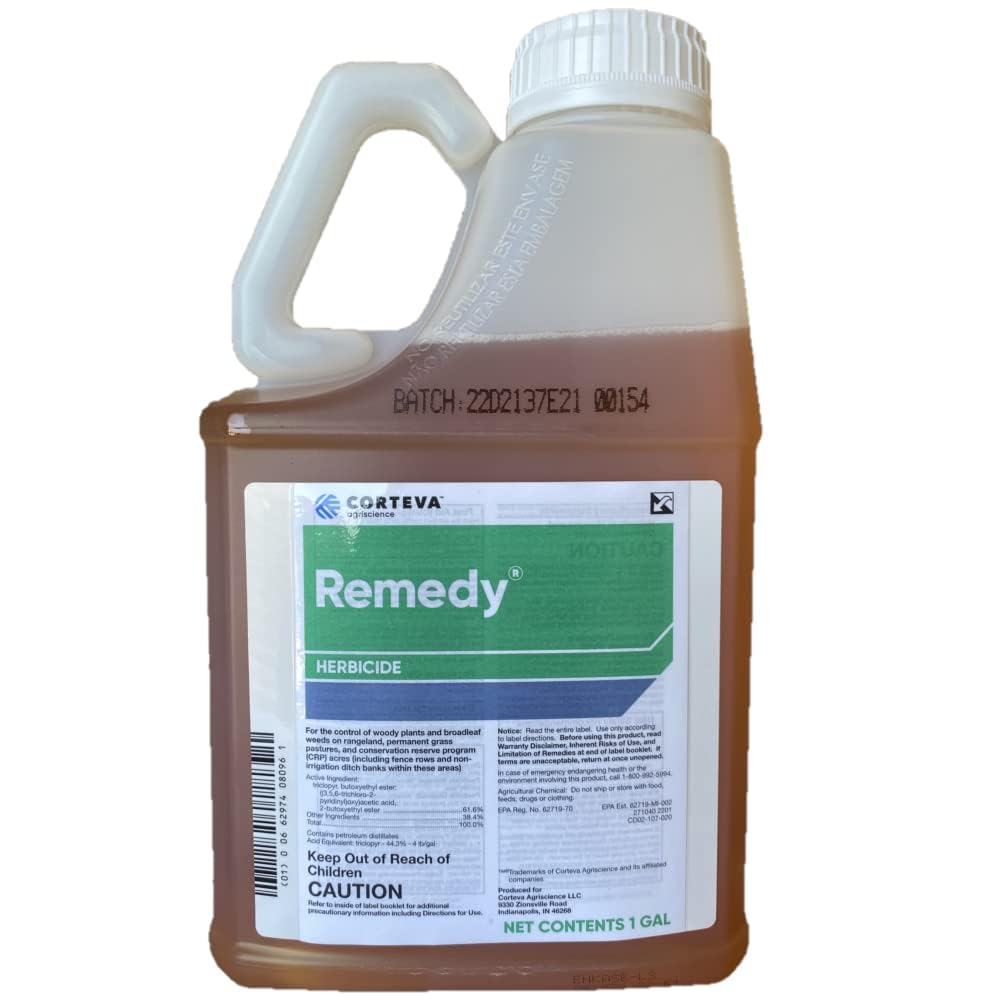
The Remedy Ultra from Dow AgroSciences is the default recommendation for pasture managers and property owners battling encroaching brush, small trees, and persistent woody vines. Its triclopyr active ingredient penetrates bark and leaf cuticles to move into the root system, providing long-term control rather than just top-growth burn. The 1-gallon size covers extensive fence rows and rangeland areas efficiently when mixed according to label rates.
Users consistently report it annihilates tough species like cogon grass, yucca plants, blackberry bushes, and even saplings that have previously survived other sprays. It is selective enough to spare established pasture grasses when applied correctly, making it a top-tier choice for grazing land. The low-odor formula also reduces the harsh applicator experience common with older brush killers.
That said, this is a premium-priced concentrate, so budget-conscious buyers with only small patches of poison ivy may find it oversized. It requires careful mixing and a decent sprayer—a backpack or electric model is recommended for even coverage. Always read the label for safe drying times before allowing children or pets back into the treated area.
Why it’s great
- Excellent translocation to woody root systems for lasting kill
- Selective for pasture grass when applied at correct rates
- Low-odor formula improves application comfort
Good to know
- Premium-tier investment; less cost-effective for tiny patches
- Requires a good tank sprayer for proper coverage
- May need 1-2 weeks to show full die-off on heavy brush
2. Southern Ag Crossbow Specialty Herbicide

Southern Ag’s Crossbow delivers a powerful triclopyr and 2,4-D blend that handles both woody brush and annual/perennial broadleaf weeds in one pass. This 1-gallon container makes up to 96 gallons of spray solution, covering roughly 2.23 acres when mixed at standard rates. It is a direct competitor to Remedy Ultra but often arrives at a slightly more accessible price point while retaining strong selective performance for grass-friendly pasture use.
Real-world feedback highlights its rapid visual impact on thistle, poison ivy, ragweed, and blackberry canes, often showing signs of wilting within 24 to 48 hours on warm, dry days. Users appreciate that it lacks glyphosate and neonicotinoids, making it a safer-feeling choice for those concerned about soil and pollinator impact. The 3-day soil half-life means it breaks down relatively fast after doing its job.
One notable variable is soil type affinity—reviews suggest it performs best on less organic-rich soils like those found in the Southeast, while very rich loam in the Midwest may see reduced efficacy against certain tough perennials. The odor is stronger than Remedy Ultra, so a respirator is recommended for prolonged spraying sessions. It also struggles with wild violets, requiring alternative treatments for that specific weed.
Why it’s great
- Highly effective mix for broadleaf weeds and woody brush
- Excellent coverage per gallon (up to 2.23 acres)
- Selective for grass, breaking down quickly in soil
Good to know
- Strong chemical odor requires ventilation and a mask
- Results can vary based on soil organic matter content
- Less effective on wild violets and some tough perennials
3. Hi-Yield Killzall 365

Hi-Yield Killzall 365 is a non-selective glyphosate concentrate designed for bare-ground total vegetation control. It kills broadleaf weeds, grasses, trees, brush, and vines. When you need a clean slate along fence lines, driveways, or gravel paths with no plant competition left behind, this formula delivers. The 32-ounce bottle treats up to 4,300 square feet, making it a solid mid-tier option for medium-sized residential properties.
Users note it works slower than diquat-based options—you’ll see yellowing in about a week and complete death in two—but the results are thorough and long-lasting. It is effective against stubborn perennials that might regrow from roots with faster-acting contact herbicides. A double application is sometimes needed for extremely resilient weeds, but overall satisfaction is high among regular buyers.
A major caveat: it is non-selective and will kill any grass or desirable plant it touches. Apply on a windless day using a shielded sprayer to avoid drift damage to your lawn. It also appears to have little effect on moss, so if that’s your primary target, look elsewhere. The lack of residual soil activity means you can replant the area after a few days.
Why it’s great
- Thoroughly kills a wide spectrum of weeds and brush down to the root
- Large coverage area per bottle (up to 4,300 sq ft)
- No residual soil activity allows quick replanting
Good to know
- Non-selective—will kill grass and desired plants on contact
- Slower visible results compared to diquat-based products
- Has little to no effect on moss growth
4. Control Solutions Eraser Grass & Weed Killer
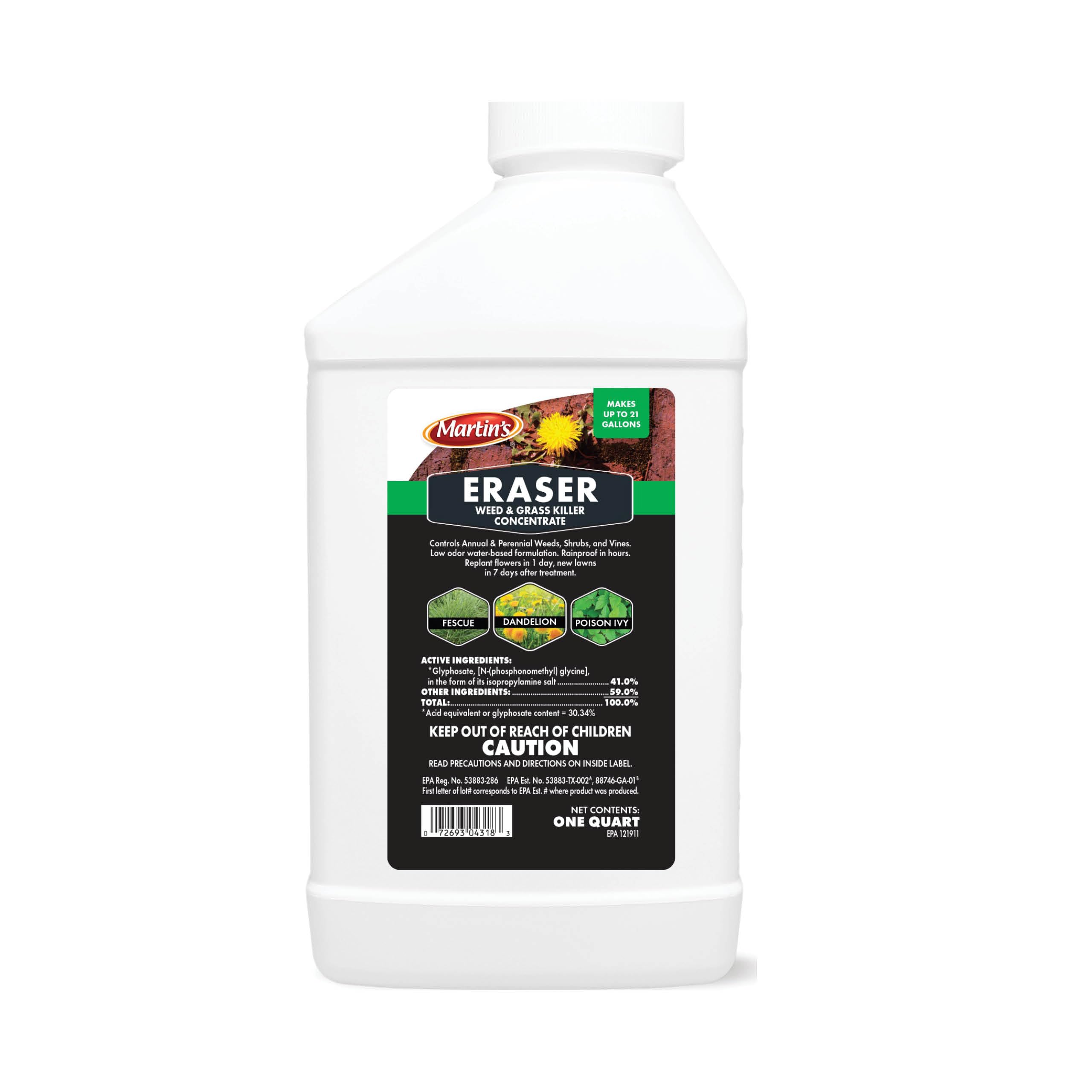
The Control Solutions Eraser is a high-concentration (41% glyphosate) non-selective killer that punches well above its modest price point. For homeowners with small to medium weed patches, poison ivy clusters, or cracked driveway vegetation, this 32-ounce concentrate offers a budget-friendly entry into effective chemical control. It works exactly like the consumer Roundup formulations but at a significantly lower cost per mixed gallon.
Patience is required here—users report no visible effect for the first two days, then gradual yellowing at four to seven days, with complete death of annuals in about one to two weeks. Woody species like poison ivy and established vines may need a follow-up application. Adding a non-ionic surfactant improves leaf adhesion and speeds results, especially on waxy or hairy leaf surfaces like poison ivy.
The main trade-off for the low price is slower action compared to diquat-based sprays. It also requires the user to mix their own solution and provide their own surfactant for optimal performance. Because it is non-selective, you must apply with precision to avoid collateral damage to garden plants. For simple, low-cost spot treatment, it is one of the most economical options available.
Why it’s great
- High 41% glyphosate concentration delivers reliable results
- Extremely affordable per mixed gallon compared to name brands
- No residual soil activity—plant-safe after drying
Good to know
- Very slow visible results—takes 1-2 weeks for full kill
- Works best with a separate surfactant for waxy leaves
- Non-selective, requiring careful targeted application
5. Spectracide Weed and Grass Killer Concentrate
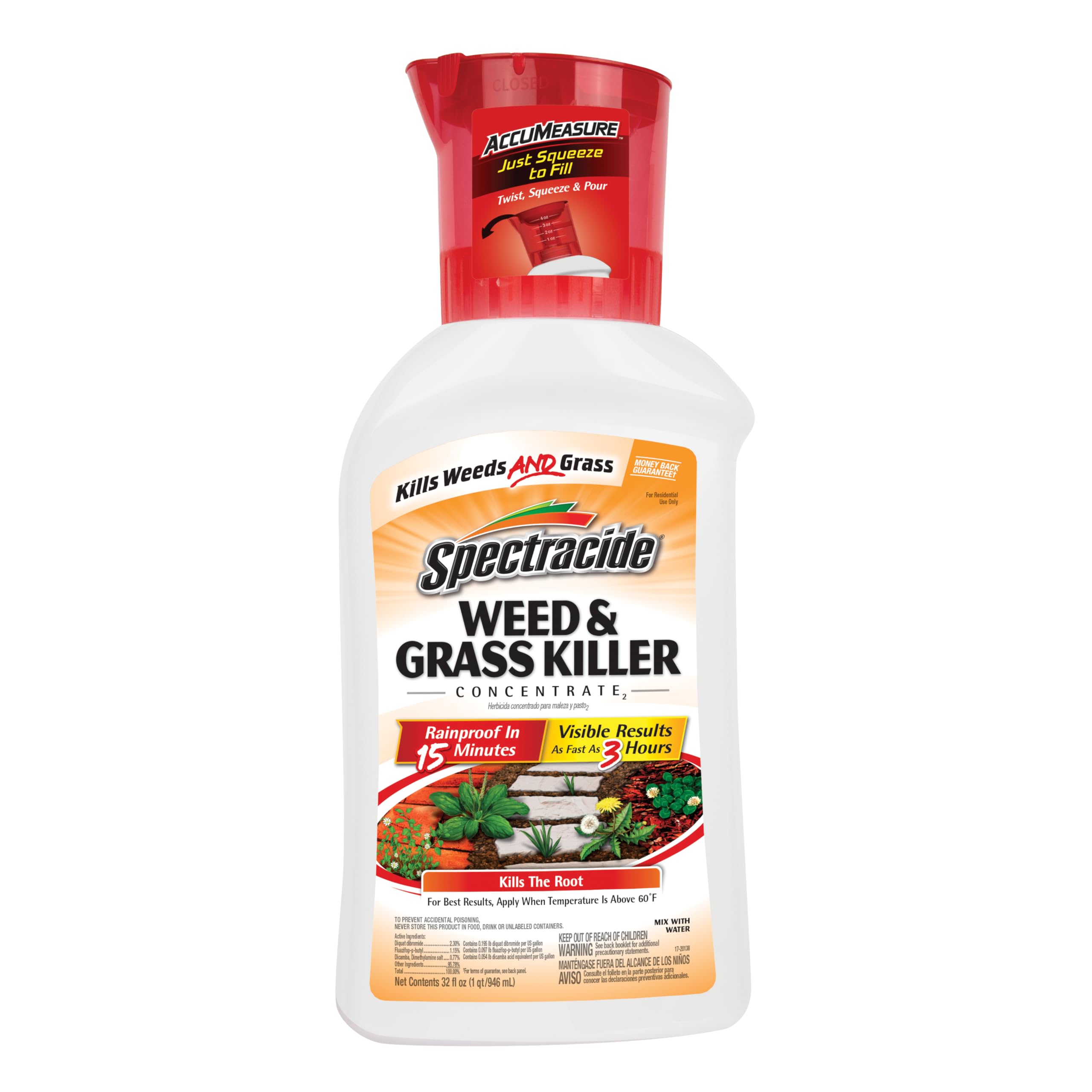
Spectracide’s concentrate uses diquat dibromide as its active ingredient, a contact herbicide that produces visible results in as little as three hours on sunny days. If you need quick visual satisfaction for weeds growing between driveway pavers or along curb edges, this is the fastest-acting option in this lineup. The Accumeasure cap is designed to simplify mixing, though many users find it finicky and swap it for a standard cap.
The 32-ounce container treats approximately 1,350 square feet when mixed at standard rates. Because diquat is a contact killer that disrupts cell membranes on foliar contact, it works best on small annual weeds and young grass. It is rainfast in 15 minutes, which is a major advantage during unpredictable weather. The product does not translocate well to roots, so tougher perennial weeds and established brush may require multiple applications for complete control.
This is not your best choice for woody brush like blackberries or poison ivy—triclopyr-based products are far more effective there. But for a quick sidewalk clean-up or a fast knockdown of grassy weeds before replanting, it fits the bill nicely. The Accumeasure system is a nice idea but often criticized as overly complicated; many long-time users prefer the old screw-cap system for its simplicity.
Why it’s great
- Extremely fast visual results—visible wilting in hours
- Rainfast in just 15 minutes for flexible application timing
- Effective on young annual weeds and grass along hardscapes
Good to know
- Poor root translocation—weak on perennial weeds and woody brush
- Accumeasure cap can be frustrating to use accurately
- Coverage area is smaller compared to glyphosate concentrates
FAQ
Can I spray brush killer before rain?
Will triclopyr kill my lawn grass?
Why isn’t my brush killer working on poison ivy?
Final Thoughts: The Verdict
For most users, the best brush and weed killer winner is the Remedy Ultra because its triclopyr chemistry provides unmatched translocation to woody roots while sparing pasture grasses. If you want a similar action with a more budget-friendly price tag, grab the Southern Ag Crossbow. And for fast non-selective spot spraying around driveways and patios where speed matters more than root kill, nothing beats the Spectracide Concentrate.

Mo Maruf
I created WellFizz to bridge the gap between vague wellness advice and actionable solutions. My mission is simple: to decode the research and give you practical tools you can actually use.
Beyond the data, I am a passionate traveler. I believe that stepping away from the screen to explore new environments is essential for mental clarity and physical vitality.