Our readers keep the lights on and my smoothie glass nicely filled. As an Amazon Associate, I earn from qualifying purchases.
When an ABS pipe joint fails, it usually isn’t a slow drip—it’s a sudden crack that sends waste water where it doesn’t belong. The difference between a watertight repair and a recurring disaster comes down to the solvent cement’s chemical formulation, body thickness, and set time. General-purpose glues cannot penetrate the amorphous molecular structure of ABS; only a solvent that softens and re-fuses the parent material creates a monolithic bond that withstands thermal cycling and hydrostatic pressure in drain, waste, and vent lines.
I’m Mohammad Maruf — the founder and writer behind WellFizz. Over years of analyzing plumbing and repair consumables, I’ve broken down how each formula’s viscosity, VOC profile, and cure timeline determine whether a joint holds at 6-inch diameters or delaminates under hot water exposure.
Whether you are patching an RV sewer line or fabricating a custom automotive panel, the right chemistry dictates success. This guide evaluates five contenders to identify the best abs glue for every repair scenario.
How To Choose The Best ABS Glue
Selecting an ABS solvent cement is not about grabbing the cheapest can. The bond line’s strength depends on three intersecting variables: the cement’s viscosity (body), its cure speed relative to ambient temperature, and the specific diameter of pipe or fitting you are joining. Understanding these helps you avoid joints that leak after the first hot water cycle.
Body Thickness and Joint Fit
Medium-bodied cement, sometimes labeled “medium black,” is the sweet spot for most ABS work up to 6-inch diameter with interference fit. It stays on the brush without dripping, fills microscopic gaps between pipe and fitting, and chemically fuses rather than merely gluing. Thin-bodied cements run off vertical surfaces, while heavy-bodied types are reserved for larger diameters (6–8 inches) where gap-filling capacity is critical.
Set Time and Working Temperature
Fast-setting formulas harden in 30–60 seconds, which is ideal for plumbing repairs where you cannot clamp indefinitely. However, in hot, arid climates (above 90°F), the solvent evaporates before the chemical weld forms. Some cements are specially formulated for these conditions, allowing a longer open time. Always match the cement’s temperature rating to your environment—most recommend application between 40°F and 110°F.
Low-VOC vs. Standard Solvent Strength
Low-VOC (volatile organic compound) cements meet California SCAQMD and LEED v4 requirements, reducing fumes and improving air quality on the job. The trade-off is that some low-VOC formulations cure slightly slower or require a primer for certain schedules. If you are working in an enclosed utility closet or occupied RV, low-VOC is worth the minor cure delay. For maximum chemical aggression on stubborn old ABS, standard-strength solvent still rules.
Quick Comparison
On smaller screens, swipe sideways to see the full table.
| Model | Category | Best For | Key Spec | Amazon |
|---|---|---|---|---|
| Oatey 30252 4 OZ | Mid-Range | Small ABS repairs (RV, motorcycle panels) | 4 oz container, low-VOC paste | Amazon |
| Oatey 30918 16 oz | Mid-Range | Hot-arid climate pipe joints up to 6″ | 16 oz, medium body, hot-arid formula | Amazon |
| WELD-ON 16383 5 oz | Mid-Range | 3D prints, acrylic, multi-plastic bonding | 5 oz tube, clear, 5-6 min working time | Amazon |
| Weld-On 10246 4 oz | Premium | High-strength ABS joints up to 8″ | 4 oz, black, fast-setting, low-VOC | Amazon |
| Barge Cement Thinner | Accessory | Reviving thickened Barge cement | 1 lb bottle, rubber-based formulation | Amazon |
In‑Depth Reviews
1. Weld-On 10246 773 ABS Medium-Bodied High Strength Solvent Cement
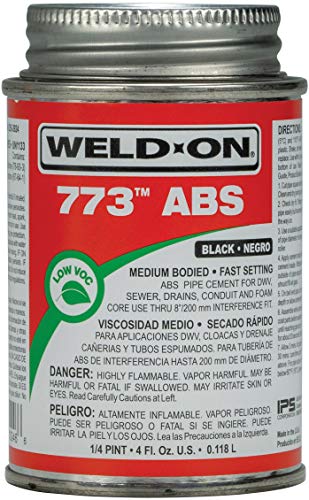
The Weld-On 10246 delivers premium solvent cement performance for ABS pipe and fittings up to 8 inches in diameter. Its medium-bodied, fast-setting formula applies smoothly without dripping on vertical risers and sets quickly enough that you can test the joint within minutes of assembly. The low-VOC chemistry reduces solvent fumes significantly, making it suitable for tighter crawl spaces and utility closets where ventilation is limited.
It meets ASTM D2235 and NSF/ANSI 14 standards, so you know it satisfies the performance specifications required by professional plumbers. Users report that it chemically welds ABS parts together so effectively that repaired panels and pipes feel monolithic after the recommended 24-hour full cure. The 4-ounce (1/4 pint) container is compact enough for occasional repairs yet sufficient for several 2-inch diameter joints.
Because it complies with SCAQMD Rule 1168/316A, this cement contributes toward LEED v4 Indoor Environmental Quality credits—a clear advantage for eco-conscious builders. If you are tackling ABS plumbing in an RV, travel trailer, or new construction, this is the formula that balances fast set, low emissions, and high-strength results.
Why it’s great
- Compatible with ABS up to 8-inch diameter with interference fit
- Low-VOC formula reduces fumes and meets LEED requirements
- Fast-setting allows handling in under 60 seconds
Good to know
- Small can leaves 95% leftover for single-joint jobs
- Requires full 24-hour cure for maximum hydrostatic strength
2. Oatey 30918 ABS Extra Special Cement, 16 oz

The Oatey 30918 is an extra special medium-bodied black ABS cement formulated specifically for hot, arid climates in the Western states. When ambient temperatures exceed 90°F, standard cements can flash off the solvent before the weld forms, leading to brittle joints. This formula extends the open time so you can apply a two-coat technique and still achieve a watertight bond on sewer, drain, waste, and vent systems.
Rated for all schedules and classes of ABS pipe and fittings up to 6 inches with interference fit, it performs in the 40°F to 110°F range. Users who have repaired cracked RV sewer lines confirm that applying two or three coats, then clamping, results in a cure that never fails under pressure. The low-VOC formulation also meets California SCAQMD 1168/316A standards, making it compliant for professional use in strict air-quality zones.
The 16-ounce can provides a generous volume for medium-to-large projects without forcing you to buy a quart. Keep the lid threads clean—if the cement thickens over time, a few drops of MEK can restore the proper viscosity. For anyone plumbing ABS in desert heat or high altitudes, this is the cement that refuses to let the heat win.
Why it’s great
- Formulated for hot, arid climates where other cements flash off too fast
- 16 oz can is economical for multiple large joints
- Low-VOC compliance for professional job sites
Good to know
- Can stain surfaces if dripped—protect flooring
- Thickens if stored open; requires periodic thinning
3. Oatey 30252 4 OZ Medium Black Cement
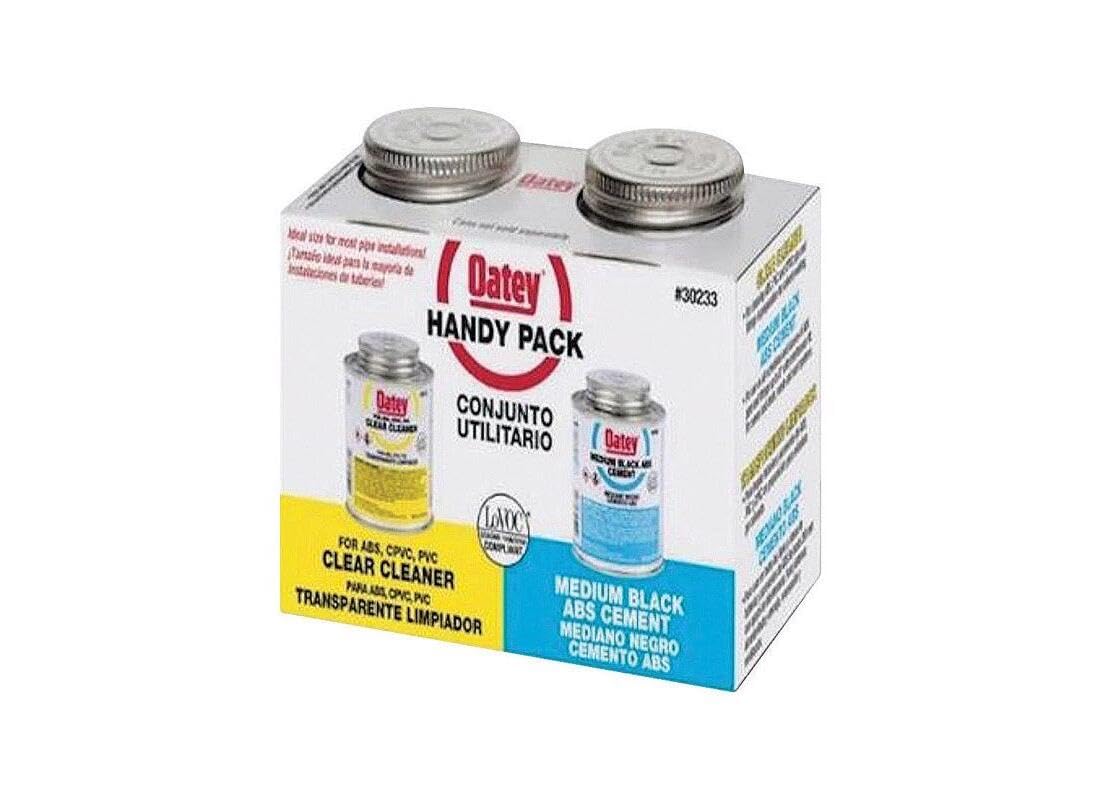
The Oatey 30252 comes in a compact 4-ounce bottle that is ideally sized for a single repair job or for keeping in an RV toolbox. Despite the small package, it delivers the same medium black cement performance as larger cans. Users have used it to bond ABS door panels on cars, repair cracked motorcycle side panels, and fix plastic parts around the house—all reporting that the weld held as strong as the original material.
Because it is a paste (not a thin liquid), it stays where you brush it and does not run off vertical surfaces. The low-VOC formulation means you can use it in a garage or covered patio without overwhelming fumes. For anyone who only needs to glue a couple of ABS fittings or a plastic repair, this eliminates the waste and storage hassle of a half-full quart can.
One note: the 4-ounce size is best for small repairs under 2-inch diameter joints. If you have a large drainage system to assemble, you will want the larger 16-ounce or quart options. But for the occasional DIY fix, this bottle is exactly the right dose.
Why it’s great
- Perfect size for single repairs and on-the-go toolboxes
- Paste consistency stays on brush for vertical application
- Low-VOC makes it friendlier for enclosed spaces
Good to know
- Not economical for big plumbing jobs—needs multiple bottles
- Can harden quickly if cap is left loose
4. WELD-ON 16383 16 Acrylic Plastic Cement

The WELD-ON 16383 is a clear, medium-bodied solvent cement designed for bonding rigid plastics: acrylic, PVC, ABS, styrene, butyrate, and polycarbonate. It works by chemically fusing the surfaces, creating a bond that is nearly invisible when dry. With a 5–6 minute working time and a 24-hour full cure, it gives you enough flexibility to position parts before the weld locks in permanently.
3D printing enthusiasts have adopted this as a go-to adhesive for PLA filament. Unlike cyanoacrylate glues that leave a white haze, Weld-On 16 dries crystal clear and forms a chemical bond that feels like the parts were always one piece. The low-VOC formulation means less eye irritation during extended use compared to older solvent blends.
The tube packaging is the main trade-off: the precision tip is handy for tight spaces, but the glue tends to pour out if you squeeze too hard, creating a mess. Transferring the liquid into a small jar with a brush may be worthwhile for frequent users. For multi-material projects that include ABS alongside acrylic or polycarbonate, this cement bridges the compatibility gap that single-plastic cements cannot.
Why it’s great
- Bonds multiple plastics including ABS, acrylic, and polycarbonate
- Dries crystal clear—no white residue on visible joints
- Low-VOC and fast-setting for 3D print repairs
Good to know
- Tube packaging can leak if squeezed too hard
- Thin consistency takes practice to control
5. Barge Cement Thinner

The Barge Cement Thinner is not an ABS glue itself but a restoration solvent designed for use with Barge all-purpose cement. Over time, contact cement can thicken into a stringy, unusable paste. Adding this thinner revives the glue to its original viscosity, saving you the cost of buying a whole new can. It works by dissolving the rubber-based formulation, restoring the tack and spreadability that makes Barge cement effective for laminating countertops, repairing shoe soles, and bonding EVA foam.
For ABS repairs, this product has an indirect role: if you use Barge cement as a flexible gap-filler between ABS and other materials (like rubber or wood), the thinner ensures the cement stays fluid enough for a thin, even application. Users who resole climbing shoes or repair sandal straps report that rejuvenating old Barge cement with this thinner is cheaper than buying new tubes, and the bond strength matches fresh product.
A strong word of caution: this thinner contains toluene and is extremely noxious. Use it outdoors with a respirator and thick nitrile gloves. It is also effective for cleaning cement from brushes and separating items bonded with Barge or similar rubber cements. If you maintain a stock of Barge cement, this thinner extends its life indefinitely.
Why it’s great
- Revives thickened Barge cement to original consistency
- Cost-effective alternative to buying new glue
- Also effective for soaking brushes and cleanup
Good to know
- Contains toluene—requires strong ventilation and gloves
- Not a direct ABS cement; only works with rubber-based formulas
FAQ
Can I use ABS cement on PVC pipe?
How long should I wait before running water through an ABS joint?
Why is low-VOC ABS cement more expensive?
Final Thoughts: The Verdict
For most users, the best abs glue winner is the Weld-On 10246 because it delivers a fast-setting, low-VOC formula that handles ABS up to 8 inches and meets professional standards without excess fumes. If you work in hot, arid climates where flash-off is a problem, grab the Oatey 30918 for its extended open time. And for small repairs or multi-plastic projects, nothing beats the compact convenience of the Oatey 30252 or the clear fusion of the WELD-ON 16383.

Mo Maruf
I created WellFizz to bridge the gap between vague wellness advice and actionable solutions. My mission is simple: to decode the research and give you practical tools you can actually use.
Beyond the data, I am a passionate traveler. I believe that stepping away from the screen to explore new environments is essential for mental clarity and physical vitality.