Our readers keep the lights on and my smoothie glass nicely filled. As an Amazon Associate, I earn from qualifying purchases.
Most budget audio receivers promise more power than a flagship amp at half the price, but the real measure is how cleanly that power reaches your speakers. Between inflated peak-watt ratings and silent Bluetooth dropout issues, finding a genuinely capable unit under requires parsing the spec sheet for what actually matters: RMS output, signal-to-noise ratio, and the quality of your digital-to-analog conversion chain.
I’m Mohammad Maruf — the founder and writer behind WellFizz. I have spent over a decade analyzing amplifier topologies, Class-D implementation nuances, and DAC chipset performance to separate hype from hardware that delivers measurable results.
This guide cuts through the marketing noise to present only receivers that balance value and performance. Every recommendation here has earned its spot through verified user feedback and concrete technical merits that define a true budget audio receiver.
How To Choose The Best Budget Audio Receiver
Choosing a budget receiver starts with understanding your speaker impedance (4, 6, or 8 ohms) and the typical listening volume you expect. A receiver that clips at moderate levels will damage tweeters and produce audible distortion, so matching continuous power to your speakers matters far more than any peak number printed on the box.
Real Output: RMS Over Peak
A receiver claiming 1000 peak watts may deliver only 25 watts RMS per channel. RMS (root mean square) measures sustained power handling — the number that determines how loud and clean your music sounds during normal playback. Ignore peak ratings and look for the continuous wattage at your speaker’s impedance rating.
Connectivity That Fits Your Sources
If you own a turntable, you need a built-in phono preamp with a moving magnet (MM) input. For TV integration, optical or coaxial digital inputs bypass the TV’s internal DAC and improve sound clarity. Bluetooth 5.0 with AptX support provides near-wireless quality, while older Bluetooth 4.1 may introduce noticeable latency and compression artifacts.
DAC and Amplifier Topology
Class-D amplifiers dominate the budget category because they run cool and fit in compact chassis, but implementation matters. Look for chips like the Texas Instruments TPA3255 with PFFB feedback for cleaner high-frequency response. Integrated DACs from ESS or AKM produce higher signal-to-noise ratios and lower jitter than generic SoC codecs.
Quick Comparison
On smaller screens, swipe sideways to see the full table.
| Model | Category | Best For | Key Spec | Amazon |
|---|---|---|---|---|
| Fosi Audio BT20A Pro | Mini Class-D | Desktop & small room | 300W x 2 peak, TPA3255, 108dB SNR | Amazon |
| Pyle PDA77BU | Full-Feature | Karaoke & multipurpose | 800W peak, dual mic, FM, remote | Amazon |
| Donner 1000W Receiver | All-in-One | Karaoke & home theater | 1000W peak, 25W x 4 RMS, optical/coax | Amazon |
| AIYIMA A80 | DAC-Amp | Audiophile desktop | ES9038Q2M DAC, 300W x 2 peak, VU meter | Amazon |
| YAMAHA R-S202BL | Traditional | Simple 2-channel music | 100W x 2, Bluetooth 4.1, 40 FM presets | Amazon |
| Sony STRDH190 | Phono-Equipped | Vinyl & digital hybrid | 100W x 2, phono input, Hi-Res Audio | Amazon |
| Dayton Audio HTA100 | Hybrid Tube | Warm audiophile sound | 50W x 2 RMS, tube preamp, phono, VU | Amazon |
| Pioneer VSX-935 | AV Receiver | Home theater 7.2 | 7.2 ch, Dolby Atmos, HDMI 2.1 8K | Amazon |
| Cambridge Audio AXR100 | Hi-Fi Stereo | Critical music listening | 100W x 2, phono, DAC, sub out | Amazon |
In‑Depth Reviews
1. AIYIMA A80 Bluetooth Stereo Amplifier DAC
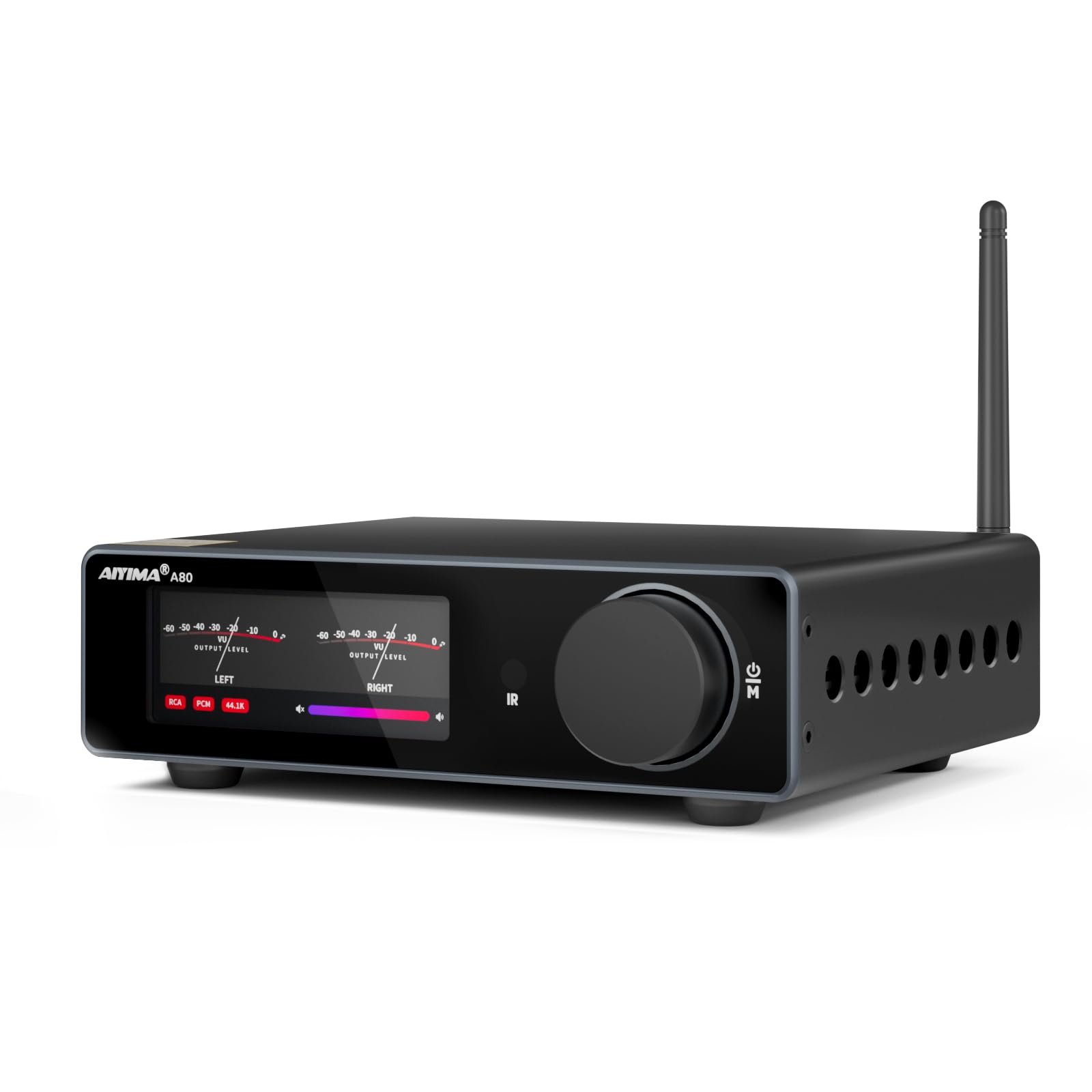
The AIYIMA A80 sits at the top of the budget category because it pairs an ESS ES9038Q2M DAC with the TPA3255 amplifier chip in a chassis no larger than a hardcover book. Owners report zero audible white noise and crystal-clear sound through optical and USB inputs, with the digital VU meter adding both function and retro aesthetic. The 48V GaN power supply keeps heat low even during extended listening at moderate volumes.
Connectivity covers nearly every modern source: PC-USB, coaxial, optical, TRS balanced inputs, and Bluetooth 5.0 that reviewers describe as indistinguishable from wired at 44kHz. The subwoofer pre-out allows seamless 2.1 setups without external crossovers. Many users note that the A80 outperforms receivers costing ten times as much in DAC accuracy and build feel.
One caveat: the amplifier runs hot enough that some owners with low-sensitivity speakers like the KEF Q150 found it underpowered at high volumes. For bookshelf speakers with sensitivity above 88dB, however, the A80 delivers exceptional clarity and headroom in small to medium rooms.
Why it’s great
- Reference-grade ES9038Q2M DAC with DSD512 support
- Built-in VU meter with multiple display modes
- Optical, coaxial, USB, and TRS balanced inputs
Good to know
- Capable but limited power for low-sensitivity speakers
- No dedicated subwoofer crossover control
- Runs warm during extended use
2. Dayton Audio HTA100 Integrated Stereo Hybrid Tube Amplifier

The Dayton Audio HTA100 delivers 50 watts RMS per channel from a hybrid Class A/B amplifier with vacuum tubes in the preamp stage. Owners consistently describe the sound as warm and musical with a relaxed top end that makes harsh digital recordings more enjoyable. The vintage VU meters and glowing tubes create a visual centerpiece while driving bookshelf and floor-standing speakers alike to satisfying volumes.
Connectivity includes RCA inputs, Bluetooth 5.0, a USB DAC, and a built-in phono preamp for turntables. Reviewers driving vintage Boston Acoustics CR8 speakers and Sony bookshelf models report ample headroom with no distortion even at uncomfortable listening levels. The front-panel headphone jack provides private listening through high-impedance headphones like the Beyerdynamic DT 880 Pro.
The included remote is sluggish and lacks backlighting, which annoys some users. The amplifier also runs warmer than typical Class-D units due to the A/B output stage. For listeners seeking tube warmth without the complexity of a separate preamp and power amp stack, this is the most approachable hybrid at the budget price point.
Why it’s great
- Vacuum tube preamp adds warm character to digital sources
- Built-in phono stage for turntables
- Classic VU meters with excellent build quality
Good to know
- Remote control feels underdeveloped
- Class A/B output runs significantly warmer than Class-D
- Limited to 50W RMS per channel
3. Fosi Audio BT20A Pro Bluetooth 5.0 Amplifier

The Fosi Audio BT20A Pro uses the Texas Instruments TPA3255 chip with PFFB feedback, delivering 300 watts per channel peak power in a palm-sized chassis that runs cool enough to tuck behind a monitor. Users consistently praise its clean, analytical sound with tight bass control and a SNR exceeding 108dB. The replaceable NE5532 op-amps let enthusiasts swap in LME49720HA or OPA2134PA chips to tailor the sound signature.
Bass and treble knobs provide basic tone shaping without adding noise, and Bluetooth 5.0 offers stable streaming with memory pairing. Reviewers driving vintage Cerwin-Vega RE speakers and modern bookshelf models note that the amp brings dead speakers back to life with surprising authority. At roughly the size of a paperback, it fits into desktop setups that lack space for traditional full-width receivers.
Banana plugs are essential for clean wiring — bare wire connections can be fiddly due to the compact binding posts. The 32V/5A power adapter is included, but some users recommend upgrading to a 48V supply for marginal headroom gains. For anyone wanting Class-D efficiency with audiophile-grade detail in a tiny footprint, this is the premier entry point.
Why it’s great
- Replaceable op-amps for customized sound tuning
- Ultra-compact size fits any desktop
- Clean 108dB SNR with 0.005% THD
Good to know
- Best results require banana plug connectors
- No built-in phono stage or DAC
- Limited gain for low-sensitivity floor-standing speakers
4. Cambridge Audio AXR100 FM/AM Stereo Receiver

The Cambridge Audio AXR100 delivers 100 watts RMS per channel with a warm, controlled sound signature that owners describe as ideal for long listening sessions without fatigue. The built-in DAC handles optical and coaxial digital inputs directly from TVs without needing external converters. The phono stage is clean and loud enough for moving magnet cartridges, making it a true all-in-one for vinyl and digital sources.
Dual A/B speaker outputs let you drive two separate pairs in different rooms or bi-wire compatible speakers. Owners driving Klipsch RP-600M and RF7 speakers report superb clarity across the frequency range with no fan noise — a common complaint in competing integrated receivers. The 200Hz fixed subwoofer crossover is a limitation for those wanting finer bass management, but it works well with most powered subs.
Bluetooth range is shorter than competing models, and the non-backlit remote feels cheap for the price tier. The AXR100 also lacks any USB audio input, so computer users need an external USB-to-optical adapter. For pure two-channel music in a living room or dedicated listening space, however, it stands as the most musical stereo receiver under .
Why it’s great
- True 100W RMS per channel with generous headroom
- Built-in DAC with optical and coaxial inputs
- Phono stage that satisfies turntable enthusiasts
Good to know
- Bluetooth range is limited and prone to dropouts
- Subwoofer crossover is fixed at 200Hz
- Remote control lacks backlighting
5. YAMAHA R-S202BL Stereo Receiver

The YAMAHA R-S202BL is the dependable workhorse of budget stereo receivers, offering 100 watts per channel into 8 ohms with a classic brushed aluminum faceplate. Owners praise its no-nonsense design with dedicated speaker selector for two systems and 40 station FM/AM presets. The Bluetooth 4.1 implementation is basic but functional for casual streaming, and the sound quality surprises listeners who expect harshness at this price tier.
Reviewers driving vintage Large Advents and modern Klipsch KX12 speakers report clean power that fills a room without distortion. The frequency response extends from 10Hz to 100kHz, providing headroom for high-resolution sources. The remote control is simple and intuitive, and the auto-power standby function saves energy when not in use.
Some audiophiles find the sound lacks the fullness and warmth of more expensive receivers, and the Bluetooth spec is outdated compared to newer competitors. The lack of optical or coaxial digital inputs means TV integration requires a separate DAC or 3.5mm-to-RCA adapter. For a straightforward, reliable two-channel receiver with a brand you trust for decades of use, this remains a solid bet.
Why it’s great
- Proven Yamaha build quality with reliable long-term performance
- Speaker selector switches between two pairs
- Excellent FM/AM tuner with 40 station presets
Good to know
- Bluetooth 4.1 lacks modern codec support
- No digital audio inputs (optical/coaxial)
- Sound profile leans neutral without tube-like warmth
6. Sony STRDH190 2-ch Stereo Receiver Bundle

The Sony STRDH190 is a classic two-channel receiver with a built-in phono preamp for turntables and Bluetooth connectivity that supports standby power-on from your paired device. This bundle includes 50 feet of 14AWG speaker wire and five pairs of gold-plated banana plugs, saving you the hassle of sourcing separate accessories. The large-capacity power transformer is designed for high-resolution audio playback at 100 watts per channel.
Owners pairing it with Klipsch RP-600M speakers and Denon turntables report satisfying sound with adjustable bass and treble controls that work well for old records with varying recording quality. The four analog audio inputs accommodate CD players, tape decks, and other legacy gear, while the single audio output lets you record to an external device. The Bluetooth connection pairs instantly and maintains stable streaming throughout a typical home.
The FM radio uses a proprietary antenna connector that cannot directly accept standard coaxial cables for roof antennas. Some listeners find the sound less refined than pricier options, but the bundle value and proven Sony reliability make this a strong entry-level package for anyone building a first turntable-to-speaker system.
Why it’s great
- Bundle includes speaker wire and banana plugs for immediate setup
- Built-in phono preamp for vinyl enthusiasts
- Bluetooth standby turns on receiver from paired device
Good to know
- FM antenna connector is proprietary and limits outdoor antenna use
- No digital inputs (optical/coaxial)
- Sound quality is good but not audiophile-grade
7. Pioneer VSX-935 7.2 Channel Network Receiver
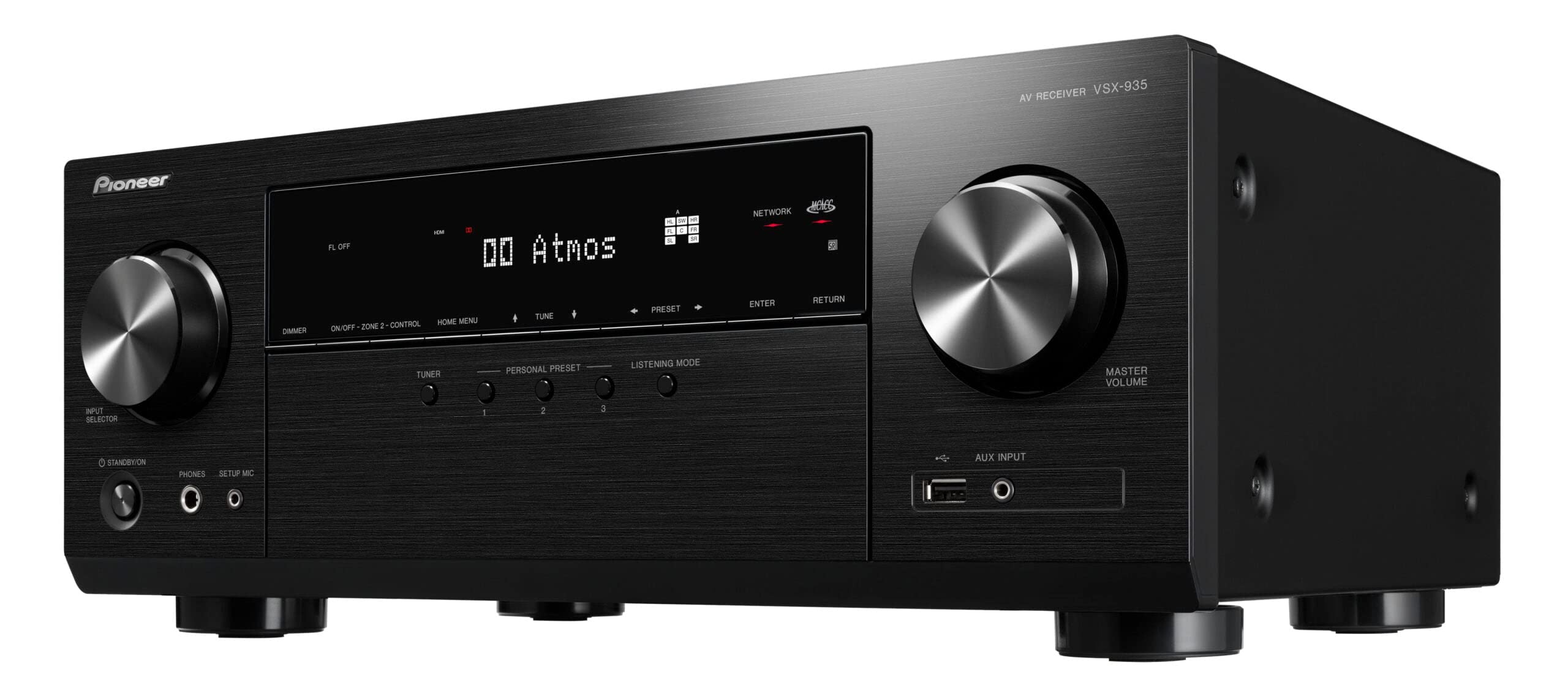
The Pioneer VSX-935 brings Dolby Atmos and HDMI 2.1 with 8K passthrough to a 7.2-channel surround receiver that fits a home theater budget. It supports Dolby Atmos Height Virtualization, which creates a simulated height effect without dedicated ceiling speakers — useful for rooms where overhead installation isn’t feasible. The built-in Wi-Fi and Ethernet expand streaming possibilities beyond Bluetooth.
Owners report excellent movie sound quality with crisp dialogue and immersive surround effects. The dual subwoofer outputs allow more even bass distribution in large rooms. The included calibration microphone helps tune speaker levels and delay for your specific room geometry, reducing the guesswork that plagues manual setups.
Firmware updates require USB transfer rather than over-the-air, which some users find cumbersome. A small number of owners experienced HDMI handshake issues with computers and needed to troubleshoot video output. For a dedicated home theater room with a 5.1.2 or 7.1 layout, the VSX-935 delivers modern features at a fraction of flagship prices.
Why it’s great
- Dolby Atmos Height Virtualization without ceiling speakers
- HDMI 2.1 with 8K passthrough for modern gaming consoles
- Dual subwoofer outputs for even bass response
Good to know
- Firmware updates require USB storage drive
- Some HDMI handshake issues reported with PC sources
- Setup complexity is higher than stereo receivers
8. Pyle Home Stereo Receiver with Bluetooth PDA77BU

The Pyle PDA77BU is a 4-channel, 800-watt peak amplifier built for versatility — not just music playback but also karaoke nights with dual 1/4-inch microphone jacks featuring independent volume, reverb, and delay controls. The digital LED display and front-panel control center make it easy to adjust settings without navigating complex menus. Bluetooth 5.0 streaming works reliably up to 30 feet, and the USB input plays MP3 files directly from flash drives.
Owners have successfully connected four speakers, a turntable, and Bluetooth sources simultaneously in home office and garage setups. The FM radio tuner with digital search provides additional free music options. Reviewers note that the amplifier sounds loud enough for workshop or outdoor use, and the included remote allows control from across the room.
Bluetooth reconnection to smart TVs sometimes requires manual pairing, and the bass depth depends heavily on the quality of connected speakers. At its core, this is a multipurpose receiver that prioritizes flexibility and karaoke features over pure audio fidelity — ideal for parties and casual listening rather than critical audiophile sessions.
Why it’s great
- Dual mic inputs with independent reverb and echo controls
- FM radio and USB/SD card playback for offline music
- Front-panel LED display simplifies adjustments
Good to know
- Bluetooth reconnection with some TVs requires manual repair
- Sound quality is serviceable but not audiophile-class
- Peak power rating does not reflect sustained output
9. Donner 1000W Peak Power 4 Channel Amplifier

The Donner 1000W receiver packs 4 channels (25W RMS per channel) supporting up to 8 speakers in parallel, with optical and coaxial digital inputs that directly connect to modern TVs. The multiband EQ lets you independently adjust treble, midrange, and bass from both the unit and the remote — a feature rare at this tier. Bluetooth 5.0 and dual microphone jacks with echo control make it a viable karaoke or party machine.
Owners in garage and outdoor spaces report great sound quality and plenty of volume for casual listening. The remote controls all EQ settings in any input mode, allowing adjustments from across the room. The Talk Over function automatically lowers background music during microphone use, useful for announcements or hosting events.
The FM radio tuning interface is unintuitive, and some units have experienced failure within months. The Bluetooth range is limited to roughly 10 feet, which may require strategic placement or a Bluetooth extender. For budget-conscious buyers who prioritize channel count, digital inputs, and microphone features over long-term durability, this offers the most features per dollar.
Why it’s great
- Optical and coaxial digital inputs for TV integration
- Independent treble, midrange, and bass EQ control
- Talk Over function for clear microphone output
Good to know
- Short Bluetooth range limits placement flexibility
- FM tuning interface is confusing
- Some reliability concerns reported after months of use
FAQ
Can a budget receiver drive 4-ohm speakers safely?
Do I need a separate DAC with a budget receiver?
How important is Bluetooth version in a receiver?
What does a phono input do and do I need it?
Final Thoughts: The Verdict
For most users, the budget audio receiver winner is the Fosi Audio BT20A Pro because it delivers reference-grade TPA3255 Class-D performance with replaceable op-amps at a price that leaves room for better speakers. If you want warm tube character and a built-in phono stage, grab the Dayton Audio HTA100. And for a full-featured home theater setup with Dolby Atmos and HDMI 2.1, nothing beats the Pioneer VSX-935 at this tier.

Mo Maruf
I created WellFizz to bridge the gap between vague wellness advice and actionable solutions. My mission is simple: to decode the research and give you practical tools you can actually use.
Beyond the data, I am a passionate traveler. I believe that stepping away from the screen to explore new environments is essential for mental clarity and physical vitality.