Our readers keep the lights on and my smoothie glass nicely filled. As an Amazon Associate, I earn from qualifying purchases.
Tap water arrives with a cocktail of chlorine, scale, heavy metals, and sometimes forever chemicals, but you don’t need a plumbing overhaul to fix it. A countertop water filter is the fastest, cheapest way to shift from metallic-tasting tap to clean, crisp hydration, yet most budget units barely skim the surface of what they claim to remove.
I’m Mohammad Maruf — the founder and writer behind WellFizz. My research focuses on filter media efficiency, certification depth, and long-term cost-per-gallon across consumer-grade water treatment systems.
After analyzing TDS reduction, filter longevity, and contaminant certifications across five very different designs, I’ve found the real best budget water filter that actually delivers clean water without burning through replacement cartridges every three weeks.
How To Choose The Best Budget Water Filter
A budget water filter should reduce chlorine taste, sediment, and heavy metals without breaking you on replacement cartridges. The trick is matching filter technology to your specific tap water chemistry and your household volume.
Filter Stages vs. Real Contaminant Removal
More stages don’t automatically mean better water. A true 5-stage system uses mechanical sediment screening, activated carbon, and ion exchange resin to strip dissolved solids. Standard carbon-block filters (common in entry-level pitchers) only tackle taste and odor. If your water has high TDS — above 200 ppm — you need ion exchange, not just carbon.
Filter Longevity and Annual Cost
The cheapest pitcher can become the most expensive if its filters need changing every two weeks under high sediment load. Check the rated gallon capacity (40 gallons per Brita standard filter vs. 20 gallons on a ZeroWater filter at moderate TDS). Calculate annual cartridge cost before buying — a unit that demands in yearly replacements is no bargain.
Faucet Compatibility and Flow Rate
Faucet-mounted filters save counter space but require removable aerators and standard threading. Pitchers slow down your pour but work with any kitchen setup. If you fill half-gallon bottles daily, a pitcher with a 10-cup reservoir flows faster than most faucet units at 0.18 liters per minute.
Quick Comparison
On smaller screens, swipe sideways to see the full table.
| Model | Category | Best For | Key Spec | Amazon |
|---|---|---|---|---|
| ZeroWater 22-Cup | 5-Stage Pitcher | Ultra-pure water from high-TDS tap | TDS reading drops to 0 ppm | Amazon |
| Culligan ZeroWater 10-Cup | 5-Stage Pitcher | Small households needing pure water | Built-in TDS meter | Amazon |
| Brita Large 10-Cup Pitcher | Carbon Filter Pitcher | Improving taste of decent tap water | 10-cup reservoir, 40-gal filter | Amazon |
| IVO Faucet Filter | Faucet Mount | Counter-space savers with standard faucets | 4-stage hollow fiber membrane | Amazon |
| Brita Standard Filters (6-Pack) | Replacement Filters | Existing Brita owners stocking up | 2-month / 40-gallon filter life | Amazon |
In‑Depth Reviews
1. ZeroWater 22-Cup 5-Stage Water Filter Dispenser
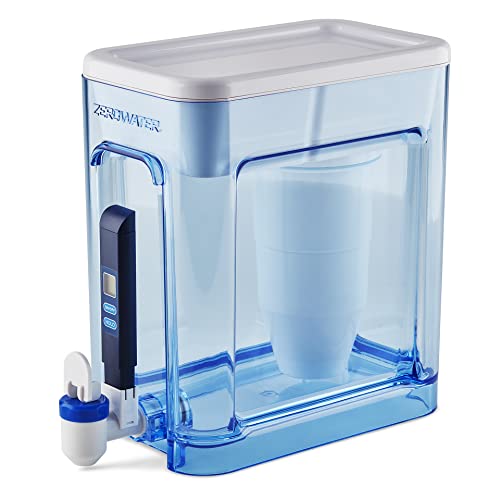
This 22-cup dispenser uses five stages of filtration — coarse screen, foam distributor, activated carbon, and dual ion-exchange layers — to strip virtually all total dissolved solids. In customer tests, Arizona tap water at 500 ppm TDS came out below 3 ppm, a result no carbon-block pitcher can touch. The integrated TDS meter reads the filtered water instantly, so you always know when the filter is exhausted. The 5.2-liter capacity means fewer refills for a family, and the BPA-free plastic body holds up to daily use.
Water from this unit tastes noticeably flat because it removes beneficial minerals along with contaminants. Many users add mineral drops to restore the mouthfeel of spring water. Filtration is slower than a standard Brita due to the dense ion-exchange resin, and the sliding hatch on the lid makes refilling easy without fully removing the top. The spout pours cleanly without the drips reported on smaller ZeroWater models.
Filter life is the real cost to watch. At moderate TDS (150–300 ppm), a cartridge lasts roughly 3–4 weeks for a couple drinking primarily filtered water. At higher TDS, annual replacement costs can approach –400. For very hard water this is still the most effective budget filter, but treat it as a drinking-water-only tool and use tap for cooking to stretch filter life.
Why it’s great
- True 0 ppm TDS output — unmatched at this price tier
- Built-in TDS meter eliminates guesswork about filter end-of-life
- 22-cup capacity suits families and frequent fillers
Good to know
- Filters last 3–4 weeks at moderate TDS, driving up annual cartridge costs significantly
- Removes beneficial minerals; water tastes flat without mineral drops
- Slow flow rate due to dense ion-exchange media
2. Culligan with ZeroWater Technology 10-Cup Pitcher
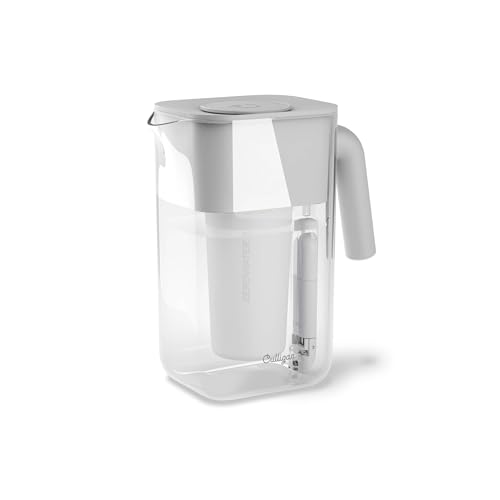
Culligan licensed ZeroWater’s 5-stage technology for this 10-cup pitcher, which means it removes 99.9% of dissolved solids just like the larger dispenser — including lead, PFAS, mercury, and chlorine. IAPMO certification backs the claims, and the built-in TDS meter provides real-time feedback. The compact design (9.5 x 5 x 10.5 inches) fits easily into small refrigerators or sits neatly on a counter, and the concave lid funnels water directly into the filter chamber.
The ergonomic handle balances well even when the pitcher is full, reducing wrist strain during pours. Filter speed is reasonable for a 5-stage unit, though noticeably slower than standard carbon pitchers. The removable TDS meter runs on a small battery; some users reported corrosion when water pooled near the meter compartment. Drying the area after refills prevents this issue. The 80-ounce capacity serves a household of 3 without constant trips to the sink.
Replacement filters cost roughly the same as ZeroWater-branded cartridges, so annual operating expense mirrors the larger unit. For a single person or couple with moderate TDS tap water, the smaller reservoir makes this a more economical entry point. The spout delivers water cleanly without the spilling issues noted on the ZeroWater dispenser design, making this a slightly more polished daily driver at the same per-filter cost.
Why it’s great
- True 5-stage ZeroWater filtration in a more compact, fridge-friendly form factor
- IAPMO certified for PFAS, lead, and mercury reduction
- Ergonomic handle and clean-pour spout improve daily usability
Good to know
- Battery compartment near water can corrode if left wet
- Same high replacement-filter cost as ZeroWater brand
- Removes beneficial minerals; water lacks natural mineral taste
3. Brita Large 10-Cup Water Filter Pitcher
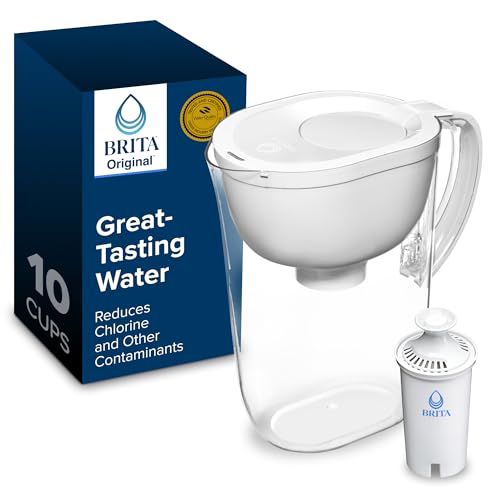
Brita’s 10-cup Everyday pitcher uses activated carbon to reduce chlorine taste, odor, zinc, copper, cadmium, and mercury. It is WQA/NSF certified to those claims and fits neatly on refrigerator shelves thanks to its 10.7 x 5.4 x 10.1-inch footprint. The easy-fill locking lid prevents spills during refilling, and the rounded handle makes pouring comfortable even when the container is full. Each included Standard filter lasts 40 gallons or roughly two months.
Coffee drinkers will notice the biggest improvement — tap water filtered through this pitcher removes the chemical aftertaste that dulls brewed coffee flavor. The flip lid lets you fill without removing it entirely, though the reservoir opening is narrow enough that you need a steady stream from the faucet. Filtration speed is fast compared to 5-stage units; you can fill the reservoir and have filtered water ready within a couple of minutes.
This is not the filter for high-TDS tap water. Hard water with TDS above 200 ppm will pass through carbon with minimal dissolved-solids reduction. If your municipal water already tastes decent but has chlorine or copper, Brita is the most cost-effective solution. The annual filter cost runs about –40, making it far cheaper to maintain than ion-exchange alternatives.
Why it’s great
- Very low annual filter cost — roughly for two replacements per year
- NSF certified for chlorine, copper, cadmium, and mercury reduction
- Fast flow rate means filtered water ready in under two minutes
Good to know
- Does not reduce TDS, so high-mineral tap stays hard
- Not certified for PFAS or lead at the levels ion-exchange filters handle
- Plastic construction can crack if dropped
4. IVO Water Filter for Sink Faucet

IVO attaches directly to standard kitchen faucets (removable aerator required) and uses medical-grade hollow fiber membrane technology from Toray Industries, Japan. The four-stage process screens out chlorine, rust, sediments, turbidity, and microscopic contaminants down to 0.1 microns while leaving healthy minerals intact. This is the only filter in this lineup that retains calcium and magnesium, so TDS readings do not change — minerals stay in the water.
A simple lever switches between filtered spray, unfiltered straight flow, and unfiltered spray, making it easy to wash dishes without running water through the filter cartridge. The unfiltered spray pattern covers a wider area and can reduce water consumption by up to 30%. Installation requires matching the included adapters to your faucet threads; some pull-down or retractable faucets are incompatible, so check compatibility before buying. Each cartridge lasts about 4 months or 1,500 liters.
The trade-off is flow rate. Filtered water comes out slower than unfiltered tap, and filling a 16-ounce bottle takes noticeable patience. Refill cartridges cost about for a three-pack, placing annual cost around –60 — roughly the middle of the pack. For renters who cannot install under-sink systems and want mineral retention, this faucet filter provides the most flexible form factor without sacrificing counter space.
Why it’s great
- Retains beneficial minerals while filtering down to 0.1 microns
- Three-way lever switches between filtered and unfiltered spray
- Compact design frees up counter space completely
Good to know
- Slow flow rate in filtered mode; requires patience for filling bottles
- Only fits faucets with removable aerators — check compatibility
- No built-in filter change indicator; need to track usage yourself
5. Brita Standard Replacement Filters (6-Pack)
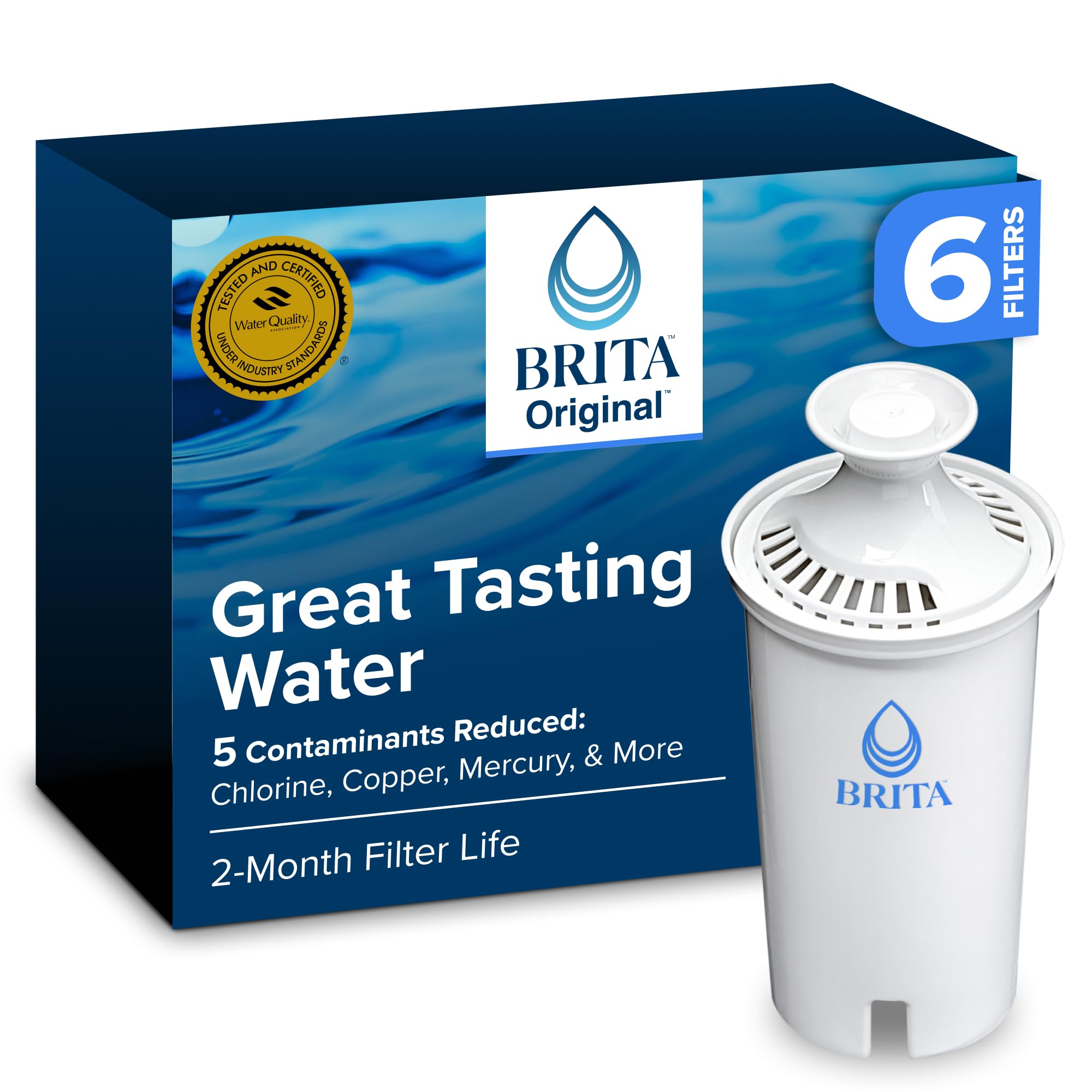
This six-pack of Brita Standard filters is the most cost-effective way to maintain an existing Brita pitcher or dispenser. Each filter lasts two months or 40 gallons, and the bundle covers a full year of replacements for most households. The activated carbon media reduces chlorine taste and odor, plus copper, cadmium, and mercury — the same contaminant reduction profile as the included filter that ships with Brita pitchers.
Installation requires no presoak — just rinse under cold water for 15 seconds, snap into the reservoir, and run two full pitchers through before drinking. The filters are compatible with all Brita pitchers and dispensers except the Stream model. Filtration speed is consistent across the lifespan, though some users report slight slowing in the final week before replacement. The six-pack packaging includes individual wrappers that keep spare filters fresh for storage.
This is strictly a taste-and-odor improvement tool, not a heavy-metal or PFAS solution. If your tap water has moderate sediment or high TDS, the carbon block will not address those issues. For the majority of municipal water drinkers who simply want chlorine-free water that tastes clean, this six-pack keeps annual operating costs under . Pair with the Brita Large 10-Cup pitcher (above) for a complete system that costs about total for the first year.
Why it’s great
- Six-pack covers a full year of replacements for most households
- Simple installation with no presoak required
- Very low annual operating cost compared to ion-exchange filters
Good to know
- Does not reduce TDS, PFAS, or significant levels of heavy metals
- Not compatible with Brita Stream systems
- Some flow reduction near end of filter life
FAQ
Will a budget water filter remove lead and PFAS from my tap water?
How often should I replace a budget water filter cartridge?
Is zero TDS water safe to drink every day?
Final Thoughts: The Verdict
For most users, the best budget water filter winner is the ZeroWater 22-Cup Dispenser because it delivers true 0 ppm TDS output at the lowest entry price point, making it the most effective option for high-sediment or hard water. If you want a smaller footprint with the same filtration power, grab the Culligan ZeroWater 10-Cup Pitcher. And for families with good municipal water who just want chlorine-free taste at minimal cost, nothing beats the Brita Large 10-Cup Pitcher combined with the Standard Filter 6-Pack.

Mo Maruf
I created WellFizz to bridge the gap between vague wellness advice and actionable solutions. My mission is simple: to decode the research and give you practical tools you can actually use.
Beyond the data, I am a passionate traveler. I believe that stepping away from the screen to explore new environments is essential for mental clarity and physical vitality.