Our readers keep the lights on and my smoothie glass nicely filled. As an Amazon Associate, I earn from qualifying purchases.
The brain of a high-end home theater does more than switch inputs. An AV processor decodes Dolby Atmos and DTS:X object-based audio, applies precision room correction via Dirac Live or YPAO, and routes pristine digital signals to external amplifiers. The difference between a muddy soundstage and a holographic one often comes down to the quality of the DACs and the calibration algorithm inside that central chassis.
I’m Mohammad Maruf — the founder and writer behind WellFizz. Over the last decade and a half, I have analyzed hundreds of surround sound components, comparing DAC architectures, channel counts, HDMI 2.1 compliance, and room correction outcomes to separate true reference-grade hardware from marketing claims.
This guide covers thirteen models that span from capable mid-range receivers used as processors to flagship separates. Whether you need 11.2 channels of ESS Sabre processing or Dirac Live Bass Control for dual subs, you will find a clear winner for your system after reading this review of the best av processor options available today.
How To Choose The Best AV Processor
Selecting a processor or preamplifier for your home theater is a decision about future-proofing, channel count, and sonic character. The wrong choice can leave you with limited upgrade paths or a sound signature that fatigues your ears over long listening sessions. Focus on these three pillars before making a purchase.
Channel Count and Processing Flexibility
Every processor lists a channel capacity — 7.2, 9.2, 11.2, or 13.2 — but the real question is whether the unit can process more channels than it amplifies internally. A model like the Onkyo TX-RZ50 processes 11.2 channels but amplifies only 9, meaning you need an external two-channel amp to run a full 7.2.4 layout. Higher-end units like the Yamaha RX-A8A or Sony STRAZ7000ES process and amplify 11 or 13 channels respectively, eliminating that extra box. Count your intended speaker positions (including overhead Atmos modules) and verify the processor’s pre-outs match or exceed that number.
Room Correction Quality
Room acoustics dominate what you hear far more than amplifier wattage. Dirac Live Full Bandwidth, available on the Onkyo TX-RZ70, measures your space with high-resolution filters and corrects both amplitude and phase across the entire frequency range. YPAO R.S.C. with 3D on Yamaha Aventage models uses multipoint measurement and a dedicated low-frequency mode to tighten bass. Audyssey MultEQ XT32 on Marantz units offers deep subwoofer EQ but requires the paid app for full manual control. Prioritize software that allows independent subwoofer calibration, especially if you run dual subs.
Digital to Analog Converter Architecture
The DAC stage determines how much detail and texture reaches your speakers. ESS Sabre 32-bit DACs, found in the Onkyo TX-RZ70, deliver low noise floors and excellent channel separation, making them ideal for critical listening. Yamaha’s Aventage line uses proprietary ESS ES9026PRO chips in the A6A and A8A, which handle high-resolution audio up to 384 kHz. Marantz leverages its HDAM (Hyper Dynamic Amplifier Module) discrete circuitry for a warmer, more musical presentation. If you stream high-resolution files or listen to vinyl through a phono stage, the DAC quality becomes a primary deciding factor.
Quick Comparison
On smaller screens, swipe sideways to see the full table.
| Model | Category | Best For | Key Spec | Amazon |
|---|---|---|---|---|
| Onkyo TX-RZ70 | AV Receiver | Reference 7.2.4 with Dirac | 11.2 ch, ESS Sabre DACs, 140W | Amazon |
| Yamaha RX-A8A | AV Receiver | 11.2 ch Auro-3D & MusicCast | 11.2 ch, 150W, YPAO R.S.C. 3D | Amazon |
| Onkyo TX-RZ50 | AV Receiver | Best value 7.2.4 with Dirac | 9.2 ch amp, 11.2 ch processing | Amazon |
| Marantz Cinema 60 | AV Receiver | Musical sound with HEOS | 7.2 ch, 100W, Audyssey XT32 | Amazon |
| Yamaha RX-A6A | AV Receiver | 9.2 ch + 11.2 processing | 9.2 ch, 150W, Auro-3D | Amazon |
| Sony STRAZ7000ES | AV Receiver | 13.2 ch 360 Spatial Sound | 13.2 ch, 150W, DCAC IX | Amazon |
| Marantz SR8015 | AV Receiver | 11.2 ch flagship warmth | 11.2 ch, 140W, HDAM | Amazon |
| Sony STRAZ5000ES | AV Receiver | 11.2 ch with 360SSM | 11.2 ch, 130W, DCAC IX | Amazon |
| Yamaha RX-A4A | AV Receiver | 7.2 ch with Surround:AI | 7.2 ch, 110W, YPAO R.S.C. | Amazon |
| Onkyo TX-RZ30 | AV Receiver | 9.2 ch bundle with Klipsch | 9.2 ch, 170W, Dirac Live | Amazon |
| OSD Audio Nero HTA5200 | Power Amp | External 5-ch amplification | 5x210W, Class AB, XLR | Amazon |
| Sony STR-AN1000 | AV Receiver | Entry-level 7.2 with 360SSM | 7.2 ch, 165W, DCAC IX | Amazon |
| Yamaha RX-A2A | AV Receiver | Budget 7.2 with 8K | 7.2 ch, 100W, YPAO R.S.C. | Amazon |
In‑Depth Reviews
1. Onkyo TX-RZ70 11.2-Channel AV Receiver
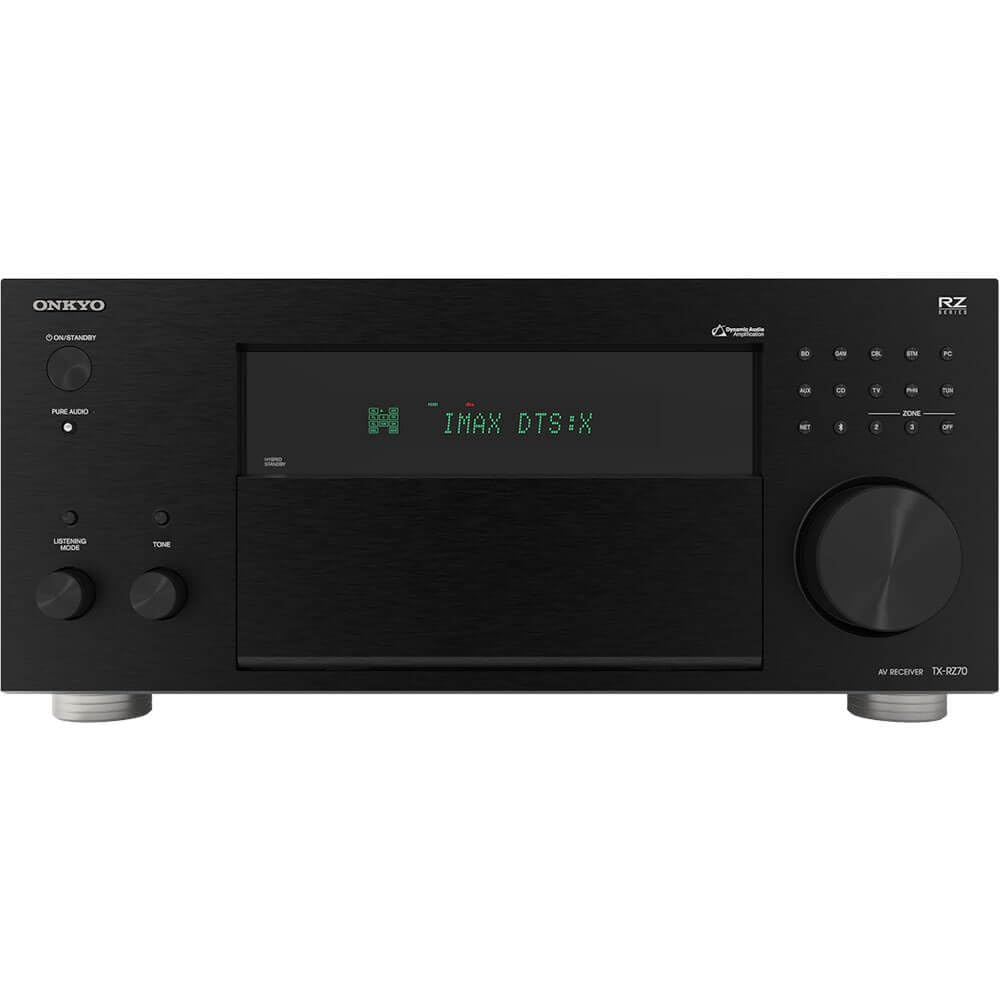
The Onkyo TX-RZ70 sits at the intersection of premium DAC topology and powerful room correction. Its ESS Sabre 32-bit DAC array delivers a noise floor low enough to reveal micro-details in film scores and high-resolution stereo tracks. Rated at 140 watts per channel across 11 channels, this receiver drives demanding floor-standing speakers without breaking a sweat, and it includes the full-bandwidth version of Dirac Live out of the box — no paid upgrade required for precision bass and phase correction.
THX Certification ensures the pre-amp section adds nothing and removes nothing from the source, making it a transparent processor for an external amplifier system. The unit supports HDMI 2.1 with 4K/120 and 8K/60 passthrough, VRR, and ALLM, so gamers benefit from the same low-latency path as movie enthusiasts. Dual subwoofer pre-outs allow independent level adjustment, a critical feature for smoothing room modes in larger spaces.
Owners consistently report that the TX-RZ70 runs cooler than previous Onkyo flagships, and the 57-pound chassis includes reinforced bracing to reduce vibration. The minor annoyance is a remote control that feels cheap compared to the build quality of the unit itself. For anyone building a 7.2.4 system with an eye on future separates, this is the benchmark receiver-processor hybrid under the five-thousand-dollar line.
Why it’s great
- ESS Sabre DACs produce exceptional clarity and channel separation for Atmos and high-resolution audio.
- Dirac Live Full Bandwidth included at no extra cost, with optional Bass Control upgrade for dual subs.
- THX Certified Select ensures no coloration from the processing stage.
Good to know
- The bundled remote control lacks the tactile quality expected at this price tier.
- Physical dimensions are large (24 inches deep) — verify cabinet depth before purchase.
2. Yamaha RX-A8A AVENTAGE 11.2-Channel AV Receiver

The Yamaha RX-A8A is the top of the Aventage line, offering 11.2 channels of processing and amplification with support for Dolby Atmos, DTS:X, and Auro-3D in a single chassis. Its ESS ES9026PRO DAC handles 384 kHz/32-bit resolution, giving it the headroom for studio-mastered soundtracks. The Surround:AI engine analyzes audio scenes in real time and adjusts the frequency balance and surround effects to emphasize dialogue during quiet moments or expand the soundstage during action sequences.
YPAO R.S.C. with 3D multipoint measurement uses a supplied microphone to take readings at multiple listening positions, then applies precision EQ and low-frequency mode to tighten the bass response. The receiver includes seven HDMI inputs with full 40 Gbps support for 4K/120 and 8K/60, plus VRR and ALLM for gaming. A built-in phono input and Roon Tested certification make it equally suited for two-channel music systems.
Critics point out that the MusicCast app lags behind competitors in usability, though the core streaming functionality works reliably once configured. The unit weighs 53.9 pounds and includes a backlit remote that illuminates when picked up. Enthusiasts praise the RX-A8A for its punchy mid-bass and the way its YPAO calibration integrates dual subwoofers without phase cancellation. It is the best choice for listeners who want one box that serves both multichannel cinema and critical stereo listening.
Why it’s great
- ESS ES9026PRO DAC delivers studio-grade detail retrieval for high-resolution audio and vinyl playback.
- Auro-3D decoding plus Surround:AI make it uniquely flexible for both object-based and legacy content.
- Independent subwoofer adjustment via YPAO improves bass coherence in rooms with standing-wave issues.
Good to know
- MusicCast app interface is less intuitive than HEOS or Sony’s Music Center.
- Firmware updates require a USB drive — the unit does not update reliably over Wi-Fi.
3. Onkyo TX-RZ50 9.2-Channel AV Receiver

The Onkyo TX-RZ50 broke new ground by bringing Dirac Live room correction to the sub-fifteen-hundred-dollar price tier. It amplifies nine channels natively but processes up to 11.2, meaning you need a two-channel external amplifier to unlock a 7.2.4 layout. The unit is THX Certified Select, guaranteeing transparent signal handling across all inputs. Klipsch Optimize Mode automatically applies the correct crossover values when paired with Klipsch Reference or Reference Premiere speakers.
HDMI 2.1 support includes 4K/120, 8K/60, VRR, and ALLM, making it fully compatible with the latest gaming consoles. Dual subwoofer pre-outs are included, though they share a single mono signal — independent level adjustment requires manual volume matching or an external minidsp. Owners note that the receiver runs quietly and drives dynamic speakers with authority, producing a warm and rounded sound signature after Dirac calibration.
The primary trade-off is build quality compared to the TX-RZ70: the chassis is lighter and lacks the deeper vibration damping of its bigger sibling. HDMI switching takes about 12 to 15 seconds, which some users find slow when switching between sources. Nevertheless, for anyone building a serious 5.2.4 or 7.2.4 system on a budget, the TX-RZ50 remains the strongest price-to-performance pick in the Onkyo lineup.
Why it’s great
- Dirac Live room correction included at this price point dramatically improves bass accuracy and soundstage focus.
- 11.2 channel processing capacity provides a clear upgrade path to 7.2.4 with an external amplifier.
- Klipsch Optimize Mode saves time for owners of Klipsch Reference speakers by setting ideal crossovers automatically.
Good to know
- HDMI input switching has a noticeable lag of 12 to 15 seconds.
- Dual subwoofer outputs are not independently configurable — they share a single channel.
4. Marantz Cinema 60 7.2-Channel AV Receiver

The Marantz Cinema 60 brings the brand’s signature warm signature and HDAM discrete circuitry to a 7.2-channel package. Rated at 100 watts per channel, it is designed for smaller to medium-sized rooms where a 5.1.2 or 7.1 system needs musicality more than raw headroom. Audyssey MultEQ XT32 handles room correction with deep subwoofer EQ filters, and the paid MultEQ Editor app lets you tweak target curves by hand — a feature demanded by critical listeners.
HEOS built-in enables multi-room streaming with support for Spotify, TIDAL, and Amazon Music HD, plus voice control via Alexa, Google Assistant, and Siri. The receiver includes six HDMI inputs with three supporting 8K/60, Dolby Vision, HDR10+, and HDCP 2.3. A phono input with a built-in preamp is included, eliminating the need for an external phono stage for turntable users.
Owners who upgrade from older receivers consistently report clearer dialogue and a more relaxed, less fatiguing treble response compared to other brands in the same bracket. The unit runs moderately warm and requires at least three inches of clearance above the chassis. For listeners who prioritize two-channel music performance alongside home theater duties, the Cinema 60 provides a balanced, detailed presentation that few competitors at this power level can match.
Why it’s great
- HDAM discrete circuitry gives the Cinema 60 a warmer, more musical character ideal for stereo and vinyl playback.
- Audyssey MultEQ XT32 with the Editor app allows granular control over subwoofer target curves.
- Full HEOS multi-room streaming with high-resolution file support.
Good to know
- Rated at 100 watts per channel — may lack headroom for very inefficient speakers in large rooms.
- No Auro-3D support; limited to Dolby Atmos and DTS:X object-based formats.
5. Yamaha RX-A6A AVENTAGE 9.2-Channel AV Receiver

The Yamaha RX-A6A offers nine channels of amplification and processes 11.2, making it a natural fit for a 7.2.4 setup with an external stereo amplifier. It includes Auro-3D in addition to Dolby Atmos and DTS:X, giving you access to the three-dimensional soundstage used in many European cinema mixes. The ESS DACs deliver clean separation across all channels, and Surround:AI continues to be one of the most effective automated DSP engines for dynamic content.
Seven HDMI inputs all support 8K60 and 4K120 with 40 Gbps throughput, and the unit handles Dolby Vision, HDR10+, and HLG without any issues. YPAO R.S.C. with 3D and Precision EQ offers one of the more refined auto-calibration systems in the market, especially for rooms with irregular shapes or reflective surfaces. The RX-A6A includes Zone 2, Zone 3, and Zone 4 pre-outs for whole-home audio distribution via MusicCast.
Users frequently mention that the setup process is more involved than competing brands, requiring patience during the firmware update and speaker configuration steps. The on-screen display is text-heavy and the MusicCast app could be more intuitive. Once configured, however, the receiver produces a dynamic, detailed sound that rivals separates systems costing significantly more. It is the best mid-point in the Aventage lineup for buyers who want more than 7 channels without jumping to the flagship.
Why it’s great
- 11.2 channel processing capacity with 9 channels of built-in amplification for flexible 7.2.4 setups.
- Auro-3D support alongside Dolby Atmos and DTS:X gives access to the broadest library of immersive audio content.
- YPAO R.S.C. 3D with Precision EQ delivers accurate multipoint calibration for irregular rooms.
Good to know
- Setup process is more involved than Onkyo or Marantz units — budget extra time for initial configuration.
- MusicCast app interface lags behind HEOS and Sony Music Center in responsiveness and clarity.
6. Sony STRAZ7000ES Premium ES 13.2 CH 8K A/V Receiver

The Sony STRAZ7000ES is the most powerful home theater receiver in Sony’s history, processing 13.2 channels with 150 watts per channel into 8 ohms. It uses Sony’s Digital Cinema Auto Calibration IX and 360 Spatial Sound Mapping to create virtual phantom speakers that fill gaps in the surround field, making a 5.1.2 setup sound remarkably like a 7.1.4 system. For owners limited by room geometry, this technology is genuinely transformative.
HDMI 2.1 connectivity with 4K/120 and 8K/60 passthrough is standard, and the unit supports Dolby Vision, HDR10, HLG, and IMAX Enhanced. It lacks HDR10+ and QMS, but Sony’s processing pipeline compensates with excellent tone mapping and motion handling. The receiver is optimized for custom integration with IP control and works seamlessly with Sonos, Google Assistant, and major control systems like Control4.
The chassis runs hot — owners universally recommend active cooling via an AC Infinity Aircom T10. Build quality is exceptional, with a front cover plate, backlit remote, and a replaceable power cord. The 360 Spatial Sound Mapping is the standout feature, creating a convincing overhead soundstage without physical height speakers. For buyers who want the largest channel count and the most advanced virtual processing in a single box, the STRAZ7000ES is the undisputed flagship.
Why it’s great
- 13.2 channel processing gives you the most speaker positions available in a single consumer receiver.
- 360 Spatial Sound Mapping creates convincing virtual height effects without physical ceiling speakers.
- Replaceable power cord and robust IP control make it ideal for custom installations.
Good to know
- Runs hot during prolonged listening sessions — supplemental cooling is strongly advised.
- No HDR10+ or QMS support, which may matter for users with Samsung displays or 4K/120 projectors.
7. Marantz SR8015 11.2 Channel AV Receiver

The Marantz SR8015 was the brand’s 2020 flagship, and it remains a formidable 11.2-channel processor-amplifier for buyers willing to buy a previous-generation model at a significant discount. Rated at 140 watts per channel, it drives all 11 channels simultaneously with the Marantz HDAM current feedback stage that produces a warm, detailed sound. It supports Dolby Atmos, DTS:X, and DTS Virtual:X, plus HEOS multi-room streaming.
HDMI connectivity includes 8K/60 and 4K/120 passthrough with Dolby Vision, HDR10+, and HLG support. The SR8015 includes seven HDMI inputs and three outputs, along with an extensive array of analog and digital inputs including a phono stage. Audyssey MultEQ XT32 handles room correction, though the receiver does not include the paid app for manual tweaking. Subwoofers default to off and must be enabled via the on-screen menu — a quirk that catches many first-time users.
Owners consistently note that the SR8015 runs cooler than earlier Marantz flagships, requiring only standard ventilation rather than an external fan. The remote control, however, is widely criticized as cheap-feeling and occasionally unresponsive. With 11 driven channels, HDAM processing, and a robust power supply, the SR8015 delivers reference-quality sound for anyone building a 7.2.4 system without the need for an external amplifier.
Why it’s great
- HDAM discrete circuitry delivers the warm, musical Marantz signature that many audiophiles prefer for music listening.
- 11 channels of built-in amplification at 140W each eliminate the need for external amps in most 7.2.4 setups.
- Heavy-duty power supply with reinforced chassis runs cooler than previous Marantz flagships.
Good to know
- The included remote control feels cheap and is sometimes unresponsive — not befitting a flagship product.
- Subwoofer outputs are disabled by default — you must manually enable them in the setup menu.
8. Sony STRAZ5000ES Premium ES 11.2 CH 8K A/V Receiver

The Sony STRAZ5000ES provides 11.2 channels of amplification at 130 watts per channel, sitting one step below the flagship STRAZ7000ES. It includes the same 360 Spatial Sound Mapping technology that creates phantom height and surround speakers, making it an excellent choice for rooms where physical speaker placement is constrained. Digital Cinema Auto Calibration IX uses a supplied microphone to measure up to 32 points in the room, optimizing frequency response and time alignment.
HDMI 2.1 is standard with 4K/120 and 8K/60 passthrough, though like its bigger sibling, it lacks HDR10+ and QMS. The unit supports Dolby Atmos, DTS:X, and IMAX Enhanced, and it integrates with Sonos, Google Assistant, and major control systems. Users report that the auto-calibration is fast and accurate, with the main setup hurdle being the requirement to plug height channels into specific ports if rear surrounds are absent.
The receiver runs hot under load, and Sony’s recommendation for active cooling is echoed by experienced owners. Build quality is outstanding, with a front cover plate, backlit remote, and a replaceable IEC power cord. The STRAZ5000ES is the best pick for buyers who want Sony’s proprietary 360SSM processing in an 11.2 configuration without paying for the 13.2 flagship.
Why it’s great
- 360 Spatial Sound Mapping provides convincing virtual surround effects that reduce the number of physical speakers needed.
- DCAC IX multi-point calibration with 32 measurement points produces accurate time alignment and frequency correction.
- Robust ES (Elevated Standard) build quality with replaceable power cord and backlit remote.
Good to know
- Running hot during extended high-volume sessions — active cooling is strongly recommended.
- Lacks HDR10+ and QMS support, which may be a concern for Samsung TV owners.
9. Yamaha RX-A4A AVENTAGE 7.2-Channel AV Receiver

The Yamaha RX-A4A is the most affordable Aventage model, offering 7.2 channels of amplification with the same Surround:AI engine found in the A6A and A8A. It includes YPAO R.S.C. with multipoint measurement and Precision EQ, plus low-frequency mode for tighter subwoofer integration. The unit amplifies seven channels natively and processes seven, making it ideal for 5.1.2 or 7.1 configurations without the need for external amplification.
HDMI 2.1 support covers 8K60 and 4K120 across all seven inputs, along with Dolby Vision, HDR10+, and HLG. The RX-A4A includes a phono input, MusicCast multi-room streaming, and Roon Tested certification. Zone 2 pre-outs allow you to run a second audio zone independently, and the unit works with Sonos via a Sonos Port. Voice control through Alexa, Google Assistant, and Siri is fully integrated.
Owners praise the A4A for its clean, natural sound signature and the effectiveness of the Surround:AI mode, which automatically adjusts the balance between dialogue and effects in real time. The main criticism involves the front panel — there is no front HDMI input, and the on-screen setup menus feel dated compared to other brands. For a 7-channel system in a medium-sized room, the RX-A4A delivers the full Aventage experience at a much lower entry point.
Why it’s great
- Surround:AI real-time DSP adjusts frequency response and surround balance dynamically based on scene content.
- YPAO R.S.C. with 3D multipoint measurement delivers accurate time alignment for immersive audio.
- Phono input and Roon Tested certification make it equally capable for two-channel music systems.
Good to know
- No front HDMI input — convenient for quick device connections but missing on an Aventage model.
- On-screen setup menu is text-heavy and lacks the polished graphical interface of Marantz or Sony units.
10. Klipsch Reference Cinema System with Onkyo TX-RZ30

This bundle combines the Klipsch Reference Cinema System 5.1.4 with the Onkyo TX-RZ30 9.2-channel receiver, giving you a complete speaker-and-processor package that supports Dolby Atmos. The five speaker cabinets include four satellite speakers with built-in Atmos elevation drivers, a center channel, and a 10-inch powered subwoofer. The Onkyo TX-RZ30 delivers 170 watts per channel and includes Dirac Live room correction.
The Klipsch Tractrix horn tweeters provide high sensitivity, meaning the TX-RZ30 can drive them to reference levels without breaking a sweat. The subwoofer is a best-in-class 10-inch ported design that produces impactful low-end for movies. Note that the Onkyo TX-RZ30 processes 9.2 channels, so a 7.1.4 layout is not possible without an external amplifier — this bundle is optimized for a 5.1.4 or 7.1.2 configuration.
Users report that the system delivers excellent dynamics and clarity for its price tier, with the Atmos elevation drivers creating a convincing overhead effect even with standard ceiling heights. Some owners have experienced reliability issues with the Onkyo receiver, including units that failed to power on after a few months. The bundle is a convenient all-in-one solution for buyers who want a complete Atmos system without shopping for separate components.
Why it’s great
- Complete 5.1.4 Dolby Atmos bundle saves time and eliminates compatibility concerns between speakers and receiver.
- Klipsch horn-loaded tweeters deliver high sensitivity (over 95 dB) for effortless dynamic output with modest amplifier power.
- Onkyo TX-RZ30 includes Dirac Live room correction, rare at this bundle price point.
Good to know
- Receiver reliability has been a concern for some owners, with reports of units failing after a few months.
- Maximum channel count is 9.2 — for a 7.1.4 layout you need an external two-channel amplifier.
11. OSD Audio Nero HTA5200 Multi Channel 5x210W Home Theater Amplifier

The OSD Audio Nero HTA5200 is a five-channel Class AB amplifier that delivers 210 watts per channel into 4 ohms and 145 watts into 8 ohms with all channels driven. It includes balanced XLR and unbalanced RCA inputs, plus a 12-volt trigger for remote power on and off. The amplifier weighs 63 pounds and features a toroidal transformer and discrete output transistors for clean, low-distortion power delivery.
Channel status LEDs show ON, Standby, or Protection mode for each channel, making troubleshooting straightforward. The HTA5200 can be bridged to output 300 watts into 8 ohms per channel, allowing you to drive a center or front left-right speaker with substantial headroom. With a signal-to-noise ratio of 110 dB at full power, it operates quietly even with very sensitive speakers.
Users consistently report that the HTA5200 runs cool even during extended high-output sessions, and its sound signature is described as neutral and uncolored. The primary use case for this amplifier is as an external power stage paired with a processor like the Onkyo TX-RZ70 or Yamaha RX-A8A, offloading the front three channels from the receiver. The 5-year warranty provides long-term peace of mind. For anyone building a separates system, this is the most cost-effective way to add substantial clean power to the front soundstage.
Why it’s great
- True Class AB amplification with a toroidal transformer delivers clean, low-distortion power for critical front channels.
- Balanced XLR inputs allow a clean signal path from a preamp or processor with XLR outputs.
- Bridged mode offers 300W per channel for speakers that need extreme headroom.
Good to know
- Weighs 63 pounds — plan for sturdy shelving or a dedicated equipment rack.
- No built-in processing or room correction — it is a pure power amplifier and must be paired with a separate preamp or processor.
12. Sony STR-AN1000 7.2 CH Surround Sound Home Theater 8K A/V Receiver

The Sony STR-AN1000 brings several technologies from the ES line, including Digital Cinema Auto Calibration IX and 360 Spatial Sound Mapping, to a more accessible 7.2-channel receiver. Rated at 165 watts into 6 ohms, it powers a 5.1.2 or 7.1 speaker system with authority. The 360SSM engine creates virtual height effects that make the soundstage feel larger than the physical speaker layout would suggest.
HDMI 2.1 support includes 4K/120 and 8K/60 passthrough with six inputs and two outputs. The receiver supports Dolby Vision, HDR10, HLG, and IMAX Enhanced, though it lacks HDR10+. It includes Bluetooth, Wi-Fi, Chromecast built-in, Spotify Connect, and Apple AirPlay, along with Google Assistant voice control. The graphical setup interface walks you through each step, making it one of the easier receivers to configure for new users.
Some owners note that Dolby Vision passthrough with Apple TV 4K can be finicky, and the sound field display on the front panel is very small and hard to read from a distance. The receiver lacks a phono input, which limits its appeal for turntable users. For the price, the STR-AN1000 offers the most advanced room correction and virtual processing features of any entry-level 7.2 receiver, making it a strong choice for budget-conscious buyers who want Sony’s spatial audio magic.
Why it’s great
- 360 Spatial Sound Mapping creates virtual height speakers that expand the soundstage without ceiling installations.
- DCAC IX calibration with 32 measurement points provides accurate time alignment and frequency correction for small rooms.
- Easy graphical setup interface is one of the most beginner-friendly on the market.
Good to know
- Dolby Vision passthrough with Apple TV 4K may experience intermittent dropouts — a known issue with some firmware versions.
- No phono input — turntable users will need an external preamp or phono stage.
13. Yamaha RX-A2A AVENTAGE 7.2-Channel AV Receiver

The Yamaha RX-A2A is the entry-level Aventage receiver, offering 7.2 channels of amplification with the premium build features of the Aventage line: an extra fifth foot on the chassis for reduced vibration, a three-year warranty, and YPAO R.S.C. with multipoint measurement. It delivers 100 watts per channel and supports Dolby Atmos and DTS:X, making it suitable for 5.1.2 or 7.1 configurations.
HDMI 2.1 is supported with three inputs offering 8K60 and 4K120 passthrough, plus ALLM and VRR for gaming. All seven inputs are HDCP 2.3 compliant and support eARC. The RX-A2A includes a phono input, MusicCast multi-room streaming, and Works with Sonos certification. Voice control via Alexa, Google Assistant, and Siri is built in, and the unit is Roon Tested for high-resolution audio playback.
Reliability has been a mixed topic — while many owners report years of trouble-free operation, a significant minority have experienced units failing shortly after the return window closed, with date stamps indicating the unit was manufactured years before purchase. For current-generation buyers, the RX-A2A represents the most affordable way to enter the Aventage ecosystem, but the value proposition is strongly tied to buying from an authorized dealer with a clear warranty path.
Why it’s great
- Aventage chassis with anti-vibration fifth foot and premium internal components for reduced signal noise.
- Three-year warranty offers extended coverage compared to the typical two-year receiver warranty.
- Phono input, MusicCast, and Roon Tested certification make it a capable music streaming hub.
Good to know
- Some units have been reported with manufacturing dates years before the sale date, complicating warranty claims.
- At MSRP, the value is stronger during sale events — the normal street price offers better competition from newer models.
FAQ
Can I use an AV receiver as a preamp-processor with external amplifiers?
What channel count do I need for a true Dolby Atmos experience?
Is Dirac Live worth the extra cost over YPAO or Audyssey?
Do I need HDMI 2.1 for 4K/120 gaming?
Should I buy a separate processor and amplifier instead of a receiver?
Final Thoughts: The Verdict
For most users, the best av processor winner is the Onkyo TX-RZ70 because it combines ESS Sabre DACs, Dirac Live Full Bandwidth, and 11.2 channels of processing in a single chassis that outperforms separates systems at double the price. If you want Auro-3D compatibility and a built-in phono stage for vinyl, grab the Yamaha RX-A8A. And for the most cost-effective entry into Dirac Live room correction with an upgrade path to 7.2.4, nothing beats the Onkyo TX-RZ50.

Mo Maruf
I created WellFizz to bridge the gap between vague wellness advice and actionable solutions. My mission is simple: to decode the research and give you practical tools you can actually use.
Beyond the data, I am a passionate traveler. I believe that stepping away from the screen to explore new environments is essential for mental clarity and physical vitality.