Our readers keep the lights on and my smoothie glass nicely filled. As an Amazon Associate, I earn from qualifying purchases.
The hollow webs and granular surface of cinder block make it one of the trickiest substrates to fasten into. Standard drywall anchors spin out, plastic sleeves crush under torque, and the wrong screw leaves you staring at a stripped hole and a loose shelf. The fix isn’t more brute force — it’s an anchor engineered for the block’s unique geometry, one that grips the thin vertical webs or expands reliably inside the hollow cavity.
I’m Mohammad Maruf — the founder and writer behind WellFizz. I’ve spent the better part of a decade analyzing mechanical fasteners, evaluating pull-out strength data, and reading through thousands of field reviews to separate genuine holding power from marketing hype.
This guide focuses on screws and anchors that actually engage cinder block without cracking it. After evaluating load ratings, thread geometry, coating corrosion resistance, and real-world installation feedback, these are the five options that dominate the category for anchors for cinder block.
How To Choose The Best Anchors For Cinder Block
Cinder block isn’t uniform. The face shells are about an inch thick, and the interior is a hollow web. An anchor that relies on continuous friction along a long shaft will fail if it lands in a cavity. You need an anchor that either cuts threads directly into the thin shell material or expands to create a mechanical lock inside the hollow cell. The three main categories are concrete screws, wedge-style expansion anchors, and the newer all-in-one polymer sleeves designed specifically for hollow block.
Concrete Screws (Tapcons and equivalents)
These are the most reliable choice for cinder block because they cut their own threads into the base material. A concrete screw doesn’t need a full-depth hole — as long as the threaded portion engages at least one inch of the block shell, it will hold. The key is using the correct pilot hole diameter. A 3/16-inch screw needs a 5/32-inch drill bit in block; a 1/4-inch screw needs a 3/16-inch bit. Oversizing the hole strips the thread engagement and reduces pull-out strength significantly.
Expansion Anchors (Sleeve and Wedge Types)
Traditional wedge anchors rely on a clip expanding against the sidewalls of a drilled hole. In solid concrete this works perfectly. In cinder block, the expansion pressure can easily crack the thin face shell if the anchor is too large or the torque is excessive. If you choose this route, stick to the smallest diameter that meets your load requirement — 1/4-inch is usually the maximum safe size for standard 8-inch block. Pre-drill with a masonry bit that matches the anchor body diameter exactly, not the thread diameter.
Polymer and Nylon Sleeve Anchors
These are the easiest for DIYers because they install without over-torquing. You drill a hole, tap the sleeve in flush, and drive the screw. The sleeve collapses, or in the case of the TOGGLER Alligator, opens “jaws” behind the hollow wall. These are excellent for medium-duty loads like shelving, TV mounts, and handrails, but they aren’t rated for structural or seismic applications. Look for a sleeve anchor that specifies a working load of one-quarter of the published maximum to keep a safety buffer.
Quick Comparison
On smaller screens, swipe sideways to see the full table.
| Model | Category | Best For | Key Spec | Amazon |
|---|---|---|---|---|
| Tapcon 1/4 x 2-3/4 Hex Head | Concrete Screw | Structural loads & code compliance | 1/4-inch diameter / 75-count | Amazon |
| Tapcon 3/16 x 2-1/4 Star Head | Concrete Screw | Medium-duty framing & heavy shelving | 3/16-inch diameter / Star drive | Amazon |
| TOGGLER Alligator AF6 | Sleeve Anchor | Hollow block & drywall versatility | 69 lb rating in drywall / 100-pack | Amazon |
| BCP Fasteners 1/4 x 1-3/4 Hex | Concrete Screw | Budget-friendly bulk projects | Self-cleaning threads / 100-count | Amazon |
| BUSY-CORNER Conical Anchor Kit | Sleeve Anchor | Variety pack for light residential tasks | 228 pieces / 4 size options | Amazon |
In‑Depth Reviews
1. Tapcon 1/4 x 2-3/4 Inch Hex Head Concrete Anchors
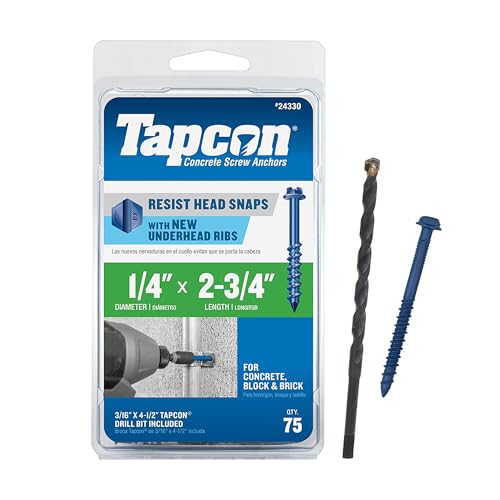
This is the reference standard for structural anchoring in cinder block. The 1/4-inch diameter provides enough thread engagement to hold heavy loads like ledger boards, fence post brackets, and electrical panels without the cracking risk that larger wedge anchors introduce in thin block shells. The hex head with under-head ribs resists snapping and spin-out — a common failure point when driving into variable-density block webs.
The Climaseal coating is corrosion-resistant enough for exterior use, and the WERCS Treadform thread geometry makes installation smoother than older Tapcon generations. Each box includes a carbide-tipped drill bit, which is critical because using a standard masonry bit with the wrong clearance can cause the screw to bind or break. The hex head is a major advantage for structural work where a socket driver provides more consistent torque than a star bit.
Users consistently report that blowing the dust out of the pilot hole before driving the screw prevents the head from snapping — a simple practice that extends the anchor’s effective holding strength. The 75-count box covers large projects, and the ICC-ESR recognition means this screw meets building codes for structural applications.
Why it’s great
- ICC-ES recognized for structural concrete and masonry applications
- Hex head with under-head ribs eliminates spin-out during installation
- Includes correct carbide drill bit and T-25 star bit for the pilot hole
Good to know
- Over-driving or insufficient hole depth will snap the head — go slow
- Heavier than the smaller 3/16-inch version for light shelving work
2. Tapcon 3/16 x 2-1/4 Inch Star Head Concrete Anchors
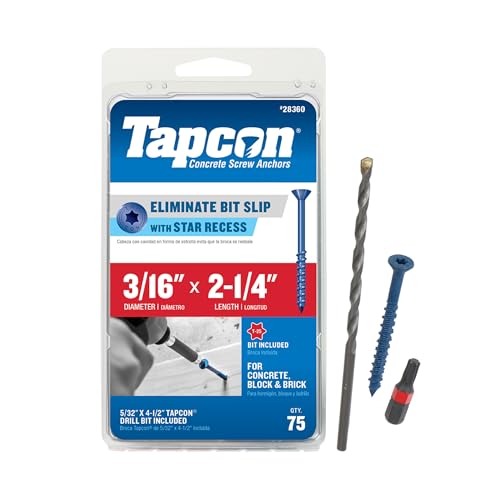
For medium-duty tasks like mounting furring strips, window frames, or heavy shelving to cinder block, the 3/16-inch Tapcon offers the sweet spot between holding power and installation ease. The smaller diameter reduces the risk of cracking the block face shell while still delivering enough shear strength for most residential and light commercial applications. The star drive (Torx) recess eliminates cam-out, which is a real problem when using a Phillips driver in the harder masonry material.
The Climaseal coating matches its larger sibling, resisting corrosion in damp basement or exterior conditions. The 2-1/4-inch length provides enough thread engagement for a single layer of block plus the material being fastened. The included drill bit is matched to the correct pilot hole size — 5/32-inch for this screw diameter — which is essential because an oversized pilot hole strips the thread grip and reduces pull-out strength by more than half.
Users caution against the star drive bugle head if you need to countersink the screw flush — the bugle profile sits slightly proud. But for frame attachments and bracket mounts where a flat head is acceptable, this is the most balanced Tapcon option for block. The 75-count box gives enough to tackle a full basement wall without frequent reloads.
Why it’s great
- Star drive eliminates cam-out in hard masonry material
- Smaller diameter reduces cracking risk in thin block shells
- ICC-ES recognized and includes matched carbide drill bit
Good to know
- Bugle head sits proud — not ideal for flush countersinking
- Bit wandering on the first hole can be avoided with a center punch
3. TOGGLER Alligator AF6 Flanged Polypropylene Anchors

This anchor is uniquely suited for cinder block because it works in both solid and hollow conditions. In solid block, the polypropylene body expands evenly along its length, distributing force without cracking the shell. In hollow block, the unique “alligator jaw” design opens behind the cavity wall as the screw drives in, creating a mechanical lock that prevents pull-through — a failure mode common with standard plastic sleeve anchors.
The flanged head sits flush against the block surface, providing stability and preventing the anchor from being pushed into the cavity during installation. It accepts common #6 to #12 screws (sold separately), which gives you flexibility to match the screw to the specific bracket or fixture you’re mounting. The rated pull-out value of 675 lb in 3,500 psi concrete gives a good reference, though real-world working loads in cinder block will be lower due to the variable density of the block material.
Professional installers report excellent performance in plaster and block walls, with the caveat that for solid concrete applications, a tubular anchor or Tapcon may be more cost-effective per unit. But for mixed substrates — block walls that transition into brick or drywall — this is the most versatile single anchor type. The 100-count bag is economical for large projects where you’re pinning through block into wooden furring strips or metal track.
Why it’s great
- Opens “jaws” behind hollow cavity for mechanical lock
- Works in solid block, hollow block, brick, and drywall
- Corrosion-resistant polypropylene suitable for damp conditions
Good to know
- Screws are not included — requires separate purchase
- More expensive per anchor than basic plastic sleeve alternatives
4. BCP Fasteners 1/4 x 1-3/4 Hex Head Diamond Tip Concrete Screws
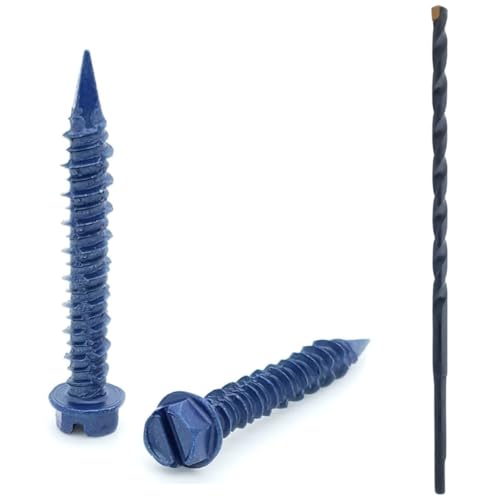
These are a direct functional equivalent to the Tapcon 1/4-inch screws at a lower per-unit cost, making them a strong choice for projects where you need a high volume of anchors — think attaching pressure-treated lumber to a block foundation wall or mounting racking in a garage. The diamond-edged tip cuts cleanly into block without walking, and the self-cleaning high-low threads clear debris as you drive, reducing the chance of binding in softer block material.
The EnviroSeal blue coating provides decent corrosion resistance for interior applications, but it’s not as robust as the Climaseal coating on Tapcons for exterior or continuously damp environments. The hex head works with a standard socket driver, and the included carbide drill bit is correctly sized for the pilot hole — a detail that budget alternatives often skip, forcing you to guess the right bit size or buy one separately.
Users confirm these hold securely in concrete block and poured floor without issues, though a few report head snapping if the pilot hole isn’t deep enough. The 100-count box at this price point represents significant savings over big-box store bulk packs. For non-structural, non-code projects, these deliver the same holding power as premium brands.
Why it’s great
- Significant cost savings per screw compared to premium brands
- Includes correctly sized carbide drill bit for the pilot hole
- Self-cleaning threads make installation faster in block
Good to know
- Blue coating is less corrosion-resistant than Climaseal for exterior use
- Head can snap if hole depth is not at least 1/4-inch deeper than screw length
5. BUSY-CORNER Conical Concrete Wall Anchors Assortment Kit

This kit targets light-duty residential tasks — hanging pictures, small mirrors, curtain rods, and lightweight shelving on block or brick walls. The conical PE plastic sleeves expand as the screw is driven, creating friction against the hole wall. The kit includes four different size combinations of anchors and matching Phillips-head screws, plus three drill bits, all packed in a compartmentalized storage box.
The carbon steel screws have a blue phosphate coating that provides basic corrosion resistance for indoor use. The conical shape of the anchor body is designed to wedge tightly into a straight drilled hole without requiring a special installation tool. The inclusion of multiple sizes means you can match the anchor to the screw gauge, which prevents the common DIY mistake of using an undersized anchor with a thick screw, causing the sleeve to split.
Reviews are mixed for heavier applications — several users note that for substantial loads like a generator interlock or heavy shelving, these anchors struggled and required upgrading to a more robust fastening system. This kit is best understood as a starter set for quick jobs around the house where the load is minimal. The organizational box is genuinely useful for keeping the different sizes sorted during a project.
Why it’s great
- Comes with multiple sizes and matching drill bits in one organized case
- Perfect for light residential tasks like hanging frames and curtain rods
- Conical design installs easily without special tools
Good to know
- Not rated for heavy loads or structural applications in block
- Plastic sleeve can deform if over-tightened in thin block shells
FAQ
Can I use regular Tapcon screws in the hollow part of a cinder block?
What size pilot hole do I need for a 1/4-inch concrete screw in cinder block?
Why do my anchors keep pulling out of cinder block?
Final Thoughts: The Verdict
For most users, the anchors for cinder block winner is the Tapcon 1/4 x 2-3/4 Hex Head because its thread-cutting design eliminates the cracking risk of expansion anchors while providing structural-grade holding power for heavy loads like framing and fence brackets. If you are working on medium-duty residential tasks and want star-drive convenience, grab the Tapcon 3/16 x 2-1/4 Star Head. And for hollow-block installations where you need versatile cavity gripping without specialized tools, nothing beats the TOGGLER Alligator AF6.

Mo Maruf
I created WellFizz to bridge the gap between vague wellness advice and actionable solutions. My mission is simple: to decode the research and give you practical tools you can actually use.
Beyond the data, I am a passionate traveler. I believe that stepping away from the screen to explore new environments is essential for mental clarity and physical vitality.