Our readers keep the lights on and my smoothie glass nicely filled. As an Amazon Associate, I earn from qualifying purchases.
Building a home theater that genuinely wraps you in sound used to mean running speaker wire across every doorway and investing in a dedicated AV receiver. The arrival of dedicated wireless rear channel kits and all-in-one soundbar systems has changed that equation entirely, letting anyone achieve true 5.1 or even Dolby Atmos immersion without the clutter. The challenge now is cutting through the marketing noise to find a kit that delivers stable connectivity, convincing soundstage depth, and enough power to fill your room.
I’m Mohammad Maruf — the founder and writer behind WellFizz. I specialize in deconstructing wireless home theater hardware, analyzing everything from RF transmission protocols and amplifier architectures to driver configuration and codec support, so you know exactly what you’re paying for.
After digging into nine of the current top contenders across every price tier, I can confidently point you to the best bluetooth surround speakers that deliver real rear channel presence without the wiring headaches.
How To Choose The Best Bluetooth Surround Speakers
Selecting the right surround speaker kit starts with understanding how the rear channels connect, how much bass you want, and whether your TV or soundbar supports the necessary audio codecs. The following breakdown addresses the critical buying factors specific to this category.
Connection Method: Wireless vs. Detachable
Most rear speaker kits communicate with the main soundbar or subwoofer via a dedicated 2.4GHz or 5GHz wireless link, not through standard Bluetooth. That dedicated link eliminates the latency and audio compression typical of generic Bluetooth streaming. Some premium systems, like the JBL Bar models, use detachable rechargeable speakers that physically click onto the soundbar for charging and lift off for placement behind you. Both approaches work, but detachable systems offer flexibility while wireless satellites usually need to stay plugged into a power outlet.
Dolby Atmos Height Channels
If you want overhead effects such as rain or helicopter sounds, look for rear speakers with up-firing drivers. The Samsung 9500S and the ULTIMEA Skywave X40 and X70 include these upward-firing channels as part of a true 5.1.2 or 7.1.4 configuration. Soundbars without dedicated up-firing rears can only simulate height via psychoacoustic processing, which doesn’t produce the same physical sensation of sound coming from above.
Subwoofer Size and Bass Extension
An 8-inch subwoofer is adequate for small bedrooms, but a 10-inch driver is the baseline for room-filling, chest-thumping bass in a living room. Pay attention to the frequency response rating — a sub that reaches down to 35Hz or lower delivers deeper, more tactile low-end. The ULTIMEA Skywave X70, for instance, pushes down to 20Hz, while the JBL Bar 1000MK2 also hits 20Hz with its 10-inch driver.
Compatibility and Codec Support
Not every rear speaker works with every soundbar. Samsung kits, for example, are locked to specific Samsung soundbar models from the same or adjacent years. For a universal approach, a complete system such as the JBL Bar 500MK2 or the Klipsch Reference 5.2 comes with everything matched out of the box. Also confirm that your TV supports HDMI eARC for lossless Dolby Atmos passthrough, or you may lose the height channel data.
Quick Comparison
On smaller screens, swipe sideways to see the full table.
| Model | Category | Best For | Key Spec | Amazon |
|---|---|---|---|---|
| Samsung 9250S | Wireless Add-On | Samsung soundbar upgrade | 6-inch woofers, wireless | Amazon |
| JBL Bar 500MK2 | 5.1 System | Cinematic power with 10″ sub | 750W peak, 10″ sub, Dolby Atmos | Amazon |
| Samsung 9500S | Atmos Add-On | Up-firing rear height channels | Dolby Atmos/DTS:X up-firing | Amazon |
| ULTIMEA Skywave X40 | 5.1.2 System | Compact Atmos with GaN amp | 530W peak, 35Hz sub, GaN | Amazon |
| SteelSeries Arena 9 | Desktop 5.1 | PC gaming surround sound | 5.1 USB, wireless rears, RGB | Amazon |
| JBL Bar 700MK2 | 7.1 System | Detachable rechargeable rears | 780W peak, 10″ sub, 7.1 ch | Amazon |
| ULTIMEA Skywave X70 | 7.1.4 System | Professional home theater | 980W peak, 10″ sub, 20Hz | Amazon |
| JBL Bar 1000MK2 | 7.1.4 System | True Atmos with detachable rears | 480W RMS, 10″ sub, 4 up-firing | Amazon |
| Klipsch Reference 5.2 | Tower System | High-end dedicated speaker setup | 12″ dual subs, Tractrix horn | Amazon |
In‑Depth Reviews
1. ULTIMEA Skywave X70 7.1.4ch System
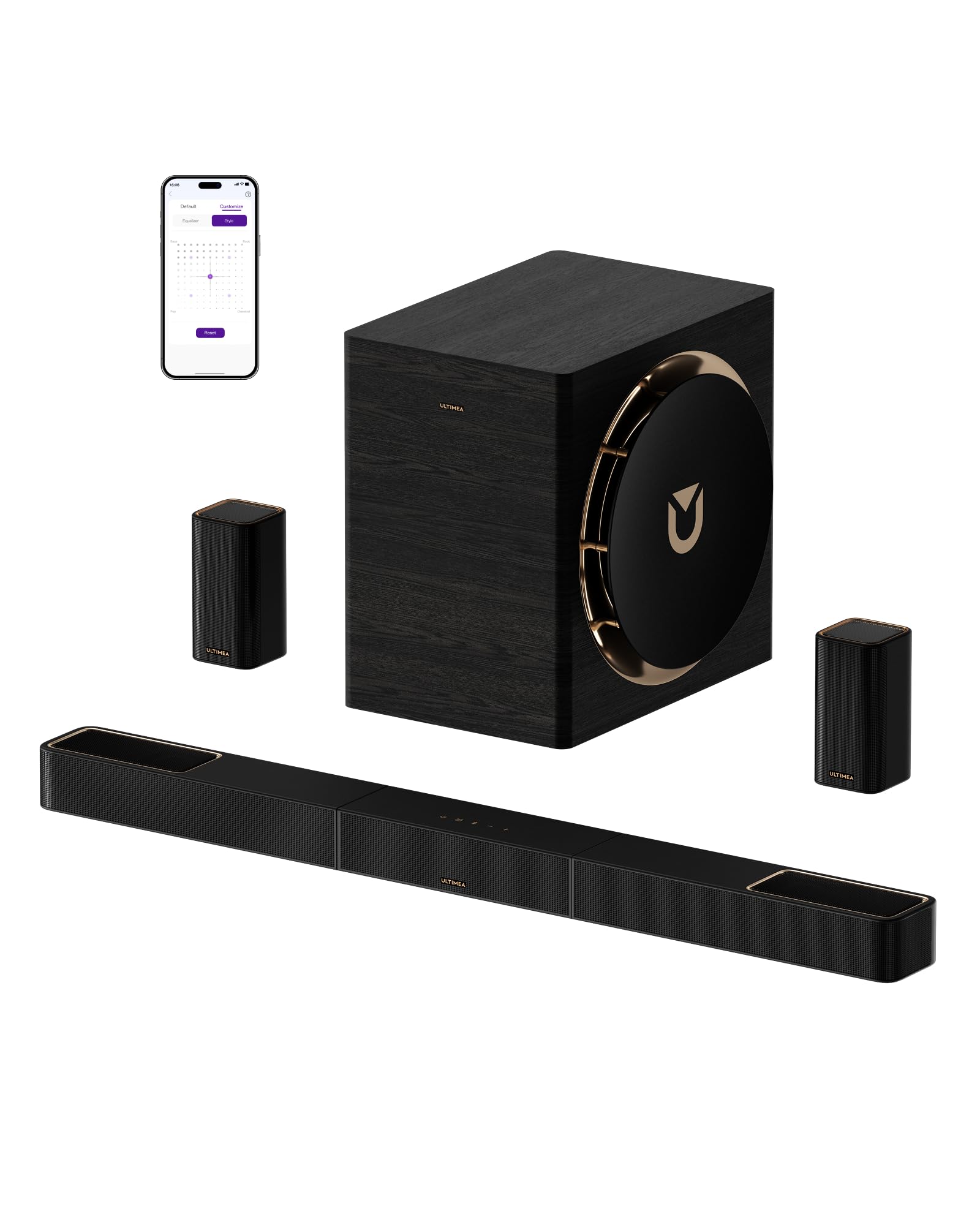
The Skywave X70 is the most complete wireless surround package I evaluated, offering a full 7.1.4 channel layout with four up-firing drivers — two in the soundbar and two in the rear satellites — for genuine Dolby Atmos height effects. The 10-inch subwoofer pushes bass down to 20Hz using Gravus ultra-linear technology, producing clean, tactile low-end that remains distortion-free even when you push the 980W peak power. The fact that everything communicates over dual 5GHz wireless links means the rear speakers stay locked in sync with nearly zero dropout risk during intense movie scenes.
The GaN amplifier architecture is the real engineering story here. Gallium nitride transistors operate with up to 98% efficiency and eight times faster switching than traditional silicon amps, which translates to less heat dissipation and cleaner signal delivery across all seven channels. The NEURACORE triple-core DSP handles up to 17 channels of processing at 24-bit/192kHz resolution, giving the X70 headroom to render spatial audio with pinpoint imaging. For a living room setup, this level of channel count and processing power is typically found in AV receiver-based systems costing significantly more.
Setup is straightforward via HDMI eARC, and the ULTIMEA app provides a 10-band EQ plus 121 sound presets to tune the system to your space. The trade-off is that the three-piece soundbar is long and requires a wide media console, and there is no auto-calibration microphone in the box — you will need to manually adjust channel levels. The remote is functional but basic for a system this capable. Overall, this is the sweet spot for buyers who want professional-grade immersion without receiver wiring.
Why it’s great
- True 7.1.4 channel count with four up-firing Atmos drivers.
- 20Hz subwoofer extension provides deep, room-shaking bass.
- GaN amplifier and high-efficiency DSP reduce heat and distortion.
Good to know
- Soundbar is a wide three-piece assembly requiring substantial shelf space.
- Manual channel leveling required; no auto room calibration.
- Speaker connecting cables feel less premium than the rest of the build.
2. JBL Bar 1000MK2 7.1.4ch System

The JBL Bar 1000MK2 rethinks the wireless rear speaker problem with a clever detachable design. The two surround speakers snap magnetically onto the ends of the main soundbar for charging, and when you lift them off and place them behind your seating area, they self-configure into wireless rear channels with built-in up-firing drivers. This eliminates the need for power outlets near the rear of the room while still delivering true Dolby Atmos and DTS:X height effects. The 10-inch wireless subwoofer handles the low end, and the system delivers 480W RMS with peak performance reaching well beyond that in dynamic content.
JBL’s MultiBeam 3.0 technology creates a wide, cinema-like soundstage that compensates for furniture placement and room irregularities, while PureVoice 2.0 keeps dialogue crisp even during explosions. The battery life on the detachable speakers lasts through long movie marathons, and when not in use they snap back to recharge automatically. The JBL ONE app gives detailed EQ control and room calibration, and the HDMI eARC input supports 4K Dolby Vision passthrough without signal loss. For gamers, the compatibility with Xbox and PlayStation Atmos routing is a strong selling point.
One thing to note is that the surround speakers rely on battery power, so if you forget to dock them after watching, they may run low for your next session. The subwoofer is large and will dominate a small room visually. A few users reported that rear channel volume initially seems low until you run the calibration process a second time, but after that the balance is excellent. For anyone wanting a clean, wire-free living room that still delivers component-grade Atmos immersion, this system is hard to fault.
Why it’s great
- Detachable rechargeable rears require no power outlets or messy wires.
- True Dolby Atmos and DTS:X with four up-firing drivers.
- Room calibration and detailed EQ via JBL ONE app.
Good to know
- Rear speakers must be regularly docked to maintain battery charge.
- Subwoofer is large and heavy, requiring dedicated floor space.
- Initial rear volume may need a second calibration pass for balance.
3. JBL Bar 700MK2 7.1ch System

The JBL Bar 700MK2 sits one step below the flagship 1000MK2, but retains the same core detachable rear speaker convenience that makes this series so appealing. It delivers 780W of peak power through a 7.1 channel array, with a 10-inch wireless subwoofer and two detachable surround speakers that lift off for rear placement. While it lacks the dedicated up-firing drivers in the rears that the 1000MK2 offers, the MultiBeam 3.0 virtualization still produces a convincing wraparound soundstage for most movie content.
Battery life on the detachable speakers is excellent — expect several days of casual viewing before needing to dock them back onto the soundbar for charging. The subwoofer is the same 10-inch unit found in the 1000MK2, so bass extension and impact are essentially identical. PureVoice 2.0 handles dialogue clarity well, and the Night Listening mode is genuinely useful for late-night viewing: it redirects the main channels to the detachable speakers beside you, muting the subwoofer so you get clear sound without shaking the house.
The system supports HDMI eARC with 4K passthrough, AirPlay 2, Google Cast, and Spotify Connect, giving you plenty of streaming options. The app-based room calibration is a bit touchier than on the flagship — you may need to run it two or three times in an irregularly shaped room to lock in the right soundstage width. For buyers who want the convenience of detachable rears but don’t absolutely need discrete up-firing height channels, this setup hits a great balance between price and daily living flexibility.
Why it’s great
- Detachable rears offer placement freedom with multi-day battery life.
- Same powerful 10-inch subwoofer as the higher-end JBL models.
- Night Listening mode routes audio to nearfield speakers without subwoofer.
Good to know
- Rear speakers lack dedicated up-firing drivers for discrete Atmos height.
- Room calibration can require multiple passes for optimal soundstage width.
- Lower mid-bass presence may need EQ adjustment via the app.
4. JBL Bar 500MK2 5.1ch System
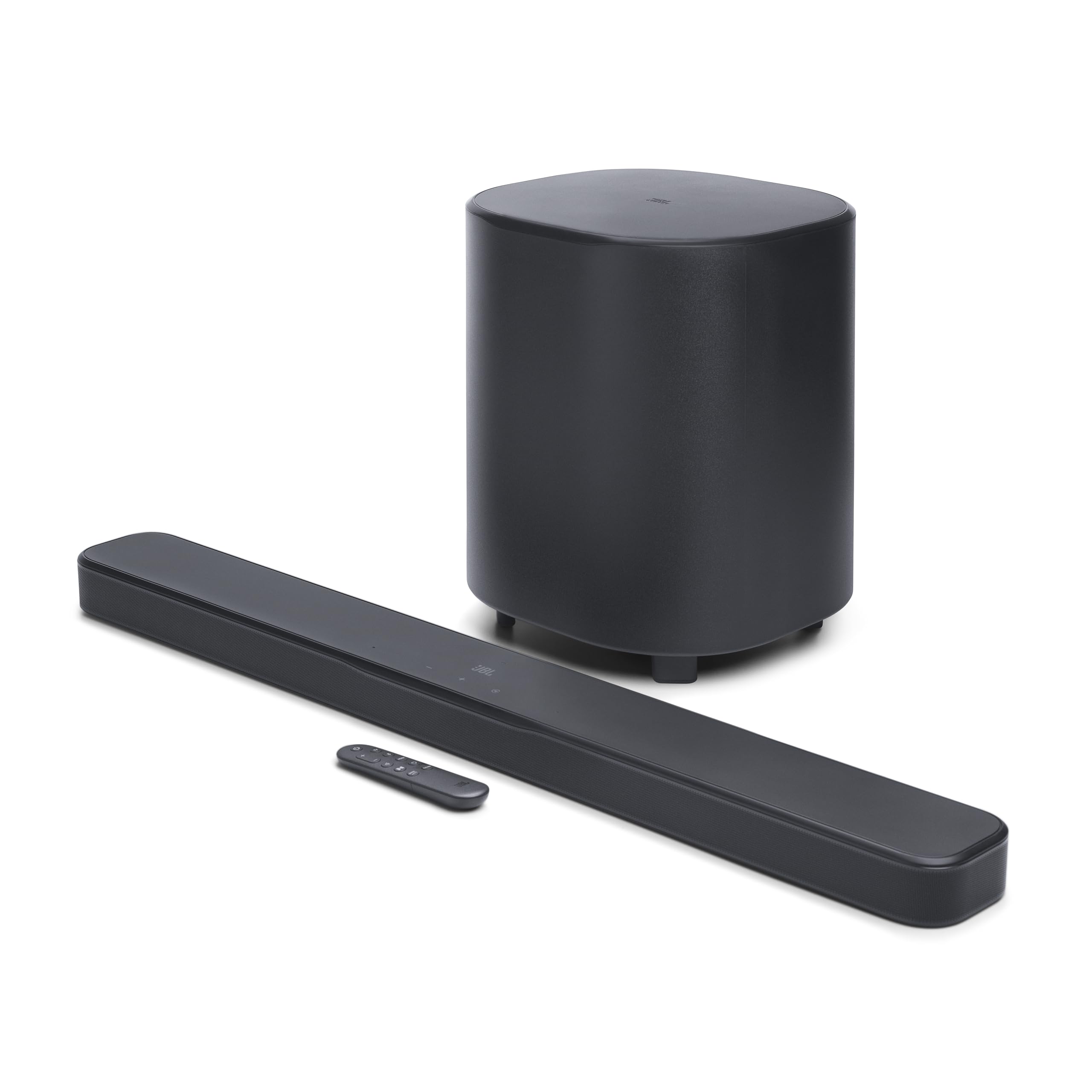
The JBL Bar 500MK2 strips away the detachable rear speakers and virtual height channels to focus on what matters most for pure cinematic power: a massive 10-inch wireless subwoofer and a clean 5.1 channel layout. At 750W peak output, this system will rattle windows with the right content, and the subwoofer’s 20Hz frequency extension means you feel deep bass in your chest rather than just hearing it. The MultiBeam 3.0 processing does a solid job of widening the soundstage from the main bar, creating the illusion of rear presence even without dedicated surrounds.
PureVoice 2.0 remains a standout feature, dynamically lifting dialogue above ambient noise across the volume range. The system includes HDMI eARC with 4K Dolby Vision passthrough, and it supports AirPlay 2, Google Cast, and Spotify Connect for music streaming. The JBL ONE app gives access to a precise equalizer and room calibration, though the calibration is more about optimizing the front stage than creating true surround imagery. Setup is genuinely quick — HDMI cable, power, and you are running within ten minutes.
The limitation is obvious: you are not getting discrete rear speakers, so sound effects that should come from behind you are processed and redirected through the soundbar’s beamforming. In small to medium rooms this virtualization is convincing, but in larger spaces or for purists, the lack of physical surrounds will be apparent. The unit is also priced to compete with systems that do include rears, so weigh your need for phantom surround versus raw bass power before committing.
Why it’s great
- 10-inch subwoofer with 20Hz extension delivers visceral low-end punch.
- 750W peak output fills even large living rooms with authority.
- Extensive streaming support including AirPlay 2 and Google Cast.
Good to know
- No physical rear speakers; surround effects are virtualized from the bar.
- Room calibration is limited to front stage optimization only.
- May sound harsh at very high volumes without EQ adjustments.
5. ULTIMEA Skywave X40 5.1.2ch System
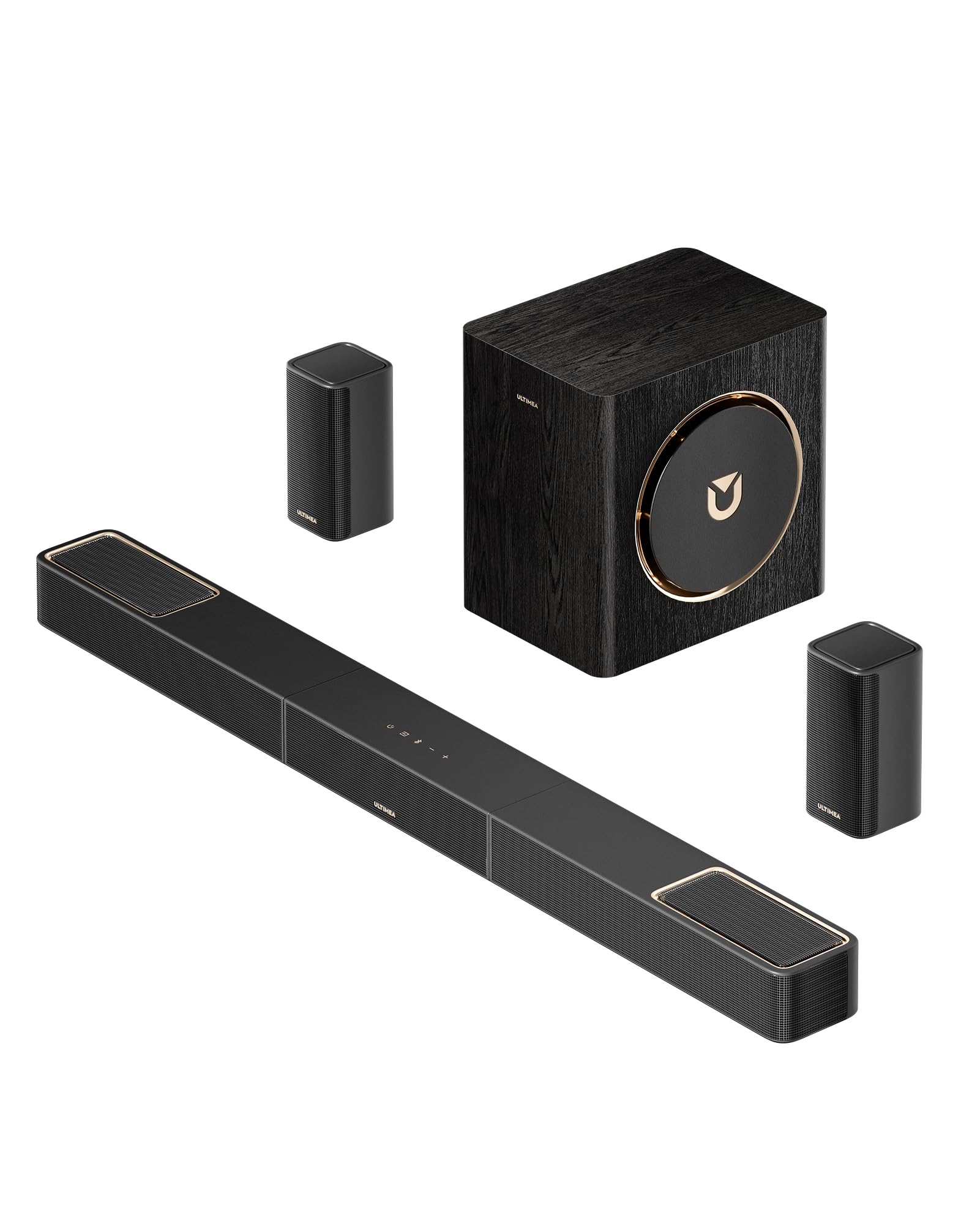
The Skywave X40 is the smaller sibling of the X70, offering a 5.1.2 channel layout that includes two wireless rear satellites with up-firing drivers for Dolby Atmos height effects. Its 530W peak output is adequate for small to medium living rooms, and the 35Hz subwoofer extension provides satisfying bass without the massive cabinet of the X70’s 20Hz unit. The GaN amplifier architecture inherits the same efficiency advantages — lower heat, faster transient response, and cleaner signal integrity through the DSP processing chain.
Setup is as simple as plugging in the soundbar, subwoofer, and rear speakers, then letting HDMI eARC handle the handshake. The ULTIMEA app offers a 10-band EQ and multiple sound presets, though the interface can occasionally disconnect from Bluetooth during tuning. The rear speakers are wired to each other with a thin cable, but the link to the subwoofer is fully wireless via dual 5GHz transmission. Build quality is solid, with a metal grille and rose gold accents that look more expensive than the system’s price tier suggests.
The biggest compromise here is peak volume headroom. In a large open-concept room, the X40 can run out of gas during loud action sequences, especially compared to the X70 or the JBL Bar series. The up-firing Atmos effects are present but subtle — you hear them in content with explicit height channels, but they won’t produce the dramatic overhead slam of a dedicated ceiling speaker. For a compact, affordable entry into real wireless surround with actual height drivers, however, this is a strong option.
Why it’s great
- True 5.1.2 channel layout with wireless Atmos rear satellites.
- GaN amplifier delivers clean signal with minimal heat buildup.
- Elegant metal and wood design fits modern decor.
Good to know
- Limited peak volume headroom for large open-concept rooms.
- Up-firing Atmos effects are subtle rather than dramatic.
- App can lose Bluetooth connection during EQ adjustments.
6. Klipsch Reference 5.2 System

The Klipsch Reference 5.2 is a fundamentally different approach to surround sound — this is a traditional passive speaker system that requires an AV receiver to drive it. The package includes two R-625FA floor-standing towers with built-in up-firing Dolby Atmos drivers, an R-52C center channel, R-41M bookshelf surrounds, and two R-12SW 12-inch powered subwoofers. The Tractrix horn-loaded tweeters deliver the bright, dynamic treble that Klipsch is known for, with sensitivity ratings above 90dB that let even moderate receivers drive the system to high volumes with low distortion.
The dual subwoofer configuration is the star here. Two 12-inch drivers with 400W peak amplifiers each provide massive headroom for low-frequency effects, and proper placement can even out bass response across large rooms. The towers themselves produce usable bass down to around 45Hz, so even without the subs, music listening has weight. The built-in up-firing drivers in the towers handle the Atmos height layer, and unlike soundbar-based systems, these physical elevation drivers are wattage-independent — they pull power directly from the receiver’s amplifier channels.
The catch is that you need an AV receiver and speaker wire to make this work. There is no wireless connectivity between components, no Bluetooth control, and no app-based room calibration unless your receiver includes it. The system is also physically imposing — towers are 40 inches tall and weigh 50 pounds each, and the dual subs take up significant floor space. For anyone willing to run wire and invest in a receiver, this setup offers a level of dynamic range, clarity, and upgradeability that no soundbar can match.
Why it’s great
- Dual 12-inch subwoofers deliver extreme low-frequency headroom.
- Tractrix horn tweeters provide high sensitivity and dynamic treble.
- Floor-standing towers with built-in up-firing Atmos drivers.
Good to know
- Requires an AV receiver and speaker wire for each channel.
- Large physical footprint with heavy tower cabinets.
- No wireless connectivity; all audio is passive wired.
7. SteelSeries Arena 9 Desktop 5.1 System

The SteelSeries Arena 9 is the only dedicated desktop 5.1 system in this lineup, designed specifically for PC gamers who want true discrete surround channels without an AV receiver. It connects via a single USB cable to your computer, decoding 5.1 audio from games and movies natively through the SteelSeries Sonar software. The rear speakers are wireless — they connect to the subwoofer wirelessly for data, though they do require power via a nearby outlet or USB-C cable. The system includes a 6.5-inch subwoofer, two front satellites with silk dome tweeters and organic-fiber woofers, a dedicated center channel, and two rear satellites.
The Control Pod is a standout usability feature: a puck-shaped controller with a small screen that gives you access to volume, muting, headset toggling, and EQ adjustments without alt-tabbing out of your game. The PrismSync RGB lighting on the front satellites is reactive and customizable via the software, adding immersion without being distracting. Audio quality is clear and well-balanced, with a slightly warm tonality that suits both gaming and music. The dedicated center channel ensures dialogue in cutscenes and competitive shooters stays front and center.
The major limitation is that true 5.1 decoding only works via USB on PC. Over optical or Aux inputs, the system downmixes to stereo, so console gamers relying on optical will not get discrete surround. The rear speakers must be wired to each other via RCA, and one rear unit needs a power cable, which partially undermines the wireless convenience. Some users report that the surround upmix feature adds reverb rather than authentic channel separation. For PC-centric gamers who want a clean, RGB-enhanced 5.1 setup without wires running across the floor, this is a unique solution.
Why it’s great
- True 5.1 over single USB cable with discrete rear channel decoding.
- Control Pod provides at-hand volume and EQ access during gameplay.
- Reactive PrismSync RGB lighting on front satellites enhances immersion.
Good to know
- True 5.1 only works via USB on PC; optical and Aux are stereo only.
- Rear speakers still need a power cable despite wireless data link.
- Surround upmix can introduce reverb rather than clean separation.
8. Samsung 9500S Rear Speaker Kit

The Samsung 9500S is a dedicated add-on rear speaker kit designed to pair with specific Samsung Q-series and S-series soundbars from 2021 onward. It eschews the simpler two-driver approach of the cheaper 9250S and instead includes up-firing drivers in each rear speaker, providing discrete height channels for Dolby Atmos and DTS:X content. This means sound effects like rain or helicopter rotor wash are physically reproduced from behind and above rather than simulated. The speakers connect wirelessly to the subwoofer or soundbar using Samsung’s proprietary ID Set pairing protocol, which is generally hassle-free when the components are from compatible generations.
Audio output is clean and well-balanced, with rear volume controllable independently through the soundbar’s remote or the SmartThings app. The up-firing channels add a genuinely noticeable vertical dimension to Atmos content, especially on Q-series soundbars like the Q800B or Q700A. Build quality is solid — the speakers are compact enough to sit on a shelf or mount to a wall, and the included brackets are straightforward to install. For existing Samsung soundbar owners, this is the simplest path to true 5.1.2 or 7.1.2 surround without buying a whole new system.
The catch is exclusivity. This kit only works with a limited set of Samsung soundbars, and there have been reports of pairing failures with certain models like the HW-B550, where the subwoofer pairs but the rears refuse to connect. Rear channel volume is also noticeably lower than the front stage out of the box, requiring you to manually boost the rear level via the soundbar settings. For Samsung users with a compatible 2021+ Q-series bar, this is an immersive upgrade. For anyone else, it is simply not an option.
Why it’s great
- Dedicated up-firing drivers for discrete Atmos height reproduction.
- Wireless ID Set pairing keeps installation clean and simple.
- Compact form factor with included wall-mount brackets.
Good to know
- Locked to specific Samsung soundbar models; not universally compatible.
- Rear volume is low by default; must be manually adjusted higher.
- Pairing failures reported with some B-series Samsung soundbars.
9. Samsung 9250S Wireless Rear Speaker Kit

The Samsung 9250S is the more budget-friendly entry point into the Samsung wireless rear ecosystem. It omits the up-firing height drivers found in the 9500S, using standard forward-firing 6-inch woofers to handle rear channel duties. The kit is compatible with 2025 Samsung soundbar models including the HW-Q600F, HW-B750F, HW-B630F, and HW-B550F, making it a targeted upgrade for owners of those specific bars. The wireless connection uses Samsung’s ID Set pairing, which involves holding a button on each speaker until it syncs with the soundbar — a process that typically completes within a minute.
Sound quality is adequate for near-field listening in small to medium rooms. The rear speakers produce clear, audible surround effects without distortion, but they lack the presence and volume headroom of larger or powered alternatives. Dialogue from the main soundbar remains dominant, and the rear channels contribute ambiance rather than aggressive directional effects. The build is lightweight and unobtrusive, and the speakers are easy to position on shelves or wall-mount using the included hardware. For a simple clutter-free upgrade, this kit adds the missing rear dimension without any added complexity.
The primary limitations are compatibility and driver capability. If you own a 2024 or older Samsung soundbar, check the model list carefully — this kit is not backward compatible with all Q-series bars, and pairing issues have been noted specifically with the HW-B550F. The lack of up-firing drivers means you get no Atmos height contribution from the rear, so the vertical soundstage still depends entirely on the soundbar’s own processing. For users on a tight budget who simply want rear fill for movies and TV, this kit does the job. For anyone seeking imaging precision or Atmos immersion, the 9500S is the better investment.
Why it’s great
- Simple ID Set pairing process with compatible 2025 Samsung soundbars.
- Lightweight, compact speakers are easy to position or wall-mount.
- Adds rear channel presence without running wires across the room.
Good to know
- Limited to specific 2025 Samsung soundbar models only.
- No up-firing Atmos drivers; height still depends on soundbar.
- Rear volume and presence are modest compared to larger kits.
FAQ
Do wireless surround speakers work with any soundbar?
How much rear channel volume is normal for a surround kit?
Can I use Bluetooth to stream music to rear surround speakers?
What’s the difference between a 5.1 and a 5.1.2 system?
Final Thoughts: The Verdict
For most users, the best bluetooth surround speakers winner is the ULTIMEA Skywave X70 because it delivers a true 7.1.4 channel count with four up-firing Atmos drivers, a 20Hz subwoofer, and a GaN amplifier architecture at a price that undercuts traditional receiver-based systems. If you want the convenience of detachable rechargeable rear speakers that need no power outlets, grab the JBL Bar 1000MK2. And for a dedicated PC gaming setup where a single USB cable gives you discrete 5.1 surround on your desktop, nothing beats the SteelSeries Arena 9.

Mo Maruf
I created WellFizz to bridge the gap between vague wellness advice and actionable solutions. My mission is simple: to decode the research and give you practical tools you can actually use.
Beyond the data, I am a passionate traveler. I believe that stepping away from the screen to explore new environments is essential for mental clarity and physical vitality.