Our readers keep the lights on and my smoothie glass nicely filled. As an Amazon Associate, I earn from qualifying purchases.
A damp basement isn’t just a nuisance — it’s a slow-motion disaster for your foundation, framing, and indoor air quality. Whether you’re dealing with efflorescence streaks, hydrostatic pressure pushing through a slab, or the musty smell of chronic humidity, the right liquid membrane or penetrating sealer is your first line of defense.
I’m Mohammad Maruf — the founder and writer behind WellFizz. My research focuses on construction-grade waterproofing chemistries, vapor transmission rates, and real-world durability data so you can pick a sealer that actually stops water, not just one that claims to.
After analyzing dozens of formulations and thousands of verified owner experiences, I’ve narrowed the field to five sealers that genuinely perform below grade. This guide covers exactly what separates a temporary patch from a lasting solution, helping you identify the best basement waterproofing sealer for your specific wall or floor condition.
How To Choose The Best Basement Waterproofing Sealer
Choosing a basement waterproofing sealer isn’t a one-formula-fits-all decision. The chemistry you need depends on whether you’re sealing interior walls against vapor drive, plugging a floor slab against hydrostatic pressure, or coating a foundation with heavy crack activity. Get the type wrong and you’ll be re-coating in a season.
Penetrating vs. Film-Forming Sealers
Penetrating sealers (silane-siloxane blends) soak into the concrete pore structure and react to form a water-repellent barrier inside the substrate. They allow the wall to breathe — critical for below-grade spaces where trapped moisture vapor needs an escape path. Film-forming sealers (acrylics and liquid rubbers) create a continuous membrane on the surface. Membranes are better for bridging cracks and handling active water intrusion, but they require perfect surface prep and can peel if applied over damp concrete.
Vapor Permeability and Hydrostatic Pressure
A sealer with low vapor permeability (measured in perms) stops liquid water but may trap interior moisture, leading to paint peeling or mold growth behind the coating. For walls with high vapor drive, a penetrating sealer (< 0.5 perms is fine for liquid rubber) is safer. For floor slabs under hydrostatic pressure, only a thick elastomeric membrane with crack-bridging ability (minimum 1/8 inch) should be considered.
Elongation and Crack-Bridging
Concrete foundations settle and develop hairline cracks over time. Sealers with high elongation percentages (like liquid rubbers with 900% stretch) can move with the substrate without tearing. Acrylic sealers typically offer less give and may crack if the foundation shifts. Check the product’s stated elongation or anti-fracture rating if you have visible cracks wider than a hairline.
Quick Comparison
On smaller screens, swipe sideways to see the full table.
| Model | Category | Best For | Key Spec | Amazon |
|---|---|---|---|---|
| AMES BMX1WRG Blue Max | Liquid Rubber | Foundations & basement walls | 900% elongation, elastomeric membrane | Amazon |
| USG DUROCK Liquid Membrane | Acrylic Membrane | Interior floor & wall prep | 0.38 perms at 20 mils dry thickness | Amazon |
| MasonryDefender Patio Paver Sealer | Water-Based Acrylic | Paver joint stabilization | Low gloss, locks joint sand | Amazon |
| Rust-Oleum 301239 Moisture Stop | Penetrating Sealer | Prepping slabs for coating | Covers up to 200 sq. ft. per gallon | Amazon |
| MasonryDefender Concrete Sealer | Silane Siloxane | Exterior & interior vapor control | Penetrating, breathable, clear | Amazon |
In‑Depth Reviews
1. AMES BMX1WRG Blue Max Liquid Rubber

AMES Blue Max isn’t a penetrating sealer — it’s a thick, white elastomeric rubber that forms a continuous waterproof membrane with a massive 900% elongation capacity. That elasticity means it can stretch across foundation settlement cracks up to 1/8 inch without tearing, which is the single biggest failure point for rigid acrylic sealers in active basements. The formula bonds aggressively to concrete, wood, and even metal, so you can brush or roll it onto poured walls, block, or underlayment with equal confidence.
Application is straightforward for a membrane product: stir well, roll or brush in one direction, and allow 24 hours between coats. Two coats at 20 wet mils each deliver a robust barrier that handles below-grade hydrostatic pressure when fully cured. Independent lab testing confirms its low VOC compliance and non-toxic formulation — it’s safe for interior use without needing a respirator. Owners report that a single gallon covers roughly 40–60 square feet per coat depending on surface porosity, which is reasonable for a membrane that builds real thickness.
The main trade-off is cure time: this sealer needs at least a week at 70°F to reach full water resistance, and even longer in cooler basements. Using it outdoors without a top coat will cause UV degradation over time, so it is a true interior or below-grade product. But for blocking liquid water intrusion on basement walls and slabs, the combination of sheer elongation, adhesion, and non-toxic safety makes Blue Max the most dependable choice.
Why it’s great
- 900% elongation bridges active settlement cracks
- Non-toxic and VOC-compliant for interior use
- Bonds to concrete, wood, and metal surfaces
Good to know
- Requires 24-hour drying between coats
- Needs a top coat for outdoor exposure
2. USG DUROCK Liquid Waterproofing Membrane
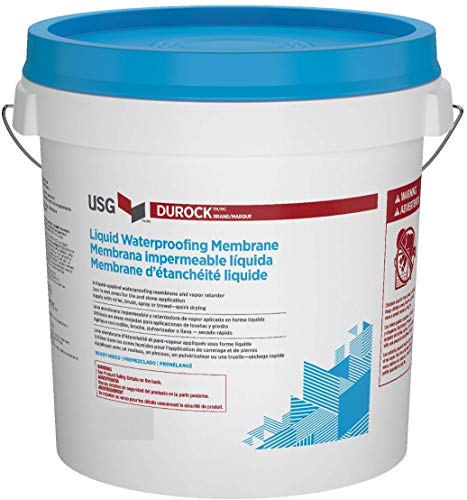
USG DUROCK Liquid Waterproofing Membrane is a blue, acrylic-based liquid that cures into a semi-flexible film designed primarily to go under tile in wet areas, but its low perm rating (0.38 perms at 20 mils dry thickness per ASTM E96 Procedure E) makes it very effective for sealing basement floors and walls against moisture vapor. The anti-fracture protection covers non-structural cracks up to 1/8 inch, which is sufficient for typical shrinkage cracks in a settled slab.
Application is beginner-friendly — brush, roller, trowel, or spray, and it dries fast enough to allow a second coat within a couple of hours in normal conditions. Owners note that the bright blue color gives a visual cue for coverage consistency, making it easy to spot thin spots. One gallon covers roughly 50–75 square feet at the recommended 20-mil dry film thickness, so plan accordingly for larger spaces. The thickness during application can feel tacky, but a small amount of water on the roller helps with spreading.
The membrane is best used as a substrate prep layer rather than a standalone long-term waterproofing system — it works exceptionally well under USG tile backer and thinset, but direct exposure to standing water or continuous hydrostatic pressure can challenge its bond on damp concrete. Ensure the surface is completely dry before application, as moisture entrapment can cause the paint-like film to peel. For interior basement slabs that will later receive tile or epoxy, this is a top-tier choice.
Why it’s great
- Low 0.38 perm rating for vapor blocking
- Fast drying allows quick recoating
- Visible blue color ensures full coverage
Good to know
- Requires bone-dry surface to bond properly
- Not designed for standing water exposure
3. MasonryDefender Patio Paver Sealer

This water-based acrylic sealer from MasonryDefender is formulated for horizontal paver surfaces — patios, walkways, and driveways laid with brick or stone — but its ability to harden and lock joint sand makes it a valid option for basement-adjacent spaces like window wells, retaining walls, and exterior foundation pavers. The low-gloss finish enhances natural stone color without creating a slippery, wet look, and the clear film resists yellowing even under sun exposure.
Coverage is quoted at 75–150 square feet per gallon, and the product applies cleanly with a pump-up sprayer followed by a back-brush to work it into joints. Owners consistently report that the sealer stabilizes polymerized sand so effectively that weed growth and ant colonization in paver joints are eliminated for at least a full season. For use on basement walk-out patios or retaining walls that drain water away from the foundation, this creates a reliable waterproof barrier that doesn’t trap moisture behind it.
The formula is not designed to bridge structural cracks or handle hydrostatic pressure — it stops rain and surface water, not groundwater forcing through a wall. Some users find the price per gallon steeper than general-purpose concrete sealers, but the specific joint-locking performance and low-odor, water-cleanup convenience justify the premium for paver-specific projects. For sealing a flatwork surface adjacent to your foundation, it’s a clean, effective solution.
Why it’s great
- Locks joint sand to prevent weed growth
- Low gloss finish avoids slippery sheen
- Water-based with easy soap cleanup
Good to know
- Not designed for vertical below-grade walls
- Higher per-gallon cost than general sealers
4. Rust-Oleum 301239 Concrete Moisture Stop

Rust-Oleum’s Concrete Moisture Stop is a penetrating fortifying sealer designed specifically as a preparatory layer before applying epoxy or paint to concrete floors. Unlike film-forming membranes that sit on top, this formula soaks into the slab’s capillary structure and reacts to block moisture vapor migration — a critical step when you’re coating a basement slab that experiences dampness from below. One gallon covers up to 200 square feet, which is generous for the category and reduces project cost.
Application requires the surface to be clean and dry; you let the liquid penetrate for 45 minutes before removing any excess, then allow it to cure before the top coat. Owners who have used it under Rust-Oleum epoxy on slabs with known hydrostatic pressure report no peeling or blistering after nearly three years — a strong real-world indicator that the moisture block holds up. The sealer is clear and leaves the surface texture unchanged, so it won’t affect the appearance of your final finish.
Because it is a penetrant rather than a membrane, it does not bridge cracks or handle active flowing water. If your slab has visible fissures or you experience standing water, this product will not replace a drainage solution. But as a budget-friendly insurance layer before an epoxy coating, it is arguably the most cost-effective moisture barrier you can apply, and Rust-Oleum’s recommendation for its own paint system gives confidence in chemical compatibility.
Why it’s great
- High coverage at 200 sq. ft. per gallon
- Blocks vapor migration under epoxy coatings
- Clear formula doesn’t alter surface look
Good to know
- Does not bridge surface cracks
- Requires dry slab and 45-minute penetration time
5. MasonryDefender Concrete Sealer — Silane Siloxane

MasonryDefender’s silane-siloxane blend is the textbook example of a breathable penetrating sealer. Rather than coating the surface, the active silicone resins react with the free lime in concrete to form a hydrophobic barrier inside the pore structure. Water beads up and rolls off the treated surface, while water vapor can still escape — a huge advantage on interior basement walls where vapor drive from moist soil would otherwise cause a film-forming coating to blister and peel.
Coverage is 90–150 square feet per gallon depending on porosity, and application is simple with a low-pressure garden sprayer. Owners in the Pacific Northwest — one of the toughest moisture climates in the country — report that three years after application, treated concrete surfaces stay visibly cleaner, resist mold and mildew, and shed rain like a duck’s back. The product has no odor, dries clear with zero sheen, and any overspray cleans up with water, making it pleasant to use in confined spaces.
The limitation is that a penetrating sealer offers no crack-bridging ability and cannot stop liquid water flowing through a visible fissure. It is also not suitable for horizontal surfaces that will receive paint or epoxy — it repels everything, including coatings. For controlling efflorescence and dampness on poured concrete or block walls where the substrate needs to stay breathable, this is the cleanest, most permanent solution in the lineup.
Why it’s great
- Breathable barrier prevents vapor trapping
- Zero odor and water cleanup
- Dries completely clear with no sheen
Good to know
- Does not bridge cracks
- Prevents adhesion of any subsequent coating
FAQ
Can I apply a basement waterproofing sealer over damp concrete?
Which type of sealer works best for a poured concrete wall with hairline cracks?
Final Thoughts: The Verdict
For most users, the best basement waterproofing sealer winner is the AMES Blue Max Liquid Rubber because its 900% elongation and robust elastomeric membrane handle the combination of hydrostatic pressure and foundation cracking better than any other product here. If you need a breathable vapor barrier that won’t trap moisture inside your walls, grab the MasonryDefender Silane Siloxane Sealer. And for a budget-friendly moisture stop under an epoxy floor coating, nothing beats the Rust-Oleum Moisture Stop.

Mo Maruf
I created WellFizz to bridge the gap between vague wellness advice and actionable solutions. My mission is simple: to decode the research and give you practical tools you can actually use.
Beyond the data, I am a passionate traveler. I believe that stepping away from the screen to explore new environments is essential for mental clarity and physical vitality.