Our readers keep the lights on and my smoothie glass nicely filled. As an Amazon Associate, I earn from qualifying purchases.
Finding a home audio system that balances room-filling immersion with practical living-space constraints is a common challenge. The gap between a thin TV’s built-in speakers and a true cinematic experience is vast, but bridging it doesn’t require a dedicated listening room.
I’m Mohammad Maruf — the founder and writer behind WellFizz. I analyze audio hardware through the lens of real-world measurements, from frequency response curves to Total Harmonic Distortion figures, to separate genuine performance from marketing hype.
After dissecting the specifications, real customer feedback, and build quality of dozens of models, I’ve assembled a curated guide to help you find the best audio system for home that fits your space and budget without compromise.
How To Choose The Best Audio System For Home
Your choice hinges on three core factors: your room’s acoustics, your primary content (movies vs. music), and your tolerance for physical footprint. A system that excels in a dedicated media room may overwhelm a small living room, while a compact soundbar might lack the headroom for a large open-plan space. Let’s break down the key differentiators.
Soundbar vs. Separates (Receiver + Speakers)
Soundbars offer simplicity and a smaller footprint, often including a wireless subwoofer and satellite speakers for a true surround experience. Systems like the JBL Bar 700MK2 or Nakamichi Shockwafe Ultra prove that soundbars can deliver room-shaking bass and 3D audio. Separates, such as the Polk Audio Signature Elite ES20 bookshelf speakers, provide a more traditional, upgradeable path, but require an AV receiver and careful speaker placement. This route typically yields greater clarity and soundstage width for critical music listening.
Channel Configuration and Decoding (Dolby Atmos, DTS:X)
A system’s channel count (e.g., 5.1, 7.1.4) describes its speaker layout: the first number is traditional channels, the second is subwoofers, and the third is height or up-firing speakers. Dolby Atmos and DTS:X are object-based formats that place sounds in a 3D space. If you want to hear rain falling overhead or a helicopter circling above, you need a system that decodes these formats and has dedicated height channels or up-firing drivers, such as the Klipsch Reference Cinema Dolby Atmos 5.1.4 System.
Driver Size and Frequency Response
The physical size of a subwoofer driver (measured in inches) generally correlates with its ability to move air and produce deep, tactile bass. A 10-inch subwoofer, like the one included in the ULTIMEA Skywave X70, can dig down to 20Hz, producing bass you feel in your chest. Bookshelf speakers with a 6.5-inch woofer can often produce satisfying low-end without a subwoofer for smaller rooms. The frequency response spec (e.g., 53 Hz – 50,000 Hz) tells you the range of sound a speaker can reproduce, with lower numbers indicating deeper bass potential.
Quick Comparison
On smaller screens, swipe sideways to see the full table.
| Model | Category | Best For | Key Spec | Amazon |
|---|---|---|---|---|
| Sonos Arc Ultra | Premium Soundbar | Whole-home audio & Dolby Atmos | 9.1.4 channels / Sound Motion tech | Amazon |
| Nakamichi Shockwafe Ultra | Flagship Soundbar | Cinema-level bass & 360° surround | 9.2.4 ch / Dual 10″ subs / 1300W | Amazon |
| JBL Bar 700MK2 | Versatile Soundbar | Flexible wireless rear speakers | 7.1 ch / Detachable surrounds / 780W | Amazon |
| ULTIMEA Skywave X70 | High-Power Soundbar | Deep sub-bass & GaN amp efficiency | 7.1.4 ch / 10″ sub / 20Hz low end | Amazon |
| Sony BRAVIA Theater System 6 | Home Theater Soundbar | Seamless Sony TV integration | 5.1 ch / Dolby Atmos & DTS:X | Amazon |
| Klipsch Reference Cinema | Dolby Atmos System | Dedicated height effects from all speakers | 5.1.4 ch / Tractrix horn tweeters | Amazon |
| Polk Audio ES20 | Bookshelf Speakers | Hi-fi stereo music & movie clarity | Pair / 6.5″ Woofer / Power Port | Amazon |
| LG S40TR | Entry Soundbar | Affordable surround with wireless rears | 4.1 ch / Dolby Audio / AI Sound Pro | Amazon |
| Sony CS Speakers | Bookshelf Speakers | Budget hi-res audio with expandability | Pair / 3-Way / 53 Hz – 50 kHz | Amazon |
In‑Depth Reviews
1. Sonos Arc Ultra Soundbar

The Sonos Arc Ultra is the gold standard for a premium, single-bar solution. It packs a 9.1.4 channel array into a sleek profile, using Sonos’s Sound Motion technology to create a wide, immersive soundstage. The dedicated center channel ensures dialogue remains crystal clear, even during complex action sequences, and its virtualized height effects are remarkably convincing for a bar without dedicated up-firing speakers.
Setup is effortless via the Sonos app, which also enables Trueplay tuning to calibrate the sound to your room’s acoustics. Beyond TV, it’s a powerhouse for music, supporting WiFi, Bluetooth, Apple AirPlay 2, and Spotify Connect. The ability to expand the system with the Sonos Sub and Era 300 rear speakers makes this a scalable foundation for a true home theater.
The primary drawback is the ecosystem’s premium cost. To unlock the full 9.1.4 spatial audio experience, you’ll need to invest in the Sub and Era 300 surrounds, significantly increasing the total investment. However, as a standalone soundbar, its performance, build quality, and software integration are unmatched in its class.
Why it’s great
- Exceptional 9.1.4 spatial audio with deep soundstage.
- AI-powered Speech Enhancement for clear dialogue.
- Scalable ecosystem with Sub and Era 300 surrounds.
- Trueplay room calibration and multi-room audio support.
Good to know
- High upfront investment, especially with Sub and surrounds.
- Requires HDMI eARC connection for full Dolby Atmos.
- No DTS:X support out of the box.
2. Nakamichi Shockwafe Ultra 9.2.4
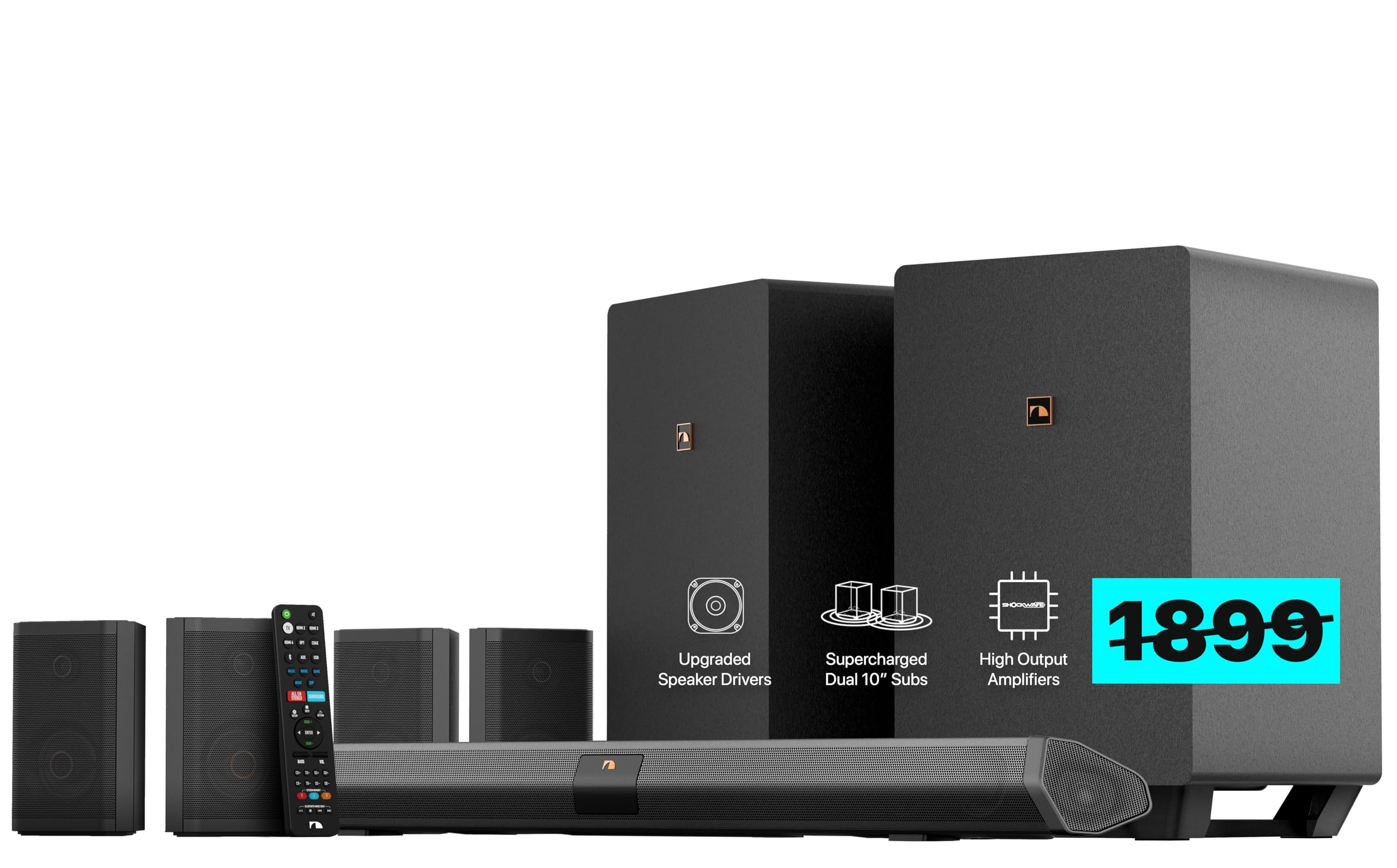
The Nakamichi Shockwafe Ultra is the ultimate plug-and-play system for those who prioritize raw, tactile bass and a massive soundstage. Its industry-exclusive dual 10-inch wireless subwoofers deliver deep, room-shaking low-end down to 20Hz, creating the physical sensation of being in a commercial cinema. The four modular surround speakers provide a dense, 360-degree bubble of sound, making object-based audio from Dolby Atmos and DTS:X incredibly lifelike.
With a 1300-watt peak output and SSE MAX processing, this system is built for large rooms or dedicated media spaces. The included HDMI eARC and three additional HDMI inputs provide ample connectivity for multiple 4K sources. The large, backlit remote is also a thoughtful touch for dark home theater environments. For sheer, uncompromising power in a soundbar format, the Shockwafe Ultra stands alone.
The system’s size is a significant consideration. The soundbar is 45.5 inches wide, and each subwoofer weighs nearly 24 pounds. Setup also requires running speaker wire from the subs to the four surround speakers. While not technically wireless for the satellites, the performance payoff is immense for those willing to manage the cabling.
Why it’s great
- Dual 10-inch subwoofers produce incredible, tactile bass.
- Four dedicated surround speakers for dense 360° sound.
- Full support for Dolby Atmos and DTS:X.
- Multiple HDMI inputs with 4K HDR pass-through.
Good to know
- Very large and heavy system requires significant space.
- Surround speakers connect to subs via RCA cables, not wireless.
- Some users report the included power cables can be finicky.
3. JBL Bar 700MK2 7.1 Channel

The JBL Bar 700MK2 solves a major pain point of surround sound: clutter. Its detachable, battery-powered surround speakers can be lifted off the main bar and placed anywhere behind you without the need for power outlets or long cable runs. This makes it uniquely versatile for rooms where wiring is difficult. The 10-inch wireless subwoofer delivers thunderous bass that anchors the soundstage.
Dolby Atmos decoding creates convincing overhead effects, and JBL’s MultiBeam 3.0 technology widens the front soundstage to fill the room. The PureVoice 2.0 system excels at clarifying dialogue, automatically adjusting based on ambient noise. The JBL ONE app provides a 10-band EQ for fine-tuning the sound to your preference.
The rechargeable surround speakers have a finite battery life, so remembering to dock them on the soundbar for charging is essential. Some users note that the surround effects are not as spatially precise as wired systems, and the lower mid-bass can feel slightly scooped without EQ adjustment. However, the convenience trade-off is excellent for most living rooms.
Why it’s great
- Detachable, battery-powered rear speakers are clutter-free.
- Powerful 10-inch wireless subwoofer delivers deep bass.
- Clear dialogue with PureVoice 2.0 technology.
- Easy setup with a single HDMI eARC connection.
Good to know
- Detachable speakers require periodic charging.
- Surround soundstage is good but not as precise as wired setups.
- Lower mid-bass may need EQ adjustment for a balanced sound.
4. ULTIMEA Skywave X70 7.1.4ch
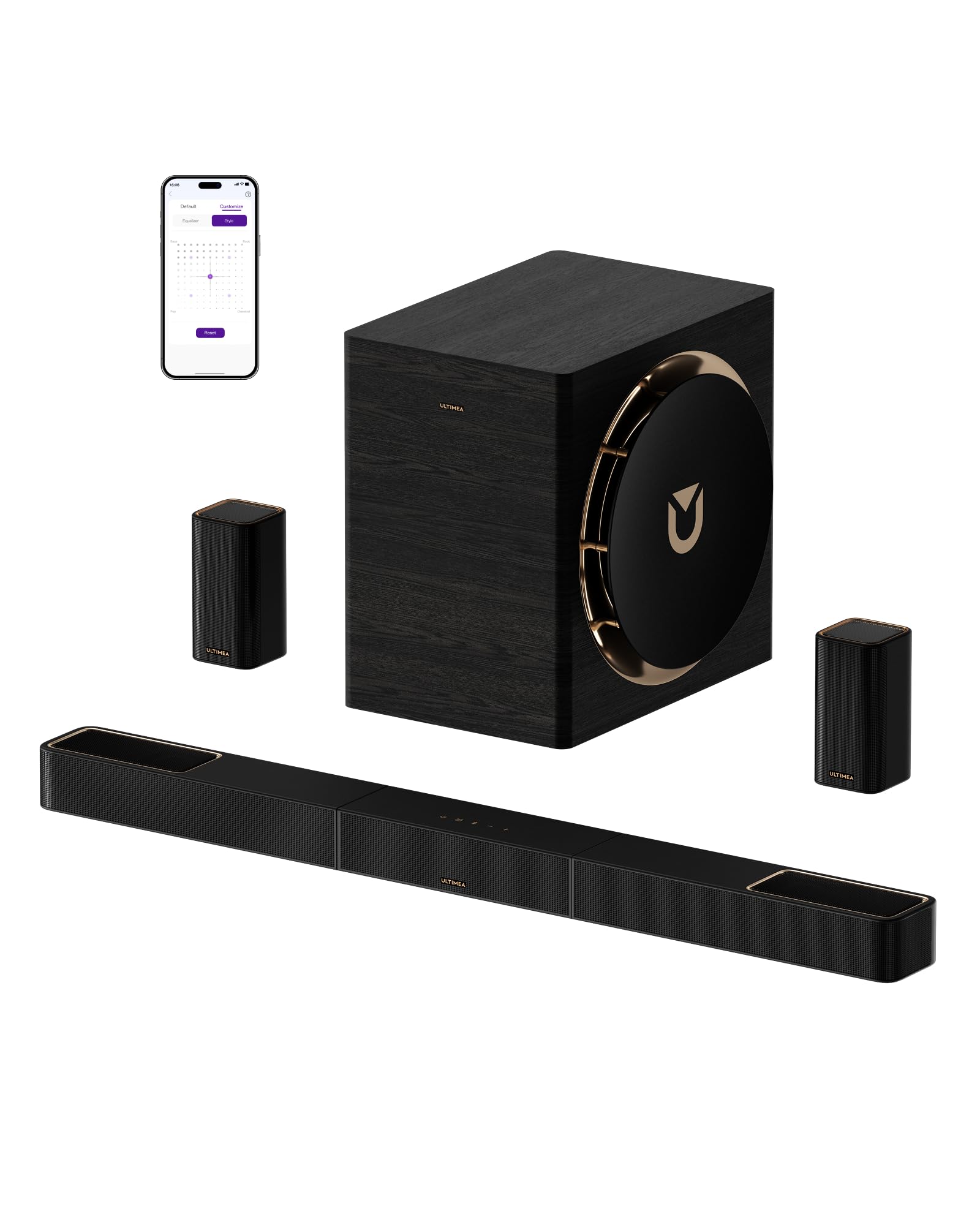
The ULTIMEA Skywave X70 is a dark horse that brings professional-grade specifications to a consumer soundbar. Its standout feature is the 10-inch wireless subwoofer that hits a true 20Hz low-frequency extension, producing sub-bass you feel as much as hear. The system is powered by a Gallium Nitride (GaN) amplifier, which offers up to 98% efficiency, meaning higher power output with significantly less heat and distortion.
The NEURACORE multi-channel audio engine processes up to 17 channels, ensuring precise object placement in a 7.1.4 configuration. The wireless surround speakers and subwoofer operate on a dedicated 5GHz band, minimizing interference. The ULTIMEA app offers massive control, including a 10-band EQ, 121 sound presets, and OTA firmware updates for future-proofing.
While the system is feature-rich, some reviews note that the surround speakers, while wireless to the system, still have stiff included cables for power. The sound profile is very bass-forward, which is fantastic for action movies but may require tuning for music. The lack of auto-calibration means you will need to manually configure levels within the app for optimal performance.
Why it’s great
- 20Hz sub-bass from 10″ subwoofer is chest-thumping.
- GaN amplifier provides clean, efficient, high-power output.
- Dual 5GHz wireless transmission prevents interference.
- Extensive app control with 121 sound presets.
Good to know
- No auto-room calibration; manual setup required.
- Surround speakers have stiff power cables despite being “wireless”.
- Bass-heavy profile needs EQ for music.
5. Sony BRAVIA Theater System 6

The Sony BRAVIA Theater System 6 (HT-S60) is the quintessential upgrade for owners of newer Sony TVs. It integrates seamlessly, allowing you to control the soundbar from the TV’s own menu and leverage Sony’s Voice Zoom 3 technology for enhanced dialogue. The 5.1-channel configuration includes a dedicated center channel, a wireless subwoofer, and wireless rear speakers, providing a true surround sound experience out of the box.
Support for Dolby Atmos and DTS:X ensures you get the latest 3D audio formats from streaming services and Blu-rays. The included subwoofer offers clean, powerful bass that enhances movie explosions without overpowering the mid-range. The dedicated center channel is a standout, ensuring dialogue remains anchored to the screen even during loud action scenes.
One notable drawback is that the subwoofer must be wired to the TV, which can complicate placement. The included cables are also somewhat short and crimped, potentially requiring longer replacements for flexible placement. Some users also report HDMI-CEC handshake issues with non-Sony devices, causing momentary audio dropouts. For pure sound quality and integration with a Sony TV, however, this system is hard to beat.
Why it’s great
- Seamless software integration with Sony BRAVIA TVs.
- Dedicated center channel for crystal-clear dialogue.
- Powerful, clean bass from the included subwoofer.
- Supports both Dolby Atmos and DTS:X.
Good to know
- Subwoofer requires a wired connection to the TV.
- HDMI-CEC can be problematic with non-Sony devices.
- Rear speakers have long, trip-hazard wire runs.
6. Klipsch Reference Cinema Dolby Atmos 5.1.4

The Klipsch Reference Cinema Dolby Atmos 5.1.4 System is a unique package that brings dedicated Dolby Atmos height effects from all four satellite speakers. Unlike many systems where only the front soundbar has up-firing drivers, this Klipsch system includes up-firing speakers in the rear satellites as well, creating a more cohesive and enveloping overhead sound field. The proprietary Tractrix horn-loaded tweeters ensure high efficiency and detailed high-frequency response.
This is a true component system with a powered subwoofer and passive satellite speakers, offering more flexibility than a soundbar. The included 10-inch subwoofer provides ample low-end punch for a medium-sized room. For its price point, it offers an exceptional array of channels and is a fantastic entry point into a serious Dolby Atmos setup.
Potential buyers should be aware that this system does not include speaker wire, and some users find the push-locking connections tight with larger gauge wire. The satellite speakers are larger and heavier than typical small satellites, requiring sturdy placement. The system also requires a 9-channel AV receiver to drive the full 5.1.4 configuration, which is an additional investment.
Why it’s great
- Dolby Atmos up-firing drivers in all four satellite speakers.
- Horn-loaded tweeters for efficient, detailed highs.
- Includes a powerful 10-inch powered subwoofer.
- Excellent value for a dedicated 5.1.4 system.
Good to know
- Speaker wire and AV receiver are not included.
- Satellite speakers are larger than average.
- Crossovers need manual setting for optimal integration.
7. Polk Audio Signature Elite ES20 (Pair)

For the audio purist who values musicality and stereo imaging, the Polk Audio Signature Elite ES20 bookshelf speakers are a stellar choice. These are not soundbars—they are passive speakers that require an AV receiver or integrated amplifier to shine. The 6.5-inch dynamic balance woofer, paired with Polk’s patented Power Port technology, delivers surprisingly deep and distortion-free bass for their cabinet size, often negating the need for a subwoofer in smaller rooms.
The 1-inch Terylene tweeter provides a smooth, detailed high end that is non-fatiguing for extended listening sessions. The cabinet is built with high-quality materials and comes in a beautiful Walnut finish. They are timbre-matched to the rest of the Signature Elite line, allowing you to build a full 5.1 system over time by adding a center channel, tower speakers, and a subwoofer.
These speakers are physically large for “bookshelves,” with a surprising depth that may not fit standard shelves. They require careful placement away from the rear wall to maximize the Power Port’s bass output. They also reveal the quality of your source material and amplification—a low-quality receiver will not do them justice. For those building a dedicated hi-fi or home theater system, the ES20s are an exceptional foundation.
Why it’s great
- Deep, clean bass for a bookshelf speaker via Power Port.
- Excellent detail retrieval and a wide soundstage.
- Timbre-matched for easy system expansion.
- High-quality build and attractive finish.
Good to know
- Requires an external amplifier or AV receiver.
- Larger and deeper than typical bookshelf speakers.
- Need space behind them for the rear-firing port.
8. LG S40TR 4.1 ch Soundbar

The LG S40TR is the entry-level champion that proves you don’t need a massive budget for a true surround sound experience. This 4.1-channel system includes a wireless subwoofer and, crucially, wireless rear satellite speakers. The rear speakers connect wirelessly to the soundbar (though they are wired to each other), eliminating the need for a separate receiver. This makes it the simplest and most affordable path to a real, multi-speaker surround setup.
Dolby Audio and DTS Digital decoding ensure solid sound quality for movies, while LG’s AI Sound Pro automatically optimizes the audio profile for the content you are watching. Clear Voice Plus is a welcome feature for improving dialogue clarity. The system supports Bluetooth for music streaming and can integrate with LG TVs for a unified control experience via WOW Interface.
While it offers fantastic value, the sound quality is a step down from more expensive systems. The bass is good but not thunderous, and the surround effects are more ambient than pinpoint accurate. The subwoofer is wireless but still needs to be plugged into a power outlet. For a small to medium-sized living room seeking an upgrade from TV speakers with minimal hassle, the LG S40TR is a smart buy.
Why it’s great
- Truly affordable entry point to 4.1 channel surround sound.
- Included wireless rear speakers and subwoofer.
- Clear Voice Plus for dialogue enhancement.
- Easy setup via optical or HDMI ARC.
Good to know
- Sound quality is good but not premium.
- Surround effects are more ambient than precise.
- Rear speakers are wired to each other.
9. Sony CS Speakers SS-CS5M2 (Pair)

The Sony SS-CS5M2 bookshelf speakers are the budget audiophile’s secret weapon. They are a true 3-way, 3-driver design, a rarity at this price point, with a dedicated super tweeter for extended high-frequency response up to 50kHz (suitable for Hi-Res Audio). The 5.12-inch woofer, while not massive, delivers tight, controlled bass that is surprisingly clean for its size. They reveal new details in familiar tracks, particularly in jazz and acoustic genres.
When paired with a quality stereo amplifier, these speakers produce a wide, spacious soundstage with excellent imaging. They are also a perfect match for Sony AV receivers, allowing for an easy upgrade path to a full 5.1 system. Their compact footprint makes them ideal for desktop setups or small rooms. The classic black finish is understated and professional.
These are passive speakers, meaning they require an amplifier or receiver. They are also rear-ported, requiring space from the wall for optimal bass performance. Their bass output is limited below 50-60Hz, so a subwoofer is recommended for movie watching or bass-heavy music. At full retail, they can be slightly overpriced, but on sale, they are an absolute steal and the best value in hi-fi bookshelf speakers.
Why it’s great
- Exceptional clarity and detail for the price.
- True 3-way design with dedicated super tweeter.
- Hi-Res Audio certified with wide frequency response.
- Compact and easy to place in small spaces.
Good to know
- Requires a separate amplifier or AV receiver.
- Rear-ported, needs space from the wall.
- Limited deep bass; a subwoofer is recommended.
FAQ
How many channels do I really need for a good home theater?
Is a soundbar better than separate speakers for a living room?
Can I use a powered subwoofer with a soundbar?
What is the difference between a passive and a powered speaker?
Does HDMI eARC matter for audio quality?
Final Thoughts: The Verdict
For most users, the audio system for home winner is the Sonos Arc Ultra because it delivers the best balance of premium sound quality, sleek design, and ecosystem expandability. If you want the most powerful, tactile bass and a massive, room-filling 360° soundstage, grab the Nakamichi Shockwafe Ultra. And for a budget-friendly entry into true hi-fi music listening, nothing beats the value of the Sony CS Speakers SS-CS5M2 when paired with a basic amplifier.

Mo Maruf
I created WellFizz to bridge the gap between vague wellness advice and actionable solutions. My mission is simple: to decode the research and give you practical tools you can actually use.
Beyond the data, I am a passionate traveler. I believe that stepping away from the screen to explore new environments is essential for mental clarity and physical vitality.