Our readers keep the lights on and my smoothie glass nicely filled. As an Amazon Associate, I earn from qualifying purchases.
Long-range binoculars are a different breed. Unlike a general-purpose 8×42 that works for a backyard bird feeder or a stadium seat, a true long-range optic sacrifices portability and field of view for sheer reach. Every millimeter of objective lens diameter and every unit of magnification comes with a trade-off in weight, hand-shake, and tripod dependency. Buying the wrong pair means wasting money on a unit that is either too dim at dusk, too shaky to resolve a target at 500 yards, or too heavy to carry to your observation point.
I’m Mohammad Maruf — the founder and writer behind WellFizz. I’ve spent years analyzing optical path data, comparing prism geometries, and correlating customer stress tests with real-world field performance for high-magnification, large-aperture binoculars.
In this guide, I break down the concrete specs, ergonomic realities, and use-case scenarios that actually matter when choosing a pair of binoculars for long range, helping you match the right optic to your specific distance demands and budget tier.
How To Choose The Best Binoculars For Long Range
Long-range binoculars are not an all-purpose tool. The decisions you make about magnification, aperture, stabilization, and tripod compatibility will determine whether your viewing experience is crisp and steady or a frustrating, blurry mess. Here are the four factors that separate a capable long-range optic from a failed purchase.
Magnification vs. Stability: The Shake Trade-Off
At 10x and below, most adults can hold binoculars steady enough for a usable image. Above 12x, the natural tremor in your hands becomes very visible through the eyepiece, turning any target into a bouncing mess. At 16x, 20x, or 25x — the typical magnifications for long-range work — a tripod is not optional; it is mandatory. Some models offer electronic image stabilization (Canon, SIG SAUER) that dampens high-frequency hand shake, allowing hand-held use at 12x to 16x. The trade-off is battery dependency and a higher cost. For any non-stabilized optic above 12x, budget for a heavy-duty tripod and a fluid video head.
Objective Lens Diameter: The Light-Gathering Formula
The second number in a binocular’s spec (e.g., 20×80, 25×100) is the objective lens diameter in millimeters. A larger objective collects more light, delivering a brighter image at dawn, dusk, or under moonlit skies. Each 10mm increase in diameter significantly boosts the exit pupil (the beam of light reaching your eye). For long-range viewing in low-light conditions, an exit pupil of 4mm or larger is ideal. The penalty is weight and bulk — an 80mm lens body is heavy enough to demand a tripod, and a 100mm pair is a stationary instrument, not a carry-along optic.
Prism Glass (BaK-4 vs BK-7) and Coatings
BaK-4 (barium crown) glass produces a rounder, brighter exit pupil than the cheaper BK-7 alternative. For long-range binoculars, where every photon matters, BaK-4 is non-negotiable. Fully Multi-Coated (FMC) optics — where every air-to-glass surface receives multiple anti-reflective layers — maximize light transmission (95%+ is excellent) and reduce internal flare. A few premium models add phase-coating on roof prisms and dielectric mirrors, but for most long-range users, BaK-4 + FMC is the reliable baseline that delivers crisp, neutral color at distance.
Tripod Compatibility and System Weight
Almost every long-range binocular above 15x or 70mm aperture includes a built-in 1/4”-20 tripod thread. Do not ignore this. The total system weight (binoculars + tripod + head) often exceeds 10 pounds. A lightweight photo tripod will vibrate, drift, or collapse under a 5-pound 25×100 pair. For stationary astronomy or long-distance terrestrial spotting, invest in a heavy-duty tripod rated for at least double your binoculars’ weight. A fluid pan-tilt head makes scanning horizons smooth and controlled.
Quick Comparison
On smaller screens, swipe sideways to see the full table.
| Model | Category | Best For | Key Spec | Amazon |
|---|---|---|---|---|
| Celestron SkyMaster 25×100 | Giant Aperture | Deep-sky astronomy, extreme range | 100mm objective / 25x mag | Amazon |
| Celestron SkyMaster Pro 20×80 | Pro-Grade | Astronomy with reflex sight option | 20x mag / XLT coatings | Amazon |
| Leupold BX-4 Pro Guide HD 12×50 | HD Roof Prism | Hunting, long-range terrestrial spotting | Calcium-fluoride lenses | Amazon |
| SIG SAUER ZULU6 HDX 16×42 | Image Stabilized | Hand-held long-range observation | OIS Scan/Target modes | Amazon |
| Bushnell Match Pro ED 15×56 | Precision Shooting | PRS matches, ballistic spotting | MRAD Shot-Call reticle | Amazon |
| Canon 12×36 IS III | Compact IS | Travel, all-purpose stabilized viewing | Vari-Angle IS system | Amazon |
| Sogries 18×70 Astronomy | Tripod Bundle | Astronomy with digiscoping | 70mm aperture / IPX7 | Amazon |
| Aurosports 20×80 | Large Aperture | Budget astronomy, low-light | 80mm lens / BaK-4 prisms | Amazon |
| Sogries 10-30×50 Zoom | Variable Zoom | Multi-distance flexibility on a tripod | 10-30x zoom range | Amazon |
In‑Depth Reviews
1. Celestron SkyMaster 25×100 Binoculars
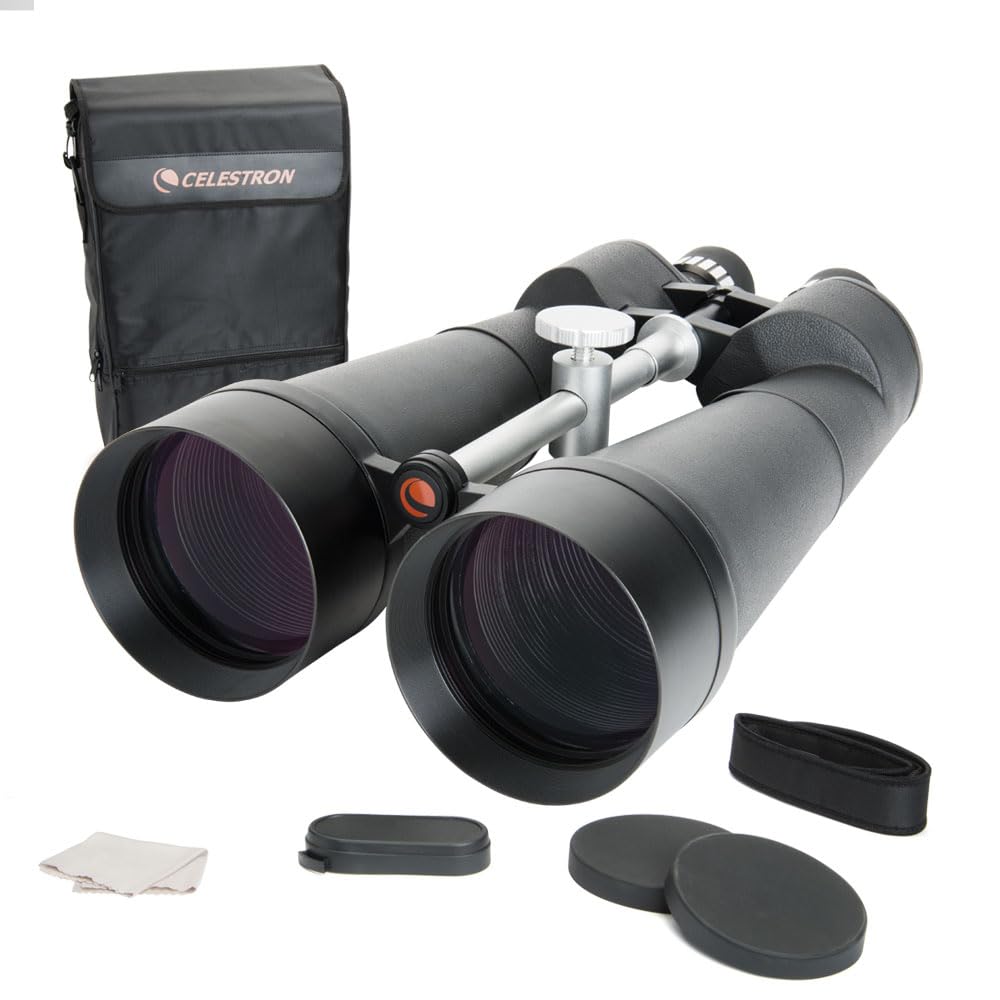
This is the giant-aperture binocular that defines the long-range category for a reason. The 100mm objective lenses capture 2.5 times more light than a 50mm unit, making deep-sky objects like galaxies and faint nebulae visible in a way smaller glasses cannot match. The individual-eye focus mechanism is slower than a center wheel, but it locks focus independently per barrel, which is critical for eliminating collimation drift during extended astronomy sessions.
At over 5 pounds, hand-holding is impossible — this is a tripod-only instrument. The built-in 1/4”-20 adapter threads into any standard tripod plate, but most users will need a heavy-duty fluid head to counter the leverage of those wide 100mm barrels. Several verified owners report resolving Jupiter’s moons and the trapezium in Orion, a performance level that rivals entry-level telescopes.
The included backpack-style case is functional but snug; some users found the zipper and padding inadequate for serious transport. A few units have shown minor manufacturing variance in tripod adapter alignment, so inspect on arrival. The 25x magnification reveals atmospheric shimmer on hot days, but under steady air, the image is stunning at price points well above.
Why it’s great
- Massive 100mm aperture delivers breathtaking light-gathering for deep-sky viewing
- 25x magnification brings distant celestial and terrestrial targets into crisp view
- Individual focus per barrel ensures sharp collimation for long sessions
Good to know
- Extremely heavy; requires a sturdy tripod and fluid head (not included)
- Included carrying case is barely adequate; consider upgrading
2. Celestron SkyMaster Pro 20×80 Binocular

The SkyMaster Pro steps up from the standard 20×80 with Celestron’s proprietary XLT fully multi-coated optics, which push light transmission higher than the base model. The 80mm aperture gathers enough light for serious lunar and planetary observation, and the rubber-armored polycarbonate housing with nitrogen-purging ensures the prism assembly stays fog-free during humid evenings. The 15.5mm eye relief is comfortable for eyeglass wearers when using the flared eyecups.
A key differentiator is the Reflex Sight Ready (RSR) rail, a detachable Picatinny-style interface on top that accepts an optional red-dot finder. This makes aiming at astronomical objects dramatically faster than hunting through the 20x field of view. It is a pro-level feature rarely seen at this price. Owners report crisp views of Jupiter’s bands and Saturn’s ring divisions on steady air, and the Moon is sharp with minimal chromatic aberration in the center field.
That said, 20x on an 80mm chassis still demands a tripod — no hand-holding here. A few users noted color fringing and some edge distortion at the extreme periphery, which is typical for porro-prism binoculars in this price tier. The Lifetime Warranty from Celestron’s California-based support team provides significant peace of mind.
Why it’s great
- XLT fully multi-coated lenses deliver exceptional brightness and contrast for the price
- RSR rail allows mounting a reflex sight for rapid target acquisition
- Waterproof and nitrogen-purged housing eliminates internal fogging
Good to know
- Heavy construction mandates a tripod for stable viewing
- Some edge chromatic aberration visible in bright conditions
3. Leupold BX-4 Pro Guide HD Binoculars, 12x50mm

The BX-4 Pro Guide HD 12×50 is a roofing-prism design that packs edge-to-edge clarity into a 1.5-pound, open-bridge body. The calcium-fluoride HD lenses deliver remarkably low chromatic aberration — you can scan power lines or treeline silhouettes at 600 yards without the purple-green fringing that plagues cheaper glass. The DiamondCoat 2 lens coating provides both scratch resistance and higher light transmission, yielding a bright image even as twilight sets.
Comfort is a strong suit: the dual-hinge, open-bridge ergonomics fit smaller interpupillary distances comfortably, and the locking diopter eliminates accidental bump-during-transport focus drift. The 4.17mm exit pupil provides a usable image in dawn and dusk conditions, though it falls short of the massive exit pupils of 20×80 or 25×100 models. Owners consistently report that the image quality rivals optics costing twice the price, including by Swarovski in side-by-side daylight comparisons.
12x magnification is hand-holdable for stable observers, but for critical long-range resolution at full 12x, bracing against a post or using a monopod still helps. The magnesium chassis is rugged enough for hard-use hunting and backcountry trips. This is the pick for someone who needs high-end glass in a portable, durable package without the astronomical bulk and weight of giant-aperture binoculars.
Why it’s great
- Calcium-fluoride HD lenses produce nearly zero chromatic aberration
- Portable at 1.5 lbs with an open-bridge, dual-hinge design
- DiamondCoat 2 coating boosts brightness and resists abrasion
Good to know
- 12x magnification still benefits from stabilization for prolonged use
- 50mm aperture cannot match massive 80-100mm low-light performance
4. SIG SAUER ZULU6 HDX OIS 16x42mm

The ZULU6 HDX 16×42 breaks the traditional tripod-only rule for high-magnification binoculars. SIG SAUER’s Optical Image Stabilization (OIS) uses gyroscopic sensors and a vari-angle prism to cancel hand shake in two modes: Scan Mode for general glassing and Target Mode for locked-on observation — the latter providing up to 50% more stabilization. At 16x, this allows a standing observer to resolve feather detail on a bird at 500 yards or read a sign text from a moving vehicle, something impossible with a standard 16x optic.
The HDX glass lens package delivers sharp resolution and excellent color rendition, though the 42mm objective has a 2.63mm exit pupil. This is inherently dimmer than larger glasses in low light, and users have noted the image is darker than some competitors at twilight. The OIS system runs on standard batteries and provides hours of continuous use, though the stabilization button must be held down continuously, which some find tiring during long sessions.
Weighing in at under 2 pounds, the ZULU6 is genuinely portable and can be pulled from a daypack and used immediately for a quick scan. The IPX-7 waterproof rating means it survives heavy rain without worry. For the user who wants 16x reach without hauling a tripod into the backcountry, this is the most capable option in this lineup.
Why it’s great
- OIS allows true hand-held use at 16x magnification
- Two stabilization modes (Scan and Target) for different observation scenarios
- Compact and lightweight enough for day-hike carry
Good to know
- 42mm objective has a small exit pupil; dimmer in low-light conditions
- IS button must be held continuously; no lock-on toggle
5. Bushnell Match Pro ED 15×56 Binoculars

The Match Pro ED 15×56 is purpose-built for the Precision Rifle Series (PRS) and long-range shooting community, with a feature set that no standard binocular matches. The Shot-Call MRAD reticle in the right barrel provides a 2/10-grid pattern inside 3 MRAD and 0.5 MRAD hash marks out to 20 MRAD, allowing direct wind and elevation corrections without external tools. An independent focus adjustment on the reticle keeps it sharp even if your distant target is unfocused.
The magnesium chassis keeps the weight at a usable 2.5 pounds, and the BridgeSet IPD Stabilizer locks your interpupillary distance so that the barrel spacing and reticle alignment remain consistent across multiple range sessions. The ED Prime glass with Ultrawideband coatings passes clean, high-clarity color to the shooter’s eye, which is critical for identifying mirage and reading the wind. Users report clear target verification out to 1100 yards on painted steel.
The dual-diopter adjustment allows independent focus per barrel, which is important for shooters who have different vision in each eye. At 15x, the unit benefits greatly from being tripod-mounted, though the 56mm aperture collects enough light for usable evening viewing. This is not an astronomy or birding glass — it is a dedicated ballistic tool for shooters who need to spot impacts and call corrections at extreme distances.
Why it’s great
- Integrated MRAD reticle with independent focus for ballistic correction
- BridgeSet IPD Stabilizer prevents accidental alignment changes
- ED Prime glass provides high-clarity, low-flare imaging for target ID
Good to know
- Reticle is only in the right barrel; not ideal for left-eye dominant shooters
- 15x magnification still requires a tripod for stable long-range spotting
6. Canon 12×36 IS III Binoculars

The Canon 12×36 IS III brings image stabilization to a compact, portable form factor that is significantly smaller and lighter than the SIG ZULU6. Weighing about 24 ounces, this is the only stabilized binocular at 12x that fits easily into a large coat pocket or small sling bag. Canon’s Vari-Angle Prism image stabilization provides a rock-steady image at 12x, effectively making hand-held shaking disappear — users report reading distant lettering and resolving small details as if the binoculars were on a tripod.
The 36mm objective lenses are modest, delivering a 3mm exit pupil. This is adequate for daytime and bright twilight use, but the image dims noticeably before full nightfall compared to 42mm-50mm stabilized competitors. The Porro II prism design and doublet field-flattener produce sharp edges with minimal distortion, which is impressive for a compact unit. Eye relief at 14.5mm is usable with eyeglasses when the eyecups are folded.
Battery life is excellent — a single set of two AA batteries lasts for many hours of IS use. The main downside is the continuous-press IS button, which some users find fatiguing during extended scanning. There is no lock or timer function. The rubberized coating has raised some long-term durability concerns, but units that are a year old are holding up well. This is the best pick for an all-around, lightweight stabilized optic that does not demand a tripod.
Why it’s great
- Effective image stabilization eliminates hand shake at 12x in a compact body
- Very lightweight — ideal for travel, hiking, and extended carry
- Superb optics for the size with minimal distortion edge-to-edge
Good to know
- 36mm objective is dim in low-light conditions (3mm exit pupil)
- IS button must be held continuously; no toggle lock feature
7. Sogries 18×70 Astronomy Binoculars

The Sogries 18×70 is a tripod-ready astronomy binocular that includes a phone adapter and tripod adapter in the box — a rare convenience for users who want to start digiscoping immediately. The 70mm objective lenses with BaK-4 prisms and fully multi-coated anti-reflective coatings deliver bright, high-contrast views of star clusters, the Moon, and even deep-sky objects in reasonably dark skies. The field of view at 231 feet per 1000 yards is generous for a 70mm glass, making sky-scanning less tedious.
The metal barrel construction gives it a solid, premium feel, but the weight — just over 3 pounds — makes it too heavy for hand-held use at 18x. Sogries includes a tripod adapter and strongly suggests a tripod in the documentation. The IPX7 waterproof rating means it can handle unexpected rain exposure without internal fogging, which is a step above many budget astronomy binoculars that are only splash-resistant.
Some users found the individual focus system slower for tracking moving terrestrial targets, but for astronomy, the per-eye focus locks in and remains set. The smartphone adapter works for grabbing quick digiscoped images of the Moon and bright planets. At the price point, the inclusion of durable accessories and IPX7 protection adds significant value over comparable open-spec glasses.
Why it’s great
- Includes phone adapter and tripod adapter for immediate digiscoping
- 70mm objective with BaK-4 prisms delivers bright low-light images
- IPX7 waterproof rating protects against rain and fogging
Good to know
- Heavy construction requires a tripod for stable use
- Individual focus is slower for terrestrial scanning
8. Aurosports 20×80 Binoculars

The Aurosports 20×80 positions itself as the budget bridge into giant-aperture binoculars. The 80mm objective lens gathers substantially more light than a standard 50mm glass, providing a bright image in dusk and dawn conditions that smaller binoculars cannot match. BaK-4 prisms and fully multi-coated lenses keep the optical path clean, with over 95% light transmission claimed. The ABS rubber-armored chassis feels solid in the hand, though weight is heavy enough that the included instructions and the product page both recommend a tripod.
At 20x magnification, the image is sharp at center field, but some edge softness is noticeable, particularly when panning across a wide landscape. The eye relief is 15mm, which is acceptable for eyeglass wearers with shorter sessions. The included carrying bag provides basic protection, and the neck strap is padded enough for short walks to a setup point. Several users have used these successfully for moon observation and distant mountain views.
The primary compromise is in build precision. A few owners noted slight collimation issues or dust inside the lenses on arrival — things that are less common on higher-priced optics. For the price, the optical performance-to-aperture ratio is strong, but careful inspection on delivery is wise. For a budget-conscious astronomer or wildlife watcher who already owns a tripod, this is a solid entry point into large-aperture long-range viewing.
Why it’s great
- 80mm objective provides major low-light advantage over 50mm binoculars
- BaK-4 prisms and FMC coatings deliver good brightness for the price tier
- Affordable gateway into giant-aperture viewing
Good to know
- Heavy weight requires a tripod for stable, comfortable use
- Occasional quality control issues with collimation and internal debris
9. Sogries 10-30×50 Zoom Binoculars
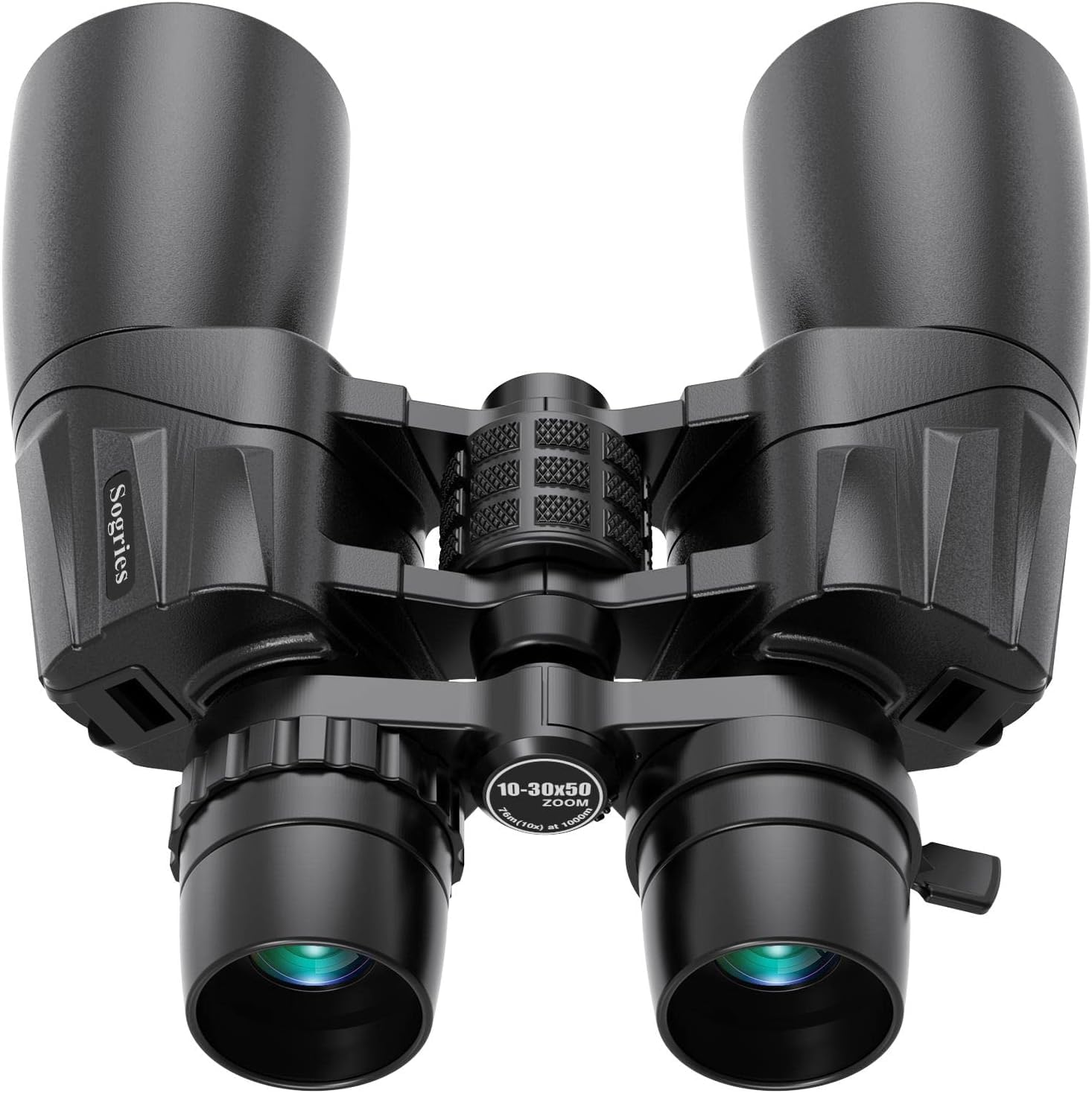
The Sogries 10-30×50 Zoom binoculars offer a continuous zoom range from 10x to 30x, giving the user the ability to sweep a wide area at low power and then zoom into a distant detail without swapping optics. The zoom joystick is smooth to operate, and the 50mm objective with BaK-4 prisms and FMC broadband green film coatings achieves a claimed 99.5% light transmission, which is unusually high for a variable zoom mechanism. At 30x, the user can read boat lettering at the horizon or inspect distant ridgelines with considerable detail.
The 50mm objective is a compromise — it is larger than a standard 42mm glass but smaller than the 70-100mm giants favored by dedicated long-range users. The field of view at 10x is 235 feet at 1000 yards, which is usable for scanning. As with all variable-zoom binoculars, image brightness and sharpness drop at the maximum zoom extreme. At 30x, the exit pupil shrinks to 1.67mm, which is dim in anything short of full daylight, and the image requires a tripod to be stable enough to resolve fine details.
The rubber armor coating provides a secure grip even in damp conditions, and the O-ring sealed construction makes them waterproof and fog-proof. The 22mm eye relief is generous for spectacles. The included 10-year warranty and 24-hour customer service add reassurance. This is the best pick for a user who values flexibility over pure image quality — it is a single binocular that can handle a morning hike at 10x and an afternoon long-range scan at 30x, as long as a tripod is available for the higher magnifications.
Why it’s great
- Continuous 10-30x zoom range offers flexibility unmatched by fixed-power binoculars
- High light transmission (claimed 99.5%) for a variable-zoom system
- Generous 22mm eye relief for comfortable eyeglass use
Good to know
- 50mm objective at 30x produces a dim 1.67mm exit pupil
- Zoom adds mechanical complexity and optical compromises versus fixed-power
FAQ
Can I use long-range binoculars without a tripod if I have steady hands?
What tripod head is best for heavy 80mm-100mm binoculars?
Why do some long-range binoculars have individual focus instead of center focus?
Final Thoughts: The Verdict
For most users, the binoculars for long range winner is the Celestron SkyMaster 25×100 because it delivers the ultimate light-gathering and magnification for deep-sky and extreme-distance terrestrial viewing at a price that undercuts larger telescope setups. If you want a portable, hand-held solution with stabilization for active scanning, grab the SIG SAUER ZULU6 HDX 16×42. And for the precision shooter who needs ballistic reticle integration and dual-diopter control, nothing beats the Bushnell Match Pro ED 15×56.

Mo Maruf
I created WellFizz to bridge the gap between vague wellness advice and actionable solutions. My mission is simple: to decode the research and give you practical tools you can actually use.
Beyond the data, I am a passionate traveler. I believe that stepping away from the screen to explore new environments is essential for mental clarity and physical vitality.