Our readers keep the lights on and my smoothie glass nicely filled. As an Amazon Associate, I earn from qualifying purchases.
Nothing ruins a fresh coat of paint faster than a primer that fails to bond, sands poorly, or leaves visible scratches. The difference between an amateur-looking respray and a professional-grade finish comes down to the specific formulation and spray pattern of the undercoat you choose.
I’m Mohammad Maruf — the founder and writer behind WellFizz. I’ve analyzed hundreds of cans of automotive primer, comparing spray nozzle design, chemical composition, dry times, and sandability against real world repair scenarios to identify which formulas actually deliver a smooth foundation.
Whether you are fixing a deep stone chip, painting a replacement bumper, or covering bare metal on a restoration project, finding the right car primer determines if your final paint job will last or flake off within weeks.
How To Choose The Best Car Primer
Automotive primer is not a one-size-fits-all product. The right choice depends on the substrate (bare metal, plastic, fiberglass, or existing paint), the depth of imperfections you need to fill, and whether you are working outdoors or in a controlled garage. Understanding these variables prevents adhesion failure and orange peel texture later.
High-Build vs. Filler vs. Etching Primer
High-build primers are thick formulas designed to fill minor scratches and pinholes in a single coat, making them ideal for plastic bumpers and sanded body panels. Filler primers contain solid particulates that level out deeper imperfections but require more sanding between coats. Etching primers (self-etching) contain acid that bites into bare metal for maximum adhesion — essential if you are spraying directly on exposed steel or aluminum without a separate etch coat.
Spray Pattern and Nozzle Design
An adjustable fan nozzle (like the EZ Touch on the Dupli-Color Perfect Match) lets you narrow the spray for small touch-ups or widen it for large panels. Fixed fan nozzles, such as the Seymour PBE Professional, offer consistent atomization but waste material on small areas. For DIY users, a wide fan with 50% overlap coverage reduces streaking and gives a more uniform base layer.
Dry Time and Sandability
Fast-drying primers (20-30 minute recoat windows) let you build multiple coats in a single session, but they also harden quickly and become difficult to wet-sand if left overnight. Slower-curing formulas (1-2 hours to sand) provide a longer working window for blocking and feathering edges. Check the technical specs for “full cure time” — some premium products require 24 hours before you can apply the topcoat without risking solvent pop.
Rust Protection and Direct-to-Metal Performance
If you are working on a chassis, trailer frame, or rusty car parts, you need a rust converter primer that chemically neutralizes existing corrosion and creates a moisture barrier. Standard automotive primers are not waterproof and will allow flash rusting if left exposed. Products like the Meuvcol Rust Converter act as both primer and encapsulator, eliminating the need for a separate rust treatment step.
Quick Comparison
On smaller screens, swipe sideways to see the full table.
| Model | Category | Best For | Key Spec | Amazon |
|---|---|---|---|---|
| Dupli-Color BPR0031 | Aerosol Filler | Scratch repair and small touch-ups | 30-min dry time | Amazon |
| Seymour 20-1674 PBE | Aerosol Filler | Deep scratch filling on metal | Heat resistant to 250°F | Amazon |
| Custom Shop 1K | High-Build Surfacer | Large panels and restoration projects | 12 oz can covers 144 sq ft | Amazon |
| Polar Gloss Black Direct to Rust | Rust Converter | Rusted metal and outdoor furniture | 24-hour full cure | Amazon |
| Meuvcol Rust Converter | Rust Encapsulator | Chassis, frames, and heavy corrosion | 35 oz liquid, brush-on | Amazon |
In‑Depth Reviews
1. Dupli-Color BPR0031 Gray Perfect Match Scratch Filler Primer – 8 oz Aerosol

The Dupli-Color Perfect Match line is a proven workhorse for DIY body repair, and the BPR0031 filler primer is the foundation that makes the topcoat match work. Its acrylic lacquer formulation dries to the touch in 30 minutes — fast enough to let you build multiple coats in an afternoon without waiting overnight. The adjustable EZ Touch nozzle rotates 360 degrees, allowing you to switch between a vertical fan for panel work and a horizontal pattern for narrow edges, which reduces overspray on small touch-ups.
Real users consistently report that this primer sands smoothly with 400-grit paper and leaves almost no witness lines after topcoat application. One verified buyer used it on a sun-damaged Toyota bumper, applying four light coats with ten-minute intervals, then let it dry overnight before painting. The result survived multiple car washes with no peeling. Another reviewer noted that the can size — 8 ounces — is perfect for a single bumper or fender but runs short if you are priming an entire hood.
The primary limitation is coverage depth. This is a scratch filler, not a high-build surfacer, so it works best on light to moderate imperfections. Deep gouges or dents still require body filler before this primer. For the majority of DIY jobs — chipped edges, key scratches, faded clear coat — it delivers a finish that matches factory paint when used with the corresponding Perfect Match color aerosol.
Why it’s great
- Adjustable spray nozzle improves control on curved panels
- Fast 30-minute dry time allows quick layering
- Sandable within an hour with no gumming
Good to know
- 8 oz can is small for large-area projects
- Not a high-build formula — won’t fill deep scratches in one coat
2. Seymour 20-1674 PBE Professional Primer, Gray Filler

Seymour’s PBE Professional Primer is formulated specifically for body shop environments, which means it prioritizes build thickness and sandability over mere coverage. The gray filler formula dries to a matte finish and sands like butter — one reviewer described it as “one of the best sandable primers I’ve used.” Its particulates are fine enough to fill pinholes and light sanding scratches in a single coat, yet it does not shrink back after the topcoat is applied.
Heat resistance up to 250°F makes this a solid choice for engine bay components or brake caliper brackets where standard primers would soften. The large sprayhead delivers a professional fan pattern, but several users note that it is a fixed fan — you cannot reduce the spray width for small touch-ups. On the plus side, the coverage is generous: approximately 10 square meters per liter, and one can handles a full sedan door or half a hood without running out.
Cosplay and 3D print enthusiasts have also adopted this primer for its ability to fill layer lines on PLA and resin prints. The same properties that make it good for car panels — thick application, fast drying, easy sanding — translate perfectly to smoothing out additive manufacturing artifacts. Just be aware that the aerosol requires a vigorous shake of 2-3 minutes to properly mix the settling solids.
Why it’s great
- Excellent filling power for scratches and pinholes
- Heat resistant to 250°F for engine bay use
- Dries fast and sands without clogging paper
Good to know
- Fixed fan nozzle — not ideal for small areas
- Requires long shake time to remix settled solids
3. Custom Shop 1K High Build Primer Spray Paint – 12 Oz Grey
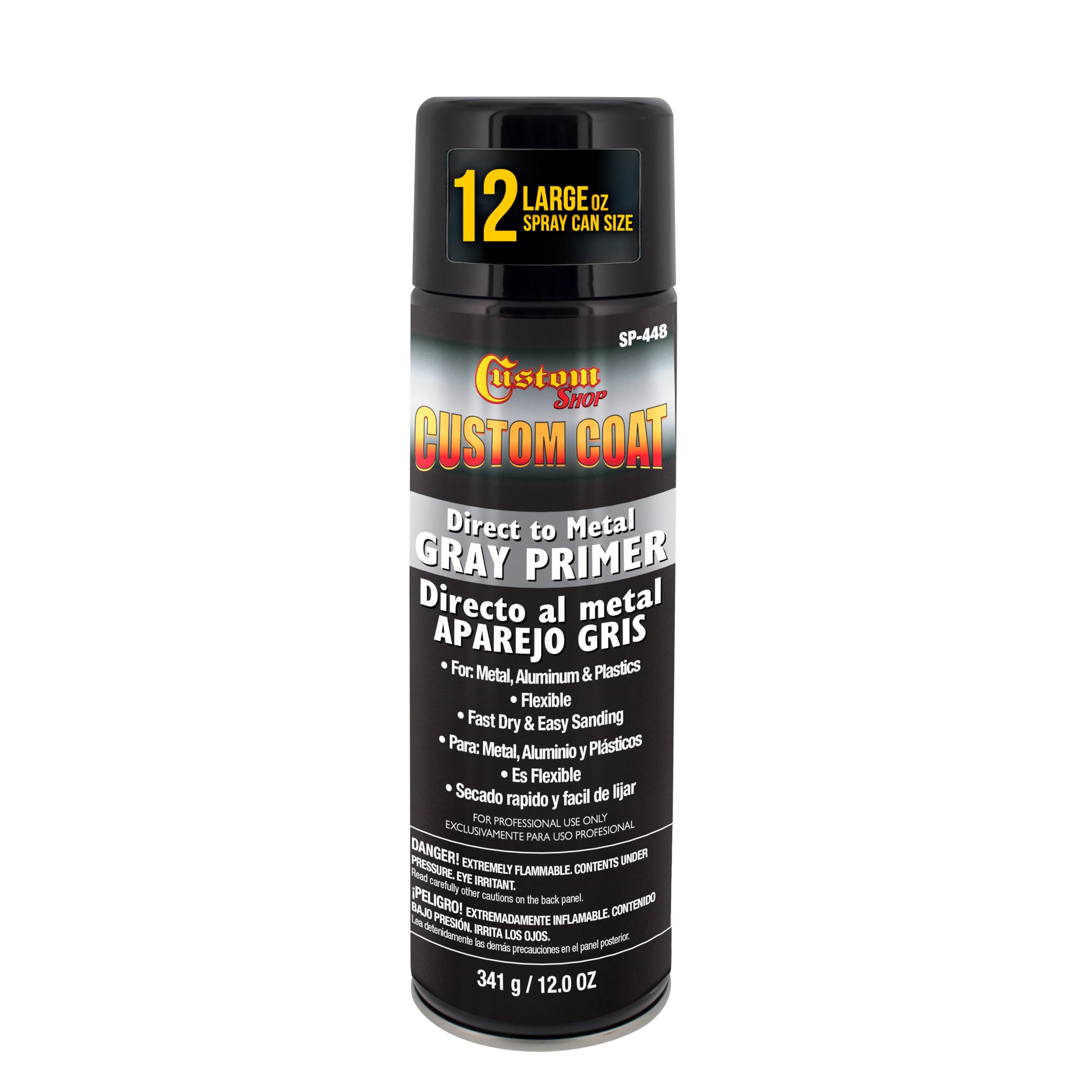
The Custom Shop 1K High Build Primer sits in the sweet spot between cost and capability. At 12 ounces per can with a claimed coverage of 144 square feet, it offers the most material per dollar in the high-build category. The flat fan high-atomization nozzle produces a wide pattern that lays down a thick, semi-gloss film in one pass, which is ideal for covering sanded body filler or feather-edged paint transitions.
Direct-to-metal adhesion means you can spray this directly on bare steel, aluminum, fiberglass, SMC, and urethane without a separate etch primer, simplifying the workflow for full-panel repaints. Reviews highlight its forgiving nature — it sprays evenly without runs even if you move slightly slower than recommended, and the buildup is thick enough to wet-sand flat without cutting through to bare metal. One user painted a paramotor propeller with metallic urethane over this primer and achieved a candy-blue finish with no bleed-through.
The reliability issue reported by some buyers involves cans that spatter black solids or separate in storage. Two of three cans in one review sprayed globs, though the manufacturer’s customer support refunded the defective units. When the product works correctly, the performance rivals premium brands at a mid-range price point. For large projects like entire truck beds or sedan roofs, this primer’s coverage-to-cost ratio makes it a smart budget-conscious choice.
Why it’s great
- High build fills minor imperfections in one coat
- Direct-to-metal adhesion eliminates etch step
- Best coverage per can in its class
Good to know
- Some cans have been reported with separation or spattering
- 12 oz can is larger than typical aerosol — ensure adequate storage space
4. Polar Gloss Black Direct to Rust Spray Paint – 2 x 13.5 Fl Oz
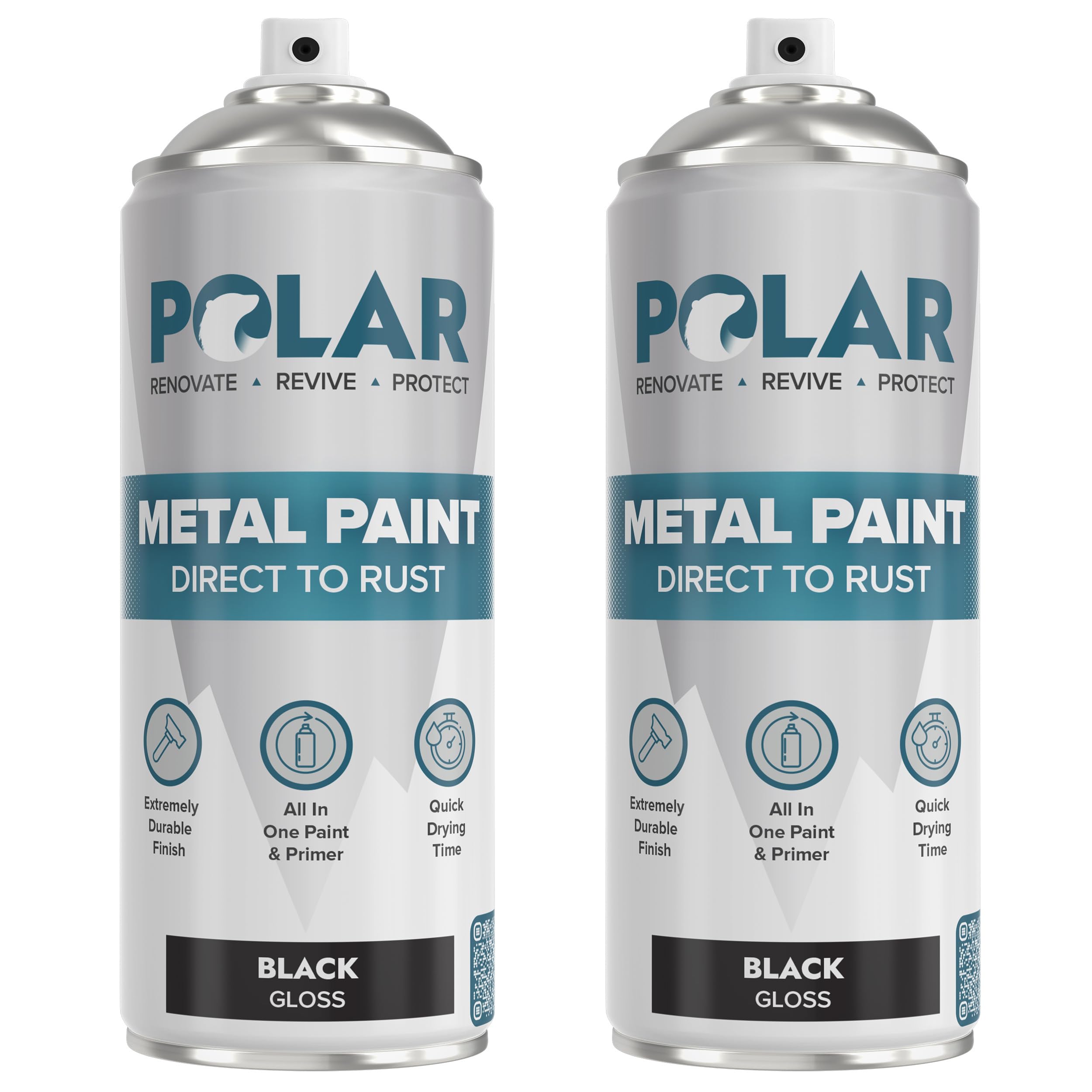
Polar’s Direct to Rust formula is a three-in-one product that acts as primer, undercoat, and gloss topcoat, which makes it a practical pick for anyone refreshing rusty metal without the patience for a multi-step system. The gloss black finish is UV and salt-spray resistant, so it works well on outdoor items like garden furniture, bike frames, and metal gates where exposure is constant. The aerosol applies from 15-25 cm distance and dries to the touch in 20 minutes, with full cure in 24 hours.
The dual-pack offers two 13.5-ounce cans, giving you enough product for a small trailer tongue, a pair of motorcycle handlebars, or a set of rusty tools. One verified buyer cleaned ground-in rust with a wire wheel, applied this as primer, then topcoated with a different color — the adhesion held through trailer use without peeling. Another user noted that the finish is glossy enough to serve as a standalone topcoat on interior metal parts where appearance is secondary to protection.
The main caveat is surface preparation sensitivity. Multiple reviews mention that if the metal isn’t sanded smooth, the paint can peel off in sheets. The product actively bonds to rust, but loose or flaking rust must be removed first. A small number of cans arrived with the nozzle blocked or felt half-empty, suggesting potential quality control variability. For light-to-moderate rust on non-structural parts, this is a fast solution; for frame rails or load-bearing components, a dedicated rust converter is safer.
Why it’s great
- All-in-one primer, undercoat, and topcoat
- Waterproof and UV resistant for outdoor use
- Dual-pack provides excellent coverage for smaller projects
Good to know
- Poor adhesion if surface is not adequately sanded
- Some units arrive with clogged nozzles or low propellant
5. Meuvcol 2 in 1 Rust Converter & Metal Primer – 35 oz Black
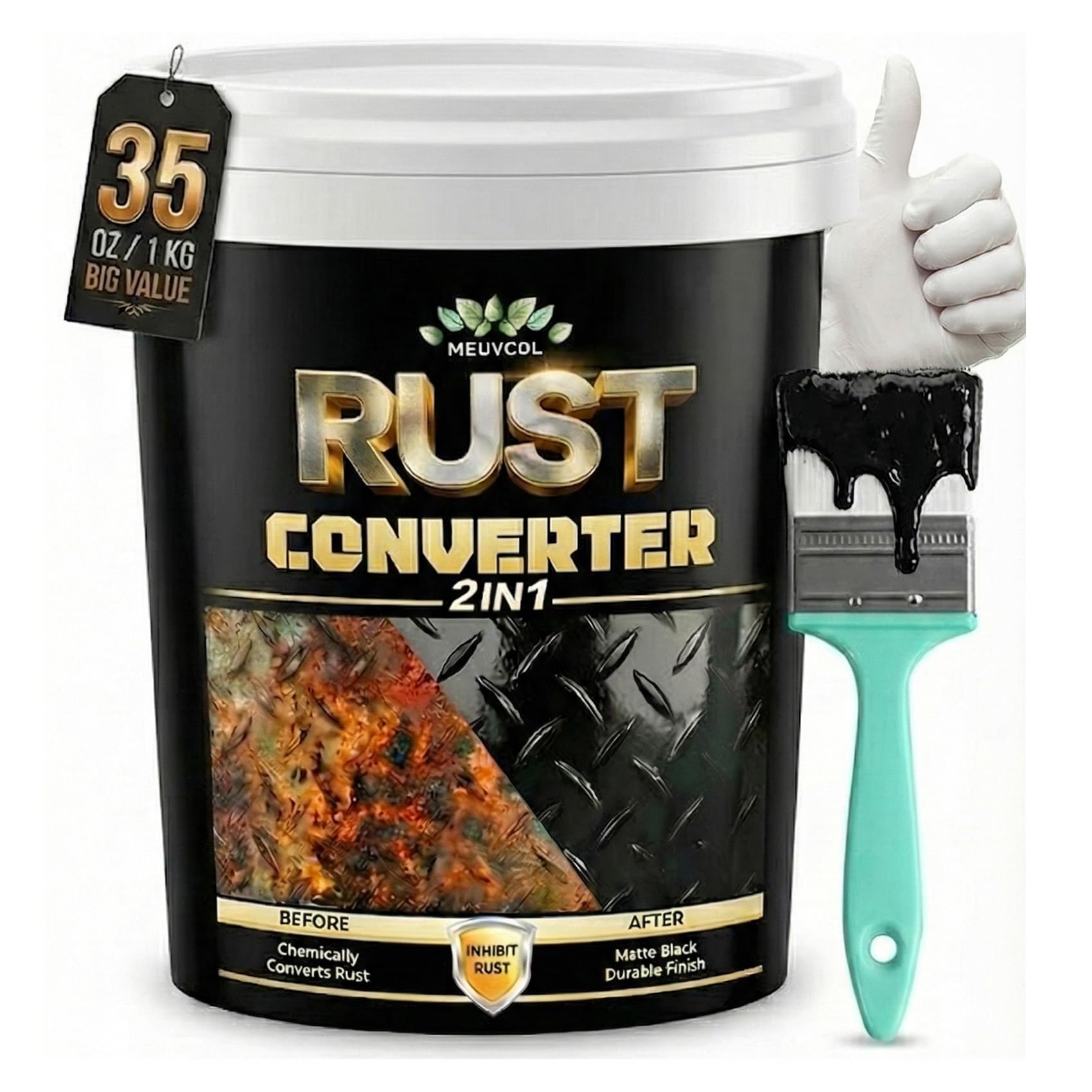
When corrosion has already taken hold, a standard primer is not enough — you need a chemical converter that neutralizes iron oxide and forms a moisture-proof barrier. The Meuvcol Rust Converter is a single-component liquid that applies with a brush (included in the box) and dries to a flat, matte-black finish that acts as both primer and rust encapsulator. The 35-ounce container is the largest in this roundup, making it the logical choice for truck frames, trailer chassis, farm equipment, and marine applications where coverage area matters more than aerosol convenience.
The chemistry works by reacting with rust to form a stable organometallic layer that blocks oxygen and moisture. After application, the surface can be topcoated with any automotive paint or left as-is for a utilitarian finish. Reviews from users who applied it to antique metal statues and swimming pool walls confirm that the coating remains intact for months without fading or cracking, even with direct water exposure. The manufacturer recommends two thin coats with 24 hours of drying time between them for maximum durability.
The strong chemical odor is the primary drawback — this product must be used in a well-ventilated area with a respirator. It is also a brush-on liquid rather than a spray, which slows down application on complex shapes and requires thorough cleaning of the brush afterward. For spot repairs on personal vehicles, the 35-ounce size is overkill; but for anyone restoring a rusted chassis or treating an entire trailer, this is the most effective rust-stopping primer in this group.
Why it’s great
- Chemically neutralizes rust instead of just covering it
- Large 35 oz container suits frame and chassis projects
- Waterproof with excellent long-term corrosion resistance
Good to know
- Brush-on application is slower than aerosol
- Strong chemical odor — requires ventilation and respirator
FAQ
Can I spray car primer over existing paint without sanding?
Should I use a separate etching primer on bare metal?
How many coats of high-build primer should I apply?
Why does my primer look rough or orange-peel after spraying?
Final Thoughts: The Verdict
For most users, the car primer winner is the Dupli-Color BPR0031 because its adjustable nozzle and fast-drying acrylic formula provide the best balance of control, sandability, and color-match compatibility for everyday DIY repairs. If you need thick filling power for deeper scratches on bare metal, grab the Seymour 20-1674 PBE. And for treating corroded chassis or trailer frames, nothing beats the chemical rust-neutralizing action of the Meuvcol Rust Converter.

Mo Maruf
I created WellFizz to bridge the gap between vague wellness advice and actionable solutions. My mission is simple: to decode the research and give you practical tools you can actually use.
Beyond the data, I am a passionate traveler. I believe that stepping away from the screen to explore new environments is essential for mental clarity and physical vitality.