Our readers keep the lights on and my smoothie glass nicely filled. As an Amazon Associate, I earn from qualifying purchases.
Building a Dolby Atmos home theater is about more than just buying any receiver with the logo on the box. The wrong choice leaves you with hollow sound, missing overhead effects, and a system that can’t grow with your speaker layout. You need a receiver that decodes object-based audio accurately, delivers clean power to every channel, and supports the HDMI 2.1 bandwidth your modern TV and gaming console demand.
I’m Mohammad Maruf — the founder and writer behind WellFizz. I’ve spent years analyzing amplifier topologies, room correction algorithms, and HDMI chipset behavior across hundreds of home theater receiver models to understand what actually separates a competent Atmos performer from an overpriced disappointment.
After reviewing eleven models spanning entry-level value to premium reference builds, the results are clear: the best av receiver for dolby atmos balances channel count, room correction sophistication, and real-world power output without forcing you into a corner with limited expandability.
How To Choose The Best AV Receiver For Dolby Atmos
A Dolby Atmos receiver must do more than decode the format — it must deliver clean amplification to overhead speakers, manage bass across multiple subwoofers, and handle the latest HDMI standards without hiccups. These four criteria separate a genuinely immersive system from a frustrating one.
Channel Count and Configuration
The number of channels (7.2, 9.2, 11.2) dictates how many speakers you can power and process. A 5.1.2 setup uses five ear-level channels, one subwoofer, and two overhead speakers. A 7.2.4 system adds rear surrounds and four ceiling channels, creating a true three-dimensional bubble of sound. If you plan to add height speakers later, buy a receiver that can process at least 9 channels from the start — upgrading later means replacing the entire unit.
Room Correction Quality
Room correction software adjusts timing, frequency response, and volume levels for each speaker based on your room’s acoustics. Dirac Live, Audyssey MultEQ XT32, and YPAO R.S.C. are the top tiers. Basic room EQ often leaves subwoofer integration muddy and center channel dialogue recessed. Invest in a receiver with advanced room correction — it makes a bigger audible difference than amplifier wattage in most rooms.
HDMI 2.1 and Gaming Features
HDMI 2.1 with 40 Gbps bandwidth supports 4K at 120 Hz and 8K at 60 Hz passthrough, essential for modern gaming consoles and high-refresh-rate TVs. Look for Variable Refresh Rate (VRR), Auto Low Latency Mode (ALLM), and Quick Frame Transport (QFT). Without these, you may face screen tearing, lag, or blackout issues when switching inputs. Verify that the receiver’s HDMI chipset actually delivers the full bandwidth — some early models shipped with 24 Gbps chips.
Amplifier Power and Impedance Stability
Manufacturer power ratings are often measured with one channel driven at 1 kHz, which inflates the number. Real-world listening with all channels driven demands clean headroom at 4-ohm loads if you use demanding tower speakers. Look for receivers tested with two channels driven at 8 ohms (20 Hz–20 kHz, <0.08% THD). Models with toroidal transformers or high-current output stages handle dynamic peaks in Atmos soundtracks without distortion.
Quick Comparison
On smaller screens, swipe sideways to see the full table.
| Model | Category | Best For | Key Spec | Amazon |
|---|---|---|---|---|
| Onkyo TX-RZ50 | Premium | 7.1.4 Atmos with Dirac Live calibration | 120W/ch (8 ohms, 20Hz–20kHz, 2ch driven) | Amazon |
| Yamaha RX-A4A AVENTAGE | Premium | Surround:AI real-time audio optimization | 7.2ch, YPAO R.S.C. with 3D multipoint | Amazon |
| Sony STRAZ1000ES | Premium | 360 Spatial Sound Mapping for phantom height | 100W/ch (8 ohms, 2ch driven) | Amazon |
| Marantz Cinema 60 | Premium | HDAM circuitry for musicality and warmth | 100W/ch (8 ohms, 2ch driven) | Amazon |
| Denon AVR-S970H | Mid-Range | Phono input and 4K/120 gaming support | 90W/ch (8 ohms, 2ch driven) | Amazon |
| Sony STR-AN1000 | Mid-Range | Works with Sonos integration | 165W/ch (6 ohms, 1kHz, 1ch driven) | Amazon |
| JBL MA710 | Mid-Range | Shallow chassis for tight media consoles | 110W/ch (8 ohms, 2ch driven) | Amazon |
| Denon AVR-S770H | Mid-Range | Entry-level 5.2.2 with Dolby Height Virtualization | 75W/ch (8 ohms, 2ch driven) | Amazon |
| Onkyo TX-NR6100 | Mid-Range | THX Select Certified with 8K HDMI 2.1 | 210W/ch (6 ohms, 1ch driven) | Amazon |
| YAMAHA RX-V6A | Mid-Range | MusicCast multi-room streaming | 7.2ch, YPAO multipoint room correction | Amazon |
| Pioneer VSX-935 | Budget | Dolby Atmos Height Virtualization without height speakers | 7.2ch, HDMI 2.1 with 8K passthrough | Amazon |
In‑Depth Reviews
1. Onkyo TX-RZ50 9.2-Channel AV Receiver

The Onkyo TX-RZ50 brings Dirac Live room correction out of the box at a price point where competitors still use basic EQ. That alone shifts the baseline for Atmos realism — you get precise time alignment and frequency smoothing across all channels, including overheads. With 120 watts per channel into 8 ohms (two channels driven), it drives demanding 4-ohm loads without breaking a sweat, and the THX Select certification confirms clean power delivery under stress.
Processing up to 11.2 channels and amplifying 9.2 natively, this receiver supports a full 7.1.4 Atmos layout when you add an external two-channel amp. The HDMI 2.1 inputs handle 8K/60Hz and 4K/120Hz with VRR and ALLM, making it equally suited for high-refresh-rate gaming. The unit runs cool even during extended movie sessions, and the included Dirac Live measurement microphone yields consistent results after a straightforward setup process.
On the downside, the on-screen display feels dated and the remote lacks backlighting. Some users report a slight HDMI switching lag when changing sources, and the onboard Wi-Fi card can be finicky — a small number of units required warranty replacement. For the price, no other receiver in this class offers Dirac Live plus 11.2 processing, making it the most future-proof option for serious Atmos builders.
Why it’s great
- Dirac Live room correction included at this price tier is unmatched
- 11.2 channel processing for 7.1.4 Atmos expandability
- THX Select certified with robust 120W/ch amplifier section
Good to know
- Requires external two-channel amp for full 7.1.4 output
- On-screen menu is visually outdated and sluggish
- Some units experienced Wi-Fi card failure needing warranty replacement
2. Yamaha RX-A4A AVENTAGE 7.2-Channel AV Receiver

The AVENTAGE line represents Yamaha’s top-tier build philosophy, and the RX-A4A backs that up with a rigid chassis designed to minimize vibration and a high-current amplifier stage rated for 4-ohm operation. The proprietary Surround:AI technology analyzes scene content in real time and adjusts dialogue clarity, surround effects, and center channel presence frame by frame — a noticeable upgrade during chaotic Atmos action sequences where lesser receivers let dialogue get buried.
YPAO R.S.C. with 3D multipoint measurement refines the sound field across your seating area, compensating for room reflections that blur overhead effects. The seven HDMI inputs include three with 8K/60Hz and 4K/120Hz support at full 40 Gbps bandwidth, with VRR and ALLM confirmed working on current-generation gaming consoles. The MusicCast multi-room platform streams hi-res audio to compatible speakers around the house, and the phono input handles moving magnet turntables cleanly.
Setup is infamously deep — the receiver requires a USB flash drive for firmware updates, and the menu system spans multiple screens that take time to learn. The lack of a front HDMI input means you cannot quickly plug in a laptop or camera without crawling behind the rack. Once dialed in, the RX-A4A delivers a spacious, accurate soundstage that makes the room feel larger than it is, especially with Dolby Atmos height virtualization engaged for content that lacks native object encoding.
Why it’s great
- Surround:AI adapts sound parameters in real time for cinematic immersion
- YPAO R.S.C. 3D provides precise multipoint room correction
- High-current amplifier stage handles 4-ohm speaker loads reliably
Good to know
- Firmware updates require USB drive, not over-the-air
- No front HDMI port for quick device connections
- Complex setup with many nested menu pages
3. Sony STRAZ1000ES Premium ES 7.2 CH 8K A/V Receiver

The ES series has always been Sony’s statement of build quality, and the STRAZ1000ES lives up to that with a solid aluminum faceplate, gold-plated terminals, and a replaceable power cord. The headline feature is 360 Spatial Sound Mapping, which uses the receiver’s processing power to create phantom height channels from a standard 5.1.2 layout, effectively mimicking a 7.1.4 array without extra ceiling speakers. In practice, this delivers convincing overhead panning effects that blur the line between real and virtual height channels.
Digital Cinema Auto Calibration IX (DCAC IX) provides automatic room correction that handles subwoofer distance errors better than previous Sony iterations, though users report that manual height adjustments yield even better imaging. The six HDMI inputs all support HDMI 2.1 with 4K/120Hz passthrough, and the receiver integrates seamlessly with Sonos systems for multi-room audio. The backlit remote is a welcome upgrade over most competitors’ unlit wands, and the front panel cover plate gives the unit a clean, professional look.
Limitations include no HDR10+ or QMS support, and the unit runs notably warm during extended use — an external cooling fan is recommended if it sits in an enclosed cabinet. The 100-watt-per-channel rating (8 ohms, two channels driven) is honest but not class-leading; combining it with powered speakers or an external amp for the mains yields better dynamic range for demanding Atmos tracks. For rooms where installing ceiling speakers is impractical, 360 Spatial Sound Mapping is a genuinely useful alternative.
Why it’s great
- 360 Spatial Sound Mapping creates convincing phantom height channels
- Backlit remote and aluminum faceplate with premium build feel
- HDMI 2.1 with full 4K/120Hz support across six inputs
Good to know
- No HDR10+ or QMS support for HDR switching
- Runs hot in enclosed spaces — consider active ventilation
- Calibration mic may misjudge subwoofer distance without manual tweaks
4. Marantz Cinema 60 7.2-Ch Receiver (100W X 7)

Marantz differentiates the Cinema 60 through its proprietary HDAM (Hyper Dynamic Amplifier Module) circuitry and current feedback amplifier topology, which deliver a warmer, more musical presentation compared to the analytical sound of many rivals. This matters for Atmos because the format’s object-based audio includes subtle ambient cues — rainfall, distant thunder, rustling leaves — that benefit from the richer harmonic texture HDAM provides. The amplifier delivers 100 watts per channel into 8 ohms with two channels driven, which is enough to fill medium-sized rooms with clear, distortion-free sound.
The receiver includes Audyssey MultEQ XT32 room correction, one of the most capable systems outside of Dirac Live. It measures eight positions across your seating area and applies high-resolution filters to tame room modes and align subwoofer integration. Running a 5.1.2 setup with height speakers, the Cinema 60 creates a cohesive sound bubble where dialogue remains anchored to the screen while overhead effects move with precision. HEOS multi-room streaming, AirPlay 2, and a phono input round out the connectivity suite.
Setup follows the same sequential firmware update path that Marantz owners are used to — plan for an hour of updates before you calibrate. The on-screen menu is clear and modern, but navigating Audyssey’s advanced settings takes some reading. The unit lacks support for IMAX Enhanced and does not process 7.1.4 natively without an external amp. For listeners who prioritize musicality in both stereo and surround content, the Cinema 60’s HDAM-based sound signature is a compelling reason to choose it over more clinical alternatives.
Why it’s great
- HDAM discrete circuitry delivers warmer, detailed sound signature
- Audyssey MultEQ XT32 provides advanced eight-position room correction
- Phono input and HEOS multi-room streaming built in
Good to know
- Requires sequential firmware updates before first calibration
- Cannot process 7.1.4 Atmos without external amplifier
- No IMAX Enhanced decoding support
5. Denon AVR-S970H 8K Ultra HD 7.2 Channel AV Receiver

The AVR-S970H occupies a sweet spot in Denon’s lineup by offering 8K HDMI 2.1 support, 90 watts per channel, and a built-in phono preamp at a price that undercuts most premium models. It supports 5.2.2 Dolby Atmos configurations, meaning you can run two overhead speakers with a 5-channel ear-level array for a convincing overhead effect. The Audyssey MultEQ room calibration (the standard version, not XT32) still cleans up major room modes effectively, though it lacks the granularity of higher-tier systems.
Gamers benefit from VRR, ALLM, and QFT support across three 8K inputs, and the receiver handles 4K/120Hz passthrough without the blackout issues that plagued early HDMI 2.1 implementations. The HEOS app is reliable for streaming Spotify, TIDAL, and local network files, and the unit runs notably cooler than previous Denon generations. The setup wizard walks you through speaker configuration step by step, making it one of the more beginner-friendly receivers in this class.
The powered Zone 2 output reduces the main zone from 7.2 to 5.2, so you lose rear surround capability if you run a second room. The remote lacks a dedicated TV power button, and the front panel display is basic compared to the graphical interfaces on premium models. For a buyer building a first Atmos setup with a turntable and a 4K gaming console, the AVR-S970H delivers the most useful features per dollar without cutting corners on HDMI bandwidth.
Why it’s great
- Integrated phono preamp for vinyl playback without external gear
- HDMI 2.1 with VRR, ALLM, and full 4K/120Hz support
- Easy guided setup wizard for first-time AVR buyers
Good to know
- Using powered Zone 2 reduces surround channels to 5.1
- Standard Audyssey MultEQ lacks the precision of XT32 version
- Remote does not include a dedicated TV power button
6. Sony STR-AN1000 7.2 CH Surround Sound Home Theater 8K A/V Receiver

Sony positioned the STR-AN1000 as the affordable entry point to its 360 Spatial Sound Mapping technology, and it succeeds by delivering convincing immersive audio without requiring four ceiling speakers. At 165 watts per channel (6 ohms, 1 kHz, one channel driven), it has generous peak power for dynamic movie soundtracks, though the rating is less meaningful than the two-channel 8-ohm spec used by competitors. The Digital Cinema Auto Calibration IX system includes a graphical setup guide that walks through each speaker distance and level adjustment, though some users report it sets subwoofer distances too short.
The “Works with Sonos” certification is a standout feature — you can integrate this receiver into an existing Sonos ecosystem using a Sonos Port, allowing the Sonos app to control volume and input switching. Chromecast built-in, AirPlay 2, and Spotify Connect cover the major streaming platforms, and the six HDMI 2.1 inputs handle 4K/120Hz and 8K/60Hz passthrough. The receiver’s front display is unfortunately small and hard to read from a seating position, and the remote lacks backlighting.
One known issue: passing Dolby Vision from an Apple TV 4K can fail with certain firmware versions, requiring an HDMI handshake reset. The unit does not include a phono input, so turntable users need an external preamp. For buyers who want Sony’s spatial processing and Sonos compatibility at a mid-range price, the STR-AN1000 offers a compelling feature set, especially if you pair it with Sony’s wireless subwoofers for cleaner bass integration.
Why it’s great
- Works with Sonos certification for unified multi-room control
- 360 Spatial Sound Mapping for convincing phantom height effects
- Graphical setup guide simplifies initial calibration
Good to know
- No phono input for turntable connection
- Front display is small and difficult to read from distance
- Dolby Vision passthrough from Apple TV may need firmware troubleshooting
7. JBL MA710 7.2 Channel 8K AV Receiver

JBL’s MA710 is a 7.2-channel receiver that prioritizes physical fit as much as electrical performance — its shallow chassis (13.7 inches deep) slides into media consoles where full-size competitors cannot. Despite the compact dimensions, it delivers 110 watts per channel into 8 ohms, enough to drive typical bookshelf and tower speakers to reference levels in medium rooms. The receiver decodes Dolby Atmos and DTS:X natively, supporting both 7.1 and 5.1.2 configurations.
Connectivity includes six HDMI inputs with eARC, all supporting 8K/60Hz and 4K/120Hz passthrough. The moving magnet phono input allows direct turntable connection, and network streaming covers Apple AirPlay 2 and Google Chromecast. A notable design choice: the front display is bright and readable, but the remote lacks backlighting, which owners of dark home theaters will find frustrating. The auto shut-off defaults to 20 minutes and must be changed in the menu settings.
Some users report that DTS-HD Master Audio does not downmix to 2.1 channels properly, so buyers with stereo-only setups should verify compatibility. The firmware update process requires a wired network connection rather than over-the-air, and the last update was over a year ago. For buyers who need a shallow receiver that still delivers genuine Atmos decoding and a phono stage, the MA710 is a rare option that fits both dimensionally and financially.
Why it’s great
- Shallow 13.7-inch depth fits tight AV cabinets comfortably
- 110W/ch with native Dolby Atmos and DTS:X decoding
- Phono input included for direct turntable connection
Good to know
- Remote is not backlit, difficult to use in dark rooms
- Firmware updates require wired Ethernet, not over-the-air
- DTS-HD Master Audio downmix to 2.1 may not work correctly
8. Denon AVR-S770H 7.2 Ch Home Theater Receiver

Denon’s AVR-S770H is the brand’s most affordable receiver with full HDMI 2.1 support and Dolby Atmos decoding, priced to attract first-time home theater builders. The amplifier delivers 75 watts per channel into 8 ohms (two channels driven), which is sufficient for compact speaker systems in small to medium rooms. It supports 5.2.2 Atmos layouts, so two overhead speakers can be added to a five-channel ear-level array for genuine height effects rather than relying solely on virtual processing.
The Audyssey MultEQ room correction (standard version) measures the room at multiple points and applies filters to smooth frequency response, though it lacks the fine-grained subwoofer EQ of the XT32 version. Setup is guided through the on-screen menu and takes about 30 minutes for a first-time user. The receiver includes Dolby Height Virtualization and DTS Virtual:X, which simulate overhead sound in rooms where ceiling speakers cannot be installed — useful for apartments where wiring is impractical.
Firmware stability has been a recurring theme in user reports: some units randomly drop volume to zero or fail to show picture on startup, requiring a power cycle. The receiver lacks phono input and only has one subwoofer output, limiting bass flexibility in larger rooms. For a buyer on a strict budget who still wants genuine 5.2.2 Atmos with HDMI 2.1 gaming features, the AVR-S770H delivers the core functionality at the lowest entry cost in Denon’s current lineup.
Why it’s great
- Lowest-cost Denon with HDMI 2.1 and genuine 5.2.2 Atmos support
- Dolby Height Virtualization creates overhead effects without ceiling speakers
- Guided setup wizard simplifies first-time configuration
Good to know
- Firmware instability may cause random volume drops or blank screen
- No phono input and only single subwoofer output
- Standard Audyssey MultEQ less advanced than XT32 version
9. Onkyo TX-NR6100 7.2 Channel THX Certified Network AV Receiver
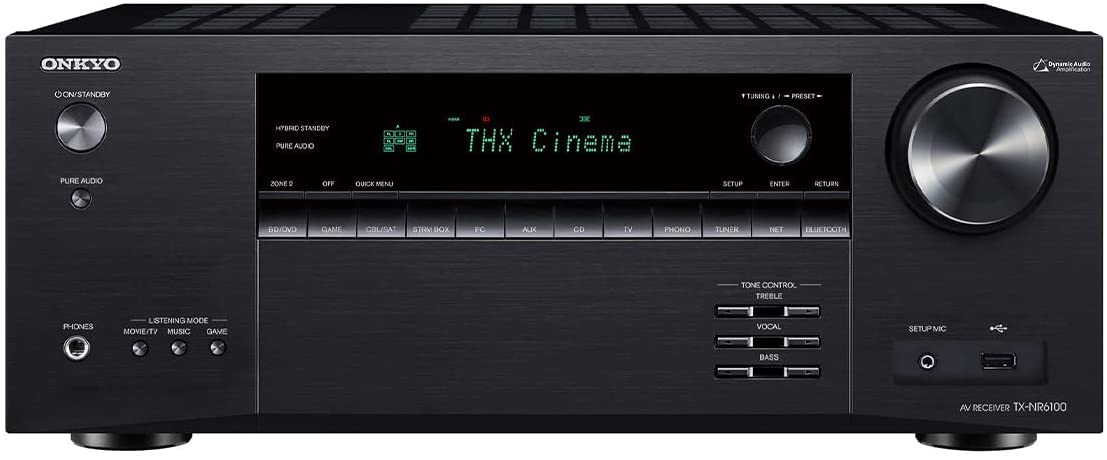
The TX-NR6100 earns THX Select certification, meaning it passes thousands of tests to ensure it reproduces film soundtracks in a medium-sized room without adding or subtracting anything from the source. It supports 5.2.2 Dolby Atmos and DTS:X playback, with three HDMI 2.1 inputs supporting 8K/60Hz and 4K/120Hz at full 40 Gbps bandwidth. At 210 watts per channel (6 ohms, one channel driven), the power supply has generous headroom for dynamic peaks, though real-world two-channel 8-ohm output is lower.
AccuEQ room calibration handles basic level and distance adjustments, but it lacks the sophistication of Dirac Live or Audyssey XT32 — subwoofer integration is noticeably less refined. The receiver includes IMAX Enhanced decoding, which optimizes audio for IMAX-certified content, and the Klipsch Optimize mode automatically sets crossover values for Klipsch Reference speakers. The AccuReflex technology aligns phase between ear-level and height speakers for seamless object movement.
Some HDMI 2.1 units shipped with defective chips that failed to deliver 4K/120Hz properly — later production runs corrected this, but verifying the manufacturing date is wise before purchase. The remote feels flimsy compared to competitors, and inputs 4 through 6 are limited to 4K rather than 8K. The TX-NR6100 offers strong baseline specs and certification at a mid-range price, but the room correction and build quality fall short of the next tier up.
Why it’s great
- THX Select certification guarantees accurate film reproduction
- Three 8K HDMI 2.1 inputs with 40 Gbps bandwidth
- Klipsch Optimize mode provides automatic crossover settings
Good to know
- Early units had defective HDMI 2.1 chips — verify production date
- AccuEQ room correction is basic compared to premium alternatives
- Remote feels cheap and some inputs are limited to 4K only
10. YAMAHA RX-V6A 7.2-Channel AV Receiver with MusicCast

The RX-V6A is Yamaha’s feature-packed mid-range workhorse, offering 7.2 channels with Dolby Atmos and DTS:X decoding plus MusicCast multi-room streaming across the entire home. It includes YPAO multipoint room correction with R.S.C. (Reflected Sound Control), which measures multiple seating positions and applies filters to tame early reflections that blur surround imaging. The amplifier section uses a high slew rate design for cleaner transient response, and users consistently note improved dialogue clarity and dynamic range over older receivers.
Connectivity is generous: seven HDMI inputs with HDCP 2.3 and eARC, three of which support 8K/60Hz and 4K/120Hz passthrough. Voice control works with Alexa, Google Assistant, and Siri via AirPlay 2, and the MusicCast app provides reliable multi-room control without the stuttering that plagues some proprietary streaming platforms. The unit works with banana plugs for clean speaker wire connections, and the dual subwoofer outputs allow more even bass distribution in irregular rooms.
Setup requires the latest firmware to unlock some HDMI 2.1 features, and the initial out-of-box experience involves a mandatory update that takes 20-30 minutes. The receiver does not auto-turn on with TV trigger in all modes, requiring manual power sequencing. The RX-V6A is a solid choice for buyers who want reliable multi-room streaming alongside competent Atmos performance, especially if they already use Yamaha wireless speakers elsewhere in the home.
Why it’s great
- MusicCast multi-room streams audio to Yamaha speakers throughout the house
- YPAO R.S.C. multipoint correction with reflected sound control
- Dual subwoofer outputs for smoother bass in challenging rooms
Good to know
- Mandatory firmware update required before full HDMI 2.1 functionality works
- Does not auto-turn on with TV in all configurations
- 3D audio effects less pronounced than higher-end AVENTAGE models
11. Pioneer VSX-935 7.2 Channel Surround Sound Network Receiver
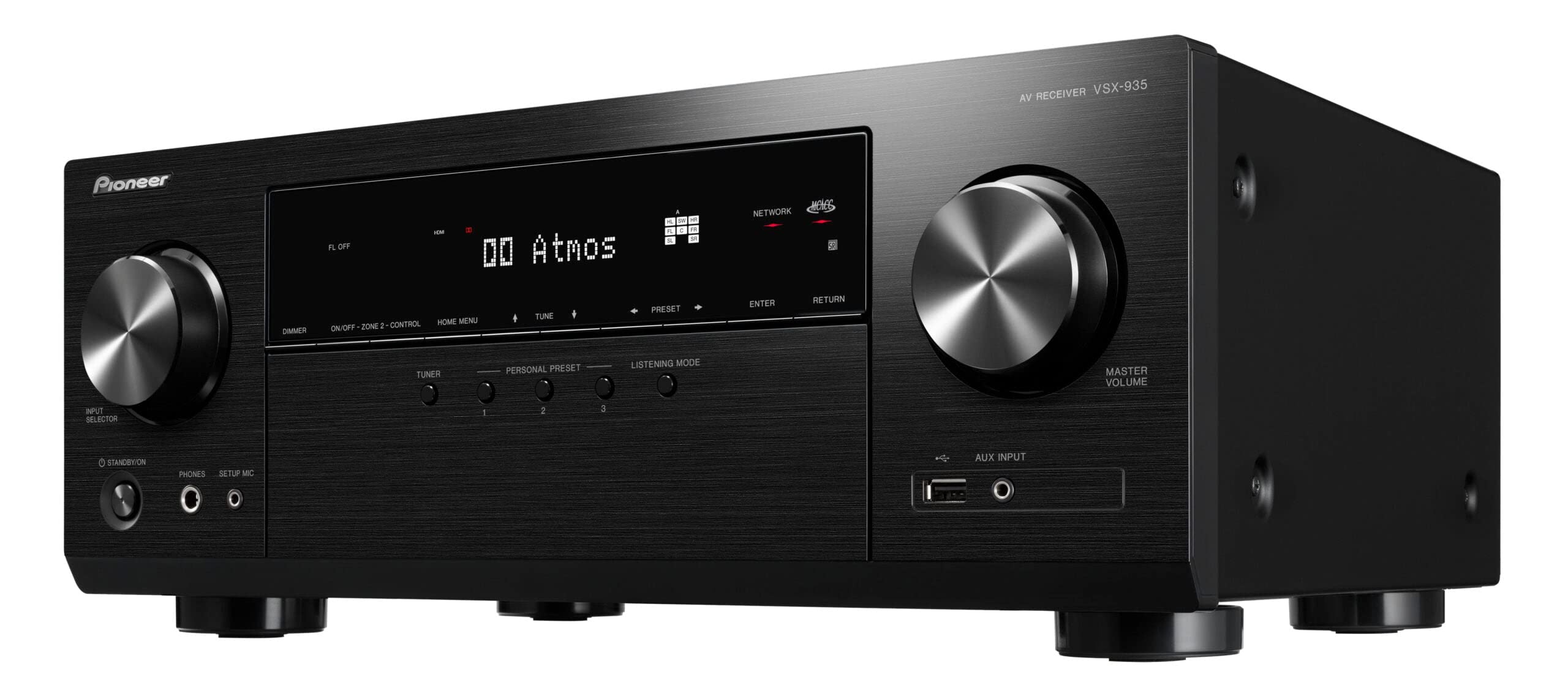
The Pioneer VSX-935 represents the most budget-conscious entry point into genuine Dolby Atmos with HDMI 2.1 support. It uses Dolby Atmos Height Virtualization to create the impression of overhead sound from traditional ear-level speaker layouts, making it a practical option for renters or rooms where ceiling speaker installation is impossible. The amplifier produces clean, clear sound with a gradual volume curve, and users upgrading from older receivers consistently note improved clarity and dynamics across movie soundtracks.
HDMI 2.1 with 8K passthrough covers basic compatibility with modern TVs and consoles, though the receiver lacks the full suite of gaming features like VRR and ALLM. It has dual zone capability, allowing a separate audio source in another room, and the RF remote works through cabinets. The display is clear and includes a dimmer for dark room use. Setup is straightforward with the on-screen menu, but the manual includes limited troubleshooting guidance.
Reliability reports are mixed — some users encounter HDMI video handshake failures with computers and total surround channel dropouts that require factory resets. The firmware update process is USB-only, which is inconvenient and prone to error codes. The room correction is basic, lacking the precision of higher-tier systems. For buyers who need the lowest-cost Atmos-compatible receiver with HDMI 2.1 and can tolerate the risk of occasional software glitches, the VSX-935 provides the core functionality at a price that undercuts everything else in this guide.
Why it’s great
- Most affordable receiver with Dolby Atmos and HDMI 2.1 support
- Dolby Atmos Height Virtualization simulates overhead effects without ceiling speakers
- Dual zone output for separate audio in second room
Good to know
- Reports of HDMI handshake failures and surround channel dropouts
- Firmware updates require USB drive, not over-the-air
- Basic room correction lacks subwoofer EQ precision
FAQ
How many channels do I need for a proper Dolby Atmos setup?
Can I use up-firing Dolby Atmos speakers instead of ceiling-mounted ones?
Does Dolby Atmos require HDMI 2.1 to work properly?
What is Dolby Atmos Height Virtualization and does it replace real height speakers?
Final Thoughts: The Verdict
For most users, the best av receiver for dolby atmos winner is the Onkyo TX-RZ50 because it bundles Dirac Live room correction with 11.2 channel processing and THX certification at a price that undercuts premium competitors. If you want the most immersive surround processing without ceiling speakers, grab the Sony STRAZ1000ES. And for a tight cabinet space and a phono input, nothing beats the JBL MA710.

Mo Maruf
I created WellFizz to bridge the gap between vague wellness advice and actionable solutions. My mission is simple: to decode the research and give you practical tools you can actually use.
Beyond the data, I am a passionate traveler. I believe that stepping away from the screen to explore new environments is essential for mental clarity and physical vitality.