Our readers keep the lights on and my smoothie glass nicely filled. As an Amazon Associate, I earn from qualifying purchases.
That drawer full of orphan batteries is a guessing game you are losing. A digital alkaline battery tester eliminates the uncertainty, measuring remaining voltage so you know which cells belong back in your remote and which belong in the recycling bin. Without one, you are either throwing away perfectly usable batteries or frustrating yourself with dead ones at the worst possible moment.
I’m Mohammad Maruf — the founder and writer behind WellFizz. I have analyzed dozens of battery testers across multiple price tiers, scrutinizing load-testing circuits, LCD readability, and compatibility with every common household cell from AA to 9V to button cells.
After evaluating build quality, measurement accuracy, and ease of use across five distinct models, I have identified the specific units that deliver reliable results without guesswork. This guide covers everything you need to find the best alkaline battery tester for your home or workshop.
How To Choose The Best Alkaline Battery Tester
A battery tester might seem like a simple device, but the differences in accuracy, durability, and supported battery types are significant. Focus on these key factors to avoid buying a unit that will leave you guessing again.
Load Testing vs. No-Load Voltage
A basic voltmeter reads open-circuit voltage, which can show a seemingly healthy 1.5V even on a nearly dead alkaline cell. A proper battery tester applies a load resistor—typically 20 to 30 ohms for AA/AAA cells—to simulate real-world usage. That loaded reading reveals the battery’s true remaining capacity. Without load testing, you are essentially checking the battery’s resting potential, not its ability to actually power a device.
Compatibility and Slot Design
Not all testers handle the same range of batteries. Look for dedicated slots or adjustable contacts for AA, AAA, C, D, 9V, CR123A, and button cells. The best units also accommodate 1.2V Ni-MH rechargeables. Check whether the tester requires its own power source (usually a single AAA battery) and whether it includes a low-battery indicator for that internal cell.
Display Quality and Readability
LCD screens vary widely. Backlit displays are helpful in dim conditions, while some testers rely entirely on ambient light. Also consider viewing angle—some inexpensive units are difficult to read unless you look straight at them. A clear, color-coded status bar (Good/Weak/Replace) simplifies interpretation, especially for family members who just want a quick answer.
Quick Comparison
On smaller screens, swipe sideways to see the full table.
| Model | Category | Best For | Key Spec | Amazon |
|---|---|---|---|---|
| Dlyfull Universal Battery Tester | Premium | Enthusiasts who need internal resistance data | Measures internal resistance plus voltage | Amazon |
| Dlypow Digital Battery Tester | Mid-Range | Users who want a rechargeable unit with backlit screen | USB-C rechargeable with magnetic buckle | Amazon |
| Tenergy T-333 Universal Tester | Mid-Range | Everyday household testing of multiple battery types | Works with button cells and CR2/CRV3 | Amazon |
| Ontel Battery Daddy with Tester | Bundle | Organization and testing in a single package | Stores up to 180 batteries plus built-in tester | Amazon |
| KKEANIC SL-049 Battery Tester | Value | Accurate load testing for common household cells | Real load testing at specific resistor values | Amazon |
In‑Depth Reviews
1. Dlyfull Universal Battery Tester
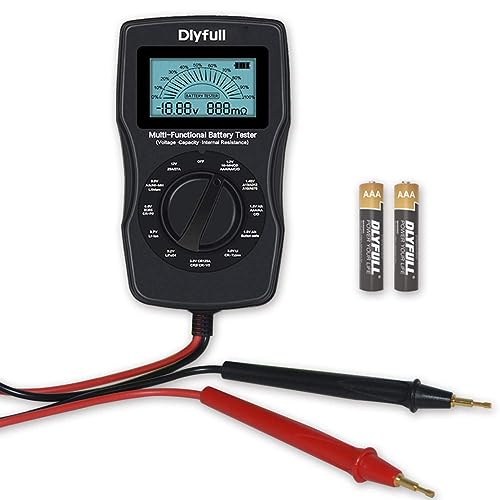
Dlyfull’s tester stands apart because it goes beyond simple voltage — it also measures internal resistance in milliohms, a critical metric for evaluating rechargeable cells like 18650s and Ni-MH. The dial selector and test leads mean you never have to force a battery into a fixed slot, and the large LCD displays voltage, percentage, and resistance simultaneously. This is the unit to pick if you treat battery health as data, not guesswork.
Compatibility is broad, covering everything from AAAA to 9V to button cells, and it even handles less common formats like 21700 and 26650. Build quality is good for the price point, though the unit is lightweight and the probe wires are somewhat stiff, which can cause the tester to slide across your workbench. The LCD is crisp but lacks a backlight, and the text around the rotary dial is very small — you will need good lighting to read battery type labels.
Customers consistently note the value of having repeatable internal resistance measurements that match analog reference testers. If you manage a household with many rechargeable batteries, the extra data this unit provides will help you retire weak cells before they cause device issues. The 18-month warranty and lifetime technical support add reassurance.
Why it’s great
- Measures internal resistance plus voltage for complete battery health analysis
- Rotary dial and test leads fit nearly any battery size without dedicated slots
Good to know
- Display is not backlit and difficult to read at sharp angles
- Stiff probe cables and lightweight body make the unit slide during use
2. Dlypow Digital Battery Tester
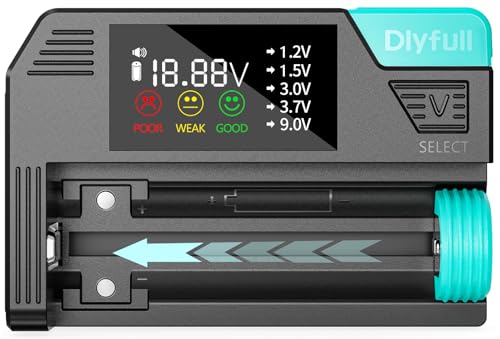
Dlypow took the common complaint about battery testers—needing to buy and replace a 9V or AAA battery just to power the tester itself—and solved it with a built-in USB-C rechargeable battery that lasts two to three months per charge. The backlit LCD panel is easy to read in low light, and the magnetic buckle on the back holds the battery under test securely in place, which is a thoughtful touch when testing larger cells like D batteries.
Operation is simple: press the SELECT button to choose the correct voltage range, insert the battery with correct polarity, and the screen shows voltage alongside a color-coded status icon—green for Good, yellow for Weak, red for Replace. Compatibility spans 1.2V Ni-MH, 1.5V alkaline, 3.0V lithium, 3.7V Li-ion, and 9V cells. The unit is compact at 3.8 x 2.5 x 1.2 inches, making it easy to store in a drawer or tool bag.
Some users note that the device is not especially compact for pocket carry, and a few reviewers mention that the LCD reading can be hard to see in very bright sunlight due to glare. Overall, the rechargeable design and backlit display make this a strong mid-range choice for anyone who tests batteries regularly and wants to eliminate the hassle of replacing the tester’s own battery.
Why it’s great
- Built-in USB-C rechargeable battery eliminates the need for a separate power cell
- Backlit LCD and magnetic buckle improve usability in various conditions
Good to know
- Screen can be difficult to read in direct bright sunlight due to glare
- Requires pressing the SELECT button each time to match battery voltage range
3. Tenergy T-333 Universal Battery Tester

The Tenergy T-333 has been a staple in homes for years, and for good reason: it is durable, simple, and handles an unusually wide range of battery types including CR123A, CR2, CRV3, 2CR5, CRP2, and multiple button cell sizes. The dedicated slots are snug and correctly sized, ensuring consistent contact without having to hold the battery in place manually. It uses a single AAA battery (included) to power its own measurement circuit, and many users report the original AAA lasting five years with regular monthly use.
The LCD metering screen is straightforward, displaying a bar graph that indicates Poor, Weak, or Good. There are no buttons or dials to fiddle with — just place the battery in the appropriate slot and read the result. At 5.25 x 3.5 x 1 inches, it is slightly larger than some competitors, but the extra footprint makes the slots easy to access even for large hands. The unit draws power from its own internal battery rather than from the battery being tested, so readings are consistent regardless of the test cell’s state.
Long-term owners consistently praise its reliability after five or more years of ownership. The build quality is good for a budget-friendly device, though the plastic casing is not impact-resistant. If you want a no-fuss, proven tester that will likely outlast your next few moves, the T-333 is a solid choice.
Why it’s great
- Tested reliability with many users reporting five-plus years of consistent use
- Exceptional battery type compatibility including button cells and uncommon formats
Good to know
- No load testing — reads open-circuit voltage only, not true capacity under load
- Plastic casing is durable but not designed to withstand hard drops
4. Ontel Battery Daddy Storage Kit with Tester

If your real problem is not testing but the chaos of loose batteries rolling around in every drawer, the Ontel Battery Daddy solves both organization and testing in one package. This double-sided case stores up to 180 batteries across common sizes — 78 AA, 64 AAA, 8 9V, 10 C, 12 coin cell, and 8 D — with a clear locking lid that lets you see inventory at a glance. The heavy-duty latches and carrying handle make it easy to move the entire stash from workshop to camping gear.
The included battery tester is simple but functional: align the battery’s positive and negative terminals with the contact pads, and the indicator shows whether the cell is still good. It is not a precision instrument — it does not display voltage — but for quickly sorting batteries into keep/recycle piles, it works fine. The case itself is well-constructed from thick plastic, and the slots are shaped to hold batteries securely even when the case is carried by the handle.
Some users note that the test slots are designed for common household sizes only, and you will not be able to test CR123A or less common button cells with the built-in tester. The case also does not provide dedicated storage for 9V batteries — they fit in the general compartment. If organization is your primary goal and testing is secondary, this combo delivers solid value.
Why it’s great
- Combines large-capacity storage with a built-in tester for a clutter-free solution
- Sturdy case with secure latches and clear lid makes battery inventory simple
Good to know
- Built-in tester does not show voltage — just Good/Weak status
- No dedicated slots for 9V or uncommon cell formats like CR123A
5. KKEANIC SL-049 Battery Tester

The SL-049 is built around real load testing, using specific resistor values for different battery types — 20 ohms for AA/AAA/C/D (drawing about 75 mA), 30 ohms for CR123A, and 1K ohms for button cells and 9V batteries. This approach gives a far more accurate picture of usable capacity than a simple open-circuit voltmeter. The LCD displays exact voltage plus a colored bar indicator (Good/Weak/Poor), and readings complete in about 0.1 seconds.
Compatibility is strong for common household sizes: AA, AAA, AAAA, C, D, N, 9V, plus CR123A, CR2, and a wide range of coin cells including CR2032, CR2016, CR2450, and LR44. It also tests 1.2V rechargeable Ni-MH cells. The unit requires one AAA battery for operation and has an auto-shutoff after three seconds of non-use, achieving roughly one year of standby life. The compact size — 4.7 x 2.8 x 1 inches — fits easily in a drawer.
Reviewers consistently note that the loaded readings differ from their multimeter’s no-load voltage, which is actually a sign of accuracy — a battery showing 1.5V open-circuit might drop below 1.2V under a 75 mA load, revealing it is nearly dead. One quirk: there is no on/off switch, so you must remove the internal AAA battery between uses or risk draining it. The screen also lacks a backlight and can be hard to read in bright light. Despite these small issues, this is the most accurate load-tested reading available at this entry-level price point.
Why it’s great
- Applies specific load resistors per battery type for real-world capacity assessment
- Ultra-fast 0.1-second reading with voltage and color-coded status display
Good to know
- No power switch — you must remove the internal AAA battery to prevent drain
- Screen is not backlit and can be difficult to see in bright ambient light
FAQ
Can a battery tester check lithium-ion rechargeable cells like 18650s?
Why does my multimeter show a higher voltage than my battery tester?
How often should I replace the battery inside my battery tester?
Final Thoughts: The Verdict
For most users, the best alkaline battery tester winner is the Dlyfull Universal Battery Tester because it provides internal resistance data alongside voltage, giving you a complete picture of battery health that no simple checker can match. If you want a rechargeable unit with a backlit display, grab the Dlypow Digital Battery Tester. And for an accurate load-tested reading at an entry-level price point, nothing beats the KKEANIC SL-049.

Mo Maruf
I created WellFizz to bridge the gap between vague wellness advice and actionable solutions. My mission is simple: to decode the research and give you practical tools you can actually use.
Beyond the data, I am a passionate traveler. I believe that stepping away from the screen to explore new environments is essential for mental clarity and physical vitality.