Our readers keep the lights on and my smoothie glass nicely filled. As an Amazon Associate, I earn from qualifying purchases.
After a knee replacement, the first few steps are a balance between relief and vulnerability. The wrong walking aid can turn recovery into a chore, while the right one lets you move with confidence. The specific challenge isn’t just support — it’s finding a cane that distributes your weight evenly, reduces stress on your healing joint, and feels stable on any floor surface.
I’m Mohammad Maruf — the founder and writer behind WellFizz. My research focuses on post-surgical mobility aids, analyzing how handle design, base width, and weight capacity directly impact recovery trajectories for knee replacement patients.
After evaluating dozens of walking aids, I have identified the top performers that offer genuine stability and comfort. This guide breaks down the essential specs and real-world usability of the best cane for knee replacement.
How To Choose The Best Cane For Knee Replacement
Selecting a walking aid after knee surgery is a medical decision as much as it is a comfort one. The wrong handle angle can aggravate your wrist, while an unstable base adds unnecessary fall risk. Focus on these three factors to match a cane to your recovery stage.
Handle Design: Offset vs. Traditional
An offset handle aligns your forearm with the shaft of the cane, placing your wrist in a neutral position. This design reduces strain on the delicate ligaments of the wrist and transfers weight directly downward — critical during early recovery when your upper body compensates for the surgical leg. Traditional crook handles force the wrist into a slight bend, causing fatigue over long periods of use indoors.
Base Configuration: Single Point vs. Quad
A single-point cane is lightweight and good for navigating stairs, but it offers minimal lateral stability. A quad base — with four small feet — provides a self-standing footprint that resists tipping when you lean off-center. For knee replacement patients who still have swelling and reduced proprioception, the quad base offers a margin of safety that a single point simply cannot match, particularly on tile or hardwood floors.
Weight Capacity and Material
Aluminum is the standard material because it balances strength and weight. Most quad canes support 250 to 300 pounds, while heavy-duty bariatric models go up to 500 pounds using reinforced aluminum or steel. For knee replacement, the cane will bear significant load during the transition from sitting to standing — so choosing a model rated for your full body weight is non-negotiable, not optional.
Quick Comparison
On smaller screens, swipe sideways to see the full table.
| Model | Category | Best For | Key Spec | Amazon |
|---|---|---|---|---|
| NOVA Designer Quad Cane | Quad | Stability with style and lightweight feel | 29.5″ to 38.5″ height range | Amazon |
| PELEGON Quad Cane | Quad | Maximum stability with 300 lb capacity | 2.1 lbs weight / 300 lb limit | Amazon |
| BeneCane Quad Cane with LEDs | Quad | Night visibility and nighttime safety | 34″ to 40″ height range | Amazon |
| NOVA Heavy Duty Quad Cane | Quad / Bariatric | Bariatric support up to 500 lbs | 500 lb weight capacity | Amazon |
| PCP Offset Handle Cane | Offset Single-Point | Style and orthopedic handle geometry | 32″ to 41″ height range | Amazon |
| Medline Quad Cane | Quad | Budget-friendly quad base entry | 3.6 lbs weight / 300 lb limit | Amazon |
| DMI Deluxe Adjustable Cane | Single-Point | Light everyday backup or basic use | 29″ to 38″ height range | Amazon |
In‑Depth Reviews
1. NOVA Designer Quad Cane

This quad cane from NOVA strikes an ideal balance between lightweight construction and four-point stability for knee replacement recovery. Weighing under 2 pounds, it offers the secure footprint of a quad base without the bulkiness that makes heavier models difficult to carry through the house. The offset handle reduces wrist strain during weight transfer, which is especially important when you are putting a third of your body weight through the cane while the surgical knee heals.
The height range of 29.5 to 38.5 inches accommodates users from 4’11” to 6’4″, and the anti-rattle lock prevents the annoying clicking sound common with cheaper push-button adjustments. The skid-resistant rubber tips on each of the four prongs provide traction on both smooth hardwood and carpeted surfaces. The chip-resistant printed finish adds a layer of visual appeal that lifts the mood during a long recovery period.
Customer reviews consistently highlight the solid feel and ease of adjustment, with many users transitioning successfully from a walker directly to this quad cane. One minor trade-off is the 250-pound weight capacity, which is adequate for most users but lower than the 300-pound limit found on similarly priced quad models. The overall depth of 9.25 inches may feel slightly wide in narrow hallway turns, but the added stability justifies the footprint.
Why it’s great
- Under 2 lbs yet quad-stable
- Offset handle reduces wrist fatigue
- Anti-rattle lock stays quiet
Good to know
- 250 lb weight capacity
- Wider base may feel bulky in tight spaces
2. PELEGON Quad Cane

PELEGON positions its quad cane as a premium balance-focused tool, and the engineering delivers on that promise. The four-pronged base measures slightly larger than standard quad models, giving it a self-standing ability that lets you release the handle without the cane tipping over — a convenience when you need both hands to open a door or pick up an object. The adjustable height spans 29.5 to 38.4 inches, covering the same demographic range as the NOVA while supporting up to 300 pounds.
The rubber handle material offers a tackier grip than foam, which resists slipping even when your palm perspires during physical therapy sessions. The shaft is made from extruded aluminum, keeping the total weight at 2.1 pounds — notably heavier than the NOVA quad but still manageable for daily use. Each of the four rubber tips is individually replaceable, extending the life of the cane when the first set wears down from repeated weight-bearing cycles.
Customer feedback emphasizes the confidence that comes with the stability of this cane, particularly for users who previously felt unsteady on single-point models. Some users note the weight is a trade-off for the increased material thickness. The blue color option receives frequent compliments, which may seem trivial until you realize you will be carrying it everywhere for weeks. A user guide included in the box shows proper walking technique — a small but genuine help for first-time cane users.
Why it’s great
- Self-standing quad base frees both hands
- Tacky rubber handle prevents slipping
- Replaceable tips reduce long-term cost
Good to know
- 2.1 lbs is heavier than comparable aluminum models
- High weight capacity increases base material thickness
3. BeneCane Quad Cane with Two LED Lights
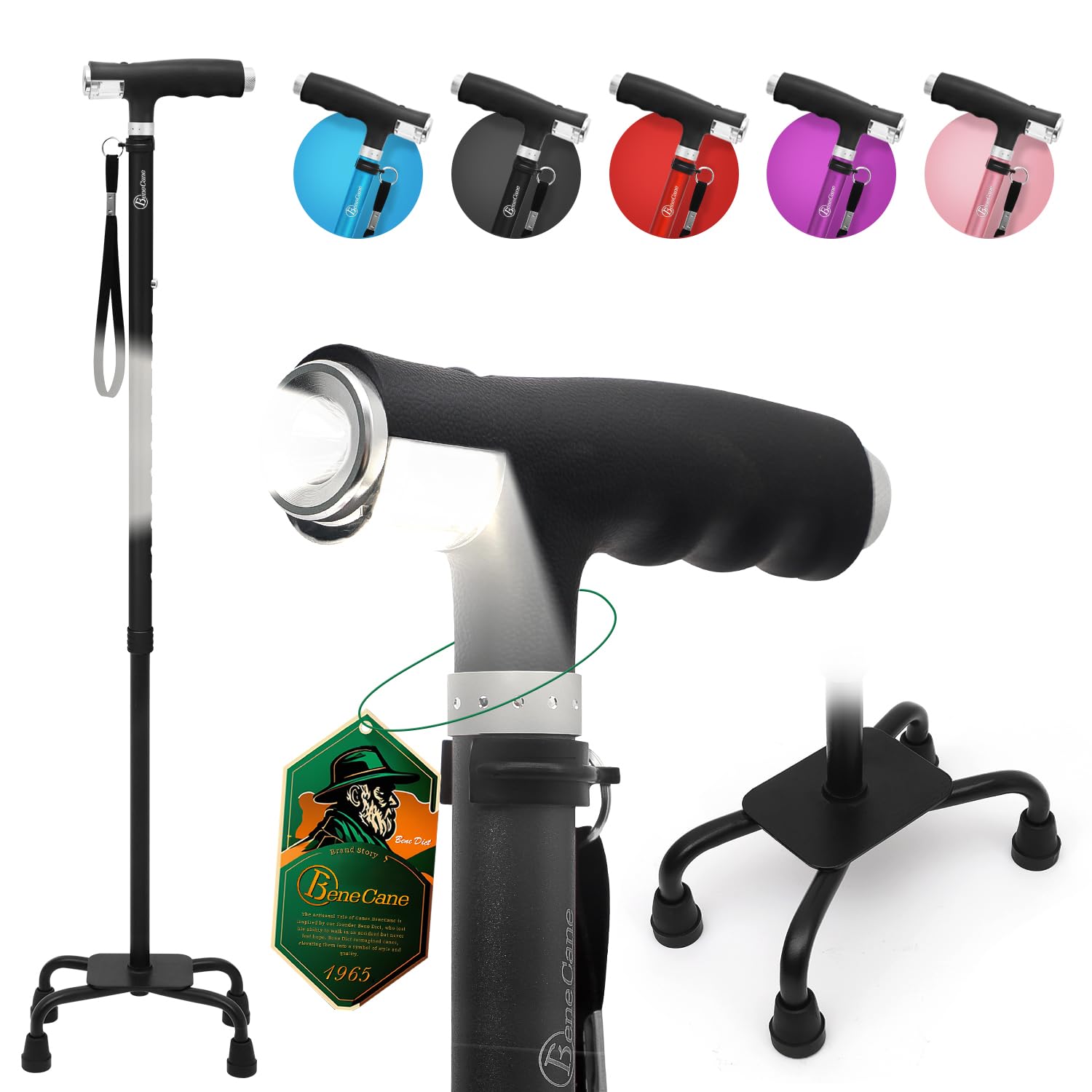
This BeneCane distinguishes itself with two integrated LED lights in the handle — one beam casts forward while the second points down at your feet. For a knee replacement patient who needs to get up for bathroom trips at night, this eliminates the need to fumble for a light switch while balancing on one leg. The quad base measures 5.1 by 8.2 inches, which is wider than standard quad canes and provides an exceptionally stable platform that resists tipping even when you lean heavily to one side.
The handle is made of hard plastic rather than foam or rubber, which is a durability advantage but a comfort trade-off for users with arthritic hands. The push-button lock adjusts the height from 34 to 40 inches, accommodating users from 5’3″ to 6’3″. The thickened aluminum alloy tube supports a weight capacity exceeding 300 pounds. The included batteries for the LEDs are simple to replace, though the plastic housing feels less premium than the all-metal construction of competitors.
Reviews consistently praise the lighting feature as a genuine safety upgrade, particularly for late-night mobility in homes with stairs or uneven flooring. The wider base does create occasional tipping if you set the cane down at an extreme angle, as noted by some users. The hard handle also drew criticism from reviewers with arthritis, so this cane is best suited for users who prioritize visibility over palm comfort.
Why it’s great
- Dual LED lights illuminate path and ground
- Wide 8.2-inch base provides exceptional stability
- Over 300 lb weight capacity
Good to know
- Hard plastic handle can irritate arthritic hands
- Battery replacement required for LEDs
4. NOVA Heavy Duty Quad Cane
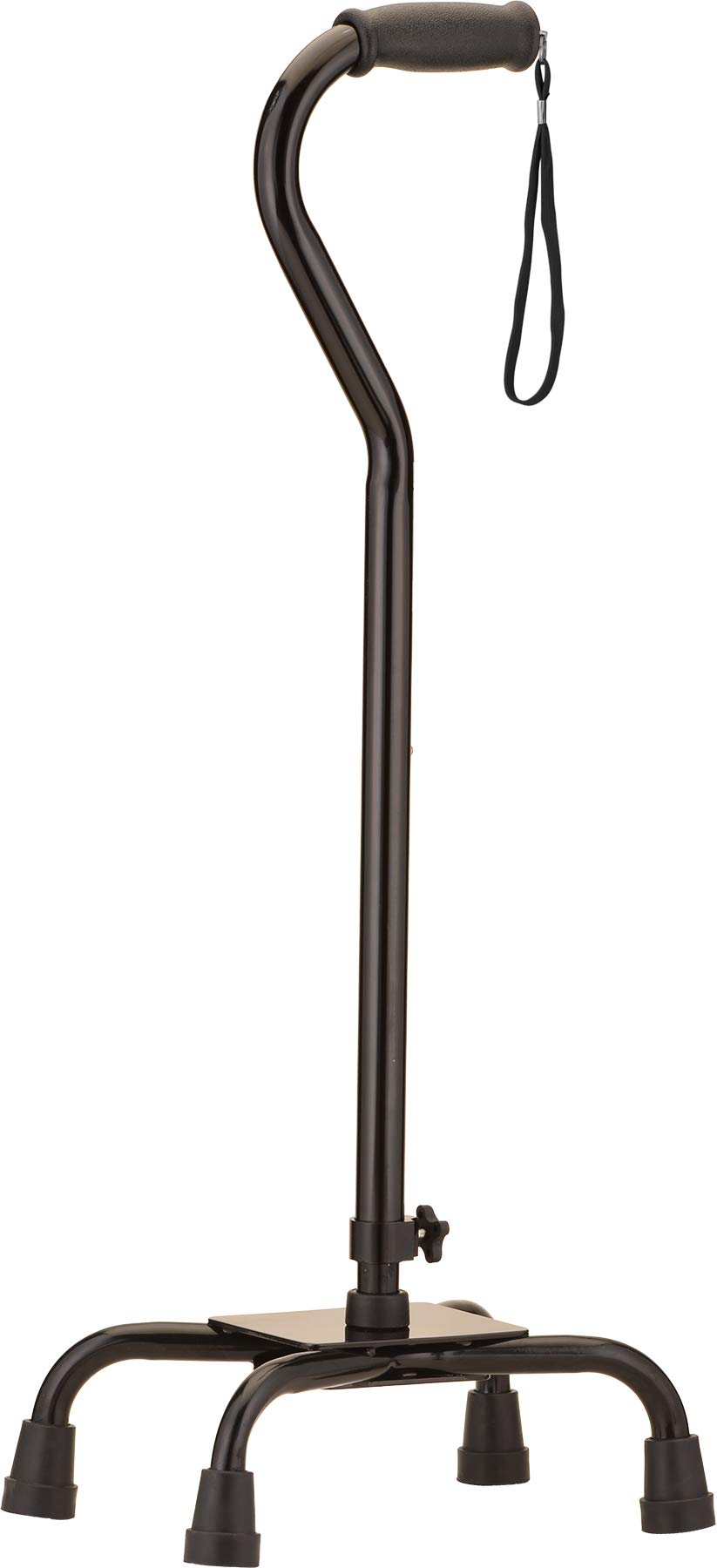
When body weight exceeds standard cane ratings, the NOVA Heavy Duty steps in as the only model in this lineup supporting up to 500 pounds. The large quad base has a wider footprint and lower center of gravity compared to standard quad canes, dramatically reducing wobble during lateral weight shifts. This is a critical safety margin for bariatric knee replacement patients who carry additional load through the surgical joint during the first few weeks post-op.
The offset handle maintains the wrist-neutral angle even under high compressive loads, and the shaft is constructed from reinforced aluminum that resists the bending failure seen in standard-weight canes. Height adjusts from 30.5 to 39.5 inches, accommodating users from 4’11” to 5’11”. At 4.5 pounds, this is the heaviest cane on the list — the trade-off for the extra strength and stability required by the higher weight capacity.
User reviews commonly mention the solid, no-wobble construction that provides a sense of security when walking on uneven ground or transitioning from a seated position. The anti-rattle locking knob is effective at stopping noise, though some users reported that the rubber tips wear faster than expected under the heavier load. Physical therapists recommended the smaller base version of this same cane for elderly users who found the large base difficult to manage at 4.5 pounds.
Why it’s great
- 500 lb capacity for heavy-duty support
- Extra-wide quad base resists tipping
- Offset handle reduces wrist strain under load
Good to know
- 4.5 lbs can be heavy for elderly users
- Rubber tips may wear quickly at high loads
5. PCP Offset Handle Foam Grip Cane

This PCP cane offers the orthopedic advantage of an offset handle in a single-point configuration, saving nearly a pound compared to quad-base models. The foam grip handle is more forgiving on the hand than rubber or plastic, particularly during long days when the cane is in constant use. The one-button height adjustment uses a locking silencer ring that prevents the metallic rattle that plagues many adjustable single-point canes.
The height range is the widest in this lineup at 32 to 41 inches, making it a strong candidate for tall users who struggle to find a cane that reaches their natural hand drop. The weight limit is 300 pounds despite the lightweight 12-ounce shaft. The wrist strap lanyard lets you release the cane to open doors without bending over, though the cane will drop to the floor if you let go without catching the strap first.
Customer feedback overwhelmingly praises the aesthetic patterns — butterfly, peacock, celestial — which add personality to a medical device, improving user morale during recovery. Some users noted that the single-point base feels unstable on slippery surfaces, particularly when coming out of a seated position. Several reviewers upgraded the tip to a quad base for better stability, which is an aftermarket solution worth considering for knee replacement patients who want the handle comfort and lightweight build but need more base stability indoors.
Why it’s great
- Lightest option at 12 oz
- Offset handle with comfortable foam grip
- Wide height range for tall users
Good to know
- Single-point base lacks lateral stability
- May require aftermarket quad tip upgrade
6. Medline Aluminum Quad Cane

The Medline quad cane is a budget-friendly entry into four-point stability, covering the same height range of 29 to 38 inches as premium models while keeping the cost accessible. The foam handle provides reasonable comfort for short to medium use periods, and the quad base allows the cane to stand upright on its own when not in hand. The flip-lock mechanism is a simple friction-based design that secures the height without the metal-on-metal clicking of push-button models.
At 3.6 pounds, this cane is heavier than the NOVA quad but lighter than the NOVA Heavy Duty, placing it in a mid-weight zone that prioritizes stability over portability. The rubber pads on all four prongs offer good traction on both dry indoor surfaces and light outdoor pavement. The 300-pound weight capacity matches the PELEGON and exceeds the standard NOVA quad, making it a solid functional option for larger users on a tighter budget.
Reviews highlight the sturdy construction and the strong stability provided by the large base, with several users noting that their physical therapists approved of the quad design for post-surgery recovery. The cane does not fold, which is typical for quad-base models, so storage requires a bit more space than collapsible single-point canes. Some users reported that the large base feels overly wide in tight doorways or kitchen spaces, but the stability trade-off was worth it for most.
Why it’s great
- Affordable quad base entry point
- 300 lb weight capacity
- Flip-lock secures height without metal noise
Good to know
- 3.6 lbs is heavier than aluminum single-point models
- Large base may feel wide in tight doorways
7. DMI Deluxe Adjustable Cane

The DMI Deluxe Cane is the most economical option for knee replacement recovery, using an anodized aluminum shaft that supports up to 250 pounds. The padded foam grip handle offers comfortable palm support, and the integrated wrist strap provides security when you need to free your hand momentarily. The classic curved handle shape is the standard design that most users picture when they think of a cane, which makes this a familiar choice for first-time users who are not ready for the offset handle learning curve.
Height adjusts from 29 to 38 inches using a locking ring system — simpler than push-button mechanisms but requiring a bit more finger strength to tighten securely. The slip-resistant rubber tip provides adequate traction on most indoor floor types, though the single-point design offers less fall protection than quad-based alternatives. At 5.12 ounces, this is one of the lightest options available, which makes it easy to carry as a backup cane stored in the car.
The foam grip on newer versions has been reported as thinner than earlier models, reducing some of the cushioning comfort. This cane is best suited as a secondary walking aid for short trips or as an emergency backup, rather than the primary recovery tool for the intense weight-bearing demands of early knee replacement rehabilitation.
Why it’s great
- Extremely lightweight at 5.12 oz
- Classic curved handle with secure strap
- Proven reliability over many years of production
Good to know
- 250 lb weight capacity is lower than quad models
- Thinner foam grip on newer production units
FAQ
Should I use a single-point or quad base cane after knee replacement?
At what height should I set my new cane for post-op recovery?
Final Thoughts: The Verdict
For most users, the best cane for knee replacement winner is the NOVA Designer Quad Cane because it combines the security of four-point stabilization with a sub-2-pound frame and an offset handle that protects your wrist during the weight-bearing phase. If you want integrated safety lighting for nighttime mobility, grab the BeneCane with dual LED lights. And for heavy-duty bariatric support with a 500-pound capacity, nothing beats the NOVA Heavy Duty Quad Cane.

Mo Maruf
I created WellFizz to bridge the gap between vague wellness advice and actionable solutions. My mission is simple: to decode the research and give you practical tools you can actually use.
Beyond the data, I am a passionate traveler. I believe that stepping away from the screen to explore new environments is essential for mental clarity and physical vitality.