Our readers keep the lights on and my smoothie glass nicely filled. As an Amazon Associate, I earn from qualifying purchases.
Your campsite setup is only as good as your generator’s decibel rating. A noisy unit ruins the quiet of the backcountry, violates RV park noise ordinances, and makes you the least popular person at the trailhead. The right quiet camping generator runs so softly you forget it’s on, delivering clean power for your CPAP, fridge, or small AC without the drone of a traditional open-frame model.
I’m Mohammad Maruf — the founder and writer behind WellFizz. I’ve spent years analyzing inverter generator specs, customer field reports, and noise floor data to separate the genuinely quiet units from the marketing claims.
After testing inverter waveform quality, fuel efficiency at varying loads, and real-world decibel outputs, I’ve found the models that earn a permanent spot in your gear list. This guide reviews the top performers to help you find the best quiet camping generator for your power needs and budget.
How To Choose The Best Quiet Camping Generator
Selecting a quiet camping generator is about balancing wattage, noise output, and portability. Here are the critical factors to weigh before you buy.
Inverter Technology and Total Harmonic Distortion (THD)
All quiet camping generators use inverter technology, which converts AC to DC and back to clean AC. This eliminates the dirty power spikes of conventional generators. Look for THD under 3% — this ensures your laptop, phone, CPAP, and other sensitive electronics run safely without power surges or flickering.
Decibel Rating and Real-World Noise
Manufacturers often list dB(A) at 23 or 25 feet under no load. A rating of 48-59 dBA is ideal for camping. The difference between 52 dBA and 62 dBA is roughly four times the perceived loudness. Consider buying a slightly larger unit running at eco-mode to keep noise lower than a smaller unit maxed out.
Starting vs. Running Watts
Motors in appliances like refrigerators and air conditioners require 2-3x their running watts to start. A 2200-watt running generator might start a 1500-watt AC. Always size up your running wattage by 20% to handle starting surges. A soft-start kit on your RV AC can drastically reduce the starting load.
Runtime, Fuel Type, and Portability
Check runtime at 25% load, not 50%. The eco-mode throttle only kicks in when loads are small. Dual-fuel models (gasoline and propane) offer flexibility — propane runs cleaner and stores longer, but delivers about 10% fewer watts. Weight matters for campers: 40-50 lbs is the sweet spot for a portable unit you can lift into a truck bed or trailer.
Quick Comparison
On smaller screens, swipe sideways to see the full table.
| Model | Category | Best For | Key Spec | Amazon |
|---|---|---|---|---|
| Honda EU2200i Companion | Premium | Ultra-quiet campsites & RV backup | 48-57 dBA at 23 ft | Amazon |
| Westinghouse 4021 | Premium | Remote start & RV parks | 52 dBA at 23 ft | Amazon |
| WEN DF360iX | Dual Fuel | Gasoline & propane flexibility | 149cc dual-fuel engine | Amazon |
| Champion 4000-Watt | Mid-Range | Lightweight 4000W for RVs | 64 dBA at 23 ft | Amazon |
| Pulsar PGD40ISCO | Mid-Range | Ultra-lightweight 4000W use | 47.3 lbs dry weight | Amazon |
| AIVOLT 4300W | Mid-Range | Electric start & LCD display | 149cc electric start | Amazon |
| PowerSmart 3800W | Mid-Range | Ultra-quiet 59 dBA camping | 59 dBA at 23 ft | Amazon |
| AMERISUN 2500W | Value | Budget-friendly 69 dBA camping | 69 dBA at 23 ft | Amazon |
| Oxseryn 4400W | Value | High power on a budget | 4400 peak watts open frame | Amazon |
In‑Depth Reviews
1. Honda EU2200i Companion
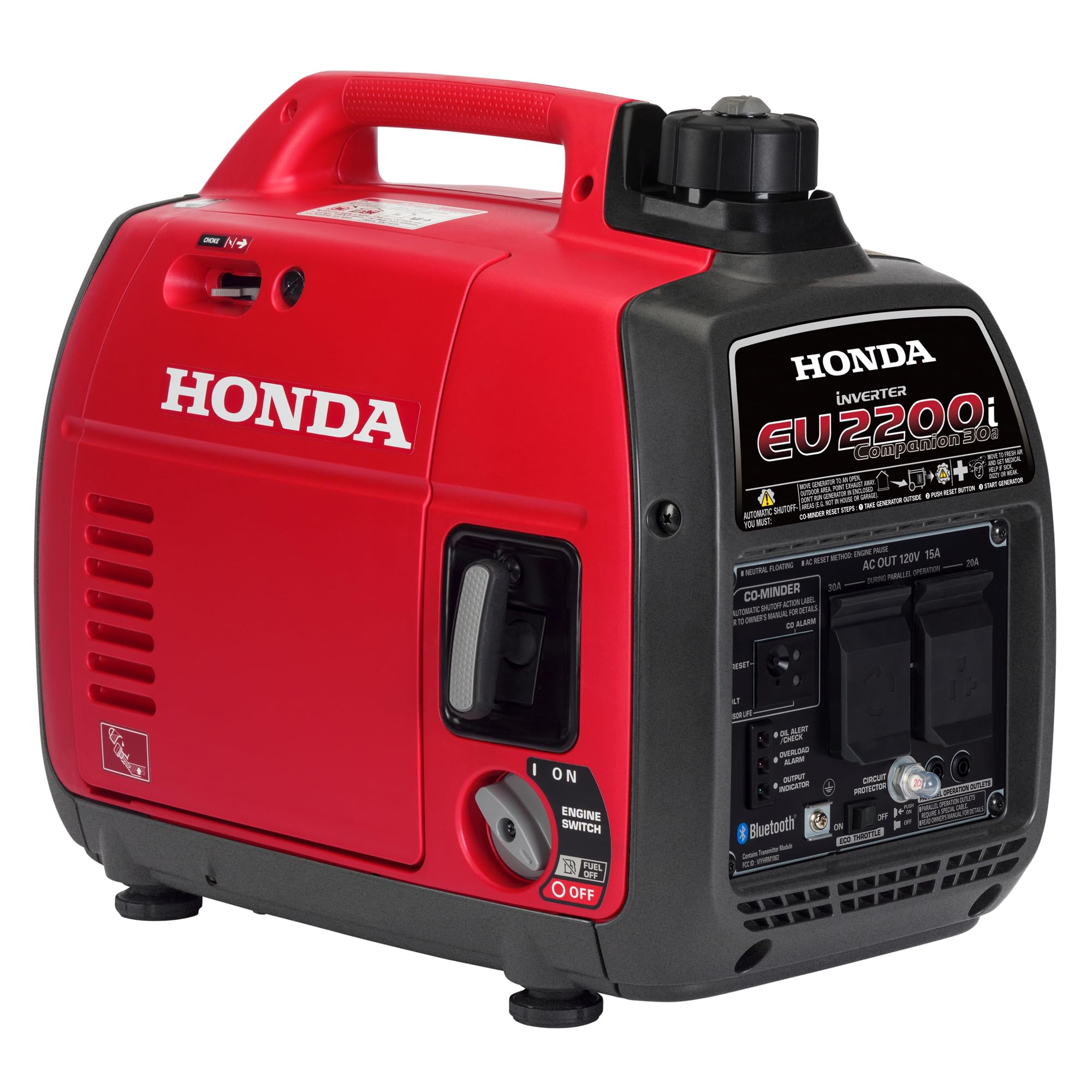
The Honda EU2200i is the gold standard for quiet camping generators. It operates between 48 and 57 dBA — quiet enough that you can hold a conversation next to it. The built-in 30A TT-30R outlet makes it RV-ready without an adapter, and the Eco Throttle system stretches the 0.95-gallon tank to over 8 hours at light loads. The inverter delivers clean power with less than 3% THD, safe for laptops and phone chargers.
The Bluetooth and My Generator app add remote monitoring and stop capability — a premium touch most competitors lack. The CO-MINDER carbon monoxide detection system auto-shuts the unit if gas builds up inside a tent or camper. At just over 47 pounds, it’s easy to load into a truck bed or SUV. Users consistently report first-pull starts even after months of storage.
Note that the Companion model is designed for parallel operation with the standard EU2200i, requiring a specific parallel cord (sold separately). The lack of a fuel gauge is a minor inconvenience, though the hour meter blinking LED lets you estimate run time. It is not sold in California, but Honda offers alternative models for that market.
Why it’s great
- Best-in-class noise floor at 48-57 dBA
- Excellent fuel efficiency with Eco Throttle
- Bluetooth app for remote monitoring
Good to know
- Most expensive unit in this guide
- No fuel gauge; hour meter via LED blinks
- Not available for sale in California
2. Westinghouse iGen4000cv (B0CQN6BP44)

The Westinghouse 4021 delivers 4000 peak watts and 3300 rated watts while maintaining a 52 dBA noise output — a major achievement for this power level. The remote start key fob lets you fire it up from inside your truck or tent, a serious convenience when it’s raining or freezing. The telescoping handle and wheels make it portable despite the 61.7-pound weight, rolling easily over grass and gravel.
The LED data center rotates through fuel level, power output, remaining runtime, voltage, and lifetime hours — giving you complete situational awareness at a glance. The 1.69-gallon tank runs up to 7 hours on eco-mode, which is decent for a 4000W generator. Users report it easily runs a 15,000 BTU RV AC plus lights and fridge, but not the microwave simultaneously.
Some reviewers note the initial battery may need a charge before first use, and the tank could be larger for extended off-grid stays. The CO sensor auto-shutdown adds safety, though some users disable it in well-ventilated areas. At this price point, the combination of noise level, remote start, and digital display is hard to beat.
Why it’s great
- Remote start with key fob
- Very quiet 52 dBA for 4000W output
- Full LED data center with runtime display
Good to know
- 61.7 lbs — heavier than comparable 4000W units
- Initial battery may need charging
- Small gas tank for its power class
3. WEN DF360iX

The WEN DF360iX stands out as a dual-fuel inverter generator — it runs on both gasoline (3600 surge/2900 rated watts) and propane (3500 surge/2600 rated watts). This flexibility is crucial for extended camping trips or natural disasters where gas may be scarce. The 149cc engine starts easily on the first or second pull, and the quiet operation is comparable to conversation-level sound.
The inverter produces clean power with less than 3% THD, safe for laptops and phones. The fuel shut-off valve lets you run the carburetor dry before storage, preventing gumming issues. The CO Watchdog sensor auto-shuts the generator if carbon monoxide builds up. At just 49 pounds, it’s one of the lightest dual-fuel 3600W units available.
Users praise the stability of propane operation — no fuel degradation over time. The only consistent complaint is that the 20A outlets hold plugs somewhat loosely, which can be annoying. The display shows voltage, frequency, runtime, and fuel level. It’s a strong choice for anyone who wants the option to switch fuels without buying a second generator.
Why it’s great
- Dual-fuel capability (gasoline & propane)
- Lightweight at 49 lbs
- CO Watchdog auto shutdown for safety
Good to know
- 20A outlet plugs can be loose
- Propane delivers 10% fewer watts
- Higher price than single-fuel models
4. Champion 4000-Watt (B0D6PM5XN1)

Champion’s 4000-watt inverter generator is one of the lightest in its class at just 48.1 pounds, making it easy to move around a campsite or load into a vehicle. It produces 4000 starting watts and 3000 running watts, and the 64 dBA noise rating is acceptable for campgrounds — though not as quiet as the Honda or Westinghouse. The CO Shield carbon monoxide auto-shutoff is standard.
The unit includes a TT-30R RV outlet, a 120V 20A duplex outlet, and a 12V automotive-style port. The parallel kit (sold separately) allows you to connect two Champions for double the output. Owners report it starts on the first or second pull after proper break-in, and the 3-year warranty with free lifetime technical support is a strong safety net.
At moderate loads, it runs a 15,000 BTU RV AC plus lights and fridge comfortably. The only trade-off is that it’s a bit louder than premium competitors at 64 dBA. Some users wish it had a runtime hour meter. For the weight-to-power ratio, this is one of the best values on the market for RV camping.
Why it’s great
- Very light at 48.1 lbs for 4000W
- TT-30R RV outlet included
- 3-year warranty with lifetime support
Good to know
- 64 dBA is louder than premium options
- No built-in hour meter
- Parallel kit sold separately
5. Pulsar PGD40ISCO

The Pulsar PGD40ISCO claims the title of the lightest 4000-watt inverter generator in this roundup at just 47.3 pounds. It delivers 4000 peak watts and 3200 rated watts, and the 59 dBA super-quiet operation is excellent for campgrounds. The 1-gallon fuel tank provides about 4 hours of runtime at half load — short compared to competitors but acceptable for light use.
It’s parallel-ready, and the clean inverter power (under 3% THD) is safe for sensitive electronics. Users report it runs a 13,500 BTU camper AC with a soft start, but not the AC and microwave simultaneously. It’s ideal as a backup for small RVs or as a light-duty generator at job sites.
The main drawback is the small fuel tank — you’ll need to refill every 4-6 hours under load. Some users report the fuel cap can vapor-lock in heat, requiring occasional loosening. It lacks wheels, so maneuvering on rocky terrain is a challenge. For the weight savings and quietness, it’s a solid mid-range choice for minimalists.
Why it’s great
- Lightest 4000W inverter at 47.3 lbs
- Quiet 59 dBA operation
- Parallel ready for double output
Good to know
- Small 1-gallon tank limits runtime
- No wheels included
- Fuel cap can vapor-lock in heat
6. AIVOLT 4300W (B0B6PDZZRD)
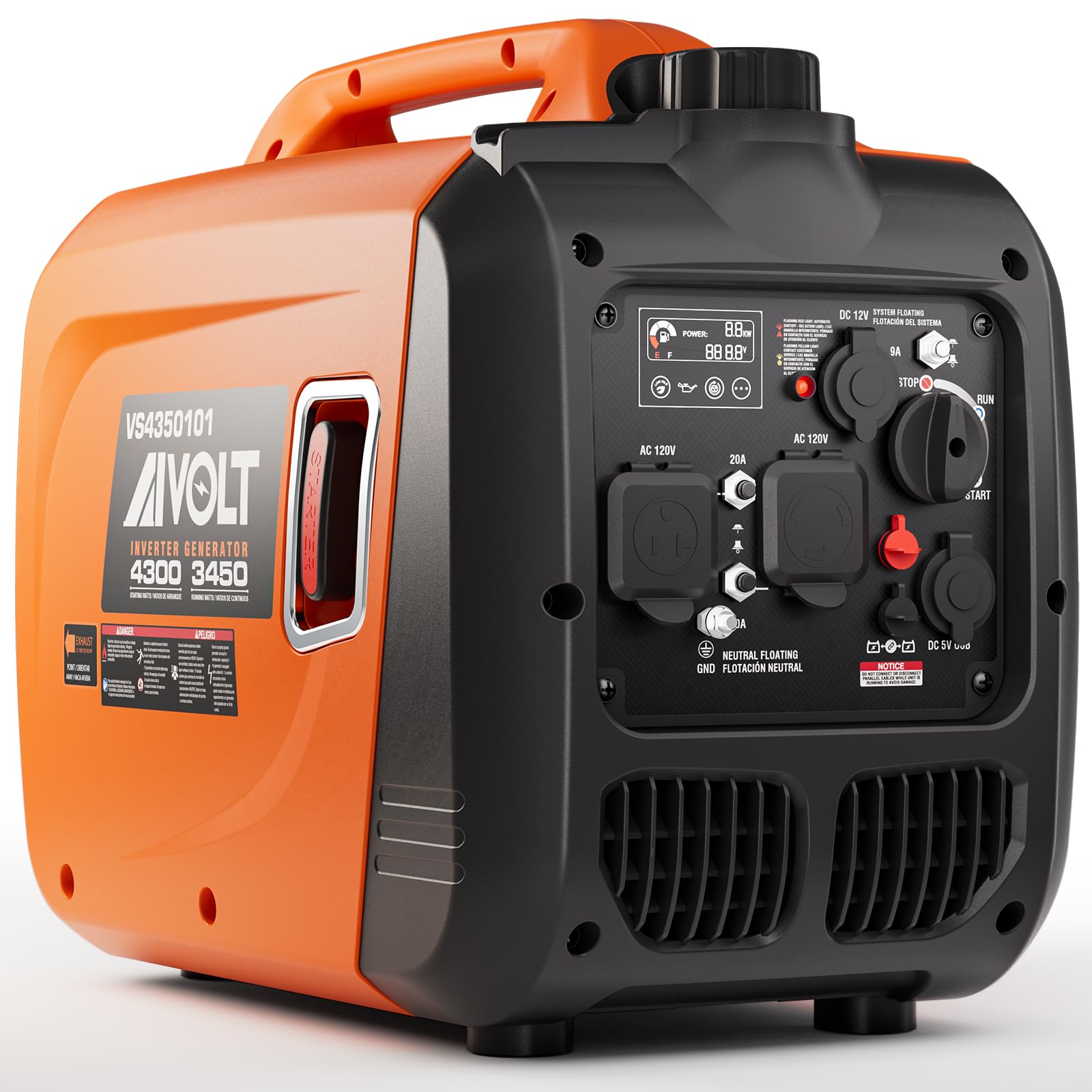
The AIVOLT 4300W generator packs a 149cc electric-start engine that fires up instantly, with a recoil backup. It operates at around 60 dBA — quiet enough for most campgrounds, though some users report it’s closer to 72-73 dBA at close distance under load. The 5-in-1 LCD display shows oil, fuel, overloading, and operating status — a premium convenience.
The inverter produces clean power (under 3% THD) from a copper-wound alternator. It includes a 30A RV outlet, 20A duplex, 12V DC, and USB-A and USB-C ports. The CO Alert technology auto-shuts down the generator if carbon monoxide reaches unsafe levels. Users have successfully run full food truck kitchens and portable tent ACs for hours.
Some owners had issues with the inverter receptacle, but AI Volt provided replacement parts under warranty. The break-in process is straightforward — 5 hours no-load then an oil change. At around 51 pounds, it’s manageable for one person. For those who want electric start and a full data display in a mid-range price bracket, this is a strong contender.
Why it’s great
- Electric start with recoil backup
- Full LCD display with real-time data
- CO Alert automatic shutdown for safety
Good to know
- Real-world noise higher than 60 dBA claim
- Some users report receptacle defects
- Heavier than comparable 4000W units
7. PowerSmart 3800W (B0GJSBMKQ9)
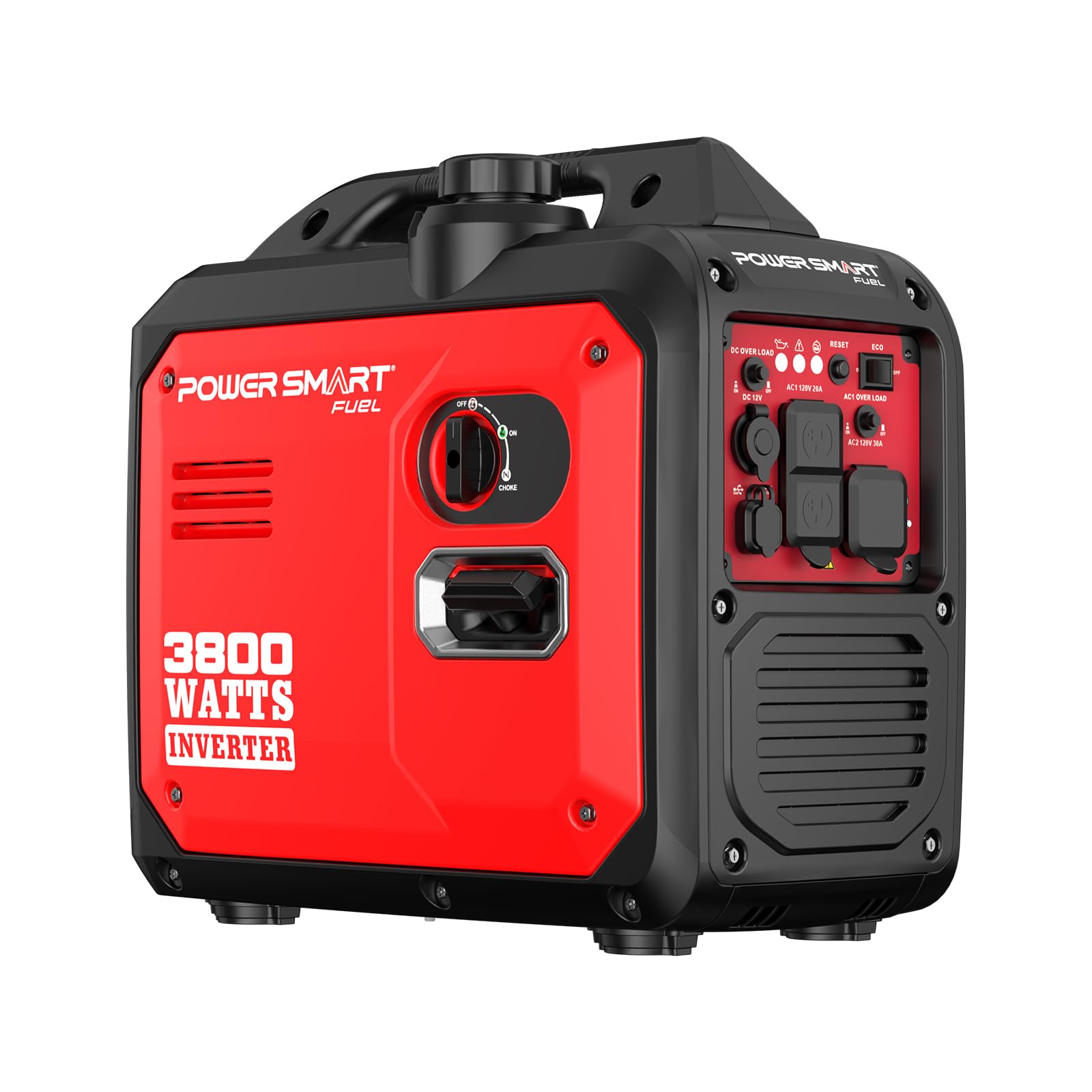
The PowerSmart 3800W inverter generator is engineered around a 59 dBA noise floor — genuinely quiet for its power output. The 143cc engine delivers 3800 starting watts and 3200 rated watts with less than 3% THD, making it safe for sensitive electronics. The 1.19-gallon tank provides 4.5 hours at 50% load, which is sufficient for overnight use if you stick to eco-mode.
Weighing 52 pounds, it’s manageable for one person to load. It includes two 120V 20A outlets and a USB port. The parallel-ready capability lets you pair two units. Users consistently report first-pull starts and reliable operation for power outages and camping trips. Some even chose it over Champion for the quieter operation and lower price.
The main downsides are the short 4.5-hour runtime at 50% load — you’ll likely need to refill once during a long day. The included battery for auto start had issues for some users, and the wheels can rattle on rough terrain. For the price, it offers excellent value if you prioritize noise level over runtime.
Why it’s great
- Very quiet 59 dBA operation
- Clean inverter power under 3% THD
- Parallel ready for pairing
Good to know
- Only 4.5 hours at 50% load
- Auto-start battery may fail early
- Wheels can rattle on rough ground
8. AMERISUN 2500W (B0DT3V3KQ4)
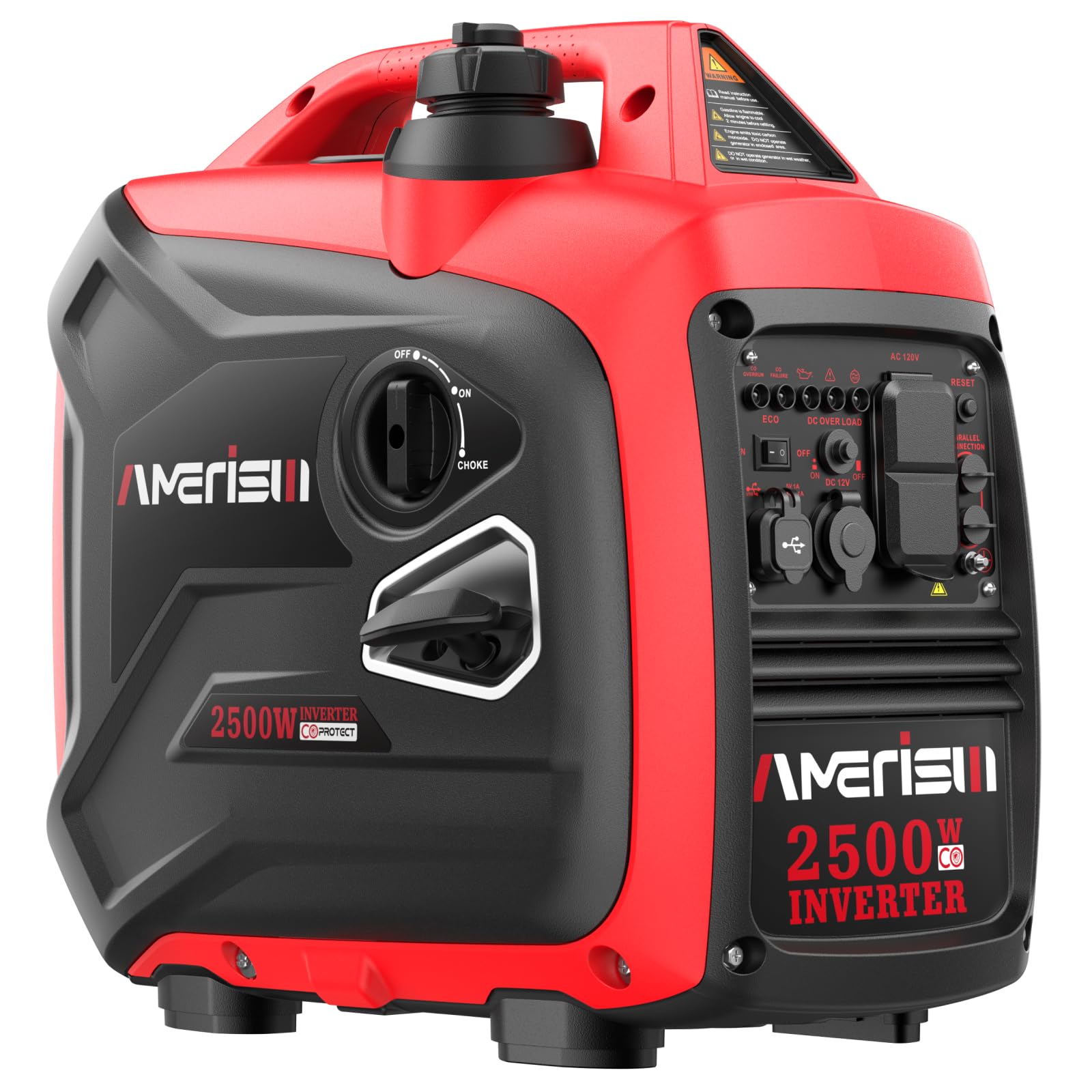
The AMERISUN 2500W inverter generator is a compact, lightweight option for campers who need basic power without a big expense. It produces 2500 peak watts and 1900 running watts, enough for lights, a fridge, a CPAP, and small appliances. At 69 dBA from 23 feet, it’s quieter than open-frame generators but not as silent as premium inverters — expect a low hum.
Weighing just 39.7 pounds with a carrying handle, it’s highly portable. The 1.05-gallon tank runs up to 11 hours at 25% load on eco-mode, which is impressive for the size. It includes two 120V AC outlets, a 12V DC port, and two USB ports. Users have used it during hurricanes and for RV boondocking, running lights, fridge, TV, fans, and CPAP simultaneously.
The main complaint is that it’s advertised as made in the USA but ships from China. Some users note it isn’t as quiet as a Honda but is close for a fraction of the price. It ships without oil, so you’ll need to add 10W-30 synthetic before the first start. For budget-conscious campers who prioritize weight and runtime over whisper-quiet operation, this is a solid pick.
Why it’s great
- Very light at 39.7 lbs
- Impressive 11-hour runtime at 25% load
- Includes USB ports for device charging
Good to know
- 69 dBA noise is louder than premium units
- Manufacturing origin may not match ads
- No oil included with purchase
9. Oxseryn 4400W (B0FXLTM47G)
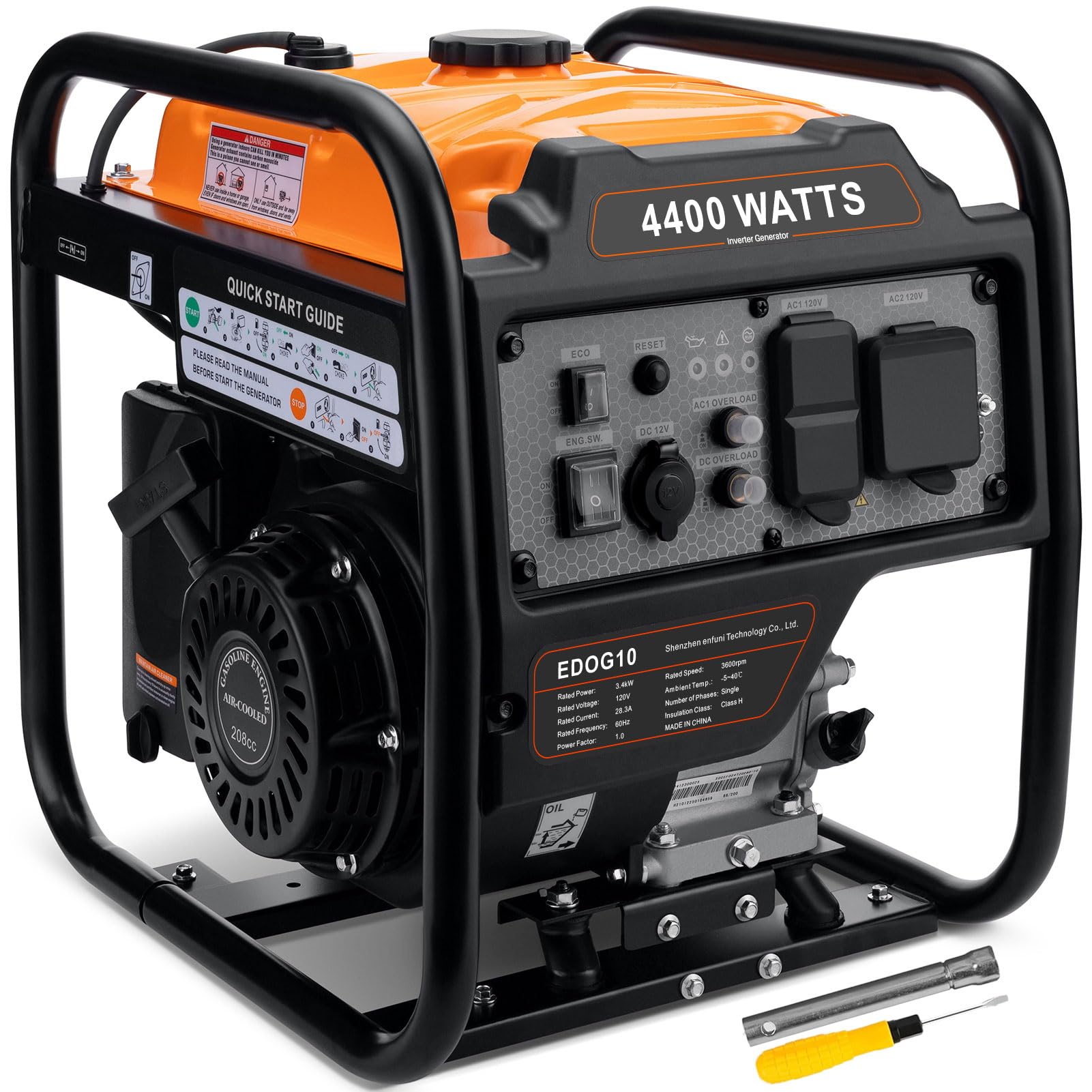
The Oxseryn 4400W inverter generator delivers the highest peak power in this guide at 4400 watts (3400 running watts) for the lowest price point. It uses an open-frame design, which means it’s louder than compact inverters — measured at about 100 dB at the unit and 75 dB at 30 feet. This is best suited for open campsites where noise ordinances are relaxed or as a home backup.
The 2-gallon fuel tank provides up to 14 hours of runtime at 25% load. It includes two 120V AC ports, a 30A RV port, and a 12V DC port. Inverter technology keeps THD low enough for electronics, though the open frame doesn’t dampen sound as well as closed inverters. Users report it starts on the first pull with proper preparation and runs reliably for home backup during outages.
The primary trade-off is noise — it’s not a “quiet” camping generator in the traditional sense, but it’s more affordable than any comparable 4400W inverter. The choke label is reported to be reversed, and you must buy oil separately. If you need maximum power on a tight budget and can tolerate the higher noise level, this unit delivers excellent value.
Why it’s great
- Highest peak wattage (4400W) at the lowest price
- 14-hour runtime at 25% load
- RV-ready 30A outlet included
Good to know
- Open frame is louder than suitcase inverters
- Choke label may be reversed
- No oil included; separate purchase required
FAQ
How quiet must a camping generator be to avoid disturbing neighbors?
Can I run my RV air conditioner with a 2200-watt quiet generator?
What does parallel operation mean and do I need it?
How do I store a quiet camping generator to keep it reliable for years?
Final Thoughts: The Verdict
For most campers, the quiet camping generator winner is the Honda EU2200i Companion because it delivers the absolute best noise-to-power ratio, legendary reliability, and Bluetooth monitoring. If you want remote start and a digital display without sacrificing quietness, grab the Westinghouse 4021. And for budget-conscious campers who need dual-fuel flexibility, nothing beats the WEN DF360iX for the price.

Mo Maruf
I created WellFizz to bridge the gap between vague wellness advice and actionable solutions. My mission is simple: to decode the research and give you practical tools you can actually use.
Beyond the data, I am a passionate traveler. I believe that stepping away from the screen to explore new environments is essential for mental clarity and physical vitality.