Our readers keep the lights on and my smoothie glass nicely filled. As an Amazon Associate, I earn from qualifying purchases.
The simple act of pulling a dandelion from the root often leaves half the taproot in the ground, guaranteeing a return in a few weeks. If you’ve sworn off synthetic herbicides but still want your gravel paths, patios, and flower beds to stay weed-free, the challenge is finding a formula that actually kills the plant without killing your peace of mind.
I’m Mohammad Maruf — the founder and writer behind WellFizz. I’ve spent years analyzing the raw chemical profiles, customer failure rates, and safety certifications of natural herbicides to find the ones that deliver the knockout punch without the toxic baggage.
The goal is to help you cut through the marketing fluff and find the absolute best and safest weed killer for your home, garden, and pets.
How To Choose The Best And Safest Weed Killer
Not all natural weed killers are created equal. The difference between a product that burns tops and one that kills the root comes down to three variables: active ingredient type, application conditions, and the delivery system. Here’s what to look for before you buy.
Active Ingredient — Salt vs. Vinegar vs. Essential Oils
The most effective natural formulas use either a high concentration of acetic acid (vinegar at 20% or higher) or sodium chloride (sea salt). Salt-based killers like those from Earth’s Ally penetrate deeper into the root system, while vinegar-based products offer rapid top-kill but often require reapplication. Formulas relying on clove oil or citrus oil are gentler but tend to only burn leaves without reaching the root crown.
Application Conditions — Heat and Sunlight Are Non-Negotiable
Every natural herbicide review will tell you the same thing: you must spray on a dry, sunny day with temperatures above 70°F. The active ingredients need heat and UV light to desiccate the plant cells. Spraying on a cool, overcast morning will deliver disappointing results, regardless of the brand name on the bottle.
Sprayer Design — Don’t Let a Bad Nozzle Ruin a Good Formula
A recurring complaint across every product in this category is the sprayer. Many ready-to-use gallons come with a hand-pump sprayer that clogs, leaks, or fails after a few uses. If you plan to treat large areas, consider buying a separate pump sprayer and decanting the solution. A wide fan pattern and a steady stream ensure full leaf coverage, which is essential for the sodium chloride to penetrate the waxy cuticle.
Quick Comparison
On smaller screens, swipe sideways to see the full table.
| Model | Category | Best For | Key Spec | Amazon |
|---|---|---|---|---|
| Earth’s Ally Grass and Weed Killer | Salt-Based | Root-kill on patios & driveways | Sea salt active — kills roots in 3 hours | Amazon |
| OrganicMatters Natural Weed Killer | Vinegar-Based | Fast top-kill on gravel & rock beds | 20% acetic acid — results under 24 hours | Amazon |
| Bonide Captain Jack’s Deadweed Brew | Organic Herbicide | Non-selective control in cool climates | OMRI listed — works at 40°F | Amazon |
| Pet’s Pal Natural Weed Killer | Pet-Safe Spray | Households with dogs and kids | Chloride-based — safe for bee population | Amazon |
| Energen Vinegar Weed & Grass Killer | High-Acetic | Clover & creeping charlie control | 20% acetic acid — 1-2 day kill time | Amazon |
In‑Depth Reviews
1. Earth’s Ally Grass and Weed Killer
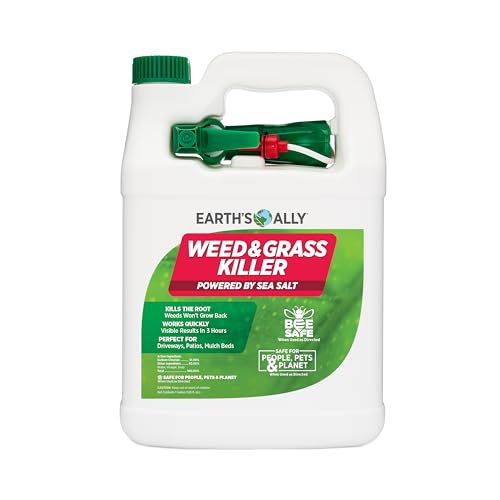
Earth’s Ally uses sodium chloride — common sea salt — as its active ingredient, which is a game-changer for homeowners who want a formula that kills to the root rather than just scorching the leaves. Independent testing shows visible wilting in as little as three hours on a sunny day, and the salt disrupts the plant’s ability to absorb water at the cellular level, meaning the taproot dries out completely. This makes it far more effective than vinegar-only sprays on perennial weeds like dandelions and Bermuda grass.
The formula is OMRI Listed and independently tested to be safe for bees, kids, and pets when used as directed. The ready-to-use gallon covers roughly 1,000 square feet, and the manufacturer recommends 4 to 5 sprays per weed. The sprayer nozzle on the bottle is functional but not heavy-duty — for large patches, you’ll want to decant into a separate pump sprayer for better pressure and coverage.
Some negative reviews mention that the user didn’t shake the bottle thoroughly enough, which is critical since the salt settles at the bottom. A quick thirty-second shake before each use ensures the sodium chloride is fully suspended in the water. If you follow the instructions, this is the most reliable natural root-killer on the market right now.
Why it’s great
- Kills weeds to the root, not just the top growth
- Visible results in 3 hours on a warm, sunny day
- OMRI Listed and safe for pollinators
Good to know
- Must be shaken thoroughly before each use
- Not effective on cool, cloudy days
- Sprayer bottle could be more durable
2. OrganicMatters Natural Weed Killer

OrganicMatters delivers a potent 20% acetic acid solution that burns through the waxy cuticle of broadleaf and grassy weeds within hours. Customers consistently report seeing brown, crispy leaf edges by the next morning when applied to weeds in gravel, rock beds, and along fence lines. The vinegar concentration is high enough to desiccate even tough crabgrass, but it is non-selective — it will kill any vegetation it touches, including your lawn if you spray carelessly.
The formula is vinegar-based, so the active ingredient breaks down rapidly in the soil and leaves no residual toxicity. This makes it a strong choice for vegetable garden borders and areas where children play. The one-gallon bottle comes with a sprayer, but several reviews mention the pump nozzle has reliability issues — priming can be tricky, and the spray pattern is inconsistent. For serious users, buying a separate garden sprayer is a smart investment.
One honest trade-off: vinegar is a contact killer, not a systemic herbicide. It destroys the above-ground foliage but may not always reach deep taproots. Perennial weeds like bindweed or poison ivy may need a second application after new growth appears. That said, for annual weeds and surface grasses, this is the fastest natural solution available.
Why it’s great
- Fast top-kill — results seen in under 24 hours
- Non-toxic, vinegar-based formula breaks down quickly
- Great for rock beds, mulch, and fence lines
Good to know
- Contact killer only — deep-rooted weeds may regrow
- Sprayer nozzle is prone to clogging
- Needs hot, sunny weather to be effective
3. Bonide Captain Jack’s Deadweed Brew

Bonide’s Captain Jack’s Deadweed Brew stands apart from the competition because of its low-temperature tolerance. Most natural herbicides demand temperatures above 70°F for the active ingredients to work, but this formula remains effective down to 40°F. If you live in a region where spring arrives late or you need to spot-treat during a cool spell, this is the product that will actually deliver results when others fail.
The ready-to-use 128-ounce bottle is approved for organic gardening and is non-selective, meaning it kills both broadleaf weeds and grasses. It becomes waterproof once dry, so a rain shower two hours after application won’t wash it away — a practical advantage over plain vinegar solutions. Users report that weeds begin to wilt within an hour of spraying on a sunny morning, with full browning by the next day.
One important distinction: this product uses a lipid-based surfactant that helps the active ingredients adhere to the leaf surface. Some users found that coarse weeds with waxy leaves (like mature poison ivy) required a thorough soaking. The included hand-pump sprayer works fine for small areas, but for a full gallon of coverage, you’ll want a wand-style sprayer for better reach and less hand fatigue.
Why it’s great
- Works at temperatures as low as 40°F
- Waterproof once dry — rain won’t wash it off
- Approved for organic gardening
Good to know
- Some users report inconsistent results on tough perennials
- Sprayer is adequate for small patches only
- Can kill grass if overspray hits the lawn
4. Pet’s Pal Natural Weed Killer

Pet’s Pal was formulated by pet owners for pet owners, and the ingredient list reflects that priority. The active ingredient is a chloride-based compound — not glyphosate or synthetic growth regulators — and the manufacturer emphasizes that it is safe for dogs, cats, and children once the spray has dried. Multiple reviews from households with multiple large dogs confirm zero adverse reactions even after the pets walked through treated areas.
The ready-to-use spray is non-selective and effective on dandelions, clover, ivy, chickweed, and crabgrass. It works best when applied on a hot, sunny day, with visible wilting occurring within hours. The coverage is rated for approximately 1,000 square feet per gallon, making it suitable for patios, driveways, and mulched beds. The formula is also marketed as bee-friendly, which matters if you maintain a pollinator garden nearby.
The biggest drawback is temperature dependency. On cooler or overcast days, the kill rate drops noticeably, and you may need a second application. The sprayer works well out of the box, but some users noted that the trigger mechanism stiffens after repeated use. For the price-conscious buyer who prioritizes safety above all else, this is a solid mid-range performer.
Why it’s great
- Formulated specifically for pet safety
- Fast results on hot, sunny days
- Bee-friendly and glyphosate-free
Good to know
- Loses effectiveness in cool weather
- Trigger sprayer can stiffen over time
- May require reapplication on established weeds
5. Energen Vinegar Weed & Grass Killer

Energen’s weed killer delivers a 20% acetic acid concentration that outperforms standard household vinegar (5%) by a factor of four. This high acidity causes rapid cell dehydration, leading to complete browning of above-ground foliage within 24 to 48 hours. Users tackling stubborn ground ivy and creeping charlie — two of the most difficult lawn weeds to eliminate without synthetics — have reported full kill after a single thorough application.
The formula is approved for organic production and is glyphosate-free, making it a safe choice for vegetable garden edges and paths. The one-gallon container comes with an attached sprayer, but this is where Energen loses points. The sprayer design is notoriously unreliable — several long-term customers report that the nozzle leaks on the hand during use and siphons product into the container during storage, creating a strong vinegar smell in the garage.
Despite the hardware issues, the weed killer itself works as advertised. For best results, decant the liquid into a quality pump sprayer with a brass nozzle. Apply on a dry, sunny day with no rain forecast for 24 hours. The 20% acetic acid will kill grass too, so keep the spray stream tight and off your lawn.
Why it’s great
- High acetic acid concentration kills tough weeds fast
- Approved for organic use and glyphosate-free
- Effective on creeping charlie and ground ivy
Good to know
- Sprayer nozzle is prone to leaking and failure
- Vinegar smell is strong during application
- Not effective on cool, overcast days
FAQ
How long does natural weed killer take to work on a sunny day?
Will natural weed killer kill grass if I spray the lawn?
Final Thoughts: The Verdict
For most users, the best and safest weed killer winner is the Earth’s Ally Grass and Weed Killer because it uses sea salt to kill weeds to the root, works in three hours, and carries the OMRI organic seal. If you want fast top-kill on gravel paths and rock beds, grab the OrganicMatters Natural Weed Killer. And for treating weeds during cool spring weather when other natural sprays fail, nothing beats the Bonide Captain Jack’s Deadweed Brew.

Mo Maruf
I created WellFizz to bridge the gap between vague wellness advice and actionable solutions. My mission is simple: to decode the research and give you practical tools you can actually use.
Beyond the data, I am a passionate traveler. I believe that stepping away from the screen to explore new environments is essential for mental clarity and physical vitality.