Our readers keep the lights on and my smoothie glass nicely filled. As an Amazon Associate, I earn from qualifying purchases.
Aviation snips are the backbone of any sheet metal job, yet a poor pair can turn a simple duct run into a battle against mangled edges and hand fatigue. The difference between a clean, controlled cut and a torn, burred edge comes down to blade geometry, compound action, and the specific cut direction you choose.
I’m Mohammad Maruf — the founder and writer behind WellFizz. My research focuses on the mechanical leverage, alloy composition, and ergonomic design that separate professional-grade tools from frustrating imitations.
After analyzing dozens of models and real-world feedback from HVAC pros and metalworkers, these are the options that define the best aviation snips for accuracy, durability, and long-term value.
How To Choose The Best Aviation Snips
Selecting the right aviation snips means matching blade orientation and handle design to your specific cutting tasks. The wrong choice will pinch the waste side of your material, bind mid-cut, or wear out prematurely. Focus on four factors: cut direction, blade material, compound action mechanism, and handle configuration.
Left Cut vs. Right Cut vs. Straight Cut
Left cut snips (yellow or red handles) curve the waste material upward and to the left, making them ideal for cutting clockwise curves or reaching into tight left-side corners. Right cut snips (green handles) do the opposite, curving waste to the right for counterclockwise arcs. Straight cut snips (often unmarked or silver) handle straight lines and wide gentle curves. Most pros carry all three to avoid fighting the natural curl of the blade.
Compound Action Leverage
Compound action snips use a pivot linkage that multiplies your hand force, typically reducing the required grip effort by 40 to 50 percent compared to standard tinner snips. This matters when cutting 18-gauge cold-rolled steel or 22-gauge stainless — materials that demand sustained pressure. Without compound action, hand fatigue sets in during the second or third cut on a long panel.
Blade Material and Heat Treatment
Drop-forged molybdenum alloy steel with austemper heat treatment produces blades that hold a sharp edge far longer than standard high-carbon steel. Cheaper snips often skip the heat-treat step, leading to dullness after a few dozen cuts through ductwork. Black oxide or powder coating adds corrosion resistance, which is critical if you work in humid crawlspaces or outdoor roofing environments.
Offset vs. Straight Handles
Offset handles position your hands several inches above the cutting line, keeping knuckles clear of the work surface. This is essential for overhead HVAC work or cutting along a roof edge where clearance is tight. Straight handles offer more direct control for bench-top notch cuts and detailed trimming, but they force your hand closer to sharp metal edges.
Quick Comparison
On smaller screens, swipe sideways to see the full table.
| Model | Category | Best For | Key Spec | Amazon |
|---|---|---|---|---|
| Midwest Blackout MWT-6510CO-NP | Offset Set | Daily pro use, 18-ga steel | 18 ga CR / 22 ga SS | Amazon |
| Midwest MWT-6510C | Offset Set | Precision trim cuts | Moly alloy, forged | Amazon |
| Crescent Wiss M123R | 3-Piece Set | All-direction cutting | 18 ga steel capacity | Amazon |
| Malco AV8 Left Cut | Vertical/Offset | Overhead tight spaces | 90° upright jaws | Amazon |
| Crescent Wiss M6M7AMZ | 2-Piece Offset | General sheet metal | 18 ga CR steel | Amazon |
| Malco AV9 Right Cut | Vertical/Offset | Tight-space right cuts | 90° forged jaws | Amazon |
| Klein Tools 89556 | Straight / Multi | Vinyl siding & light jobs | 3.5-inch replaceable blade | Amazon |
In‑Depth Reviews
1. Midwest Blackout Series MWT-6510CO-NP
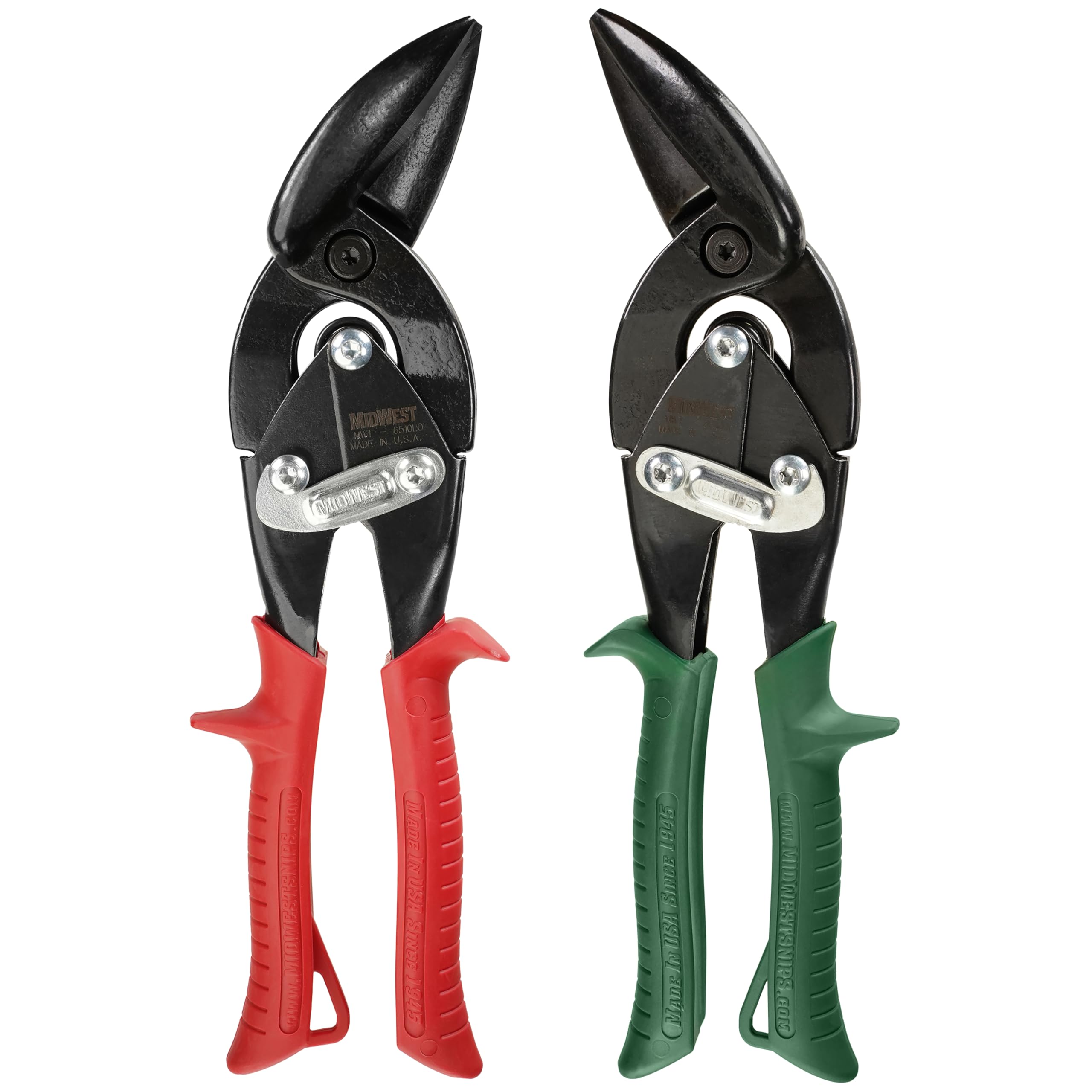
The Midwest Blackout Series delivers the clearest balance of edge retention and ergonomic comfort among any offset snip set in this range. Its hot drop-forged molybdenum alloy steel blades undergo austemper heat treatment — a process that refines the crystalline structure of the steel, keeping the cutting edge sharp through repeated contact with 18-gauge cold-rolled steel and 22-gauge stainless. Seasoned Sheet Metal workers who have used Midwest snips for 15-plus years report that replacement cycles average six to eight years, which is exceptional for daily trade use.
The offset handle design lifts your knuckles well above the work surface — a decisive advantage when cutting along a roof drip edge or trimming overhead ductwork. The Kush’N-Power grips use a contoured finger stop and non-slip ribs that stay planted even when your hands are sweaty. The black oxide coating resists rust far better than bare steel or painted finishes, so these snips survive humid job sites and truck boxes without developing pitted blades.
Users mention that the left and right offset set covers nearly every scenario on a typical HVAC or roofing job: the right snip handles counterclockwise curves and left-side waste, while the left snip manages clockwise arcs and right-side waste. The only trade-off is that the offset pivot creates a slightly thicker jaw profile, making them less ideal for ultra-tight electrical boxes compared to a dedicated vertical snip.
Why it’s great
- Molybdenum alloy steel with austemper hardening for long edge life
- Offset handles keep hands clear of sharp edges and overhead material
- Black oxide coating prevents rust in humid conditions
Good to know
- Jaw thickness makes them slightly bulky for confined electrical panel cuts
- No straight-cut model included in the two-piece set
2. Midwest Tools MWT-6510C Offset Set

The MWT-6510C shares the same forged molybdenum alloy steel pedigree as the Blackout series, but its defining feature is the Pinch-Thru-Point blade geometry that cuts cleanly all the way to the very tip of the blades. Many snips begin to tear or misshape the last quarter-inch of a cut because the blades lose bypass overlap near the tip — Midwest engineered this pair to maintain full bite through the entire stroke, which translates to accurate notch cuts and trim work without secondary filing.
Professional tradesmen consistently rank this set as the go-to for finish-grade sheet metal work where burrs and ragged edges are unacceptable. The Kush-N-Power grips mirror the Blackout design, but the overall weight balance feels slightly more neutral in the hand due to a thinner handle profile. The offset angle lifts your hand position high enough to avoid scraping knuckles on sharp metal, yet the jaw gap remains narrow enough for controlled inside cuts on gutters and downspouts.
The main caution is that the red and green color coding is subtle — new buyers should verify the left and right orientation by looking at the blade bevel rather than relying on handle hue alone.
Why it’s great
- Pinch-Thru-Point design eliminates the failed end-of-cut tear
- Molybdenum steel with austemper hardening for industry-leading edge life
- Comfortable contour finger stop reduces grip fatigue
Good to know
- Color identifiers are less vivid than competitor snips
- No hang hole on the grip for pegboard storage
3. Crescent Wiss M123R MetalMaster Set

The Crescent Wiss M123R set delivers the classic three-snip configuration that covers every cutting direction: straight (M1R), right cut (M2R), and left cut (M3R). This is the kit that lets you approach any cut direction without fighting the natural blade curl. The compound action mechanism multiplies your hand force, so cutting 18-gauge low-carbon steel requires noticeably less squeeze than offset snips of similar capacity.
Wiss has been manufacturing these snips in the USA for decades, and the design remains remarkably consistent: serrated blades that grip the metal surface to prevent slipping during the cut, plus a free-float pivot bolt that self-adjusts as the blades wear, maintaining the bypass alignment over time. The spring-action handles snap the jaws open after each cut, accelerating repetitive scoring work on long duct seams.
Experienced users mention that the single-handed latch operation works smoothly for both left and right-handed users, and the ergonomic non-slip handle grips clean easily after adhesive or tar exposure. The trade-off is that the straight-jaw profile on the M1R demands more knuckle clearance than offset snips — these are best on a workbench or table, not for overhead reach work.
Why it’s great
- Three-snip set handles straight, left, and right cuts without swapping
- Compound action reduces hand force for sustained cutting
- Free-float pivot bolt extends tool life by self-aligning blades
Good to know
- Straight model lacks offset handles for knuckle clearance
- Serration pattern can leave fine marks on soft aluminum
4. Malco AV8 Left Cutting Vertical Snip
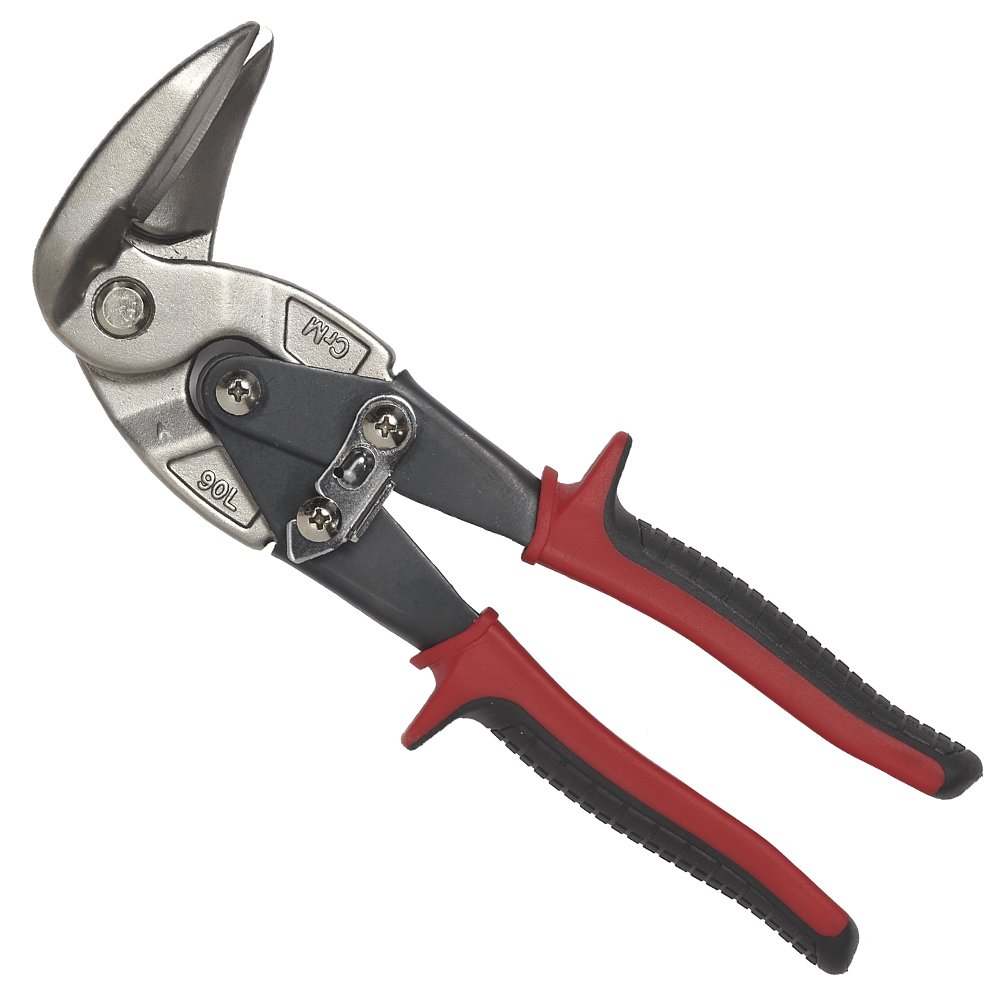
The Malco AV8 solves a problem that standard offset snips cannot handle: cutting in a vertical plane where the material runs perpendicular to your arm. The jaws are set at a 90-degree angle to the handles, so the cutting action happens upright rather than flat. This is the tool you reach for when cutting oval holes into mounted aluminum gutters from underneath, or trimming flashing while standing on a ladder with the material overhead.
Forged steel jaws with a serrated upper blade keep the workpiece locked in position, preventing the creeping that can throw off a precision cut. The non-slip cushion grips are contoured to fit a gloved hand, and the overall length of 9.25 inches keeps the tool manageable in tight chases between roof joists. Users cutting birdcage screen at elevated angles report that the vertical orientation lets them match the contour of the fascia without crumpling the edges.
The limitation is that this is a single-direction tool — left cut only. If your job requires right-side turns, you will need the AV9 alongside it. The 24-gauge steel and 28-gauge stainless capacity is adequate for most HVAC ductwork but may struggle with thicker structural gauge metal used in some architectural sheet metal.
Why it’s great
- 90-degree upright jaws enable flush cutting in vertical orientation
- Forged steel construction resists bending under heavy load
- Serrated upper jaw prevents material slip during cut
Good to know
- Left-cut only — requires partner AV9 for right turns
- Limited capacity on steel thicker than 24 gauge
5. Crescent Wiss M6M7AMZ Offset Set

The Crescent Wiss M6M7AMZ two-piece set gives you offset handles with left (M6R) and right (M7R) cutting orientations, covering straight lines and sweeping arcs in both directions. The offset blade geometry lifts the handles above the cutting line, which is a practical upgrade over the straight-handle M123R set for anyone who works on ductwork where the material is already in place.
Blade serrations run the full cutting edge, distributing the shear force evenly and reducing the likelihood of a jagged edge. The spring-action handle mechanism snaps the blades open automatically after each squeeze, which accelerates high-volume cutting where you would otherwise have to manually pry the jaws apart. Users who cut 18-gauge rolled steel report that the offset pivot keeps the waste strip curling away from the work surface, preventing scratches on finished panels.
The main trade-off compared to Midwest snips is the blade steel: Wiss uses a high-carbon steel that sharpens easily but does not hold an edge quite as long as molybdenum alloy under daily professional use. The lifetime warranty offsets this somewhat, but for continuous commercial work, the Midwest sets remain the longer-lasting choice.
Why it’s great
- Offset handles keep knuckles clear for safer cutting
- Spring-action automatically opens blades for faster repetition
- Covers both left and right arcs in one package
Good to know
- High-carbon steel edge dulls faster than molybdenum alloy alternatives
- No straight-cut model included for notch work
6. Malco AV9 Right Cutting Vertical Snip

The Malco AV9 mirrors the AV8 but in a right-cutting orientation, making it the companion tool for clockwise arcs, left-side waste relief, and any cut where the waste material needs to curl upward and to the right. The 90-degree forged steel jaws allow you to cut directly overhead without the handle bumping into the ceiling or bottoming out against a roof deck — a scenario where straight snips are completely useless.
HVAC installers who use these daily report that the compound action geometry cuts through 24-gauge steel with noticeably less hand strain than basic tinner snips, and the serrated upper jaw keeps the material from skating sideways under pressure. The 10-inch overall length gives enough reach to chase cuts into the back of a cabinet or against a wall stud where clearance is tight.
The limitation mirrors the AV8: this is a specialized single-direction tool. You need the AV8 for left-side work, and neither vertical snip handles straight-line scoring as naturally as a traditional offset pair. For installers who do primarily overhead ductwork, the vertical pair earns its place; for general shop work, a standard offset set is more versatile.
Why it’s great
- Vertical jaw orientation enables flush overhead cutting
- Forged steel jaws withstand repeated heavy use
- Serrated edge prevents material creep during cut
Good to know
- Right-cut only — needs AV8 for comprehensive coverage
- Less effective for straight bench-top cuts than offset snips
7. Klein Tools 89556 Metal Cutter

The Klein Tools 89556 stands apart from traditional aviation snips by offering replaceable high-carbon steel blades — a feature that lets you restore sharpness without replacing the entire tool. The 3.5-inch blades cut straight lines and wide curves through 24-gauge steel and 28-gauge stainless, but the real niche for this tool lies in softer materials: vinyl siding, copper, aluminum, and even old metal credit cards.
The all-steel construction feels robust in the hand, and the large handles accommodate gloved fingers comfortably. Users cutting vinyl siding for storm damage repairs report that the blades slice through the material cleanly without cracking the substrate — a common failure point with standard snips that apply uneven pressure. The ambidextrous design means left-handed users can operate it without fighting the geometry.
The limitation is that the straight-cut blade orientation and lack of compound action make this tool less suited for heavy-duty sheet metal work on 18-gauge steel. The full-length cutting edge also means it cannot match the leverage of a dedicated aviation snip when tackling thick galvanized ductwork. It is best thought of as a capable multi-material cutter rather than a pure sheet metal snip.
Why it’s great
- Replaceable blades extend tool life without resharpening
- Large handles fit comfortably with work gloves
- Cuts a wide range of soft metals and vinyl cleanly
Good to know
- No compound action — requires more hand force on thick steel
- Straight cut only, no offset or directional variant available
FAQ
What is the difference between left cut and right cut aviation snips?
Can aviation snips cut stainless steel?
Are offset aviation snips better than straight snips?
Final Thoughts: The Verdict
For most users, the best aviation snips winner is the Midwest Blackout Series MWT-6510CO-NP because its molybdenum alloy steel with austemper heat treatment provides the longest edge life in daily professional use, and the offset handles keep you safe during overhead and tight-space cutting. If you want a three-tool kit that covers every cut direction from a bench, grab the Crescent Wiss M123R MetalMaster Set. And for overhead work where standard offsets won’t fit, nothing beats the Malco AV8 and AV9 vertical snip pair.

Mo Maruf
I created WellFizz to bridge the gap between vague wellness advice and actionable solutions. My mission is simple: to decode the research and give you practical tools you can actually use.
Beyond the data, I am a passionate traveler. I believe that stepping away from the screen to explore new environments is essential for mental clarity and physical vitality.