Our readers keep the lights on and my smoothie glass nicely filled. As an Amazon Associate, I earn from qualifying purchases.
The problem is rarely the temperature — it’s the noise of a motor that keeps you from falling asleep. Most fans sold as “quiet” still hum at a frequency that disturbs light sleepers, and the difference between 25dB and 37dB is the difference between drifting off and staring at the ceiling. A fan designed for sleeping must prioritize motor refinement, blade geometry, and mode logic over raw airflow.
I’m Mohammad Maruf — the founder and writer behind WellFizz. I’ve spent years analyzing appliance specifications, decibel claims, and motor technologies to separate marketing noise from measurable sleep compatibility.
These reviews dissect the airflow velocity, motor type, oscillation range, and timer depth that actually matter when choosing the best bedroom fans for sleeping for a restful night.
How To Choose The Best Bedroom Fans For Sleeping
Selecting a fan for sleeping requires a different set of priorities than choosing one for a living room. Airflow power matters less than noise floor, and features like a sleep mode that gradually reduces speed matter more than maximum wind velocity. Focus on these four specifications.
Motor Type — DC vs. AC
DC motors consume about 70% less electricity than AC motors and operate at significantly lower decibel levels, especially at low speeds. A DC-powered fan typically runs at 20-25dB on its lowest setting, which is barely audible in a quiet bedroom. AC motors tend to hum at 30-40dB on low and double that on high. If you are hypersensitive to motor whine, prioritize a model with a brushless DC motor.
Noise Rating and Sleep Mode Logic
Manufacturers often quote noise levels at the lowest speed setting. Check whether the sleep mode actually reduces speed over time rather than just running at a constant low speed. A true sleep mode gradually decelerates the fan over 2-4 hours and then turns it off, preventing temperature drop in the middle of the night. Also look for display-off functions that eliminate LED light pollution.
Oscillation Angle and Airflow Direction
Wider oscillation angles — 70 to 90 degrees — circulate air more evenly across the room rather than blasting directly at your face, which can cause nasal dryness or stiff muscles. For sleeping, indirect airflow is generally healthier. Tower fans with bladeless designs also produce a smoother, uninterrupted stream of air compared to blade fans that chop the breeze into pulses.
Timer Depth and Remote Access
A timer that runs at least 8 hours is essential for overnight use. The best fans offer 12-hour timers so you do not wake up cold at 3AM. A remote control lets you adjust speed or oscillation without sitting up, which matters more at 2AM than during the day. Some models also include a built-in handle for easy relocation from the living room to the bedroom.
Quick Comparison
On smaller screens, swipe sideways to see the full table.
| Model | Category | Best For | Key Spec | Amazon |
|---|---|---|---|---|
| DREO Tower Fan | Premium Tower | Ultra-quiet sleep | 20dB noise floor | Amazon |
| LEVOIT Tower Fan | Compact DC | Nightstand use | 20dB at 7.5W | Amazon |
| OmniBreeze Tower Fan | Mid Tower | Auto temperature mode | 540 CMM airflow | Amazon |
| PELONIS Tower Fan | Mid Tower | Budget-friendly tower | 847 CFM capacity | Amazon |
| Abolee Tower Fan | Compact Tower | Small bedrooms | 23ft/s max velocity | Amazon |
| Comfort Zone Tower Fan | Budget Tower | Oscillating floor use | 32-inch height | Amazon |
| Amazon Basics Air Circulator | Budget Desk | Desktop personal use | 70W motor power | Amazon |
In‑Depth Reviews
1. DREO Tower Fan for Bedroom

This is the only fan in this lineup that combines a brushless DC motor with a claimed 20dB floor and 28ft/s top-end velocity. The TurboWind technology and Coanda-effect impeller actually deliver on the promise of strong yet silent airflow — on speeds 1 through 3, the blade noise is virtually inaudible, leaving only a gentle whoosh of moving air. Eight speeds give you granular control that 3-speed fans simply cannot match when you are trying to find the exact breeze strength that lets you fall asleep without feeling blasted.
The sleep mode logic here is genuinely useful: it automatically reduces speed over a set period rather than staying on a single low setting, which prevents the room from getting too cold overnight. At 90 degrees of oscillation combined with a 34-foot projection range, it circulates air throughout the entire room rather than just drying out your sinuses. The display auto-shuts off in sleep mode, eliminating all light pollution — a small detail that matters when total darkness is required for melatonin production.
Build quality is solid for the price tier. The base is stable enough that a cat bumping into it won’t topple the unit, and the removable rear grille makes cleaning the impeller simple — a feature most tower fans skip. A few users reported reduced airflow after 1-2 years of continuous use, but the combination of energy efficiency, noise floor, and customization depth makes this the strongest all-rounder for serious sleepers.
Why it’s great
- 20dB noise floor on low settings — genuinely silent in a quiet room
- 8 speeds provide precise airflow calibration for sleep
- 90° oscillation covers the whole room, not just one spot
Good to know
- May lose some airflow velocity after extended daily use
- High speeds produce audible motor noise around setting 7
2. LEVOIT Tower Fan for Bedroom
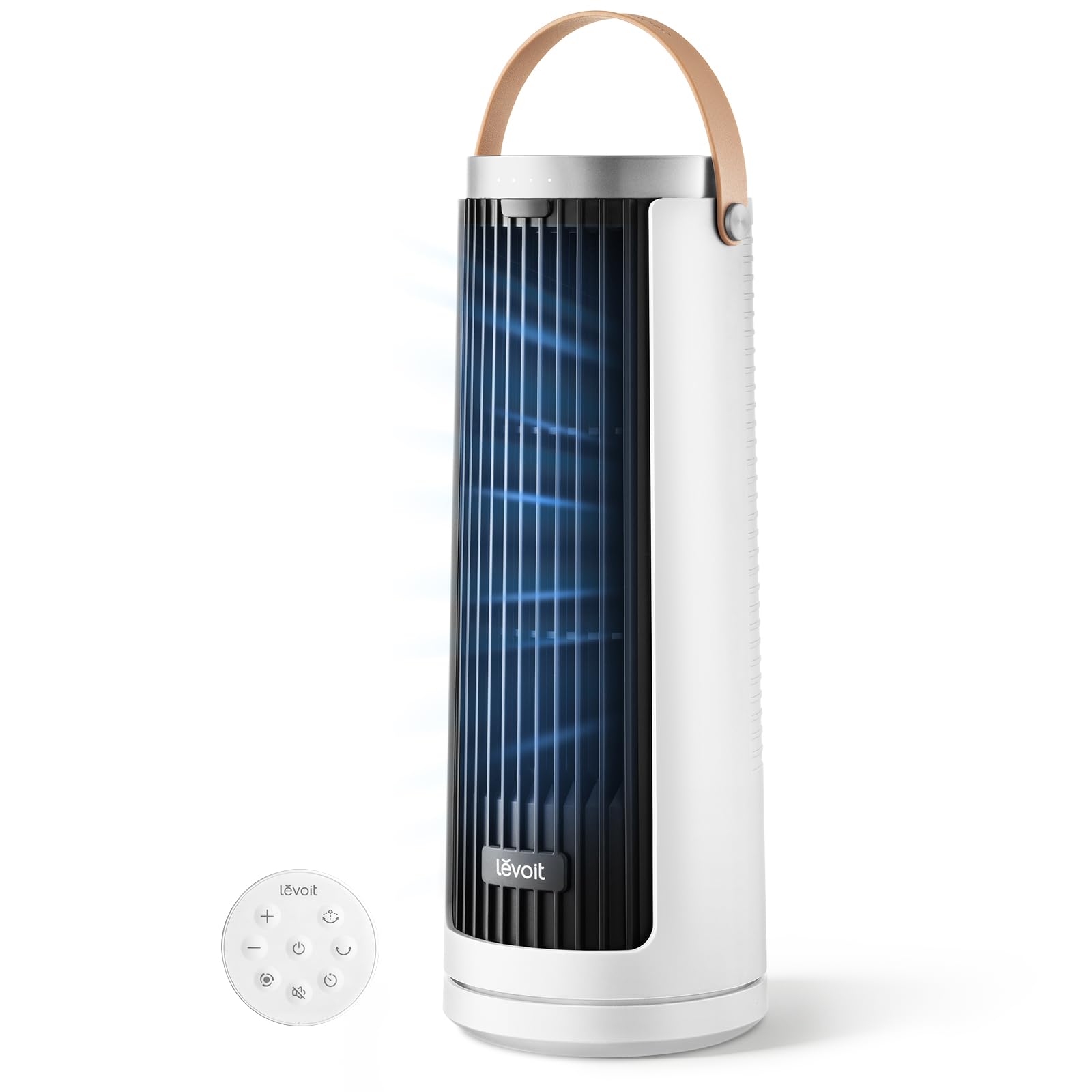
At only 13 inches tall with a 5-inch square footprint, this is the smallest tower fan in the list, but the DC motor and VortexAir Technology produce a focused 23ft/s breeze that feels disproportionate to its size. The lowest setting is nearly silent at around 20dB — you have to put your ear next to the grille to hear the motor. The 5 speed settings plus a Turbo mode give you more options than most compact fans, and the 30/60/90-degree multi-angle oscillation means you can limit the sweep to avoid direct face airflow.
The carrying handle is a practical addition for moving the fan between the desk and the nightstand. Power consumption maxes out at 7.5 watts, so running it all night costs pennies per month. The remote includes a display-off button that kills the LED lights, and the 12-hour timer covers the entire sleep cycle. Users in humid climates like Florida praise it as an effective air conditioner supplement that does not disturb sleep.
One limitation — the small air outlet means the breeze is concentrated rather than dispersed. This works well for a nightstand position where you want a gentle stream aimed at your torso, but it will not circulate air across a large master bedroom the way a full-size tower fan would. For single-person sleeping in a small to medium room, this is the most space-efficient option available.
Why it’s great
- Extremely quiet operation at 20dB on the lowest setting
- Multi-angle oscillation prevents direct face airflow
- Ultra-low power consumption at just 7.5W max
Good to know
- Concentrated airflow not ideal for large rooms
- Short height limits coverage to bed-level only
3. OmniBreeze Digital Electric Tower Fan

The standout feature on this 36-inch tower fan is the Auto mode, which adjusts fan speed based on the room temperature read by its built-in sensor. When the bedroom cools down at night, the fan automatically reduces speed — no more waking up shivering because the fan stayed on high all night. The Sleep mode gradually decelerates wind speed over the night, and the Natural mode simulates outdoor breeze patterns by varying speed randomly, which some users find more relaxing than constant airflow.
Assembly takes about 30 seconds with a two-piece base and lock nut. The 90-degree oscillation covers the room effectively, and the remote works from up to 20 feet away. The mute function and display-off feature eliminate clicking sounds and LED light, respectively, both of which are critical for a dark, silent sleep environment. One user specifically praised the digital room temperature display, noting they prefer seeing the temp over the fan speed.
The trade-off is that at full manual speed, the fan produces noticeable motor noise — it is quiet on low but not whisper-quiet on high. The base could be more robust; a few users found it slightly wobbly if bumped. For the price, however, the combination of auto temperature logic, four modes, and a tall tower form factor makes this a strong mid-range contender for anyone who runs hot at night but wants the fan to throttle back automatically.
Why it’s great
- Auto mode adjusts speed based on room temperature
- Sleep mode and Natural mode add variety for rest
- Tall 36-inch design covers the whole bed area
Good to know
- Manual high speed produces noticeable motor hum
- Base feels less sturdy than premium competitors
4. PELONIS 30-Inch Oscillating Tower Fan

PELONIS positions this fan at 37dB, which is louder than the DREO and LEVOIT but still below the threshold where most sleepers notice motor noise. The CycleBoost technology pushes air up to 11 feet away with 90 degrees of oscillation, and the 847 CFM airflow capacity is the highest in this comparison. The 7-hour timer is sufficient for most sleep cycles, though shorter than the 12-hour timers on competitors.
Assembly is tool-free — snap the two base pieces together, pass the cord through the flute, twist the plastic nut, and you are done. The control panel sits on top of the fan and includes touch-sensitive buttons, though the LEDs are tiny and default to off to avoid light disturbance. The included remote is essential because the top panel is difficult to see from bed. Users consistently note that the low and medium settings are genuinely quiet, while the high setting produces a clear airflow hum.
A design limitation worth noting: the airflow outlet sits high on the tower, so the breeze primarily hits above waist level. For a person lying in bed, this means the airflow mostly cools the calves and feet, which may not be sufficient if you need upper-body cooling. If you sleep on your back and want chest-level airflow, you may need to elevate the fan on a low table. The built-in handle makes it easy to reposition, at least.
Why it’s great
- High 847 CFM airflow for strong circulation
- Easy tool-free assembly in under 5 minutes
- Quiet on low and medium settings
Good to know
- Airflow outlet height mainly cools lower body
- 7-hour timer is shorter than some competitors offer
5. Abolee Tower Fan with Remote

This 13-inch bladeless tower fan is engineered for personal cooling within a 4-5 foot radius, making it a strong fit for a nightstand or desk next to a single bed. The high-efficiency turbine blade inside the slim body pushes air at 23ft/s, which is genuinely surprising from a unit that measures only 4.7 inches square. At 25dB on the lowest setting, it is quiet enough for most sleepers, though not as silent as the 20dB-class DC motor fans.
The AI mode automatically adjusts speed based on ambient temperature, similar to the OmniBreeze but in a much smaller package. The 70-degree oscillation is narrower than the 90-degree standard on larger fans, but for a personal fan that sits next to you, the reduced sweep prevents the breeze from wandering off-target. The 12-hour timer is generous for a fan at this price, and the remote works up to 20 feet away. Users report that the fan survived being thrown onto a porch and a 4-foot drop onto laminate, so build quality exceeds expectations for the cost.
One common observation — the temperature sensor reads about 6 degrees Fahrenheit higher than actual room temperature, so the AI mode may run the fan slightly faster than necessary. The slim air moving window (about 4 inches tall) means the breeze is focused rather than dispersed, which some users find overstimulating if the fan is positioned too close to their face. For a bedside companion in a small bedroom, this is a reliable and compact option with solid feature depth.
Why it’s great
- Compact 4.7-inch square footprint for tight spaces
- AI mode and 12-hour timer provide set-and-forget convenience
- Surprisingly durable for the price point
Good to know
- Temperature sensor reads higher than actual room temp
- Narrow air outlet creates a focused rather than dispersed breeze
6. Comfort Zone 32-Inch Oscillating Tower Fan
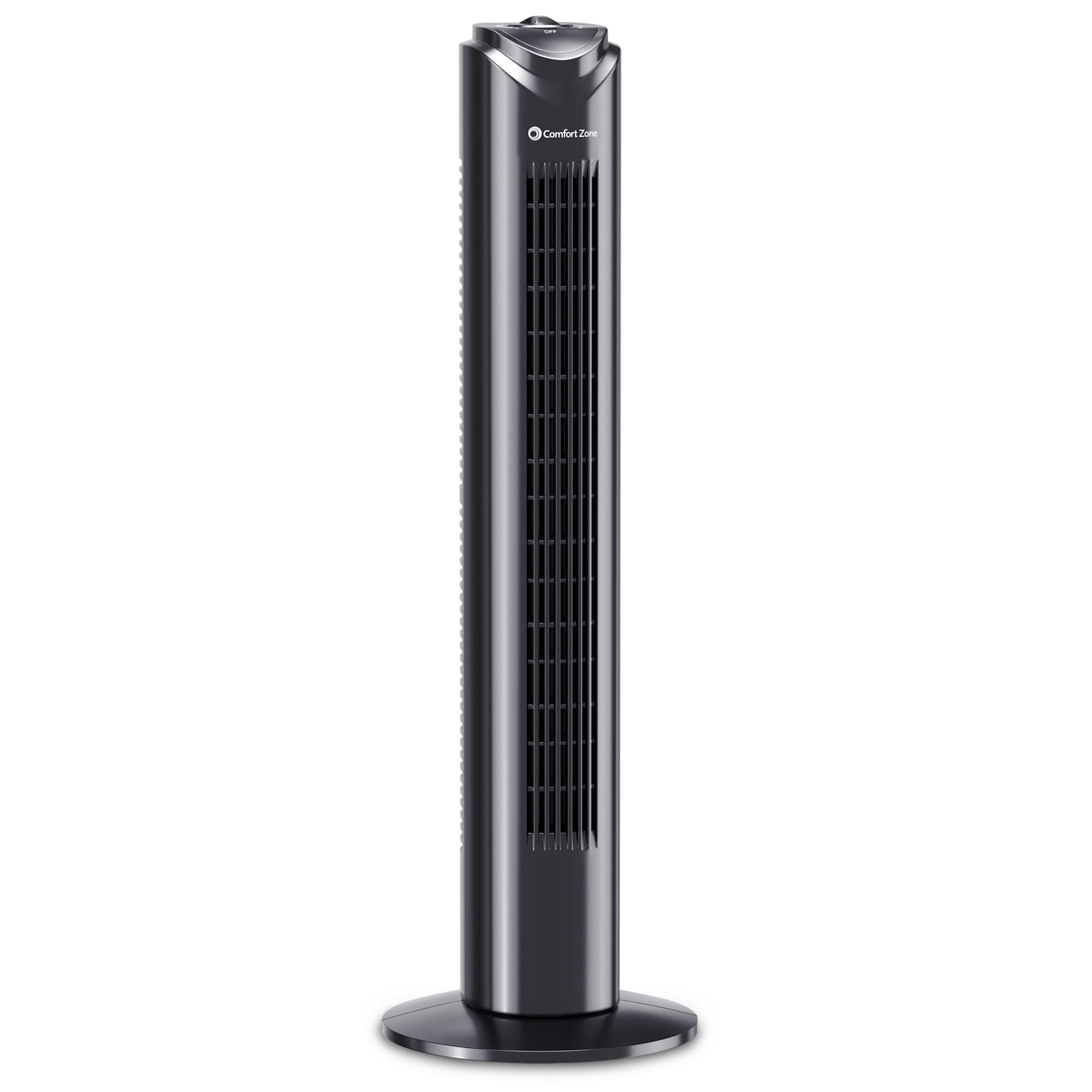
As a 32-inch tower fan with a 90-degree oscillation range and 3-speed dial control, this is a straightforward, no-frills option for those who want bladeless safety and a slim profile without paying extra for smart features. The design prioritizes stability and safety — the bladeless construction and ETL-certified safety plug make it a reasonable choice for households with children or pets who might bump into a floor fan.
The built-in carry handle makes it easy to move between rooms, and the gloss-black finish blends into most bedroom decor without standing out. Users who value the white noise aspect of a fan note that this model produces a consistent airflow sound that helps mask street noise. On its low setting, the fan is quiet enough to sleep next to, though not as refined as DC-motor alternatives.
The primary drawback is inconsistent build quality. Some users report that the base does not clamp securely, causing the fan to wobble, and the manual knob has been reported to fall off (though it snaps back on). A few found the fan significantly louder than expected, particularly on the high setting. If you get a unit with tight tolerances, it is a solid budget tower fan. If you get one with loose assembly, it may require returns or DIY reinforcement.
Why it’s great
- Bladeless design is safe for kids and pets
- Carry handle allows easy room-to-room movement
- 90° oscillation covers wide area for the price
Good to know
- Inconsistent build quality reported on base assembly
- Louder on high setting than similarly priced options
7. Amazon Basics Air Circulator Fan

This 14.8-inch desk fan uses a 70-watt motor and 11-inch blades to move a substantial amount of air for its size, but this is not a fan designed for silent sleep. The motor produces a clear hum on medium and high speeds, and even on low it generates more audible blade noise than the DC-motor tower fans in this list. It is best suited for those who need white noise to sleep or for use as a secondary cooling source during the day rather than a primary bedside fan.
The 90-degree tilt head lets you angle the airflow upward to avoid direct face contact, and the lightweight 4.2-pound build makes it easy to relocate from a desk to the floor next to the bed. The back-mounted knob control is simple and intuitive — no remote, no display, no smart features. Just three speeds and a tilt adjustment. For users who sleep hot and want maximum airflow regardless of noise, the 70W motor delivers more raw power per dollar than any tower fan in this lineup.
The lack of oscillation means you cannot circulate air across the room; it will only cool the direction it is pointed. If you can tolerate motor noise and prefer white noise for sleep, this is the cheapest way to move serious air. For pure sleep silence, the DC-motor options above remain the better choice.
Why it’s great
- 70W motor delivers strong airflow for the size
- Lightweight and easy to move between rooms
- 90° tilt head directs air where needed
Good to know
- Motor generates audible hum not suitable for silent sleep
- No oscillation feature limits room-wide circulation
FAQ
Is a DC motor fan really quieter than an AC motor fan for sleeping?
What sleep mode features should I look for in a bedroom fan?
How tall should a tower fan be for a standard bed?
Final Thoughts: The Verdict
For most sleepers, the best bedroom fans for sleeping is the DREO Tower Fan because its 20dB DC motor and 8-speed control give you genuine silence at low settings and powerful airflow when you need it, all in a stable, easy-to-clean tower design. If you need a compact fan that fits on a nightstand or small desk, grab the LEVOIT Tower Fan — its multi-angle oscillation and 12-hour timer cover single-bed sleeping areas without sacrificing whisper-quiet operation. And for a smart value pick with automatic temperature-based speed adjustment, nothing beats the OmniBreeze Tower Fan at its price point.

Mo Maruf
I created WellFizz to bridge the gap between vague wellness advice and actionable solutions. My mission is simple: to decode the research and give you practical tools you can actually use.
Beyond the data, I am a passionate traveler. I believe that stepping away from the screen to explore new environments is essential for mental clarity and physical vitality.