Our readers keep the lights on and my smoothie glass nicely filled. As an Amazon Associate, I earn from qualifying purchases.
Your tap water might smell like a swimming pool or taste like a chemical lab, and a standard sediment screen won’t touch those dissolved compounds. A carbon block water filter attacks chlorine, volatile organic compounds (VOCs), and the musty odors that ruin a glass of water, all while leaving beneficial minerals intact. The difference between a cheap string-wound filter and a dense carbon block is the difference between polishing the surface and curing the root cause of bad-tasting water.
I’m Mohammad Maruf — the founder and writer behind WellFizz. I’ve spent over a decade analyzing filtration hardware, from lab-tested coconut-shell carbon blocks to high-flow whole-house cartridges, comparing micron ratings, chlorine reduction capacities, and real-world pressure drops.
Whether you’re battling a persistent sulfur smell from a private well or just want clean, crisp water from every tap in your home, this guide to the best carbon block water filter will help you choose the right cartridge based on your specific water chemistry and flow demands.
How To Choose The Best Carbon Block Water Filter
Carbon block filters use compressed activated carbon particles to create a dense matrix that traps particles and adsorbs chemical contaminants. Unlike loose granular carbon, a solid block prevents channeling — the formation of unfiltered pathways — ensuring every drop of water passes through active media. Three critical factors will guide your selection.
Micron Rating and Its Trade-offs
The micron number tells you the smallest particle size the filter can physically block. A 1-micron carbon block will trap fine sediment, cysts like giardia, and even some bacteria, but it will also slow water flow significantly. A 10-micron block lets water pass faster but allows smaller particles through. If your main goal is chlorine taste and odor reduction at a high flow rate — like a whole-house system serving multiple bathrooms — a 10-micron block is the sweet spot. If you’re polishing drinking water at a single under-sink tap, step down to 1 or 5 microns.
Chlorine Reduction Capacity
Manufacturers rate their cartridges for a specific gallon capacity of chlorine reduction — typically between 500 and 30,000 gallons. This number assumes a certain flow rate and influent chlorine level (usually 2.0 ppm). If your municipal water carries a higher chlorine residual, the effective life of the filter will shrink. Pay attention to the certified NSF/ANSI 42 standard, which specifically covers aesthetic effects like chlorine, taste, and odor removal.
Physical Dimensions and Housing Compatibility
Carbon block cartridges come in two common diameters and two lengths: 2.5″ x 10″ for standard under-sink and reverse osmosis systems, and 4.5″ x 10″ or 4.5″ x 20″ for Big Blue whole-house housings. A 20-inch filter offers much higher dirt-holding capacity and longer service life than a 10-inch, but requires a larger housing and more space under your sink or in your mechanical room. Confirm the exact dimensions and end-cap style of your existing housing before ordering any replacement.
Quick Comparison
On smaller screens, swipe sideways to see the full table.
| Model | Category | Best For | Key Spec | Amazon |
|---|---|---|---|---|
| Pentair Pentek EPM-20BB | Whole House | Long-lasting whole-house chlorine reduction | 30,000 gal. capacity at 10 micron | Amazon |
| iSpring FC25B | Whole House | High-flow whole-house (up to 15 GPM) | 20” x 4.5” carbon block | Amazon |
| Express Water ACB 10-Pack | Under Sink / RO | Value pack for RO systems | 5 micron, 10” x 2.5” | Amazon |
| Pentair Pentek NCP-BB | Whole House | Dual sediment + chlorine removal | 10 micron, 10” x 4.5” | Amazon |
| Waterdrop WD-10CT | Under Sink | Quick-twist under-sink replacement | IAPMO certified, 3-second change | Amazon |
| OEMIRY Countertop | Countertop | No-plumbing countertop alkaline filter | 8,000 gal. capacity, 1.6 GPM flow | Amazon |
| Aquaboon Premium 6-Pack | Under Sink / Whole House | Budget-friendly 1-micron precision | 1 micron, 10” x 2.5” coconut carbon | Amazon |
In-Depth Reviews
1. Pentair Pentek EPM-20BB Carbon Block Filter

The Pentek EPM-20BB is a bonded powdered activated carbon (PAC) block engineered specifically for 20-inch Big Blue housings, delivering a certified 30,000-gallon chlorine reduction capacity. Its high-porosity extruded design maintains a low pressure drop — users report no noticeable flow restriction even when the filter is months old — while the 10-micron rating strikes a practical balance between capturing fine sediment and preserving decent GPM for an entire household.
Real-world owners consistently note that this cartridge knocks out well-water sulfur odors and municipal chlorine smells for six months or longer without clogging. The oversize 4.5-inch diameter provides a large media surface area, meaning the filter doesn’t exhaust prematurely even on high-use homes. I recommend pairing it with a dedicated sediment pre-filter to extend its life even further.
NSF/ANSI certification adds a layer of trust that the carbon block actually meets its advertised contaminant reduction claims. If you own a 20-inch Big Blue housing and want the one filter that combines maximum capacity, reliable flow, and proven chlorine/sediment removal, this Pentek is the anchor piece of your whole-house setup.
Why it’s great
- 30,000-gallon chlorine capacity eliminates frequent swaps
- High-porosity formulation maintains flow for months
- Dual-function reduces both sediment and chlorine
Good to know
- Requires a 20-inch Big Blue housing (larger footprint)
- Premium price, though justified by the capacity
2. iSpring FC25B Whole House Carbon Block
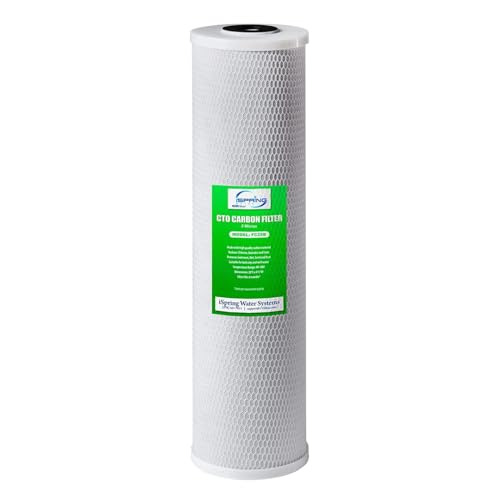
The iSpring FC25B is a 20-by-4.5-inch CTO (chlorine, taste, odor) carbon block that prioritizes flow rate — it’s rated for up to 15 gallons per minute, making it one of the most forgiving whole-house cartridges for homes with multiple bathrooms running simultaneously. The coconut-shell carbon media is independently tested to meet NSF/ANSI standards, and users consistently report virtually undetectable chlorine residuals in the weeks following installation.
What separates the FC25B from smaller 10-inch alternatives is the sheer media volume: a 20-inch block holds roughly twice the carbon of a 10-inch cartridge, translating to longer life between changes. Several long-term reviewers have paired it with iSpring’s sediment pre-filter (WSP-50) and noted crystal-clear, odor-free water at every tap for six to eight months between swaps.
One caveat: a small number of users experienced chlorine breakthrough around the two-month mark under very high usage (200+ gallons per day). iSpring’s US-based support team responded with a free replacement, which suggests good warranty backing. For the vast majority of 2-4 person households, this filter delivers consistent, high-volume chlorine reduction without pressure drop complaints.
Why it’s great
- Exceptional 15 GPM flow rate for whole-house use
- NSF-tested coconut carbon reduces chlorine up to 99%
- Long service life in standard families
Good to know
- Some reports of earlier breakthrough under heavy use
- Only fits 20-inch Big Blue-style housings
3. Express Water ACB 10-Pack

The Express Water ACB is a 10-inch by 2.5-inch carbon block specifically built for under-sink and reverse osmosis stages, sold in a 10-pack that drastically reduces per-filter cost. Each cartridge features 100% vacuum-heated coconut husk carbon with a 5-micron nominal rating, striking a practical middle ground between the deep filtration of 1-micron blocks and the high flow of 10-micron alternatives.
Real-world reviews emphasize two things: first, these filters fit a huge range of standard 10-inch housings, including Rainsoft UF-50t systems, which are notoriously expensive with proprietary cartridges. Second, the 10-pack means one purchase covers two to three years of replacement cycles for a typical under-sink RO system, a convenience that eliminates subscription fatigue.
The main trade-off is packaging consistency — some recent batches have lacked cardboard separators between cartridges, allowing the end caps to knock loose during shipping. Inspect each filter before installation. Otherwise, the ACB delivers reliable VOC and chlorine reduction at a cost-per-filter that undercuts most competitors by a wide margin.
Why it’s great
- Extremely low per-filter cost in the 10-pack
- Wide compatibility with standard 10” housings
- Solid 5-micron reduction for chlorine and VOCs
Good to know
- Occasional cap detachment during shipping
- Shorter lifespan than 20-inch cartridges
4. Pentair Pentek NCP-BB Big Blue
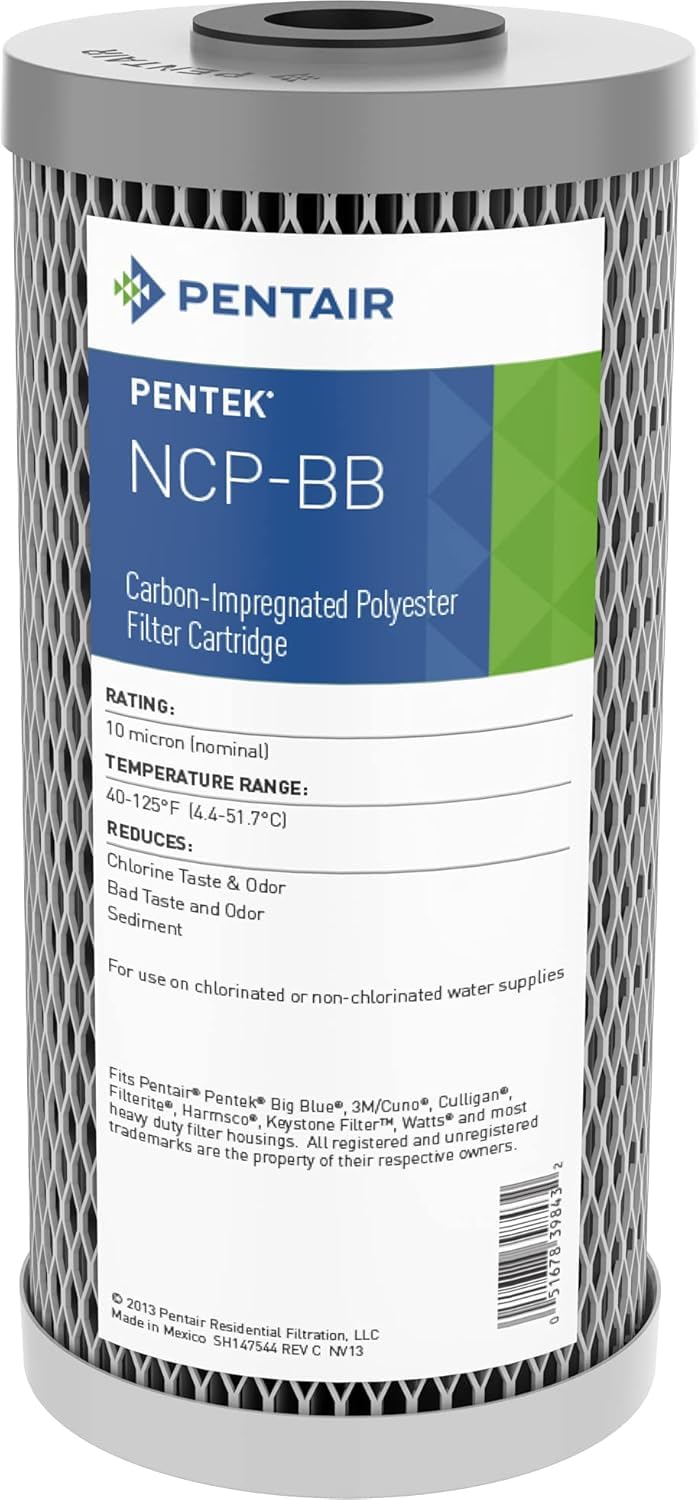
The Pentek NCP-BB is unique in this lineup because it combines sediment filtration and carbon adsorption in a single pleated cartridge. Carbon-impregnated polyester media wraps around a polypropylene core, capturing particulate down to 10 microns while simultaneously reducing chlorine taste and odor. This dual-purpose design eliminates the need for a separate sediment pre-filter in systems where incoming water is reasonably clean to begin with.
Owners in areas with heavy chlorinated municipal supply report that the NCP-BB effectively protects downstream water softener resin beds from chlorine degradation while keeping pressure loss to just 2 psi at 8 GPM. The pleated construction also means a higher dirt-holding capacity than standard string-wound filters, extending service life in sediment-prone water.
The trade-off is a relatively modest 500-gallon chlorine reduction rating at 2 GPM. If your household goes through heavy water volume, you’ll replace this cartridge more frequently than a dedicated carbon block. But for light-to-moderate use — a single faucet or as a pre-filter for an RO system — the NCP-BB’s all-in-one convenience is hard to beat.
Why it’s great
- Combines sediment and carbon filtration in one cartridge
- Pleated design offers high surface area and long life
- Very low pressure drop (2 psi at 8 GPM)
Good to know
- Chlorine capacity limited to 500 gallons
- Best suited as a pre-filter, not primary drinking water filter
5. Waterdrop WD-10CT Under Sink Replacement
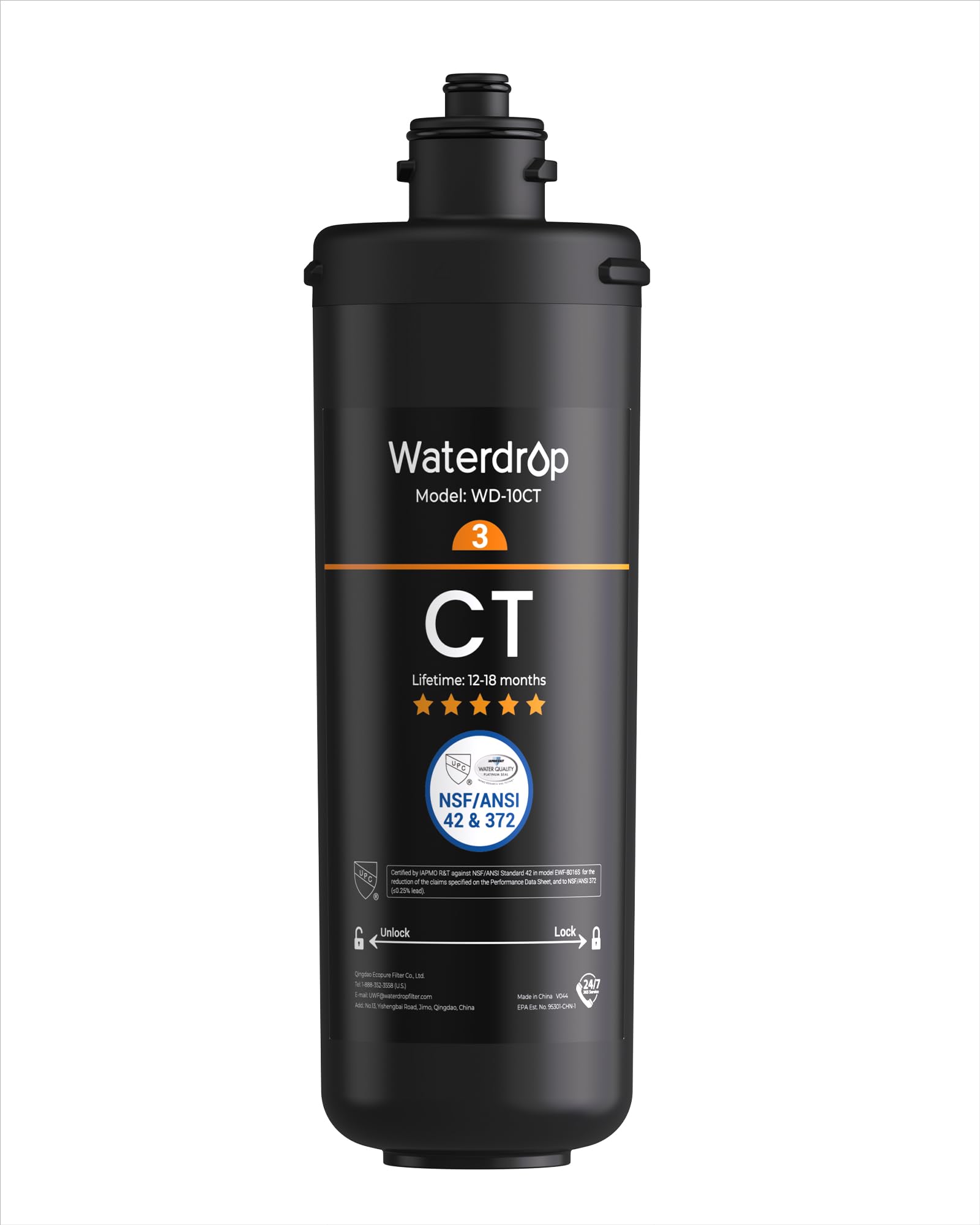
The Waterdrop WD-10CT is a proprietary replacement cartridge designed exclusively for the Waterdrop TSA and TSB 3-stage under-sink systems. Its primary claim is a three-second twist-and-lock installation that requires no tools, no shut-off valve wrestling, and no plumber’s tape. The carbon block is IAPMO-tested against NSF/ANSI 42 standards for chlorine, taste, and odor reduction, and users confirm a clear improvement in water palatability from day one.
What stands out in customer feedback is the build quality: the sealed, one-piece construction eliminates the risk of a separate bottom cap loosening or breeding bacteria over the 12-18 month service life. Several long-term owners mention setting up Amazon subscription reminders and replacing the filter every six months or so, noting that the water flow remains strong right up to the change point.
The catch is strict compatibility — this filter will not fit any standard 10-inch housing. If you don’t own a Waterdrop TSA or TSB system, you’ll need to buy the whole assembly. But for existing Waterdrop users, the WD-10CT is the exact OEM part that keeps your setup running without leaks or guesswork.
Why it’s great
- Tool-free 3-second installation
- Sealed design prevents leaking and bacterial growth
- Certified reduction of chlorine and odors
Good to know
- Only compatible with Waterdrop TSA/TSB systems
- Shorter life under heavy usage than some alternatives
6. OEMIRY Countertop Water Filter

Unlike the cartridge-only models above, the OEMIRY is a complete countertop system that diverts water from your existing faucet. Its multi-stage filtration includes a carbon block stage for chlorine and heavy metals, plus an alkaline mineral cartridge that raises pH and adds calcium, magnesium, and potassium. The tested flow hits 1.6 GPM — roughly eight ounces in three seconds — making it competitive with dedicated under-sink units.
Customer reviews from well-water users and those on catchment systems consistently highlight drastic reductions in sulfur odors and a noticeable improvement in taste. The system produces zero wastewater and requires no electricity, keeping setup simple: match the included adapter to your faucet thread, tighten, and twist the switch to toggle between filtered and unfiltered water.
Note that this system does NOT reduce Total Dissolved Solids (TDS), so if you’re trying to soften water or remove dissolved salts, it won’t accomplish that. Also, the included wrench for filter changes is small and easy to misplace. But for renters or anyone who wants a high-capacity carbon block filter without modifying plumbing, the OEMIRY delivers strong performance with minimal commitment.
Why it’s great
- 8,000-gallon life from a single filter
- Fast 1.6 GPM flow for a countertop unit
- Adds beneficial minerals while removing chlorine
Good to know
- Does not reduce TDS or dissolved solids
- Not compatible with pull-out or spray faucets
7. Aquaboon Premium 6-Pack Carbon Block

The Aquaboon six-pack offers the tightest filtration in this roundup at a true 1-micron nominal rating, built from 100% activated coconut shell carbon in a hard-shell block. NSF/ANSI 42 certification confirms the material safety and chlorine reduction claims, while the 1-micron pore size is aggressive enough to trap fine sediment and some microbial cysts — particles roughly 70 times smaller than a human hair.
Real-world feedback from well owners reveals that these filters dramatically reduce sulfur smells and improve water clarity when used as a final polishing stage before a UV light. One reviewer measured effluent TDS below 5 ppm after installing these blocks, a strong indicator of thorough contaminant capture. The 6-pack provides up to 18 months of supply for a typical under-sink system, making it a budget-conscious alternative to buying single cartridges.
The downside is flow restriction: 1-micron blocks naturally create more backpressure than 5 or 10-micron alternatives. If your incoming water pressure is below 40 psi, you may notice a slowdown at the tap. Additionally, some users with heavy sediment loads reported the filter clogging faster than expected. Flushing the cartridge for ten minutes before first use is essential to clear loose carbon dust and stabilize flow.
Why it’s great
- NSF-certified 1-micron coconut carbon block
- Excellent chlorine and odor removal capabilities
- Good value with 6-pack and universal fit
Good to know
- Tighter pores reduce flow on low-pressure systems
- May clog faster with heavy sediment in well water
FAQ
What’s the difference between carbon block and granular activated carbon (GAC)?
How often should I replace a carbon block water filter?
Can a carbon block filter remove fluoride or heavy metals?
Final Thoughts: The Verdict
For most users, the best carbon block water filter winner is the Pentair Pentek EPM-20BB because its 30,000-gallon capacity, reliable flow, and proven NSF certification make it the ultimate whole-house solution for chlorine and sediment reduction. If you want high flow for a large home, grab the iSpring FC25B. And for budget-conscious under-sink polishing, nothing beats the value of the Express Water ACB 10-Pack.

Mo Maruf
I created WellFizz to bridge the gap between vague wellness advice and actionable solutions. My mission is simple: to decode the research and give you practical tools you can actually use.
Beyond the data, I am a passionate traveler. I believe that stepping away from the screen to explore new environments is essential for mental clarity and physical vitality.