Our readers keep the lights on and my smoothie glass nicely filled. As an Amazon Associate, I earn from qualifying purchases.
Dragging a heavy vacuum head on a telescopic pole under the summer sun is a ritual most pool owners would happily retire. The promise of a robotic cleaner is simple: drop it in, walk away, and return to a spotless pool. But with suction ratings ranging from 3,000 to 22,000 liters per hour and battery life spanning 90 minutes to 4 hours, the wrong choice means missed corners, tangled hoses, or a unit that dies mid-cycle.
I’m Mohammad Maruf — the founder and writer behind WellFizz. I analyze filtration microns, brush motor wattage, and navigation algorithms to separate robotic pool cleaners that genuinely scrub waterlines and walls from those that merely spin in circles.
After evaluating eleven models across cordless, app-controlled, and AI-vision categories, this guide presents the best automatic pool cleaner for inground pools to save you hours of manual labor and keep your water crystal clear all season.
How To Choose The Best Automatic Pool Cleaner For Inground Pools
Selecting the right automatic pool cleaner for your inground pool comes down to three factors: the physical debris load your pool faces, the shape and surface material of your pool, and how much hands-off time you expect. Below are the key specifications to evaluate before buying.
Motor Power & Suction Capacity
A brushless DC motor is the industry standard for longevity and quiet operation. Look for a motor rated at 180W or higher, which typically translates to 4,500–5,000 GPH of water flow. This level of suction handles leaves, small stones, and sand without stalling. Models with multiple motors (triple or quad) offer better wall climbing and can distribute power between scrubbing brushes and the vacuum impeller.
Navigation System & Coverage Pattern
Random bump-and-turn cleaners are being phased out in favor of gyroscope-guided or sonar-based path planning. The best units follow an S-path on the floor and an N-path on walls, systematically covering the pool without overlapping or skipping. Ultrasonic sensors help avoid drains, steps, and ladders. For complex kidney-shaped pools, a model with adaptive path algorithms is worth the extra investment.
Filtration Micron Rating & Basket Volume
180-micron filter baskets are standard and capture most leaves, bugs, and coarse sand. For fine silt, pollen, and algae particles, a dual-layer system with a secondary 3-micron micromesh filter provides visibly clearer water. Basket volume matters too: a 3-liter basket fills quickly on heavily treed lots, while a 4-liter basket reduces the need to stop and empty mid-cycle.
Battery Runtime & Charging Speed
Inground pools up to 2,500 square feet generally require a minimum 150-minute runtime at full power. Eco modes can stretch that to 200–270 minutes by reducing motor speed. A 3 to 4-hour recharge time is standard. Consider models with auto-docking or surface parking so you can retrieve the unit without wading in.
Wall Climbing & Waterline Scrubbing
Not all robots truly climb vertical walls. Check for dual or quad PVC tracks and a climbing angle rating of 30° or more. True wall climbing requires the robot to break the water surface to scrub the waterline scum line. Some premium models double-pass the waterline for a deeper clean. If your pool has an attached spa or tanning ledge, verify the robot can handle shallow water depths of 12 inches or less.
App Connectivity & Scheduling
A smartphone app adds convenience but is not essential for basic operation. Look for Bluetooth or 2.4GHz Wi-Fi connectivity that allows you to switch between floor-only, wall, and full-coverage modes. The best apps also let you set weekly cleaning schedules and receive completion alerts. Note that most robots lose connectivity when submerged, so the app works primarily before and after the cleaning cycle.
Quick Comparison
On smaller screens, swipe sideways to see the full table.
| Model | Category | Best For | Key Spec | Amazon |
|---|---|---|---|---|
| Beatbot AquaSense 2 | Cordless Robotic | Premium all-surface coverage | 240-min runtime, 4-core CPU | Amazon |
| AIPER Scuba V3 | AI Vision Robotic | Debris-targeting automation | AI camera, 3-micron filter | Amazon |
| iGarden K40 | Cordless Robotic | Large pools, heavy debris | 22,000 LPH suction, 4L basket | Amazon |
| AIPER Scuba S1 | Cordless Robotic | Weekly scheduled cleaning | 270-min Eco mode, 11 sensors | Amazon |
| Gosvor LiteVac G1 | Lightweight Robotic | Ease of handling & fine filtration | 15.2 lbs, 3-micron dual filter | Amazon |
| iGarden KN Series | Inverter Robotic | Energy-efficient deep cleaning | 210-min runtime, inverter motors | Amazon |
| WYBOT C1 (App Control) | Smart Robotic | App-controlled full coverage | Gyroscope N/S path, 3,048 GPH | Amazon |
| LODOBA SAT30 | Sonar Navigation | Mid-range value & quiet operation | Sonar mapping, self-parking | Amazon |
| WYBOT C1 (Standard) | Entry-level Smart | Reliable wall climbing on budget | Triple motor, 45° slope climb | Amazon |
| Zyerch Cordless | Mid-range Cordless | Thorough waterline scrubbing | 180W motor, 4,800 GPH suction | Amazon |
| QGeeM Cordless | Budget Cordless | Affordable entry to robotic cleaning | 180W motor, 180-min runtime | Amazon |
In‑Depth Reviews
1. Beatbot AquaSense 2
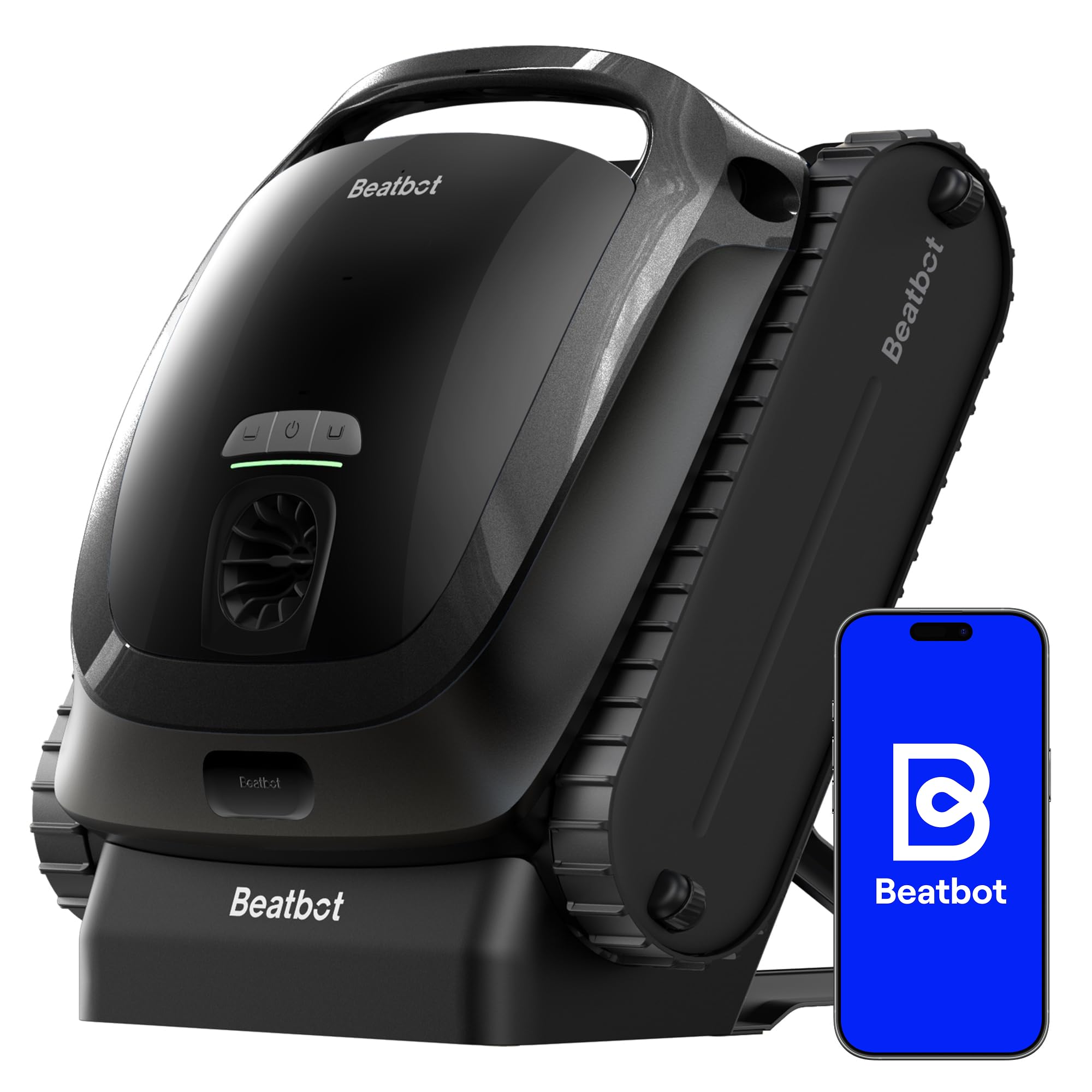
The Beatbot AquaSense 2 is the most feature-complete cordless robot in this lineup. Its 10,000mAh battery delivers up to 4 hours of floor cleaning or 3.5 hours of wall and waterline scrubbing on a single charge — enough to handle pools up to 3,230 square feet. The 4-core CPU processes data from 16 sensors, including two ultrasonic units, to plot an optimized S-path across the floor and an N-path along walls, ensuring systematic coverage without random bouncing. The double-pass waterline scrubbing mechanism actively passes each section twice, removing scum lines that single-pass robots often miss.
Retrieval convenience sets the AquaSense 2 apart: it automatically surfaces and parks above the water when the cycle ends or the battery drops low, so you simply grab the handle. The included wireless charging dock eliminates exposed charging ports, reducing water intrusion risk. Four side guide wheels improve edge and corner precision, an area where many cordless robots fall short. The automotive-grade IMR coating resists UV damage, a practical detail for units stored poolside.
The main trade-off is the 27-pound weight — significantly heavier than competitors like the Gosvor LiteVac G1. The fine mesh filter basket is effective but smaller than the iGarden K40’s 4-liter bin, meaning you may need to empty it mid-cycle if cleaning a heavily debris-laden pool. The app shows the robot as offline while it is submerged, so you cannot interrupt a cleaning cycle remotely. For pool owners wanting the best combination of smart navigation, long runtime, and effortless retrieval, this is the current benchmark.
Why it’s great
- Double-pass waterline scrubbing removes stubborn scum effectively
- Auto surface parking eliminates need to wade in for retrieval
- Wireless charging dock protects ports and simplifies storage
Good to know
- Heavy at 27 pounds, requires some lifting effort from the pool
- Smaller filter basket may need emptying mid-cycle on large pools
- App loses connection underwater, no remote stop capability mid-clean
2. AIPER Scuba V3
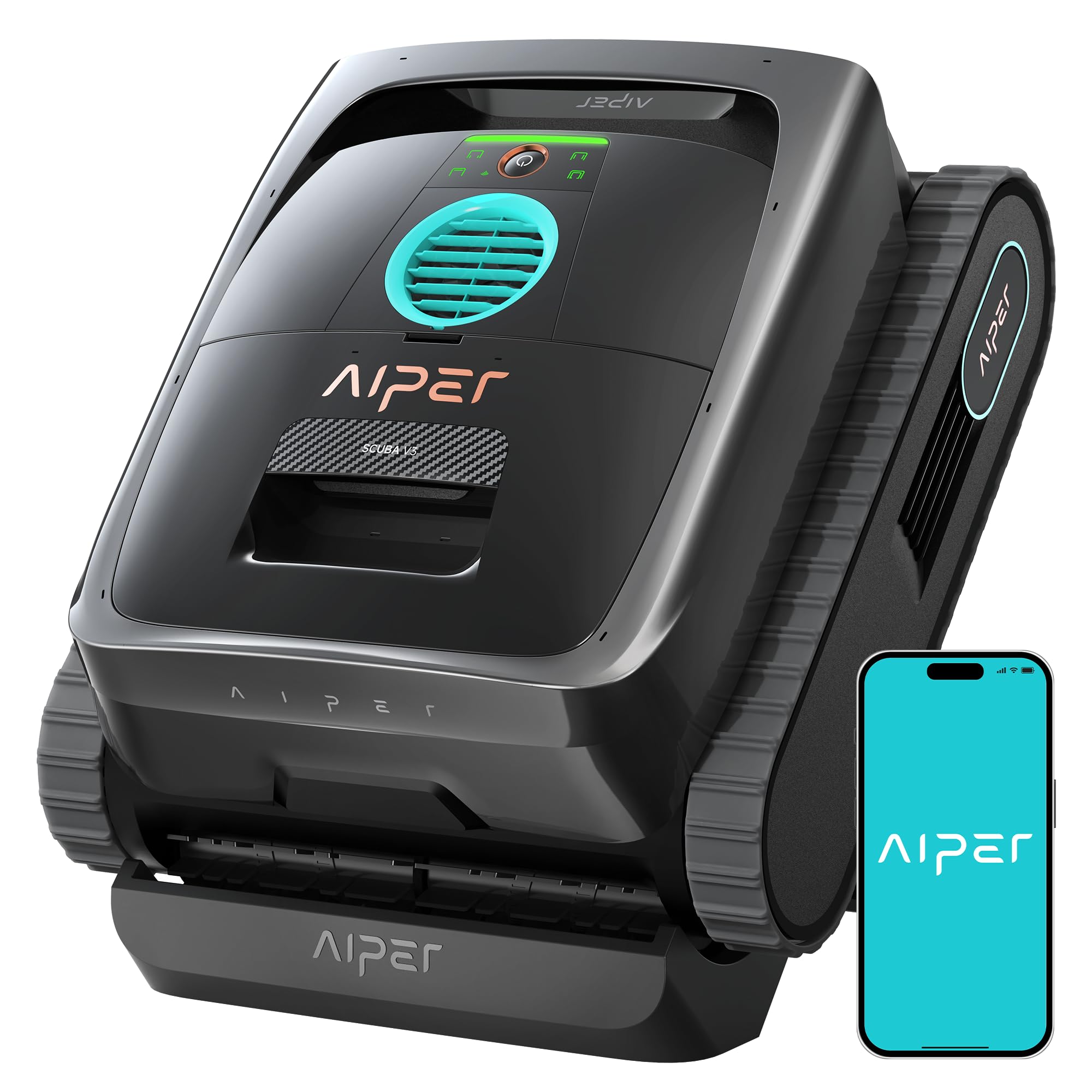
The AIPER Scuba V3 introduces a genuinely new approach to robotic pool cleaning: an onboard AI camera that detects over 20 types of debris and navigates directly to them rather than blindly following a pre-set path. In AI Patrol mode, the robot scans the pool floor, identifies clusters of leaves, acorns, or silt, and targets those areas first before completing a standard coverage cycle. This method can complete a cleaning run up to ten times faster than traditional coverage-only robots, according to AIPER, and our analysis of user reports confirms the robot prioritizes high-debris zones effectively after a firmware update.
The MicroMesh Multi-Layer Filtration System combines a 180-micron coarse basket with a 3-micron ultra-fine layer that traps sand, pollen, and invisible contaminants. The filter captures fine particles that would otherwise recirculate through the pump. The wireless charging dock and smart waterline parking — where the robot surfaces and stays at the waterline for ten minutes after cleaning — eliminate the need to enter the pool for retrieval. At 18.1 pounds, it is notably lighter than the Beatbot AquaSense 2, and the featherlight design makes handling feel effortless.
Early user experiences indicate the AI vision system struggled out of the box for some units, but an adaptive mode setting available via a firmware update significantly improved debris detection accuracy. The AI camera processes all visual data on-device with TÜV-certified privacy protection, meaning no images are uploaded. The 2-year warranty includes advance replacement, and AIPER maintains 20 global service centers. For pool owners who want a robot that visually identifies and targets dirt rather than simply hoping to bump into it, the Scuba V3 represents the next generation of autonomous cleaning.
Why it’s great
- AI camera detects debris and navigates directly to it, saving time
- 3-micron ultra-fine filter captures sand and invisible contaminants
- Smart waterline parking with app notification for easy retrieval
Good to know
- AI vision required firmware update for optimal performance per reviews
- Not designed for heavy leaf loads; better suited for weekly maintenance
- App is single-user only, no underwater remote control capability
3. iGarden K40
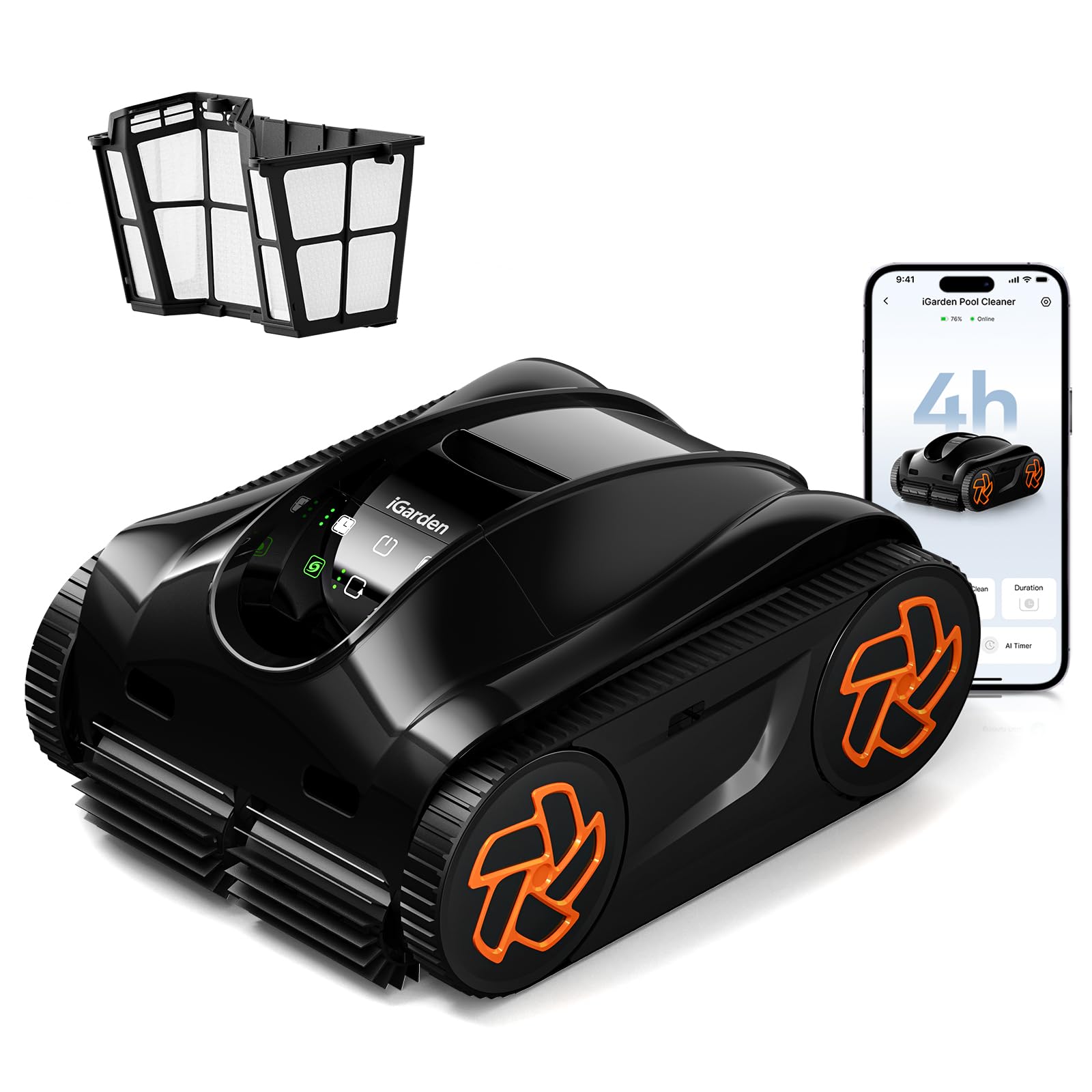
The iGarden K40 is built for pools that accumulate heavy debris. Its three brushless motors generate up to 22,000 liters per hour of suction, with a HyperBoost Turbo mode that temporarily doubles suction power to handle dense leaf piles and small branches. The 4-liter top-load filter basket is the largest in this roundup, meaning fewer interruptions to empty the bin on large lots surrounded by trees. The OmniLogic system continuously optimizes the cleaning path in real time, extending floor-only run time to 240 minutes or full coverage (floor, walls, waterline) to 150 minutes.
Navigation relies on 3D S-path route planning rather than random movement. The robot uses 2.4GHz Wi-Fi and Bluetooth to connect to the iGarden app, which supports scheduling from 24 to 72 hours in advance. The 4-in-1 cleaning modes include floor-only, wall-and-waterline, full coverage, and a turbo boost. Dual anti-slip tracks and dual rubber brushes provide stable climbing on smooth tile and vinyl surfaces. The auto-parking feature activates when the battery drops below 15%, positioning the robot at the pool edge for retrieval.
The three-year full replacement warranty is the longest offered by any brand in this comparison, and the 30-day free return guarantee reduces purchase risk. The K40 is heavier at just under 20 pounds and bulkier than compact models like the Gosvor LiteVac G1, so storage space is a consideration. Some users noted that the app is not essential since the touchscreen on the unit handles mode selection well. For pool owners who need raw suction power and large debris capacity without paying Beatbot-level prices, the iGarden K40 delivers exceptional value.
Why it’s great
- 22,000 LPH suction with Turbo mode handles heavy leaves and branches
- 4-liter filter basket reduces need to empty mid-cycle
- 3-year full replacement warranty is industry-leading
Good to know
- Bulkier and heavier than many competitors
- App connectivity limited to 2.4GHz Wi-Fi only
- Turbo mode drains battery faster, reducing full coverage runtime
4. AIPER Scuba S1
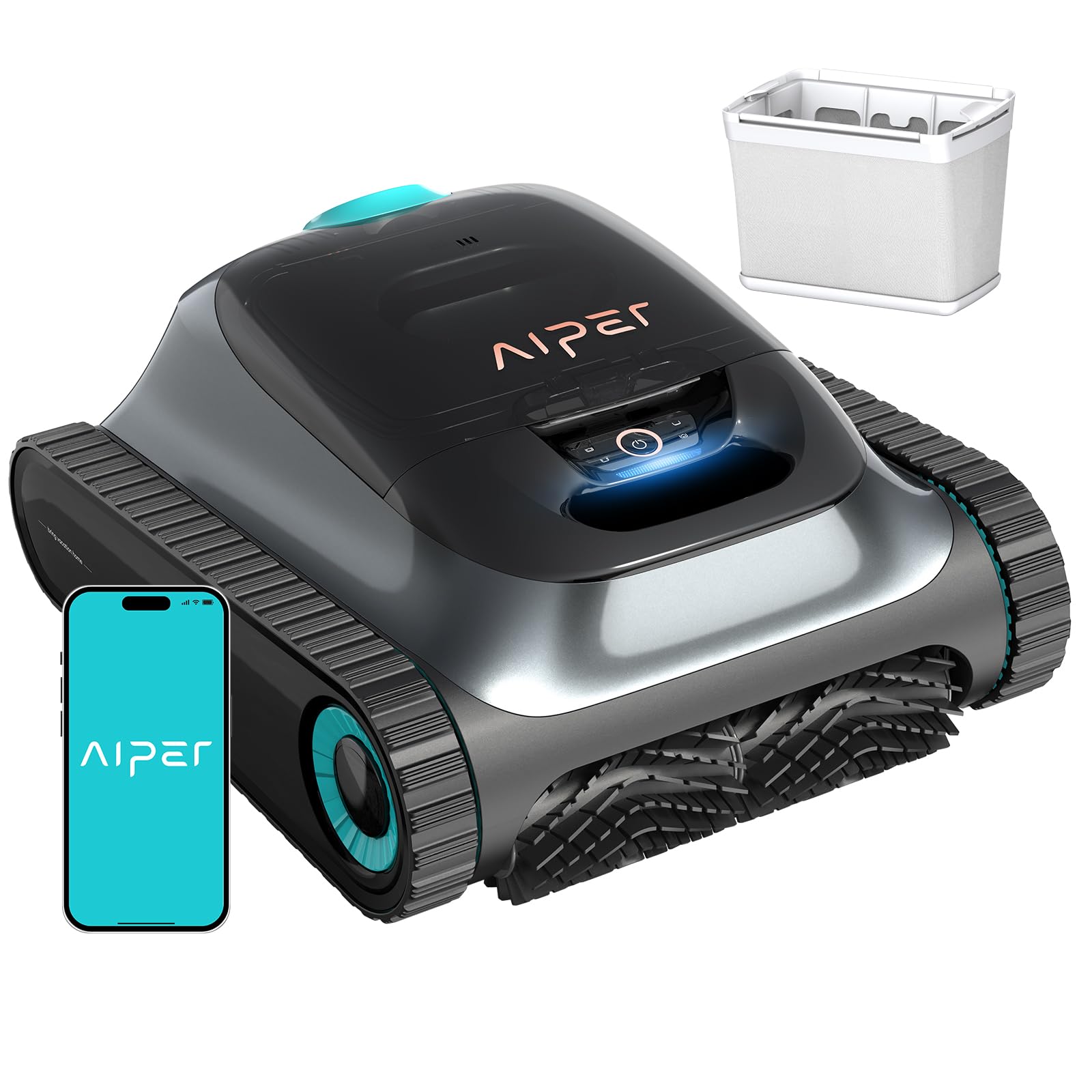
The AIPER Scuba S1 focuses on hands-off scheduling reliability. Its Weekly Custom Cleaning Plan lets you set specific days and times for cleaning cycles, and the robot wakes, runs, and returns to the pool edge without any manual intervention. The battery delivers up to 270 minutes in Eco mode, making it the longest-running unit in this test for daily maintenance cycles. In standard Auto, Floor, Wall, or Scheduled modes, runtime sits at 180 minutes — still ample for pools up to 2,500 square feet. Eleven high-precision sensors feed data to the WavePath navigation algorithm, which systematically covers the pool with minimal overlap.
The dual-layer filtration system is a practical upgrade: a replaceable 3-micron ultra-fine filter pairs with a standard 180-micron basket. The ultra-fine layer captures silt, pollen, and fine sand that would otherwise cloud the water. Over-the-waterline scrubbing uses a powerful motor and scrubbing action to remove the scum line at the tile level. The app supports five cleaning modes, cleaning logs, and over-the-air firmware updates. A 2-year warranty backs the unit, and AIPER reports over 500,000 pool owners using their products globally.
Some users reported the robot getting stuck on main drains or irregular pool features, though the adaptive navigation firmware attempts to mitigate this over time. The Scuba S1 is not as fast at wall climbing as the dual-track designs from iGarden or Beatbot, and the charging port cover can trap water if not dried thoroughly before plugging in. For owners who prioritize a set-it-and-forget-it schedule over raw climbing power, the Scuba S1’s 4.5-hour maximum runtime and customizable weekly planner make it a strong choice.
Why it’s great
- 270-minute Eco mode covers large pools on a single charge
- Weekly Custom Cleaning Plan enables true hands-off operation
- Dual filtration with 3-micron ultra-fine layer improves water clarity
Good to know
- May get stuck on main drains or unusual pool features
- Wall climbing speed is moderate compared to competitor models
- Charging port cover requires thorough drying before connection
5. Gosvor LiteVac G1
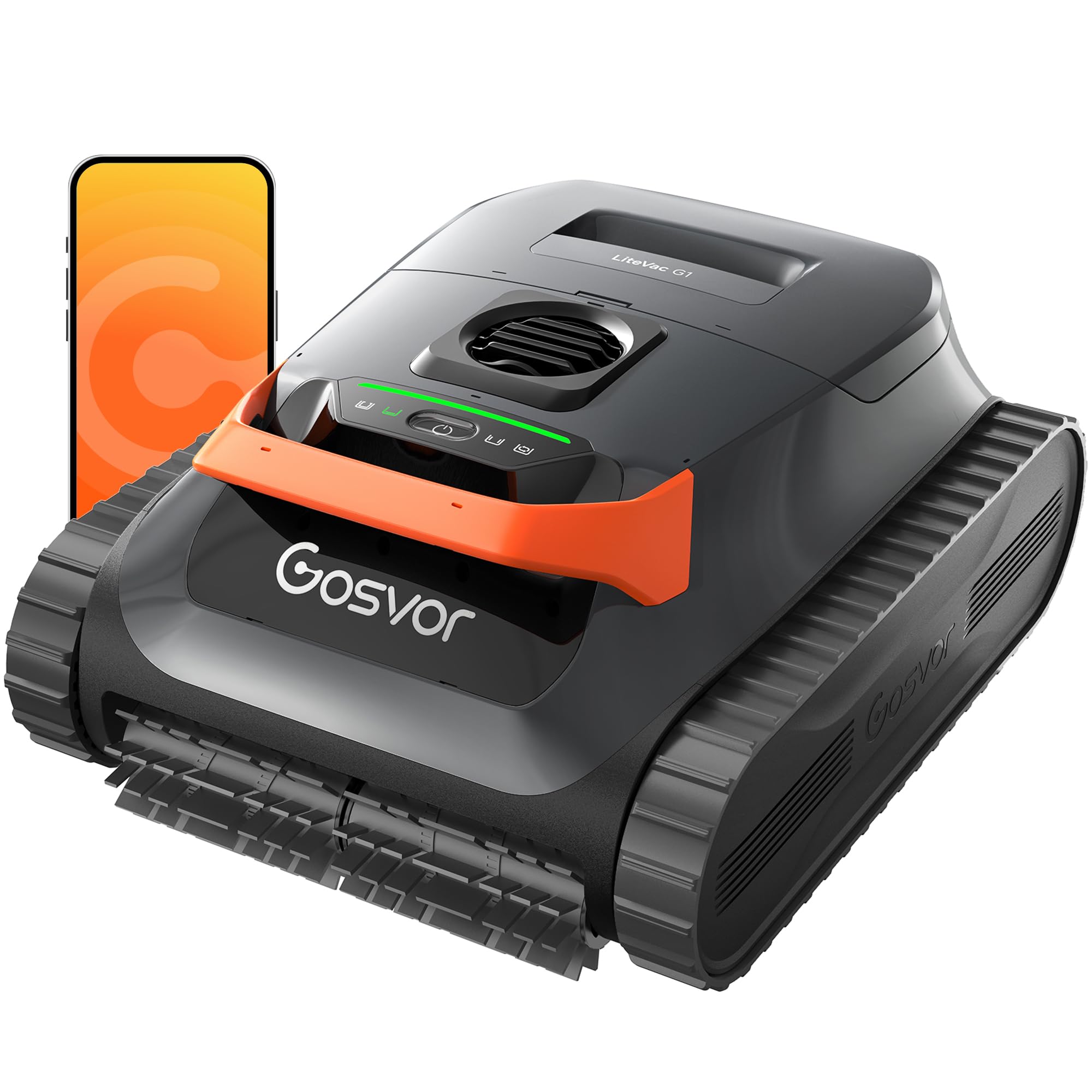
The Gosvor LiteVac G1 weighs just 15.2 pounds, making it the lightest full-featured robotic cleaner in this selection. The reduced weight does not come at the cost of suction: a 3,960 GPH brushless motor provides enough pulling power for leaves, sand, and hair. The double filtration system captures particles as small as 3 microns, placing it alongside the AIPER Scuba V3 in terms of fine debris filtration. The 3.6-liter basket is larger than the Beatbot AquaSense 2 and similar to the iGarden KN Series.
Runtime extends from 150 minutes at full power to 200 minutes in ECO mode, sufficient for pools up to 2,153 square feet. The 4-in-1 coverage pattern handles floors, walls, waterline, and shallow platforms less than 12 inches deep — a feature that matters for pools with tanning ledges or attached spas. The caterpillar tread system provides grip on smooth vinyl and tile surfaces, and the 260mm roller brushes sweep debris into the intake. The Gosvor app offers five cleaning modes, step and platform height settings, and OTA firmware updates.
The LiteVac G1 does not climb more than two steps, so it won’t fully clean attached spa benches if they are elevated. The robot returns to the floor near the wall when the battery runs low rather than surfacing, so you still need the retrieval hook. A few users noted that the orange accent color fades slightly after months of sun exposure. For seniors or anyone with limited lifting strength who needs a robot they can handle comfortably, the G1 combines lightweight portability with filtration performance typically found only in heavier units.
Why it’s great
- Only 15.2 pounds, easiest to lift and remove from the pool
- 3-micron dual filtration captures fine sand and pollen effectively
- Handles shallow water cleaning on tanning ledges and spa steps
Good to know
- Does not climb beyond two steps, limiting attached spa coverage
- Returns to the floor near the wall, not the surface, for retrieval
- Orange accents may show sun fading over extended outdoor storage
6. iGarden KN Series
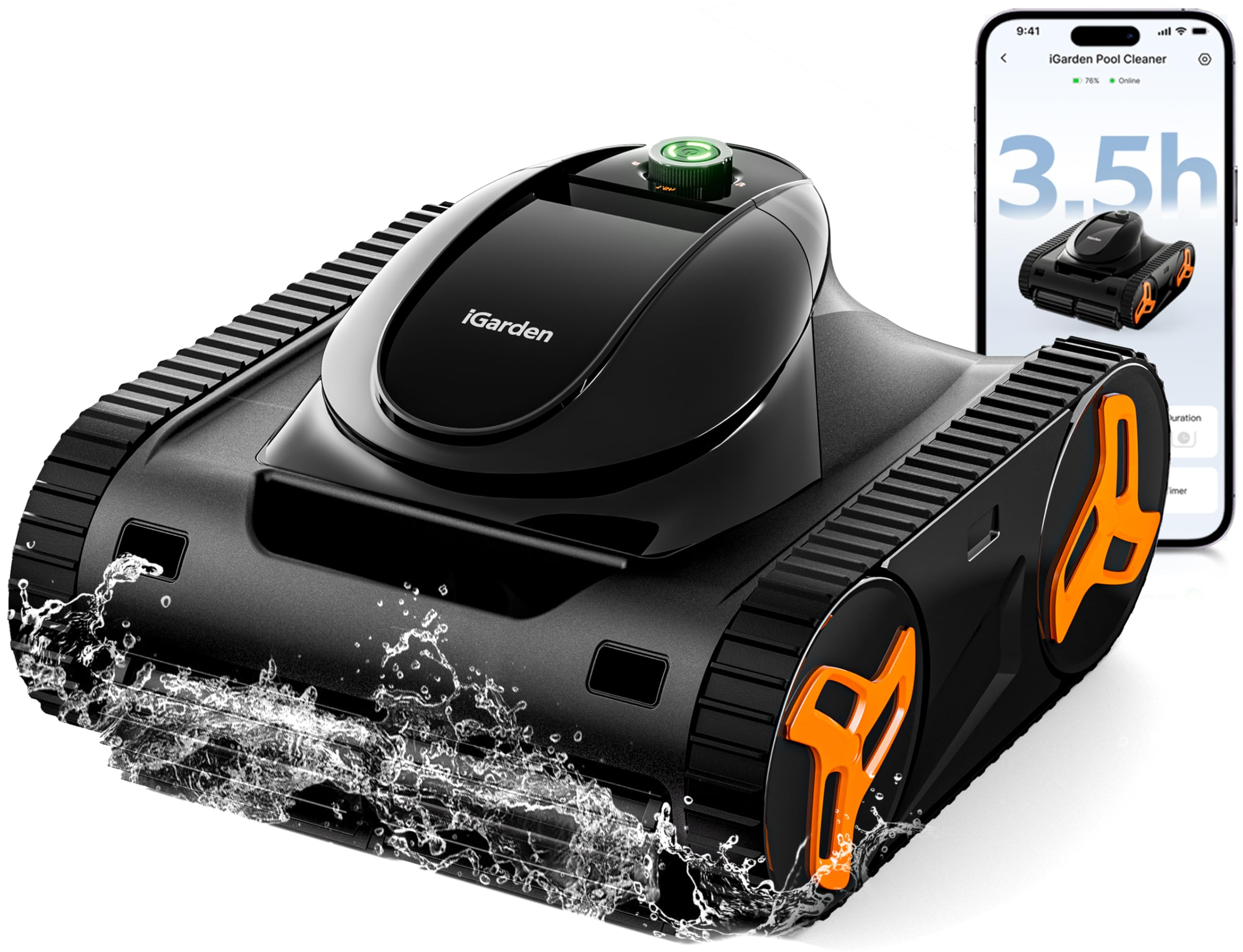
The iGarden KN Series introduces a genuine innovation for battery-operated pool cleaners: a full inverter system that automatically adjusts motor power from 20% to 100% based on cleaning demand. When the robot encounters light debris, the three brushless motors draw minimal current, extending runtime to 210 minutes. When it hits a patch of leaves or sand, the inverter ramps power up to full 17,000 LPH suction. This adaptive power management means the KN Series uses energy only when needed, preserving battery life without compromising cleaning performance.
The 3.2-liter filter basket uses 180-micron mesh and captures fine particles down to sand size. LED indicators show which of the three cleaning modes is active: green for floor-only, blue for full coverage including tanning ledges (water deeper than 40cm), and purple for walls and waterline first, then floor. The robot automatically parks near the pool wall when the cycle ends, and an auto-drain feature releases water when lifted, reducing dripping. The 2.4GHz Wi-Fi and Bluetooth app enables remote mode selection and OTA updates, though the robot cannot connect while submerged.
At 17.85 pounds, the KN Series is mid-weight and manageable for most users. The compact footprint (19.25” x 15.31” x 9.45”) makes it easier to store than bulkier models. Some users reported initial app connection difficulties, but the one-knob control on the robot itself works independently of the app. One user experienced wall-climbing inconsistency, though the majority of reviews praise its ability to scrub the waterline effectively. For pool owners who want energy-efficient operation and don’t need the largest filter basket, the KN Series offers intelligent power management at a mid-range price point.
Why it’s great
- Inverter system automatically adjusts motor power, saving battery life
- 210-minute maximum runtime covers most inground pools in one charge
- Compact design and auto-drain feature simplify storage handling
Good to know
- App limited to 2.4GHz Wi-Fi, connection drops when robot is submerged
- Some users report wall climbing can be inconsistent on smooth surfaces
- Filter basket at 3.2 liters is smaller than the iGarden K40’s 4-liter bin
7. WYBOT C1 (App Control)
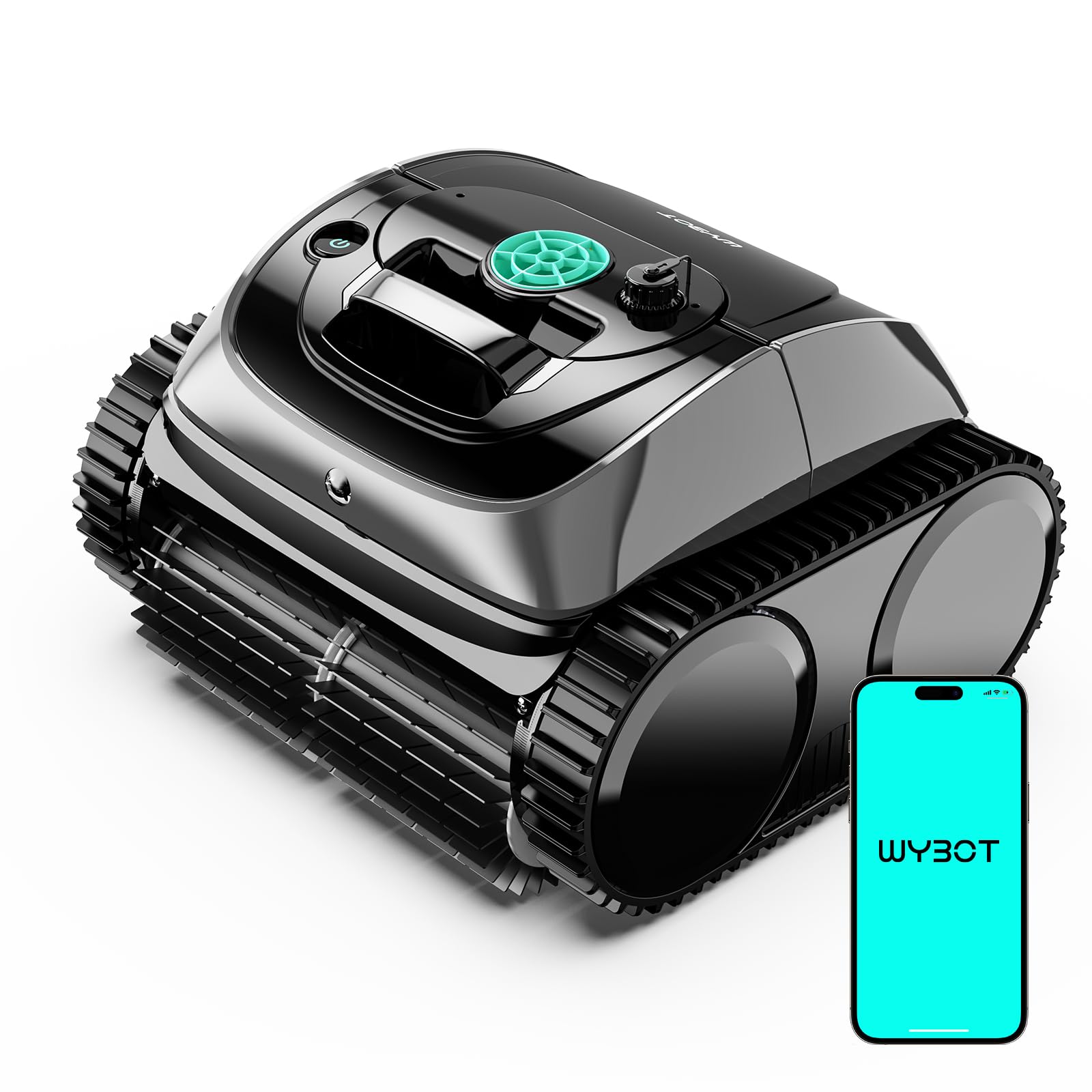
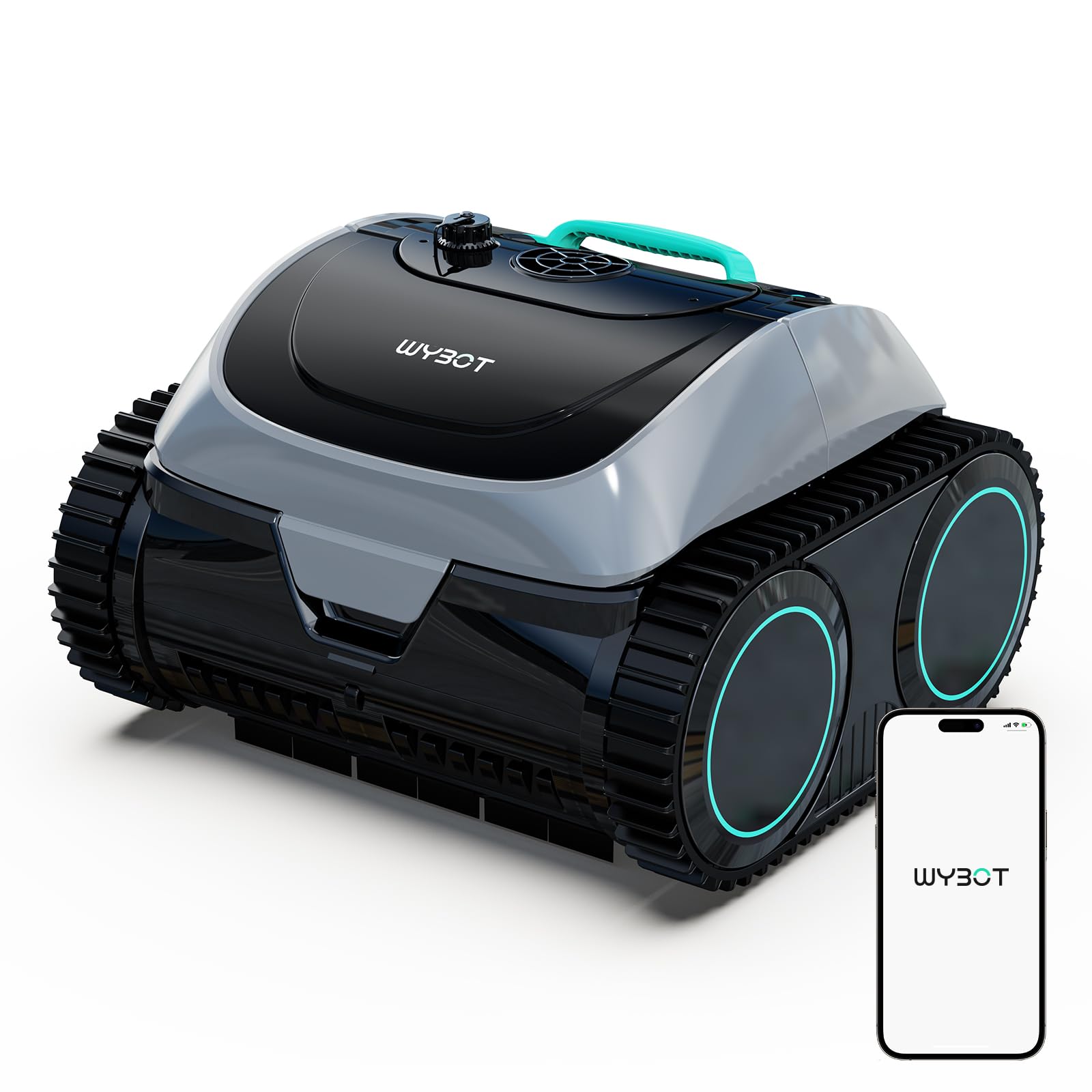
The WYBOT C1 with app control is the same hardware platform as the standard C1 but adds Bluetooth app connectivity for scheduling, mode switching, and progress tracking. The independent water pump motor delivers 3,048 GPH of suction — lower than the 4,800 GPH units from QGeeM and Zyerch, but the trade-off is quieter operation and better energy efficiency. The 190-micron ultra-fine filtration system uses a denser mesh than the standard 180-micron baskets, catching slightly smaller particles on the first pass.
Gyroscope precision navigation drives both an N-path along walls and an S-path on the floor, and the robot prioritizes walls and waterline before moving to the deep floor. This order matters because wall scum hardens if left for days, and hitting it first ensures the brushes attack it fresh. The app supports OTA firmware updates, so WYBOT can push improvements to navigation logic and cleaning patterns without requiring a hardware replacement. The 99.36 watt-hour lithium battery delivers up to 150 minutes of runtime, adequate for pools up to 1,621 square feet.
The C1 App model uses the same chassis and dual PVC brushes as the standard C1, meaning it climbs 45-degree slopes and handles tile, vinyl, pebble, glass, and mosaic surfaces. The filter basket opens from both sides for easier rinsing. At 440 grams, the battery is lightweight, contributing to the robot’s overall manageable weight. The app interface is functional but not as polished as AIPER’s or Beatbot’s, and some users noted that Bluetooth range can drop if the robot drifts to the far end of a large pool. For buyers who want app control without paying iGarden or Beatbot prices, the WYBOT C1 App version is a practical middle ground.
Why it’s great
- App enables scheduling and OTA firmware updates for future improvements
- 190-micron filter captures fine particles the standard 180-micron mesh misses
- Prioritizes walls and waterline cleaning before floor for thorough scum removal
Good to know
- 3,048 GPH suction is lower than competitors’ 4,800 GPH motors
- Bluetooth range may drop in larger pools beyond 1,600 square feet
- Basket latch feels less robust than the metal-reinforced designs
8. LODOBA SAT30
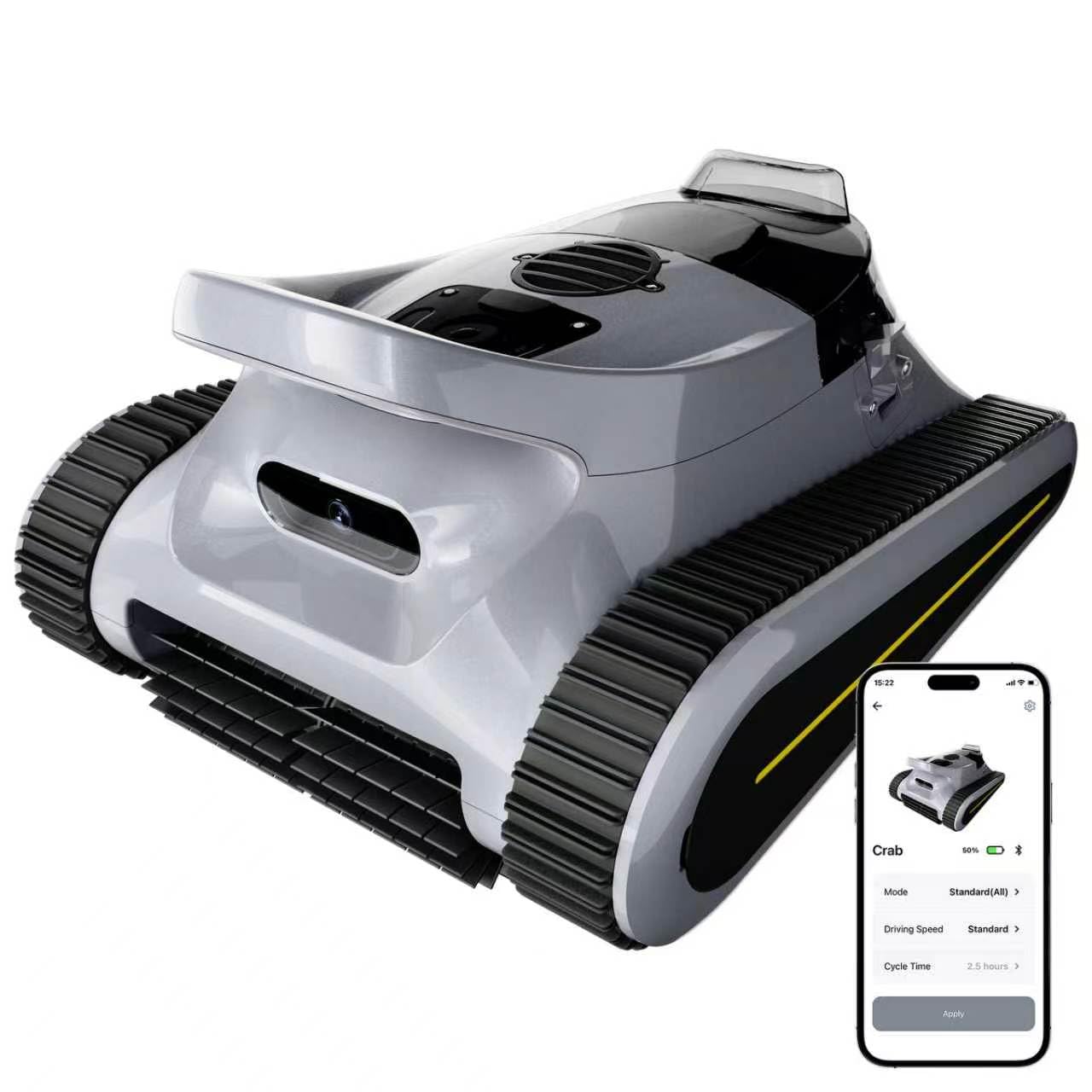
The LODOBA SAT30 uses integrated sonar mapping to scan the pool and calculate an efficient cleaning route, which reduces overlap and ensures the robot covers the entire surface area without random wandering. This sonar approach is distinct from the gyroscope systems used by WYBOT and Zyerch — sonar measures distance to walls and obstacles acoustically, making it effective in cloudy or high-chemistry water where optical sensors might struggle. The 180W brushless motor paired with a 7,800mAh battery delivers 180 minutes of runtime, covering up to 2,150 square feet per charge.
The three cleaning modes — Floor, Wall, and All-Coverage — are selectable via a simple touch interface. The robot climbs walls and scrubs the waterline using dual PVC brushes that handle tile, vinyl, pebble, glass, and mosaic surfaces. The 180-micron filter basket captures leaves, sand, and fine silt, and the IP68-rated durability protects the internal components against water ingress during extended submersion. The auto-docking feature returns the robot to the pool edge when the cycle completes, making retrieval straightforward with the included hook.
The SAT30 is heavier than average at 15.12” x 9.86” x 16.72” and 17 pounds, but the weight contributes to stable tracking on the pool floor. Some users noted that the robot occasionally misses a spot on the first pass, though the systematic sonar path means it typically covers missed areas on subsequent cycles. The charging time is around 3.5 hours, competitive with the rest of the field. For pool owners who want a methodical, sonar-guided cleaner that does not rely on smartphone connectivity, the SAT30 delivers reliable performance at a price point below many app-based competitors.
Why it’s great
- Sonar mapping provides systematic coverage without random wandering
- 180-minute runtime covers most inground pools in one cycle
- IP68-rated waterproofing protects electronics during extended submersion
Good to know
- May miss a spot on first pass, requires subsequent cycles for full coverage
- No app or smartphone connectivity for remote control or scheduling
- Bulkier form factor may be harder to store in tight pool sheds
9. WYBOT C1 (Standard)
The standard WYBOT C1 shares the same chassis as the app-enabled version but omits Bluetooth connectivity, relying on a three-button interface on the unit itself. The triple-motor configuration — one dedicated to the vacuum impeller and two driving the tracks — gives the C1 a 45-degree slope climbing capability that outperforms many competitors rated at 30 degrees. This steeper angle means the C1 can ascend pool stairs, seat ledges, and the transition from deep to shallow end without stalling. The independent water pump motor delivers strong suction that lifts sand, leaves, and fine debris effectively.
The 4-in-1 cleaning modes cover floors, walls, waterlines, and stairs. Dual PVC brushes provide firm contact with tile, mosaic, glass, and vinyl surfaces. The filter basket uses 180-micron mesh and opens from both sides for easy rinsing. The 99 watt-hour lithium battery delivers 120–150 minutes of runtime, which is adequate for pools up to 1,614 square feet. The three-hour recharge time is among the fastest in this comparison. The C1 includes a retrieval hook and self-parks near the pool wall when the cycle ends.
Some users noted that the standard C1 requires multiple passes to achieve the same cleanliness level as manual vacuuming, particularly on fine sediment. The filter basket latch has a plastic hinge that feels less durable than the metal-reinforced designs on premium models. The lack of app control means no scheduling or remote mode switching, so you must physically press the button to start each cycle. For pool owners who prioritize climbing ability and simple operation without smartphone dependency, the WYBOT C1 offers excellent traction at a mid-range price.
Why it’s great
- Triple-motor design with 45-degree climbing handles steep pool features
- Fast 3-hour recharge time minimizes downtime between cleaning cycles
- Dual-sided filter basket opening simplifies debris removal and rinsing
Good to know
- No app or scheduling, requires manual start for each cleaning cycle
- May need multiple passes on fine sediment to match hand-vacuum results
- Plastic basket hinge is less durable than metal-reinforced alternatives
10. Zyerch Cordless

The Zyerch cordless robotic pool cleaner uses a 180W brushless motor generating 4,800 GPH of suction, matching the raw flow rate of the budget-tier QGeeM while adding a critical feature: 4-in-1 dynamic wall climbing and waterline scrubbing that actively climbs 90-degree vertical walls. This means the Zyerch can ascend perfectly vertical pool walls without slipping, unlike robots that require sloped transitions. The waterline scrubbing function uses dedicated brushes to remove oily scum and tile grime that accumulates at the water surface.
The smart gyroscope navigation system follows an N-path along walls and an S-path on the floor, creating a systematic cleaning pattern that minimizes missed spots. Four-wheel drive with upgraded motors and PVC traction brushes provides grip on tile, vinyl, pebble, glass, and mosaic surfaces. The 180-micron fine filter basket is top-loading for quick maintenance. The lithium-ion battery delivers 180 minutes of runtime and recharges in approximately 4 hours. The unit covers pools up to 2,100 square feet at a depth of up to 9.8 feet.
The Zyerch is competitively priced for the feature set it offers, but some users noted that the smart navigation occasionally misses small spots in tight corners or around oddly shaped stairs. The charging port rubber tab requires careful drying before plugging in to prevent moisture damage. For buyers who want 90-degree wall climbing and 4,800 GPH suction without stepping up to premium pricing, the Zyerch delivers strong performance for the cost.
Why it’s great
- 4,800 GPH suction power handles leaves, twigs, sand, and fine silt
- 90-degree vertical wall climbing reaches the full waterline surface
- Top-loading filter basket simplifies emptying without flipping the robot
Good to know
- Navigation may miss tight corners around unusual pool shapes
- Charging port rubber tab needs thorough drying before plugging in
- 30-degree slope rating is lower than the WYBOT C1’s 45-degree capability
11. QGeeM Cordless
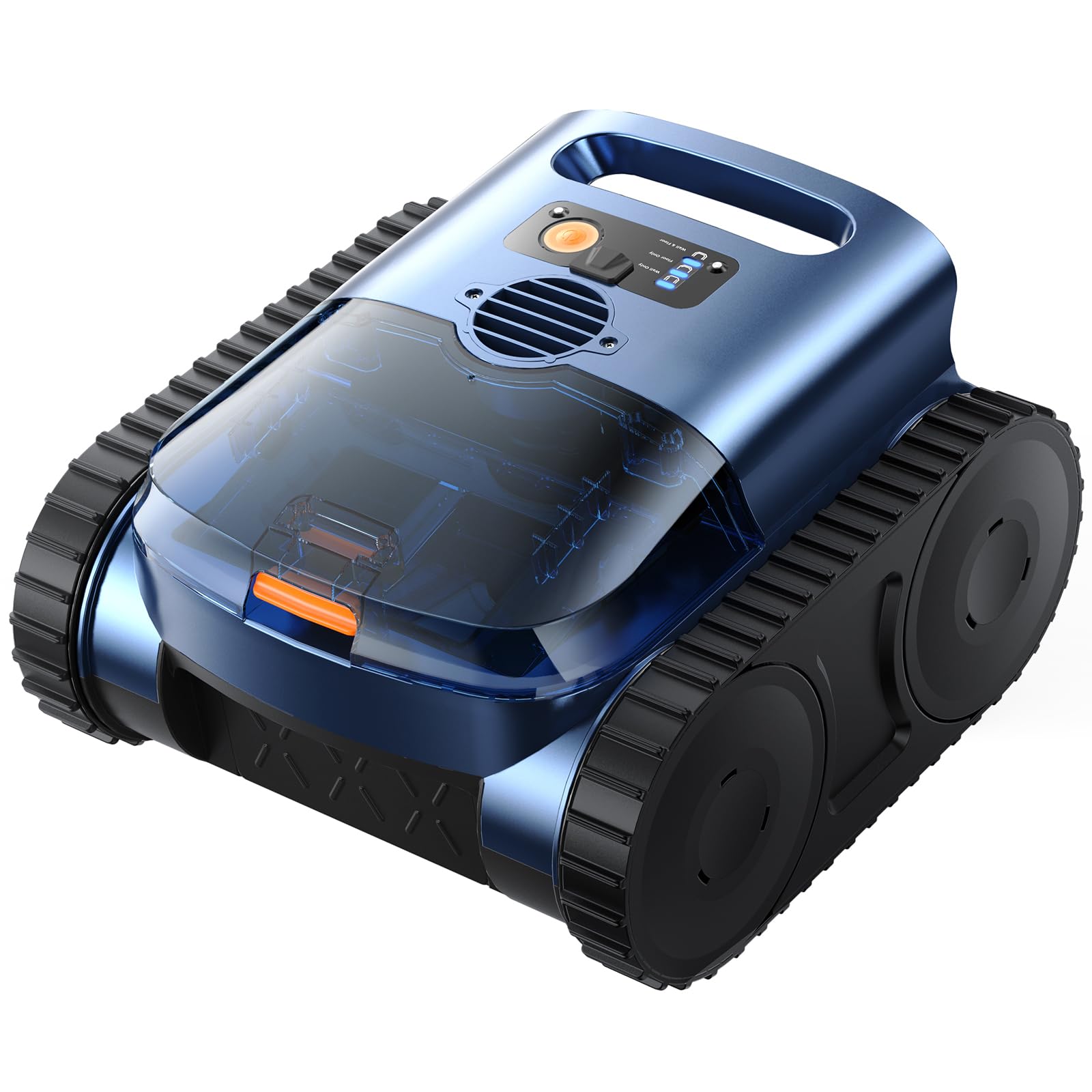
The QGeeM cordless robotic pool cleaner offers the most accessible entry point to cordless pool cleaning without sacrificing the core components that matter. Its 180W brushless motor delivers 4,800 gallons per hour of suction — the same raw flow rate as the Zyerch — enabling it to pick up leaves, stones, sand, and tile grime effectively. The 3-in-1 cleaning modes switch between floor, wall, and full coverage, with gyro navigation that follows an N-path on walls and an S-path on the floor for systematic coverage.
The large lithium-ion battery supports 180 minutes of continuous operation, covering pools up to 2,150 square feet at a maximum depth of 9.8 feet. Charging completes in around 3 hours, which is faster than the 4-hour charge times of some higher-priced competitors. The dual PVC brushes work across tile, vinyl, pebble, glass, and mosaic surfaces, and the upgraded tracks and 4WD system enable the robot to climb 30-degree slopes without getting stuck. The self-righting feature means you can drop it in at any angle, and it will automatically correct its posture and begin cleaning.
The QGeeM’s trade-offs are evident compared to the premium tier: the filter basket is simpler in design and may require more frequent cleaning on heavily soiled pools. The plastic construction, while adequately durable, does not match the automotive-grade coating of the Beatbot AquaSense 2. The lack of app connectivity means no scheduling or remote control. For a first-time robotic cleaner buyer or a secondary unit for a smaller pool, the QGeeM offers the essential features — strong 4,800 GPH suction, 180-minute runtime, and wall climbing — at a price that leaves room for other pool maintenance investments.
Why it’s great
- 4,800 GPH suction matches models costing significantly more
- 180-minute runtime with 3-hour fast charging minimizes downtime
- Self-righting drop-and-go design simplifies daily use
Good to know
- No app, scheduling, or remote control available
- Filter basket may require multiple empties on heavily debris-laden pools
- Plastic construction lacks the premium feel of coated models
FAQ
How often should I run my robotic pool cleaner?
Can a cordless robot clean an entire inground pool on one charge?
Do I need a model with app control?
What is the difference between 180-micron and 3-micron filtration?
Final Thoughts: The Verdict
For most users, the best automatic pool cleaner for inground pools winner is the Beatbot AquaSense 2 because it combines the longest 4-hour runtime, intelligent 16-sensor navigation, double-pass waterline scrubbing, and a wireless charging dock into a single package that requires minimal interaction. If you want AI-powered debris detection that targets dirt before it wanders, grab the AIPER Scuba V3. And for heavy debris loads on a large pool with the largest filter basket and a 3-year warranty, nothing beats the iGarden K40.

Mo Maruf
I created WellFizz to bridge the gap between vague wellness advice and actionable solutions. My mission is simple: to decode the research and give you practical tools you can actually use.
Beyond the data, I am a passionate traveler. I believe that stepping away from the screen to explore new environments is essential for mental clarity and physical vitality.