Our readers keep the lights on and my smoothie glass nicely filled. As an Amazon Associate, I earn from qualifying purchases.
A dull knife is more dangerous than a sharp one — it slips, it tears, it makes every slice a battle. The right sharpener restores that factory-fresh bite and makes prep work feel effortless again. Whether you’re breaking down a chicken or just dicing an onion, a properly honed edge saves time and spares your wrists.
I’m Mohammad Maruf — the founder and writer behind WellFizz. I’ve spent hundreds of hours analyzing abrasives, angle guides, and sharpening systems to separate the tools that actually deliver a lasting edge from those that just grind away metal.
This guide cuts through the grit confusion and shows you which sharpeners earn a permanent spot in your kitchen drawer. You’ll learn exactly what to look for in a best knife sharpener — from stone material to angle precision — so you can bring every blade back to life with confidence.
How To Choose The Best Knife Sharpener
The right sharpener depends on how you cook, what knives you own, and how much time you want to spend. Three factors — abrasive type, angle control, and grit range — define whether you end up with a screaming edge or a frustrated afternoon.
Abrasive Material: Diamond vs. Corundum vs. Ceramic
Diamond abrasives are the hardest and cut the fastest — ideal for modern super-steels and ceramic blades. Corundum (aluminum oxide) is the standard for water and oil stones; it wears evenly and gives great feedback for those who sharpen by feel. Ceramic discs polish at ultra-fine grits and rarely need flattening. Electric sharpeners tend to use diamond or ceramic because they deliver consistent results with no technique required. Manual stones favor corundum because it’s affordable and effective across a wide grit range.
Angle Precision: Guided vs. Freehand
Every edge has two angle numbers that matter: the sharpening angle (15° for fine slicing, 20° for durable chopping) and the included angle (the total V-shape — 30° total for a 15° per side). Guided systems — rolling sharpeners, bench-top jigs, and electric pull-through units — lock that angle so every pass is identical. Freehand stones (oil, water, diamond plates) rely on your muscle memory. Beginners get sharper edges sooner with magnetic or preset angle guides; experienced sharpeners prefer the speed and feedback of a stone.
Grit Progression: From Repair to Polish
A complete system lets you move through at least three stages: repair (100-400 grit to set a new bevel), sharpen (800-1000 grit to refine the edge), and hone/polish (3000-8000 grit to remove the burr and create a mirror finish). Skipping the coarse stage means you’ll struggle to remove nicks. Skipping the fine stage leaves a ragged edge that dulls fast. Multi-grit stones and 3-stage electric sharpeners handle this progression in one tool, while single-grit stones require you to own several.
Quick Comparison
On smaller screens, swipe sideways to see the full table.
| Model | Category | Best For | Key Spec | Amazon |
|---|---|---|---|---|
| Work Sharp Benchtop Whetstone | Water Stone | Guided beginner sharpening | 1000 / 6000 grit, 15°/17° angle guides | Amazon |
| Bogoni Rolling Sharpener | Diamond/Ceramic | Quick, mess-free guided sharpening | 400 diamond / 3000 ceramic, magnetic guides | Amazon |
| Norton Combination Oil Stone | Oil Stone | Traditional knife & tool sharpening | 100 / 280 grit, 8-inch length | Amazon |
| Goodjob Whetstone Kit | Water Stone | Complete starter bundle | 400/1000 + 3000/8000 grit, 4-piece kit | Amazon |
| VIDOME Electric Sharpener | Electric Diamond | Straight-edge & ceramic knives | 100% diamond abrasives, 3-stage, 15° | Amazon |
| XARILK GEN3 Guided System | Fixed-Angle Jig | Precision at-home sharpening | 320 / 800 / 2000 diamond, aluminum jig | Amazon |
| Chef’sChoice 15XV | Electric Diamond | Professional kitchen volume | 100% diamond abrasives, 3-stage, metal housing | Amazon |
In‑Depth Reviews
1. Work Sharp Benchtop Whetstone

This guided whetstone system solves the biggest problem beginners face: holding a consistent angle. The magnetic guides click into 15° or 17° positions, so every pass on the 1000-grit side removes equal metal, and every stroke on the 6000-grit side polishes evenly. The included water-control base holds the stone securely and catches the mud, keeping cleanup simple.
The 1000-grit face is aggressive enough to restore a dull German steel chef’s knife in about three minutes, while the 6000-grit side refines the edge to a squeaky-clean finish. No need for separate flattening stones — the base doubles as storage. The anti-skid mat underneath prevents the unit from walking across the counter during sharpening.
Work Sharp backs this with a limited lifetime warranty, which speaks to the durability of the corundum stone and the ABS base. At roughly 2.25 pounds, it’s heavy enough to stay put but light enough to tuck into a drawer. The only catch is the stone size: at 4 inches long, it’s short for long blades over 10 inches, requiring multiple passes.
Why it’s great
- Preset magnetic angle guides deliver consistent edges without freehand practice
- Dual 1000/6000 grit covers sharpen and hone in one stone
- Water-control base reduces mess and stores the stone
Good to know
- Stone surface is small for blades longer than 10 inches
- Base plastic feels less premium than the stone itself
2. Bogoni Rolling Knife Sharpener

This rolling design flips the script on traditional sharpening: instead of dragging the blade across a stone, you roll the sharpener over the blade. The 400-grit diamond disc on one side handles reprofiling and repair, while the 3000-grit ceramic disc on the other delivers a polished, razor-sharp edge. The natural wood body and leather strop give it a premium, gift-ready feel.
Two magnetic angle guides — one at 15° for delicate slicing edges, another at 20° for heavy-duty durability — snap onto the blade and guide the roller at exactly the right angle. A professional chef with tendonitis reported sharpening a dull blade to razor sharpness in under four minutes with no wrist strain. The high-grade N52 magnets hold the knife firmly in place during rolling, preventing slipping.
The replaceable discs extend the unit’s lifespan, though the diamond disc will wear faster on super-hard steels like SG2 or ZDP-189. The built-in strop is a thoughtful addition for final burr removal. At 0.5 kilograms, it’s heavier than it looks, but the ergonomic roller grip makes one-handed operation easy. Works best with straight-edge blades — serrated knives are not recommended.
Why it’s great
- No water or oil needed — dry operation with no cleanup
- Magnetic angle guides remove guesswork for beginners
- Leather strop included for final edge refinement
Good to know
- Diamond disc will eventually need replacement with heavy use
- Not suitable for serrated or scalloped blades
3. Norton Combination Oil Stone

Norton has been making abrasives since the 1880s, and this oil stone shows why their reputation endures. The 100-grit side cuts fast enough to reshape a damaged edge or repair a chipped blade, while the 280-grit side refines the bevel to a working sharpness suitable for everyday kitchen tasks. The stone is prefilled with oil, so lubricant stays on the surface during use.
Unlike water stones, this corundum stone requires no soaking — just add a few drops of honing oil or even WD-40 and start sharpening. The 8-inch length accommodates full-sized chef’s knives in a single pass, and the 2-inch width provides enough surface area for broad bevels. Users report excellent results on hard steels like those used in hunting knives and planes, where the stone’s density prevents gouging.
At 1.5 pounds, it’s substantial enough to stay on the bench without a non-slip base. The fine side (280 grit) feels more like a medium stone; it won’t produce a polished mirror edge on its own. You’ll want a finer stone or strop afterward if you’re chasing a hair-popping finish. The combination of speed and control makes this a go-to for tool sharpeners who prioritize function over polish.
Why it’s great
- No soaking required — oil stays on the surface, ready to sharpen
- 8-inch length handles full chef’s knives in one stroke
- Durable corundum material outlasts softer water stones
Good to know
- 280-grit side is not fine enough for a true polished edge
- Requires oil or lubricant — not compatible with water-only use
4. Goodjob Whetstone Kit

This kit covers the full grit progression — 400/1000 on one stone and 3000/8000 on the other — so you can repair, sharpen, hone, and polish without buying additional stones. The white corundum stones are fired using Japanese Osaka production techniques at 2000°F for 48 hours, which creates a dense structure that wears evenly and resists dishing.
The bundle includes a bamboo base with a silicone non-slip pad, an angle guide and honing guide for beginners, cut-resistant gloves, two leather strops, and green polishing compound. Users report that even a severely dull, damaged kitchen knife returned to paper-cutting sharpness in under ten minutes. The included flattening stone lets you true the surface when the stone starts to dish.
The cut-resistant gloves are a smart addition for novice sharpeners who are nervous about blade control. The only notable drawback is that the stone quality, while good for the price, won’t match high-end Japanese water stones in speed or feedback on super-hard steels. The logo printed on the stone face creates a slight roughness that some users sand down on arrival. For home cooks and budget-conscious enthusiasts, this kit offers the best accessories-per-dollar value.
Why it’s great
- Four grits (400/1000/3000/8000) cover full progression from repair to polish
- Includes angle guide, honing guide, strops, and cut-resistant gloves
- Bamboo base with silicone pad keeps stones stable during use
Good to know
- Stone quality is decent but not elite — slower on very hard steels
- Logo printed on stone may leave a rough patch; light sanding helps
5. VIDOME Professional Electric Sharpener
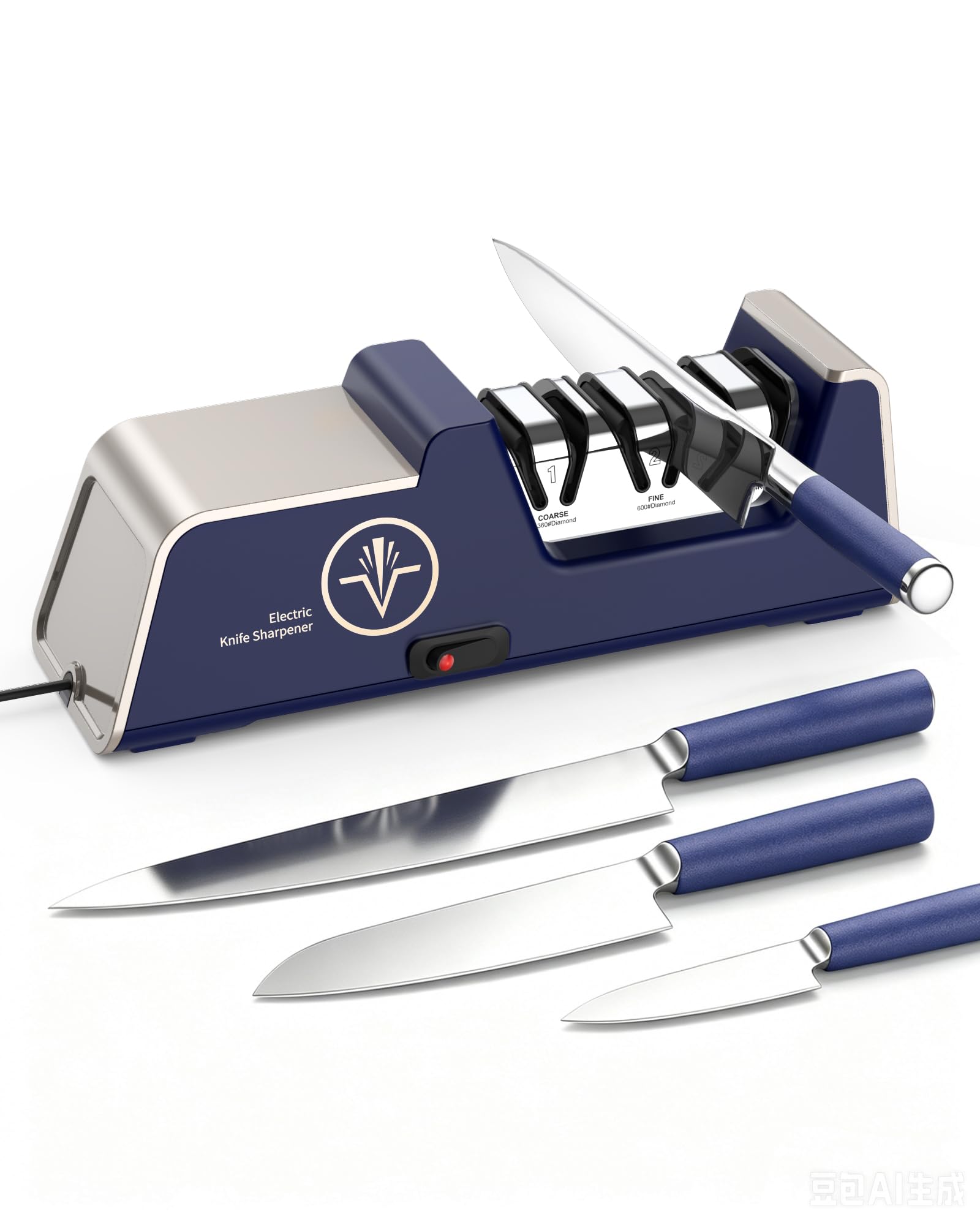
VIDOME uses 100% diamond abrasives in both Stage 1 and Stage 2 of this three-stage electric sharpener — a feature usually found only in models twice its price. Stage 1 sets a new edge at 15°, Stage 2 refines the bevel, and Stage 3 uses stropping disks to polish the blade and remove the burr. The motor runs at a moderate 60-80 dB, less intrusive than many pull-through electrics.
The flexible spring guide system adjusts automatically to the blade’s curve, applying even pressure across the full edge. First-time sharpening takes about 30 seconds; touch-ups are as quick as 10 seconds. The magnetic chip collector catches metal filings for easy cleanup. A professional chef reported reviving a dull ceramic knife to a near-shaving edge in about a minute, though shorter ceramic blades were more challenging to guide through the slots.
The champagne gold finish and compact footprint (9.46 x 2.91 inches) fit neatly on a countertop without dominating the space. The spring-loaded guides protect blade surfaces from scratches, a common complaint with fixed-slot electrics. The energy-saving German motor is efficient, but the sharpener is limited to straight-edge knives and serrated blades — it won’t work on traditional single-bevel Japanese knives or cleavers that need a full flat side.
Why it’s great
- 100% diamond abrasives handle both metal and ceramic blades effectively
- Flexible spring guides ensure even pressure across curved blades
- Compact, counter-friendly design with magnetic chip collection
Good to know
- Slot design can be awkward for very short or very narrow blades
- Not suitable for single-bevel Japanese knives or heavy cleavers
6. XARILK GEN3 Guided System
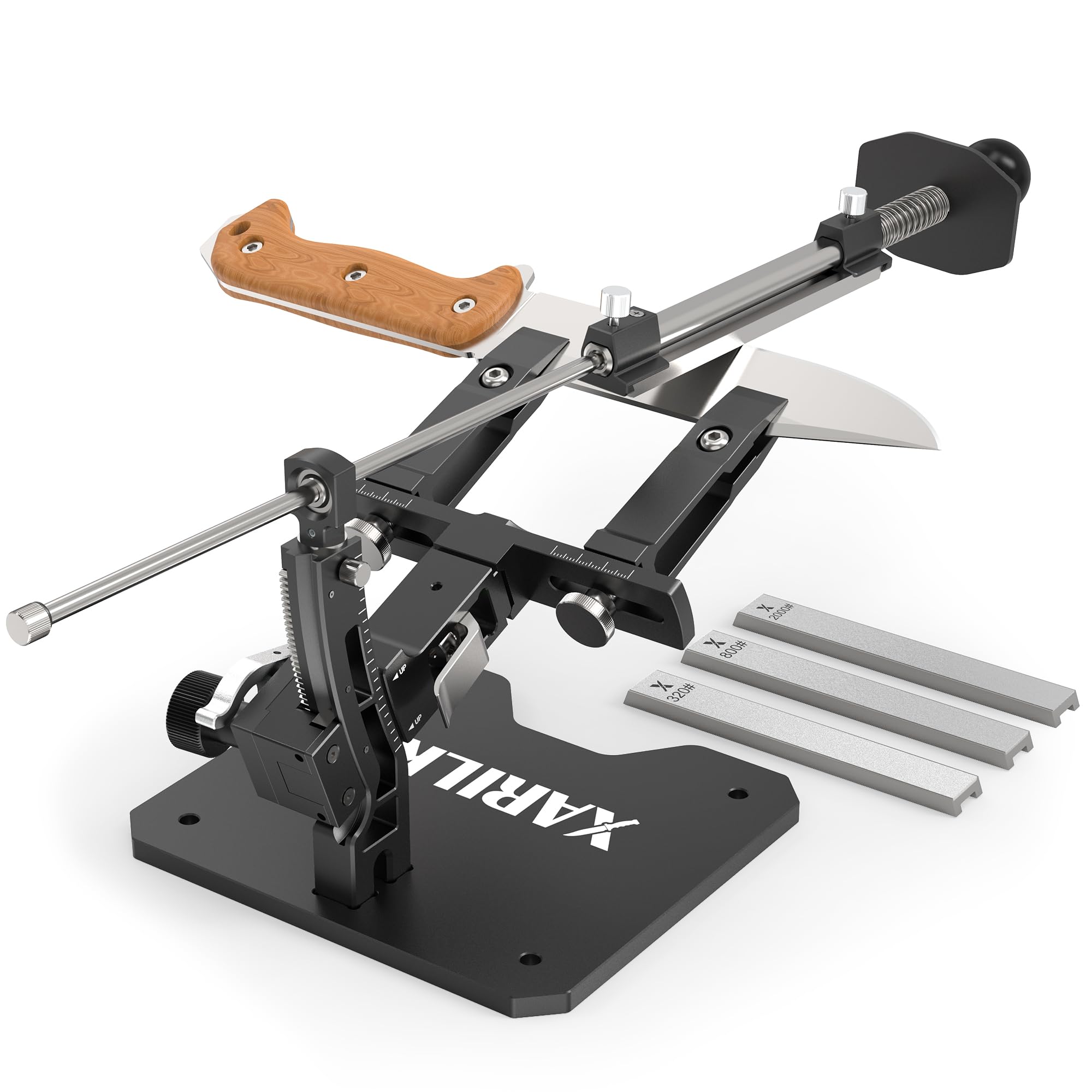
This fixed-angle sharpening jig clamps the blade in place and guides diamond stones at a precise, repeatable angle — making it the closest thing to a professional sharpening system for home use. The aluminum body provides a stable platform, and the three included diamond stones (320, 800, 2000 grit) cover repair, sharpening, and initial polishing. Users consistently report razor-sharp edges on the first try, even with no freehand experience.
The gimbal-mounted rod allows the stone to follow the blade’s curve, creating an arch-shaped edge that cuts through the full length of the blade. The system accepts non-proprietary stones, so you can swap in higher-grit plates or ceramic rods later. Assembly is straightforward with the included Allen wrench, though the clamp uses hex set screws that require careful tightening to avoid marring blade finishes.
At 4 pounds, the all-metal construction feels solid but portable. A digital angle finder is strongly recommended to verify the clamp’s angle, as the included marks are approximate. The diamond stones are effective but may show grit contamination or wear after 10-15 sharpenings, depending on steel hardness. For the price, it competes directly with the Work Sharp Precision Adjust family but adds the advantage of non-proprietary stone compatibility.
Why it’s great
- All-metal aluminum jig provides a stable, repeatable sharpening platform
- Accepts non-proprietary stones for customizable grit progression
- Gimbal rod follows blade curve for full-length edge consistency
Good to know
- Included diamond stones may show wear after repeated use on hard steels
- Requires a digital angle finder for accurate angle setup
7. Chef’sChoice 15XV Professional

The 15XV is the long-time benchmark for electric sharpeners in professional kitchens. Its brushed metal upper housing withstands daily commercial use, and the three-stage EdgeSelect system uses 100% diamond abrasives to sharpen, hone, and polish straight-edge and serrated blades. Stage 1 and 2 are plated with diamond for aggressive edge setting and refinement; Stage 3 uses a patented flexible abrasive system to polish serrations without damaging the scallops.
The Trizor XV technology converts traditional 20-degree factory edges into a 15-degree edge that is both sharp and durable. Spring-loaded flexible guides automatically adjust to the blade’s thickness and curve, maintaining consistent pressure. Users report that a single pass through all three stages restores a four-year-old neglected knife to factory-like sharpness in under five minutes. The unit weighs 5 pounds, giving it the stability to handle heavy-duty sharpening without sliding.
Noise level is rated between 65 and 75 dB — quieter than many countertop appliances. The motor is built for volume: one user reported sharpening 25 knives over several days with no performance drop. The plain brown box packaging is a common frustration, but the unit inside is exactly the same as the retail-boxed version. This sharpener removes more material per pass than a manual jig, so it’s less ideal for expensive, thin-bladed Japanese knives where you want to preserve steel.
Why it’s great
- Professional-grade metal housing and diamond abrasives built for high-volume use
- 3-stage system sharpens, hones, and polishes serrated and straight blades
- Automatic spring guides maintain consistent pressure across blade shapes
Good to know
- Removes more metal per session than manual systems — avoid over-sharpening thin knives
- Packaging may arrive in a plain brown box despite being a premium product
FAQ
Can I use an oil stone with water instead of oil?
What angle should I sharpen my kitchen knives to?
Do electric sharpeners damage my knives by removing too much metal?
Why does my knife feel sharp after a 1000-grit stone but dull again quickly?
Final Thoughts: The Verdict
For most users, the best knife sharpener winner is the Work Sharp Benchtop Whetstone because it combines beginner-friendly magnetic angle guides with a genuine 1000/6000 grit water stone that produces consistently sharp edges without the steep learning curve of freehand sharpening. If you want absolutely no mess and the fastest possible setup, grab the Bogoni Rolling Sharpener — its dry diamond and ceramic discs deliver a razor edge in minutes with zero cleanup. And for professional kitchens or high-volume sharpening, nothing beats the Chef’sChoice 15XV for speed, consistency, and commercial-grade durability.

Mo Maruf
I created WellFizz to bridge the gap between vague wellness advice and actionable solutions. My mission is simple: to decode the research and give you practical tools you can actually use.
Beyond the data, I am a passionate traveler. I believe that stepping away from the screen to explore new environments is essential for mental clarity and physical vitality.