Our readers keep the lights on and my smoothie glass nicely filled. As an Amazon Associate, I earn from qualifying purchases.
That hollow, distant, or overly sibilant vocal sound from a cheap desktop mic kills a podcast, stream, or voiceover faster than any content mistake. The difference between a recorded voice that sounds like it came from a tin can and one that feels warm, present, and broadcast-ready is the capsule design and the polar pattern engineering inside the housing. An at home studio microphone isn’t just a computer peripheral — it’s a precision acoustic instrument designed to capture the human voice with body and clarity, even in an untreated bedroom or spare room.
I’m Mohammad Maruf — the founder and writer behind WellFizz. I’ve spent years analyzing audio hardware specifications, evaluating capsule types, frequency response curves, and self-noise floors to separate real vocal reproduction quality from marketing claims dressed up as specs.
Whether you are recording a solo podcast, hosting a two-person interview, laying down scratch vocals, or streaming live on Twitch, the right mic boils down to capsule type, polar pattern, connectivity, and room tolerance. This guide breaks down seven carefully selected condenser and dynamic models across USB, XLR, and hybrid configurations — the definitive starting point for anyone choosing their best at home studio microphone.
How To Choose The Best At Home Studio Microphone
Choosing a home studio mic comes down to matching the capsule type and connectivity to your recording environment. A large-diaphragm condenser in a noisy room without acoustic treatment will sound worse than a decent dynamic mic 12 inches from your mouth. Understand these three pillars before you buy.
Capsule Type: Condenser vs. Dynamic
Condenser mics use a thin, electrically charged diaphragm that is extremely sensitive to subtle acoustic details — they pick up breath, finger slides on guitar strings, and room reverb with equal precision. Dynamic mics use a coil and magnet assembly that is less sensitive but more forgiving in untreated rooms, making them the standard for podcasting and live broadcast. If your space has bare walls, a hard floor, or an open window, lean toward a dynamic capsule with a tight cardioid pattern. If you have some acoustic treatment or soft furnishings, a condenser will reward you with richer, more detailed vocal reproduction.
Polar Pattern: Rejection Angle
Cardioid is the default pattern for almost every home studio application — it rejects sound from the rear and sides while capturing what is directly in front of the capsule. Bidirectional (figure-8) patterns pick up sound from both front and back, useful for two-person interviews facing each other across a single mic. Omnidirectional captures sound equally from all directions and is rarely useful for untreated rooms. Multi-pattern mics switch between these options electronically, removing the need to own multiple microphones.
Connectivity: USB vs. XLR
USB mics contain a built-in analog-to-digital converter and preamp, making them true plug-and-play devices for any computer or tablet — no audio interface required. XLR mics require an external audio interface or mixer with phantom power, but they give you the freedom to upgrade preamps, add compressors, and use longer cable runs without signal degradation. Hybrid mics that offer both USB-C and XLR outputs provide the best of both worlds: convenient direct recording now with the option to integrate into a pro-level setup later.
Quick Comparison
On smaller screens, swipe sideways to see the full table.
| Model | Category | Best For | Key Spec | Amazon |
|---|---|---|---|---|
| Logitech Yeti Blackout | USB Condenser | Multi-pattern flexibility | 4 pickup patterns | Amazon |
| MAONO PD200W | Hybrid Dynamic | Wireless duo podcasting | 60m wireless range | Amazon |
| Sennheiser Profile | USB Condenser | Warm vocal capture, no software | Cardioid condenser capsule | Amazon |
| AKG P220 | XLR Condenser | Instrument + vocal recording | Bass-cut filter switch | Amazon |
| Audio-Technica AT2020USB-X | USB Condenser | High-resolution USB recording | 24-bit / 96 kHz ADC | Amazon |
| Shure MV7+ | Hybrid Dynamic | Professional podcast/broadcast | Auto Level Mode | Amazon |
| LEWITT LCT440PURE | XLR Condenser | Studio-grade vocal depth | 1-inch true condenser capsule | Amazon |
In‑Depth Reviews
1. Logitech Creators Blue Yeti USB Microphone Blackout

The Blue Yeti remains the most versatile USB condenser microphone on the market because of its unique three-capsule array that enables four switchable polar patterns — cardioid, omnidirectional, bidirectional, and stereo. This means you can use it for solo podcasting, group interviews around a table, ASMR recordings, or even room ambience capture without owning four separate microphones. The onboard gain knob, mute button, and headphone volume control put every adjustment at your fingertips, eliminating the need to dig into software during a live stream or recording session.
The metal body and heavy desktop stand give it a sturdy, premium feel that resists vibrations from desk bumps. The plug-and-play USB connectivity works instantly on both Mac and PC without driver installation, and the included Blue VO!CE software adds real-time effects, HD audio samples, and advanced modulation for streamers who want broadcast polish. The frequency response spans a wide 20 Hz to 20 kHz, which captures sub-bass thump and airy highs beyond typical vocal range — useful for instrument recording or full-bandwidth voiceover work.
One real-world trade-off is its sensitivity: the condenser capsule will pick up room echo, keyboard clatter, and HVAC noise if your space isn’t treated. Best practice is to set the gain low and sit within 6 inches of the grille. The micro-USB connector, though reliable, feels dated compared to newer models using USB-C. For the creator who wants one mic that handles any recording scenario out of one box, the Yeti delivers unmatched flexibility.
Why it’s great
- Four pickup patterns cover solo, duo, and group recording without extra gear.
- Heavy all-metal construction and built-in gain/mute controls for direct access.
- Included desktop stand with adjustable tilt for precise positioning.
Good to know
- Condenser design picks up room echo and background noise in untreated spaces.
- Micro-USB connection instead of modern USB-C.
2. MAONO PD200W Hybrid Wireless Podcast Microphone
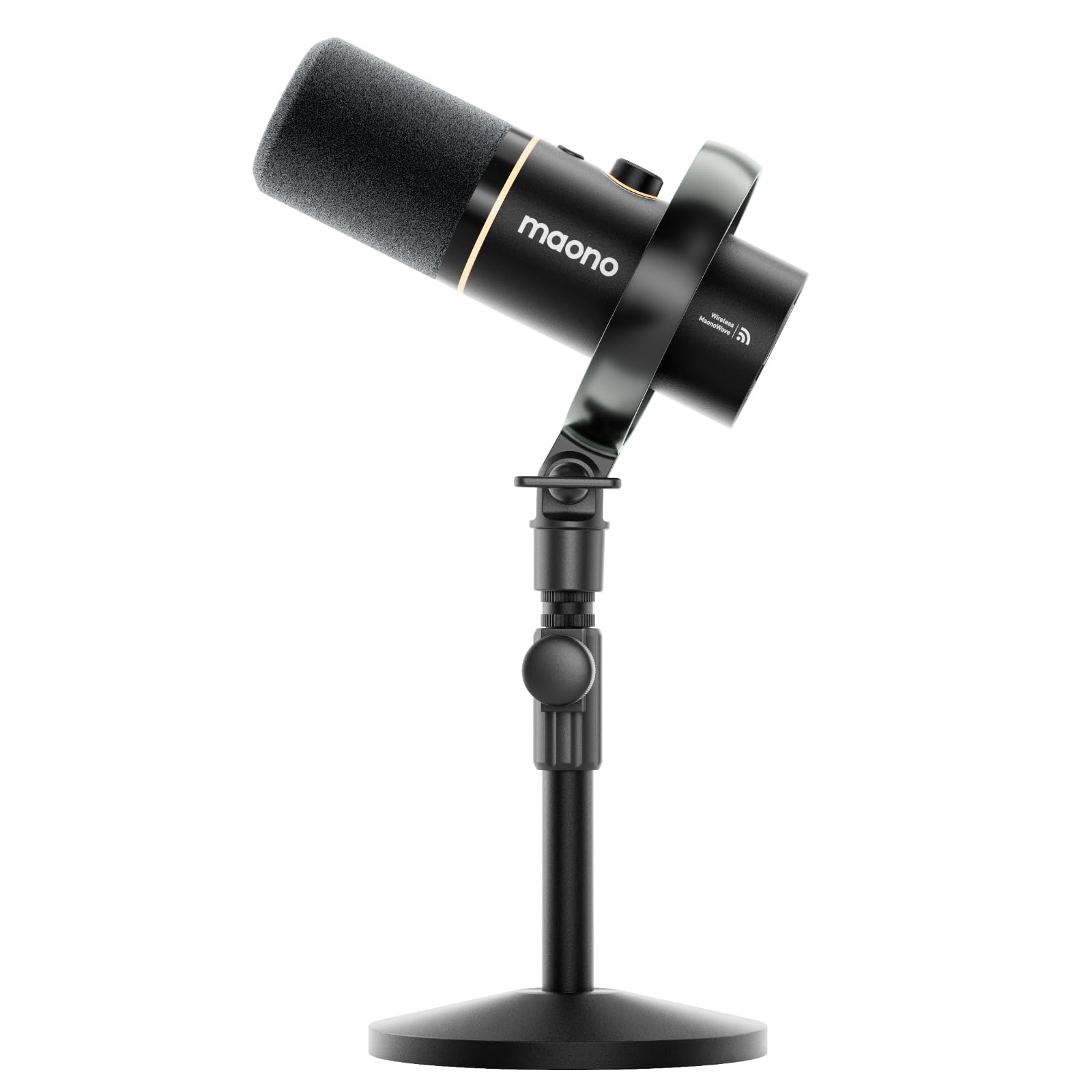
The MAONO PD200W is a hybrid dynamic microphone that breaks the cable tether with wireless connectivity, making it the most flexible home studio mic for co-hosted podcasts and on-the-go recording. It offers three connection modes: a 60-meter wireless range via a Type-C receiver, standard USB-C for plug-and-play use with phones and laptops, and XLR for integration with professional audio interfaces. The 30mm dynamic capsule and cardioid pattern deliver a focused, noise-rejecting sound signature that excels in untreated rooms — background noise and echo are suppressed before they reach your recording.
An 82 dB signal-to-noise ratio ensures the floor between takes stays remarkably clean, while the ability to handle up to 128 dB SPL means loud vocal pops or acoustic guitar strums won’t distort. The real standout feature is dual-microphone support: a single receiver can connect two PD200W mics simultaneously, recording each to its own track for independent editing. The desktop stand is sturdy and adjustable, and the included MaonoLink app gives you four preset modes plus manual EQ and reverb control without needing a separate audio interface.
The wireless range holds up reliably through walls in a home environment, and the 60-hour battery life with RGB lighting turned off covers weeks of regular podcast sessions. On the downside, the onboard button layout can be confusing — you will likely rely on the app for mode switching at first. The RGB lighting, while aesthetically fun, does draw battery life down noticeably when enabled. For creators who want to move around the room, conduct duo interviews, or keep a clean desk free of cables, the PD200W redefines convenience.
Why it’s great
- True wireless connectivity with 60-meter range for unteathered recording.
- Dual-mic support with independent track recording for duo interviews.
- Dynamic capsule with 3-stage noise cancellation excels in untreated rooms.
Good to know
- Button layout requires app assistance until muscle memory builds.
- RGB lighting reduces battery life significantly when active.
3. Sennheiser Professional Profile USB Condenser Microphone

The Sennheiser Profile is built around a simple philosophy: capture a warm, natural vocal sound without requiring a single piece of software. The cardioid condenser capsule inside the metal housing is tuned to accentuate the body and presence of the human voice, delivering a smooth frequency response that avoids the thin, tinny quality of many entry-level USB mics. The analog controls — gain dial, mix control between mic and computer audio, and a dedicated headphone volume knob — sit front-facing so you can adjust them mid-stream without reaching around the mic body.
Setup is genuinely one-cable: plug the USB-C cable into a PC, Mac, or Linux machine, and the system recognizes it as a standard USB audio device immediately. No drivers, no downloads, no software layer that might introduce latency or compatibility bugs. The built-in headphone jack delivers zero-latency monitoring directly from the mic, which is critical for voice artists who need to hear their own delivery timing without delay. The compact table stand is low-profile but stable, and the slim form factor saves desk space compared to the bulky Yeti.
The Sennheiser name carries weight in audio engineering, and the Profile lives up to it with a 125 dB maximum SPL — high enough to capture loud vocal performances without clipping. Some users find the included stand too short for comfortable seated use, often requiring a separate boom arm. The lack of a multi-pattern switch means it is strictly a solo-performer mic, not suited for multi-person roundtables. For the creator who values pure, unprocessed vocal tone and hates dealing with bloatware or settings menus, the Profile is the minimalist’s dream.
Why it’s great
- True plug-and-play with no drivers or software — universal USB audio standard.
- Warm, natural vocal tonality that avoids harsh highs or thin mids.
- Front-facing analog controls for gain, mix, and headphone volume.
Good to know
- Included stand is short; a boom arm is recommended for comfortable posture.
- Single cardioid pattern only — no omnidirectional or bidirectional options.
4. AKG P220 Perception 220 Professional Studio Microphone
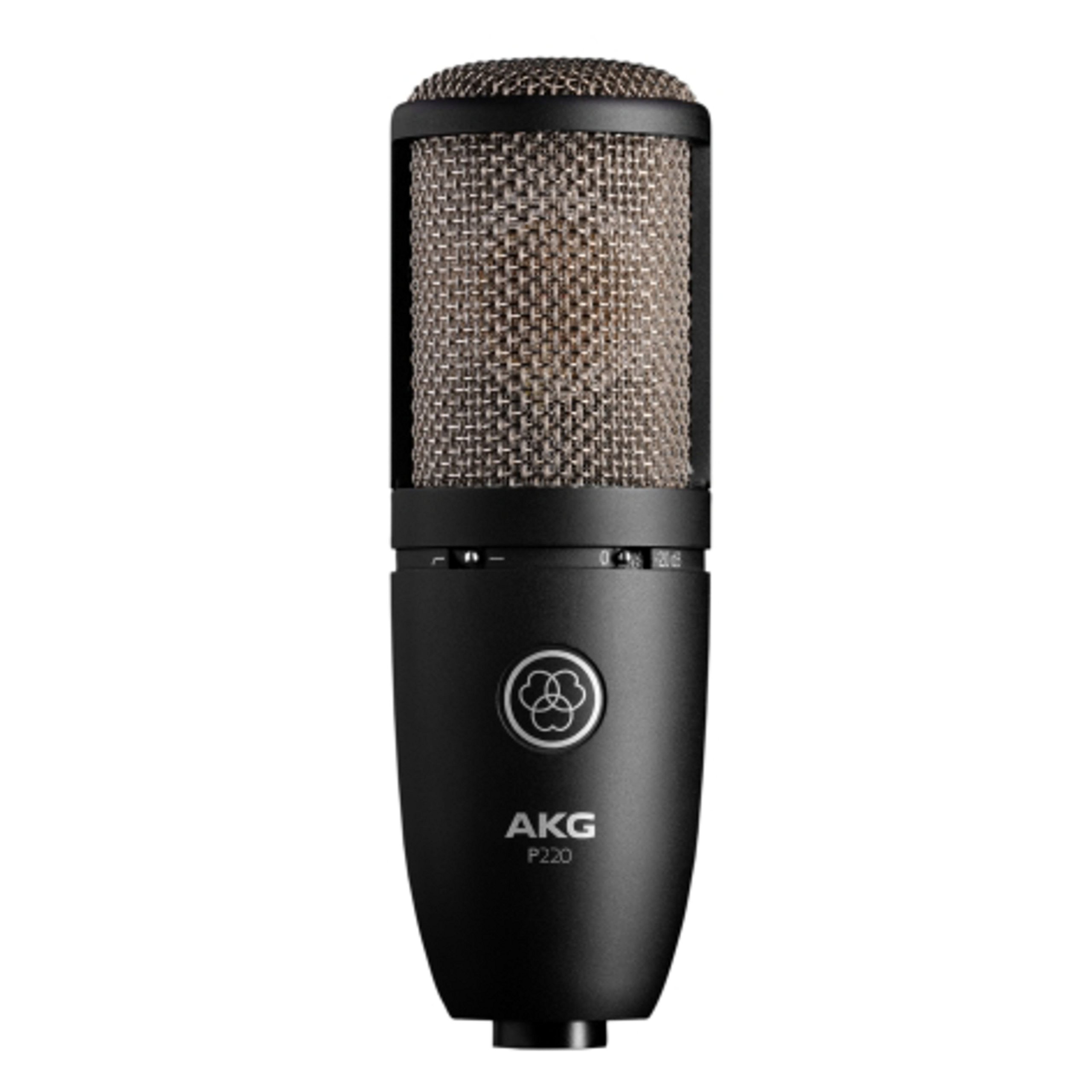
The AKG P220 is a traditional large-diaphragm XLR condenser microphone designed for serious recording through an audio interface or mixer. Its 1-inch diaphragm delivers a warm, detailed sound that reviewers consistently describe as far exceeding its class — capable of capturing vocals, acoustic guitars, drum overheads, and amplified instruments with clarity and depth. The all-metal body and robust construction, engineered in Vienna, withstand the rigors of daily use and transport without mechanical noise or loose connections.
Two onboard switches add practical utility: a bass-cut filter that eliminates low-frequency rumble from footfall, HVAC vibration, or traffic noise, and a 20 dB pad that prevents distortion when recording loud sound sources like snare drums or cranked guitar amps. The cardioid polar pattern provides reliable rear rejection, focusing the pickup zone tightly on the sound source in front of the capsule. An impedance rating of 200 ohms makes it compatible with virtually any standard audio interface preamp without impedance mismatch issues.
The P220’s XLR-only connectivity means it requires a separate audio interface or mixer with phantom power — an extra investment that raises the entry cost. The included shock mount, while functional, has been noted for its plastic construction and occasional durability issues after extended use. The blue metallic finish can scratch more easily than matte black alternatives. For the home studio owner who already has an interface and wants a step-up condenser that sounds richer than typical budget XLR mics, the AKG P220 delivers professional tonal quality at a compelling price point.
Why it’s great
- Warm, full-bodied condenser sound that outperforms its price tier on vocals and instruments.
- Built-in bass-cut filter and 20dB pad for flexible recording in varied environments.
- Rugged all-metal body built for daily studio use.
Good to know
- Requires external audio interface or mixer with phantom power and XLR cable.
- Included shock mount has plastic components reported to wear over time.
5. Audio-Technica AT2020USB-X Cardioid Condenser USB Microphone

The Audio-Technica AT2020USB-X brings the legendary AT2020 side-address condenser design into the USB era with a high-resolution 24-bit / 96 kHz analog-to-digital converter that captures audio detail beyond standard CD quality. The cardioid polar pattern is fixed and effective — it rejects off-axis room noise well enough to use in a moderately treated home office without excessive bleed from computer fans or street sounds. The smooth, extended frequency response is ideally suited for podcasting, home studio recording, field recording, and voiceover work where natural instrument or vocal timbre matters.
A built-in headphone jack with direct monitoring allows you to hear your own voice in real time without the delay that plagues software-based monitoring. The capacitive mute button on the front of the body is a nice touch — a soft, silent touch mutes the microphone instantly without the mechanical click of a physical switch, and the LED ring around the grille glows blue when active and red when muted for at-a-glance status. The included custom desk stand and USB-C to USB-A cable (with a USB-A to USB-C adapter) ensure compatibility with modern and legacy ports out of the box.
Its sensitivity is a double-edged sword: while it picks up vocal nuances beautifully, it also captures background sounds like furnace vents, PC fans, and mouse clicks with equal fidelity. Reviewers frequently note the LED ring remains illuminated even after the PC shuts down, a minor annoyance for those who prefer a completely dark room at night. The 600-ohm output impedance is higher than typical USB mics, but the internal preamp handles it well. For the recordist who values high-definition capture and wants the AT2020 sound without an interface, this is the USB version to choose.
Why it’s great
- 24-bit / 96 kHz ADC for exceptionally detailed, high-resolution audio capture.
- Soft-touch capacitive mute button with clear blue/red LED status indicator.
- Delivers the classic AT2020 smooth frequency response in a USB format.
Good to know
- High sensitivity picks up ambient room noise — requires quiet environment or treatment.
- LED ring stays lit after PC shutdown for some users.
6. Shure MV7+ Dynamic Microphone

The Shure MV7+ is the modern evolution of the legendary SM7B, repackaged as a hybrid dynamic microphone with USB-C and XLR outputs, OBS certification, and intelligent audio processing that makes broadcast-grade vocal capture accessible without a sound engineer. The Auto Level Mode is genuinely useful: the microphone continuously adjusts gain based on your distance from the capsule and your vocal volume, maintaining consistent levels even if you lean back or get excited during a stream. The built-in real-time denoiser and Voice Isolation Technology keep your voice present and clear while reducing background hum, computer fan noise, and room echo.
The customizable full-color LED touch panel adds a visual element that is both functional and aesthetic — it displays real-time level monitoring in a glanceable color gradient, and a simple tap mutes the microphone instantly. The integrated reverb effects (Plate, Hall, and Studio) add polish to vocals without post-processing, a feature that streamers and live podcasters will appreciate for adding depth on the fly. The dual USB-C and XLR outputs mean you can start with plug-and-play simplicity and later integrate into a full hardware mixer or audio interface without buying a new microphone.
The dynamic capsule is inherently less sensitive than a condenser, which is an advantage in untreated rooms — it won’t pick up every paper shuffle or air conditioner cycle. The included foam windscreen reduces plosives, and the metal body feels dense and professional. The trade-off is that the frequency response rolls off above 16 kHz, meaning it sacrifices some airy top-end detail for focused vocal presence. The touch-sensitive mute button requires a deliberate tap — accidental brushes won’t trigger it. For podcasters, streamers, and remote workers who want a professional, forgiving microphone that handles bad rooms gracefully, the MV7+ is a premium solution that earns its reputation.
Why it’s great
- Auto Level Mode maintains consistent vocal levels without manual gain riding.
- Dynamic capsule rejects room echo and background noise in untreated spaces.
- Dual USB-C and XLR outputs for expandability from plug-and-play to pro studio.
Good to know
- Upper frequency response rolls off at 16 kHz — less airy than a condenser.
- Touch mute panel requires deliberate tap; accidental brushes are ignored.
7. LEWITT LCT440PURE Large Diaphragm Condenser Mic

The LEWITT LCT440PURE is a true condenser microphone built around a 1-inch hand-crafted capsule that delivers a level of clarity and depth that competes with microphones costing three times as much. The cardioid polar pattern provides exceptional off-axis rejection, and the self-noise floor measures an astonishingly low 7 dBA — one of the quietest specs in its class, meaning your recordings start from a nearly silent background. This mic captures the nuance of vocal performances, acoustic guitar string texture, and the transient snap of drum hits with a natural, uncolored fidelity that requires minimal EQ in post-production.
The zinc die-cast metal body is robust and dense — so heavy that smaller lightweight boom arms may tip over if not counterbalanced properly. The included shock mount is well-constructed from plastic but securely grips the mic, and the magnetic pop filter clicks into place around the grille for easy installation and removal. The frequency response extends to 20 kHz with a slight presence boost around 5-8 kHz that adds intelligibility to spoken word and vocal performances without sounding harsh. The 200-ohm impedance is compatible with all standard interface preamps.
This is a bare-bones XLR microphone — no USB, no software, no onboard effects, no mute button. It demands an audio interface with 48V phantom power and a decent preamp to shine. The lack of any pad or bass-cut switch means you need to handle loud sources via your interface’s gain stage or external attenuation. For the home studio owner who prioritizes sonic purity and plans to upgrade preamps over time, the LCT440PURE is a long-term investment that will never be the weak link in your signal chain. Reviewers who have owned it for six years still consider it their forever microphone.
Why it’s great
- Ultra-low 7 dBA self-noise floor for exceptionally clean recordings.
- 1-inch true condenser capsule rivals sound quality of far more expensive mics.
- Included magnetic pop filter and shock mount save on accessory costs.
Good to know
- XLR only — requires audio interface with phantom power; no USB convenience.
- Heavy build can destabilize light stands and smaller boom arms.
FAQ
Should I get a condenser or dynamic mic for my untreated home room?
Can I record two people on a single USB microphone?
Do I need an audio interface for a USB microphone?
What does a bass-cut filter switch do on a studio microphone?
Final Thoughts: The Verdict
For most users, the best at home studio microphone winner is the Blue Yeti Blackout because its four pickup patterns and plug-and-play USB design make it the most versatile single microphone for solo recording, duo interviews, and group streams without needing additional gear. If you want a dynamic mic that rejects room echo and supports wireless duo recording, grab the MAONO PD200W. And for professional-grade vocal purity that will still impress you six years from now, nothing beats the LEWITT LCT440PURE paired with a decent audio interface.

Mo Maruf
I created WellFizz to bridge the gap between vague wellness advice and actionable solutions. My mission is simple: to decode the research and give you practical tools you can actually use.
Beyond the data, I am a passionate traveler. I believe that stepping away from the screen to explore new environments is essential for mental clarity and physical vitality.