Our readers keep the lights on and my smoothie glass nicely filled. As an Amazon Associate, I earn from qualifying purchases.
When you’re just starting out, a sewing machine shouldn’t feel like a spaceship control panel. The best basic sewing machine cuts through the confusion, offering a handful of essential stitches, straightforward threading, and a metal frame that keeps the needle where you put it—without trying to sell you on embroidery fonts you’ll never use.
I’m Mohammad Maruf — the founder and writer behind WellFizz. I’ve spent hundreds of hours cross-referencing technical specs, comparing motor power, feed-dog design, and bobbin systems to find the machines that actually serve a beginner’s real-world needs.
After reviewing dozens of models, I’ve narrowed it down to nine contenders that represent the true best basic sewing machine choices available today, from lightweight portables to workhorse mechanicals.
How To Choose The Best Basic Sewing Machine
A basic sewing machine should simplify your entry into garment making, mending, and quilting—not complicate it. The key is ignoring the marketing noise and focusing on the mechanical foundation that determines whether your machine will stitch reliably for years instead of weeks.
Internal Frame Material
The single biggest predictor of long-term reliability is whether the machine uses a full metal internal frame or a plastic skeleton. A metal frame absorbs vibration, keeps the timing mechanism aligned, and allows the machine to handle multiple layers of denim or canvas without shimmying. Plastic frames are lighter and cheaper, but they wear faster and often lead to skipped stitches after moderate use.
Bobbin System
Two common bobbin systems dominate the basic machine market: front-loading vertical oscillating hooks and top drop-in rotary hooks. The drop-in style is universally easier to load and monitor because you can see the thread supply through a clear cover. Front-loading bobbins are more traditional and often produce a slightly straighter stitch at high speeds, but they demand more dexterity to insert correctly.
Stitch Count vs. Stitch Utility
A machine boasting 100 built-in stitches sounds impressive, but ask yourself how many of those you will actually use. The essential stitches for a beginner are straight, zigzag, and blind hem. A one-step buttonhole feature saves real frustration. Decorative stitches are nice to have, but they should not be the deciding factor—a machine with 12 well-chosen stitches and a metal frame will outlast a plastic machine with 60 gimmicks.
Quick Comparison
On smaller screens, swipe sideways to see the full table.
| Model | Category | Best For | Key Spec | Amazon |
|---|---|---|---|---|
| Brother XM3700 | Mechanical | Ease of threading | 37 stitches, jam‑resistant drop-in bobbin | Amazon |
| Brother CP100X | Computerized | Quilting projects | 100 stitches, wide extension table | Amazon |
| SINGER Heavy Duty 4452 | Mechanical | Thick fabrics like denim | 32 stitches, 1100 stitches/min | Amazon |
| Janome JW8100 | Computerized | All‑around versatility | 100 stitches, 7‑piece feed dog system | Amazon |
| SINGER Heavy Duty 6800C | Computerized | Versatility & stitch applications | 586 stitch apps, 1,100 stitches/min | Amazon |
| Janome 2212 | Mechanical | Pure simplicity & reliability | 12 stitches, vertical oscillating hook | Amazon |
| American Home AH600 | Mechanical | Learning the basics | 12 stitches, metal frame/ bobbin case | Amazon |
| StitchMaster Pro | Mechanical | Ultra‑portability | 14 stitches, twin‑needle compatible | Amazon |
| Stoigeld SM‑725 | Mechanical | Total starter kit experience | 12 stitches, 2‑speed control | Amazon |
In‑Depth Reviews
1. Brother XM3700

The Brother XM3700 hits the sweet spot where feature count meets genuine beginner-friendliness. Thirty-seven built-in stitches cover everything from straight and zigzag to decorative heirloom patterns, and the one-step auto-size buttonhole saves you from measuring buttonholes by hand. The automatic needle threader, once mastered, eliminates one of the most frustrating parts of setup—threading the eye of a needle.
Its jam-resistant drop-in bobbin is a standout: you load it from the top, watch the thread through a clear cover, and rarely deal with the tangled messes common on front-loading systems. The free arm lets you slide cuffs and sleeves right onto the narrow bed, making hemming pants a natural motion rather than a wrestling match. At 12.5 pounds, it’s light enough to move from table to storage without groaning.
Reviewers consistently praise how easily it handles materials from delicate silk felt to multiple layers of heavy material, and the Brother At Your Side support provides real phone and chat backup for the life of the machine. The only real adjustment is learning the precise technique for the auto-threader, but a few practice tries make it second nature.
Why it’s great
- Automatic needle threader saves time and eye strain
- Five included sewing feet cover most home tasks out of the box
- Lightweight but still uses a metal internal frame for stability
Good to know
- Needle threader has a learning curve for some users
- Reverse stitch location takes a moment to locate by feel
2. Brother CP100X

The Brother CP100X is a computerized machine that doesn’t overwhelm beginners with complexity. One hundred built-in stitches—including utility, decorative, heirloom, and eight auto-size buttonholes—give you room to grow, but the intuitive LCD screen and tactile button controls keep the learning curve gentle. The fixed needle bar ensures straighter lines, which is a boon for free-motion quilting.
The package includes ten sewing feet plus a quilt guide, and the wide extension table is a + accessory that comes right in the box. It makes managing large quilts and multiple yards of fabric easy without buying aftermarket add-ons. The durable metal frame keeps the machine stable even when you push it through heavy quilts or denim, and the machine runs quieter than many comparably priced models.
Users appreciate that the CP100X can be operated entirely without the foot pedal via a start/stop button and speed slider—a lifesaver for those with back or leg issues. Bobbin winding can be uneven if the thread isn’t guided manually at first, but the overall build quality and included hard cover make this a long-term investment for the home sewer who wants to grow into more advanced projects.
Why it’s great
- Wide extension table included for large quilting projects
- Foot-pedal-free operation with speed slider
- Metal frame construction reduces vibration and noise
Good to know
- Bobbin winding may require manual thread guidance
- Decorative monogramming foot is for stitches only, not letters
3. SINGER Heavy Duty 4452

The SINGER Heavy Duty 4452 is a mechanical machine built for speed and brute force. Its 50% more powerful motor compared to standard models means it punches through denim, canvas, and multiple layers of corduroy without the needle struggling or skipping. The 1100-stitches-per-minute top speed lets you finish projects fast, but the low-speed option is available for precise work on delicate fabrics.
Thirty-two built-in stitches unlock 110 stitch applications, including stretch stitches for knits and basic decorative patterns. The top drop-in bobbin with a clear cover lets you monitor thread levels at a glance. The full metal frame provides the stability needed to handle heavy materials without the machine walking across your table. The accessory kit includes a walking foot, non-stick foot, clearance plate, and heavy-duty needles—everything you need for tackling upholstery, bags, and thick garments.
Users emphasize that the upright spool pin can cause thread jumping, but switching to the horizontal pin resolves it. The reverse stitch mechanism depresses downward rather than a lever, which takes a little muscle memory. For anyone who plans to sew denim jackets, canvas tote bags, or multiple layers of fleece, the 4452 is a reliable workhorse that won’t break under pressure.
Why it’s great
- Stronger motor pierces dense fabrics with ease
- High stitch speed of 1100 per minute for efficiency
- Full metal frame absorbs vibration and keeps timing accurate
Good to know
- Thread jumps from upright spool pin; use horizontal pin
- No built-in storage compartment for accessories
4. Janome JW8100

The Janome JW8100 proves that a fully-featured computerized machine can still be accessible to a beginner. With 100 built-in stitches and seven one-step buttonholes, it offers serious creative range without a steep learning curve. The LCD screen shows the selected stitch, its number, and presser foot recommendations, so you never guess whether you’re using the right foot for a satin stitch.
The 7-piece feed dog system is a genuine upgrade—it moves fabric more uniformly than the standard 4-piece or 5-piece designs, preventing shifting and puckering on knits and layered materials. The extra-wide extension table and even feed foot come included, making this machine quilting-ready straight out of the box. The hard cover protects the machine from dust when not in use, adding to its lifespan.
Experienced sewers upgrading from older mechanical machines rave about the smoothness and quiet operation. The built-in needle threader and jam-proof drop-in bobbin mean less fiddling and more sewing. The only common complaint is that the built-in light could be brighter for dark fabrics, but that is easily fixed with an auxiliary task lamp. For the home sewer who wants quilting capability and long-term durability, the JW8100 is a superb mid-range investment.
Why it’s great
- 7-piece feed dog prevents fabric puckering
- Included extension table and even feed foot for quilting
- JProvides stitch number and presser foot recommendations
Good to know
- Built-in light can be dim on darker fabrics
- Needle does not raise extremely high for very thick items
5. SINGER Heavy Duty 6800C

The SINGER Heavy Duty 6800C is the computerized evolution of the classic Heavy Duty line, combining the piercing power of a 60% stronger motor with the convenience of an LCD screen and touch buttons. Its 586 stitch applications include basic, stretch, decorative patterns, and two built-in lettering fonts, allowing you to personalize projects with stitched names or monograms. Nine one-step buttonhole styles give you professional-looking results on different button sizes.
The full metal frame keeps the machine steady at speeds up to 1,100 stitches per minute, and the adjustable stitch length (up to 6mm) and width (up to 5mm) give you fine control over every seam. Ten included presser feet—including a walking foot, satin stitch foot, and open toe foot—reduce the need for immediate aftermarket purchases. The built-in thread cutter, tie-off button, and drop feed for free-motion sewing make this machine feel genuinely premium.
Users love the auto-cut feature and find the machine runs smoothly and quietly even after extensive use. The included soft cover is basic, but the overall accessory package is generous for the price range. This is a great choice for someone who wants to start with a basic mechanical feel but grow into computerized features over time without buying a second machine.
Why it’s great
- Motor is 60% stronger than standard models for heavy layers
- LCD screen shows stitch image and presser foot recommendation
- 586 stitch applications including two lettering fonts
Good to know
- Soft cover is included but not a protective hard case
- Included needles may wear out faster than replacement brands
6. Janome 2212

The Janome 2212 is a no-frills mechanical machine that has earned a reputation for reliability over years of service. Its 12 built-in stitches—straight, zigzag, blind hem, and a four-step buttonhole—are the essential toolkit for clothing repair, hemming, and simple garment construction. The front-loading vertical oscillating hook is an older design, but it produces a consistently tight and even stitch at moderate speeds, which is ideal for a learner who values predictability.
The snap-on presser feet and 5-piece feed dog provide stable fabric advancement. The free arm and drop feed allow for darning and free-motion work. At 14.85 pounds, it’s heavier than many plastic-framed competitors, but that weight comes from genuine metal components inside. The push-pull bobbin winder and extra-high presser foot lift make handling thicker materials easier than expected for a basic machine.
Users consistently praise its ability to sew through four layers of fleece or multiple folds of denim without complaint. The reverse switch must be held down continuously—a minor inconvenience, but it ensures you never accidentally lock in reverse. For those who want a machine that will still be sewing a decade from now, the Janome 2212 offers unmatched durability at its tier, provided you don’t mind the lack of an automatic needle threader or LCD screen.
Why it’s great
- Metal internal components provide decades of reliable service
- Handles four layers of fleece and thick denim easily
- Clear manual with straightforward, intuitive controls
Good to know
- Reverse switch must be held down—no lock
- Foot pedal cord could be longer for flexibility
7. American Home AH600

The American Home AH600 surprises at its price point with a metal bobbin case and a solid build that many cheaper machines lack. Its 12 pre-set stitches plus a four-step buttonhole cover the fundamentals, and the automatic stitch control manages width and length, so beginners can focus on fabric feeding rather than dial adjustments. The automatic bobbin winder stops when full, eliminating overflow tangles—a small but genuine timesaver.
The free arm is notably spacious compared to other budget machines, giving you room to slide cuffs and pant legs without the fabric bunching. Two snap-on presser feet (zigzag and buttonhole) cover basic needs, and the included darning plate, seam ripper, and needle set mean you can start working without a trip to the craft store. At 12.8 pounds, the carry handle makes it genuinely portable for taking to classes or sewing circles.
Reviewers mention that the manual’s sequence for bobbin winding is confusing (it asks you to wind the bobbin before threading the machine), but YouTube tutorials clear it up quickly. The built-in light is dimmer than ideal, so a nearby lamp helps. For a parent buying for a child or an adult wanting to test sewing without a big commitment, the AH600 offers remarkable value for the price.
Why it’s great
- Metal bobbin case and internal frame for durability
- Spacious free arm for hemming sleeves and pants
- Automatic bobbin winder stops when full
Good to know
- Manual sequence for bobbin winding is confusing at first
- Built-in light is dim; consider adding a task lamp
8. StitchMaster Pro
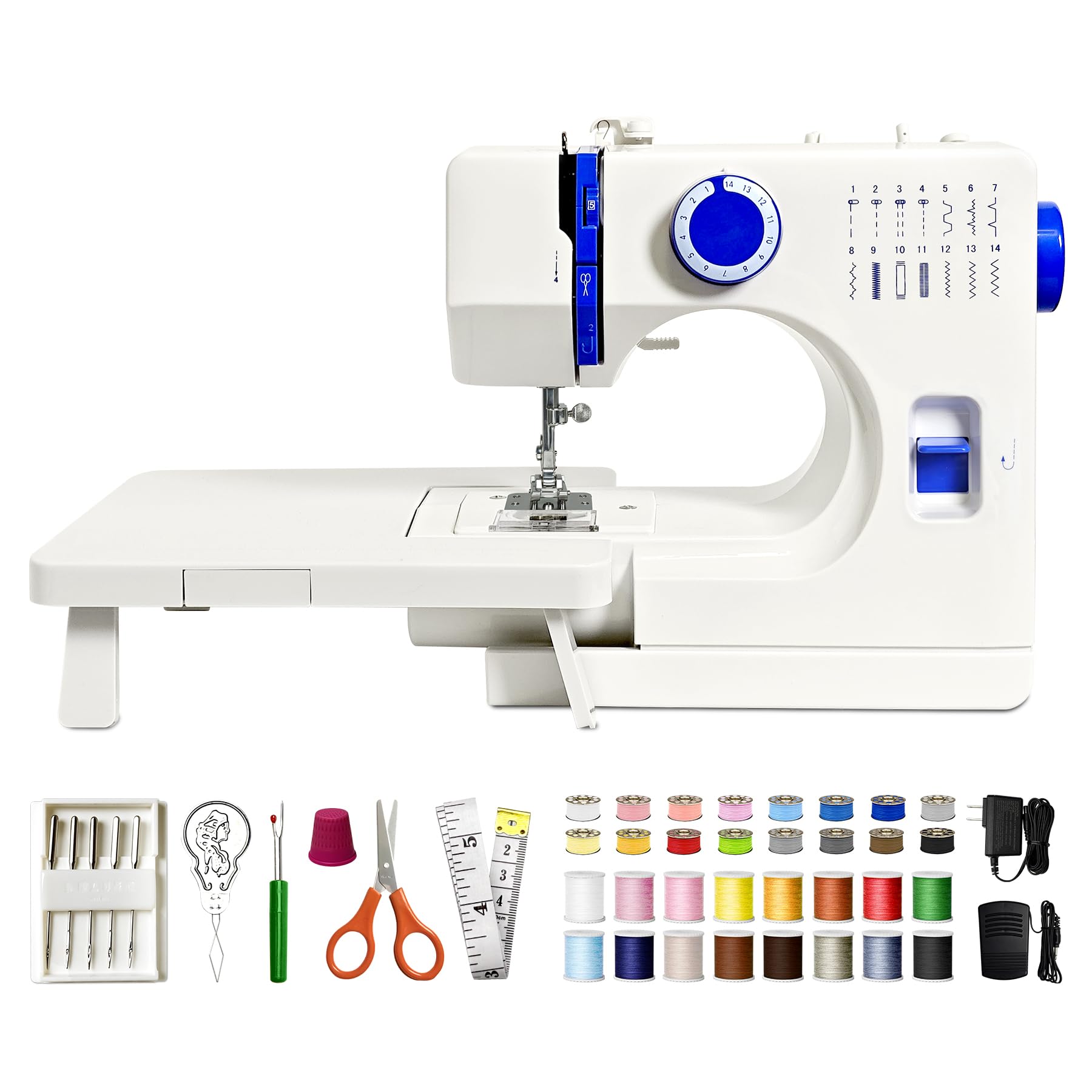
The StitchMaster Pro is built for portability without sacrificing essential features. Weighing just 5.5 pounds with a built-in carry handle, it’s the lightest machine on this list—perfect for taking to classes, craft fairs, or small dorm rooms. Its 14 stitches include straight, zigzag, blindstitch, and twin-needle compatibility for parallel stitching. Dual-speed control lets you choose slow precision for silk or high-speed efficiency for thicker materials like canvas.
The machine offers both foot pedal and one-touch button operation, making it accessible for children or anyone who struggles with pedal coordination. Color-coded threading guides and auto tension adjustment simplify setup, reducing the usual first-time frustration. The included kit of 12 thread spools, six needles, scissors, measuring tape, and a seam ripper gives you a working station in a single box.
Users note that the spool pin is recessed and may not fit full-size thread spools, which requires using mini spools or an external thread stand. The foot pedal is small and lightweight, so it tends to slide on smooth floors; a grippy pad underneath helps. For a traveler or beginner who values compact storage above all else, the StitchMaster Pro is functional and exceptionally easy to store.
Why it’s great
- Ultra-lightweight at 5.5 lbs with carry handle
- Twin-needle compatibility for parallel stitching
- Color-coded threading guides for fast setup
Good to know
- Recessed spool pin may not fit full-size thread spools
- Foot pedal is small and slides on smooth surfaces
9. Stoigeld SM‑725
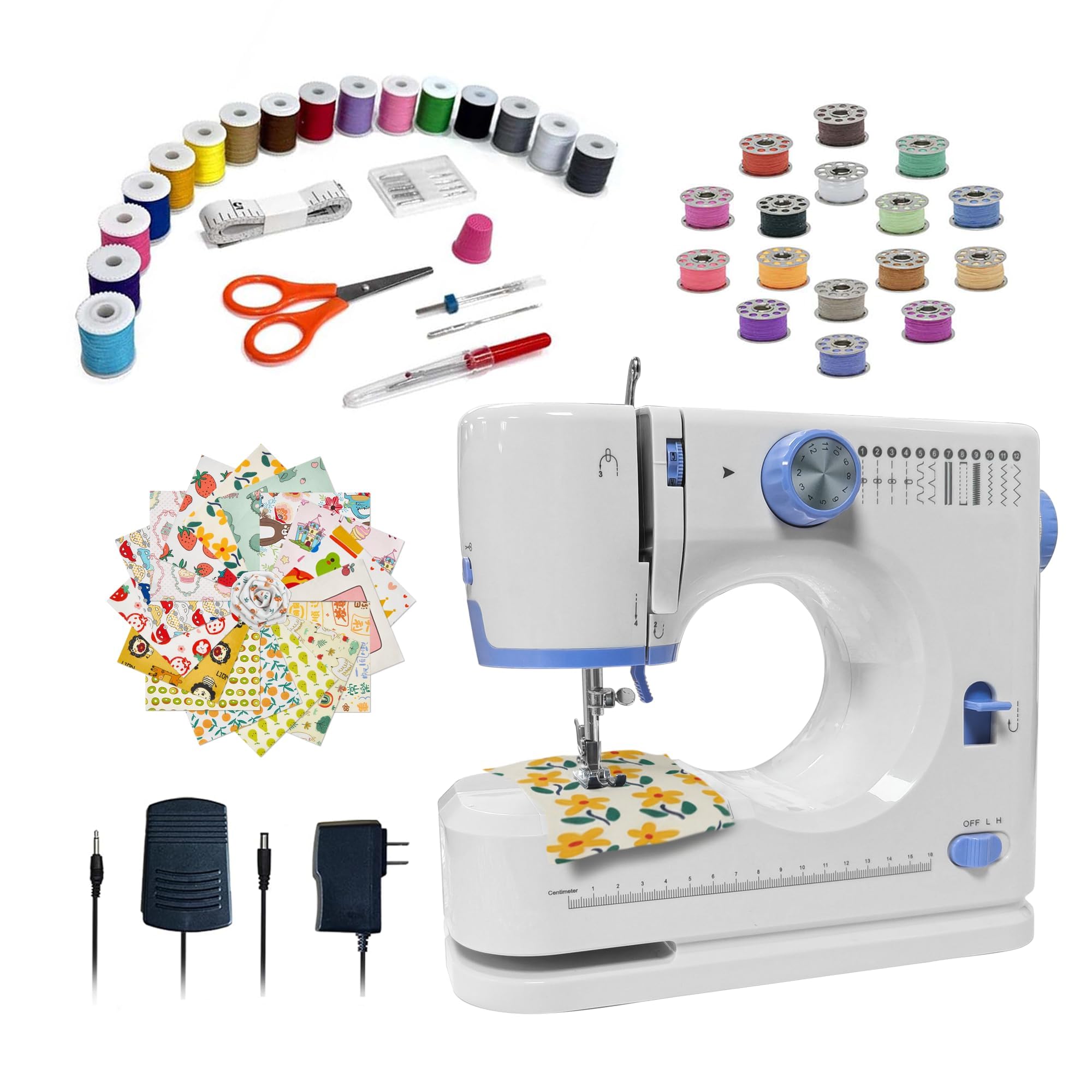
The Stoigeld SM‑725 is an entry-level machine designed explicitly for light fabric work—cotton, linen, thin woven fabrics up to 4–6 layers—and it comes with 32 spools of thread and 20 practice fabrics right in the box. That means a complete beginner can open the package, watch the quick-start guide, and start sewing immediately without a separate fabric run. The 12 built-in stitches and reverse function cover basic mending and small craft projects.
Two-speed control is ideal for teaching; slower speeds give you precision for stitching straight lines, while the higher option handles quick seams. The compact size (10.3″ x 9.5″ x 4.4″) stores easily in a closet or under a bed. The automatic needle threader and 4-step buttonhole are both functional, though the plastic chassis means this machine is best suited for occasional hobby use rather than daily heavy sewing.
Some users report thread breakage issues after a few hours of use, often related to the upper tension path. It is critical to follow the threading instructions exactly and avoid denim or thick multilayer fabrics beyond 2–4 layers. For a parent teaching a child, a school sewing club, or an adult who wants to test the hobby before buying a more expensive machine, the Stoigeld SM‑725 provides a complete, low-commitment starter experience.
Why it’s great
- Comes with 32 thread spools and 20 practice fabrics
- Two-speed control for gradual skill building
- Compact footprint fits in small storage spaces
Good to know
- Plastic chassis limits to light/medium fabrics only
- Some users experience thread breakage if tension path is not followed exactly
FAQ
How many stitches do I really need on a basic sewing machine?
Is a front-loading or drop-in bobbin better for a beginner?
What’s the difference between a mechanical and a computerized sewing machine?
Final Thoughts: The Verdict
For most users, the best basic sewing machine winner is the Brother XM3700 because it balances 37 useful stitches with an automatic needle threader and a jam-resistant drop-in bobbin that removes the biggest frustrations for new sewers. If you want a machine that can handle thick fabrics like denim and canvas, grab the SINGER Heavy Duty 4452 for its 50% stronger motor and metal frame. And for pure, reliable simplicity that will last for years, nothing beats the Janome 2212—a mechanical workhorse that proves you don’t need hundreds of stitches to sew well.

Mo Maruf
I created WellFizz to bridge the gap between vague wellness advice and actionable solutions. My mission is simple: to decode the research and give you practical tools you can actually use.
Beyond the data, I am a passionate traveler. I believe that stepping away from the screen to explore new environments is essential for mental clarity and physical vitality.