Our readers keep the lights on and my smoothie glass nicely filled. As an Amazon Associate, I earn from qualifying purchases.
A 7.25-inch miter saw isn’t a shrunk-down compromise; it’s a deliberate tool choice for finish carpenters, floor installers, and DIYers who value portability over sheer crosscut width. The smaller blade spins faster relative to its diameter, producing cleaner cuts on trim, baseboard, and engineered flooring while the reduced mass lets you carry the saw one-handed. The dilemma isn’t power—many 7.25 models match 10-inchers in torque—but selecting the right bevel system, slide mechanism, and cutline guide for your specific workflow.
I’m Mohammad Maruf — the founder and writer behind WellFizz. Over the past decade I’ve analyzed torque curves, arbor lock mechanisms, and dust port geometry to separate genuinely precise compact saws from poorly built imitations that waste material with blade wobble.
Whether you’re working flush against a wall in a tight hallway or cutting 2x10s for a deck frame, the best 7.25 miter saw delivers the precision of a larger tool in a package that fits under your workbench.
How To Choose The Best 7.25 Miter Saw
A 7.25 miter saw occupies a specific niche: it offers enough blade to crosscut a 2×10 in a single pass while staying light enough to carry between rooms on a remodelling job. But the differences between models—slide mechanism, bevel type, cutline accuracy—dictate whether your saw feels like a precision instrument or a frustrating compromise. Here are the factors that separate the top performers.
Slide Rail Geometry: Compact vs. Full-Length
Compact rail systems use telescoping rods or articulated arms that allow the saw to sit flush against a wall while still sliding forward for wider cuts. Full-length rails protrude behind the saw, requiring more bench depth but often delivering smoother extension with less play. If you work in a small shop or a van, prioritize a compact rail model like the SKIL MS6306-00. If you need maximum stability for repeated compound cuts, a full-slide saw like the Evolution R185SMS+ may suit you better.
Bevel Configuration: Single or Dual
Single-bevel saws tilt only to the left, requiring you to flip the workpiece for opposite-direction bevels on crown molding. Dual-bevel models tilt both left and right, letting you make complex cuts without repositioning—a major time saver when cutting baseboard crown or picture rails. The Milwaukee 2733-20 delivers dual-bevel capability in a cordless 7.25 package, while many corded models in this size class offer only single bevel, which is adequate for most flooring and trim work.
Cutline Guide: Shadow Line vs. Laser vs. LED
A laser guide projects a red line onto the workpiece—helpful but prone to drift if the saw is jostled. LED shadow lines cast a black shadow from the blade itself, always remaining perfectly aligned because the light source is fixed to the arbor housing. Shadow lines work better on dark or laminated materials where a red laser washes out. The SKIL MS6306-00 and WEN MM0713 both use LED shadow lines; the Hoteche and Evolution models use lasers. For precision trim work, the shadow-line approach is less finicky.
Motor Power and Torque Curve
Amp rating alone doesn’t tell the full story—look at no-load RPM and build quality. A 10-amp motor spinning at 4800 RPM (like the SKIL) can cut engineered hardwood faster than a 15-amp motor geared for lower RPM. Brushless motors (CRAFTSMAN V20, Bosch PROFACTOR, Milwaukee M18 Fuel) are more efficient and last longer but often cost more. If you’re cutting mainly pine and MDF, a brushed motor is perfectly adequate. For frequent cuts in hardwood or aluminum trim, a brushless motor holds its speed under load better.
Quick Comparison
On smaller screens, swipe sideways to see the full table.
| Model | Category | Best For | Key Spec | Amazon |
|---|---|---|---|---|
| Milwaukee 2733-20 | Cordless Dual-Bevel | Pro job-site flexibility | Dual bevel, 600 cuts per charge | Amazon |
| Bosch GCM18V-07SN | Cordless Single-Bevel | Mobile trim work | 26 lbs, BITURBO brushless | Amazon |
| CRAFTSMAN CMCS714M1 | Cordless Kit | Home project versatility | 3800 RPM, batteries included | Amazon |
| SKIL MS6306-00 | Corded Compact | Tight-space crosscutting | Compact rail, LED shadow line | Amazon |
| WEN MM0713 | Corded Compact | Garage workshop value | 9.5-amp, 40-tooth blade | Amazon |
| RYOBI PBT01B | Cordless Single-Bevel | ONE+ battery system users | 2×10 crosscut capacity | Amazon |
| Evolution R185SMS+ | Corded Multi-Material | Cutting steel and aluminum | Multi-material TCT blade | Amazon |
| Metabo HPT C10FCG2 | Corded 10-Inch | Light contractor use | 15-amp, 24 lbs | Amazon |
| Hoteche P805219A | Corded Entry-Level | Budget small projects | 7.5-amp, laser guide | Amazon |
In‑Depth Reviews
1. Milwaukee 2733-20 M18 Fuel 7-1/4″ Dual Bevel Sliding Compound Miter Saw

The Milwaukee 2733-20 is the only 7.25-inch saw in this guide with dual-bevel capability, meaning you can tilt the blade left or right without flipping your crown molding—a massive time saver on trim jobs. The brushless M18 Fuel motor delivers enough torque to crosscut 2x10s and engineered hardwood with authority, and Milwaukee claims over 600 cuts per charge with a high-capacity battery. The sliding mechanism is buttery smooth, and the integrated carry handle makes one-handed transport genuinely easy.
Build quality is typical Milwaukee—the fence stays true, the detent plate clicks cleanly at common angles, and the dual bevel adjustment locks securely without drifting. The blade included is a basic 24-tooth carbide unit, so upgrading to a Diablo or Freud finishing blade will improve cut quality on trim. At 31.9 pounds, it’s heavier than the Bosch, but the dual-bevel convenience offsets the extra weight for pros who cut crown daily.
This saw is bare-tool only—no battery or charger included—so factor in the cost of M18 batteries if you’re not already in the Milwaukee ecosystem. On the job site, the combination of dual bevel, brushless power, and smooth slide action makes it the most versatile 7.25 option available, though the premium price places it firmly in pro territory.
Why it’s great
- Dual bevel eliminates workpiece flipping for crown molding
- Brushless motor maintains speed under heavy load
- Smooth slide action with minimal play
- Excellent battery life—600+ cuts per charge
Good to know
- Bare tool—requires separate battery and charger purchase
- Stock blade is basic; upgrade for finer finish
- Heavier than some corded 7.25 models at 31.9 lb
2. BOSCH GCM18V-07SN PROFACTOR 7-1/4″ Single-Bevel Slide Miter Saw

At just 26 pounds bare tool, the Bosch GCM18V-07SN is the lightest premium 7.25 miter saw you can buy, making it ideal for mobile trim installers who pack their saw into a truck bed every morning. The BITURBO brushless motor is engineered to extract full power from Bosch’s Core18V high-output batteries (sold separately), delivering pro-grade torque for nested crown cutting up to 3-3/4 inches and crosscuts up to 8-1/4 inches. The precisely centered sliding bars move with zero lateral wobble, which is rare in a saw this light.
The tall fence design supports larger baseboard vertically, and the bevel detents click cleanly at common angles without over-travel. Several owners report that the stock 24-tooth blade tends to leave a rougher edge on hardwood and composite decking—replacing it with a Diablo 40-tooth finishing blade transforms cut quality dramatically. Dust extraction works well with a shop vac connected, though the included bag is adequate for light use only.
Bare-tool buyers should note that Bosch’s PROFACTOR line requires Core18V batteries to reach full power—standard 18V batteries work but won’t deliver the same torque. If you’re invested in Bosch’s battery platform and need a saw that disappears into a small storage space, this is the ultimate lightweight performer.
Why it’s great
- Extremely lightweight at 26 lb—easiest to carry
- BITURBO brushless motor delivers pro torque
- Smooth sliding bars with no wobble
- Tall fence supports 3-1/2-inch baseboard
Good to know
- Bare tool—requires Core18V battery for full power
- Stock blade needs upgrading for finish work
- Single bevel only—no right-tilt capability
3. CRAFTSMAN V20 Cordless 7-1/4″ Single Bevel Sliding Miter Saw (CMCS714M1)

The CRAFTSMAN CMCS714M1 is the only cordless 7.25 saw in this guide that ships with two 4.0Ah batteries and a fast charger, making it a turnkey solution for homeowners who don’t already own a 20V V20 system. The 3800 RPM brushless motor is quieter than many corded saws and still manages to crosscut 2×6 lumber, 3-1/2-inch baseboard vertically, and nested crown up to 3-5/8 inches. The LED cutline positioning system casts a bright shadow that aligns perfectly with the blade—no calibration drift like laser guides.
Slide action uses a single-rail system that feels slightly less refined than the Bosch or Milwaukee, but it’s smooth enough for trim and flooring. The 9 cast miter detents click positively at 0°, 15°, 22.5°, 31.6°, and 45° on both sides. Reviewers consistently note that this saw makes up to 585 cuts on a single 4.0Ah battery in 3-1/4-inch MDF baseboard, which is impressive for a compact saw. The side carry handles and 21.8-pound weight make it easy to move between workstations.
The stock blade is adequate for softwood and MDF but will struggle on hardwood and aluminum—plan to replace it with a 40-tooth carbide blade if you’re cutting oak or maple trim. The dust bag is better than nothing but a shop vac connection improves collection significantly. For homeowners who want cordless convenience out of the box, this kit represents the best value per dollar.
Why it’s great
- Two batteries and charger included—ready to use
- LED shadow line is always accurate
- Lightweight at 21.8 lb with carry handles
- Long runtime—585 cuts per charge
Good to know
- Stock blade dulls quickly on hardwood
- Single-rail slide has slight play
- Single bevel—no right tilt
4. SKIL 10 Amp 7-1/4″ Single Bevel Miter Saw with Compact Rail System (MS6306-00)

The SKIL MS6306-00 uses a fixed compact rail system that minimizes the saw’s benchtop-to-wall depth, so you can work flush against a wall in a hallway or closet without sacrificing crosscut capacity. Despite its small footprint, it crosscuts 2×10 lumber at 0° and 3-1/2-inch crown molding nested—numbers that rival many 10-inch saws. The 10-amp motor spins at 4800 RPM, providing fast, clean cuts through engineered hardwood, pine, and composite trim without bogging.
The LED shadow line is the standout feature here—it projects a crisp black line exactly where the blade will cut, and it doesn’t drift even if the saw is jostled during transport. The quick miter lock detent works smoothly at 0°, 15°, 22.5°, 31.6°, and 45° left and right (0–47° left, 0–50° right), covering all common angles. At 31 pounds, it’s heavier than cordless options but still manageable for a corded saw, and the sturdy aluminum base with rubber feet keeps it planted during cuts.
Owners praise its out-of-box accuracy—many report that it cuts square without any fence adjustment. The single bevel (0–45° left) is adequate for most flooring and baseboard work, but crown molding pros will need to flip the workpiece for compound cuts. If you work in tight spaces and need a corded saw with precise cutline guidance, this SKIL is the smartest pick in its segment.
Why it’s great
- Compact rail—works flush against walls
- LED shadow line never needs calibration
- Crosscuts 2×10 in a single pass
- Fast 4800 RPM motor for clean cuts
Good to know
- Single bevel only—no right tilt
- At 31 lb, heavier than cordless options
- Dust bag is small; connect a shop vac
5. WEN MM0713 9.5-Amp 7.25-Inch Single Bevel Compact Sliding Compound Miter Saw

WEN’s MM0713 slots into the value-first corner of the 7.25 market with a 9.5-amp motor that crosscuts boards up to 11.5 inches wide and 2.5 inches thick—enough for 2×10 framing lumber. The dual-rail compact slide system reduces the saw’s bench depth while still delivering smooth extension, and the integrated LED cutline guide illuminates the cut path with a bright shadow. It includes a 40-tooth carbide-tipped blade (5/8-inch arbor), two table extensions for longer workpieces, and a dust port compatible with standard shop vacs.
Build quality is decent for the price point: the miter detents click into place at 0°, 15°, 22.5°, 31.6°, and 45° both left and right, and the bevel tilts 45° left. Several owners report that the blade depth stop screw loosens during use—a common WEN annoyance that a dab of thread locker or a locking nut can fix permanently. The hold-down clamp feels slightly flimsy compared to premium brands, but it works for most trim-sized material.
Dust collection is mediocre even with a shop vac attached, so plan to wear a dust mask or work outside. The weight—about 32 pounds—is on par with the SKIL but feels heavier due to less ergonomic carry handle positioning. For garage DIYers who need a capable 7.25 saw without spending premium dollars, the WEN delivers reliable cuts with a few minor fit-and-finish compromises.
Why it’s great
- Cuts 11.5-inch wide boards—2×10 capable
- LED cutline guide illuminates the blade path
- Dual-rail compact slide saves bench space
- 40-tooth blade included for better finish
Good to know
- Blade depth stop screw loosens during use
- Hold-down clamp feels light-duty
- Dust collection is poor even with vac
6. RYOBI ONE+ 18V Cordless 7-1/4 in. Sliding Compound Miter Saw (PBT01B)

RYOBI’s PBT01B is the only bare-tool 7.25 sliding miter saw that plugs into the massive ONE+ 18V system, making it an obvious choice for homeowners already invested in Ryobi’s battery ecosystem. It offers best-in-class 2×10 crosscut capacity for its size, and Ryobi claims up to 800 cuts per charge with a 9Ah battery. The sliding action uses a single-rail system that’s smooth but has slightly more lateral play than the Bosch or Milwaukee—the stock blade should be swapped for a 60-tooth finishing blade if you’re doing precise trim.
The bevel is single-direction (0–45° left), which is fine for baseboard and flooring but requires flipping workpieces for crown molding. Miter detents click at common angles but feel less positive than premium saws. Several owners note that the saw works best with high-capacity 9Ah batteries—standard 4Ah packs will run it but cut counts drop significantly. At just over 28 pounds, it’s easy to carry, and the integrated handle makes transport simple.
For finish carpenters working out of a compact vehicle, this saw is a revelation—it fits behind a seat and cuts 90% of the miters you’ll ever need. The spindle lock makes blade changes tool-free, and the dust bag is adequate for light indoor work. If you’re already in the Ryobi ONE+ family, this is the most convenient 7.25 option available.
Why it’s great
- Fits RYOBI ONE+ battery system—no new platform
- Crosscuts 2×10 lumber with ease
- Lightweight and compact for storage
- Spindle lock for quick blade changes
Good to know
- Bare tool—battery and charger sold separately
- Best with 9Ah battery for full cuts per charge
- Slide has more lateral play than premium saws
7. Evolution Power Tools R185SMS+ 7-1/4″ Multi-Material Sliding Miter Saw

The Evolution R185SMS+ is the only 7.25 saw in this lineup purpose-built for cutting steel, aluminum, wood with embedded nails, and plastic—all with the included premium tungsten carbide tipped blade. The 1500-watt (10-amp) motor drives a specialized gearbox that produces virtually no sparks, heat, or burrs when cutting mild steel, making it invaluable for metal fabricators and remodelers who encounter rebar or steel studs. The laser guide projects a red line for alignment, and the 0–45° bevel range covers common angle cuts.
Slide rails are full-length (not compact), providing smooth extension with minimal play. The miter range spans 50° left and right with positive stops at common angles. Owners consistently praise the build quality—the aluminum base is sturdy, the clamp holds material securely, and the dust collection bag works better than most in this class. The saw cuts steel angle iron and aluminum trim cleanly without needing a separate metal-cutting blade, which saves both money and setup time.
One trade-off: the Evolution is a single-bevel saw (left tilt only), so complex crown molding cuts require flipping. It’s also not as portable as cordless models—it weighs just under 40 pounds and plugs into a wall outlet. But if your work regularly involves cutting metal alongside wood, this saw’s multi-material capability is a legitimate time-saver that justifies the mid-range price.
Why it’s great
- Cuts steel, aluminum, wood, plastic with included blade
- Virtually spark-free on mild steel
- Sturdy base with smooth full-length slides
- 3-year manufacturer warranty included
Good to know
- Single bevel only—no right tilt
- Heavier than cordless options at ~40 lb
- Laser needs occasional calibration checks
8. Metabo HPT 10-Inch Single Bevel Compound Miter Saw (C10FCG2)
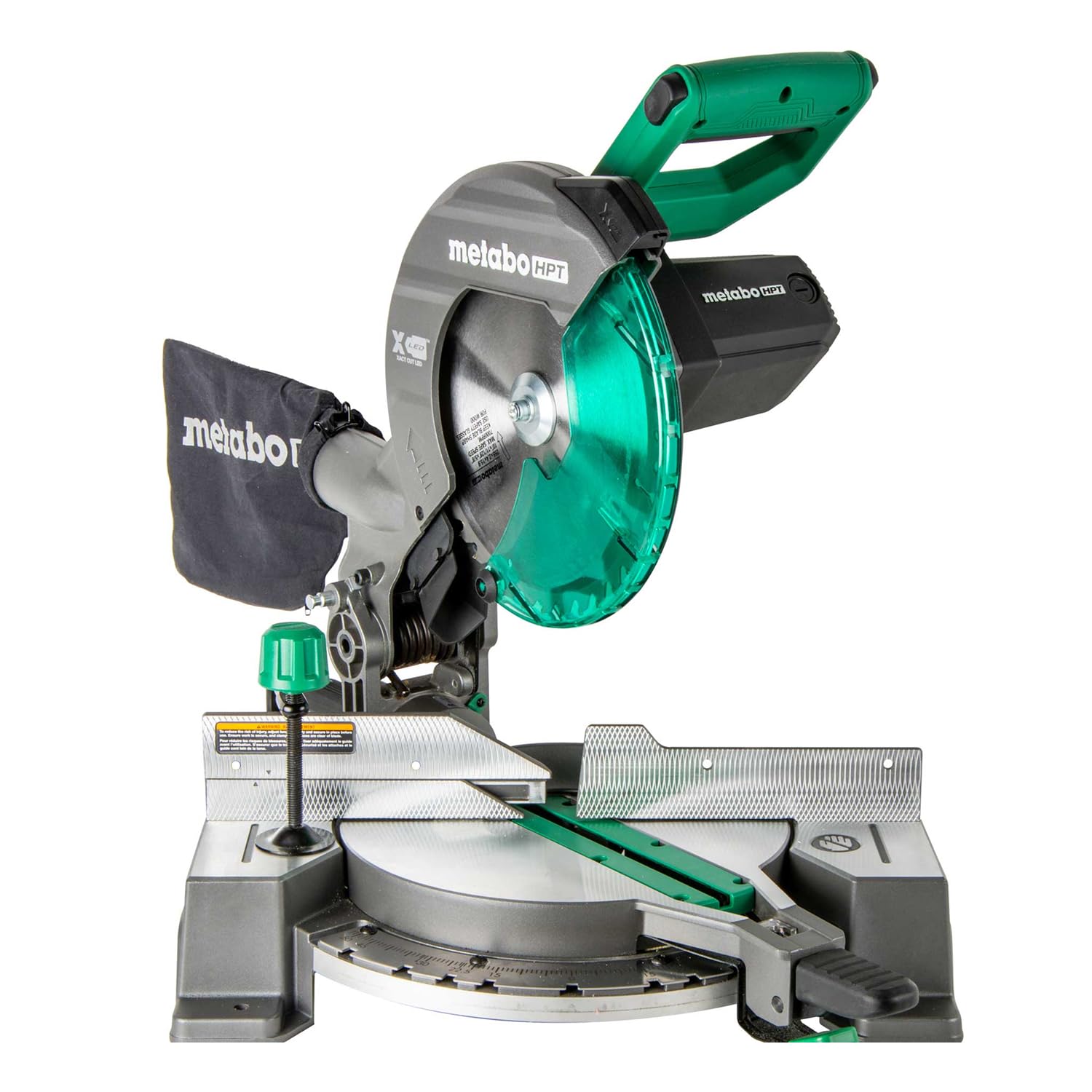
Though this Metabo HPT is technically a 10-inch saw, it’s included here because its 24.2-pound weight and 15-amp motor make it a direct competitor to 7.25 models for users who prioritize crosscut width over compact size. The single-bevel design tilts 0–45° left, and the miter range spans 0–52° left and right with positive stops. The Xact Cut shadow line provides accurate cutline guidance without laser drift, and the large table surface offers better material support than most compact saws.
Assembly takes about 10 minutes out of the box, and the saw cuts square without adjustment—a frequent compliment in reviews. The 15-amp motor delivers 5,000 RPM, cutting through hardwood, LVP flooring, and pressure-treated lumber without hesitation. Owners report that the stock blade is adequate for general use but dulls quickly on dense materials; upgrading to a Diablo blade improves finish quality. The dust collection bag captures about 60% of debris; connecting a shop vac improves this significantly.
At this price point, it’s one of the best values for light contractor use—homeowners who are doing a single flooring or trim project will find it powerful, accurate, and easy to store. The 5-year warranty adds peace of mind, though service centers can be scarce in rural areas. If you want a 10-inch blade but the weight and portability of a 7.25 model, this Metabo HPT bridges that gap effectively.
Why it’s great
- Lightweight 24.2 lb for a 10-inch saw
- 15-amp motor cuts dense hardwood easily
- Xact Cut shadow line—no laser calibration
- 5-year warranty for long-term reliability
Good to know
- Stock blade dulls quickly on LVP and hardwood
- Single bevel only—no right tilt
- Dust collection bag catches only ~60% of debris
9. Hoteche 7-1/4-Inch Miter Saw 7.5A Compound Single Bevel with Laser (P805219A)
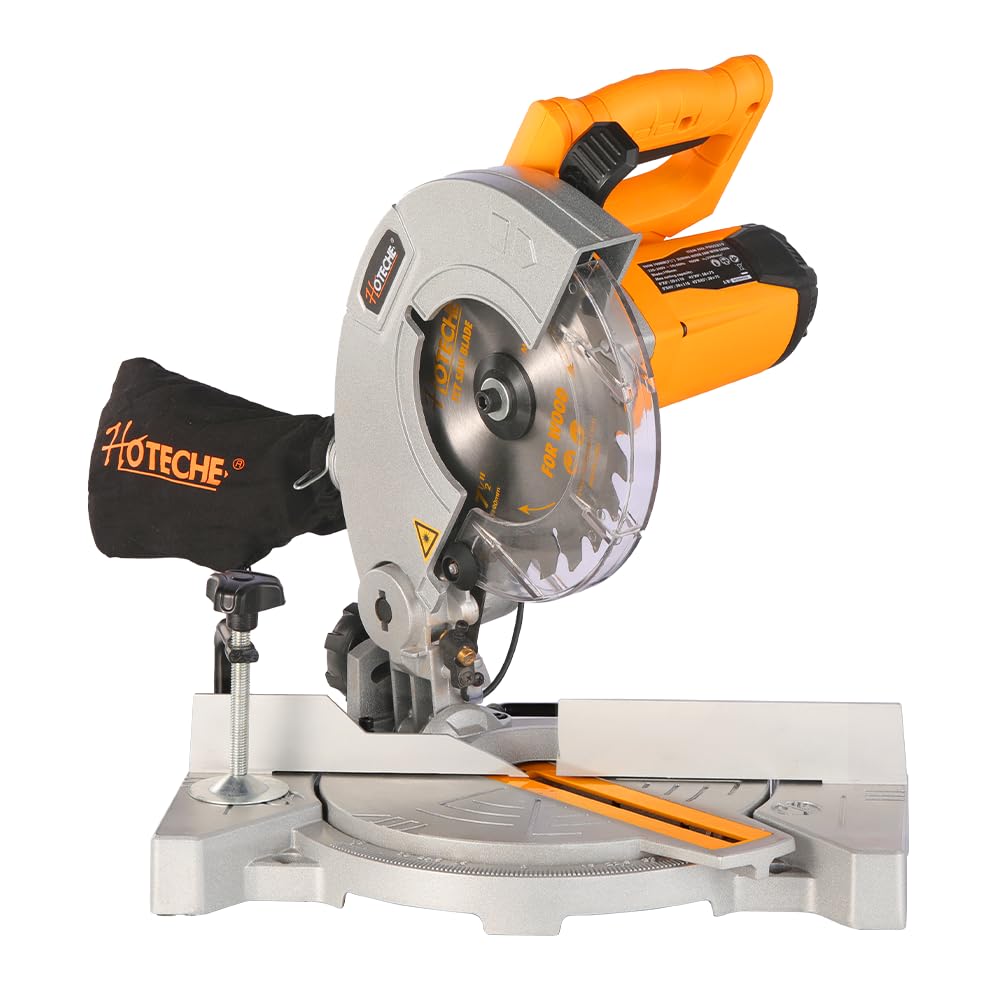
The Hoteche P805219A is the most affordable 7.25 sliding miter saw in this guide, making it an attractive entry point for DIYers who need to cut baseboard, picture frames, or small trim pieces without a large investment. The 7.5-amp copper motor delivers 5,000 RPM—fast enough for clean cuts in pine, MDF, PVC trim, and aluminum. The built-in laser guide projects a red line onto the workpiece, and the sliding arm extends to handle wider boards up to 120mm at 90°.
The aluminum base with rubber feet keeps the saw stable, and the included kit is generous: extension bars for wide workpieces, two hex wrenches, a dust bag, and spare carbon brushes for motor maintenance. Positive miter stops at 0°, 15°, 22.5°, 30°, and 45° cover the angles most needed for furniture and trim. Some owners note that the miter lock feels less solid than pricier saws, and the instructions for releasing the lock mechanism are unclear for first-time users.
The blade bolt uses reverse threads (loosen clockwise), which catches many users off guard—check the manual before forcing it. For homeowners doing window casing, baseboard, or small shelving projects, this saw cuts accurately out of the box. It won’t survive daily commercial use, but for the occasional weekend project, it offers surprising value.
Why it’s great
- Very low entry price for a sliding miter saw
- Laser guide helps with alignment
- Fast 5,000 RPM motor cuts cleanly
- Includes extension bars and spare brushes
Good to know
- Blade bolt has reverse threads—check manual
- Miter lock feels less solid than premium saws
- Not suitable for heavy daily commercial use
FAQ
Can a 7.25 miter saw cut 2×10 lumber?
Are 7.25 miter saws suitable for crown molding?
What is the difference between laser and LED shadow line?
How often should I replace the blade on a 7.25 miter saw?
Can I cut metal with a 7.25 miter saw?
Final Thoughts: The Verdict
For most users, the best 7.25 miter saw winner is the SKIL MS6306-00 because its compact rail system, reliable LED shadow line, and 10-amp motor deliver pro-level accuracy in a footprint that fits any workspace. If you want dual-bevel capability for crown molding without flipping boards, grab the Milwaukee 2733-20—it’s the most versatile cordless option available. And for cutting metal and wood without swapping blades, nothing beats the Evolution R185SMS+.

Mo Maruf
I created WellFizz to bridge the gap between vague wellness advice and actionable solutions. My mission is simple: to decode the research and give you practical tools you can actually use.
Beyond the data, I am a passionate traveler. I believe that stepping away from the screen to explore new environments is essential for mental clarity and physical vitality.