Our readers keep the lights on and my smoothie glass nicely filled. As an Amazon Associate, I earn from qualifying purchases.
A polarizing filter is the single most impactful accessory you can screw onto your lens. It cuts through glare on water and glass, saturates skies to a deeper blue, and pulls contrast out of foliage that looks flat in raw sunlight. But the market is flooded with cheap glass that softens your image or imparts a sickly warm color cast, and high-end models with names like “HD3” and “Nano-X” that promise the world without explaining the real differences. You need a filter that delivers optical clarity, color neutrality, and a coating tough enough to survive a day in the field.
I’m Mohammad Maruf — the founder and writer behind WellFizz. I’ve spent years analyzing optical glass specs, multi-coating technologies, and filter factor math to separate premium light-control tools from average screw-on glass.
If you want richer, reflection-free images straight out of camera without spending hours in post-production, this guide to the best camera polarizing filter breaks down exactly which models deliver true color, sharpness, and durability across every common thread size.
How To Choose The Best Camera Polarizing Filter
A polarizing filter is a precision optical instrument, not a simple piece of glass. A bad one introduces flare, reduces sharpness, and shifts color. A great one disappears optically while giving you creative control over reflections and contrast. Here are the three criteria that separate the winners from the also-rans.
Optical Glass and Coating Quality
The substrate matters. Premium filters use German Schott B270 or Japanese AGC optical glass that maintains a flat transmission curve across the visible spectrum. Cheap glass absorbs unevenly, creating a warm or cool cast. Multi-layer coatings — 10 layers is entry-level; 16 to 30 layers is pro territory — reduce surface reflections to below 0.1 percent, which eliminates ghosting and maintains contrast in backlit scenes. A waterproof, oil-repellent top coat makes field cleaning simple and prevents dust from baking onto the surface.
Filter Factor and Light Transmission
A circular polarizer always cuts some light. Typical CPLs have a filter factor of 2.3 to 2.5 stops, meaning they block roughly 75 percent of incoming light. Higher-end models like the Hoya HD3 HRT push transmission closer to a 1.7-stop loss, which keeps your shutter speed and ISO in a more comfortable range. Every stop matters when you’re shooting handheld in the golden hour or trying to freeze motion in bright conditions. The less light your polarizer steals, the more flexibility you keep in your exposure triangle.
Build, Threads, and Frame Profile
A polarizer that binds, cross-threads, or vignettes on a wide-angle lens is useless in the field. Look for an ultra-slim aluminum frame — ideally brass or CNC-machined aluminum — with smooth, precise threading. A low-profile front ring (meaning the filter sits flush or nearly flush with the lens barrel) prevents mechanical vignetting at 16mm and wider. The detent mechanism that clicks into place at the correct rotation angle should feel positive, not loose or mushy, so you can operate the filter without looking away from the viewfinder.
Quick Comparison
On smaller screens, swipe sideways to see the full table.
| Model | Category | Best For | Key Spec | Amazon |
|---|---|---|---|---|
| Breakthrough Photography X4 CPL 77mm | Premium CPL | Color-critical landscape & architecture | Schott B270 glass, 16-layer MRC, 25-year support | Amazon |
| Hoya HD3 HRT Circular Polarizer 52mm | Premium CPL | High-resolution sensors & low-light handheld | 100MP+ certified, 200% harder nano coating, 1-stop loss | Amazon |
| K&F CONCEPT Nano-X CPL 77mm | Mid-Range CPL | All-around outdoor photography | Japanese AGC glass, 28-layer nano coating, 99.9% polarization | Amazon |
| Hoya NXT Plus CPL 55mm | Mid-Range CPL | Landscape & outdoor with fast autofocus | 10-layer HMC, 1.72 filter factor, waterproof top-coat | Amazon |
| K&F CONCEPT Variable ND+CPL 58mm | Variable Combo | Video & long exposure on a single lens | 2-in-1 ND2-32 + CPL, self-locking, no X cross | Amazon |
| NEEWER 2-in-1 Variable ND+CPL 43mm | Variable Combo | Compact cameras & phone rigs with small threads | 30-layer nano coating, no dark cross, 1-5 stop ND | Amazon |
| NEEWER 58mm Filter Kit (UV/CPL/ND4) | Budget Kit | Beginners wanting UV, CPL, and ND in one case | 3-filter kit, nano coatings, aluminum frames, hard case | Amazon |
In‑Depth Reviews
1. Breakthrough Photography X4 CPL 77mm

This is the reference standard for color-neutral polarizers. Where most CPLs suffer from a gradual transmission spike starting at 600nm that produces a yellow cast, the X4’s film actually decreases transmission from that point onward, keeping skin tones and green foliage natural. The glass is Schott Superwhite B270 — ultra-clear crown glass made in Germany — paired with a 16-layer MRC nano coating that suppresses flare and resists smudging.
In real-world use, the X4 adds roughly one stop of light loss, which is the best performance among premium polarizers. Images remain critically sharp on a 61-megapixel Sony a7R V sensor; there is no visible resolution drop. The ultra-slim brass ring threads smoothly onto a 77mm lens and the knurled grip provides positive purchase even with clammy hands. The 25-year ironclad guarantee backs the investment with a serialized frame you can register online.
The only drawback is that the thin frame can be difficult to grip when removing the filter from a lens — a rubber band or filter wrench solves this. The price also sits at the top of the market, but for color-critical work — architecture, product photography, high-end landscapes — the X4 is worth the premium over any alternative.
Why it’s great
- Most color-neutral CPL on the market; no yellow cast
- Schott B270 glass delivers outstanding sharpness even on 100MP+ sensors
- 25-year manufacturer support with registered serial number
Good to know
- Thin frame can be hard to grip when removing
- Premium price reflects top-tier optical construction
2. Hoya HD3 HRT Circular Polarizer 52mm

Hoya’s HD3 HRT uses a high-rate transmission film that passes significantly more light than a standard CPL — approximately two-thirds to one stop less light loss compared to typical 2.5-stop polarizers. This matters when you are shooting handheld at dawn or chasing a fast-moving subject and need every fraction of a stop. The filter is re-certified for sensors up to 100 megapixels, meaning the optical resolution is high enough to avoid softening details on the latest full-frame bodies.
The ultra-hard nano coating is 200 percent harder than a standard multi-coating. In practice, this means fingerprints do not adhere easily; a quick brush or a breath and a microfibre cloth leave the glass spotless. The polarization effect is even across the frame — no dark uneven patches in the sky, which can plague cheaper polarizers. The low-profile aluminum ring does not vignette on wide lenses at 52mm.
The only complaint from users is about packaging. Some units arrive in oversized bubble mailers that crush the plastic case, though the filter itself is protected by its own metal ring. The filter also requires a lens wrench or step-up ring to separate it if it gets tight. Overall, the HD3 HRT is the best choice if you shoot with high-resolution sensors and want maximum light transmission from your polarizer.
Why it’s great
- High-rate transmission loses only about 1 stop of light
- Hard nano coating resists scratches and fingerprints
- Certified for 100MP+ sensors without sharpness loss
Good to know
- Plastic case can arrive damaged in poor packaging
- Tight fit can make separation difficult without a tool
3. K&F CONCEPT Nano-X CPL 77mm

The Nano-X series from K&F CONCEPT uses Japanese AGC optical glass with a 28-layer multi-coating — one of the highest layer counts in this segment. The titanium coating technology eliminates the yellowish tint that plagues cheaper CPLs, delivering what the brand calls “True Color.” The filter achieves 99.9 percent polarization efficiency with a 45 percent light transmission rate, which translates to roughly a 1.15-stop loss. That is competitive with filters costing significantly more.
In the field, the Nano-X cuts reflections from wet paint, glass storefronts, and water surfaces effectively. The CNC-machined non-slip frame makes installation and removal straightforward. A 28-layer coating also means water beads up and rolls off, and dust does not stick easily. For a 77mm filter at this tier, the build quality punches above its weight.
Some users report a very slight blue or yellow cast depending on the rotation angle, so if you are doing color-critical product work, you may still need to correct in post. But for 95 percent of shooters — landscape, travel, portrait — the Nano-X is a mid-range CPL that delivers near-premium results without the premium price tag. It is an easy recommendation for the value-conscious photographer upgrading from a generic no-name filter.
Why it’s great
- 28-layer nano coating for excellent flare and water resistance
- High 45% light transmission for a CPL
- Japanese AGC glass provides good sharpness
Good to know
- Not perfectly color neutral under all rotation angles
- Frame lacks a detent for positive rotation feel
4. Hoya NXT Plus CPL 55mm

Hoya’s NXT Plus series sits above the entry-level Alpha line and below the HD3, offering a clean balance of optical performance and affordability. The 10-layer Hoya multi-coating (HMC) reduces ghosting and reflections in backlit scenes, and the waterproof top-coat makes cleaning effortless. The filter factor of 1.72 — roughly 0.8 stops darker than the industry-standard 2.5-stop CPL — means your autofocus system loses less light and can lock faster in marginal conditions.
The low-profile aluminum frame is designed to avoid vignetting on wide-angle lenses, and it stacks cleanly with step-up rings or other filters. The threading is smooth and precise; users report no cross-threading even on lenses with tight tolerances. For a 55mm size, this is a versatile choice for the Sony RX10, Fuji X-series kit lenses, or vintage glass that uses this diameter.
The main limitation is the 10-layer count, which is respectable but not class-leading. In extreme direct sunlight, you may catch a slight flare hotspot. This is a non-issue for typical outdoor and landscape work. The NXT Plus is a reliable, well-priced mid-range CPL from a brand that has manufactured optical glass since 1941, making it a safe choice for the shooter who wants proven performance without overpaying.
Why it’s great
- 1.72 filter factor keeps viewfinder bright and AF fast
- Waterproof top-coat repels smudges and dust
- Low-profile aluminum build avoids wide-angle vignetting
Good to know
- 10-layer coating is good but not best-in-class for flare
- Limited to 55mm thread size; step-up ring needed for larger lenses
5. K&F CONCEPT Variable ND+CPL 58mm
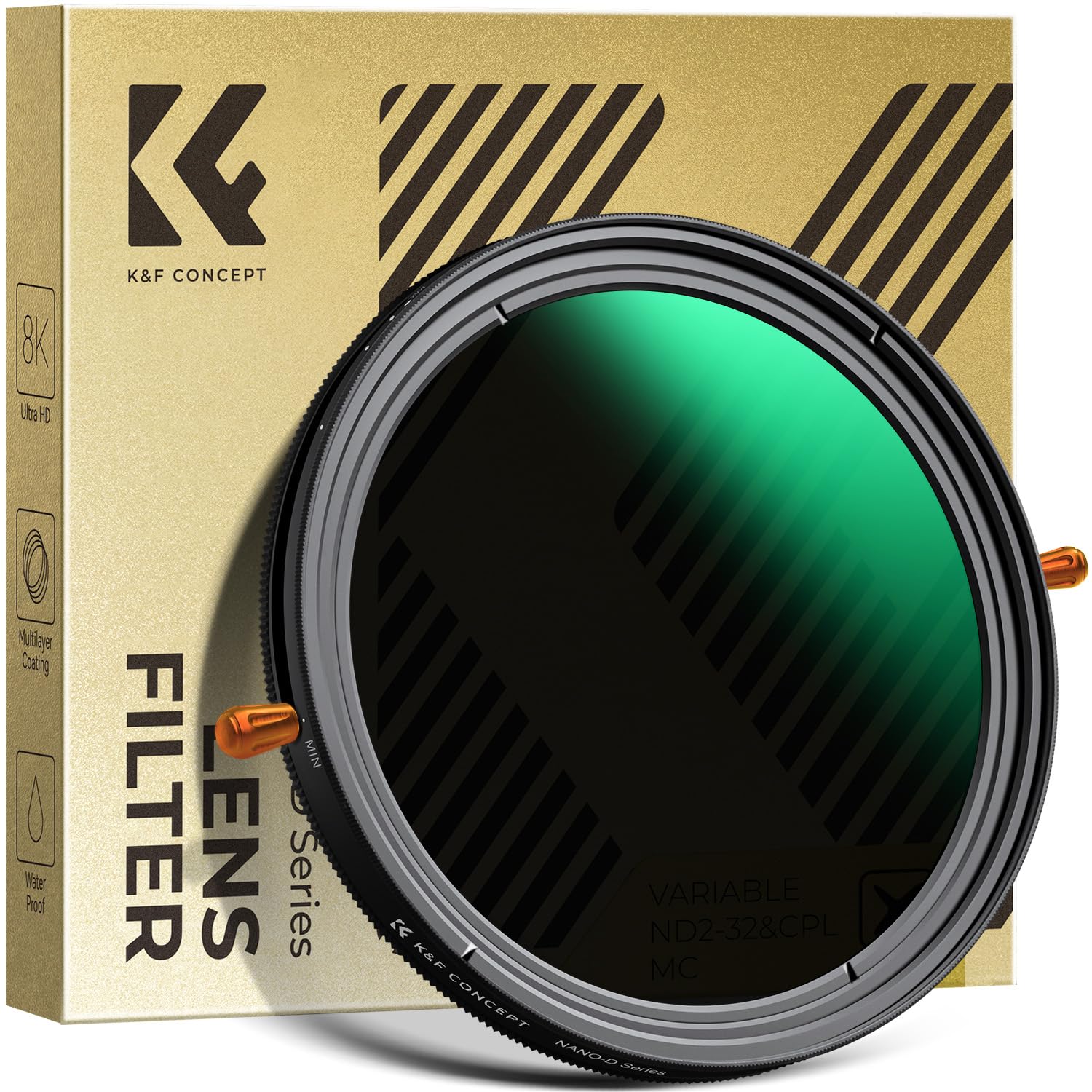
Combining a variable neutral density filter and a circular polarizer into a single rotating ring is a clever space-saving solution, and K&F CONCEPT executed it well with this model. The ND range covers 1 to 5 stops (ND2-32), and the CPL function cuts reflections and boosts contrast simultaneously. The self-locking technology prevents the dreaded dark “X” cross that plagues many variable ND filters, especially at the wide end.
The frame uses imported AGC optical glass with a 24-layer multi-coating that maintains image sharpness and prevents color shift. Users shooting video with a Sony or Canon kit lens love the convenience: they dial in the exact exposure reduction while also eliminating glare from a lake or storefront without stacking two separate filters. The pusher-style adjustment ring helps with precise stop changes, and the filter works with all 58mm lenses.
The trade-off is that adjusting the ND ring can slightly rotate the polarization angle, and the filter cannot be stacked with another filter behind it. Also, the 58mm version requires a 67mm lens cap. The build is solid for the tier, and the optical performance is clean. For the travel videographer who needs one filter to handle both exposure and reflections, this combo is a smart, lightweight answer.
Why it’s great
- Single filter replaces both a VND and a CPL
- Self-locking mechanism avoids dark X cross
- Good sharpness with 24-layer AGC glass
Good to know
- Adjusting ND ring shifts polarization angle
- Must be last filter in stack; cannot attach others behind it
6. NEEWER 2-in-1 Variable ND+CPL 43mm

The 43mm thread size is rare but essential for specific compact cameras and cine-style rigs like the DJI Osmo Pocket or small mirrorless kit lenses. NEEWER addressed this niche with a 2-in-1 filter that combines a CPL and a variable ND (ND2-ND32). The standout spec is the 30-layer nano coating on both sides, which reduces reflectivity to below 0.1 percent and provides waterproof, scratch-resistant protection.
Users mounting this filter on an iPhone rig via a Moment lens adapter report clean ProRes Log footage with reduced overexposure in harsh sunlight. The self-locking technology prevents dark shadow crosses at wider angles. The aircraft-grade aluminum alloy frame is CNC-machined and has a non-slip texture for easy grip. The laser-etched marks make it easy to dial in the exact ND stop without guessing.
The biggest caveat is that the front diameter of the filter is larger than the rear, so you need a 62mm lens cap for the 43mm version. Also, adjusting the ND ring requires two hands; the filter can spin at the extremes if you only use one hand. But for anyone shooting with a 43mm thread — a small but dedicated group — this 2-in-1 combo is a well-built, optically clean solution.
Why it’s great
- 30-layer nano coating for minimal reflection and ghosting
- Self-locking design prevents dark X cross on wide angles
- CNC aluminum frame is durable and easy to grip
Good to know
- Requires a 62mm lens cap (not standard for 43mm thread)
- Two-handed operation needed to adjust ND without slipping
7. NEEWER 58mm UV/CPL/ND4 Filter Kit
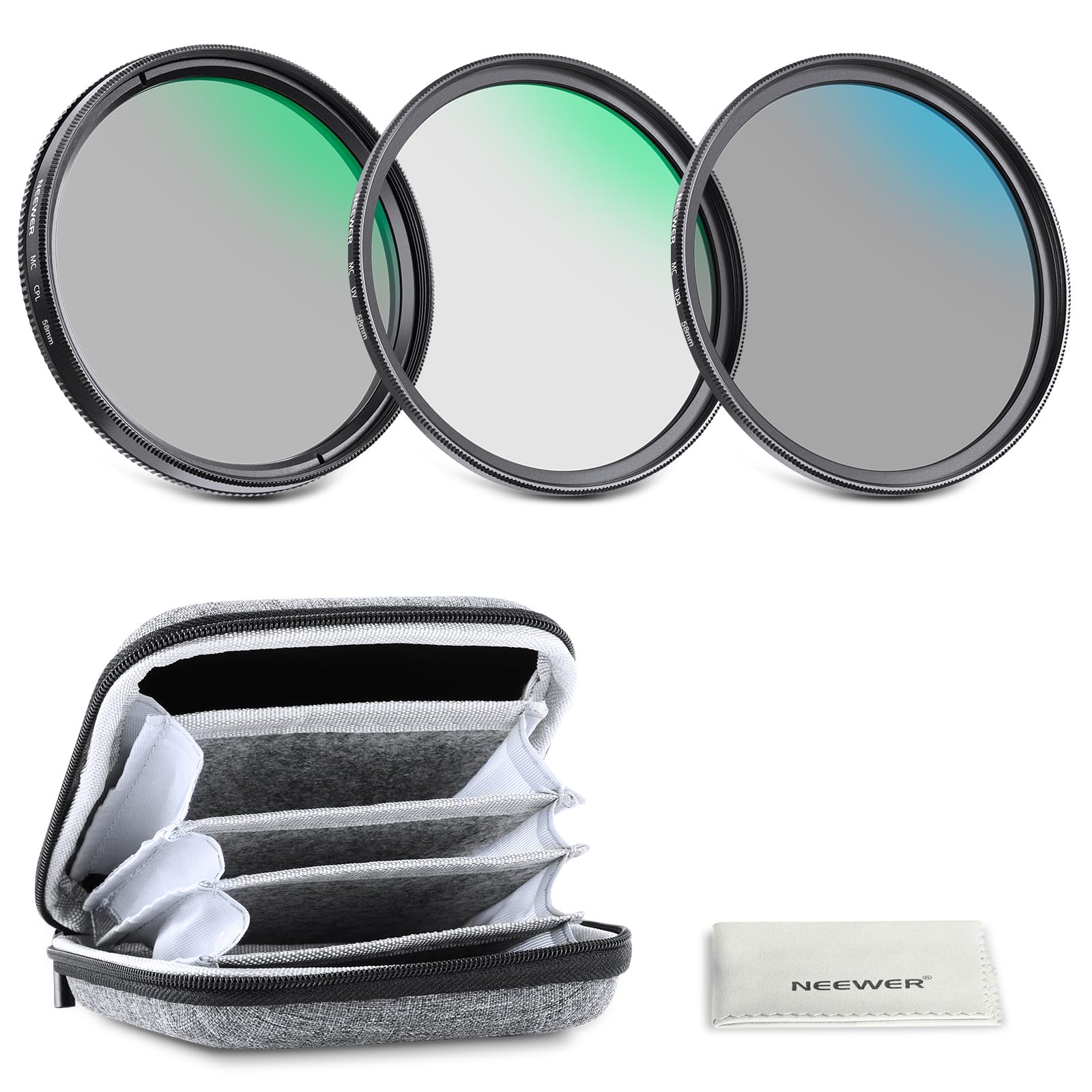
This kit includes three filters — UV, CPL, and ND4 — in a single purchase, making it the most practical entry point for new photographers who want to experiment with polarizing, light reduction, and lens protection. The CPL effectively eliminates reflections from water and glass while increasing color saturation. The ND4 reduces light by 2 stops, which is perfect for introducing motion blur in cloudy conditions. The UV filter doubles as a permanent lens protector.
The multi-layer nano coatings on the optical glass keep flare and ghosting manageable, and the aluminum alloy frames thread smoothly. The hard-shell storage case has individual felt-lined slots for each filter, protecting them from scratches during transport. For the price, the optical clarity is acceptable — no significant color shift or sharpness degradation is reported in typical daylight use.
That said, this is a budget-tier solution. The coatings are not as durable as premium filters; in harsh backlight, you may see some flare. The ND4 is a fixed density, so you cannot adjust exposure without changing filters. But for the beginner who does not yet own a polarizer, this kit offers three essential tools at a minimal cost, making it the best way to learn the effects of each filter without a big investment.
Why it’s great
- Three filters (UV, CPL, ND4) in a single economical kit
- Hard case keeps filters organized and scratch-free
- Aluminum frames thread smoothly for the tier
Good to know
- Fixed ND4 density cannot be adjusted for varying light
- Coating quality is good but not pro-level for flare control
FAQ
Can I use a CPL filter in low-light or indoor conditions?
What is the difference between a circular polarizer and a linear polarizer for modern cameras?
How do I know which filter thread size to buy for my lens?
Does a variable ND+CPL combo filter degrade image quality compared to a dedicated CPL?
Final Thoughts: The Verdict
For most users, the best camera polarizing filter winner is the Breakthrough Photography X4 CPL because it achieves near-perfect color neutrality and unmatched build quality for critical shooting. If you want the best light transmission and a hard nano coating that laughs at fingerprints, grab the Hoya HD3 HRT. And for a budget-friendly entry into the world of polarizers without sacrificing essential features, nothing beats the NEEWER Filter Kit.

Mo Maruf
I created WellFizz to bridge the gap between vague wellness advice and actionable solutions. My mission is simple: to decode the research and give you practical tools you can actually use.
Beyond the data, I am a passionate traveler. I believe that stepping away from the screen to explore new environments is essential for mental clarity and physical vitality.