Our readers keep the lights on and my smoothie glass nicely filled. As an Amazon Associate, I earn from qualifying purchases.
Forget the aching wrist, the visible brush strokes, and the hours wasted on a single fence panel. A proper sprayer transforms a weekend chore into a satisfying project with results that look factory-applied. The trick is finding a unit that doesn’t punish a learner with clogged nozzles, uneven sputtering, or a cleanup that takes longer than the painting itself.
I’m Mohammad Maruf — the founder and writer behind WellFizz. I’ve analyzed dozens of consumer paint sprayers, parsing real user failure points from marketing hype to identify the models that actually make a first-timer’s life easier.
Whether you are tackling a garden shed, a set of kitchen cabinets, or a whole fence, choosing the right tool is essential. My research shows which models deliver a forgiving learning curve and consistent results, helping you find the absolute best beginner paint sprayer for your specific project.
How To Choose The Best Beginner Paint Sprayer
The first sprayer you buy should forgive mistakes, not amplify them. Three core specs matter more than brand flash: the spray technology, the viscosity range it handles, and the ease of disassembly for cleaning. A unit that scores well on these three will turn a novice into a confident DIYer by the end of the first job.
HVLP vs. Airless: Why HVLP Wins for Beginners
High-Volume, Low-Pressure (HVLP) is the gold standard for the home user. It delivers a soft, controllable cloud of paint that lands on the surface rather than bouncing off into the air. Airless sprayers push paint at extreme pressure and are overkill for furniture, fences, and cabinets — they create massive overspray that a beginner cannot control. Every sprayer in this guide uses HVLP technology for a reason.
Nozzle Selection: Thin vs. Thick Materials
Nozzles are the gateway to a smooth finish. Small orifices (1.0mm–1.5mm) handle thin liquids like stains, sealers, and varnishes. Larger openings (2.0mm–3.0mm) are necessary for thicker paints like latex, chalk paint, and primers. The best beginner sprayers ship with at least three nozzle sizes so you can move between projects without buying extra parts. Ignore this and you’ll battle constant clogs or a weak, sputtering pattern.
Cleanup Simplicity Is Not Optional
Paint hardens. Dried latex inside a nozzle is the number one reason beginners throw their sprayer in the trash. Look for models that break down into a few large components that rinse directly under a faucet. A cleaning brush, needle, and viscosity cup are signs the manufacturer expects you to maintain the tool. Models with complex air passages or non-removable tips will frustrate you after the first use.
Quick Comparison
On smaller screens, swipe sideways to see the full table.
| Model | Category | Best For | Key Spec | Amazon |
|---|---|---|---|---|
| HomeRight Super Finish Max | HVLP Sprayer | Furniture, Doors, Trim | 450W Motor / Brass Tips | Amazon |
| Wagner Control Spray QX2 | HVLP Stain Sprayer | Fences, Decks, Lattice | 3 Spray Patterns / Light Bodied | Amazon |
| Batavia 700W Split Design | HVLP Sprayer | Walls, Large Furniture | 700W / 6.5ft Hose / Split Body | Amazon |
| Tilswall Shark 800 | HVLP Sprayer | Fences, Sheds, Furniture | 800W / Side-Feed Cup / 4 Brass Nozzles | Amazon |
| Batavia 500W HVLP | HVLP Sprayer | Large Walls, Home Renovation | 500W / 1200ml Cup | Amazon |
| Wagner Control Spray QX1 | HVLP Stain Sprayer | Crafts, Small Furniture | Lightweight / 20 Oz Cup | Amazon |
| Tilswall Alien500 | HVLP Sprayer | Small Projects, Fences, Cabinets | 1.54 lbs / 4 Nozzles | Amazon |
In‑Depth Reviews
1. HomeRight Super Finish Max HVLP Paint Sprayer

The HomeRight Super Finish Max commands respect among experienced DIYers for a simple reason: it handles real latex paint with minimal thinning. The 450-watt motor pushes material through a choice of three brass tips (1.5mm, 2.0mm, and 4.0mm) that outlast the plastic alternatives found on cheaper models. Real users report spraying Benjamin Moore paints straight from the can with a factory-like finish on doors and trim, a feat budget sprayers cannot match without aggressive dilution.
The learning curve is real. First-timers note that overspray can drift up to five feet, and the short power cord forces you to use an extension. But the adjustable air cap and material flow knob give you the control needed to correct your technique mid-project. Cleanup is straightforward if you do it immediately — users who neglected cleaning quickly regretted it.
This is not a fence-staining speed demon. It excels at precision jobs: cabinet doors, baseboards, and furniture where a brush would leave streaks. The two-year warranty backed by U.S.-based support adds a safety net that no-brands do not offer. For the beginner who wants professional-looking interior work on the first try, this is the pick.
Why it’s great
- Brass tips deliver superior durability and performance over plastic.
- Sprays thick paints like latex and primer with minimal thinning required.
- Adjustable material flow and three spray patterns offer real learning control.
Good to know
- Overspray travels farther than expected; requires good masking discipline.
- Short cord length forces reliance on an extension lead.
- Occasional spitting if tip is not wiped clean between refills.
2. Wagner Spraytech Control Spray QX2 HVLP Handheld Stain Sprayer

The Wagner QX2 is laser-focused on one task: applying transparent, semi-transparent, and solid stains faster than a brush — and it nails that job. A 70-year-old user with arthritis single-handedly stained an entire fenced acre with this tool, which says everything about its ergonomics and output. It sprays a 6’ x 8’ area in roughly four minutes with no brush marks, a speed that makes manual staining feel like punishment.
The design dials back complexity in favor of purpose. There are no brass tips for latex paint, no high-viscosity promises. This unit is for stain, water-based lacquer, and similarly thin materials. The adjustable flow control and three-pattern air cap (horizontal, vertical, round) give you enough command to handle fence pickets, lattice, and outdoor furniture without oversaturating the wood.
Cleanup is faster than a brush — rinse the removable parts with soapy water. Some users report spitting issues when the material is too thick or the tip is not fully seated, but this is a user-error problem, not a design flaw. If your world is decks, fences, and sheds, the QX2 is the most efficient tool in this roundup.
Why it’s great
- Cuts staining time by more than half compared to a brush or roller.
- Extremely lightweight and comfortable for long sessions.
- Easy to disassemble and rinse clean after each use.
Good to know
- Strictly for light-bodied materials — will not spray thick latex paint.
- Small cup capacity requires frequent refills on big fences.
- Some units have quality control issues with spitting at the start.
3. Batavia 700W HVLP High Power Spray Paint Gun

Batavia tackled the two biggest beginner frustrations with a single engineering decision: they split the motor from the spray gun. The handheld unit weighs just one pound, so you do not develop arm fatigue halfway through a wall. The 700-watt turbine sits on your shoulder via a strap, connected by a flexible 6.5-foot air hose that gives you freedom to move around a 12×12 room without dragging the whole machine.
Performance is a clear step up from standard handheld sprayers. The motor produces twice the airflow of Batavia’s regular models, reducing paint particle size for a smoother finish. Users report spraying Behr exterior stain with half the paint consumption of a Graco airless. The four nozzle sizes (1mm through 3mm) cover everything from thin varnish to thick latex, and the 360-degree anti-backflow design prevents clogging during long sessions.
The downsides are logistical. Refilling the 40-ounce cup is a bit fiddly, and the turbine does heat up during extended use — Batavia recommends rest periods. Cleanup takes patience because the jar shape makes it hard to reach internal surfaces. For a beginner who plans to paint large areas like walls or a whole shed, the extra effort pays off in speed and finish quality.
Why it’s great
- Lightweight one-pound spray gun reduces arm fatigue dramatically.
- Powerful motor handles thick latex without requiring thinning.
- Long air hose provides excellent mobility across a room.
Good to know
- Turbine needs periodic rests to prevent overheating.
- Refilling the cup is messy and requires careful alignment.
- Plastic nozzles may wear faster than brass alternatives.
4. Tilswall Paint Sprayer 800W HVLP (Shark 800)

The Tilswall Shark 800 addresses a specific pain point that few sprayers solve: the side-feed cup. You can add paint without flipping the entire machine upside down or detaching the cup mid-job. This sounds minor until you are balancing on a ladder painting crown molding and realize you are out of material. It also means you use every last drop in the cup, reducing waste and dripping.
The split body design mirrors the Batavia approach — the 800-watt motor sits on a shoulder strap while the spray gun connects via a 98-inch hose. The four brass nozzles (1mm, 1.5mm, 2mm, 3mm) resist wear and produce a consistent fan pattern. Users who painted a 5x6x5-foot shed as complete beginners finished in about an hour, reporting an easy learning curve once they adjusted the flow control knob. The 120 din-s viscosity rating means it handles thick wall paints without complaint.
Assembly is the weak point. Multiple users found the initial setup confusing, and the included manual is sparse on detail. Once assembled, however, the machine runs reliably. The shoulder strap and long hose make it the best option for a beginner who wants to spray large fences or whole rooms without stopping to refill every ten minutes.
Why it’s great
- Side-feed cup design makes refilling fast and mess-free.
- Four brass nozzles cover thin stains to thick latex paint.
- Long 8.2-foot air hose and shoulder strap reduce handling fatigue.
Good to know
- Initial assembly is difficult and the manual could be clearer.
- Slightly heavier overall system than all-in-one handhelds.
- Learning the correct flow setting takes a few test sprays.
5. Batavia 500W HVLP Electric Spray Paint Gun

Batavia’s 500W model delivers the largest cup in this test — a 1200ml reservoir that covers a 10×12-foot wall in a single fill. For a beginner painting a room or a big fence, this means fewer interruptions and a more consistent finish because you are not stopping every few minutes to reload. The four nozzle sizes (1.5mm through 3mm) include a 3mm opening for thick latex and chalk paint without thinning.
The 500-watt motor handles viscosity up to 100 din-s, which covers most homeowner paints and sealers. Users report excellent results with Sherwin Williams Emerald paint on metal ceilings and with lacquer straight from the can. The ETL certification provides peace of mind that the electrical components meet safety standards. Batavia also backs it with an 18-month warranty, which is generous for the price tier.
The catch is stability and cleanup. The cup base is narrow, and some users resorted to gluing a plywood disc to prevent tipping. Cleanup is described as “very painful” by one reviewer — the lid and internal passages require thorough scrubbing to prevent dried paint from ruining the next session. If you are willing to invest fifteen minutes in cleaning after each use, the large cup and powerful motor make this the most efficient budget option for big jobs.
Why it’s great
- Massive 1200ml cup minimizes refill stops on large projects.
- Runs latex, chalk paint, and lacquer without thinning.
- ETL certified with an 18-month warranty for peace of mind.
Good to know
- Cup base is unstable on uneven surfaces; may tip over.
- Cleanup is time-consuming and requires thorough scrubbing.
- Coarse spray pattern on some nozzles — not ideal for fine furniture.
6. Wagner Spraytech Control Spray QX1 HVLP Stain Sprayer
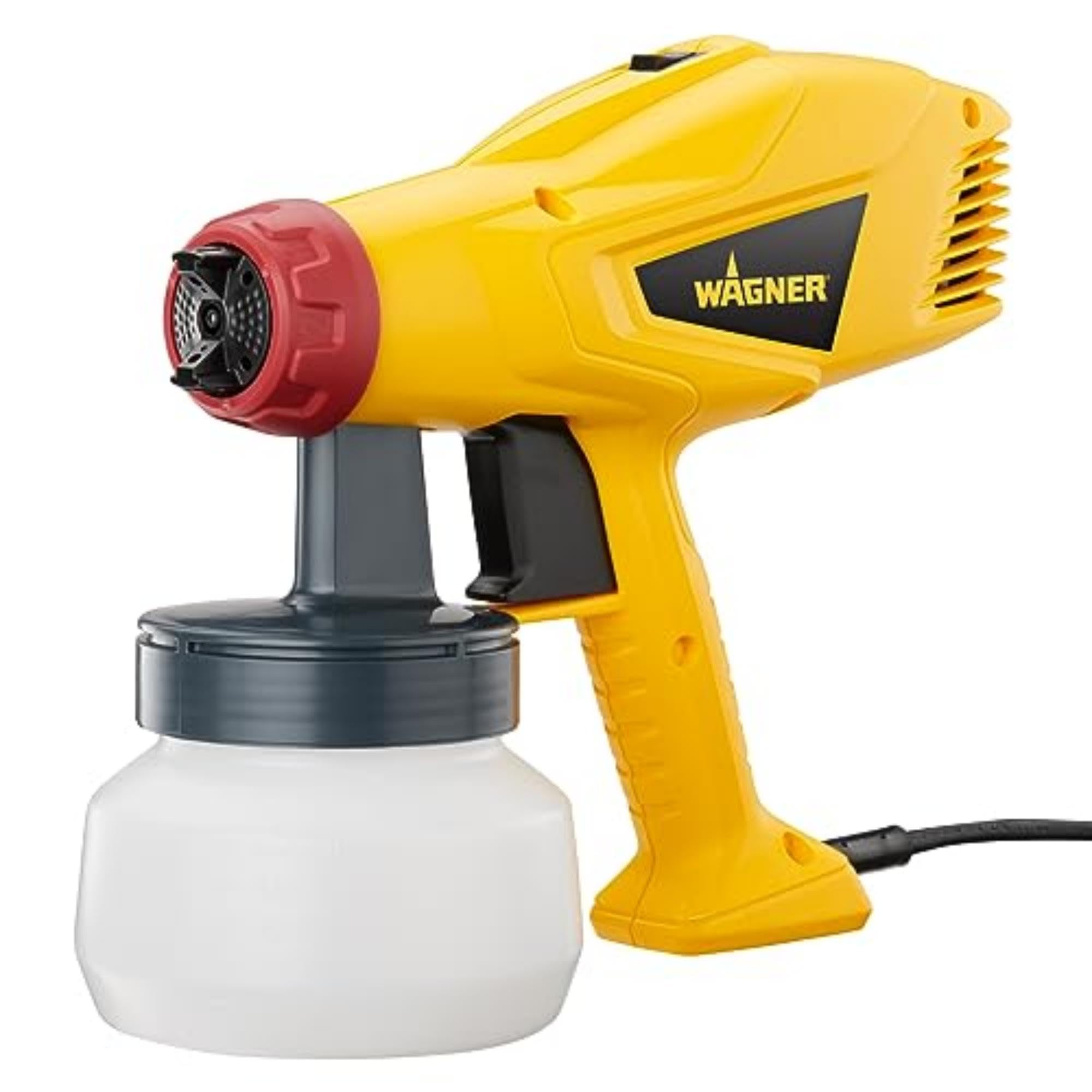
The Wagner QX1 is the most approachable sprayer on this list. It weighs almost nothing, fits in a tool bag, and requires only two moving parts to assemble. It is designed explicitly for small projects: a single chair, a craft shelf, a small gate. The 20-ounce cup is enough for a thin coat of stain or varnish on a piece of furniture without leftover material to waste.
The three spray patterns (horizontal, vertical, round) and the adjustable flow control give the beginner room to experiment without overwhelming them. One user reported staining a full fence in two hours — a job that previously took two full days by hand. This is the tool to reach for when your project is measured in square feet, not square yards. It handles light-bodied stains, sealers, and thinned craft paints like milk paint and chalk paint.
The limitation is clear: it struggles with thick paints. Multiple users report that even thinned latex paint is too viscous for the QX1, leading to sputtering and an uneven finish. Stick to thin materials and this sprayer will reward you with even coverage and effortless cleanup. For the absolute beginner whose first project is a small fence or a single piece of furniture, this is the safest learning tool available.
Why it’s great
- Extremely light and compact — ideal for first-time users.
- Simple two-component assembly and quick water rinse cleanup.
- Applies stain and sealer with an even, consistent coat.
Good to know
- Will not handle thick paint; strictly for thin materials.
- Small 20-ounce cup is impractical for large projects.
- Not designed for a fine, furniture-grade finish.
7. Tilswall Paint Sprayer (Alien500)
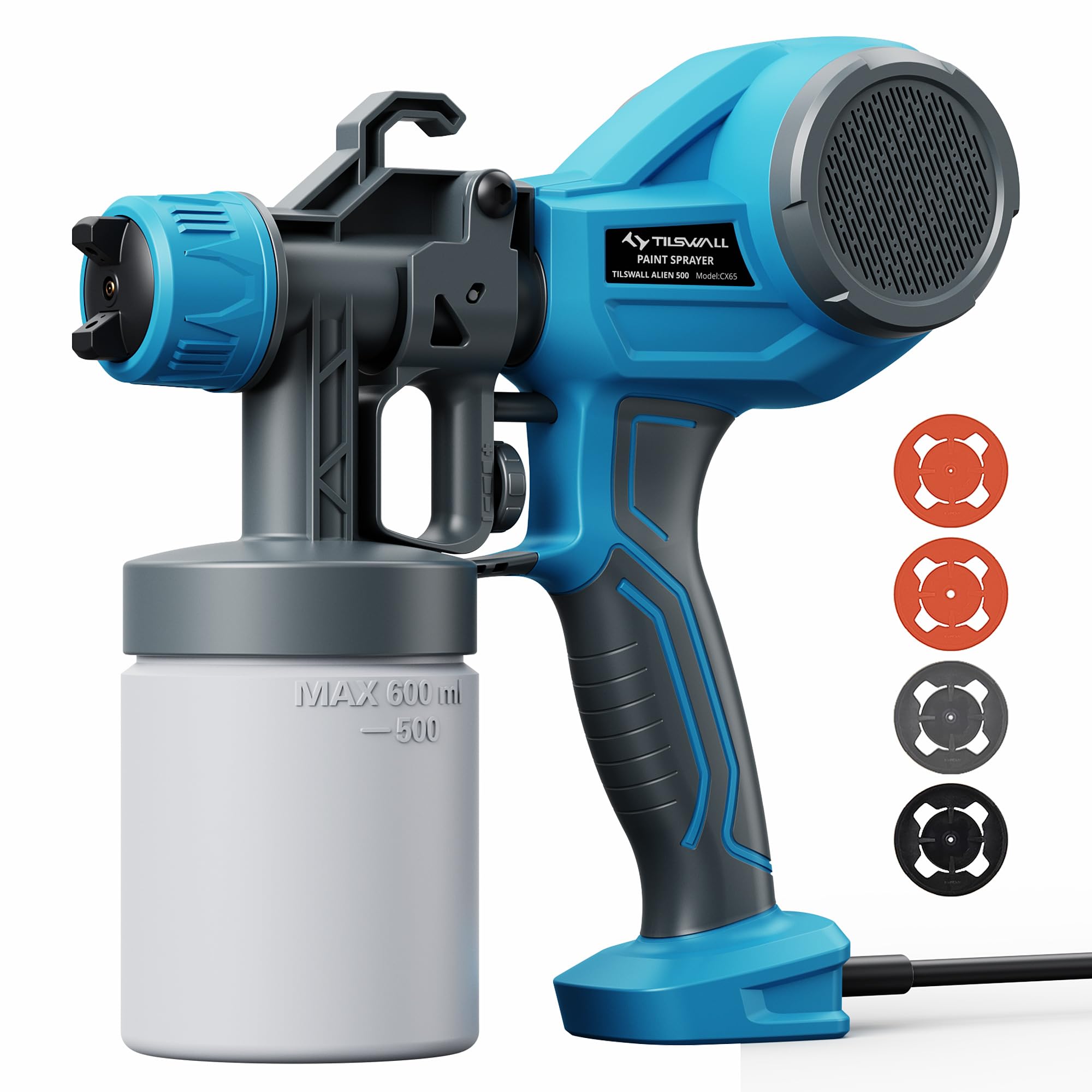
The Tilswall Alien500 is the lightest handled sprayer in the roundup at under 1.6 pounds, and it shows. The ergonomic grip and simple press-and-twist assembly mean a complete beginner can go from unboxing to spraying in under five minutes. The four included nozzles (1.0mm, 1.5mm, 1.5mm, 2.0mm) cover the most common material viscosities, and the 600ml cup is a practical size for furniture, cabinets, and small fences.
Real-world performance holds up to the convenience. Users report flawlessly painting a 200-square-foot deck over two weekends, with even coats and minimal overspray thanks to the adjustable pressure control. The unit handles thinned latex and emulsion paint well, and the 100 din-s viscosity limit covers most water-based and oil-based paints. Cleanup takes about ten minutes with the included brush and needle, a manageable commitment for an entry-level tool.
The trade-offs are volume and noise. This is not a production tool — the small cup and motor are best suited for weekend projects, not whole-house painting. The unit is noticeably louder than larger split-body sprayers, and the cord is short enough to require an extension for anything beyond a single room. For the budget-conscious beginner who wants a reliable, no-fuss sprayer for small-to-medium projects, the Alien500 delivers impressive value.
Why it’s great
- Ultra-light design at 1.54 pounds prevents arm fatigue.
- Four included nozzles provide versatility for different paints.
- Quick assembly and straightforward cleaning process.
Good to know
- Paint must be thinned for best results; not ideal for thick latex.
- Loud operation compared to split-body sprayers.
- Small cup requires frequent refills on larger surfaces.
FAQ
Do I need to thin latex paint before using a beginner sprayer?
What is the difference between HVLP and airless sprayers for a beginner?
How important is the cup material (plastic vs. metal) on a sprayer?
Final Thoughts: The Verdict
For most users, the best beginner paint sprayer winner is the HomeRight Super Finish Max because it balances powerful 450W performance with durable brass tips and a forgiving learning curve on interior projects. If you want a dedicated stain sprayer for outdoor fences and decks, grab the Wagner Control Spray QX2. And for a budget-friendly lightweight option that handles small furniture and cabinets, nothing beats the Tilswall Alien500.

Mo Maruf
I created WellFizz to bridge the gap between vague wellness advice and actionable solutions. My mission is simple: to decode the research and give you practical tools you can actually use.
Beyond the data, I am a passionate traveler. I believe that stepping away from the screen to explore new environments is essential for mental clarity and physical vitality.