Our readers keep the lights on and my smoothie glass nicely filled. As an Amazon Associate, I earn from qualifying purchases.
Manually spooning powder into caps is a losing game—one sneeze, one twitch, and your carefully measured batch scatters across the counter. For small-batch supplement makers, herbalists, and kitchen-scale entrepreneurs, a dedicated capsule filling machine transforms a tedious, dusty chore into a repeatable, clean process. The question isn’t whether you need one, but which type—manual lever, semi-automatic, or full-scale weigh-and-pack—matches your daily volume and material.
I’m Mohammad Maruf — the founder and writer behind WellFizz. I’ve spent hundreds of hours cross-referencing technical spec sheets, customer failure reports, and real-world calibration data to separate the machines that hold their accuracy from the ones that drift after a week.
Whether you’re filling 50 bottles of turmeric powder or 500 pouches of protein blend, this guide to the best capsule filling machine will help you match the right hardware to your specific material type and production speed.
How To Choose The Best Capsule Filling Machine
Selecting the right filler means matching the machine’s mechanism to your material’s texture and your target batch size. One wrong assumption—like assuming a paste filler works for dry powder—can cost hours of cleanup and ruined product.
Material Consistency: Paste vs. Dry Powder vs. Granules
Thick creams, honey, and essential oils require a manual lever filler with a food-grade stainless steel piston and an anti-drip nozzle. Dry powders (flour, protein, herbal blends) need vibration-based automatic weigh fillers—the vibration breaks surface tension and prevents bridging. Granules like seeds or coffee beans demand a dual-vibration hopper with adjustable speed to avoid crushing the product during feed.
Filling Range and Accuracy Tolerance
A machine with a 1-50g range and 0.3g accuracy is fine for glitter or tea, but too coarse for pharmaceutical-grade supplements where every 0.1g counts. Look for machines that let you dial in the weight via a digital control panel with at least one decimal point resolution. Machines that rely solely on a manual scale rod are less repeatable across long runs.
Build Material and Cleanability
Every surface that touches your product must be 304 stainless steel, food-grade PTFE, or platin-cured silicone. Avoid chrome-plated steel or bare aluminum—they corrode with acidic powders and are impossible to sanitize. A hopper that detaches with a single clamp (rather than screws) speeds up changeovers and prevents cross-contamination between batches.
Volume and Cycle Speed
Manual lever machines fill 5-15 containers per minute—fine for small-batch skincare. Automatic weigh-and-pack units push 10-15 bags per minute with a 77-lb hopper capacity, making them the choice for semi-commercial operations. If you plan to scale, buy the machine that can handle your projected peak volume, not today’s small run.
Quick Comparison
On smaller screens, swipe sideways to see the full table.
| Model | Category | Best For | Key Spec | Amazon |
|---|---|---|---|---|
| VEVOR Auto Particle Packager | Seal & Weigh | Bagging & Sealing | 1-100g / 10-15 bags/min | Amazon |
| Particle Filler 10-999G | Auto Weigh | High-volume granules | 77-lb hopper / dual vibration | Amazon |
| Powder Filler 1-100G | Auto Weigh | Dry powders & glitter | 0.3g accuracy / foot pedal | Amazon |
| Hanchen Powder Filler 1-50g | Auto Weigh | Small-batch granules | Infrared sensor / 3 speeds | Amazon |
| A03 Pro 100ml Manual | Manual Lever | Thick creams & sauces | 10-100ml / 22-lb hopper | Amazon |
| VEVOR Manual 5-100ml | Manual Lever | Lotions & honey | 5-100ml / 11.5L hopper | Amazon |
| KIMTEM Manual A03 | Manual Lever | Entry-level paste filling | 5-50ml / anti-drip nozzle | Amazon |
In-Depth Reviews
1. VEVOR Automatic Particle Packaging Machine 1-100g

This unit fuses a weigh filler with a bag sealer, a rare combo that eliminates the step of moving material between stations. The microcomputer controls two separate digital screens—one for weight calibration, one for seal timing—and runs at 10-15 bags per minute for 1-100g loads. The 304 stainless steel body resists corrosion from acidic powders like vitamin C or fruit blends.
Part of the complexity is the learning curve for paper alignment: the machine accepts 7-inch wide roll stock, and several users reported that the factory instructions on threading the film were incomplete. Once you tune the seal temperature and vibration speed for your specific material (coarse grains vs. fine flour), the output is remarkably consistent.
The 4 casters make it movable, but at 145.5 lbs, you won’t want to relocate it often. The biggest recurring complaint across owner reports is the lack of post-warranty support; several units developed seal failures after the first year, and the manufacturer did not offer repair parts. This machine is best for a producer who can justify the upfront cost with consistent daily volume.
Why it’s great
- Combines weighing and heat-sealing in one footprint
- Food-grade 304 stainless steel construction
- Dual digital control for weight and seal timing
Good to know
- Requires specific paper roll dimensions; not universally available
- Heavy unit—plan for a permanent station
- Limited manufacturer support after warranty expires
2. Particle Filling Machine 10-999G
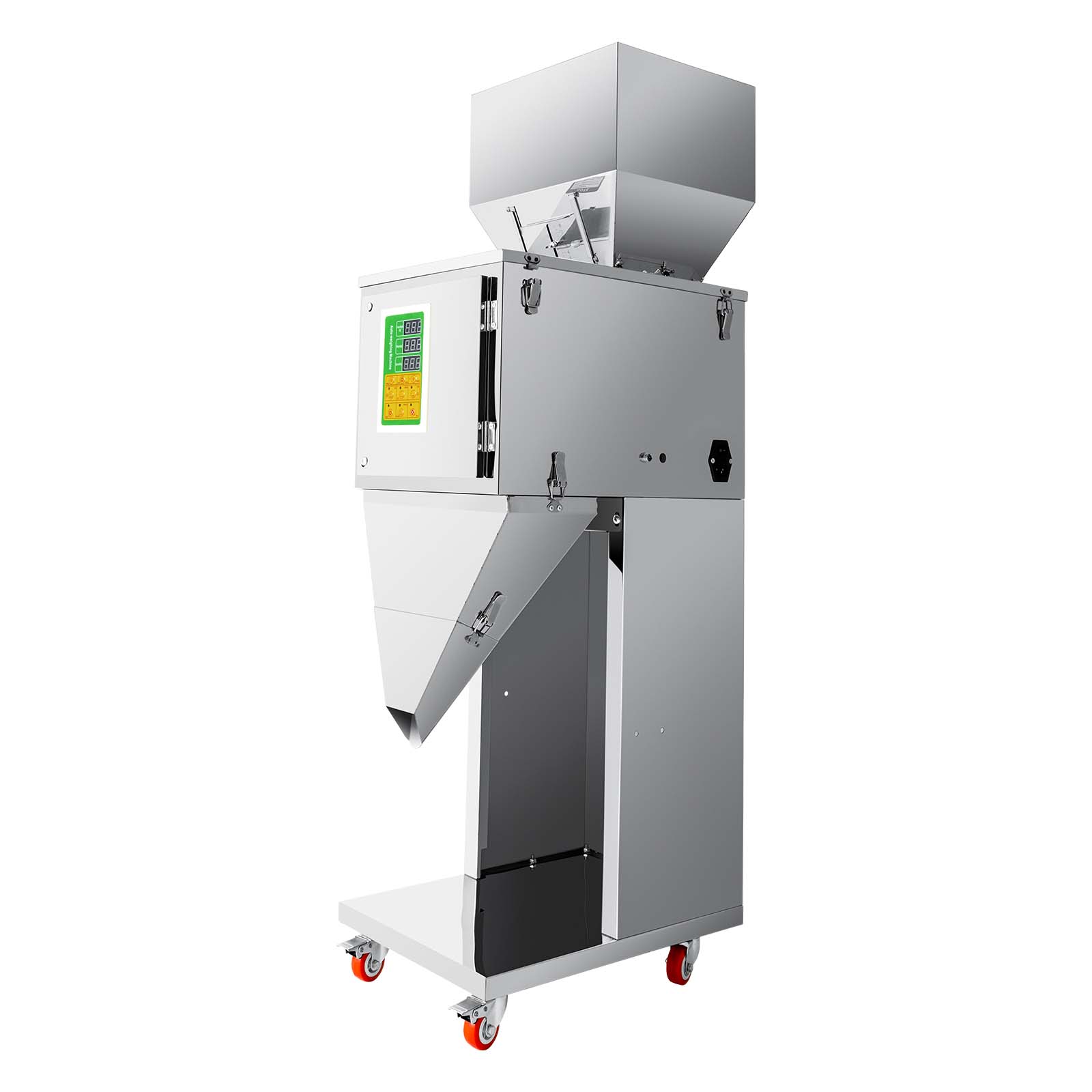
With a 77-lb rice hopper and a dual-vibration design, this automatic filler targets high-throughput operations—think coffee roasters bagging whole beans or supplement makers portioning 500g of protein powder per pouch. The 10-999g range is unusually wide, and the two dispensing nozzles (large and small) let you switch between bulk nuts and fine seeds without changing hardware.
The intelligent control panel includes pre-set weight buttons and a foot pedal for hands-free dispensing, which real-world users confirm saves hours per day once calibrated. A known caveat: the scale ships slightly off, so plan to run a reference test with a verified digital scale and adjust the offset setting before production. The unit also auto-shuts when the hopper runs low, preventing air-only cycles that waste time.
Where this machine stumbles is with sticky or hygroscopic powders—several owners noted that clumping materials (like certain protein isolates) required frequent stirring to keep the vibration feed consistent. The 61.6-lb weight makes it a floor unit, not a benchtop filler, so measure your space before committing. Overall, for dry, free-flowing granules at large scale, this model is a production workhorse.
Why it’s great
- Wide 10-999g range covers everything from samples to bulk bags
- Dual vibration system reduces bridging in dry materials
- Foot pedal enables hands-free, high-speed operation
Good to know
- Scale requires initial offset calibration
- Struggles with sticky or clumping powders
- Heavy unit—needs dedicated floor space
3. Powder Filling Machine 1-100G

This automatic filler lands in the sweet spot for small businesses making the jump from scoop-and-weigh to mechanized filling. It handles dry powders like flour, glitter, matcha, and instant tea in a 1-100g range with a stated accuracy of 0.3g. The foot pedal and sensor induction give you three control modes, and the clamp-off hopper design makes cleaning straightforward—just pop the hopper off and rinse.
The real-world durability stories are strong: one commercial tea producer reported running it for eight hours straight with only a wipe-down between batches, while the VEVOR competitor clogged within two hours. The vibration frequency and speed tuning are adjustable, and several owners noted that once they dialed in the settings for their specific powder density, the repeatability was reliable over months of use.
On the downside, a minority of units arrived with calibration drift that required frequent adjustment during long runs. The machine also lacks a seal function, so you’ll need a separate heat sealer if you’re making pouches rather than filling jars. For a dedicated powder-only filler at this price tier, the consistency-to-cost ratio is difficult to beat.
Why it’s great
- Reliable out-of-box performance for dry powders
- Easy hopper removal for batch changeovers
- Adjustable vibration frequency for density tuning
Good to know
- Occasional calibration drift during extended runs
- No built-in sealing feature
- Not suitable for wet or sticky powders
4. Hanchen Powder Filling Machine 1-50g

Built around an intelligent weigh-and-discharge system, this Hanchen machine uses infrared induction to trigger the fill cycle the moment a container is placed under the nozzle. The three speed levels (fast, medium, slow) give you granular control over how aggressively the vibrating disc feeds material, which is critical when switching from coarse grains to fine powders that aerate easily.
The dual-fuse electrical design and dust-proof shell around the motherboard address a real operational risk: fine powders like flour or protein can infiltrate electronics and cause shorts. The transparent visualization window on the hopper side lets you see material level and flow behavior without stopping the cycle, a small but time-saving detail. Setup is intuitive—multiple users reported getting their first accurate fill within 20 minutes of unboxing.
The reliability record is mixed. Several buyers reported the motor burning out after 12-18 months of daily use, and the manufacturer’s response to warranty claims has been uneven. The infrared sensor also requires a solid reflective surface in the container; transparent glass jars can cause misfires unless you tape a reflective strip to the outside. For occasional small-batch work it is solid, but high-volume daily operators may want a more robust motor platform.
Why it’s great
- Infrared sensor triggers fill only when container is present
- Dust-proof housing protects motherboard from fine powders
- Visual window lets you monitor hopper level mid-cycle
Good to know
- Motor longevity is a concern for daily commercial use
- Sensor struggles with transparent containers
- Warranty support response is inconsistent
5. A03 Pro 100ml Manual Filling Machine

The A03 Pro is the most refined of the KIMTEM lever-filler family, with a 10-100ml adjustable scale, a 22-lb 304 stainless steel hopper, and an anti-drip nozzle that actually works when the piston is fully depressed. The entire material path—hopper, piston, nozzle—is food-grade stainless or PTFE, so it can handle hot sauces up to 392°F without degrading or leaching chemicals into your product.
The key difference from cheaper manual fillers is the integrated shelf bracket: you rest the bottle under the nozzle rather than free-handing it, which eliminates wobble and spillage. The scale markings are etched, not printed, so they last through repeated washing. Owners of hot sauce and body-butter businesses report that the lever action is smooth and bubble-free once you learn to pull it fully to the stop—a partial pull leaves the rubber washer unsealed and causes drips.
Cleaning is the trade-off: the cylinder and piston design has several internal crevices that require a detailed brush session after each use. Users who fill multiple products in the same session often buy two units to avoid tear-down mid-run. The machine occupies a large footprint (28 inches tall with the lever), so measure your bench height carefully. For a manual machine that delivers repeatable, mess-free fills for thick pastes and liquid cosmetics, this is the tier to start with.
Why it’s great
- Full 304 stainless and PTFE food-grade material path
- Built-in bottle shelf for hands-free alignment
- Anti-drip nozzle when piston is fully actuated
Good to know
- Detailed cleaning required after each product run
- Large vertical footprint needs dedicated bench space
- Lever requires firm, full-stroke pulls for consistent seal
6. VEVOR Manual Paste Liquid Filling Machine 5-100ml
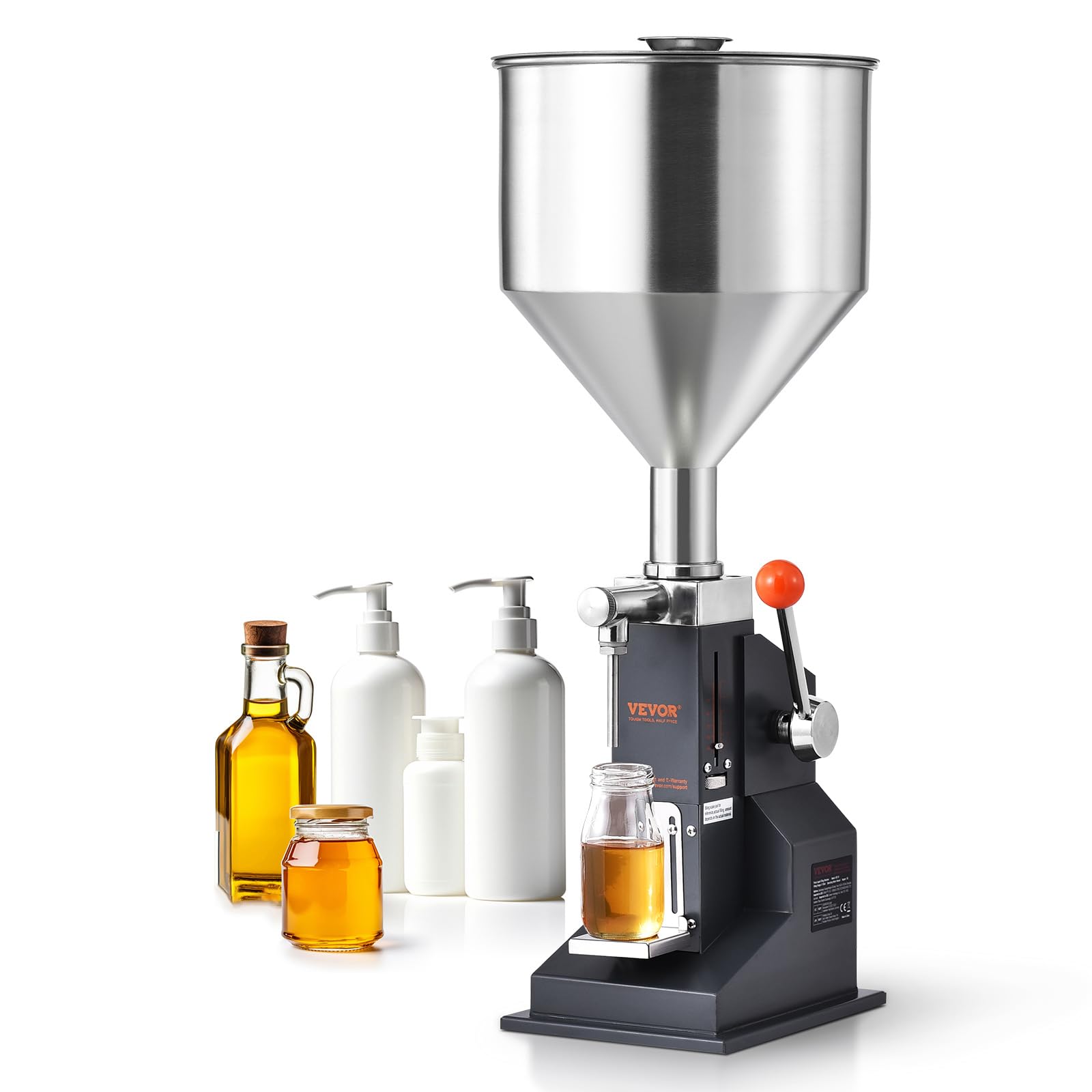
VEVOR’s entry into the manual lever space brings a reinforced handle with a spring-return mechanism that reduces the physical effort of repetitive filling—a genuine ergonomic upgrade over the older no-spring designs. The 5-100ml range covers both small sample vials and larger 4-oz bottles, and the two included nozzle sizes (4mm and 8mm) handle thin liquids and thick creams equally well.
Owners who make lotions and sauces in batches under 500 units per week report that this machine saves them hours of wrist strain. The height-adjustable shelf accommodates containers from 2 inches to nearly 10 inches tall, and the gear-turn adjustment for fill volume is noticeably more precise than the simple screw-set found on cheaper models. The food-grade material list (304 stainless, PTFE) matches the A03 Pro for safety.
The quality-control variance is the biggest concern: while the majority of units perform well, several buyers received machines with dented hoppers, rust spots on internal metal, or leaking oil seals that required replacement parts within the first week. The anti-drip seal rings work when new, but users with acidic products (vinegar-based sauces) noted accelerated seal wear. For the price, the ergonomics and adjustability are strong, but you need to inspect every component on arrival and be prepared for potential return processing.
Why it’s great
- Reinforced spring handle reduces operator fatigue
- Wide 5-100ml range with precise gear adjustment
- Height-adjustable shelf fits most bottle sizes
Good to know
- Inconsistent quality control—inspect immediately on arrival
- Seal wear accelerated by acidic liquids
- Reported issues with internal metal burrs and rust on some units
7. KIMTEM Manual Paste Liquid Filling Machine A03

The original KIMTEM A03 is the entry-level workhorse that introduced many small-batch makers to manual piston filling. It handles 5-50ml per stroke with an anti-drip nozzle, and the entire product-contact assembly—hopper, piston, seals—uses 304 stainless steel, food-grade silica gel, and PTFE. The new “Pro” version adds a scale rod for reference, while this baseline model uses a screw-and-wrench adjustment that requires a bit more trial and error to dial in.
Owner reviews consistently highlight two strengths: the unit builds quality at its price point, and the manufacturer stocks spare parts (seal rings, nozzles, wrenches) that are easy to replace. Users filling body butters, herbal extracts, and lip glosses report that the machine paid for itself within the first month by reducing spill waste and filling time. The anti-drip function is effective with moderate-viscosity liquids—thin essential oils may still leak between strokes.
The 5-50ml limit means you cannot fill containers larger than a 1.7-oz bottle in one stroke, which slows down production for larger jars. The lever also requires a firm, consistent pull; if your material is very thick (think cold honey), the piston may squeak on the return stroke, a sign that the lubrication seal needs greasing. For a low-cost, repairable machine that takes the mess out of small-batch liquid filling, this is the logical starting point.
Why it’s great
- All food-grade materials at a budget-friendly entry point
- Manufacturer sells replacement seals and nozzles separately
- Proven anti-drip design for medium-viscosity liquids
Good to know
- Maximum 50ml stroke—too small for bulk jar filling
- Volume adjustment requires tools (screw and wrench)
- Thick pastes may cause piston squeak without re-greasing
FAQ
Can a manual paste filler handle dry powder?
What does the dual-vibration system prevent?
How often should I lubricate the piston seal on a manual filler?
Final Thoughts: The Verdict
For most users, the best capsule filling machine winner is the VEVOR Automatic Particle Packaging Machine because it combines weighing and sealing in one footprint, saving an entire production step for high-volume operators. If you need a dependable automatic filler for dry powders without the seal function, grab the Powder Filling Machine 1-100G. And for small-batch creams and sauces where manual control is fine, nothing beats the build quality of the A03 Pro Manual Filling Machine.

Mo Maruf
I created WellFizz to bridge the gap between vague wellness advice and actionable solutions. My mission is simple: to decode the research and give you practical tools you can actually use.
Beyond the data, I am a passionate traveler. I believe that stepping away from the screen to explore new environments is essential for mental clarity and physical vitality.