Our readers keep the lights on and my smoothie glass nicely filled. As an Amazon Associate, I earn from qualifying purchases.
A dead car battery miles from the trailhead or a phone that dies on the second night of a four-day trip — the wrong battery for camping turns a peaceful escape into a frustrating wait for sunlight. The real challenge isn’t finding a battery; it’s matching capacity, chemistry, and recharge speed to your specific camp loadout.
I’m Mohammad Maruf — the founder and writer behind WellFizz. I’ve spent years analyzing portable power station specs, comparing LiFePO4 cycle life ratings, and parsing real-world solar input data to separate marketing claims from usable capacity for campers.
Whether you need a sub-10-pound power station for weekend tent camping or a 2kWh backup for a family RV trip, this guide breaks down the compact, premium, and high-capacity options to help you find the best battery for camping that actually matches your gear list.
How To Choose The Best Battery For Camping
Selecting a camping battery isn’t about the biggest number on the box — it’s about matching chemistry, usable capacity, and recharge flexibility to how you camp. Here are the three specs that separate a great camp companion from a dead weight.
Battery Chemistry: LiFePO4 vs. Lead-Acid vs. Lithium-Ion
LiFePO4 (lithium iron phosphate) batteries dominate the mid-range and premium tiers because they deliver 3,000 to 6,000 charge cycles and weigh roughly 60% less than an equivalent lead-acid battery. Lead-acid deep-cycle batteries cost less upfront but lose capacity with each partial discharge and require regular maintenance. Standard lithium-ion packs are lighter but degrade faster — LiFePO4 is the preferred choice for regular campers.
Capacity in Watt-Hours (Wh) and Real-World Draw
A 300Wh power station charges a smartphone 25 times or runs a 10W CPAP machine for roughly 6 to 8 hours. If you plan to power a 12V fridge (40W draw) through a three-day trip, you need at least 500Wh to 700Wh of usable capacity. Always subtract 10–15% from the stated Wh for inverter and conversion losses.
Recharge Speed and Solar Input
The quickest rechargers hit 80% in under 1.5 hours via AC wall power. Solar input matters more than panel wattage — look for a power station that accepts at least 100W of solar input if you plan to stay off-grid. Stations with adjustable AC charging speeds (Turbo, Standard, Silent) let you prioritize speed or noise depending on time of day and campground rules.
Quick Comparison
On smaller screens, swipe sideways to see the full table.
| Model | Category | Best For | Key Spec | Amazon |
|---|---|---|---|---|
| Anker SOLIX C200 DC | Power Station | Ultra-portable power for small gear | 192Wh, LiFePO4, 200W | Amazon |
| GRECELL 300W | Power Station | Budget-friendly campsite charging | 288Wh, Li-ion, 300W output | Amazon |
| WEIZE 12V 100Ah | Deep Cycle | Solar/RV off-grid banks | 100Ah, AGM Lead-Acid | Amazon |
| Apowking 300W w/ Panel | Solar Kit | All-in-one solar start | 220Wh, 40W panel included | Amazon |
| BLUETTI Elite 30 V2 | Power Station | Fast-charging lightweight camp power | 288Wh, LiFePO4, 600W output | Amazon |
| VTOMAN Jump 600X | Power Station + Jump | Car camping and roadside emergencies | 299Wh, LiFePO4, 600W+ Jump | Amazon |
| BLUETTI Elite 200 V2 | Power Station | High-capacity RV and off-grid | 2074Wh, LiFePO4, 2600W | Amazon |
| EF ECOFLOW DELTA 3 Max | Power Station | Fast-charging home/vehicle backup | 2048Wh, LiFePO4, 3400W X-Boost | Amazon |
| Jackery Explorer 2000 v2 | Power Station | Lightest 2kWh for extended trips | 2042Wh, LiFePO4, 2200W output | Amazon |
In-Depth Reviews
1. Anker SOLIX C200 DC Power Bank Station

The Anker SOLIX C200 DC packs 192Wh of LiFePO4 power into a chassis that’s 39% smaller than comparable power stations, making it the most compact option for ultralight campers. Its 200W output drives a single 140W USB-C PD 3.1 port that can fast-charge a laptop from empty in under 90 minutes. The 100W solar input keeps it topped off during a basecamp rest day.
Real users confirm it runs a Starlink Mini for 6 to 8 hours on a full charge, which underscores the efficiency of the 60,000mAh capacity. The LiFePO4 chemistry supports 3,000 recharge cycles, so this unit will outlast several camping seasons before noticeable capacity fade. The absence of AC wall charger in the box is an intentional trade-off for size — most campers already own a 65W or higher USB-C laptop charger.
At 2.6 pounds, it’s easy to toss into a daypack or stash in a canoe dry bag. The five ports — three USB-C (140W, 100W, 15W) and two USB-A (12W each) — cover phones, tablets, cameras, and a headlamp battery pack simultaneously.
Why it’s great
- Ultra-compact footprint fits any pack
- 140W USB-C PD 3.1 charges laptops faster than most stations
- 3,000-cycle LiFePO4 battery lasts years
Good to know
- Wall charger not included — requires your own USB-C PD charger
- No AC outlet, limits appliance use
2. BLUETTI Elite 30 V2 Portable Power Station
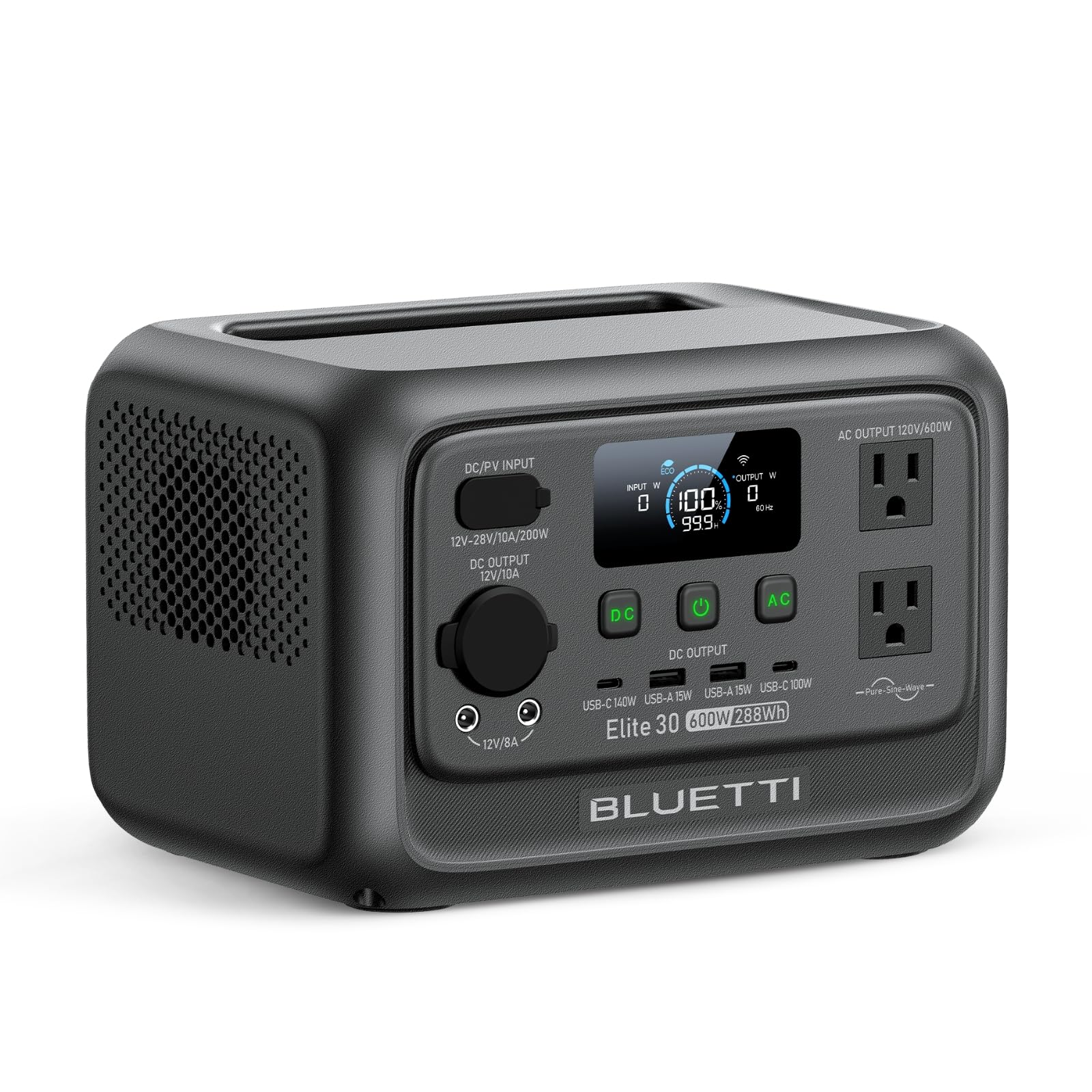
The BLUETTI Elite 30 V2 delivers 288Wh and 600W continuous output (1,500W Power Lifting mode) in a 9.4-pound package, making it the strongest balance of weight and output in the mid-range tier. Its UltraCell technology cuts standby power consumption by half, and the 380W AC fast charger brings the battery from zero to 80% in just 45 minutes — a class-leading recharge speed for this capacity class.
User reports show it runs a CPAP machine all night and charges the rest of camp the next day. The 10ms UPS switch protects sensitive electronics like laptops and CPAP devices during a sudden grid drop. The included AC charging cable plus car and solar input options give three reliable ways to refill the tank at a drive-in campground or a backcountry solar array.
The compact dimensions (9.8 x 7 x 6.6 inches) and integrated handle make it easy to carry from car to picnic table. The BLUETTI app adds remote monitoring and smart charging schedule adjustments.
Why it’s great
- 0–80% charge in 45 minutes via AC
- Power Lifting mode runs small appliances over 600W
- Lightweight at 9.4 pounds with 600W inverter
Good to know
- AC fan audible under full load at close range
- Limited to 288Wh for extended off-grid trips
3. GRECELL Portable Power Station 300W
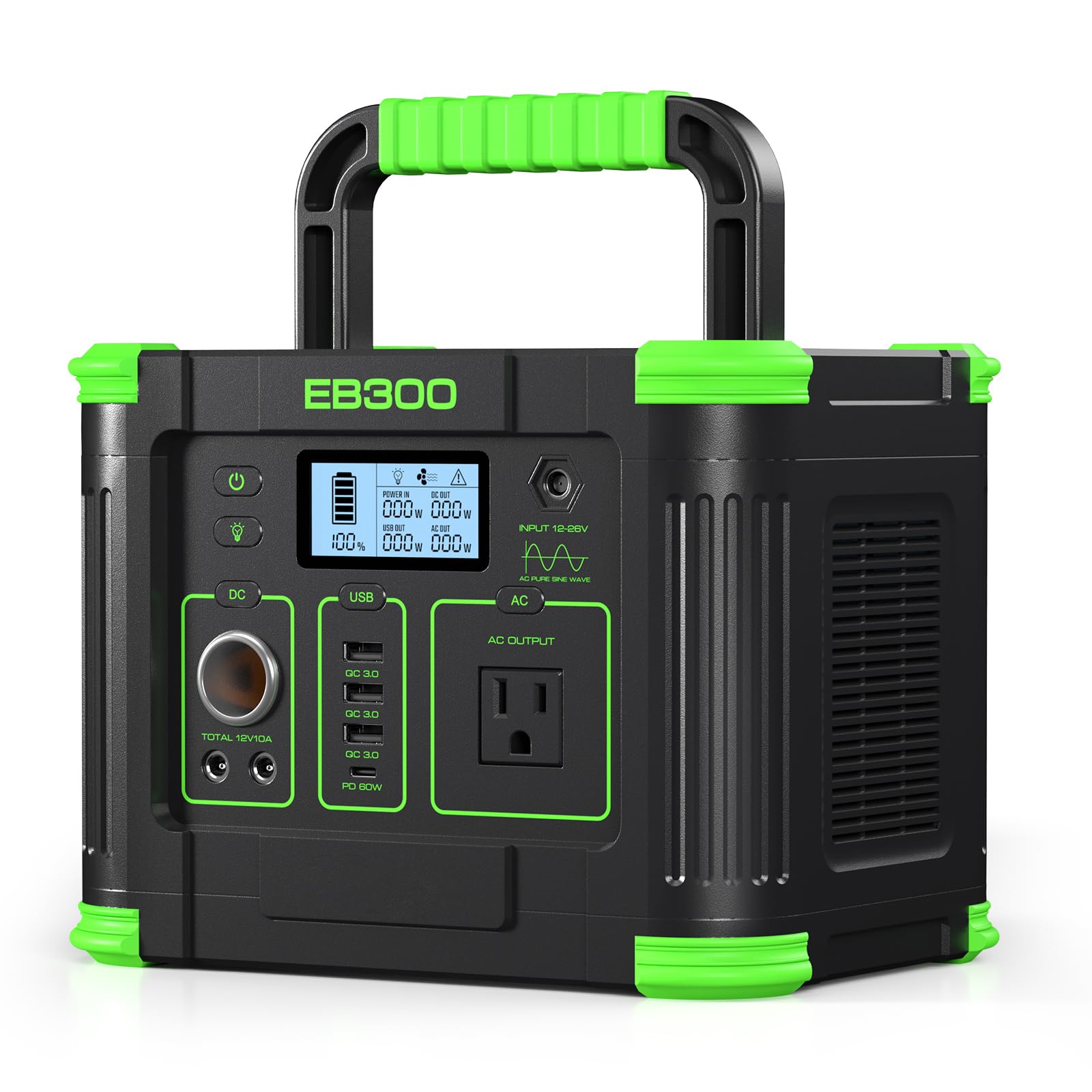
The GRECELL 300W station offers 288Wh of capacity with a 330W pure sine wave inverter (600W surge) at a price point that undercuts most LiFePO4 competitors. The battery pack uses lithium-ion chemistry, which keeps the unit affordable but limits cycle life to roughly 500 full cycles compared to the 3,000+ cycles of LiFePO4 models. For a casual camper who uses the station a few weekends per year, that difference rarely matters.
Users consistently praise the battery life during multi-family camping trips — one reviewer reported recharging phones, lights, and a Nintendo Switch for multiple families without depleting the station. The 60W USB-C PD port charges a laptop, and the three USB-A ports handle phones and tablets simultaneously. The built-in LED flashlight with three brightness levels and SOS mode adds a practical safety feature for night setups.
The unit weighs 7.3 pounds and measures 12.8 x 7.68 x 8.46 inches. The AC wall charger replenishes the battery in 6 to 7 hours, while a 100W solar panel (not included) cuts that to 5–9 hours depending on sunlight.
Why it’s great
- Budget-friendly with usable 288Wh capacity
- Wireless charging pad built into top surface
- Three brightness LED flashlight with SOS
Good to know
- Li-ion chemistry offers fewer recharge cycles than LiFePO4
- AC outlet disabled during charging, no pass-through AC
4. Apowking Portable Solar Powered Generator 300W

The Apowking HP200L is one of the few kits in this roundup that ships with a solar panel — a 40W monocrystalline panel with 24% conversion efficiency. The 300W-rated station (220Wh actual capacity) powers up to seven devices simultaneously via two 110V AC outlets, three USB-A ports, one USB-A fast-charge port, and one DC vehicle output. The pure sine wave inverter protects sensitive devices like laptops and CPAP equipment.
Real-world users note that the 40W panel is adequate for trickle charging but recommend upgrading to a 60W+ panel for faster solar refills. The station charges from AC in about 4 hours and takes 6 to 8 hours from the included panel in direct sun. The unit weighs just 5 pounds and measures 8.5 x 6.7 x 4.1 inches, making it the lightest station in this guide.
The full-back LED light is significantly brighter than the small side LEDs common on budget stations. The advanced BMS manages temperature and prevents overcharge, short-circuit, and overpower scenarios. Apowking backs the kit with a 12-month support warranty.
Why it’s great
- Solar panel included, ready out of the box
- Lightest kit at 5 pounds
- Bright full-back LED light for night camp
Good to know
- No USB-C PD port for laptop fast charging
- Included 40W panel charges slowly; consider 60W+ upgrade
5. VTOMAN Jump 600X Portable Power Station

The VTOMAN Jump 600X combines a 299Wh LiFePO4 power station with a dedicated car jump-start port — a unique 2-in-1 design that eliminates the need for a separate jumper pack. It delivers 600W continuous output (1,200W surge) through two AC outlets, and the 600W constant-power feature keeps the AC outlets active when feeding devices over 600W instead of shutting down. This is a safety net for powering a space heater or kettle in an emergency.
The expanded capacity reaches 939Wh when paired with VTOMAN’s external battery (sold separately), making it the only station in the mid-range that can grow with your needs. Users report running a CPAP for 10 hours plus charging phones and a light simultaneously. The jump-start port started a Dodge Ram in three seconds with the station at 9% battery level.
The regulated 12V/10A DC outputs (two DC5521 ports plus one car port) are ideal for running a 12V fridge or CPAP without inverter losses. Pass-through charging lets you charge the station and run devices at the same time. The unit weighs 14.6 pounds and measures 10.2 x 8.7 x 8.6 inches.
Why it’s great
- 2-in-1 power station and car jump starter
- Expandable to 939Wh with add-on battery
- 600W constant-power mode for over-rated appliances
Good to know
- Heavier at 14.6 pounds compared to similar capacity stations
- Jumper cables required separately
6. BLUETTI Elite 200 V2 Portable Power Station

The BLUETTI Elite 200 V2 packs 2,074Wh of automotive-grade LiFePO4 capacity with a 2,600W continuous inverter (3,900W Power Lifting) — enough wattage to run a full-size refrigerator, coffee maker, and air fryer simultaneously. Its HyperWatt technology, combined with a standby power draw of just 10W, makes it one of the most efficient high-capacity stations available. The 0–80% AC charge time is 50 minutes in Turbo mode, which is exceptionally fast for a 2kWh class unit.
Users report powering a 60W diesel heater for 3.3 days straight (10 hours per day) without recharge. The unit passed 33 rigorous testing standards and claims a CNAS-certified 17-year lifespan with 6,000+ cycles. The BLUETTI app lets you switch between Turbo, Standard, and Silent charging modes — Silent mode runs at 16–30 dB, which is 45% quieter than typical 30–50 dB stations.
At 53.4 pounds and dimensions of 13.78 x 9.84 x 12.74 inches, the Elite 200 V2 is a car-camping or RV companion, not a backpacking solution. The dual handles make it manageable for one person to lift from a trunk.
Why it’s great
- Lightning-fast 0–80% charge in 50 minutes
- 3,900W Power Lifting handles high-draw appliances
- Whisper-quiet Silent charging mode at 16–30 dB
Good to know
- Weighs 53.4 pounds; not for backcountry use
- No 30A RV port for direct trailer connection
7. WEIZE 12V 100Ah Deep Cycle Battery

The WEIZE 12V 100Ah AGM battery is a sealed lead-acid deep-cycle workhorse designed for RV, solar, marine, and off-grid setups. It delivers 100Ah of capacity at 12V (1,200Wh) with a max discharge current of 1,150A, making it suitable for running a 700W inverter or powering a cabin’s LED lights and small fridge. The AGM construction is maintenance-free and spill-proof, unlike flooded lead-acid batteries that require distilled water refills.
Users running two of these in parallel with a 300W solar array report two full years of off-grid RV use without issues. The 3% monthly self-discharge rate means the battery holds a charge through the off-season without a maintainer. One reviewer built a 4.8kWh backup bank with four units in parallel feeding a 2,000W inverter for whole-house backup excluding HVAC and stove.
At 63 pounds, the WEIZE is heavy — this is a permanent install, not a portable pack. The group size 31 form factor (12.99 x 6.73 x 8.34 inches) fits standard battery boxes and trays. The battery includes terminal screws but no wire harness or mounting hardware.
Why it’s great
- High 1,150A max discharge for high-draw inverters
- Maintenance-free AGM construction, no water refills
- Low 3% monthly self-discharge rate
Good to know
- Very heavy at 63 pounds
- Lead-acid chemistry limits cycle life vs. LiFePO4
8. EF ECOFLOW Portable Power Station DELTA 3 Max
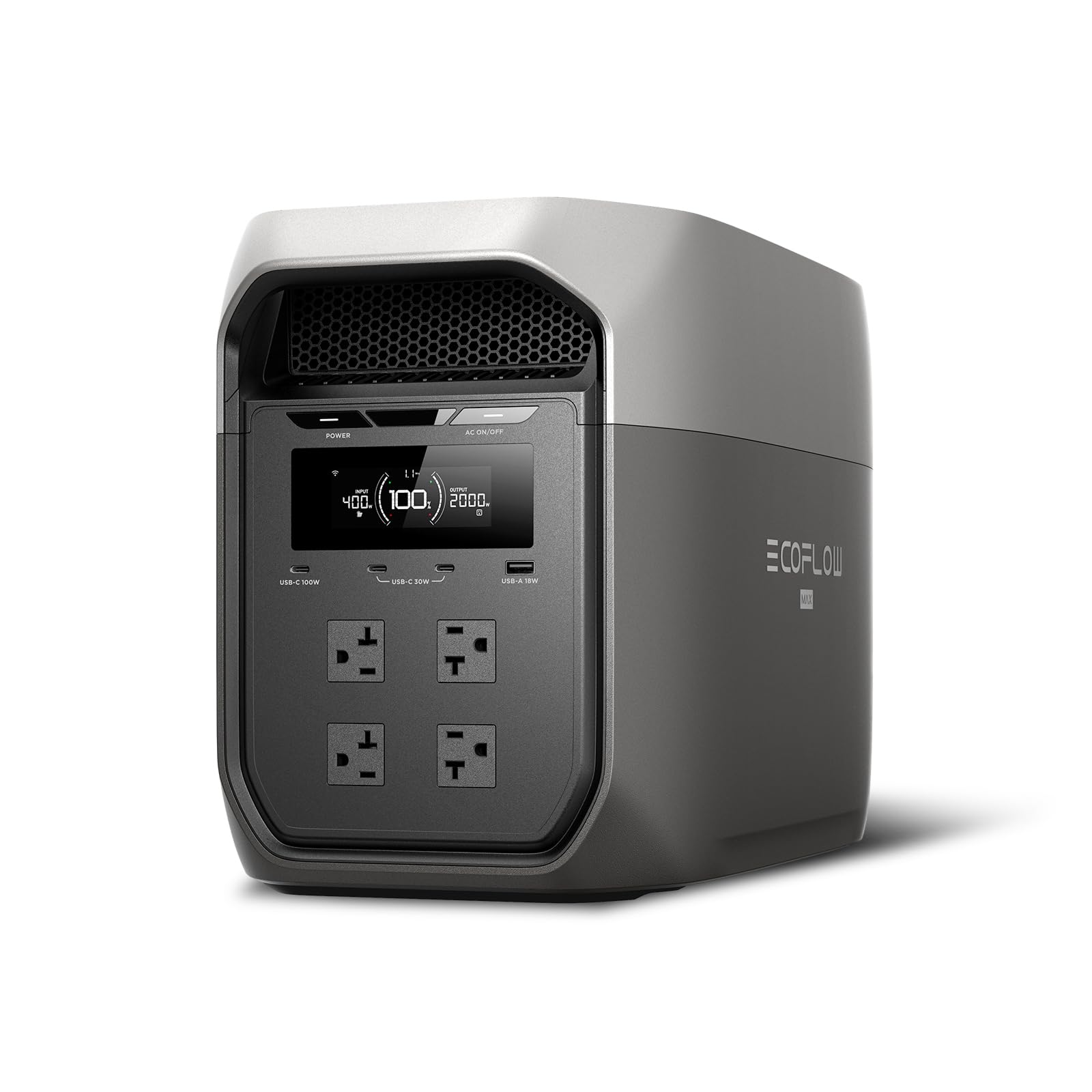
The EF ECOFLOW DELTA 3 Max offers 2,048Wh of LiFePO4 storage with X-Stream technology that recharges from 0–80% in just 1.13 hours — among the fastest charge times for a 2kWh station. The 3,400W X-Boost mode covers 99% of household and camping appliances, including microwaves, power tools, and refrigerators. The 2,400W native AC output handles the same loads without boosting.
Real users confirm the station works seamlessly as a UPS for a gas furnace and circulator pump, lasting three days on a single charge at 37W load. The app provides storm-triggered full-charge settings and individual outlet power draw monitoring. The unit runs quietly under load — reviewers note the fan is only audible at sustained 1,700W draw.
At 12 x 9.4 x 19.44 inches, the DELTA 3 Max is taller than the BLUETTI Elite 200 V2 but includes dual handles for balanced lifting. The metal and aluminum enclosure adds durability for rough transport. The 5-year extended service plan adds peace of mind for long-term investment.
Why it’s great
- 0–80% charge in 1.13 hours via X-Stream
- 3,400W X-Boost handles heavy appliances
- App with storm mode and power draw monitoring
Good to know
- No 240V outlet for well pumps or EV charging
- Internal self-discharge of ~1% per day when stored
9. Jackery Explorer 2000 v2 Portable Power Station

The Jackery Explorer 2000 v2 redefines the high-capacity portable power station category with its CTB (Cell-to-Body) technology, borrowed from EV battery packs. The result is a 2,042Wh station that weighs just 39.5 pounds — that’s 41% lighter than the average 2kWh competitor. The 2,200W continuous output handles most camping appliances, and the 20ms UPS switch keeps sensitive electronics safe during power drops.
Users report keeping a standard fridge running for 21.3 hours on a single charge. The AC fast charge mode hits 80% in 66 minutes (102 minutes to full from Emergency Super Charging mode). Silent Charging mode recharges in 5 hours at just 30 dB, making it ideal for overnight refueling in a van or near a tent without disturbing sleep. The IP-rated enclosure is not fully sealed but resists dust better than open-frame stations.
The front panel hosts three AC ports, USB-A, USB-C PD 100W, and DC outlets. The LCD screen displays remaining charge, input/output wattage, and estimated runtime. Jackery’s app adds remote monitoring and silent charging scheduling.
Why it’s great
- Lightest 2kWh station at 39.5 pounds
- Silent Charging at 30 dB for overnight use
- CTB construction is compact and durable
Good to know
- 200W solar panel charges slowly; 400W recommended
- UPC certification pending for UPS mode
FAQ
How many watt-hours do I need to run a CPAP machine while camping?
Can I leave a LiFePO4 camping battery plugged in all winter?
Final Thoughts: The Verdict
For most users, the best battery for camping winner is the BLUETTI Elite 30 V2 because it delivers 288Wh of long-lasting LiFePO4 power with a fast 45-minute recharge and a 600W inverter in a 9.4-pound package that fits car camping and short off-grid trips. If you want massive 2kWh capacity for an RV or week-long base camp, grab the Jackery Explorer 2000 v2. And for car campers who also want a jump starter, nothing beats the VTOMAN Jump 600X.

Mo Maruf
I created WellFizz to bridge the gap between vague wellness advice and actionable solutions. My mission is simple: to decode the research and give you practical tools you can actually use.
Beyond the data, I am a passionate traveler. I believe that stepping away from the screen to explore new environments is essential for mental clarity and physical vitality.