Our readers keep the lights on and my smoothie glass nicely filled. As an Amazon Associate, I earn from qualifying purchases.
A hiking backpack that shifts, chafes, or overloads your shoulders turns a scenic trail into a painful chore. For women, the geometry of the torso, the curve of the shoulders, and the angle of the hips demand a pack designed to match that anatomy—not a unisex sack you simply tighten and hope for the best. The right suspension transfers weight to your hips, keeps your center of gravity stable, and lets you breathe freely on climbs.
I’m Mohammad Maruf — the founder and writer behind WellFizz. I analyze load-transfer frame designs, torso-adjustment ranges, and ventilation channel layouts to find packs that solve the specific fit problems women encounter on the trail.
We evaluated seven contenders on suspension architecture, torso fit range, feature density, and real-world trail feedback to identify the best backpacks for hiking women that balance weight distribution and breathable comfort for day hikes through multi-day treks.
How To Choose The Best Backpacks For Hiking Women
Picking a hiking pack comes down to your torso length, the volume needed for your trip length, and the suspension system that suits your load. Women’s packs typically have a shorter torso range, more contoured shoulder straps, and a hip belt that angles inward at the iliac crest rather than sitting flat across the waist. Here are the three specs that separate a great fit from a frustrating one.
Torso Length and Hip-Belt Geometry
The most critical measurement is your torso length—cervical vertebra C7 to the top of your iliac crest. Most women’s packs accommodate torsos from roughly 14 to 19 inches. If your torso sits at either end of that range, look for an adjustable suspension system that offers fine-tuning rather than a fixed frame. The hip belt should wrap around the bony crest of your hips, not ride above it. A contoured, S-shaped belt transfers load more efficiently than a straight padded band.
Suspension and Ventilation
Three main suspension types dominate this category: a trampoline mesh backpanel (like Osprey’s AirSpeed) that creates an air gap and keeps your back cool but adds weight; an internal frame with ventilated foam channels (like Deuter’s Airstripes) that brings the load closer to your body and improves stability at the cost of slightly warmer contact; and a flexible backpanel (like Gregory’s BioSync) that moves with your gait. Heavier loads above 25 pounds generally prefer the closer-to-body frame for better balance, while hot-weather hikers prioritize the trampoline gap.
Volume vs. Trip Duration
Volume is measured in liters. A 20-30 liter pack covers day hikes and fast-and-light missions. A 35-50 liter range works for overnight or two-night trips where you carry a sleeping bag, pad, stove, and extra food. Packs above 50 liters are built for multi-day treks with bear canisters or winter gear. Don’t over-buy volume—a half-empty bag shifts weight poorly and strains your shoulders. Conversely, cramming a 50-liter load into a 30-liter pack compromises your packing efficiency and access.
Quick Comparison
On smaller screens, swipe sideways to see the full table.
| Model | Category | Best For | Key Spec | Amazon |
|---|---|---|---|---|
| Osprey Renn 50L | Premium Overnight | Multi-day treks with adjustable torso fit | 3.5 lb / 50 L / AirSpeed suspension | Amazon |
| Deuter Aircontact Lite 35+10 SL | Premium Lightweight | Long-distance hikes with expandable volume | 3.2 lb / 35+10 L / narrow fit | Amazon |
| Gregory Miko 30L | Mid-Range Daypack | Day hikes and travel with lumbar support | BioSync hipbelt / 1.8 lb / 30 L | Amazon |
| Deuter Trail 30L | Mid-Range Daypack | Biking and hiking with high ventilation | 1.9 lb / 30 L / Airstripes back | Amazon |
| High Sierra Pathway 30L | Value Daypack | Budget-conscious day hikes | Internal frame / 1.5 lb / 30 L | Amazon |
| Salomon Trailblazer 30L | Value Daypack | Light hikes and urban commutes | 19.4 oz / 30 L / padded back | Amazon |
In‑Depth Reviews
1. Osprey Renn 50L Women’s Backpacking Backpack

The Renn 50 is Osprey’s women’s-specific backpacking pack that uses the same AirSpeed trampoline suspension found on their iconic Aura series but in a simpler, lighter build. The tensioned mesh backpanel keeps the pack frame 3-4 inches off your lower back, creating ventilation that significantly reduces sweat pooling on warm climbs. The LightWire frame transfers loads above 30 pounds cleanly to a contoured women’s hip belt, so your shoulders stay free of pressure points even after a full day with a bear canister and tent.
Fit adjustment spans 15 to 18 inches of torso length, which covers the majority of female hikers between 5’2” and 5’8”. The hip belt pockets are large enough for a modern smartphone, and the integrated rain cover stows in its own dedicated pocket—no fumbling for a separate stuff sack when a squall hits. The sleeping bag compartment features a floating divider, letting you compress or expand the bottom zone depending on your bedding setup.
Some short-torso women (5’1” and under) report the shoulder straps don’t cinch tight enough, so petite hikers should test the fit before committing. At 3.5 pounds, it’s not the lightest 50-liter pack on the market, but the combination of ventilated carry, thoughtful organization, and Osprey’s lifetime All Mighty Guarantee makes it the go-to choice for women tackling multi-day routes.
Why it’s great
- AirSpeed mesh panel eliminates sweaty back contact
- Integrated rain cover saves packing time and weight
- Women’s-specific hip belt and curved shoulder straps
Good to know
- May not cinch tight enough for very petite torsos
- Top pocket is small and can be awkward to access when full
2. Deuter Women’s Aircontact Lite 35 + 10 SL

The Aircontact Lite 35+10 SL earned its reputation on the Pacific Crest Trail, where it held up for 2,600 miles without structural failure. The “SL” designation stands for “Slim Line,” a women’s-specific cut with a shorter torso, S-curved shoulder straps that taper narrower at the ends, and conical hip fins that follow the natural flare of a woman’s hips. The Vari Quick system lets you adjust torso length on the fly by loosening a ladder strap and repositioning the shoulder yoke—no tools required.
The Aircontact back system uses hollow-chamber foam that creates a pump-effect ventilation channel as you move. It’s not as breezy as a trampoline mesh panel, but it keeps load transfer direct: the pack rides tight to your center of gravity so 30-pound loads feel balanced rather than cumbersome. The expandable +10 liter lid gives you flexibility for a resupply day without buying a larger pack.
The hip belt pockets are zippered and generously sized, and the pack includes trekking-pole attachment loops, an ice-axe keeper, and a separate bottom compartment for a sleeping bag. The main downside is weight: at 3.2 pounds for a 35-liter pack, it’s heavier than some ultralight alternatives. But for hikers who prioritize load stability and bombproof construction over shaving ounces, this Deuter delivers.
Why it’s great
- Proven durability over thousands of trail miles
- Expandable 10L volume for resupply flexibility
- Narrow, S-shaped straps fit slimmer shoulders
Good to know
- Heavier than ultralight packs of similar volume
- Ventilation is good but not as airy as mesh trampolines
3. Gregory Miko 30L Unisex Day Hiking Backpack
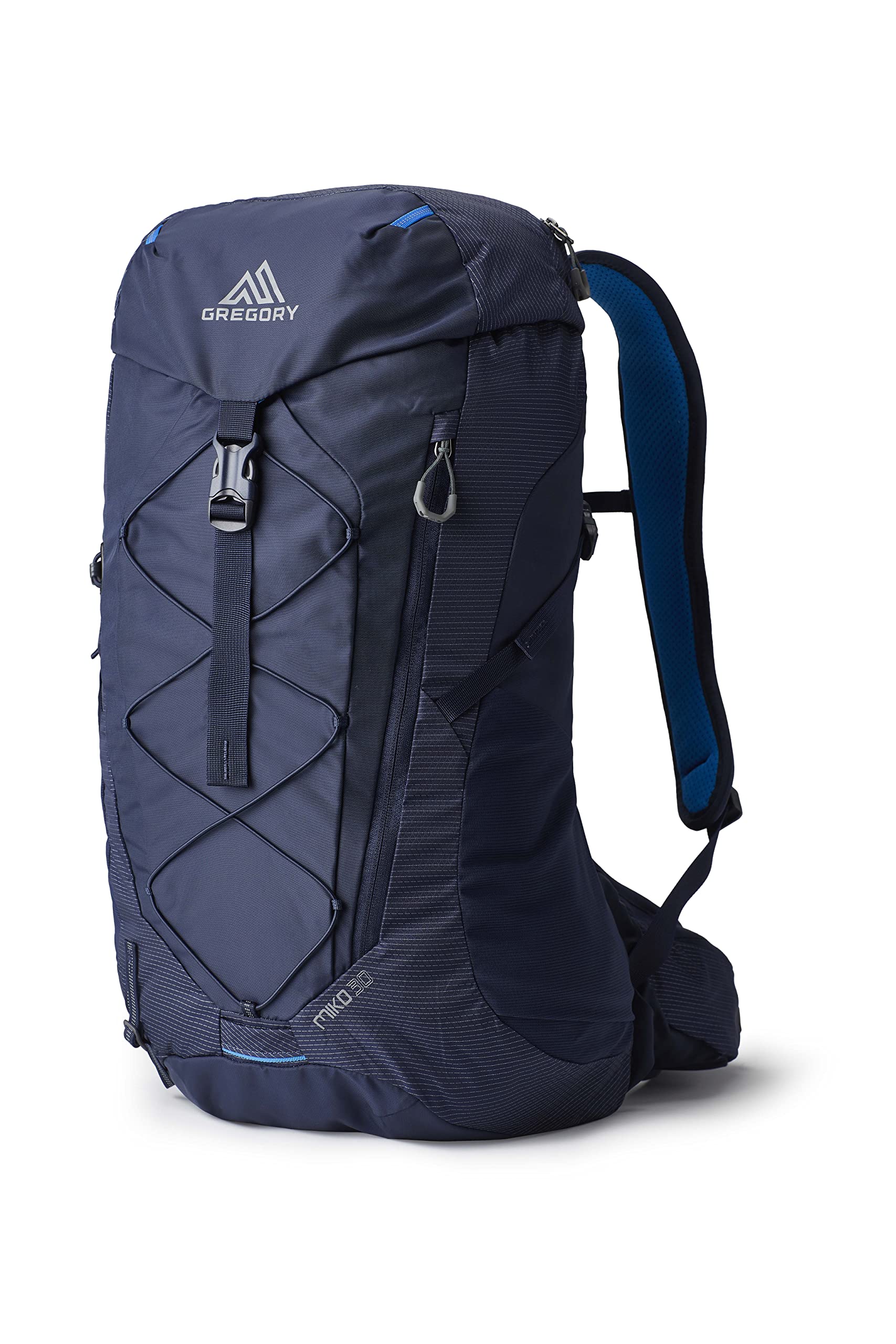
The Gregory Miko 30L splits the difference between a dedicated hiking pack and a travel daypack better than anything in its class. The BioSync hip belt uses flexible, edge-to-edge construction that moves with your natural gait, so the pack follows your body’s rotation rather than fighting it. The channeled foam backpanel has aerodynamic grooves that promote air movement—not as open as a trampoline, but enough to keep you from soaking your shirt during moderate effort.
One of its standout features is the adjustable torso length, which provides 3.5 inches of range. Most unisex packs skip this entirely; the Miko includes a ladder-style adjuster that connects edge-to-edge for balanced load transfer. The hip belt pockets are large enough to swallow a phone and a granola bar, and the SpeedClip hydration hanger works with Gregory’s Hydro reservoirs or generic bladders.
At roughly 1.8 pounds, it’s light enough for fast day hikes but built well enough to handle occasional loads up to 25 pounds. The lack of a padded laptop sleeve bothers urban commuters more than hikers, and the external attachment loops are minimal. Still, for a mid-range daypack that fits women’s torsos well out of the box, the Miko delivers uncommon value.
Why it’s great
- Adjustable torso length rare at this price point
- Flexible BioSync hipbelt moves with your stride
- Large hip belt pockets fit modern phones
Good to know
- No padded laptop sleeve for dual-use commuters
- Ventilation is adequate but not class-leading
4. Deuter Trail 30L Backpack

The Trail 30L uses Deuter’s Airstripes system, which replaces a full backpanel with two vertical foam pads separated by a wide central channel. The result is a striking ventilation path: hot air escapes through the channel while the pads keep the pack stable and close to your body. This design is especially effective on warm, steep ascents where a trampoline pack might sway off-center. The perforated shoulder straps and hip fins add moisture-wicking properties.
The Delrin U-frame gives the bag structure without adding much weight, and it maintains a recommended load range of 9 to 18 pounds—perfect for a day hike with lunch, layers, water, and a camera. The front zip access is a practical touch: you can reach the bottom of the main compartment without digging through the top. Trekking pole holders, ice-axe attachment loops, and a 3-liter hydration compartment round out the feature set.
The hip belt pockets are small—too small for a large smartphone—which is a notable omission for a pack at this tier. And while the Airstripes system improves airflow dramatically compared to solid foam panels, it doesn’t create as wide an air gap as Osprey’s trampoline design. But the trade-off is a more planted carry that doesn’t shift when you’re scrambling.
Why it’s great
- Outstanding central ventilation channel for hot hikes
- Front zip access to bottom of main compartment
- Delrin U-frame for stable load distribution
Good to know
- Hip belt pockets are too small for large phones
- Not ideal for loads above 18 pounds
5. High Sierra Pathway Internal Frame Hiking Backpack, 30L

The High Sierra Pathway gives entry-level hikers an internal frame pack at a budget-friendly entry point. The U-shaped main opening reveals a single large compartment with a padded divider panel and interior hold-down straps to keep gear from shifting. The internal frame provides enough structure to manage loads up to 20 pounds without sagging, and the adjustable sternum strap and hip belt offer basic load transfer.
For its price, the Pathway packs surprising versatility. The compression straps on each end let you cinch down a weekend’s worth of clothing or tie on extra gear externally. The fabric is a medium-weight polyester that has held up well in customer reports for regular day hikes and even airline travel. The bag also includes a hydration sleeve that fits most 2-3 liter bladders.
The trade-offs come in fit and finish. The hip belt is padded but not contoured for women’s anatomy, so shorter torsos may find the pack rides on their shoulders rather than transferring weight to the hips. The strap adjustment hardware feels less premium than the mid-range and premium packs on this list. For occasional hikers or families outfitting multiple people on a tight budget, it works well enough.
Why it’s great
- Internal frame at a budget-friendly price point
- Good compression straps for load stabilization
- Durable polyester construction for regular use
Good to know
- Hip belt lacks women’s-specific contouring
- Hardware feels less durable than premium options
6. Salomon Unisex Trailblazer 30, Hiking & Trekking Backpack

At just 19.4 ounces, the Salomon Trailblazer 30 is the lightest pack on this list by a wide margin. It achieves this through minimalist construction: a polyamide body, perforated foam backpanel, and a 3D padded harness system with EVA foam that provides enough structure for loads up to about 15 pounds. For fast-and-light hikers, trail runners, or anyone who treats pack weight as a primary consideration, this is a compelling option.
The storage layout is thoughtful for such a weight-conscious design. Two zippered hip belt pockets accommodate snacks and a phone, a top pocket includes a key clip, and side stretch pockets hold water bottles without adding bulk. The internal sleeve fits a hydration bladder or a slim laptop for hybrid trail-to-desk use. YKK zippers and PFC-free fabric construction add a small sustainability edge.
The trade-off is load capacity and frame stiffness. The backpanel is padded, not framed, so heavier loads above 15 pounds begin to sag and cause shoulder strain. The unisex fit means the shoulder straps and hip belt are not shaped for a woman’s anatomy—hikers with narrower shoulders may find the straps slide outward. It’s a specialized tool, not an all-rounder, but for minimalists who prioritize weight, it delivers.
Why it’s great
- Ultra-light 19.4 oz for fast-and-light missions
- YKK zippers and PFC-free materials
- Two useful hip belt pockets despite low weight
Good to know
- No frame structure—struggles above 15-pound loads
- Unisex straps may not fit women’s shoulder geometry
FAQ
How do I measure my torso length for a hiking backpack?
What liter size do I need for a weekend backpacking trip?
Is a women’s-specific pack really necessary or is unisex fine?
Final Thoughts: The Verdict
For most hikers, the backpacks for hiking women winner is the Osprey Renn 50L because its AirSpeed suspension provides the best balance of ventilation, load transfer, and women’s-specific fit for multi-day adventures. If you want a lightweight, expandable pack built for long-distance thrus, grab the Deuter Aircontact Lite 35+10 SL. And for day hikers who need a ventilated, stable carry under 18 pounds, nothing beats the Deuter Trail 30L.

Mo Maruf
I created WellFizz to bridge the gap between vague wellness advice and actionable solutions. My mission is simple: to decode the research and give you practical tools you can actually use.
Beyond the data, I am a passionate traveler. I believe that stepping away from the screen to explore new environments is essential for mental clarity and physical vitality.