Our readers keep the lights on and my smoothie glass nicely filled. As an Amazon Associate, I earn from qualifying purchases.
An underwater camera needs to keep water out and produce a usable image. Many so-called “budget” options fail on one of these fronts, offering either a sealed body with noisy, washed-out shots or a low price tag paired with an unreliable waterproof case. Buying the wrong one leaves you with a useless brick at the bottom of a pool.
I’m Mohammad Maruf — the founder and writer behind WellFizz. My research focuses on the real-world trade-offs between depth ratings, sensor resolution, and battery life across dozens of sub- water-ready cameras so you can separate functional gear from marketing fluff.
After reviewing nine models across action cameras and dedicated point-and-shoots, I have filtered the reliable options to help you find the best budget underwater camera for your next snorkel trip, dive adventure, or poolside vlog.
How To Choose The Best Budget Underwater Camera
Choosing a budget underwater camera means balancing depth rating, image quality, and battery life within a tight price range. The following criteria will help you pinpoint the model that matches your specific aquatic activities.
Depth Rating Versus Construction
A camera rated to 33 feet is fine for pool play and casual snorkeling, but if you plan to scuba dive even to recreational depths, you need a model that is waterproof to at least 40 feet without a separate plastic housing. Action cameras with an included waterproof case often claim 131 feet, but the case seal must be meticulously maintained — a single grain of sand can cause a leak.
Video Resolution and Stabilization
4K at 30fps is the baseline for crisp footage, but stabilization is what separates usable underwater video from seasick-inducing clips. Electronic Image Stabilization helps smooth out the sway of currents and hand tremors. Without it, even high-resolution video looks amateurish. A dedicated point-and-shoot like the OM System TG-7 offers none, relying instead on a steady hand, while the AKASO Brave 7 LE provides effective 6-axis EIS.
Battery Life and Accessory Ecosystem
Cold water drains batteries faster than land use. Look for cameras that include at least two rechargeable batteries so you can swap without cutting your dive short. The included mounting kit also matters — a floating hand grip or carabiner strap can prevent a sinking disaster, while a waterproof remote allows you to start and stop recording without surfacing.
Quick Comparison
On smaller screens, swipe sideways to see the full table.
| Model | Category | Best For | Key Spec | Amazon |
|---|---|---|---|---|
| AKASO Brave 7 LE | Action Camera | Vloggers needing dual screens | 131ft Depth / 6-axis EIS | Amazon |
| OM System TG-7 | Point & Shoot | Dedicated macro underwater shots | 50ft Depth / F2.0 Lens | Amazon |
| Kodak PIXPRO WPZ2 | Point & Shoot | Casual snorkeling with zoom | 49ft Depth / 4x Optical Zoom | Amazon |
| PENTAX WG-1000 | Point & Shoot | Rugged outdoor day trips | 49ft Depth / Shockproof 2m | Amazon |
| SPUNALP 8K Camera | Point & Shoot | High-res travel photos | 33ft Depth / 70MP Photo | Amazon |
| Ruysaie 8K Camera | Point & Shoot | Macro details underwater | 33ft Depth / 1.97in Macro | Amazon |
| Maxmango D50 | Point & Shoot | Kids and beginners | 33ft Depth / Dual Screens | Amazon |
| AKASO EK7000 Pro | Action Camera | First-time action cam buyers | 131ft Depth / Touch Screen | Amazon |
| AKASO Brave 4 | Action Camera | High-value accessory bundle | 131ft Depth / 170° View | Amazon |
In‑Depth Reviews
1. AKASO Brave 7 LE

The AKASO Brave 7 LE earns the top spot by combining an IPX7 weather-resistant body with a waterproof housing rated to 131 feet. The dual-color display — a front-facing screen for selfies and a 2-inch rear touchscreen — makes it one of the most versatile sub- action cameras for underwater vlogging. Its 6-axis Electronic Image Stabilization 2.0 delivers gimbal-like smoothness even when you are swimming against a current, which is rare at this price point.
Video quality tops out at 4K 30fps, and the included remote control lets you start or stop recording without surfacing. The bundle ships with two rechargeable batteries, a waterproof housing, and a full mounting kit, so you do not need to buy extra gear for your first dive trip. The EIS works best at the highest resolution, keeping footage steady without the fish-eye distortion common in cheaper action cams.
The trade-off is that the touchscreen can be slow to respond when wet, and the included microSD card is only 64GB, which fills up quickly at 4K. Users report that battery life drops noticeably in cold water — about two hours of continuous recording — so carrying the spare is essential. For a combined land-and-sea camera with strong stabilization, this is the most well-rounded option available.
Why it’s great
- Effective 6-axis EIS keeps underwater footage smooth
- Front and rear dual screens simplify framing
- Remote control included for remote start/stop
Good to know
- Touchscreen response slows down with wet fingers
- Battery life drops in cold water; carry the spare
2. OM System OLYMPUS Tough TG-7

The OM System OLYMPUS Tough TG-7 is the dedicated point-and-shoot that serious underwater photographers reach for when a phone or action camera falls short. It is waterproof to 50 feet without a housing, shockproof from 7 feet, and crushproof to 220 pounds, making it nearly indestructible. The F2.0 lens lets in more light than typical budget cameras, which matters when you are shooting below the surface where colors drain fast.
Its variable macro system includes four dedicated underwater modes — including Underwater Microscope and Underwater HDR — that let you capture details as close as one centimeter from the lens. The 4K video at 30fps is clean, and the 120fps high-speed mode allows slow-motion playback of fast marine life. The TG-7 also records in RAW format, giving you flexibility to correct white balance during post-processing.
The biggest catch is the price: it sits well above the entry-level tier. The battery life is decent but the charge meter can drop without much warning, so a spare battery is recommended. The controls are small and can be fiddly with thick dive gloves, and low-light performance is limited by the small sensor. For a photographer who values macro capability and rugged construction over raw megapixel counts, the TG-7 is the specialist tool.
Why it’s great
- F2.0 lens delivers brighter underwater images
- Four dedicated underwater shooting modes
- Built tough: waterproof, shockproof, and crushproof
Good to know
- Premium tier price compared to action cameras
- Small controls are hard to operate with dive gloves
3. Kodak PIXPRO WPZ2

The Kodak PIXPRO WPZ2 stands out among its peers because it packs a true 4x optical zoom lens into a waterproof body rated to 49 feet. Most budget underwater cameras use digital zoom, which simply crops the image and reduces quality, but the WPZ2’s optical zoom lets you pull in subjects like a distant sea turtle without degrading detail. The 16-megapixel sensor provides enough resolution for crisp 8×10-inch prints or generous crops.
This bundle includes a 32GB SD card, a floating strap, a hard case, and a monopod, so you have nearly everything you need out of the box. The camera is also shockproof to 6.6 feet and dustproof, making it a solid companion for beach days and hiking trails where sand and grit are constant threats. The 1080p Full HD video is adequate for social media clips, though it lacks the detail of 4K.
The main drawback is the lack of image stabilization, so you must brace the camera or use a steady hand to avoid blur. The battery door is a bit finicky to close securely, and the 2.7-inch LCD screen is small compared to modern action cameras. For users who prioritize optical zoom over raw video resolution, the WPZ2 is a smart mid-range choice.
Why it’s great
- True 4x optical zoom for detailed distant subjects
- Waterproof to 49 feet with shockproof and dustproof build
- Comprehensive accessory bundle included
Good to know
- No image stabilization; requires a steady hand
- Battery door can be tricky to seal properly
4. PENTAX WG-1000

PENTAX brings decades of compact camera engineering to the WG-1000, a gray all-weather body that is waterproof to 49 feet for up to one hour. The standout feature is its dustproof and shockproof rating — it survives a 6.6-foot drop — along with the ability to be sterilized with ethanol or bleach solutions, making it suitable for medical and worksite environments where cleanliness is critical.
The 4x optical zoom lens starts at a wide 27mm equivalent, giving you a broad field of view for underwater landscapes. The ISO 3200 top sensitivity helps in darker water, and the twenty color modes — including Japan Style, French Style, and Negative — let you dial in a specific look without editing later. The included O-CC180 Protector Jacket shields the body from scratches when not underwater.
Several users report autofocus struggles in low-visibility water and a green hue in the images that requires manual white balance correction. The internal lens is prone to fogging in sudden temperature changes, and there are reports of the battery compartment corroding after a shallow dive. For casual pool and beach use, it is a capable rugged camera, but serious underwater shooters may find the image quality inconsistent.
Why it’s great
- Rugged build: shockproof, dustproof, and sterilizable
- 4x optical zoom with 27mm wide-angle coverage
- Twenty creative color modes built into the camera
Good to know
- Autofocus can hunt in murky water conditions
- Lens fogging and green tint reported by some users
5. SPUNALP 8K Underwater Camera
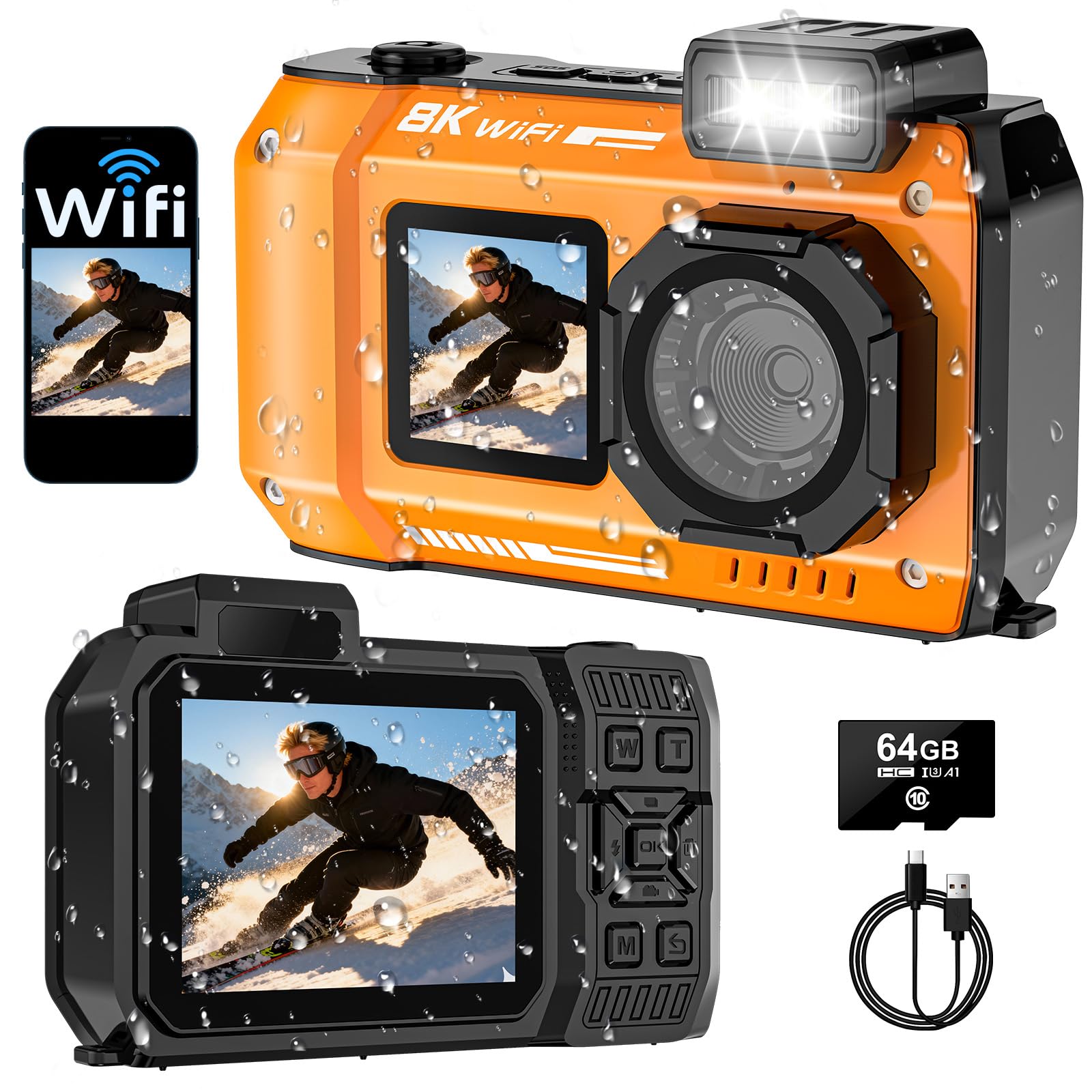
The SPUNALP 8K Underwater Camera markets itself aggressively on resolution, claiming 70-megapixel stills and 7680×4320 video. In practice, the interpolated 70MP output produces files that are large but not necessarily full of detail — the real-world benefit is that you can crop aggressively and still have usable resolution. For a snorkeler who wants to share images immediately, the built-in WiFi lets you transfer photos to a phone above water.
The camera is sealed to 33 feet with a double-lock construction that also resists dust and sand. It includes a 64GB SD card and a 2500mAh battery rated for up to five hours, which is generous for a full day at the beach. The dual-screen design — 2.88-inch front and 1.44-inch rear — helps with both selfies and standard framing, and the integrated SOS light adds a safety layer for emergencies.
The companion app is reportedly slow and sometimes unusable, but the camera works fully without it. Some users have noted bubbles escaping from the seal on first submersion, which causes panic but may not indicate a leak. The autofocus is contrast-detection rather than phase-detection, which can be sluggish in low light. It is a feature-dense camera for the price, but the waterproofing consistency and software quality are not yet proven.
Why it’s great
- High 70MP photo output allows heavy cropping
- Included 64GB card and long-lasting 2500mAh battery
- Built-in SOS light for emergency situations
Good to know
- WiFi app performance is slow and unreliable
- Waterproof seal can leak bubbles on first immersion
6. Ruysaie 8K Underwater Camera

The Ruysaie 8K camera differentiates itself with a dedicated macro shooting mode that lets you focus as close as 1.97 inches from the subject — ideal for capturing the texture of coral polyps or the scales of a tiny blenny. The autofocus frame shifts from red to green to confirm focus lock, which is a helpful visual cue when you are bobbing in the water. The 70MP photo resolution, like its SPUNALP counterpart, benefits from interpolated scaling, but the macro clarity is genuinely useful.
The 4:3 aspect ratio on the 2.88-inch front screen and 1.44-inch rear display provides a taller field of view that helps with composition compared to the standard 16:9. The 2500mAh battery delivers about 2.5 hours of continuous video, and the included 64GB card stores up to 8,000 photos. The camera is waterproof to 33 feet and is also dustproof and shockproof to 4 feet, making it suitable for rugged travel.
The WiFi app, as with the SPUNALP model, is described as almost unusable — slow and prone to disconnecting — so you will likely rely on a card reader for file transfers. Some users report that the camera does not feel as premium as the spec sheet suggests, with a lightweight plastic shell. For a dedicated macro enthusiast on a tight budget, the close-focus capability is a genuine differentiator, but the overall build quality reflects the price.
Why it’s great
- Real macro photography down to 1.97 inches
- Autofocus lock indicator removes guesswork
- 4:3 aspect screens improve underwater composition
Good to know
- WiFi app is very slow and often disconnects
- Plastic body feels less durable than metal rivals
7. Maxmango D50
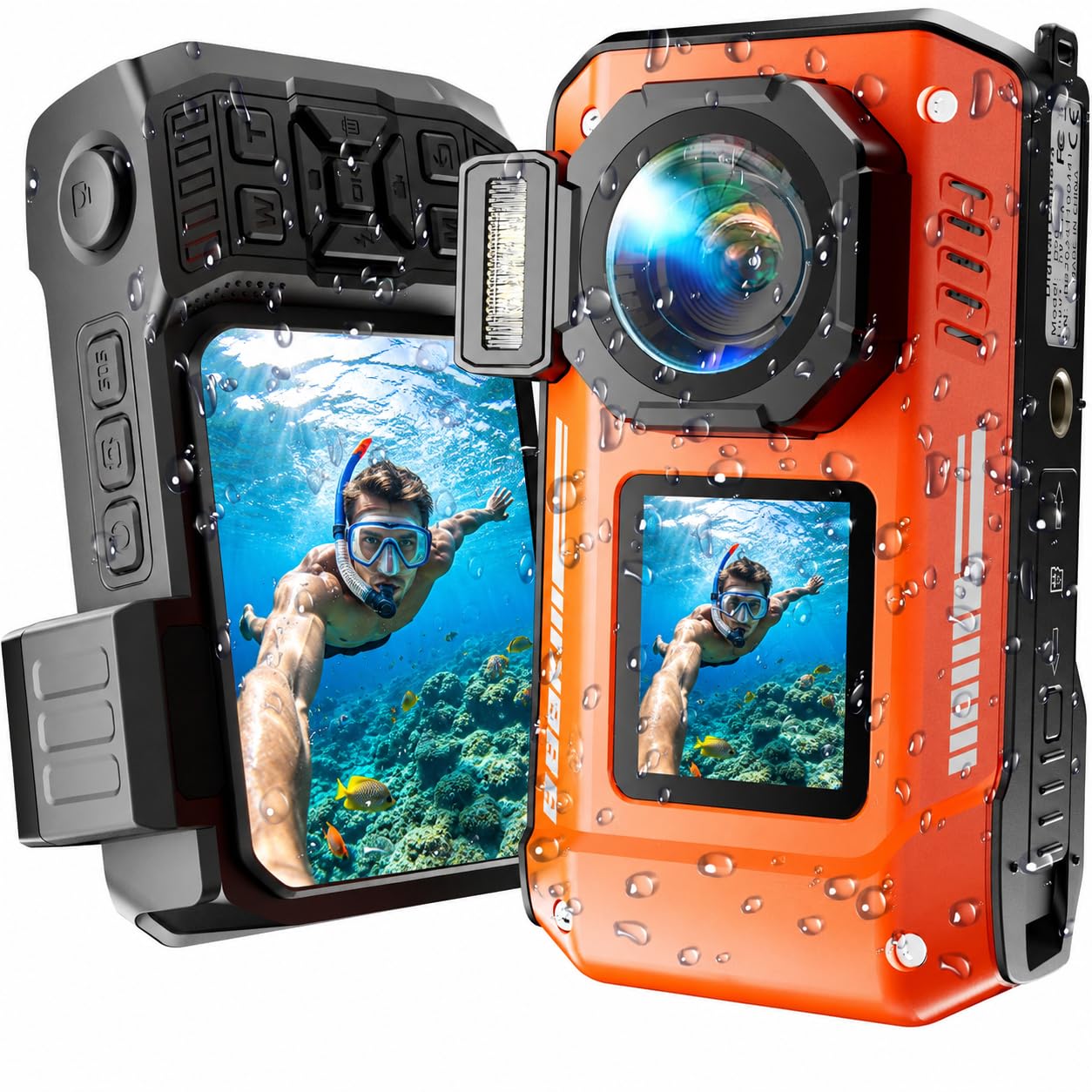
The Maxmango D50 is the simplest point-and-shoot on this list, designed for kids and absolute beginners who just want to press a button and get a decent picture. It is waterproof to 33 feet without a housing, and the IP68 seal is simple to check — just lock the battery cover. The dual-screen design (front and rear) makes selfies and group shots easy to frame without guessing, and the included 16GB card is enough for a day of casual snapping.
At 8K video and 70MP photos, the specs sound impressive on paper, but the actual output is best described as “good enough” for social media and small prints. The autofocus is quick for a sealed camera, and the built-in 2500mAh battery supports longer sessions without mid-day recharges. The camera floats, which is a critical safety feature if you drop it while snorkeling — a sinking camera is a lost camera.
The main compromises are the lack of optical zoom (everything is digital) and no WiFi, so transferring photos requires removing the microSD card. The image quality in low light or deep water (beyond 10 feet) drops significantly, and the flash is weak. For a parent buying a first camera for a child or a casual pool companion that you do not mind getting scratched, the D50 is a worry-free, low-stakes option.
Why it’s great
- Simplest interface — great for kids and non-techies
- Camera floats if dropped, preventing loss
- Long 2500mAh battery for full-day outings
Good to know
- No optical zoom; digital zoom only
- No WiFi — requires card removal for transfers
8. AKASO EK7000 Pro
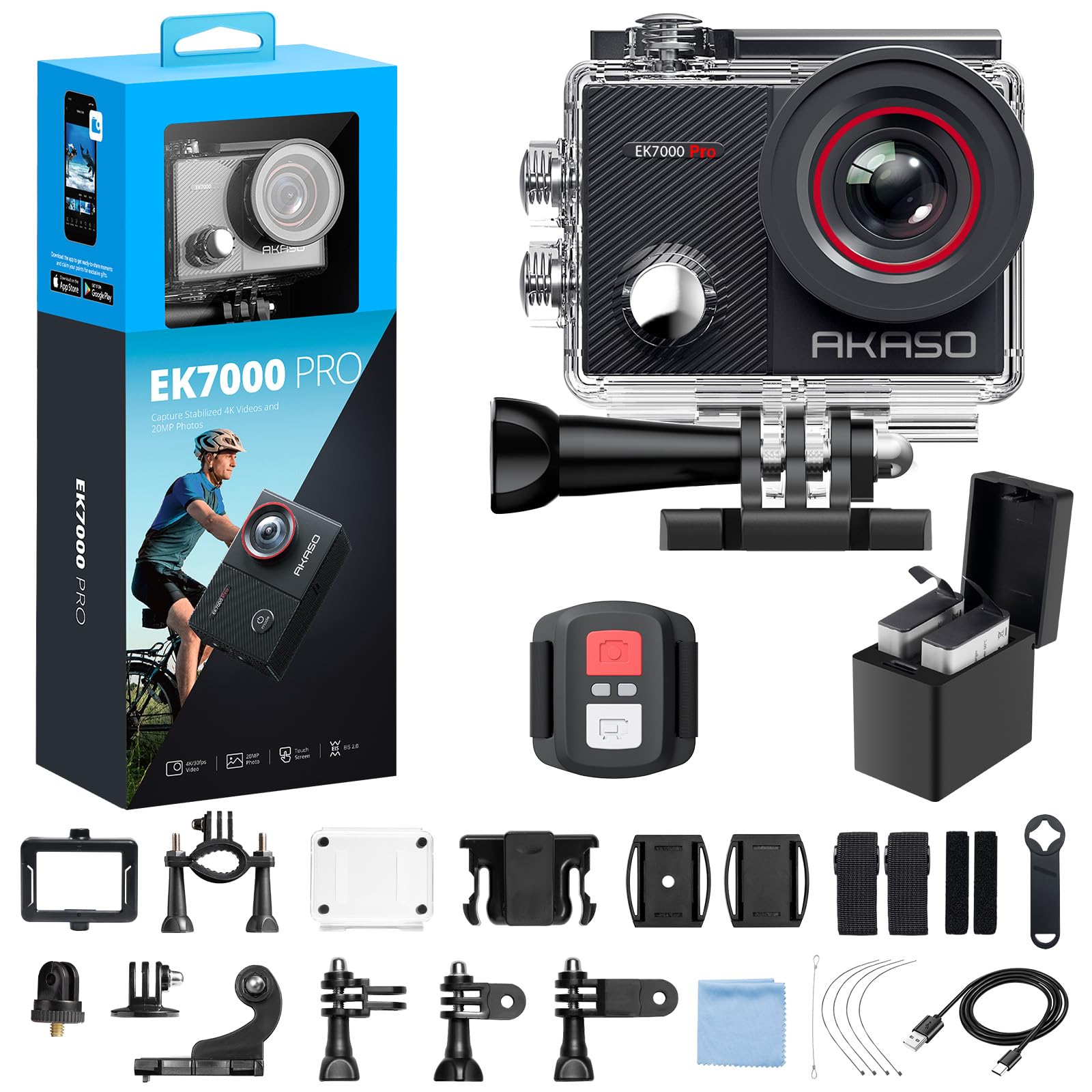
The AKASO EK7000 Pro is the updated version of one of Amazon’s most popular budget action cameras, adding a 2-inch IPS touchscreen that makes changing settings and previewing footage much easier than button-only models. It records 4K at 30fps and 1080p at 60fps, and the 20-megapixel photo mode is adequate for well-lit scenes. The waterproof case takes it down to 131 feet, matching the deeper dive rating of pricier competitors.
Electronic Image Stabilization is present, but it is the first-generation EIS that works best when you are walking or swimming at a steady pace — fast, jerky movements still produce some wobble. The 1350mAh batteries last about 140 minutes each, and the kit includes two, along with a remote control, a floating handle, and a full set of mounts. The touchscreen is responsive and the menu layout is straightforward for beginners.
The main downside is that the stabilization is noticeably weaker than the Brave 7 LE’s 6-axis system, and the 5X digital zoom is essentially useless — it just enlarges the center of the sensor, reducing quality. The Wi-Fi connection range above water is decent, but underwater range drops to near zero. For the price, it is a capable starter action camera that leaves room to grow into a more stabilized model later.
Why it’s great
- Intuitive 2-inch IPS touchscreen interface
- Waterproof to 131 feet with included housing
- Two batteries provide nearly 5 hours total recording
Good to know
- First-gen EIS struggles with fast, jerky motion
- 5X digital zoom reduces image quality significantly
9. AKASO Brave 4
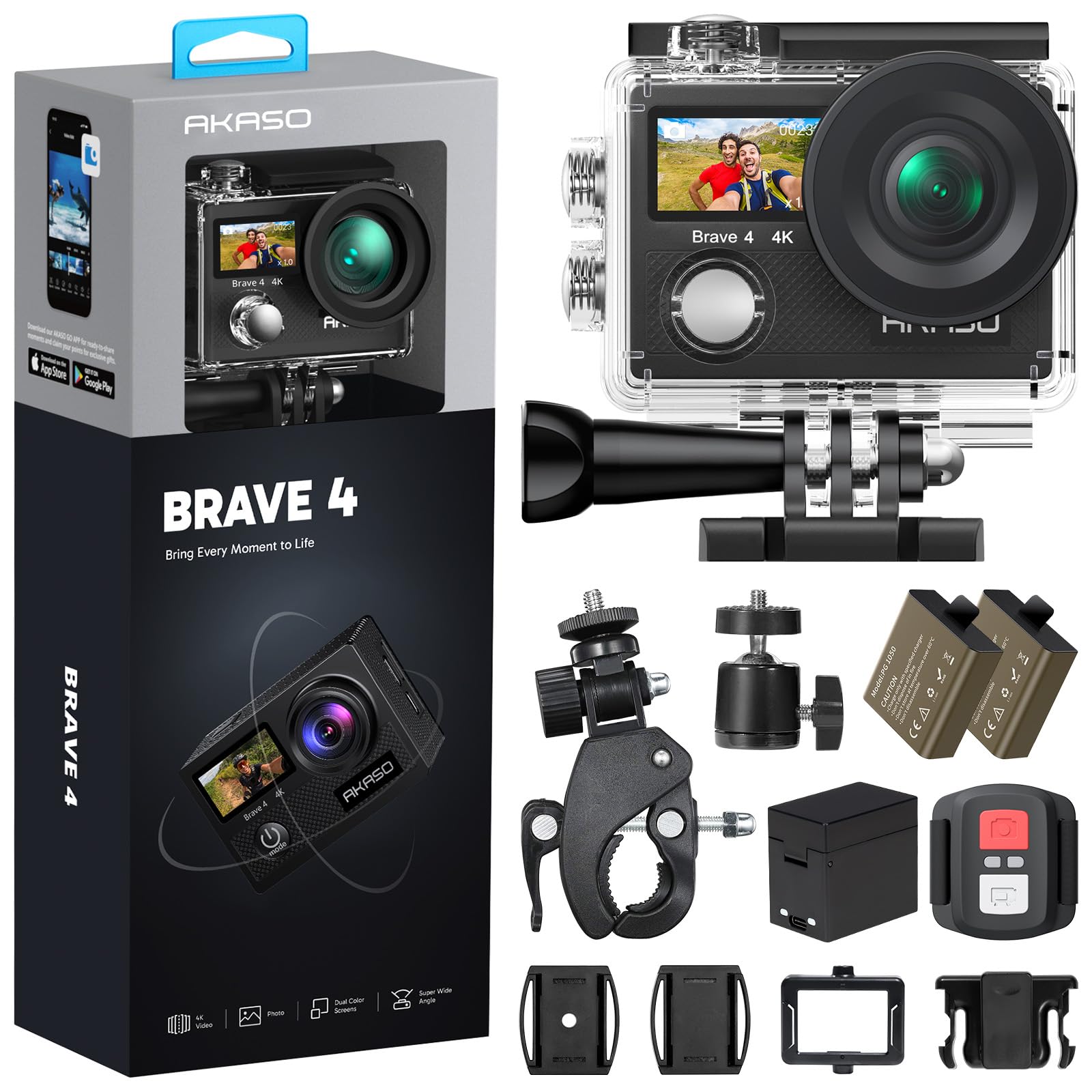
The AKASO Brave 4 is the entry-level king of accessories — the bundle includes a USB dual charger, two 1050mAh batteries, a waterproof case rated to 131 feet, and enough mounting brackets to attach the camera to a bicycle, helmet, surfboard, or chest strap. The camera itself records 4K at 30fps and 20-megapixel photos, with four adjustable viewing angles (170°, 140°, 110°, and 70°) so you can frame the shot exactly how you want.
The 0.96-inch front screen is useful for framing selfies, though it is small and low-resolution compared to newer models. The built-in smart gyroscope provides basic image stabilization, but it is not as effective as the EIS in the EK7000 Pro or Brave 7 LE — expect some jitter during active water sports. The 1050mAh batteries each last about 90 minutes, which is shorter than the EK7000 Pro’s cells, but the dual charger makes it easy to swap.
The biggest weakness is that the Wi-Fi signal drops to nearly zero within six inches underwater, and the remote wristband only triggers start and stop — no live view. The 4K video also appears softer than the EK7000 Pro’s output, and the menus feel older. For a first-time buyer who wants the fullest accessory set possible at the lowest entry price, the Brave 4 is the easiest recommendation, but the image quality ceiling is lower than the rest of this list.
Why it’s great
- Most comprehensive accessory bundle at the lowest cost
- Four adjustable FOV angles for versatile framing
- Two batteries with external dual charger included
Good to know
- WiFi drops instantly underwater; remote is start/stop only
- 4K video is noticeably softer than newer AKASO models
FAQ
How deep can a budget underwater camera safely go?
Is 4K video essential for underwater recording?
Do I need a separate waterproof case for these cameras?
Final Thoughts: The Verdict
For most users, the budget underwater camera winner is the AKASO Brave 7 LE because it combines a dual-screen vlogging design, 6-axis stabilization, and a 131-foot depth rating at a price that undercuts action cameras with similar features. If you want true optical zoom for distant subjects, grab the Kodak PIXPRO WPZ2. And for dedicated macro photography of tiny marine life, nothing beats the OM System OLYMPUS Tough TG-7.

Mo Maruf
I created WellFizz to bridge the gap between vague wellness advice and actionable solutions. My mission is simple: to decode the research and give you practical tools you can actually use.
Beyond the data, I am a passionate traveler. I believe that stepping away from the screen to explore new environments is essential for mental clarity and physical vitality.