Our readers keep the lights on and my smoothie glass nicely filled. As an Amazon Associate, I earn from qualifying purchases.
Home blood pressure monitoring has shifted from an optional health accessory to a daily necessity for millions, yet the experience hasn’t changed much in decades: a loud pump, an over-inflated cuff, and a moment of discomfort before you get the number. The newest generation of BP monitors is changing that, focusing on quieter operation, smarter inflation that doesn’t over-squeeze, and seamless data tracking that makes sharing trends with your doctor effortless.
I’m Mohammad Maruf — the founder and writer behind WellFizz. I analyze the technical specs, clinical validation, and real user experiences behind wellness hardware to help you separate genuinely better designs from marketing claims.
After comparing dozens of models ranging from basic units to connected premium devices, I’ve identified the clear winners that deliver real value without inflated promises — every option on this list has been clinically validated or FDA-cleared, making this the definitive guide to the best bp monitor for your specific needs and budget.
How To Choose The Best BP Monitor
Not all blood pressure monitors are created equal, and the differences go beyond brand names. Here are the specific factors that separate a reliable home monitoring tool from one that will frustrate you or, worse, deliver inconsistent readings.
Cuff Size and Fit Accuracy
A monitor is only as accurate as its cuff fit. The standard medium cuff fits arms 9 to 17 inches, but if your arm circumference falls outside that range, you need a model that includes an XL cuff (up to 21 inches) or supports replacement cuffs from the manufacturer. Always check the cuff range before buying — a loose cuff overestimates systolic pressure, while too-tight cuffs cause false alarms.
Memory and Multi-User Support
If two people in your household need daily readings, look for a monitor with at least dual‑user memory (typically 90 to 500 readings per user). The ability to calculate averages of your last three readings is especially useful for doctors who want trend data, not single snapshots. Models without app connectivity should store at least 30 readings locally.
Connectivity and Data Export
Bluetooth models that sync with Apple Health, Google Fit, or dedicated apps make trend tracking effortless, but you don’t need a smartphone for a reliable reading. The key differentiator is whether the app exports PDF reports for your physician and whether your data stays on US‑based servers (relevant for privacy‑conscious users). Non‑Bluetooth monitors with large backlit displays remain perfectly valid for users who prefer manual logging.
Inflation Comfort and Noise Level
Traditional monitors inflate the cuff to a preset high pressure before releasing. Newer comfort‑inflate technology stops pumping as soon as the device captures your systolic reading, reducing overall squeeze duration by roughly 10 seconds per reading. This matters if you take multiple readings per day or have sensitive arms. The pump noise also varies — some units sound like a small air compressor, while premium models are nearly silent.
Quick Comparison
On smaller screens, swipe sideways to see the full table.
| Model | Category | Best For | Key Spec | Amazon |
|---|---|---|---|---|
| AQESO | Mid-Range | Two‑cuff versatility | 2 cuffs M/L + XL (21″) | Amazon |
| Acenis | Mid-Range | Simple solo tracking | 3‑user 90‑reading memory | Amazon |
| Finicare | Mid-Range | Color‑coded results | 240 readings (120/user) | Amazon |
| Omron Silver | Mid-Range | Doctor‑recommended brand | Bluetooth + 30‑reading memory | Amazon |
| Greater Goods | Mid-Range | Wirecutter‑acclaimed app | 120 total readings + AC adapter | Amazon |
| Urion | Premium | Large 4.5″ LED screen | 199 readings (2‑user) | Amazon |
| VeriSmart | Premium | Comfort‑inflate + secure app | 6.5″ LED + 99 readings/user | Amazon |
In‑Depth Reviews
1. Omron Silver (BP5255)
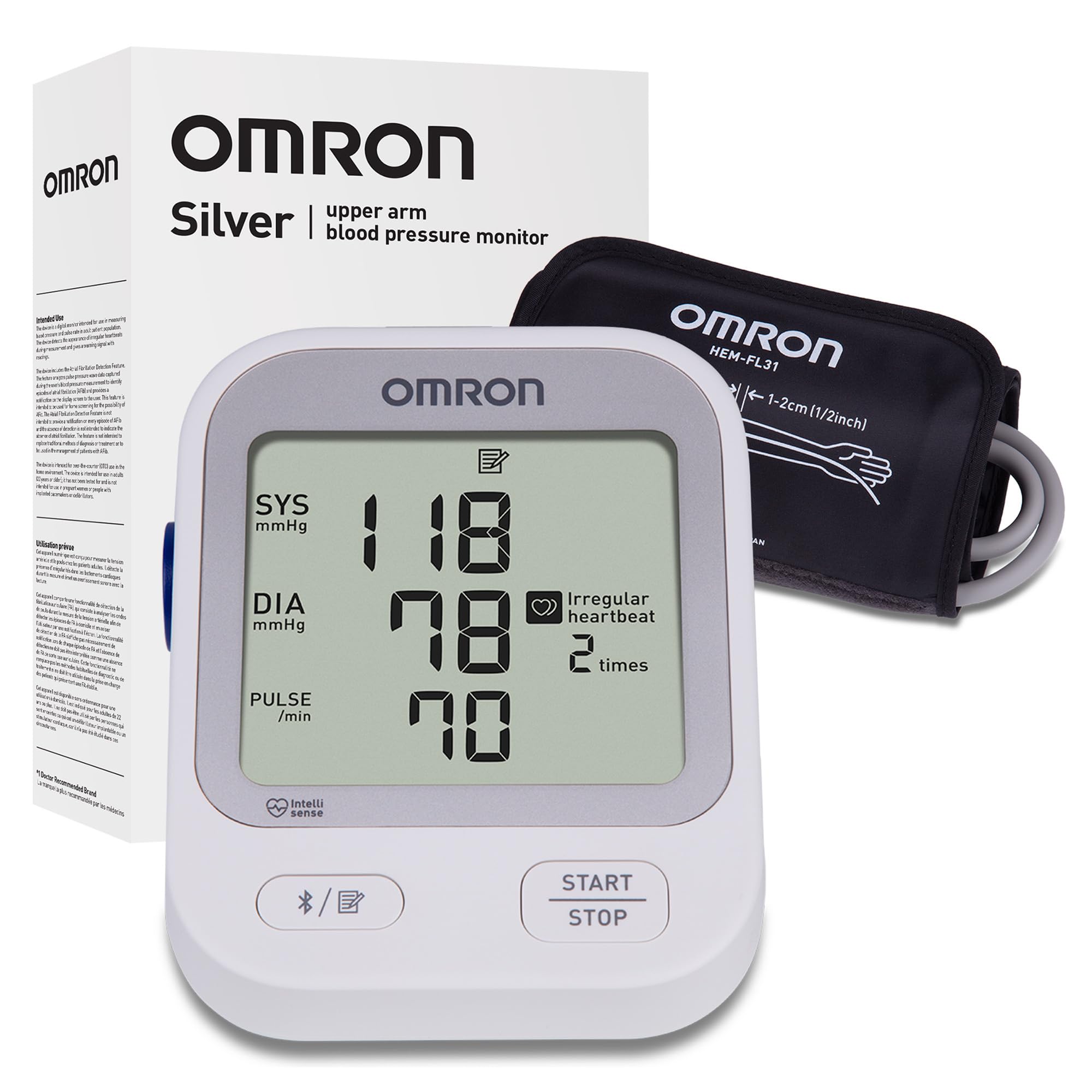
The Omron Silver is the baseline for clinical accuracy in consumer monitors. Its Advanced Accuracy Technology delivers readings that are consistently validated against a mercury manometer, and the pre‑formed ComFit cuff slides on with minimal effort — no fumbling with long fabric straps. The 9‑to‑17‑inch cuff covers most adult arms comfortably, and the one‑touch operation makes it a straightforward choice for daily use.
Bluetooth connectivity pairs with the free Omron Connect app, which stores unlimited readings on your phone and syncs automatically with Apple Health and Google Fit. The Hypertension Indicator lights up when your reading exceeds 135/85, which is a useful early flag between doctor visits. The irregular heartbeat detection is a nice safety net, though it should not replace medical evaluation.
The only real trade‑off is battery life — the four AA batteries drain faster than some competitors, roughly every four to six weeks with twice‑daily use. There is no AC adapter in the box, so plan on keeping spares handy. For the brand that doctors themselves recommend and a proven track record of accuracy, the Omron Silver is hard to beat for overall dependability.
Why it’s great
- Clinically validated accuracy (per validatebp.org)
- Easy‑don pre‑formed cuff reduces positioning errors
- Seamless Bluetooth sync with iOS and Android
Good to know
- No AC adapter included — batteries drain fairly quickly
- Memory limited to 30 local readings before syncing required
- Cuff size fixed at 9″–17″; no XL option included
2. AQESO Upper Arm BP Monitor (2 Cuffs)

The AQESO solves the single biggest fit problem in home BP monitoring: arm circumference variation within the same household. It comes with two cuffs — a Medium/Large that fits 9 to 17 inches and an XL that goes up to 21 inches — so you don’t need to buy a separate large cuff for one family member. The oscillometric algorithm is fast, delivering readings in about 30 seconds, and the WHO classification bar on the display helps you interpret results at a glance.
Memory capacity is generous at 500 readings per user (two users), which is more than enough for months of twice‑daily tracking. The backlit LCD is legible in low light, though not as bright as premium LED models. Dual power is a nice touch: you can run on four AAA batteries or plug in via USB‑C (though the monitor itself is not rechargeable — it needs continuous USB power).
One small frustration is that the USB‑C cable and wall plug are included, but the device is not rechargeable, which some users find confusing at first. The build quality is solid, and the unit is compact enough to toss in a travel bag. For families with a mix of arm sizes, this is the most inclusive option in the mid‑range.
Why it’s great
- Two cuffs in the box cover 9″ to 21″ arm circumferences
- 1000 total reading memory — best for multi‑user families
- USB‑C power option saves batteries when used at home
Good to know
- USB‑C powers the unit but does not charge a battery
- Backlight is adequate but not as vivid as LED competitors
- No app connectivity — manual logging only
3. Finicare Large LCD BP Monitor
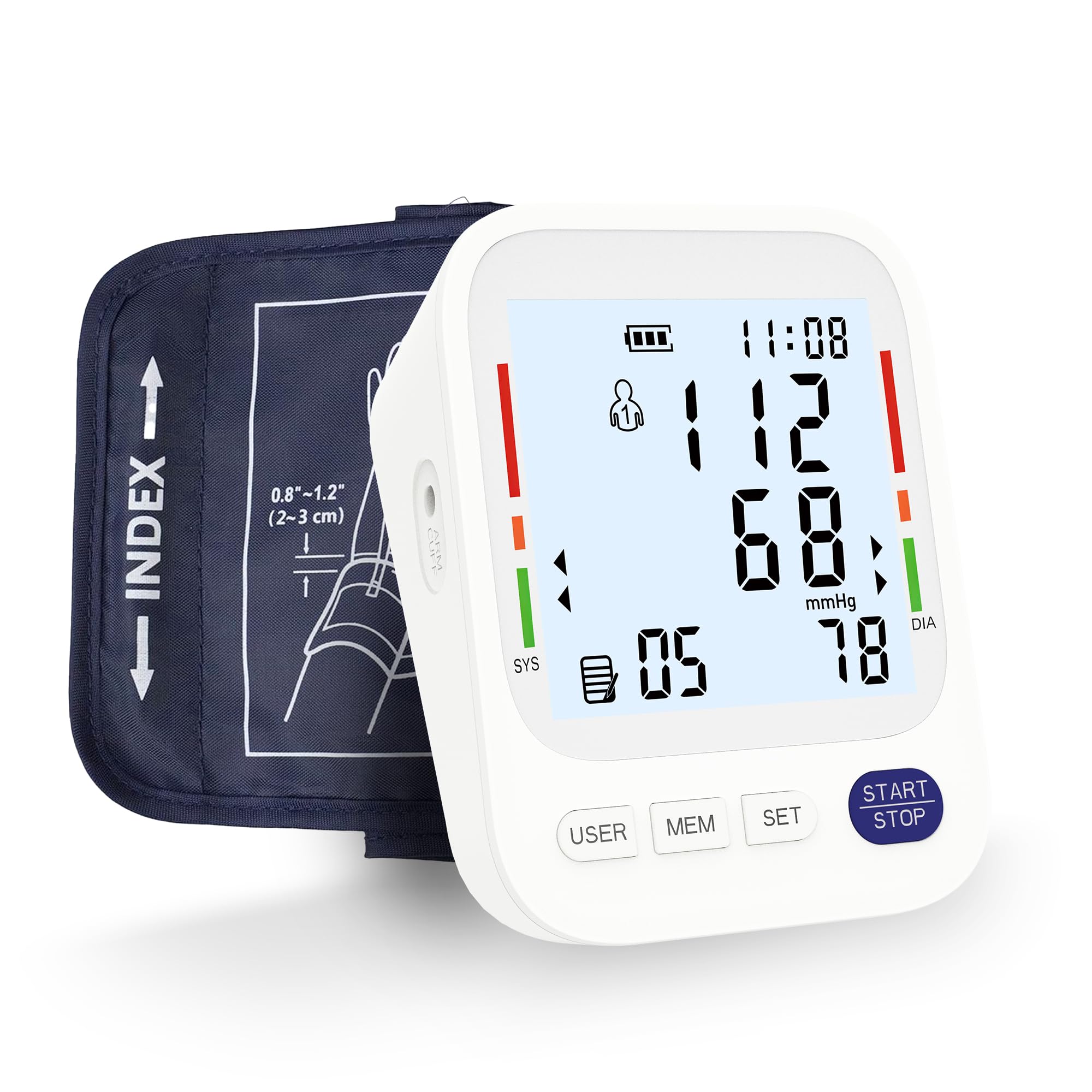
The Finicare monitor focuses on readability and feedback, which makes it a strong candidate for older users. The extra‑large LCD uses green, yellow, and red color zones so you instantly know where your reading falls without interpreting numbers — a feature that reduces anxiety for new monitors. The adjustable cuff fits 8.7 to 20.5 inches, and a wear‑check reminder confirms the cuff is seated correctly before the reading starts.
The irregular heartbeat detection and movement alert work as a pair: if the sensor detects arm motion during inflation, it flags the reading for a retake. This is genuinely useful because even small movements can skew results by 5 to 10 mmHg. The memory holds 240 readings total (120 per user), and it automatically averages the last three readings when you press the memory button — exactly what doctors want to see.
On the downside, the unit does not come with AAA batteries despite requiring them (only the USB‑C cable is included). A few users reported inconsistent readings at extreme BP levels, though the vast majority found it consistent with their doctor’s office. For its price point, the color‑coded feedback and wide cuff range make it a very user‑friendly daily driver.
Why it’s great
- Three‑color WHO indicator makes interpretation instant
- Wear‑check reminder reduces positioning errors
- Motion sensor triggers retake flag for more reliable data
Good to know
- AAA batteries not included in the package
- No Bluetooth or smartphone sync available
- One isolated report of wildly inaccurate high reading
4. Acenis Automatic Blood Pressure Monitor
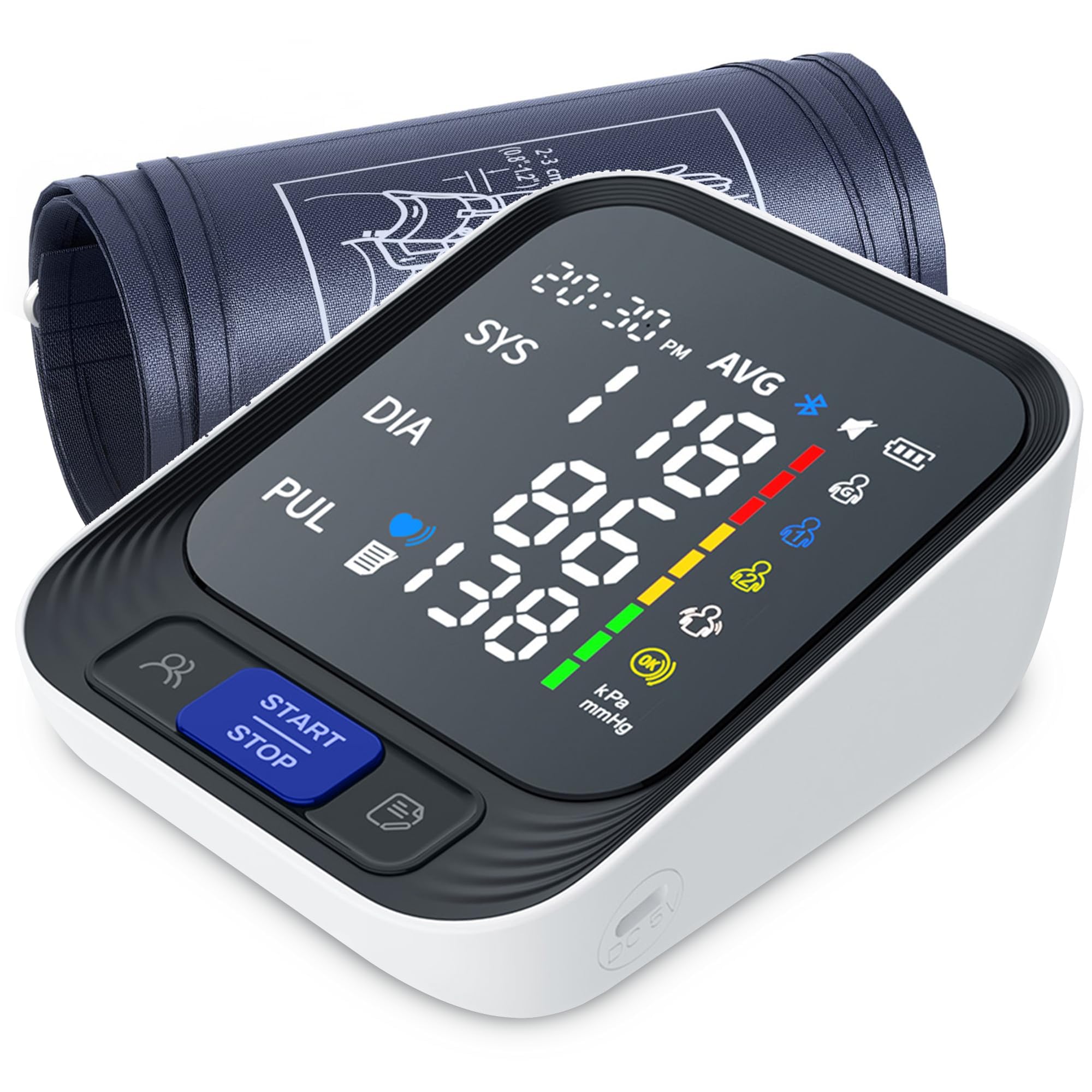
The Acenis monitor strips away unnecessary complexity and delivers exactly what a solo user or couple needs: accurate readings, a legible color screen, and straightforward memory for three individuals. The 90‑reading memory (30 per user) is modest compared to other models, but it covers a month of twice‑daily logs for one person before needing a manual reset. The large digital display uses bold digits that are easy to read without glasses.
The adjustable XL cuff fits most arm sizes without pinching, and the one‑button operation is genuinely one‑button — press start, wait 40 seconds, and your systolic/diastolic/pulse appear. The unit is lightweight at just over a pound, and the four included AAA batteries get you running immediately. Several users confirmed readings matched their prior monitor, giving confidence in the oscillometric algorithm.
Where the Acenis falls short is feature depth: there is no irregular heartbeat detection, no Bluetooth, no color‑coded indicator, and no USB power option. It is a basic, reliable tool for someone who wants a no‑fuss home monitor without app subscriptions or confusing menus. The simplicity is a strength for users who find smart monitors overwhelming.
Why it’s great
- Large color screen with bold, senior‑friendly digits
- Three‑user memory keeps separate logs for the household
- Includes batteries and power cord out of the box
Good to know
- No irregular heartbeat or motion detection features
- Memory limited to 30 reads per user — needs occasional clearing
- No Bluetooth or smartphone connectivity
5. Greater Goods Bluetooth Smart BP Monitor
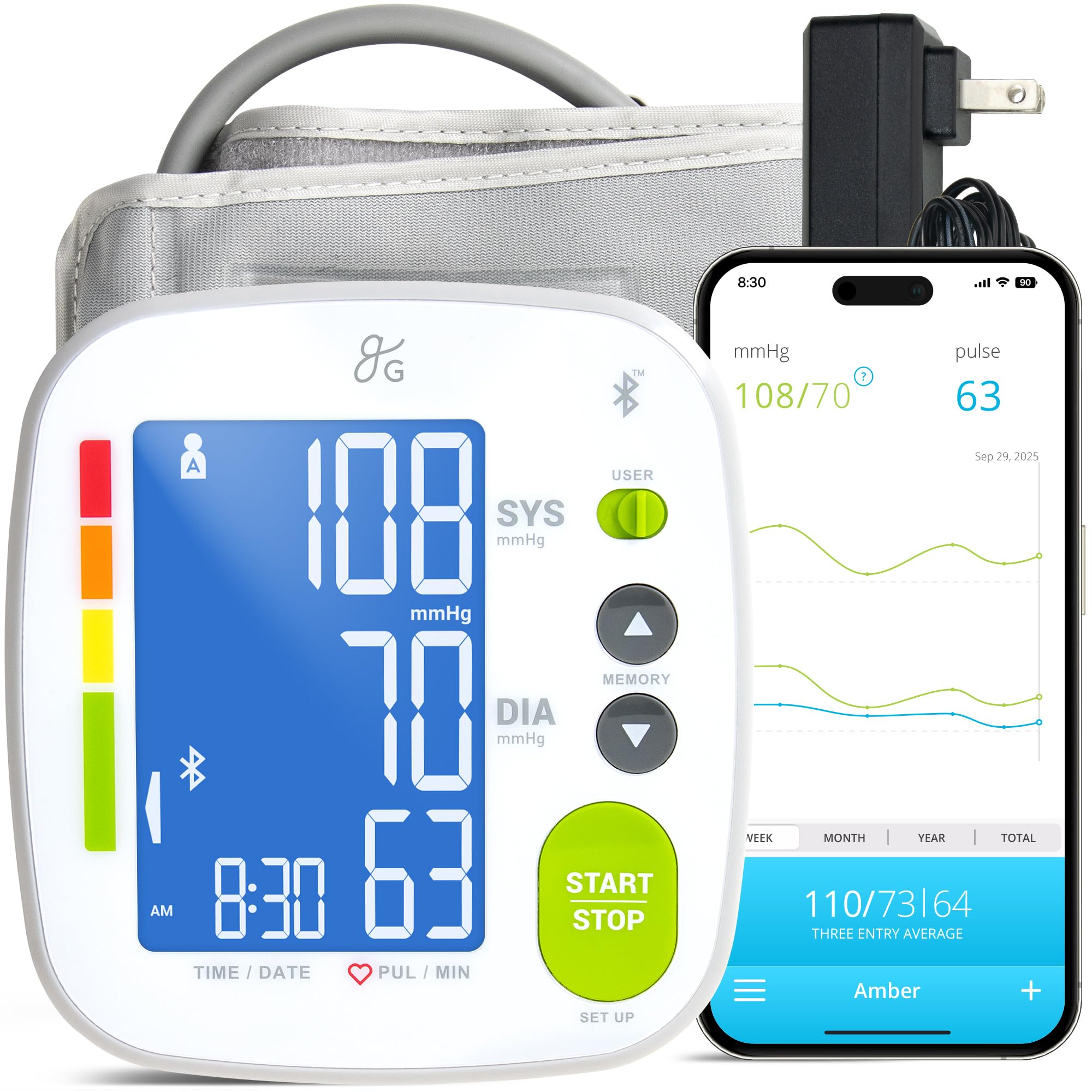
The Greater Goods monitor has been named a Wirecutter top pick multiple years running, and for good reason: the Balance Health app is one of the most polished companion apps on the market. It stores unlimited readings, calculates trends, generates PDF reports for your physician, and integrates with Apple Health. The hardware itself is solid, with an adjustable 8.7‑to‑16.5‑inch cuff, a large backlit display, and one‑touch operation that takes roughly a minute per reading.
The built‑in memory holds 60 readings per user (120 total) even without Bluetooth, so you don’t need your phone nearby for every measurement — it syncs later when you open the app. The irregular heartbeat detector adds a layer of safety, and the included AC adapter means you never have to worry about battery swaps at the wall. The travel case is also a nice touch for those who monitor on the road.
The cuff design is the main point of contention: it is a traditional wrap cuff that some users find harder to tighten one‑handed compared to Omron’s pre‑formed cuff. The start button is also a bit too easy to bump accidentally, causing premature inflation. Despite these ergonomic quirks, the combination of app quality, hardware reliability, and St.‑Louis‑based customer support makes this a top contender for data‑focused users.
Why it’s great
- Award‑winning Balance Health app with PDF export for doctors
- 120‑reading local memory — works offline, syncs later
- Includes both batteries and AC adapter out of the box
Good to know
- Cuff is not pre‑formed; one‑handed donning is trickier
- Start button protrudes and may inflate accidentally in storage
- Bluetooth sync requires app open during the reading session
6. Urion FDA‑Cleared BP Monitor
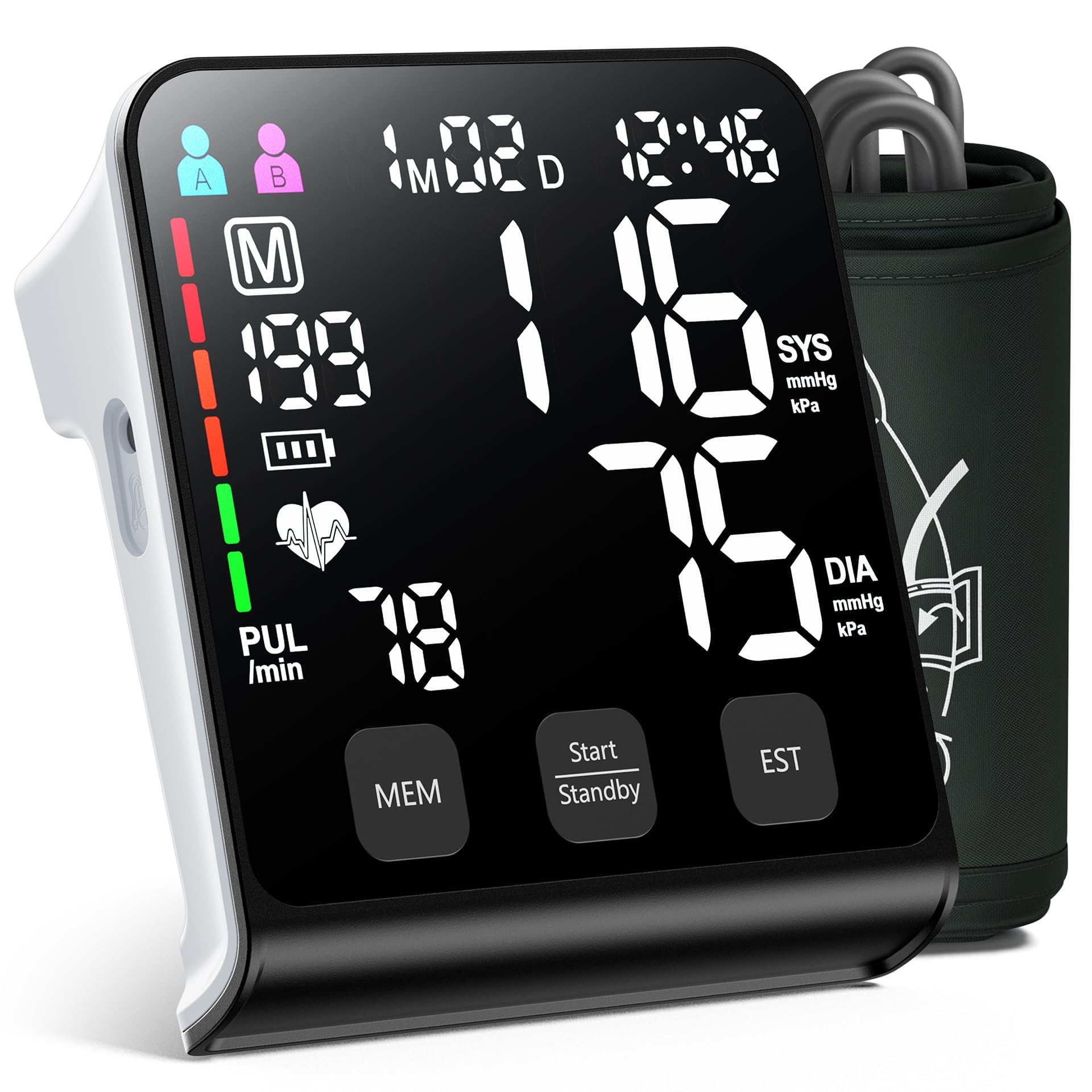
The Urion monitor stands out for its 4.5‑inch LED screen, which is genuinely brighter and more contrasty than LCD alternatives. This is a meaningful upgrade for users who check their BP in dim bedrooms or have visual impairments — the self‑illuminated digits are readable from across the room. The adjustable wide‑range cuff fits a broad spectrum of arm sizes, and the intelligent pressure algorithm maintains a tight error margin of ±3 mmHg.
The dual‑user memory stores up to 199 readings, which is enough for several months of tracking for two people. The one‑touch operation is as simple as it gets, and the irregular heartbeat alert provides an extra checkpoint. The unit is FSA and HSA eligible, which can save you pre‑tax dollars if you have a flexible spending account. The scratch‑resistant acrylic front panel also adds durability for travel.
The biggest omission here is Bluetooth — there is no app connectivity whatsoever, so trend tracking requires manual logging or just relying on the on‑device memory. The USB‑C power option is welcome, but like many USB‑powered monitors, it does not charge the unit; it requires a continuous connection. For anyone who prioritizes display clarity above all else, the Urion delivers the best screen quality in the mid‑to‑premium segment.
Why it’s great
- 4.5‑inch LED display is the brightest and most legible at this price
- FSA and HSA eligible for pre‑tax purchase
- Durable build with scratch‑resistant acrylic panel
Good to know
- No Bluetooth or smartphone app for data syncing
- USB‑C powers the unit only — no rechargeable battery inside
- Memory is generous but lacks average‑of‑last‑3 calculation
7. VeriSmart Bluetooth BP Monitor (VSH-B550)
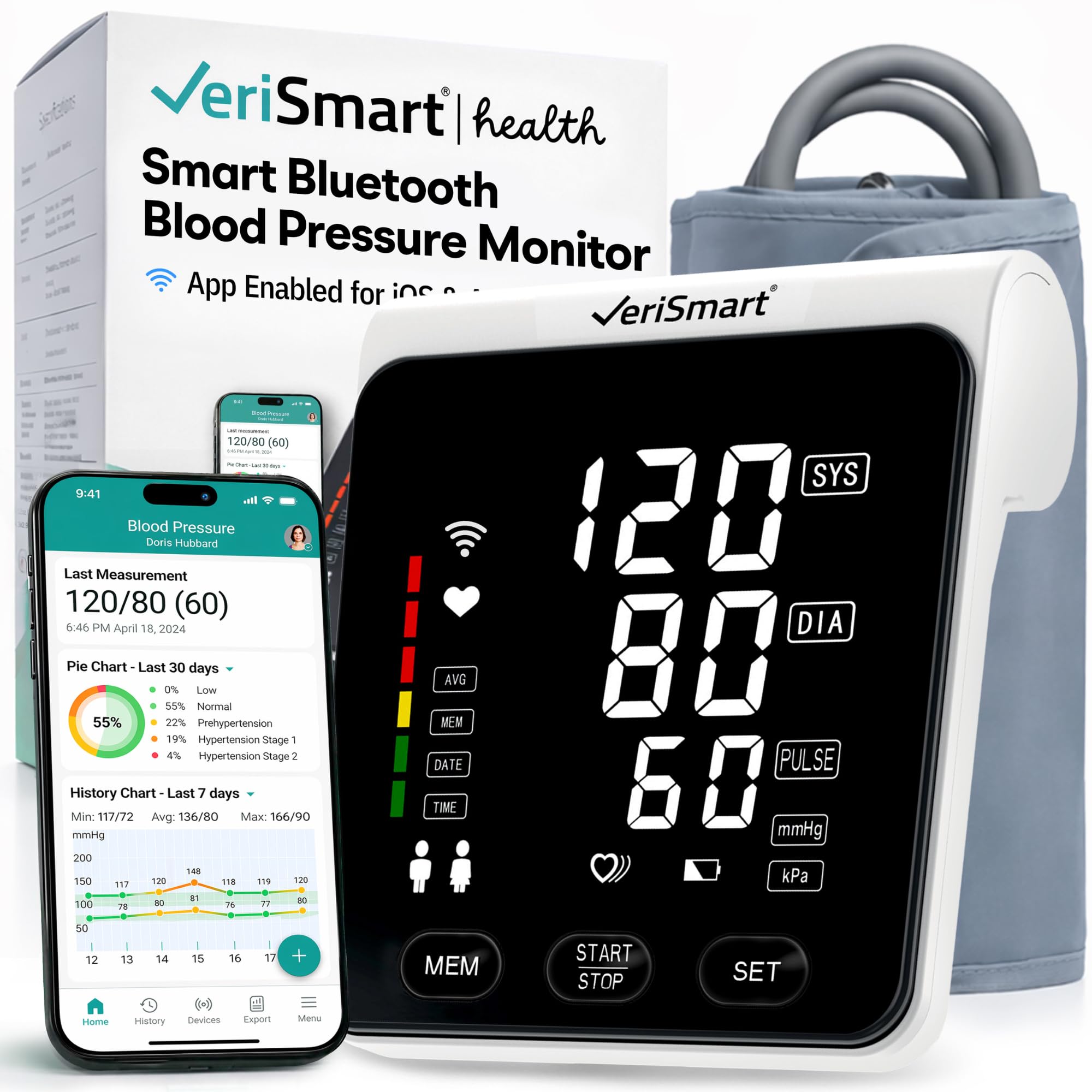
The VeriSmart VSH-B550 is the most technologically ambitious monitor on this list. Its headline feature is Comfort‑Inflate Technology — the device captures your blood pressure data as the cuff pumps up rather than over‑inflating and then releasing. The result is a reading that is both faster (roughly 35 seconds) and noticeably quieter, with far less squeeze than traditional monitors. For users who dread the tight‑cuff sensation, this is a genuine improvement in daily experience.
The 6.5‑inch LED display is the largest on this list, with self‑illuminated digits that are almost impossible to misread. The ultra‑slim profile (1.6 inches thick) and included microfiber travel bag make it genuinely portable. The dual‑user memory holds 99 readings per person locally, and the MedM Health app stores unlimited data on secure US‑based servers with Apple Health and Google Fit integration. The 5‑year warranty is also the longest coverage offered by any model here.
The main consideration is the price premium — there are cheaper Bluetooth monitors that get the job done. The VeriSmart app is excellent but requires a subscription for some premium features like automated sync with Garmin and FitBit. The comfort‑inflate system also means the cuff never reaches a high pressure, which can feel unfamiliar if you are used to the traditional “tight and release” sensation. For the quietest, most comfortable cuff experience and the brightest screen, the VeriSmart is the premium choice.
Why it’s great
- Comfort‑Inflate is quieter, gentler, and faster than standard pumps
- 6.5‑inch self‑illuminated LED display — best in class for readability
- 5‑year warranty and secure US‑based app data storage
Good to know
- Premium price point compared to equivalent‑spec competitors
- Some app features require a subscription for full ecosystem sync
- Unique inflation feel takes a few uses to get used to
FAQ
Why do my home monitor readings differ from the doctor’s office?
How often should I replace my BP monitor cuff?
What does an irregular heartbeat alert actually mean?
Can I use a BP monitor if I have arrhythmia like atrial fibrillation?
Are wrist or finger monitors as accurate as upper arm models?
Final Thoughts: The Verdict
For most users, the best bp monitor winner is the Omron Silver because it combines clinically validated accuracy, the most trusted brand name among doctors, and Bluetooth convenience without the premium price of advanced‑feature models. If you value a comfortable, nearly silent reading with the brightest screen and a robust warranty, grab the VeriSmart VSH-B550. And for families with widely varying arm sizes who want two cuffs in one box, nothing beats the AQESO with M/L and XL cuffs.

Mo Maruf
I created WellFizz to bridge the gap between vague wellness advice and actionable solutions. My mission is simple: to decode the research and give you practical tools you can actually use.
Beyond the data, I am a passionate traveler. I believe that stepping away from the screen to explore new environments is essential for mental clarity and physical vitality.