Our readers keep the lights on and my smoothie glass nicely filled. As an Amazon Associate, I earn from qualifying purchases.
Finding a board game that works brilliantly for exactly two players, where you work as a team rather than against each other, is a specific challenge. Many “cooperative” titles feel flat or too easy with just two, while others suffer from the dreaded “alpha player” problem where one person dictates all the moves. The games on this list were chosen because they solve this tension, offering strategic depth and genuine partnership that scales perfectly down to a duo.
I’m Mohammad Maruf — the founder and writer behind WellFizz. I’ve spent years analyzing the mechanical structures, player-count scaling, and component quality of hundreds of board games to identify which titles truly deliver when it’s just two players against the game itself.
After researching playtime lengths, difficulty curves, and replayability factors, I’ve curated a selection of the absolute best 2-player cooperative board games that turn your table into a true co-op command center.
How To Choose The Best 2-Player Cooperative Board Games
The most common mistake is assuming a game’s player count means the experience scales linearly. A game labeled for 2-4 players can feel vastly different with just two. The key is finding titles designed or optimized for the duo dynamic.
Game Mechanics That Foster True Partnership
Look for mechanics that require both players to act independently but toward a shared goal. Games that rely on silent communication (like Sky Team’s dice placement behind screens) or role-based actions (like Pandemic’s distinct specialists) prevent one player from quarterbacking. Avoid games where the team’s optimal move is obvious or dictated by a single card draw.
Playtime and Difficulty Curve
A 20-minute game like Sky Team is perfect for a weeknight, while a 60-minute session of Pandemic offers a deeper strategic arc. Harder doesn’t always mean better—look for adjustable difficulty (like the number of Epidemic cards in Pandemic) so the game grows with your skill level. A game that you can win roughly 40-70% of the time keeps the stakes high without causing frustration.
Replayability and Component Quality
Variable setups, multiple scenarios, or campaign modes are essential for long-term value. Games with high-quality cards, thick tokens, and durable boards handle repeated play without wear. Pay attention to box size and storage solutions—a compact box (like Splendor Duel) is better for travel, while a more elaborate box (like Forbidden Jungle) requires shelf space.
Quick Comparison
On smaller screens, swipe sideways to see the full table.
| Model | Category | Best For | Key Spec | Amazon |
|---|---|---|---|---|
| Sky Team | Dice Placement | Intense silent teamwork | 20 Minutes | Amazon |
| Lord of the Rings: Duel for Middle-Earth | Card Drafting | Asymmetrical thematic strategy | 30 Minutes | Amazon |
| Pandemic | Role-Based Co-op | Classic high-stakes strategy | 45-60 Minutes | Amazon |
| Splendor Duel | Engine Building | Competitive head-to-head drafting | 30 Minutes | Amazon |
| Castle Panic 2nd Ed. | Tower Defense | Family-friendly monster defense | 45 Minutes | Amazon |
| Forbidden Jungle | Tile Exploration | Team survival puzzle | 45 Minutes | Amazon |
| Escape The Dark Castle | Narrative Co-op | Quick storytelling sessions | 30 Minutes | Amazon |
In‑Depth Reviews
1. Sky Team

Sky Team earned its “Game of the Year 2024” status by redefining two-player cooperative play. You and your co-pilot must land a plane by silently placing dice on a cockpit board—no talking during the round except for pre-planned signals. This mechanic completely eliminates the quarterbacking problem because each player has a private hand of dice and a unique set of responsibilities (like controlling speed or leveling wings).
The game comes with 20 different airport scenarios, each adding new rules like ice on the tarmac or a kerosene leak. This modular approach means you can play for months without repeating the exact same puzzle. The components are clean and compact, with a control panel board and player aid screens that feel thematic without being cluttered.
Setup takes under two minutes, and a single game finishes in about 20-30 minutes. The dice mitigation via coffee tokens keeps the randomness in check—you’re never at the mercy of a bad roll. For couples or duos who want a tense, cooperative challenge that rewards trust and planning, Sky Team is the clear frontrunner.
Why it’s great
- Silent dice placement creates genuine tension and teamwork.
- 20 unique scenarios offer exceptional replayability.
- Quick setup and playtime fit busy schedules.
Good to know
- Requires a partner who enjoys limited communication.
- Some scenarios are significantly harder than others.
2. The Lord of the Rings: Duel for Middle-Earth

Based on the acclaimed 7 Wonders Duel system, this game drops you into the epic struggle between the Fellowship and Sauron. The core card-drafting mechanism is sharp, but the Middle-earth theme adds tactical layer with area control on the map board, tower building, and asymmetrical win conditions. You can win by destroying the Ring, forging alliances with six Peoples, or dominating territory—three distinct paths that keep every game feeling different.
The asymmetry is the star here. One player controls the Ringbearers, the other commands the forces of Mordor. Each side has unique leader cards and abilities, so mastering both roles takes time. The game plays in about 30 minutes, making it deceptively deep for its length. The artwork is gorgeous, and the component quality—thick cards, sturdy tokens, and a two-part board—matches the premium price point.
This is a game that rewards repeated plays as you learn the specific card combos and tempo shifts. It’s slightly more competitive-leaning than pure co-op, but the asymmetrical objectives create a tight, balanced duel. If you want a thematic, brain-burning strategy game that looks beautiful on the table, this is a top-tier choice.
Why it’s great
- Three distinct win conditions add strategic variety.
- Asymmetrical roles feel balanced and thematic.
- Exceptional component quality and artwork.
Good to know
- More competitive-feeling than pure co-op.
- Some familiarity with 7 Wonders Duel helps.
3. Pandemic

Pandemic is the gold standard of cooperative board games for a reason. With two players, each person takes on a specialist role (Medic, Scientist, Dispatcher, etc.) and the team works to cure four deadly diseases before outbreaks overwhelm the world. The key to its two-player brilliance is that each player controls two characters, which adds a layer of complexity without feeling like a burden. You must manage two hands of cards and two sets of actions, which forces constant communication and planning.
The adjustable difficulty is a massive plus for duos. You can start with four Epidemic cards for a manageable challenge and ramp up to six for a brutal test. The cascade outbreaks—where a chain reaction of infections can lose the game in a single turn—create real tension. A 45-60 minute session feels like a mini-campaign, and the random roles and disease hotspots ensure high replayability.
The component quality is solid, with thick city cards and a sturdy board. The only minor drawback is the small city spaces on the map, which can get crowded. But as a foundational co-op experience that works beautifully with two, Pandemic is an essential part of any collection.
Why it’s great
- Adjustable difficulty with Epidemic cards.
- Each player controls two roles for deep strategy.
- Timeless cooperative formula with high replayability.
Good to know
- Requires tracking two hands of cards per player.
- City spaces on the board can feel cramped.
4. Splendor Duel
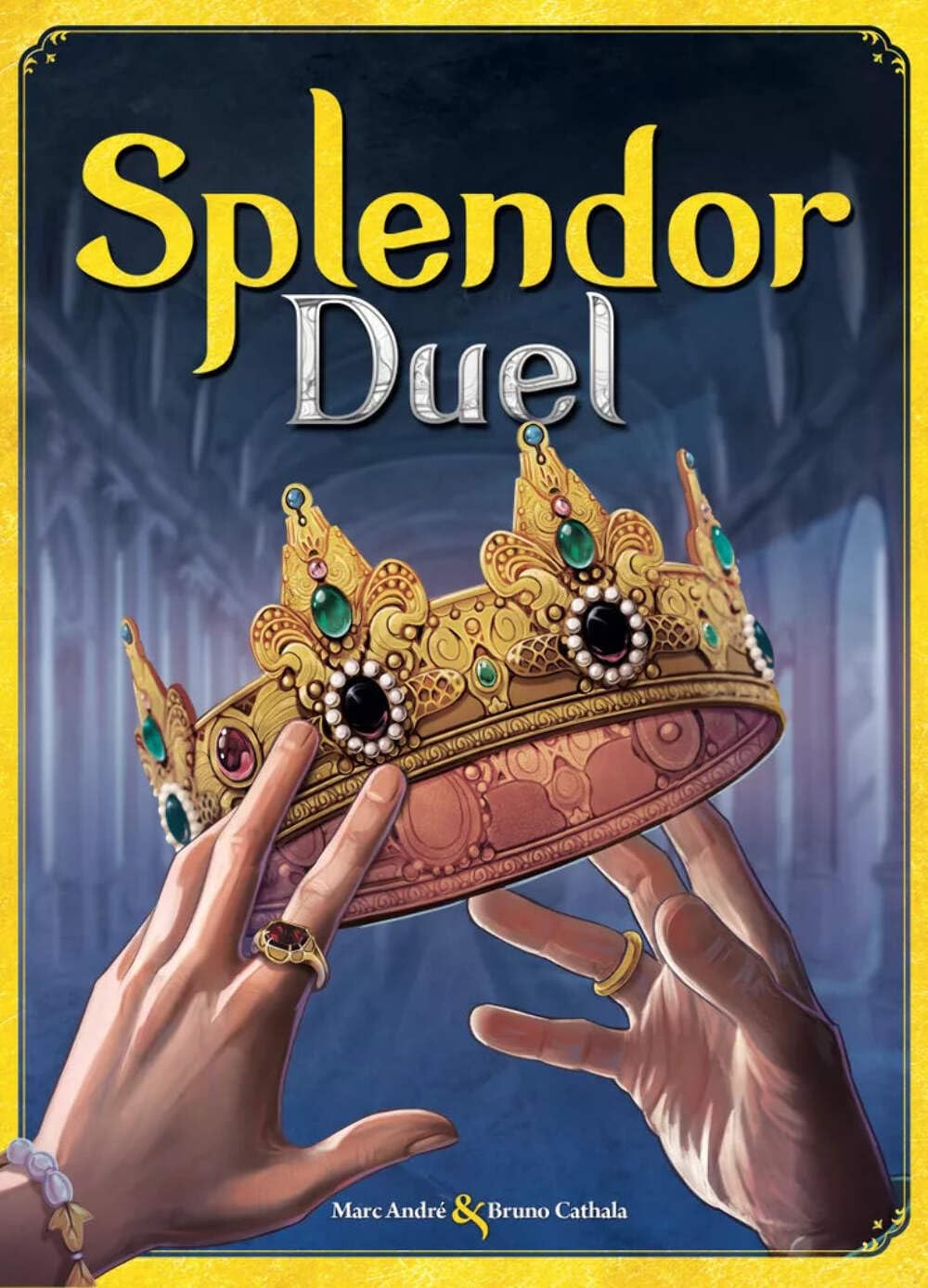
Splendor Duel is the rare game that improves on its famous predecessor for the two-player count. While the original Splendor works with 2-4 players, this version is designed exclusively for a head-to-head gem-collecting battle. The central board adds a shared card market and a restriction that you can only pull gem tokens from certain rows, creating a tense tug-of-war over resources.
New mechanics like pearl tokens, privilege scrolls, and alternative win conditions (60 prestige points, or collecting 10 points and a specific noble tile) add layers the original lacked. The game is fast—each round takes about 30 minutes—but the decisions are crunchy. You have to balance gem acquisition, card drafting, and denying your opponent key moves. The components are high-quality: thick plastic gem tokens, sturdy cards, and a nice board.
This is more competitive than purely cooperative, but the tight resource economy forces reactive play that feels like a dance. If you and your partner enjoy a competitive but fair fight with beautiful production values, Splendor Duel is an easy recommendation.
Why it’s great
- Designed exclusively for two players, no compromises.
- New mechanics add depth over original Splendor.
- Compact box great for travel.
Good to know
- Competitive, not cooperative.
- Can be frustrating if one player gets a lucky early run.
5. Castle Panic 2nd Edition

Castle Panic is the perfect entry-level cooperative game for duos who want to defend a castle against waves of monsters. The 2nd Edition adds 3D towers and updated artwork, giving the game a tactile, toy-like feel that kids and adults love. The core loop is simple: trade cards to hit monsters in different ring zones of the board, and keep at least one tower standing to win.
The cooperative element works well with two because you each have a hand of cards and must decide together which monsters to target first. The monster tokens are colorful and chunky, and the card-trading mechanism forces you to communicate. The game also includes an Overlord mode where one player controls the monsters, adding a competitive variant if you want a change of pace.
With a 45-minute playtime and adjustable difficulty (by adding more boss monsters or plagues), it scales well from a relaxed family game to a tense siege. The components are durable enough for repeated play, and the simple rules mean you can teach it in under five minutes. A solid, low-stress option for regular game nights.
Why it’s great
- Easy to learn, accessible for all ages.
- 3D towers and chunky tokens feel great.
- Multiple game modes increase longevity.
Good to know
- Artwork is functional but not premium.
- Experienced gamers may crave more depth.
6. Forbidden Jungle

From the designer of the Forbidden Island/Desert series, this latest entry adds an alien-infested jungle to the survival formula. You and your team must explore the board, remove sinkholes, align crystals, and escape before the aliens overrun the map. The cooperative twist is that each player has a unique role with four possible actions per turn (move, reveal, use equipment, or fight aliens), which means no two turns are the same.
With two players, each person can control one or two characters (like a mini-Dungeons & Dragons session). The threat cards escalate the difficulty, and aliens move from eggs to mature forms, adding a dynamic puzzle element. The tiles are high-quality, and the miniatures are solid plastic pieces that feel substantial. The adjustable starting threat level lets you calibrate the challenge.
At 45 minutes per game, it’s a tense race against time. The combination of strategy and luck (from card draws and dice rolls) keeps it fresh. It’s harder than Forbidden Island but more approachable than some other co-op titles, making it a great middle ground for duos who want a tough but fair challenge.
Why it’s great
- Unique tile-laying and alien evolution mechanics.
- Adjustable difficulty for all skill levels.
- High-quality components and miniatures.
Good to know
- Lots of small pieces require good storage.
- Can be hard to win on advanced settings.
7. Escape The Dark Castle

Escape The Dark Castle is a narrative-driven game where you and your partner play as prisoners trying to escape a castle’s horrors. The game uses large, beautifully illustrated chapter cards that tell a story as you flip them. You roll dice and make decisions—but the outcomes are often brutal. With two characters, the game is incredibly hard; you may not reach the boss on your first few attempts.
The components are thematic: 45 chapter cards, 35 item cards, 6 character cards, and a set of dice specific to characters and chapters. Setup takes two minutes, and a single session lasts about 30 minutes. The vintage fantasy art style (reminiscent of old-school D&D illustrations) is a major selling point for fans of the genre. The expansions add more chapters and items, extending the life of the base game.
The difficulty is its biggest double-edged sword. With two players, the game feels almost unfair sometimes, but that makes winning genuinely satisfying. It’s not for those who dislike high randomness, but if you enjoy a shared storytelling experience where you can laugh at your failures, it’s a charming and affordable entry.
Why it’s great
- Unique narrative format with beautiful chapter cards.
- Quick setup and short playtime.
- Strong theme and atmospheric art.
Good to know
- Extremely difficult with two players.
- Large chapter cards are awkward to shuffle without sleeves.
FAQ
How do I avoid the alpha player problem in a two-player co-op game?
Which 2-player co-op game offers the best replay value?
Are these games suitable for beginners?
Final Thoughts: The Verdict
For most users, the best 2-player cooperative board game winner is the Sky Team because it perfectly solves the quarterbacking problem with its silent dice placement and offers 20 unique scenarios for endless replayability. If you want a thematic, asymmetric strategy duel, grab the Lord of the Rings: Duel for Middle-Earth. And for a classic, high-stakes team experience, nothing beats the Pandemic.

Mo Maruf
I created WellFizz to bridge the gap between vague wellness advice and actionable solutions. My mission is simple: to decode the research and give you practical tools you can actually use.
Beyond the data, I am a passionate traveler. I believe that stepping away from the screen to explore new environments is essential for mental clarity and physical vitality.