Our readers keep the lights on and my smoothie glass nicely filled. As an Amazon Associate, I earn from qualifying purchases.
Porcelain is tough—until it chips, cracks, or starts popping loose. The wrong adhesive leaves you with a brittle fix that fails under humidity, foot traffic, or thermal cycling, turning a simple repair into a full tear-out. Finding an adhesive that actually bonds to the dense, non-porous surface of porcelain requires understanding specific chemistry, not just grabbing any construction tube off the shelf.
I’m Mohammad Maruf — the founder and writer behind WellFizz. My research focuses on matching real-world material science to consumer repair scenarios, analyzing over 200 adhesive formulations across epoxy, acrylic, and copolymer categories to identify what truly locks onto glazed and unglazed porcelain substrates.
This guide breaks down five distinct solutions for best adhesive for porcelain repairs, from color-matching chip fillers to syringe-injected floor re-bonding systems, helping you choose the exact chemistry and application method your specific damage demands.
How To Choose The Best Adhesive For Porcelain
Porcelain’s low porosity and high density make it one of the hardest surfaces to bond. Unlike ceramic or stone, many adhesives simply sit on the surface rather than penetrating, leading to quick failure. Three factors separate a lasting bond from a weekend repair that pops off Monday morning.
Bond Chemistry: Epoxy vs Acrylic vs Copolymer
Epoxy-based adhesives cure to a hard, waterproof finish that mimics the original porcelain surface—ideal for chip and crack repairs where sanding and polishing follow. Acrylic pastes like Quikrete’s mortar repair offer faster setting times and better texture matching for grout-line and masonry-level repairs. Copolymer liquids such as Fix-A-Floor are thin enough to flow under hollow tiles, re-bonding to the subfloor without needing to remove the tile. Match the chemistry to the damage: epoxy for surface defects, acrylic for structural gaps, copolymer for under-tile voids.
Application Method: Syringe, Squeeze Tube, or Mat
Small vertical chips on wall tiles call for a precision squeeze tube or brush-on epoxy that stays put without dripping. Loose floor tiles on a concrete subfloor benefit from a syringe-injected copolymer that flows into the void and creates a suction-like bond. For new installations or full backsplash projects, an adhesive mat like MusselBound eliminates dry time entirely, allowing immediate grouting. The application tool dictates whether you fix the damage or make it worse—choose the delivery system that matches the repair’s location and orientation.
Cure Conditions: Humidity, Temperature, and Weight
Every porcelain adhesive has a specific cure window. Most epoxies and acrylics require 24 hours of undisturbed setting in room-temperature conditions (60–80°F). High humidity slows evaporation-based cures, while extreme heat can cause epoxy to yellow or crack. For floor tile re-bonding, applying even weight (flat-bottomed water buckets or weighted boards) during the full cure period prevents the tile from shifting and ensures the adhesive spreads into every micro-gap. Ignoring cure conditions is the single most common reason for bond failure in porcelain repairs.
Quick Comparison
On smaller screens, swipe sideways to see the full table.
| Model | Category | Best For | Key Spec | Amazon |
|---|---|---|---|---|
| Fix-A-Floor Loose Tile Repair | Copolymer Liquid | Re-bonding loose floor tiles | Syringe-injected, 24 hr cure | Amazon |
| Hupeyna Fiberglass Repair Kit | Epoxy Paste | Multi-surface chip & crack repair | 1:1 epoxy mix, 8 pigments | Amazon |
| Ankita Tile Repair Kit | Epoxy Paste | Color-matched chip repair | 8 pigments, super hard finish | Amazon |
| Quikrete Mortar Repair | Acrylic Paste | Brick & grout line repair | Acrylic, 5.5 oz tubes (3-pack) | Amazon |
| MusselBound Adhesive Mat | Peel-and-Stick Mat | New wall tile installation | 15 sq ft roll, peel-and-stick | Amazon |
In‑Depth Reviews
1. Fix-A-Floor Loose Tile Repair Adhesive with Syringe
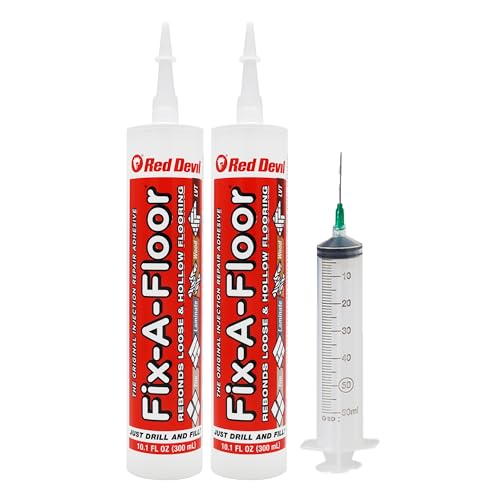
Fix-A-Floor solves the most frustrating porcelain problem: a tile that feels solid but sounds hollow when you walk on it. Instead of chiseling out the tile and risking breakage, this copolymer liquid flows through a small drilled hole or existing narrow grout lines, spreading underneath to re-bond the tile to the subfloor. The syringe applicator gives you precise control for injecting into gaps as tight as 2.5mm, and the 24-hour full cure creates a permanent bond without drying or cracking—critical for high-traffic porcelain floors.
Users consistently report fixing between 7 and 20 loose tiles in a single session, noting that the product eliminates the hollow sound and prevents tiles from shifting under foot traffic. The extra-strength formula is compatible with ceramic, marble, stone, and engineered wood subfloors, making it a versatile option for homes with mixed flooring. The method is straightforward: drill a small hole in the grout line, inject the adhesive, and apply even weight over the repair spot for the full cure period.
A few users mention that the product flows slowly, requiring patience and steady hand pressure, especially when filling larger voids. It is not recommended for floating floors, and the manufacturer advises against using skeleton-style or high-thrust caulk guns—stick with the Red Devil 3935 or similar models for optimal output. For anyone facing a loose floor tile that risks becoming a full replacement project, Fix-A-Floor offers a non-destructive, proven solution.
Why it’s great
- Eliminates hollow-sounding tiles without removal
- Syringe allows precision injection into tight grout lines
- Permanent copolymer bond resists cracking under foot traffic
Good to know
- Requires specific caulk gun type for best results
- Not suitable for floating or click-lock floors
2. Hupeyna Fiberglass Repair Kit

Hupeyna’s repair kit takes a broad-spectrum approach, offering an epoxy paste that bonds to porcelain, fiberglass, enamel, acrylic, granite, marble, and even quartz. The 1:1 mix ratio between part A (resin) and part B (hardener) cures to a smooth, waterproof finish that can be sanded and polished to match the surrounding surface. With eight pigments included—white, black, yellow, light yellow, red, blue, coffee, and green—you can mix custom colors to match virtually any porcelain tile or fixture shade.
Real-world applications range from fixing a chunk busted out of a ceramic floor tile to repairing bathtub chips and scratches. Users describe the repair as so seamless that visitors cannot spot where the damage was. The kit works especially well for larger surface defects like dents, holes, and deep scratches, where the epoxy paste can fill the void and be shaped before curing. The waterproof and heat-resistant properties make it suitable for bathroom and kitchen environments where moisture and temperature changes are constant.
The chemical smell during mixing requires proper ventilation, and some users note that the included instructions are sparse—basic epoxy mixing knowledge helps. The dye vials have sealed nipples that need to be pierced carefully to avoid spillage. For those who want a single-kit solution for multiple surface types and are comfortable mixing their own color match, Hupeyna delivers excellent versatility and a hard-wearing final surface.
Why it’s great
- Works on 10+ surface materials, not just porcelain
- 8 pigments enable custom color blending
- Waterproof and heat-resistant after 24-hour cure
Good to know
- Strong chemical odor during application
- Instructions lack detail for first-time epoxy users
3. Ankita Tile Repair Kit
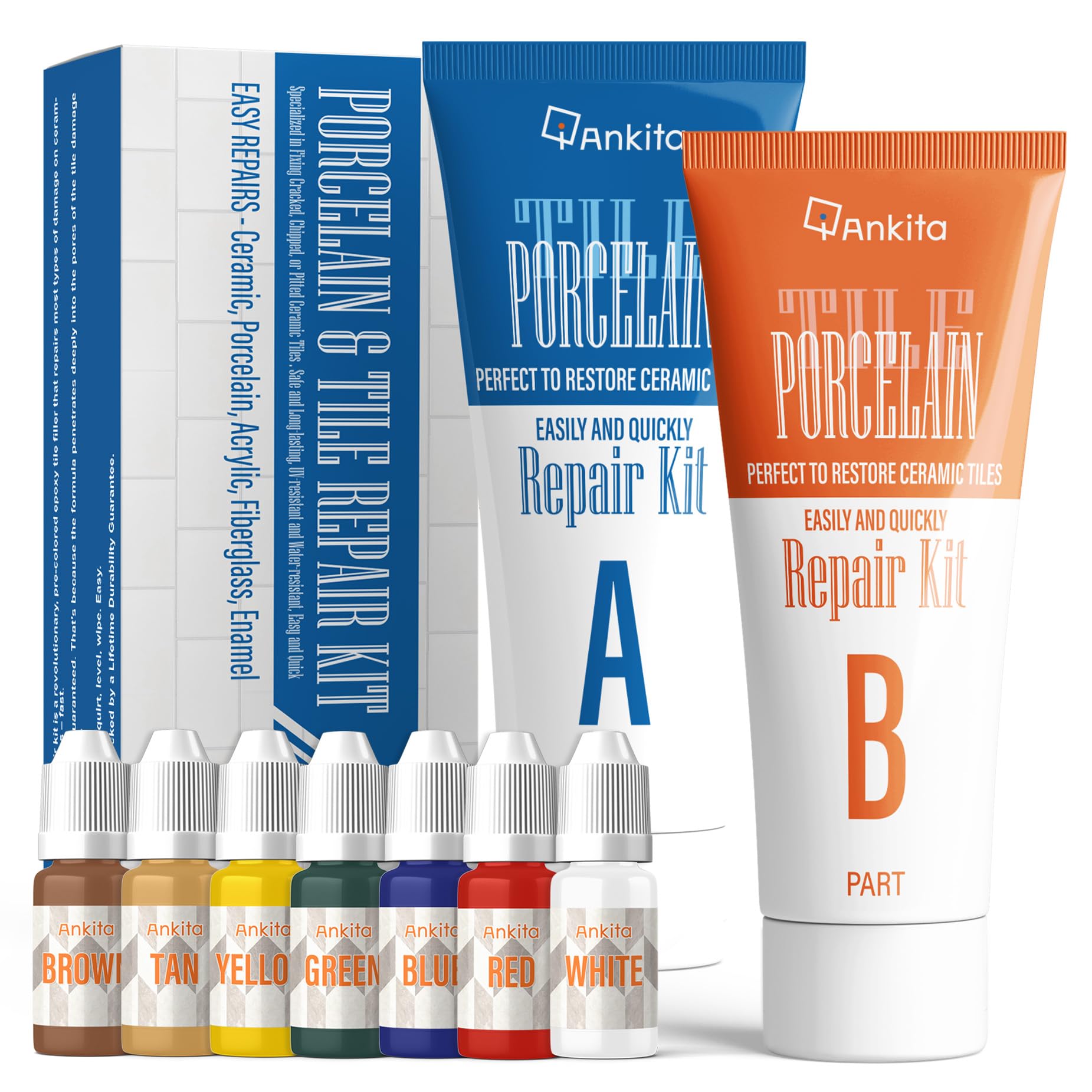
Ankita’s kit focuses on one thing that matters most for visible porcelain repairs: making the fix invisible. The two-part epoxy paste cures to a high-gloss, super-hard finish that resists wear, chips, and scratches. Eight included pigments allow unlimited mixing to match shades from white and beige to brown, orange, green, and black. The accompanying manual walks beginners through each step, from surface preparation to final polishing, reducing the guesswork that often leads to mismatched repairs.
Users have successfully repaired enamel sink scratches, tub chips, cracked window sill tiles, and floor tile holes. The epoxy bonds aggressively—reviewers warn to work quickly and keep it off your fingers, as the cured finish is difficult to remove from skin. Color accuracy is generally very good immediately after curing, though some users report a slight yellowing over several months, particularly in areas exposed to direct sunlight or heat.
The main tradeoff is the learning curve for achieving a perfectly smooth surface. The paste is thick and can leave subtle ridges if not tooled properly, and sanding the cured epoxy is less effective than expected due to its hardness. For small chips and cracks where color match is the priority, Ankita delivers a dense, durable fill that stands up to daily use. Just be aware that the color may shift slightly over time in bright conditions.
Why it’s great
- Exceptional color-matching capability with 8 pigments
- Cures to a scratch-resistant, high-gloss finish
- Includes step-by-step manual for beginners
Good to know
- May yellow slightly after months in direct light
- Thick consistency makes smoothing challenging
4. Quikrete 8620-05 Mortar Repair

Quikrete’s Mortar Repair is not a traditional porcelain adhesive—it is an acrylic paste designed to fill and seal gaps in brick, concrete, and stone mortar joints. However, it earns a place in this guide because porcelain tiles are often installed in masonry contexts: around fireplaces, on exterior patios, or as brick-edge accents. The black color matches dark grout lines and cement-based fillers, and the squeeze tube tip allows precise application into thin gaps without overfilling.
Users report that it matched 15-year-old cement perfectly, repaired brick gaps without visible patches, and has held up well through weather exposure. The water-resistant formulation prevents the filler from washing out during rain or cleaning, making it a practical choice for outdoor or high-moisture masonry repairs where porcelain meets brick or stone. The three-tube pack provides enough material for multiple smaller jobs, and the acrylic base dries quickly compared to epoxy alternatives.
The main drawback is consistency inconsistency between tubes—some users received tubes where one leaked watery thinner while another was extremely thick and hard to extrude. This batch variability means you might need to test each tube before committing to a large repair. It is also not designed for bonding porcelain to porcelain or for filling chips in glazed tiles; its strength lies in gap-filling between masonry units. For budget-conscious mortar and grout-line repairs in porcelain-installed settings, Quikrete offers a fast-drying, low-cost solution.
Why it’s great
- Excellent color match for dark mortar and grout
- Water resistant for outdoor and wet-area repairs
- Three tubes provide good value for multi-spot jobs
Good to know
- Inconsistent tube consistency reported by some users
- Not formulated for direct porcelain-to-porcelain bonding
5. MusselBound Adhesive Tile Mat with Spacers
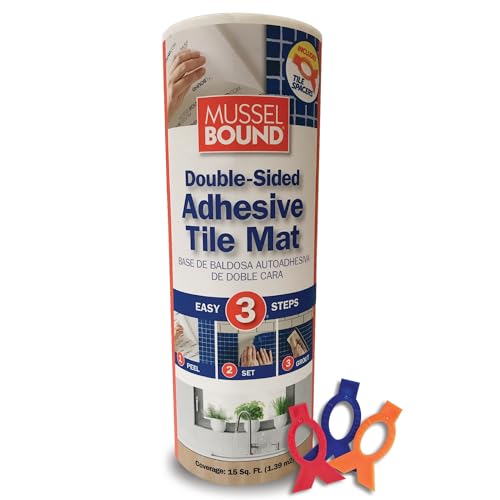
MusselBound flips the adhesive paradigm by eliminating the wet mixing step entirely. This double-sided adhesive mat replaces traditional mortar for installing real wall tiles up to 1 square foot in size. You peel the backing, press the mat onto the wall, then peel the second liner and stick your porcelain tiles directly onto it—no mixing, no drying time, no mess. The included spacers (1/6-inch, 1/32-inch, and 1/8-inch) ensure even grout lines, and the mat allows you to lift and realign tiles if needed before final pressing.
Users describe the bond as exceptionally strong, gripping tiles firmly while remaining removable from drywall without causing damage—a major advantage for renters or temporary installations. The instant grab means you can grout immediately after setting the last tile, cutting project time from days to hours. Backsplashes behind stoves, laundry room updates, and decorative wall tile projects are where this mat shines, especially for DIY beginners intimidated by mortar troweling.
MusselBound is not recommended for shower floors, submerged applications, or any area with constant standing water—the bond, while waterproof, is not designed for wet-floor submersion. Wall cleanliness is critical; any dust or grease will compromise adhesion. The per-roll price is higher than mortar for the same coverage area, but the time savings and reduced skill requirement offset the cost for small- to medium-sized projects. For anyone installing new wall tiles without wanting to mix mortar, MusselBound is a genuinely stress-free alternative.
Why it’s great
- Zero mixing or dry time—grout immediately after setting
- Removable from drywall without damage for easy corrections
- Includes spacers for uniform professional-looking grout lines
Good to know
- Not suitable for shower floors or submerged areas
- Requires absolutely clean, dust-free wall surface for adhesion
FAQ
Can I use standard construction adhesive on glazed porcelain tile?
How do I fix a hollow-sounding floor tile without replacing it?
Why does my epoxy chip repair turn yellow after a few months?
Final Thoughts: The Verdict
For most users, the best adhesive for porcelain winner is the Fix-A-Floor Loose Tile Repair Adhesive because it solves the most common and costly porcelain problem—hollow and loose floor tiles—without requiring tile removal or replacement. If you need a color-matched chip repair for a visible surface defect, grab the Ankita Tile Repair Kit for its excellent pigment blending and hard wear-resistant finish. And for a new wall tile installation that skips the mortar mess entirely, nothing beats the MusselBound Adhesive Mat for speed and ease of use.

Mo Maruf
I created WellFizz to bridge the gap between vague wellness advice and actionable solutions. My mission is simple: to decode the research and give you practical tools you can actually use.
Beyond the data, I am a passionate traveler. I believe that stepping away from the screen to explore new environments is essential for mental clarity and physical vitality.