Our readers keep the lights on and my smoothie glass nicely filled. As an Amazon Associate, I earn from qualifying purchases.
The search for a reliable cassette tape deck in 2025 isn’t about nostalgia alone; it’s about finding a durable transport mechanism that won’t chew your precious Type II or metal tapes, a clean preamp section for low noise floors, and the right connectivity for modern systems. Whether you’re digitizing a lifetime of mixtapes or re-entering the analog world, the wrong deck can introduce wow-and-flutter that ruins the listening experience.
I’m Mohammad Maruf — the founder and writer behind WellFizz. My approach to evaluating tape decks focuses on the motor specs, head materials, signal-to-noise ratios, and real-world reliability of the transport systems, not just cosmetic retro styling.
After analyzing the market for playback accuracy, recording head quality, build materials, and connectivity options, I’ve compiled the definitive guide to the best cassette tape deck available today so you can make an informed purchase.
How To Choose The Best Cassette Tape Deck
Buying a cassette deck today requires understanding that not all decks handle tape with the same care. The transport mechanism, head type, and noise reduction circuitry define whether the deck will preserve your tapes or damage them over time.
Transport Mechanism & Motor Quality
The heart of any tape deck is its motor and flywheel assembly. Decks with metal flywheels and direct-drive or servo-controlled motors deliver lower wow-and-flutter — typically below 0.08% WRMS — which translates to stable pitch during playback. Cheap plastic mechanisms found in entry-level all-in-one systems often cause speed inconsistency and tape-eating issues.
Recording Versus Playback-Only Priority
If you only need to listen to vintage mixtapes, a playback-only deck saves money. For archiving or making new recordings, prioritize a deck with independent record/play heads, bias adjustment for Type I (Normal) and Type II (CrO2) tapes, and a dedicated recording level control with VU meters. Dual-well decks that record on only one well are common — verify the configuration before buying.
Noise Reduction and Signal Fidelity
Dolby B is the standard noise reduction found on most vintage and modern decks, reducing tape hiss by up to 10 dB. Some modern units offer equivalent circuitry labeled “NR” that performs a similar function. Without noise reduction, the inherent hiss of the tape medium becomes audible during quiet passages, especially on older or lower-grade cassettes.
Modern Connectivity for Digital Archiving
Decks with onboard USB output — either as a flash-drive recorder or a USB-B port for connecting to a computer — eliminate the need for an external analog-to-digital converter. Look for decks that support at least 48 kHz/16-bit PCM recording via USB if your goal is high-quality digital preservation. Models that limit output to 128 kbps MP3 are only suitable for casual archiving.
Quick Comparison
On smaller screens, swipe sideways to see the full table.
| Model | Category | Best For | Key Spec | Amazon |
|---|---|---|---|---|
| Tascam 202MKVII | Dual Well | Pro-Level Archiving | USB-B output, metal chassis | Amazon |
| TEAC W-1200B | Dual Well | Dubbing & Digitization | 12% pitch control, USB 48kHz/16-bit | Amazon |
| TEAC AD-850-SE | Combo Unit | CD & Cassette Playback | USB MP3 recording, mic input | Amazon |
| Aiwa Retro Boombox | All-in-One | Portable Retro Listening | Dual 40W speakers, Bluetooth 5.0 | Amazon |
| Pyle PT659DU | Dual Well | MP3 Conversion | Dual-speed dubbing, USB PC link | Amazon |
| Victrola Century | All-in-One | Living Room Versatility | Vinylstream Bluetooth output | Amazon |
| Supersonic SC-2121BT | All-in-One | Budget Family Entertainment | Double cassette recorder, Bluetooth | Amazon |
| JORLAI T408 | All-in-One | Portable Turntable Combo | 3-speed turntable, 2500mAh battery | Amazon |
| Seasonlife HQ-KZ017 | All-in-One | Full Media Conversion | Record vinyl/CD/tape to USB/SD | Amazon |
In‑Depth Reviews
1. Tascam 202MKVII Double Cassette Deck Recorder
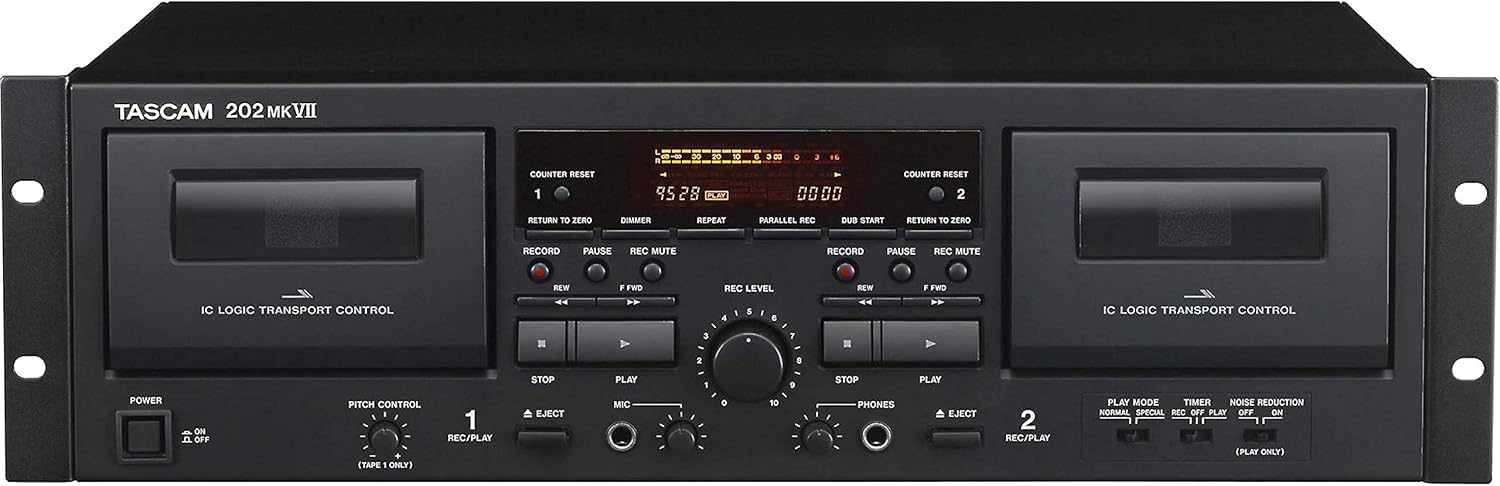
The Tascam 202MKVII is the gold standard for anyone serious about cassette archiving. It features a metal chassis with full-width rack-mount ears, two Tanashin mechanisms equipped with metal flywheels to minimize wow-and-flutter, and a dedicated USB-B port that sends raw audio to your computer for software-based recording at any bitrate. The dual recording capability supports Type I tapes, and Dolby B decoding ensures clean playback of your vintage collection.
Orange/red VU meters provide real-time visual feedback on record and playback levels, while the independent transport controls for each well let you manage dubbing or sequential playback with precision. Deck A runs slightly louder than Deck B — a known quirk for this model — but the pitch control on Deck A compensates if synchronization matters in your workflow.
This deck is built for longevity: the metal flywheels resist the warping that plagues consumer-grade plastic transports, and the rear USB-B port bypasses the 128 kbps MP3 limit of flash-drive-based systems. You will need separate audio software for MP3 conversion, but that trade-off yields the highest possible archival quality. It is the definitive tool for preserving degrading cassette collections.
Why it’s great
- Metal chassis and metal flywheel transport resist wear and maintain speed accuracy
- USB-B output allows lossless PCM recording to PC or Mac at any sample rate
- Dual-well recording with Dolby B decoding for reliable tape duplication
Good to know
- Records Type I tape only — no support for Type II or Type IV recording
- No onboard MP3 encoding; requires external software for compressed file creation
2. TEAC W-1200B Dual Cassette Deck
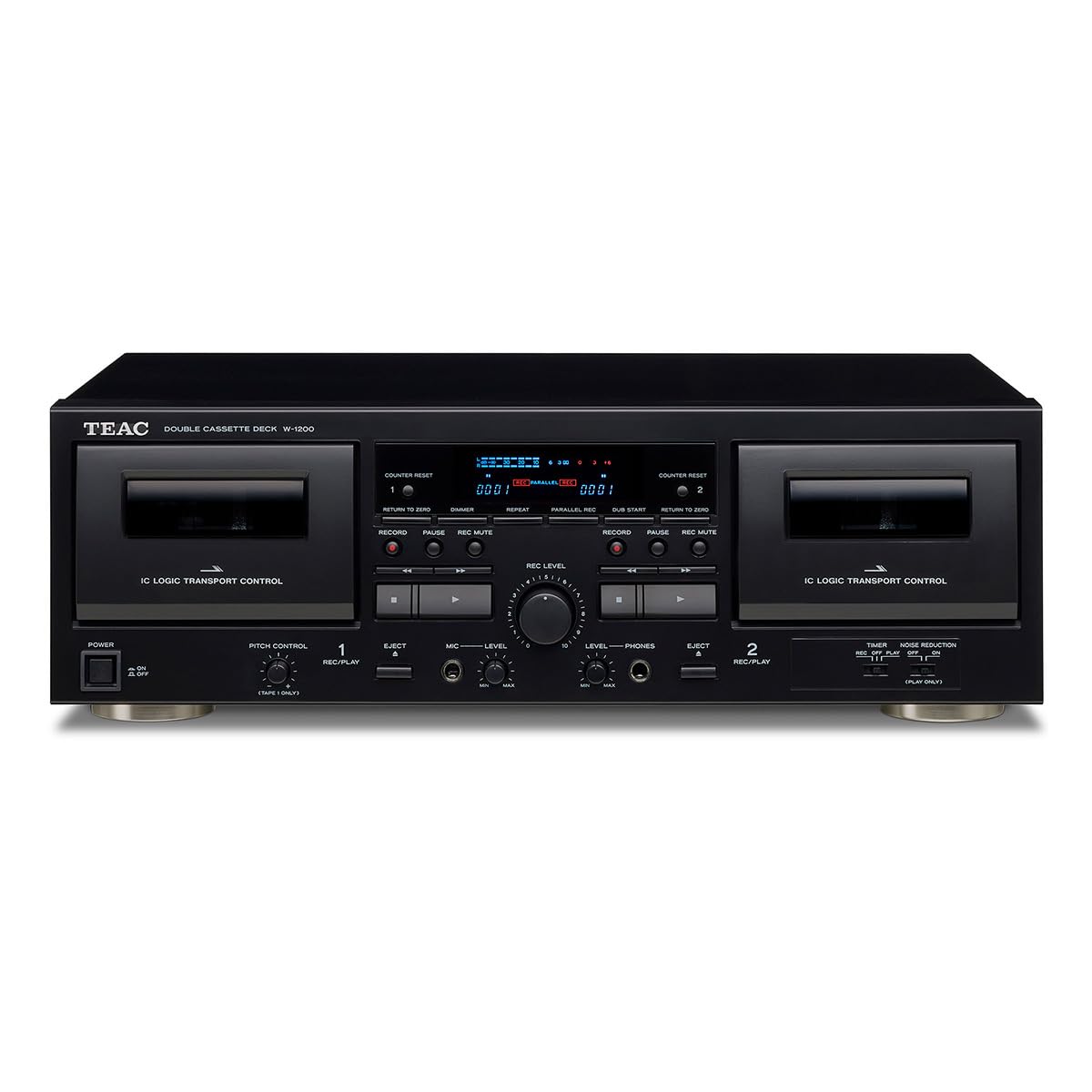
The TEAC W-1200B offers dual independent well mechanisms that both support recording and playback, a feature rarely seen at this price point. Each well handles Type I and Type II tapes with auto-detect, and it will play Type IV metal tapes as well. The 12% pitch control is a critical asset for musicians or anyone correcting tapes recorded off-speed, and the A-B repeat function simplifies transcription work.
The built-in USB output delivers CD-quality 48 kHz/16-bit PCM audio to a computer, making this one of the few modern decks that strikes a balance between convenience and fidelity without forcing a compressed file format. The fluorescent display is dimmable, and the level meters offer a clear visual reference during recording. TEAC includes a full-featured remote control for basic transport commands.
Some users report a mild treble roll-off on the left deck, likely requiring azimuth adjustment out of the box. The warranty covers such issues, but it is worth checking both channels early. Parallel recording — writing the same signal to two tapes simultaneously — is a standout feature for anyone making backup copies of fragile media in a single pass.
Why it’s great
- Dual independent decks both record and play, enabling parallel tape duplication
- USB output at 48 kHz/16-bit PCM offers true CD-quality digital archiving
- 12% pitch control saves off-speed recordings without external software correction
Good to know
- Left deck may need azimuth adjustment for balanced treble across both channels
- No auto-reverse — each deck plays in one direction only
3. TEAC AD-850-SE Cassette Deck & CD Player
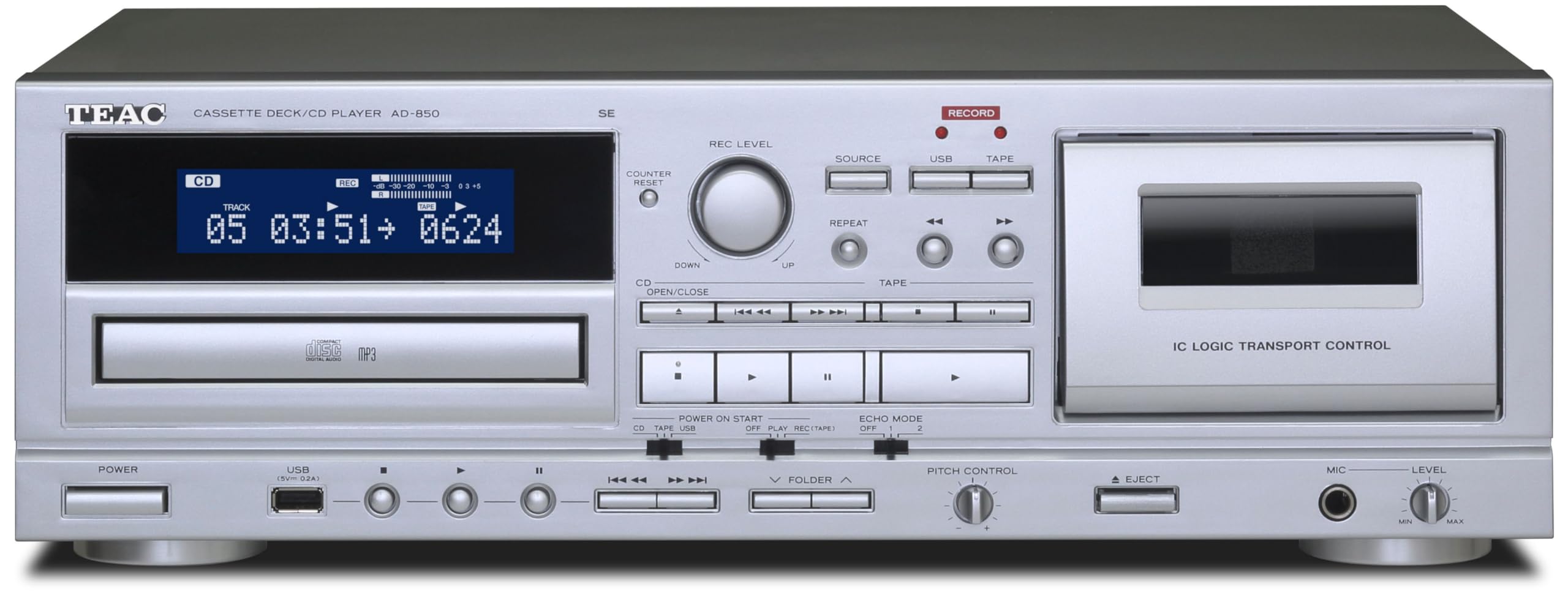
The TEAC AD-850-SE merges a full-function cassette deck with a CD/MP3 player in a single silver component. The cassette section supports Type I, II, and IV tapes for playback, and records on Type I and II formulations with auto-detect. The front-panel microphone input with adjustable echo effect doubles as a karaoke feature, though an external amplifier and speakers are required to hear the result effectively.
USB recording on this unit writes directly to flash drives as MP3 files, capturing audio from the cassette mechanism, the CD player, or an external line source. The CD section reads CD-R/RW discs and displays ID3 tags for MP3 files, making it easy to browse digital libraries through the component. The cassette deck includes timer recording and playback for scheduled operation.
Isolated reports mention the transport can eat tapes, particularly older or brittle shells, which suggests careful handling of fragile media is necessary. The lack of auto-reverse means you must flip the tape manually to access the second side. For users who need a single component to serve both CD and cassette duties without separate boxes, this silver unit delivers clean integration.
Why it’s great
- Two-in-one design saves rack space by combining CD and cassette functionality
- Direct USB flash-drive recording from cassette, CD, or external input sources
- Supports Type IV metal tape playback for high-end vintage collections
Good to know
- Transport can damage fragile older tape shells — inspect tapes before playing
- Single-direction mechanism requires manual tape flip for side B playback
4. Aiwa Retro Boombox with Cassette Recording

The Aiwa Retro Boombox (model AI7012) revives the iconic 1980s boombox silhouette with genuine heft — 17.8 pounds loaded with eight D cells. The dual 5.25-inch woofers and 1.2-inch tweeters deliver 40 watts of clean output that reaches 90 dB without distortion at moderate volumes. The cassette deck includes recording capability, though its permalloy head and permanent erase magnet produce adequate but not archival-grade fidelity.
Bluetooth 5.0 streaming is flawless, with clear signal integrity at distances up to 30 feet. The CD player, FM radio (with usable reception), and USB/SD media slots make this a truly all-format portable. The VU meters and LCD display add authentic visual flair, and the dual microphone ports lend themselves to impromptu karaoke sessions.
The tape deck demonstrates slight wow-and-flutter — audible on piano recordings — and the internal 128 kbps MP3 encoding for USB/SD recording limits archival quality. This unit is built for the person who wants a loud, portable, retro-styled party machine with cassette capability, not for critical listening or high-fidelity archiving. The yellow color scheme and oversized handle lean into the visual nostalgia hard.
Why it’s great
- Massive 40-watt sound output from dual woofers and tweeters fills large rooms
- True portable operation using 8 D-cell batteries or AC power
- Bluetooth 5.0 stream quality is clear and stable across all media sources
Good to know
- Tape mechanism has audible wow-and-flutter during music playback
- Extremely heavy — over 17 pounds with batteries installed
5. Pyle PT659DU Dual Stereo Cassette Tape Deck

The Pyle PT659DU targets the budget-conscious archivist with dual-well dubbing at normal and high speed, CrO2 tape compatibility, and a bundled USB cable for transferring tape audio to a computer. The front panel includes both record level and gain controls, a digital tape counter, and a noise reduction circuit that does a respectable job suppressing tape hiss on older recordings.
Deck B handles recording and dubbing duties exclusively, while both decks can play back tapes. The high-speed dubbing feature cuts duplication time in half, which is convenient for creating backup copies of spoken-word or educational tapes. The RCA inputs and outputs allow integration with a standard receiver or amplifier for monitoring through a proper stereo system.
Quality control is a known variable with this unit: some users report the right deck playing at approximately 1.5x speed due to an inconsistent motor, and a few units have failed completely within weeks. The plastic chassis and budget transport feel light compared to vintage Japanese decks. For the price, it functions as a usable stopgap for basic tape playback and digitization, but reliability remains a gamble.
Why it’s great
- High-speed dubbing (2x) speeds up tape duplication workflows
- CrO2 tape selector improves playback and recording quality on Type II media
- Included USB cable and software assist in PC-based MP3 conversion
Good to know
- Motor speed inconsistency reported on some units, especially the right deck
- Plastic transport components may not handle frequent daily use
6. Victrola Century 6-in-1 Music Center

The Victrola Century combines a 3-speed turntable, CD player, and cassette deck inside a mid-century modern walnut wood cabinet. The cassette mechanism is a basic playback-oriented transport with no recording capability, but it handles standard tapes without excessive mechanical noise. The Vinylstream Bluetooth output is a unique differentiator, allowing turntable audio to stream wirelessly to external BT speakers while the unit itself plays cassettes or CDs through its built-in stereo speakers.
The built-in speaker array has been custom-tuned for this cabinet and delivers surprisingly full sound for a self-contained unit in this form factor. The walnut finish and tapered mid-century legs make it a decorative centerpiece rather than a stack of black boxes. An RCA output and headphone jack offer wired options for private listening or sending audio to a more capable amplifier.
Cassette playback speed accuracy is adequate for casual listening but not precise enough for critical pitch-sensitive content. Some owners report the cassette mechanism runs slightly fast, and the CD player can be fussy with scratched discs. The absence of a remote control — despite the unit’s living room positioning — is an oversight that limits convenience during multi-step playback switching.
Why it’s great
- Vinylstream Bluetooth output streams turntable audio to external wireless speakers
- Custom-tuned built-in speakers deliver decent room-filling sound
- Mid-century walnut cabinet design fits as a statement furniture piece
Good to know
- Cassette speed accuracy varies — may run slightly fast on some units
- No remote control included for a living room-oriented 6-in-1 unit
7. Supersonic SC-2121BT Bluetooth Entertainment System

The Supersonic SC-2121BT is an entry-level all-in-one micro system that includes a double cassette recorder, a top-loading MP3/CD player, AM/FM radio, Bluetooth 5.0 streaming, and USB flash drive playback. The dual-well cassette mechanism can record from the internal CD player, radio, or built-in microphone, making it a functional tool for casual tape creation without any external wiring.
The detachable speakers are a surprising convenience for stereo separation in small rooms, and the 10.1-pound system is portable enough to move between rooms. The remote control attempts to add convenience, but the limited range and lack of power-on functionality from the remote diminish its usefulness. The headphone jack supports private listening when the built-in speakers would disturb others.
Build quality is where this system shows its budget roots: the speaker wires are short, the radio reception is prone to drift and popping sounds on weaker stations, and several users report defective components out of the box. The cassette recorder functions as advertised for basic dictation or recording radio broadcasts, but audio fidelity is thin with a frequency response limited to 125-6300 Hz. It is a functional nostalgia box for the casual listener, not a serious deck.
Why it’s great
- Double cassette recorder with built-in microphone for personal voice recording
- Detachable speakers allow basic stereo separation in small rooms
- Bluetooth 5.0 adds wireless streaming from modern devices
Good to know
- Narrow 125-6300 Hz frequency response limits music playback fidelity
- Short speaker wires and unreliable remote control reduce ergonomic value
8. JORLAI T408 9-in-1 Vintage Turntable & Cassette Player

The JORLAI T408 packs a 3-speed turntable, CD player, cassette player, Bluetooth receiver, and AM/FM radio into a suitcase-style portable body with a built-in 2500mAh battery. The cassette deck is a basic playback mechanism optimized for casual use — no recording capability — and it handles standard tapes without excessive flutter for a device in this class. The ability to run completely cordless from a battery charge makes it a true portable for picnics, classrooms, or patio listening.
The integrated stereo speakers deliver clear midrange with a warm tilt that flatters spoken-word content and older pop recordings. The Bluetooth streaming function works reliably within 20 feet, and the RCA output jacks allow connection to a more capable sound system when the built-in speakers feel limiting. The dark brown/rose gold suitcase design is visually appealing and the carrying handle makes transport effortless.
The turntable section has a known assembly flaw where the platter and arm plate arrive loose, causing records to wobble during playback — a glue fix resolves it but requires user intervention. The cassette player lacks the refinement of a dedicated deck, exhibiting slightly imprecise tape guidance that can cause occasional mis-tracking on thinner-shelled cassettes. For the price, it functions best as a portable all-format player for casual enjoyment rather than archival work.
Why it’s great
- Built-in 2500mAh battery provides hours of cordless portable playback
- 9-in-1 functionality covers records, CDs, tapes, radio, and Bluetooth in one box
- RCA line output allows connection to external speakers for upgraded sound
Good to know
- Turntable platter and arm plate may arrive loose and require user repair
- Cassette deck lacks recording capability and has basic tape guidance
9. Seasonlife HQ-KZ017 10-in-1 Record Player & Cassette Deck
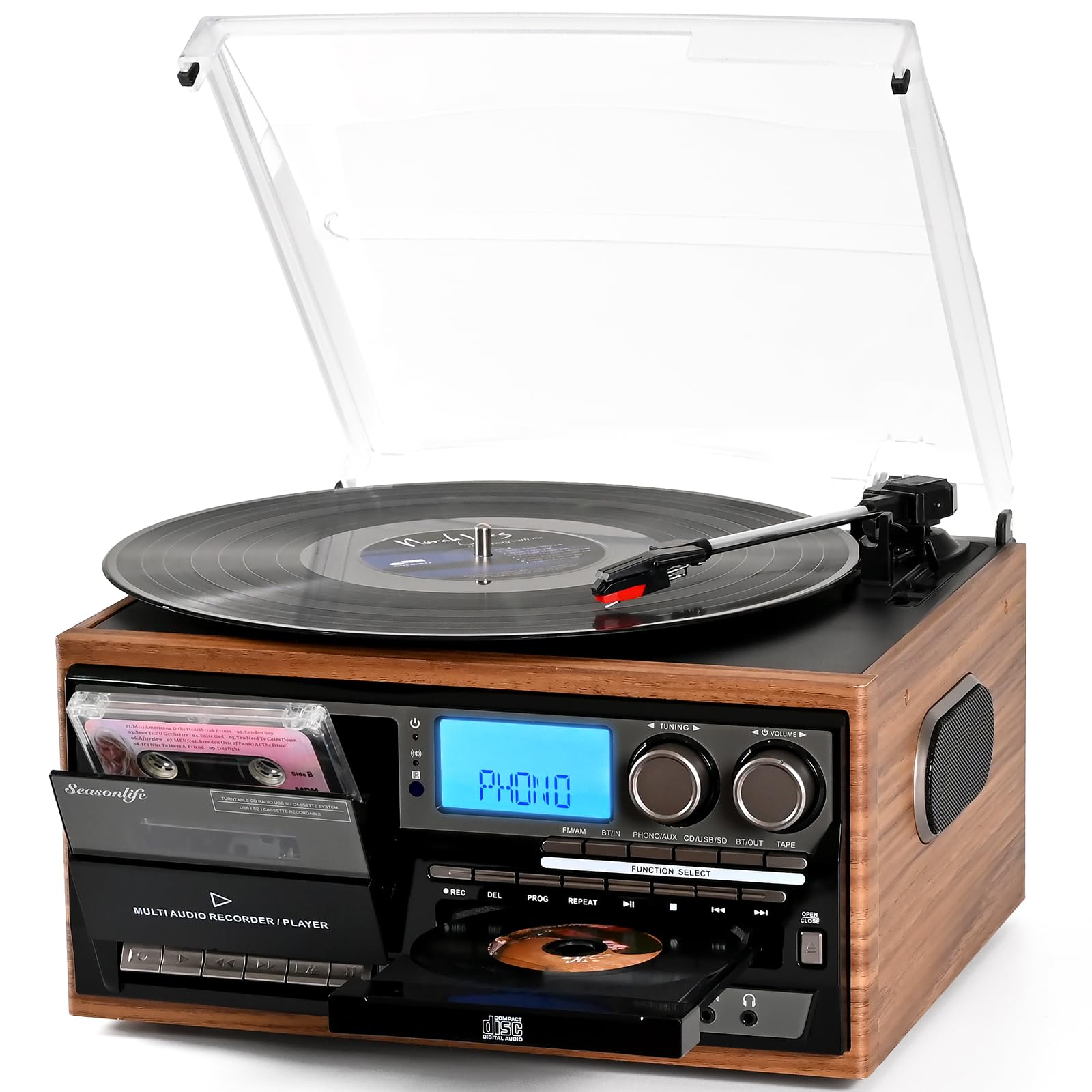
The Seasonlife HQ-KZ017 is a 10-in-1 music center built around the unique ability to record from vinyl, CD, and cassette directly to a USB flash drive or SD card as MP3 files. This feature positions it as a practical conversion station for someone liquidating their physical media collection without connecting a computer. The cassette deck plays and records tapes, and the Bluetooth functionality works in both directions — stream music into the unit or send audio out to a wireless speaker.
The built-in stereo speakers offer decent clarity for casual listening, though they lack deep bass extension. The belt-driven 3-speed turntable uses a diamond-tipped stylus and includes an auto-stop function that lifts the tonearm at the end of a record. The wood-brown cabinet and dust cover give the unit a vintage furniture aesthetic that blends into a living room or office without looking like industrial AV gear.
The cassette sections are adequate for recording radio broadcasts or converting tapes to digital, but recording quality is limited to compressed MP3 format at a modest bitrate. Users seeking true high-resolution archiving will need to route analog outputs to an external interface. The all-in-one nature means component quality is compromised compared to separates — this is a convenience device, not an audiophile tool.
Why it’s great
- Direct recording of vinyl, CD, and cassette to USB/SD as MP3 files
- Bidirectional Bluetooth supports both input streaming and output to external speakers
- Auto-stop turntable mechanism prevents stylus wear at record end
Good to know
- MP3 recording bitrate is limited — not suitable for high-resolution archiving
- Built-in speakers lack bass extension; external speakers recommended for full sound
FAQ
What is the difference between Type I, Type II, and Type IV cassette tapes?
Can I play a Dolby-encoded tape on a deck without Dolby decoding?
Does a dual-well cassette deck play and record in both wells?
How do I connect a modern tape deck to an amplifier without a dedicated tape input?
What should I do if my tape deck is eating tapes or slowing down?
Final Thoughts: The Verdict
For most users, the cassette tape deck winner is the Tascam 202MKVII because it offers a metal chassis, reliable Tanashin transports with metal flywheels, and a USB-B port for uncompromised digital archiving at any bitrate your software supports. If you need dual independent recording wells with pitch control and true CD-quality USB output for musicians or transcriptionists, grab the TEAC W-1200B. And for a complete combo unit that serves both CD and cassette duties with USB flash-drive recording in a silver component stack, nothing beats the TEAC AD-850-SE.

Mo Maruf
I created WellFizz to bridge the gap between vague wellness advice and actionable solutions. My mission is simple: to decode the research and give you practical tools you can actually use.
Beyond the data, I am a passionate traveler. I believe that stepping away from the screen to explore new environments is essential for mental clarity and physical vitality.