Our readers keep the lights on and my smoothie glass nicely filled. As an Amazon Associate, I earn from qualifying purchases.
Bonding rubber to plastic presents a unique challenge because these two materials have very different surface energies and flexibilities. A rigid glue that works on wood or metal will often crack or peel when the rubber part flexes, leaving you with a failed repair and a mess to clean up. The right adhesive must bridge that gap between a flexible substrate and a rigid one without losing grip over time.
I’m Mohammad Maruf — the founder and writer behind WellFizz. I’ve spent years analyzing adhesive formulations, peel-strength data, and real-world user reports across hundreds of rubber-to-plastic bonding scenarios to separate the formulas that actually hold from those that fail under stress.
Whether you’re reattaching a rubber gasket to a plastic housing or repairing a cracked bumper, finding the right adhesive for rubber to plastic depends on understanding cure time, flexibility, and surface preparation — and this guide breaks down exactly what works.
How To Choose The Best Adhesive For Rubber To Plastic
The wrong adhesive for a rubber-to-plastic bond is one that cures too rigid. When the rubber component stretches or vibrates, a brittle bond line snaps instantly. The best adhesives in this category balance peel strength with enough flexibility to absorb movement without delaminating.
Consider the substrate compatibility first
Low-surface-energy plastics like polypropylene (PP) and polyethylene (PE) are notoriously difficult to bond. Many adhesives simply bead up and fail. If your plastic part is one of these types, you need a specialty formula with a surface primer or a cyanoacrylate designed for tough substrates — like the 3M Scotch-Weld PR100, which handles EPDM, Santoprene, and plasticized PVC.
Working time versus handling strength
Fast-setting adhesives are tempting, but they leave almost no room for alignment. A five-minute epoxy gives you enough working time to position parts and clamp them before the bond sets, while an instant adhesive bonds in under 20 seconds — useful for small joints where positioning is simple. For larger repairs where misalignment means starting over, a slower-curing epoxy like the Starbond Pro Kit offers a safer window.
Evaluate real-world flexibility
Rubber components in automotive, marine, or outdoor applications will experience temperature swings and mechanical stress. A toughened epoxy formula — one that includes impact modifiers or flexibility agents — handles vibration without cracking. The Starbond 5 Minute Epoxy Pro Kit and the RH Adhesives S-18 both mention flexibility and peel strength specifically, which is exactly what you want when bonding neoprene or SBR rubber to a rigid plastic base.
Quick Comparison
On smaller screens, swipe sideways to see the full table.
| Model | Category | Best For | Key Spec | Amazon |
|---|---|---|---|---|
| Starbond 5 Min Epoxy Pro Kit | Toughened Epoxy | Flexible, high-stress joints | 2,600 lb shear strength | Amazon |
| 3M Scotch-Weld PR100 | Instant Adhesive | Small joints, rapid bonding | Handling time under 20 sec | Amazon |
| Gorilla 2 Part Epoxy | General Epoxy | Household repairs, wide use | 5-minute set time | Amazon |
| West System G/5 | Epoxy | Crafts and quick repairs | 3-5 minute working time | Amazon |
| RH Adhesives S-18 | Contact Cement | Rubber-to-metal, marine use | Water-resistant neoprene | Amazon |
In‑Depth Reviews
1. Starbond 5 Minute Epoxy Pro Kit

The Starbond 5 Minute Epoxy Pro Kit uses a toughened formula that absorbs vibration and stress without brittle cracking — exactly the behavior needed when bonding flexible rubber to rigid plastic. Its stated 2,600 lb shear strength gives you a confidence window for load-bearing repairs, and the 1:1 volume mix ratio eliminates guesswork. The screw-cap bottles and included mixing trays make it much easier to store and reuse compared to single-use syringe epoxies.
Real users report successful repairs on everything from basement cracks to crown molding projects. The flexible nature of the cured bond is a recurring positive theme — the epoxy stays firm but gives slightly under movement, which prevents delamination along the rubber-plastic interface. The clear finish also means you don’t end up with an ugly repair line on visible surfaces.
The biggest practical advantage of this kit is the shelf life. Unlike instant adhesives that expire inside a sealed container, the screw-cap bottles keep the resin and hardener fresh for months after opening. If you do multiple repairs over time, the waste reduction alone makes this a smarter buy than single-use alternatives.
Why it’s great
- Toughened formula resists cracking under vibration
- Clear finish for visible repairs
- Excellent shelf life with reusable bottles
Good to know
- 5-minute working time is short for large surface areas
- Full cure takes 24 hours
2. 3M Scotch-Weld Plastic & Rubber Instant Adhesive PR100

3M’s Scotch-Weld PR100 is an instant adhesive engineered for the hardest-to-bond rubber and plastic substrates — EPDM, silicone rubber, heavily plasticized PVC, ABS, Nylon, and Santoprene. The low-viscosity formula penetrates into tight joint gaps and wets out low-energy surfaces better than general-purpose super glues. Handling strength develops in less than 20 seconds, which is critical for production environments or small repairs where clamping is impractical.
Users consistently describe it as “super glue on steroids” — outperforming standard cyanoacrylates on both bond strength and durability. It has been used successfully for gasket attachment, small joint assembly, glasses repair, and even radiator fixes. The flexibility of the cured bond is notable for a cyanoacrylate; it doesn’t shatter under peel stress like cheaper instant adhesives do.
The main downside is the price per ounce — this is a premium product for targeted jobs, not a budget bulk adhesive. It also requires refrigeration to extend shelf life once opened, and the bottle tip can be short for reaching into deep recesses. But for applications where speed and substrate compatibility are non-negotiable, the PR100 is unmatched.
Why it’s great
- Engineered for difficult substrates like EPDM and silicone
- Sub-20-second handling strength
- Low viscosity penetrates tight gaps
Good to know
- High cost per ounce
- Requires refrigeration after opening
3. Gorilla 2 Part Epoxy

The Gorilla 2 Part Epoxy syringe format is one of the most accessible options for general-purpose rubber-to-plastic bonding. The 5-minute set time gives you enough working time to align parts, and the clear finish keeps the repair unobtrusive. It bonds to metal, plastic, wood, glass, and ceramic surfaces, making it a solid multi-material solution for around-the-house fixes.
User reports highlight its strength on PVC molding and end-grain wood projects, and the water-resistant quality means it holds up in environments where moisture is a concern. The syringe dispenser ensures precise application without the mess of mixing from separate bottles, though the small 0.85-ounce size means you’ll go through it quickly on larger repairs. The 4-pack option included here is good value for ongoing projects.
Some users note that the bond isn’t as adhesive as they’d hoped on certain plastic types — this is a common trade-off with general-purpose epoxies that aren’t formulated specifically for low-energy surfaces. For rubber-to-plastic jobs where both materials are smooth and non-porous, light surface sanding is recommended to improve grip.
Why it’s great
- Easy syringe application with no mixing guesswork
- Dries clear and water-resistant
- Good value in multi-pack form
Good to know
- Not optimized for low-energy plastics
- Small individual syringe size
4. West System G/5 Five Minute Epoxy Adhesive

The West System G/5 is a two-part epoxy designed for quick repairs where speed matters but you still need a reliable bond. Its viscosity is notably well-balanced — thin enough to penetrate porous surfaces yet thick enough to bridge gaps when gluing broken objects back together. The 3-5 minute working time is realistic for small to medium joints, and the 4-hour full cure is faster than most 24-hour epoxies.
Users praise its consistent quality and ease of use, especially compared to other 5-minute epoxies that thicken or yellow over time. The hardener stays fresh longer in the bottle, and the resin doesn’t crystallize. It bonds well to wood, ceramic, metal, leather, plaster, stone, and some plastics — but West System is honest that G/5 is not as strong or waterproof as their 105 Resin-based epoxies or G/flex formulations.
The odor is a noticeable drawback — several users report that the uncured hardener produces strong fumes that require ventilation or a respirator. This is not a glue you want to use in a closed workspace. For dry, indoor repairs where moisture and high loads aren’t factors, the G/5 delivers fast, dependable results at a fair price per ounce.
Why it’s great
- Ideal viscosity for gap-filling and penetration
- Faster full cure than standard epoxies
- Stays fresh in storage longer than many alternatives
Good to know
- Strong odor requires ventilation
- Not recommended for high-load or wet environments
5. RH Adhesives S-18 All-Purpose Adhesive
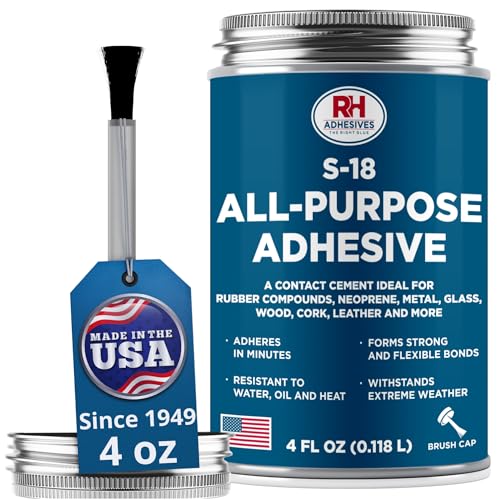
The RH Adhesives S-18 is a neoprene-based contact cement that excels at bonding rubber to metal and a variety of plastics. Its water-resistant and heat-resistant properties make it suitable for marine applications and outdoor repairs where moisture is a constant factor. As a contact cement, it requires you to coat both surfaces, let them dry, then press them together for an immediate bond — no clamping needed once the surfaces touch.
Users have used it successfully for leather boot repairs, neoprene yoga mat projects, and general household fixes. The peel strength and oil resistance of the cured film are strong points, and being made in America since 1949 adds a layer of quality assurance. The 4-ounce can is small but goes a long way because you apply a thin film rather than a thick bead.
The main limitation of the S-18 is its sensitivity to high temperatures and prolonged moisture exposure once cured. Multiple user reports mention bonds failing in summer heat or rain after initial success. This adhesive is best reserved for indoor or sheltered applications where it won’t face extreme conditions. It also requires very good ventilation during application due to solvent fumes.
Why it’s great
- Flexible neoprene base ideal for rubber
- Water and heat resistant
- No clamping needed with contact bond
Good to know
- Not suitable for high-temperature or wet environments
- Strong solvent fumes require ventilation
FAQ
Do I need to sand plastic before applying adhesive?
Can a cyanoacrylate bond rubber to plastic permanently?
How long does an epoxy bond between rubber and plastic last outdoors?
Is a contact cement or an epoxy better for large rubber panels?
Final Thoughts: The Verdict
For most users, the adhesive for rubber to plastic winner is the Starbond 5 Minute Epoxy Pro Kit because its toughened, flexible formula handles vibration and stress without cracking, and the reusable bottles offer far better value over time than single-use syringes. If you need a rapid bond for small, precision joints on difficult substrates like EPDM or Santoprene, grab the 3M Scotch-Weld PR100. And for budget-friendly indoor repairs where a flexible contact cement works best, nothing beats the RH Adhesives S-18.

Mo Maruf
I created WellFizz to bridge the gap between vague wellness advice and actionable solutions. My mission is simple: to decode the research and give you practical tools you can actually use.
Beyond the data, I am a passionate traveler. I believe that stepping away from the screen to explore new environments is essential for mental clarity and physical vitality.