Our readers keep the lights on and my smoothie glass nicely filled. As an Amazon Associate, I earn from qualifying purchases.
You plant your canopy, settle into your chair, and within ten minutes you’re chasing it down the shoreline. A beach canopy that can’t handle a gust isn’t shade — it’s a liability. The key difference between a canopy that stays planted and one that turns into a kite isn’t the price tag; it’s the anchoring system, the frame geometry, and how the fabric handles lateral force.
I’m Mohammad Maruf — the founder and writer behind WellFizz. I’ve spent months breaking down the engineering behind beach shelters, from sandbag configurations to pole-wall thickness, comparing how each design manages the real-world wind loads you actually face on an open shoreline.
Whether you’re after a quick pop-up for a family day or a premium shelter that handles heavy gusts, this guide helps you pick the right option by matching the design to your conditions. My goal is to simplify the decision process for finding the best beach canopy for wind that matches your budget and beach habits.
How To Choose The Best Beach Canopy For Wind
The right wind-resistant beach canopy balances weight, coverage, and anchoring strength. You don’t need the heaviest poles — you need the right anchoring system for your local beach conditions.
Anchoring System: Sandbags vs. Stakes
Sandbags are the gold standard for beaches where stakes won’t hold. Look for at least 4 sandbags, but 8 gives you true 360-degree stability. Stakes only work in packed sand or grass.
Frame Material and Pole Diameter
Aluminum poles resist corrosion and offer better strength-to-weight ratios than fiberglass. Thicker walls (1.5mm+) prevent bending in sustained gusts. Fiberglass is cheaper but flexes more under load, which can destabilize the canopy.
Fabric Type and Aerodynamics
Lycra fabric stretches and allows wind to pass through, reducing lift. Polyester is more rigid but can catch wind like a sail. The best wind-resistant canopies use high-stretch Lycra that vents air rather than blocking it.
Coverage vs. Stability Trade-off
Larger canopies (10×10 ft or more) catch more wind. A 6×6 ft or 8×8 ft canopy with sandbags is far more stable in high winds than a 10×13 ft model with the same anchoring. Decide what matters more: total shade or all-day stability.
Quick Comparison
On smaller screens, swipe sideways to see the full table.
| Model | Category | Best For | Key Spec | Amazon |
|---|---|---|---|---|
| Shibumi Shade 2.0 | Premium | Wind-powered shade for groups | 4.25 lbs, 150 sq ft | Amazon |
| CoolCabana Beach Shade | Premium | All-day wind resistance | 14 lbs, 35 lbs sand pockets | Amazon |
| Solbello Shade | Premium | Swivel design for shifting winds | 4.52 lbs, 48.55″ x 4.85″ | Amazon |
| Osoeri Beach Tent | Mid-Range | Large group coverage | 260 sq ft, 8 sandbags | Amazon |
| Rhino Valley Beach Tent | Mid-Range | Family-size wind stability | 10×10 ft, 8 sandbags | Amazon |
| Vibemo Beach Tent | Mid-Range | Budget wind-resistant shade | 8.27 lbs, 8 sandbags | Amazon |
| Old Bahama Bay Pop Up Tent | Budget | Quick pop-up for light winds | 8.18 lbs, 4 guylines | Amazon |
In‑Depth Reviews
1. Shibumi Shade (2.0 Version)
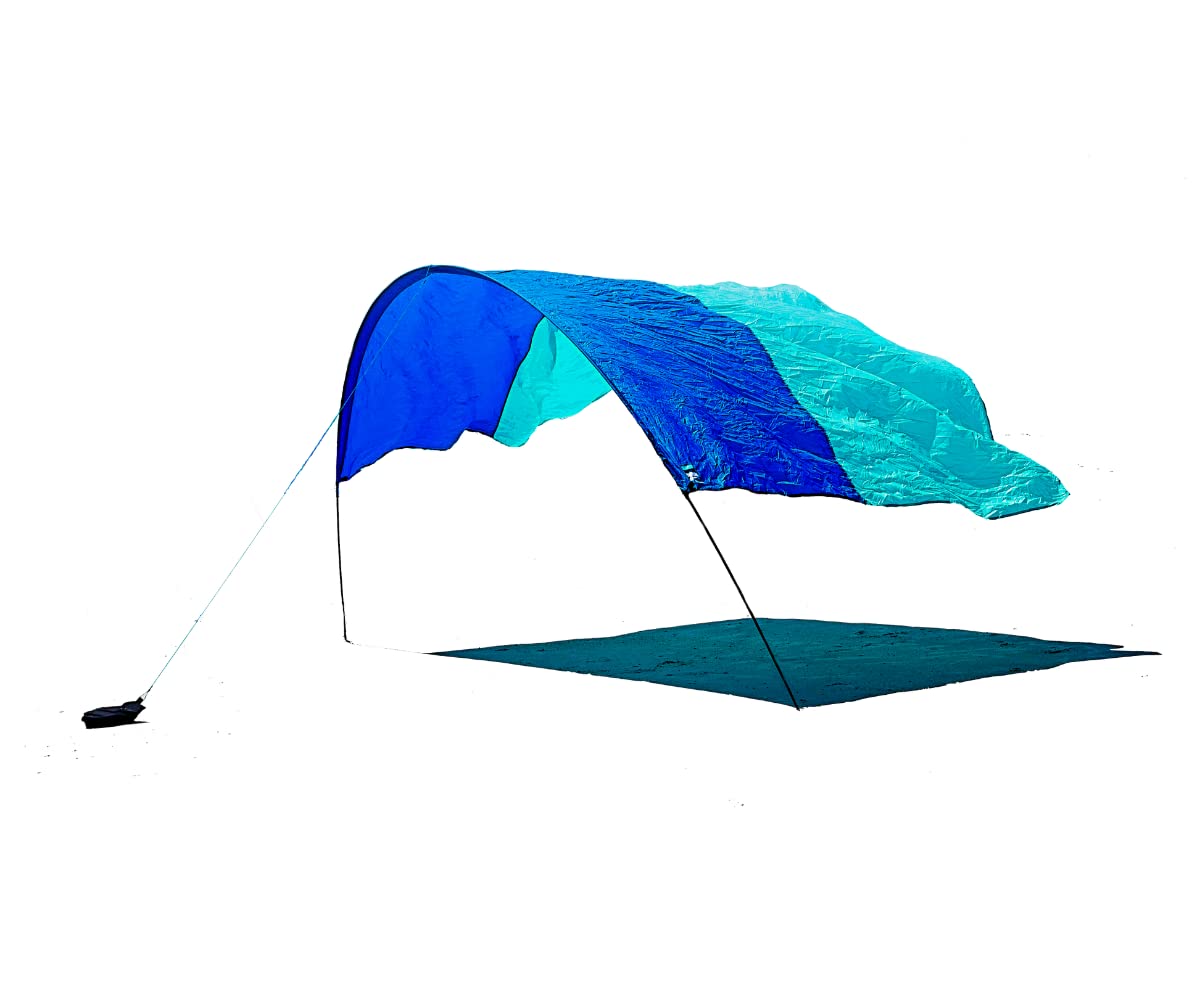
The Shibumi Shade uses the wind itself to stay aloft — a counter-intuitive approach that works brilliantly on breezy beaches. At only 4.25 pounds, it covers 150 square feet using a single aluminum pole and a sand bag anchor. The fabric floats on the breeze, providing shade without the rigid frame that causes most canopies to collapse or fly away. Setup takes about 3 minutes solo.
It requires a steady sea breeze to function. On still days, the shade collapses to the ground. In winds from 5 to 25 mph, it floats overhead with no flapping or strain. The shade accommodates up to 8 people, though 4 is more comfortable with chairs and coolers. The 2023 version improved the pole joint durability and sand bag stitching.
For beachgoers who visit windy beaches regularly, this is the most elegant solution. You never chase it down the sand. The price is high, but the design eliminates the primary failure point of traditional canopies: the rigid frame fighting the wind.
Why it’s great
- Uses wind for stability instead of fighting it.
- Ultralight at 4.25 lbs for easy carrying.
- Easy 3-minute setup for one person.
Good to know
- Requires a breeze to function; useless on calm days.
- High upfront cost for a fabric-only shelter.
- Limited shade coverage without wind.
2. CoolCabana Beach Shade Tent

The CoolCabana uses a single-pole design with sand pockets in all four corners — fill each pocket with sand and each one holds roughly 8-9 pounds, totaling 35 pounds of ballast. This anchoring system keeps the 8×8 ft canopy planted in conditions that would send a standard umbrella tumbling. Setup takes under 2 minutes for one person, with instructions stitched inside the carry bag.
The 64 square feet of shade fits 3-4 chairs plus a cooler or playpen. The pole is aluminum, and the canopy fabric is polyester with UPF 50+ protection. At 14 pounds, it’s heavier than the Shibumi but still manageable for a single carry. The sand pockets are sewn into the corners with reinforced stitching that holds up after dozens of beach trips.
It performs best on beaches with soft sand where the pockets can be fully buried. On packed sand or rocky shores, the pockets may not fill completely, reducing stability. For families who want a predictable, all-day shade solution that doesn’t rely on the wind, this is the top contender.
Why it’s great
- 35 lbs of sand ballast keeps it planted in high winds.
- One-person setup under 2 minutes.
- UPF 50+ rated with tested UV protection.
Good to know
- Heavier than other options at 14 lbs.
- Relies on soft sand for sand pocket filling.
- Limited to 64 sq ft of shade coverage.
3. Solbello Shade – Wind-Driven Beach Umbrella
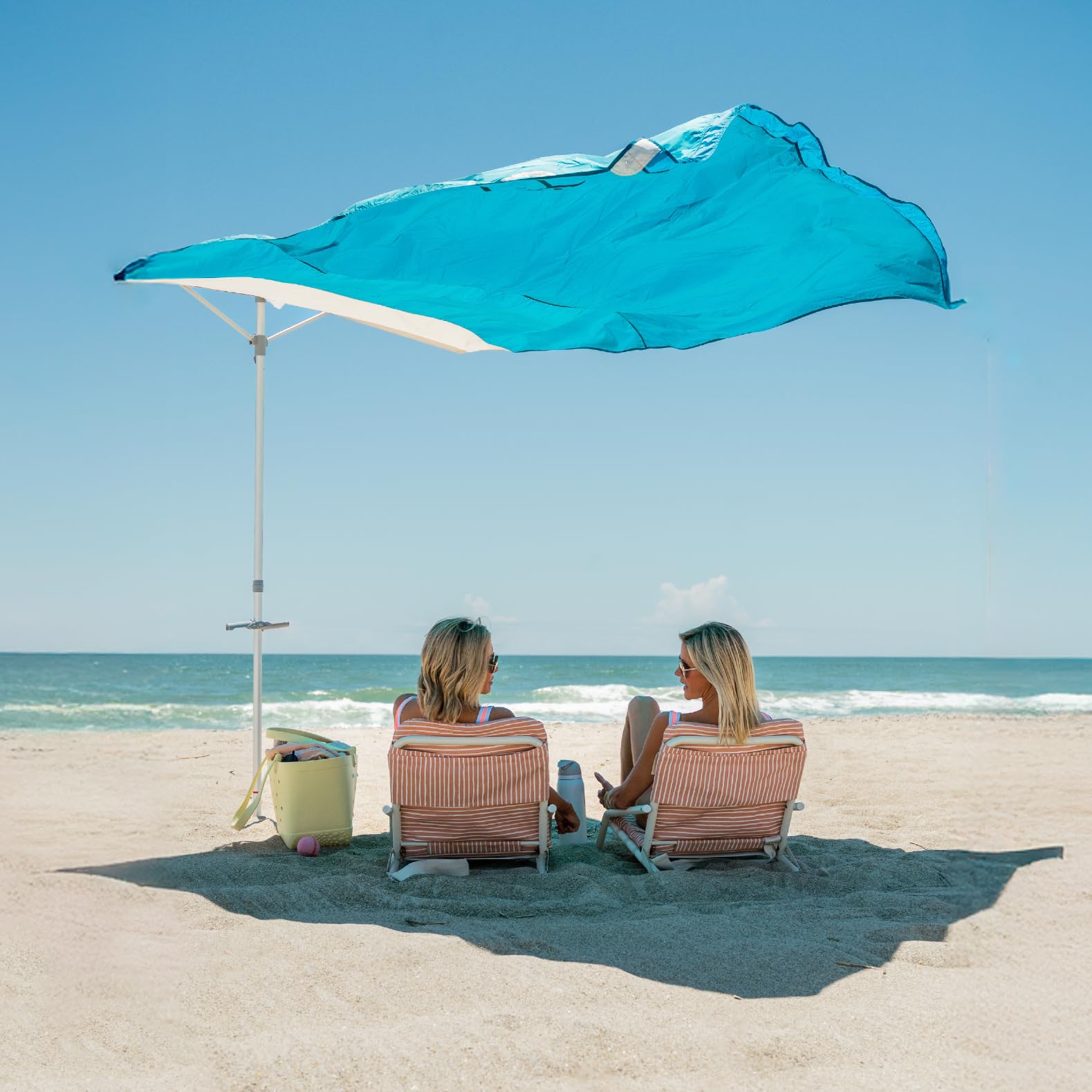
The Solbello Shade reimagines the beach umbrella by allowing the canopy to swivel with the wind rather than resist it. Its aerodynamic shape and pivoting mechanism mean the shade follows the breeze, reducing lateral force on the pole. At 4.52 pounds, it’s lighter than most dedicated beach canopies, and the setup involves staking the front two holes and letting the rear fabric float free.
Multiple customer reports confirm stability in 25-30 mph winds after proper auger base installation. The auger must be screwed deep into the sand past the red line for full holding power. The shade covers a family of four, offering enough height for standing. The company proactively replaced early models with a quieter version after user feedback about noise in high winds.
The main trade-off is coverage area — it shades a smaller footprint than a full canopy. The swivel design requires clear space around the umbrella to rotate freely. For beachgoers who want umbrella-style convenience with wind-resistant engineering, this bridges the gap between a standard beach umbrella and a full canopy.
Why it’s great
- Swivel design tracks wind direction automatically.
- Light enough for one-person carry and setup.
- Stable in 25-30 mph winds with correct installation.
Good to know
- Smaller shade footprint than full canopies.
- Requires correct auger depth for stability.
- Swivel mechanism needs clear space around it.
4. Osoeri Beach Tent 20x13ft

The Osoeri is the largest canopy in this lineup, covering 260 square feet — enough for 10-12 people and all their gear. Its stability comes from 8 symmetrical sandbags and 1.5mm thick aluminum poles. The third pole can be positioned to create a taller entry or a wider viewing angle, a flexibility that larger groups appreciate during beach parties or volleyball tournaments.
Setup takes 10-15 minutes for one person, 5-7 with two. The Lycra fabric offers UPF 50+ protection and stretches to reduce wind loading. Multiple user reports confirm it resists wind well, with the 8 weight points distributing lateral force across the frame. The included sand shovels are functional but users recommend upgrading to metal stakes for extra security.
The size is the key decision factor here — more coverage means more fabric to catch the wind. With all 8 sandbags filled and buried, it holds firm in moderate gusts. For large groups who need maximum shade and don’t mind the extra setup time, this is the best choice among the mid-range options.
Why it’s great
- Massive 260 sq ft coverage for large groups.
- 8 symmetrical sandbags provide balanced wind resistance.
- Flexible third pole for varied shade configurations.
Good to know
- Setup time is longer than smaller canopies.
- Large surface area catches more wind.
- Included sand shovels are low quality.
5. Rhino Valley Beach Tent 10x10ft

The Rhino Valley canopy uses 8 sandbags and 4 thickened aluminum poles to achieve wind resistance that rivals canopies costing twice as much. The 10×10 ft footprint provides 100 square feet of shade, enough for 4-6 people with chairs and a cooler. The Lycra fabric with triple stitching resists tearing while allowing some wind passage to reduce lift.
Setup is straightforward: spread the fabric, fill the sandbags using the included scoop, and insert the aluminum poles. Multiple users report stable performance in strong beach winds after burying the sandbags. The 6.5 ft peak height is slightly lower than the product images suggest — a 6-foot person cannot stand fully upright inside.
The sandbag fabric and plastic sand scoops are the weakest points. Users note the sandbag material may wear over time, and the scoops are flimsy. For the price point, this canopy offers the best balance of coverage, wind resistance, and portability among the mid-range options.
Why it’s great
- 8 sandbags for solid wind stability at a mid-range price.
- Aluminum frame resists corrosion better than fiberglass.
- Large 10×10 ft footprint for family shade.
Good to know
- Peak height is lower than advertised; 6ft person can’t stand.
- Plastic sand scoops are fragile and may break quickly.
- Sandbag material may wear after extended use.
6. Vibemo Beach Tent 10x10ft

The Vibemo canopy competes directly with the Rhino Valley at a similar price point, offering 8 upgraded sandbags and 4 thickened aluminum poles. The 10×10 ft coverage fits up to 8 people, and the Lycra fabric provides UPF 50+ protection. At 8.27 pounds, it’s lighter than the Osoeri and Rhino Valley, making it easier to carry in a trunk or luggage.
Customer feedback consistently praises the wind resistance when all 8 sandbags are filled and buried. The included sand shovel helps with quick bag filling. Users note that the main poles feel slightly flimsy compared to heavier-duty models, but the canopy still stands up to high wind days when properly anchored.
Some users report UV penetration through the fabric despite the UPF 50+ rating, so fair-skinned beachgoers should still apply sunscreen. The fabric also traps sand, requiring washing on a delicate cycle. For beachgoers who want a lightweight, wind-resistant canopy that packs small, the Vibemo delivers solid performance at an entry-level price.
Why it’s great
- Lightweight at 8.27 lbs for easy portability.
- 8 upgraded sandbags for stable wind performance.
- Packs compactly for trunk or luggage storage.
Good to know
- Poles feel flimsier than heavier-duty models.
- UV penetration reported despite UPF 50+ rating.
- Fabric traps sand and requires washing.
7. Old Bahama Bay Pop Up Beach Tent

The Old Bahama Bay is a classic pop-up tent design — it opens in seconds without assembly, making it the fastest setup in this lineup. It includes 4 guylines, stakes, and sand pockets to secure the tent to the ground. The 81×54.5×62 inch interior fits 3-4 people, with an extended floor that provides privacy for changing clothes.
This is not a wind-resistant canopy in the same class as the anchored models above. It holds up well in light breezes but will struggle in sustained gusts above 15 mph. The fiberglass poles are less rigid than aluminum, and the single-pole hub design creates a high windage profile. Multiple users note it can feel like an oven inside without a breeze — the mesh ventilation panels are positioned low.
For calm-day beach trips, park outings, or fishing where wind isn’t a concern, the instant pop-up design is genuinely convenient. Solo parents handling multiple kids appreciate the 30-second setup. If your beach is consistently windy, invest in one of the anchored canopy designs instead.
Why it’s great
- Instant pop-up setup in 30 seconds without assembly.
- Extended floor provides changing space and privacy.
- Lightweight at 8.18 lbs for easy carrying.
Good to know
- Struggles in winds above 15 mph.
- Poor ventilation; gets hot without a breeze.
- Fiberglass poles are less durable than aluminum.
FAQ
How many sandbags do I need for a 15 mph beach wind?
Can I use a beach canopy in hard-packed or rocky sand?
What is the difference between fiberglass and aluminum poles for wind resistance?
Final Thoughts: The Verdict
For most users, the best beach canopy for wind winner is the Shibumi Shade 2.0 because it uses the wind rather than fighting it, offering unmatched stability in breezy conditions with almost zero setup effort. If you want predictable all-day wind resistance on calm days, grab the CoolCabana Beach Shade. And for large groups who need maximum coverage without breaking the bank, nothing beats the Osoeri Beach Tent.

Mo Maruf
I created WellFizz to bridge the gap between vague wellness advice and actionable solutions. My mission is simple: to decode the research and give you practical tools you can actually use.
Beyond the data, I am a passionate traveler. I believe that stepping away from the screen to explore new environments is essential for mental clarity and physical vitality.