Our readers keep the lights on and my smoothie glass nicely filled. As an Amazon Associate, I earn from qualifying purchases.
An engineer’s 3D printer must translate CAD tolerances into physical reality without constant calibration or failed first layers. The market now offers high-speed CoreXY frames, actively heated chambers, and multi-material tool heads that turn a printer into a true prototyping partner rather than a hobby project.
I’m Mohammad Maruf — the founder and writer behind WellFizz. Over the past several years, I’ve analyzed over 200 FDM and resin printer specifications, comparing vibration compensation algorithms, hotend thermal capacity, and chamber insulation figures to identify which machines actually hold tight tolerances for functional parts.
The real challenge is filtering through marketing speed claims to find a machine that delivers repeatable layer adhesion and dimensional stability. This guide evaluates the most promising options to help you select the best 3d printer for engineers based on real hardware specs and user-reported reliability data.
How To Choose The Best 3D Printer For Engineers
Selecting a printer for functional prototyping demands more than looking at top speed figures. Engineering parts require consistent layer-to-layer bonding, precise dimensional accuracy, and the ability to run advanced materials without constant babysitting. Below are the specific factors that separate a capable workshop tool from a hobby machine.
Motion System and Frame Rigidity
CoreXY architecture offers a clear advantage in speed and accuracy because the toolhead is lighter and the belt paths cancel out certain vibration modes. A rigid die-cast or welded aluminum frame further reduces ringing at high accelerations. Look for printers that pair CoreXY with independent dual Z-axis motors to maintain tram under heavy print beds.
Hotend Temperature and Flow Rate
Engineering materials such as polycarbonate, nylon, and carbon-fiber-reinforced compounds require nozzle temperatures above 300°C. An all-metal hotend with a hardened steel or bimetal nozzle resists abrasive fillers. High-flow designs (measured in mm³/s) allow larger layer heights without underextrusion, which is critical when printing dense structural parts.
Chamber Heating vs. Enclosure
Simply enclosing the machine reduces drafts, but an actively heated chamber — capable of maintaining 50-60°C — is the key to printing ABS, ASA, and polycarbonate without warping or delamination. A chamber thermistor and PID control loop are the specs to look for if your work involves any material with a high glass-transition temperature.
Auto-Leveling and First-Layer Reliability
Strain-gauge or inductive auto-leveling systems that probe dozens of points and compensate for minor bed tilt save hours of manual adjustment. The best implementations perform this routine before every print and store the mesh for the session. Look for printers that combine this with a flexible PEI-coated spring steel sheet for easy part removal.
Open vs. Closed Ecosystem
An open-source firmware base — typically Marlin or Klipper — allows engineers to tune acceleration profiles, linear advance, and input shaping parameters. It also ensures compatibility with third-party slicers and slicing profiles. Closed ecosystems offer convenience and excellent out-of-box tuning, but they limit the ability to push the machine beyond its stock envelope.
Quick Comparison
On smaller screens, swipe sideways to see the full table.
| Model | Category | Best For | Key Spec | Amazon |
|---|---|---|---|---|
| ELEGOO Centauri Carbon | Mid-Range | High-speed functional prototypes | 500mm/s, 320°C nozzle | Amazon |
| Anycubic Kobra X Multicolor | Mid-Range | Multi-color parts with less waste | 600mm/s, 300°C nozzle | Amazon |
| FLASHFORGE Adventurer 5M Pro | Mid-Range | User-friendly start without sacrifice | 600mm/s, 280°C nozzle | Amazon |
| Bambu Lab P1S | Mid-Range | Reliable enclosed prototyping | 500mm/s, fully enclosed | Amazon |
| QIDI Q1 Pro | Mid-Range | Chamber-heated advanced materials | 600mm/s, 350°C nozzle | Amazon |
| ELEGOO Saturn 4 Ultra 16K | Mid-Range | Ultra-high-detail resin parts | 16K mono LCD, 150mm/h | Amazon |
| IdeaFormer IR3 V2 | Premium | Continuous belt prototyping | 400mm/s, infinite Z-axis | Amazon |
| Creality K2 Plus Combo | Premium | Large-format multi-color prints | 600mm/s, 350mm³ build | Amazon |
| Original Prusa MK4S | Premium | Proven reliability for production | Input shaping, open-source | Amazon |
| Dremel DigiLab 3D45 | Premium | Educational and office environments | 280°C nozzle, carbon filter | Amazon |
| Original Prusa XL 5-Toolhead | Premium | Multi-material industrial prototypes | 5-tool, 360mm³ build | Amazon |
In‑Depth Reviews
1. ELEGOO Centauri Carbon
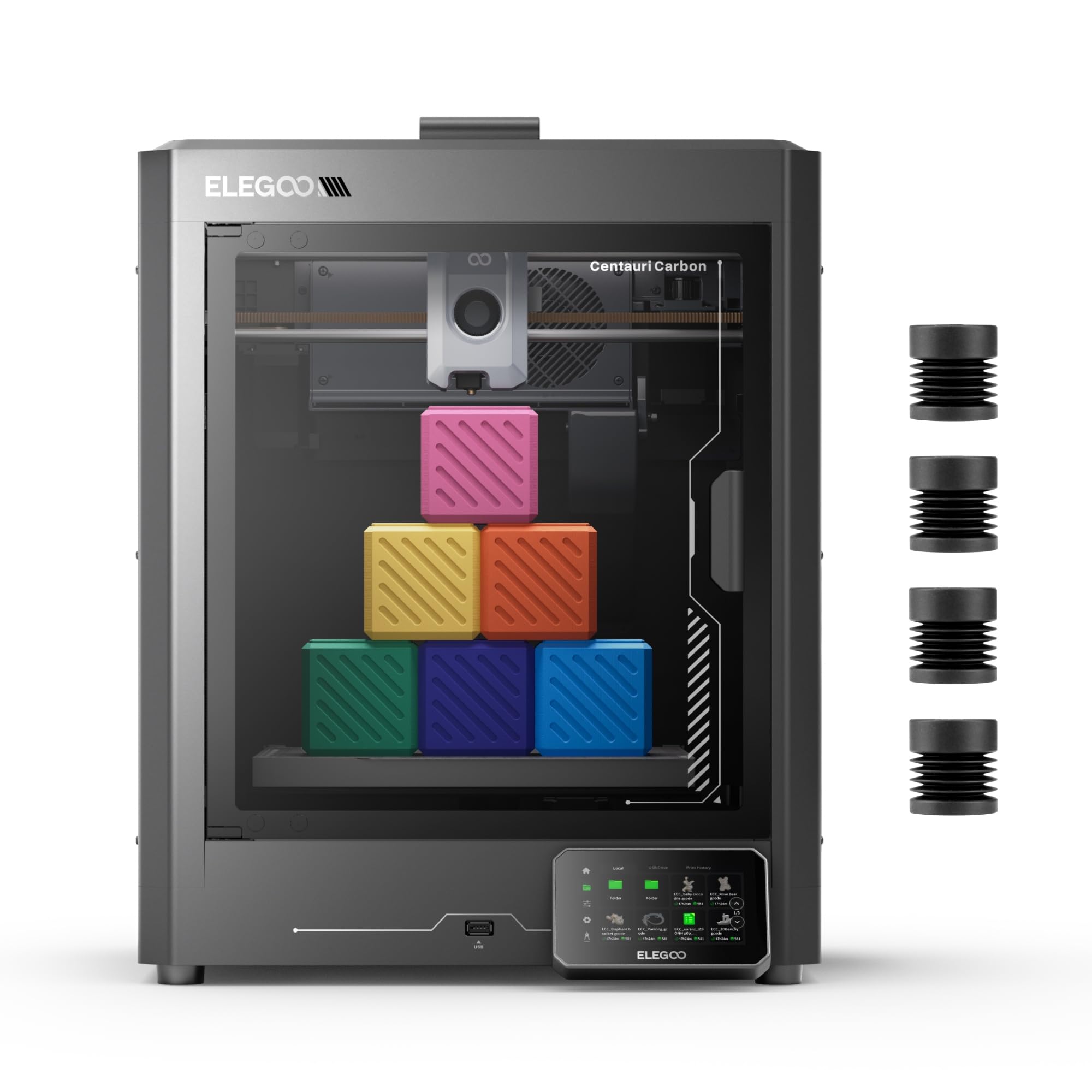
The ELEGOO Centauri Carbon combines a rigid die-cast aluminum CoreXY frame with automatic vibration compensation, delivering stable high-speed prints at up to 500 mm/s. Its 320°C brass-hardened steel nozzle handles carbon-fiber-reinforced filaments, and the enclosed chamber with dual-sided PEI plate ensures strong first-layer adhesion for PLA without high bed temps.
Out-of-box experience is genuinely plug-and-play: auto bed leveling, a built-in camera for time-lapse monitoring, and pre-calibrated profiles in the ElegooSlicer. Users report printing a benchy in under 18 minutes with quality that rivals slower machines. The 256 mm³ build volume is generous for a mid-frame printer.
Where it falls short is software maturity — the slicer can crash on very complex STLs with older laptops, and the USB-C port placement on a moving component is a questionable design choice that contributed to early failure in a small number of units. Still, ELEGOO’s support eventually resolved issues, and the overall reliability after initial setup is strong for the price tier.
Why it’s great
- Die-cast aluminum frame minimizes vibration at high speeds
- 320°C hotend enables carbon-fiber and other advanced filaments
- Built-in camera with LED lighting for remote monitoring
Good to know
- Slicer can struggle with very large or complex STL files
- USB-C port on moving assembly may wear over time
- Heavy unit at 38.5 lbs requires a sturdy table
2. Anycubic Kobra X Multicolor
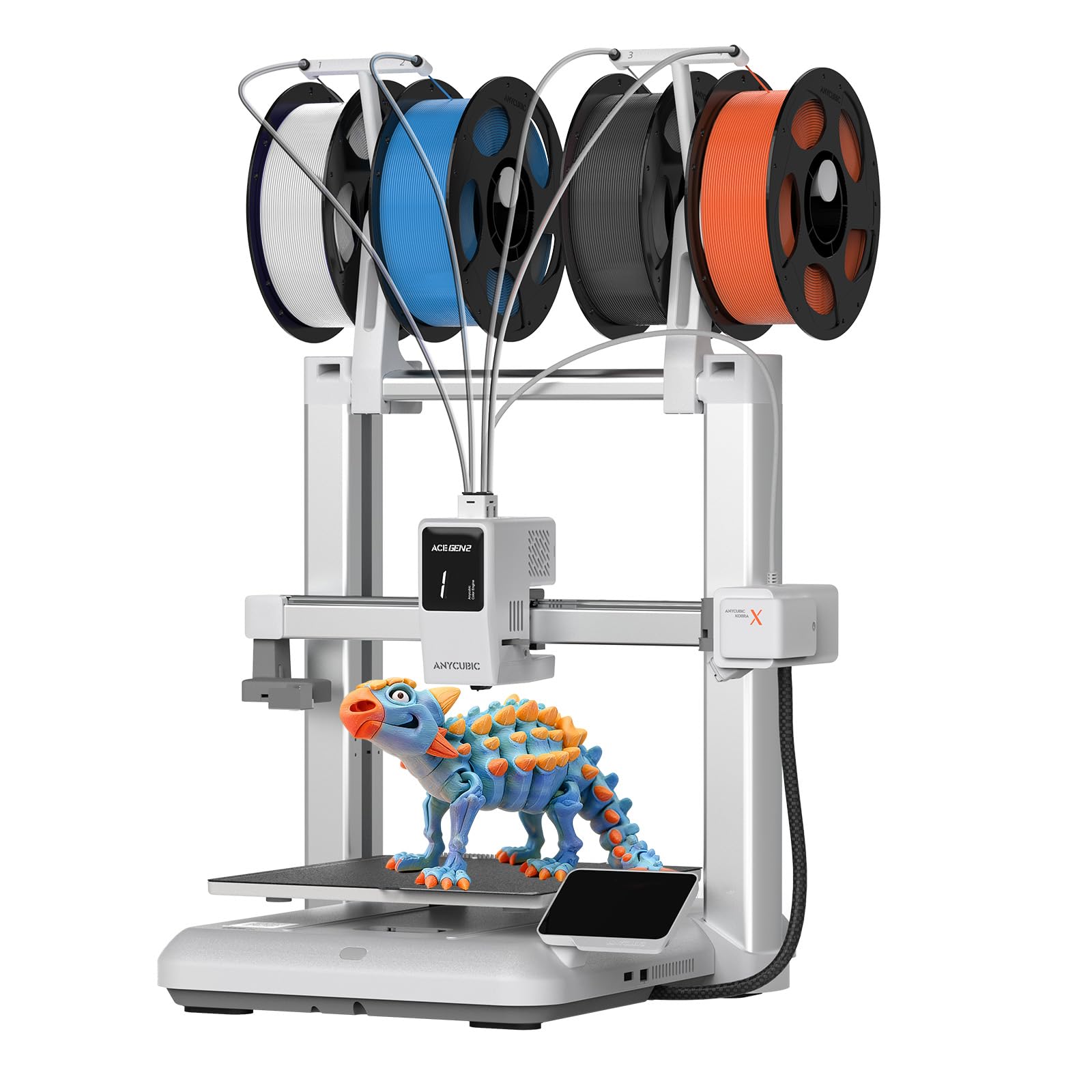
The Kobra X is built around a 600 mm/s CoreXY motion system with a hardened steel nozzle rated to 300°C, and it ships with a native four-color printing capability that can expand to 19 colors with additional ACE 2 Pro units. Its key innovation is a reduced purge path that cuts filament waste by roughly 80%, making multicolor prototypes more economical.
LeviQ 3.0 auto-leveling uses a 49-point calibration routine that delivers a consistent first layer, and the top-mount spool holder frees up desk space. The machine supports PLA, PETG, TPU, PVA, and ASA, and the AI camera offers spaghetti and foreign-object detection. Dual-band Wi-Fi and LAN connectivity allow remote control through the Anycubic app.
Reliability complaints are not trivial — several users report failed prints due to poor bed adhesion out of the box, and the phone app still needs polish. The printer is quiet at about 45 dB, but those seeking purely single-material engineering prints may find the multicolor mechanism adds unnecessary complexity and potential failure points.
Why it’s great
- Reduced purge path cuts multicolor filament waste by 81%
- 49-point auto-leveling ensures reliable first layers
- Very quiet operation at around 45 dB
Good to know
- Some units exhibit bed adhesion issues from the factory
- ACE 2 Pro and ACE Pro are not cross-compatible
- Phone app interface could be more polished
3. FLASHFORGE Adventurer 5M Pro

The Adventurer 5M Pro uses a CoreXY all-metal frame with a maximum travel speed of 600 mm/s and acceleration up to 20,000 mm/s². The nozzle reaches 200°C in 35 seconds, and the machine supports nozzle sizes from 0.25 mm up to 0.8 mm, giving engineers flexibility to balance surface finish against print speed. The build volume is 220 mm³, which is sufficient for most prototype brackets, jigs, and fixtures.
Pressure-sensing auto-leveling measures platform height at multiple points without needing a Z-axis calibration routine. The dual-sided PEI spring steel sheet allows tool-free model removal. The dual circulation system incorporates a HEPA and activated carbon filter, reducing airborne particulates during ABS or PETG prints — a notable safety feature for office-adjacent workshops.
Software setup can be frustrating: the Flash Maker app is required for initial Wi-Fi registration, and the included FlashPrint 5 slicer may not install on the latest macOS versions. A few users report nozzle clogs or communication failures after auto-leveling, suggesting quality control inconsistencies. When it works, print quality is very good, but the initial experience is not as seamless as the marketing suggests.
Why it’s great
- HEPA and activated carbon filtration for safer enclosed printing
- Interchangeable nozzle sizes from 0.25 to 0.8 mm
- 35-second heat-up to 200°C saves time between prints
Good to know
- Wi-Fi registration requires a phone or tablet app
- Slicer software may be incompatible with latest macOS
- Some units arrive with extruder or leveling defects
4. Bambu Lab P1S

The Bambu Lab P1S is a fully enclosed CoreXY machine that hits 500 mm/s with 20,000 mm/s² acceleration. Its 260 mm³ build volume is paired with auto bed leveling that runs before every print, and the enclosed design allows the use of ABS and ASA without external enclosure mods. The AMS add-on enables up to 16-color multi-material printing, though it is sold separately.
Setup takes roughly 30 minutes from unboxing to first print, and the Bambu Studio slicer offers well-tuned profiles that deliver excellent surface quality with minimal layer lines. The machine handles PLA, PETG, TPU, PVA, ABS, and ASA reliably, though carbon-fiber-reinforced materials are not recommended because of the standard brass nozzle. Users report the P1S is noticeably quieter than earlier Bambu models.
The main trade-off is the closed ecosystem: the printer requires a cloud connection for some features, which raises security concerns in professional environments. TPU printing can be finicky, requiring careful tuning of retraction settings. For engineers focused on fast, reliable prototyping of common engineering materials, the P1S is a strong contender, provided you accept the software and connectivity constraints.
Why it’s great
- Excellent out-of-box print quality with auto-leveling before every print
- Enclosed chamber handles ABS and ASA without warping
- Very fast setup and intuitive software workflow
Good to know
- Cloud dependency may be a concern for professional settings
- Not recommended for carbon-fiber-reinforced filaments without modification
- TPU requires careful profile tuning for good results
5. QIDI Q1 Pro

The QIDI Q1 Pro stands out with an actively heated chamber that can maintain up to 60°C, controlled by a closed-loop thermostat. This makes it one of the few printers in its price range capable of printing polycarbonate and nylon with minimal warpage. The 350°C bimetal nozzle handles carbon-fiber and glass-fiber compounds, and the independent dual Z-axis motors ensure bed tram is maintained during long jobs.
Full-auto calibration uses dual sensors for precise leveling, and the filament runout sensor is located near the extruder — not the spool — reducing false triggers from tangled spools. The printer runs on Klipper firmware, which is fully open-source, allowing engineers to tune acceleration profiles, pressure advance, and input shaping. A 1080P camera with time-lapse is included, and the 32 GB eMMC storage means prints can run without a tethered computer.
Downsides include the lack of a built-in air filter for ABS fumes — users have to print a carbon filter box from the official wiki. The side spool mount feels flimsy, and the touchscreen interface can be slightly unresponsive at times. For engineers who need chamber heating for advanced materials without stepping up to the premium tier, the Q1 Pro delivers exceptional value.
Why it’s great
- Active chamber heating to 60°C enables warp-free PA and PC prints
- 350°C bimetal nozzle handles carbon and glass fiber filaments
- Open-source Klipper firmware for advanced tuning
Good to know
- No built-in air filter for ABS/ASA fume management
- Side spool mount is not very sturdy
- Touchscreen responsiveness could be better
6. ELEGOO Saturn 4 Ultra 16K
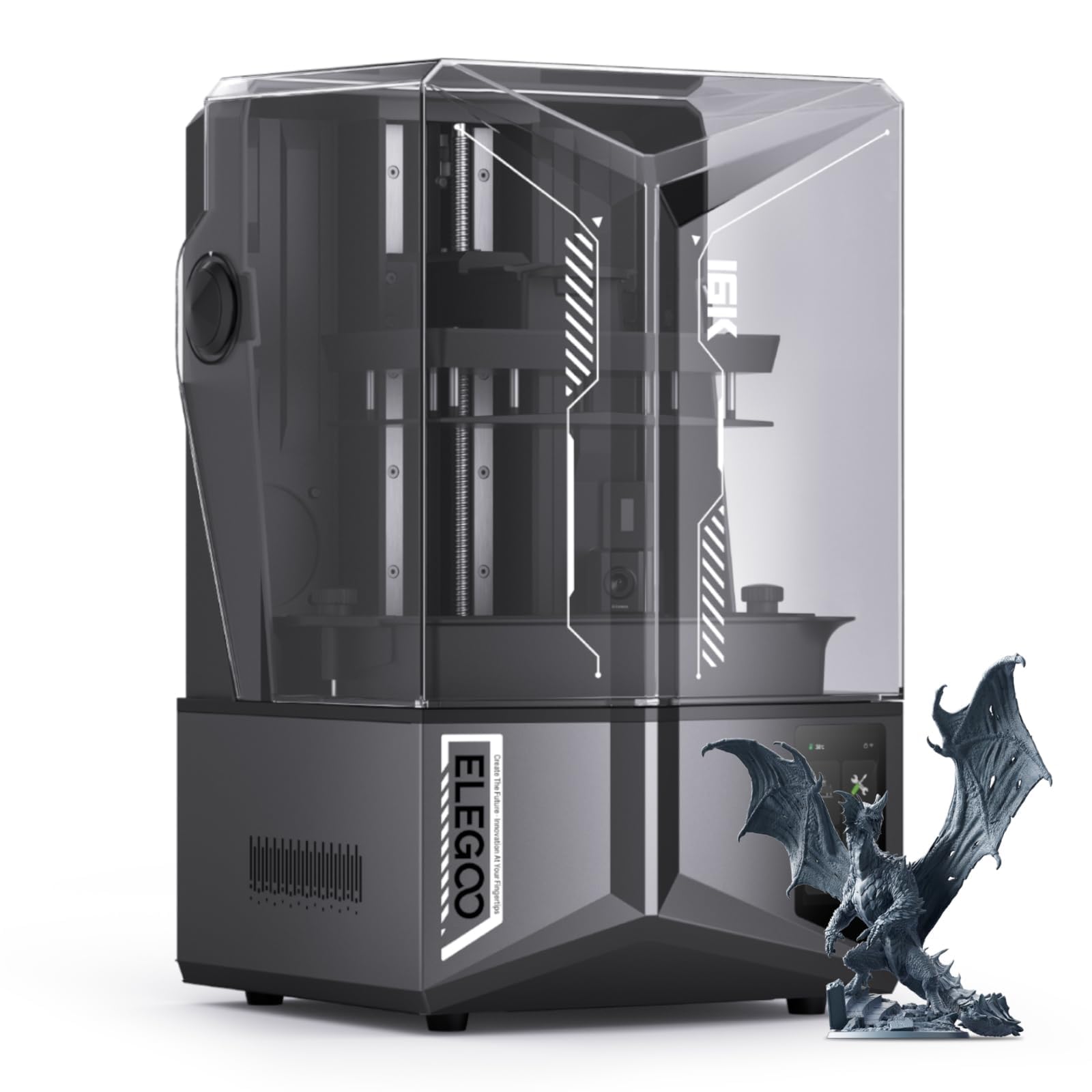
For engineers who need micron-level detail for investment casting patterns, microfluidics, or snap-fit connector prototypes, the Saturn 4 Ultra 16K uses a 10-inch monochrome LCD with 16K resolution (roughly 19 µm pixel pitch). The tilt-release mechanism peels each layer without the high peel forces typical of direct Z-lift designs, allowing speeds up to 150 mm/h with fine detail retention.
An integrated tank heating system maintains the resin at 30°C, reducing viscosity-related defects like bubbles and layer separation — a critical feature when printing with high-viscosity engineering resins. The AI camera detects empty build plates and warped models, though detection accuracy varies by resin color and ambient light. Auto-leveling is truly hands-off, and WiFi file transfer eliminates USB stick shuffling.
Resin pooling on the build plate after printing is an annoyance that requires a printed drip bracket. Firmware upgrades can occasionally reset saved settings. Post-processing is messier than FDM, and the 35.5-pound machine requires a vibration-free surface. For engineers prioritizing surface finish and feature resolution over part strength, this is a compelling choice.
Why it’s great
- 16K resolution delivers nearly 19 µm pixel pitch for ultra-fine details
- Tilt-release mechanism reduces peel forces for faster, reliable prints
- Resin tank heating at 30°C improves viscosity and layer adhesion
Good to know
- Resin pooling on build plate requires user-printed drip bracket
- Firmware updates can reset saved settings
- Post-processing messier than FDM alternatives
7. IdeaFormer IR3 V2

The IdeaFormer IR3 V2 is a conveyor-belt 3D printer with an infinite Z-axis, allowing continuous production of long parts like cosplay swords, architectural trims, or long functional beams. The belt is coated with PEI for good adhesion, and the Klipper-based firmware provides ultra-smooth XY motion. Maximum print speed is 400 mm/s on a 250 × 250 mm belt width.
One-click auto-leveling uses a Y-offset strain sensor, eliminating manual calibration cards. The machine is designed for batch production — users report running it 24/7 with a chute for automatic part removal. It handles PLA, PETG, ABS, TPU, ASA, and even PP, making it versatile for different engineering materials.
This is not a beginner machine. The gantry must be squared at a 45° angle during assembly, and the software workflow is Klipper/Fluidd-based, which requires some familiarity with command-line tuning. The printer is noisy compared to enclosed alternatives, and some units have arrived with cracked screens. It excels in specific use cases — mass production of long, low-profile parts — but fails as a general-purpose workshop printer.
Why it’s great
- Infinite Z-axis enables continuous production of long parts
- PEI-coated belt offers good adhesion for various filaments
- Klipper firmware allows deep tuning for production workflows
Good to know
- Assembly requires careful squaring of the gantry at 45°
- Not suitable for beginners; requires Klipper fluency
- Some build quality issues reported (cracked screens, sensor omissions)
8. Creality K2 Plus Combo

The Creality K2 Plus Combo offers the largest build volume in this lineup at 350 mm³, paired with a step-servo motor system that delivers 600 mm/s print speed and 30,000 mm/s² acceleration. The actively heated chamber and high-temp hardened steel nozzle unlock materials like PA-CF, PPA-CF, and PET-CF, which are essential for functional engineering prototypes that require thermal or chemical resistance.
The CFS (Creality Filament System) enables up to 16-color multi-material printing, and the dual AI cameras monitor for spaghetti failures and foreign objects. The anti-tilt auto-leveling uses independent dual Z-axis motors with strain-gauge compensation, ensuring a perfect first layer even across the large build surface. The die-cast “Matrix” frame and four linear rods provide rigidity for consistent layer alignment.
Quality control has been inconsistent: some units arrive with DOA components like Y-axis communication failures or extruder gear issues that require firmware-level fixes. The machine is extremely heavy at roughly 75 pounds including the CFS, and the assembly instructions are vague. When it works, it produces large-format prints with excellent quality, but it demands a patient, technically inclined owner.
Why it’s great
- Massive 350 mm³ build volume for large prototypes and batches
- Step-servo motors enable 30,000 mm/s² acceleration
- Actively heated chamber and high-temp nozzle for advanced engineering materials
Good to know
- QC issues are common — DOA units and miswired components reported
- Assembly instructions are vague and difficult to follow
- Very heavy; requires two people to unbox and set up
9. Original Prusa MK4S

The Prusa MK4S builds on the company’s decade of open-source development, adding input shaping to reduce ringing at higher speeds. The 250 × 210 × 210 mm build volume is smaller than many competitors, but the machine’s reliability is legendary — users report thousands of hours of production with minimal downtime. The hotend reaches 280°C, compatible with PLA, PETG, ABS, and flexible filaments.
The MK4S retains the fully open-source philosophy: Marlin firmware is accessible for tuning, and all parts are documented and upgradeable. Prusa’s slicer profiles are some of the most refined in the industry, delivering excellent surface quality and dimensional accuracy straight from default settings. The included 1 kg spool of Prusament PLA gets you printing immediately, and the textured PEI sheet provides strong adhesion across a wide temperature range.
The main limitations are the smaller build volume — insufficient for large enclosures or big structural parts — and the price, which rivals larger-format machines. Some users experience warping on large flat parts, though this is often addressed with brims and chamber temperature management. For engineers who value long-term support and open-source flexibility over raw speed or volume, the MK4S remains a benchmark.
Why it’s great
- Industry-leading reliability and long-term support from Prusa Research
- Fully open-source firmware and hardware for complete customization
- Refined slicer profiles produce excellent surface quality out of the box
Good to know
- Build volume (250 × 210 × 210 mm) is smaller than competing options
- Price is high relative to build volume
- Large flat parts may still experience some warping
10. Dremel DigiLab 3D45

The Dremel 3D45 is designed for educational and office environments where ease of use and safety are paramount. It features a 5-inch full-color touchscreen, a fully enclosed plastic body with built-in carbon and particulate filters, and a heated glass build plate that reaches 100°C. The all-metal nozzle heats to 280°C, supporting PLA, PETG, ECO-ABS, and Nylon.
Setup is genuinely fast — less than 15 minutes from unboxing to first print — and the RFID-enabled filament cartridges automatically configure temperature settings, reducing the chance of user error. The machine is quiet, produces minimal odor thanks to the filter, and includes a filament runout sensor that pauses prints automatically. Dremel’s customer support is widely praised for resolving issues quickly.
Limitations are significant for engineering use: the build volume is only 170 × 254 × 152 mm, the proprietary Dremel filament spools are expensive and only 0.75 kg each, and the DigiLab slicer lacks the advanced tuning options found in PrusaSlicer or Orca Slicer. The onboard camera quality is low, and the door must remain closed during printing. For an educational shop or an office prototyping station, this is a safe, low-maintenance choice, but power users will quickly outgrow it.
Why it’s great
- Very beginner-friendly with RFID filament auto-configuration
- Built-in carbon and particulate filters minimize fumes
- Reliable customer support and easy setup
Good to know
- Small build volume limits larger prototyping projects
- Proprietary Dremel filament rolls are expensive
- Limited slicer tuning capabilities for advanced users
11. Original Prusa XL 5-Toolhead
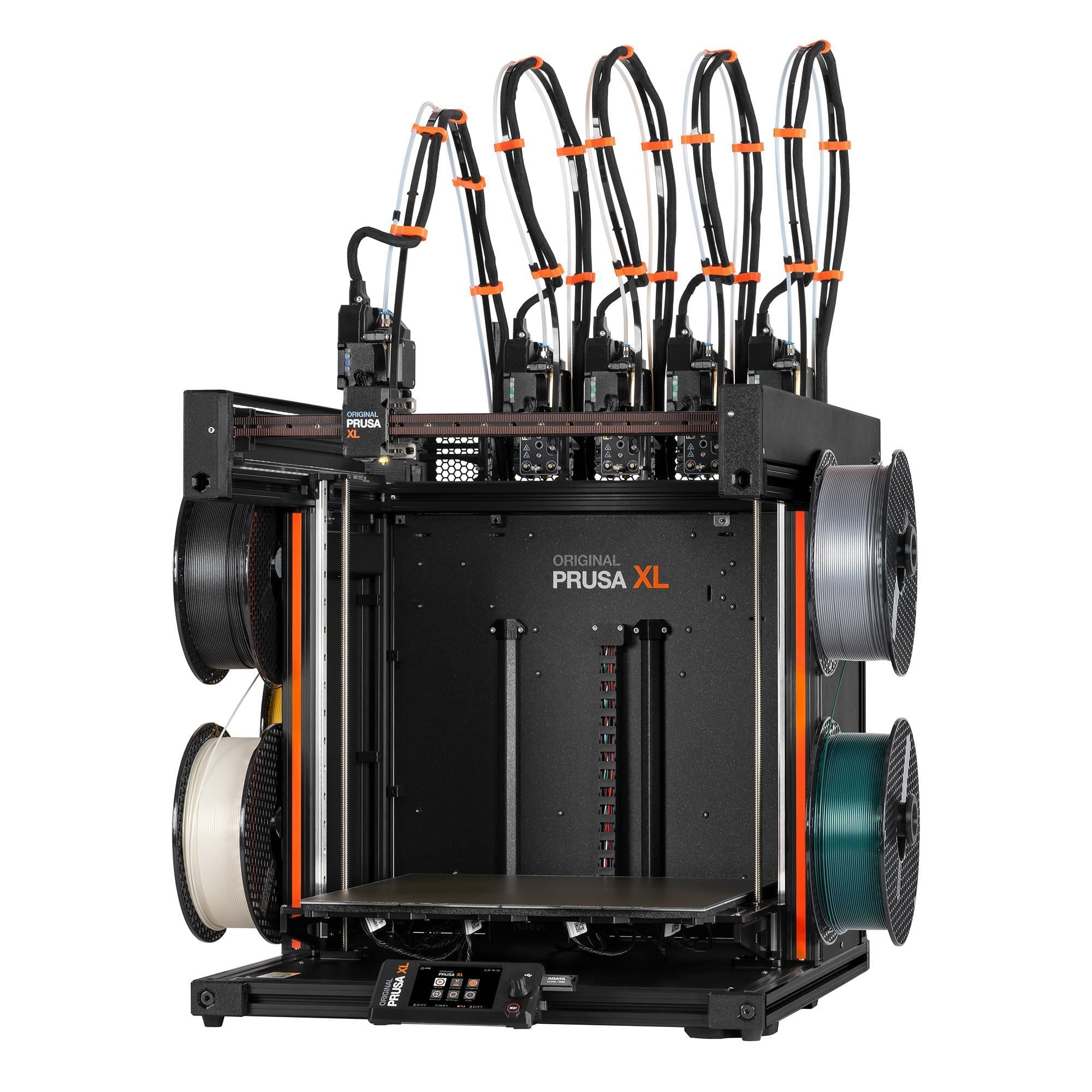
The Prusa XL 5-Toolhead is the most advanced machine in this lineup, using a CoreXY gantry with five independent tool heads that can be hot-swapped during a single print. This enables multi-material parts with dissolvable supports, or full-color visual prototypes without manual filament changes. The build volume is a generous 360 mm³, and the segmented heated bed uses intelligent zones to reduce energy consumption and warping on large parts.
Each tool head holds a separate hotend, allowing different nozzle diameters or materials in the same job — for example, a 0.6 mm nozzle for structural infill and a 0.25 mm nozzle for fine outer surfaces. The machine includes one Satin print sheet and a 1 kg spool of Prusament PLA. Prusa Connect enables remote monitoring and control, and the open-source philosophy means the printer is not locked into any proprietary ecosystem.
The XL is not plug-and-play. Despite being sold as assembled, critical components like the LCD and extruder assemblies must be installed after shipping, which can take half a day. The software — particularly the Prusa Connect integration — has had reports of Wi-Fi instability and blue-screen crashes. Shipping can be rough: broken plastic parts and scattered packing debris (including gummy bears) are common complaints. At 75 pounds and a massive footprint, it requires dedicated floor space. For a serious prototyping lab with a budget for a professional multi-material machine, the XL delivers unmatched capability, but it demands an advanced operator.
Why it’s great
- Five independent tool heads enable true multi-material and multi-color printing
- Segmented heated bed reduces warping and energy use on large parts
- Fully open-source and compatible with Prusa’s extensive software ecosystem
Good to know
- Requires significant post-shipping assembly despite “assembled” labeling
- Software bugs (Wi-Fi drops, blue screens) are still being ironed out
- Very heavy (75 lbs) and physically large; needs dedicated floor space
FAQ
Do engineers need an actively heated chamber or is a passive enclosure enough?
What is the minimum hotend temperature for carbon-fiber-filled filaments?
Is CoreXY always better than a bed-slinger for engineering prints?
How important is open-source firmware for engineering use?
Final Thoughts: The Verdict
For most engineers, the best 3d printer for engineers winner is the QIDI Q1 Pro because its actively heated chamber and 350°C hotend unlock advanced materials without jumping to the premium price tier, while the open-source Klipper firmware allows complete tuning control. If you want a machine that delivers exceptional print quality and reliability without sacrificing build volume, grab the Bambu Lab P1S. And for engineers who need to produce multi-material, full-color prototypes or require the largest possible build volume in a single machine, nothing beats the Original Prusa XL 5-Toolhead.

Mo Maruf
I created WellFizz to bridge the gap between vague wellness advice and actionable solutions. My mission is simple: to decode the research and give you practical tools you can actually use.
Beyond the data, I am a passionate traveler. I believe that stepping away from the screen to explore new environments is essential for mental clarity and physical vitality.