Our readers keep the lights on and my smoothie glass nicely filled. As an Amazon Associate, I earn from qualifying purchases.
Your phone hits 10% mid-afternoon, and you are scrambling for a wall outlet that does not exist. That sinking feeling of power anxiety is what a reliable battery pack eliminates—provided the one you grab actually delivers the wattage and capacity it claims.
I’m Mohammad Maruf — the founder and writer behind WellFizz. I study the real-world performance specs, cell chemistry, and charging protocols that separate a trustworthy power bank from a frustrating dud.
This guide breaks down five distinct options to help you find the battery charger for phone that matches your daily carry needs, travel habits, and charging speed expectations.
How To Choose The Best Battery Charger For Phone
Not every power bank delivers the same real-world charge. Three core factors—capacity, charging speed, and physical size—determine whether a pack actually solves your power problem or becomes another piece of clutter in your bag.
Match Capacity to Your Device
A 10,000mAh bank roughly doubles the battery of most flagship phones (iPhones, Galaxy S-series). If you need to charge two phones or a phone and a tablet, 20,000mAh is the next logical step. Higher capacity adds weight—so consider whether you carry the bank daily or only for travel.
Check the Charging Protocol
Look for USB-C Power Delivery (PD) at 20W or higher for iPhones and modern Android devices. A bank that only provides 5V/2.4A will trickle-charge a newer phone, often requiring two to three hours to reach full. Bi-directional PD (the bank charges itself fast and outputs fast) is a massive convenience.
Prioritize Cell Safety and Build
Lithium-polymer cells are lighter, slimmer, and inherently safer than older lithium-ion prismatic cells. They also pass airline regulations more easily. A quality bank should include overcharge, overcurrent, and temperature protection circuits, not just a low price tag and a high mAh number on the label.
Quick Comparison
On smaller screens, swipe sideways to see the full table.
| Model | Category | Best For | Key Spec | Amazon |
|---|---|---|---|---|
| Anker Zolo 10K 30W | Mid-Range | Reliable all-around 30W charging | Built-in USB-C cable, 30W bi-directional | Amazon |
| INIU 45W 10K Slim | Premium | Ultra-compact 45W fast charging | 45W PD output, 40% smaller than typical 10K | Amazon |
| VEGER 22.5W 10K Slim | Mid-Range | Built-in Lightning & USB-C cables | 22.5W max output, dual built-in cables | Amazon |
| Miady 2-Pack 10K | Budget | Two banks for under total | 2-pack, 10,000mAh each, USB-C input | Amazon |
| Anker 313 Wireless Pad | Premium | Fuss-free wireless charging at home | Qi-certified 10W max, non-MagSafe | Amazon |
In‑Depth Reviews
1. Anker Zolo 10K 30W Power Bank
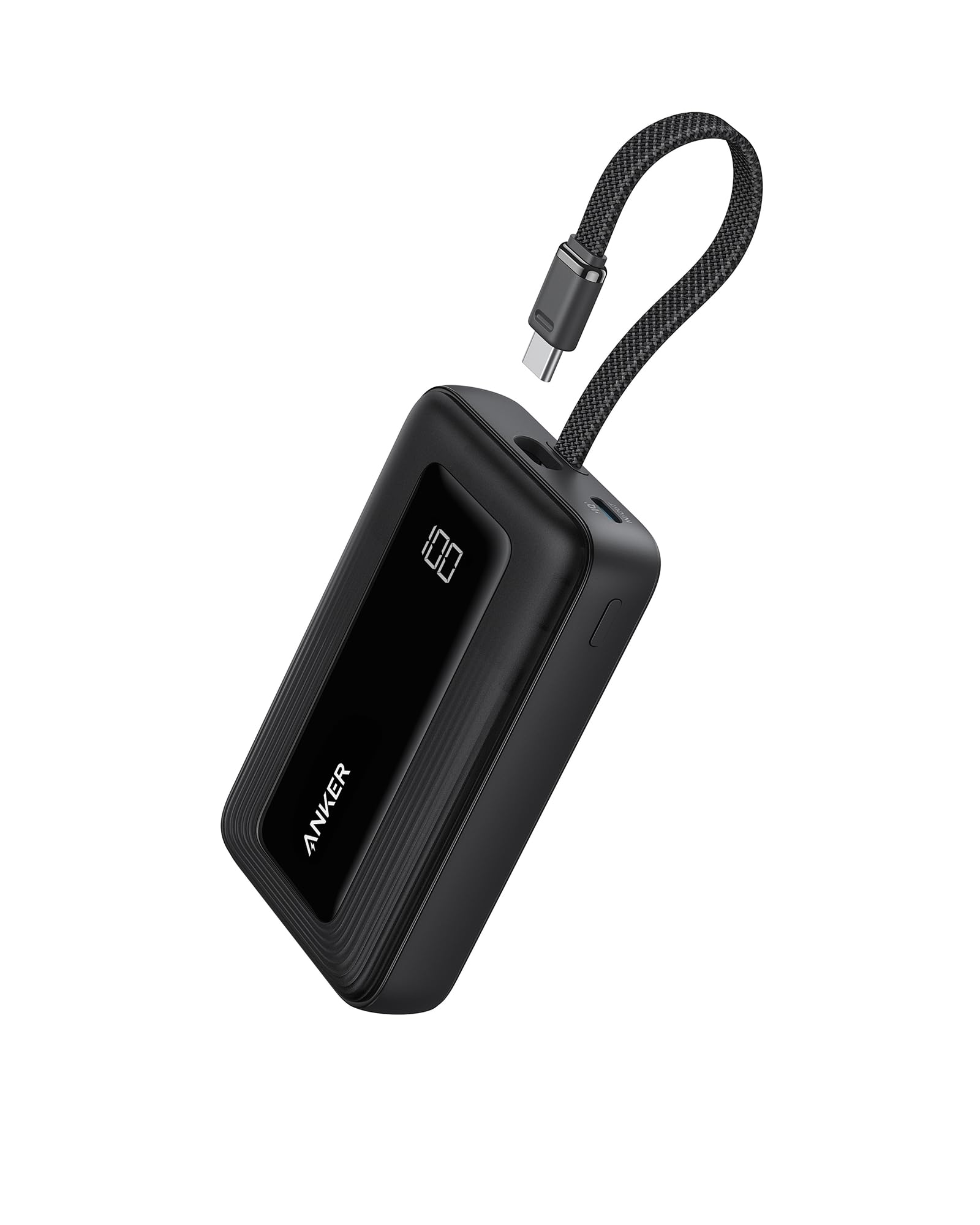
The Anker Zolo hits the sweet spot between charging speed and everyday portability. Its 30W Power Delivery output pushes an iPhone 16 Pro Max to 50% in 27 minutes—roughly half the time of a standard 5V/3A bank. The 10,000mAh lithium-polymer cell delivers roughly two full charges for a modern flagship phone, and the built-in 5.4-inch USB-C cable is tested for 10,000 bends, so it withstands daily bag abuse.
Bi-directional charging means you can refill the bank itself at 20W while simultaneously outputting 30W to your phone. The bank measures just 4.32 x 2.58 x 0.98 inches and weighs 217 grams—small enough to slip into a jeans pocket alongside your phone. Owners consistently note the built-in cable’s convenience and the accurate on-screen battery percentage display that eliminates guesswork about remaining power.
If you want a single power bank that handles daily commutes, travel, and emergency top-offs without requiring a separate cable, the Anker Zolo is the most balanced choice at this capacity tier. The 18-month warranty adds security, and the compact form factor means you will actually carry it every day rather than leaving it at home.
Why it’s great
- True 30W bi-directional charging speeds both output and recharge
- Built-in USB-C cable rated for 10,000 bends reduces travel clutter
- Clear digital display shows exact remaining battery percentage
Good to know
- Built-in cable is short (5.4 inches) and not detachable if the cable fails
- Heftier than some slim 10K competitors due to rugged casing
2. INIU 45W 10000mAh Power Bank
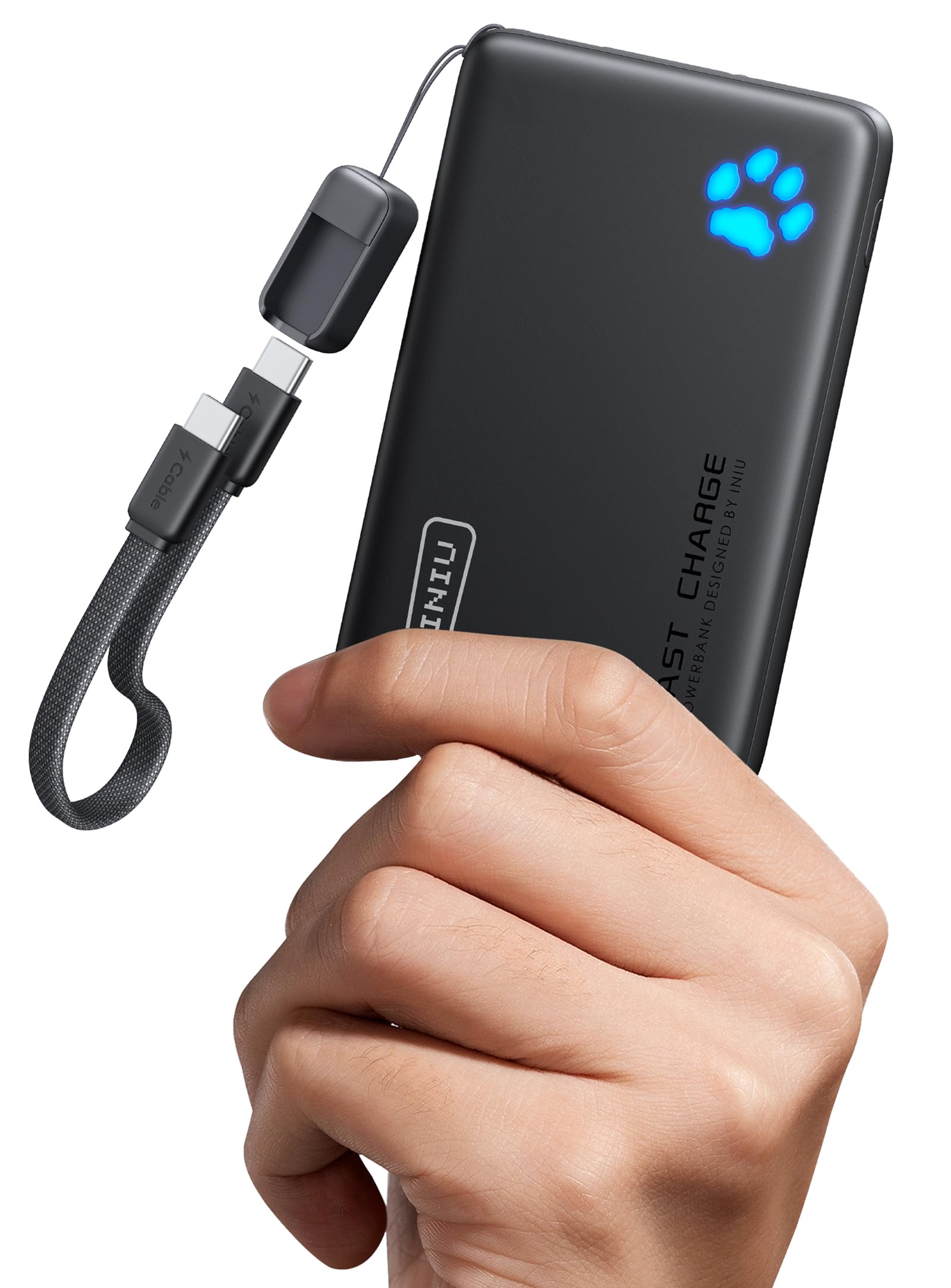
The INIU 45W power bank is a standout for anyone who prioritizes pocketability without sacrificing charging speed. At just 0.5 inches thick and 160 grams, it is 40% smaller than a typical 10,000mAh bank, thanks to INIU’s TinyCell high-density battery technology. Despite the slim profile, it delivers 45W Power Delivery—enough to push an iPhone 17 Pro Max to 76% or a Galaxy S25 Ultra to 84% in just 30 minutes from 20% battery.
A key design differentiator is the detachable braided USB-C cable. Unlike banks with a permanently bonded cord that renders the whole unit useless if the cable frays, INIU’s cable clips off and can be swapped. The pack also features dual USB-C outputs and one USB-A port, plus a clever paw-print battery indicator and a flashlight function that can be activated with a double-press of the side button.
The 3-year INIU care program (a new unit replacement if issues arise) is industry-leading for this price tier. For frequent travelers, hikers, or commuters who need maximum power density in the smallest footprint, this bank delivers. Some users note the matte plastic case shows fingerprints easily, but that is a minor cosmetic quibble on an otherwise technically impressive unit.
Why it’s great
- 45W output provides the fastest charging of any 10K bank in this guide
- Detachable USB-C cable means the bank isn’t a throwaway if the cord breaks
- Extremely slim and light (0.5″ thick, 160g) for daily pocket carry
Good to know
- Matte plastic finish is prone to smudges and fingerprints
- Flashlight can be accidentally activated by pocket pressure
3. VEGER 22.5W Slim Power Bank
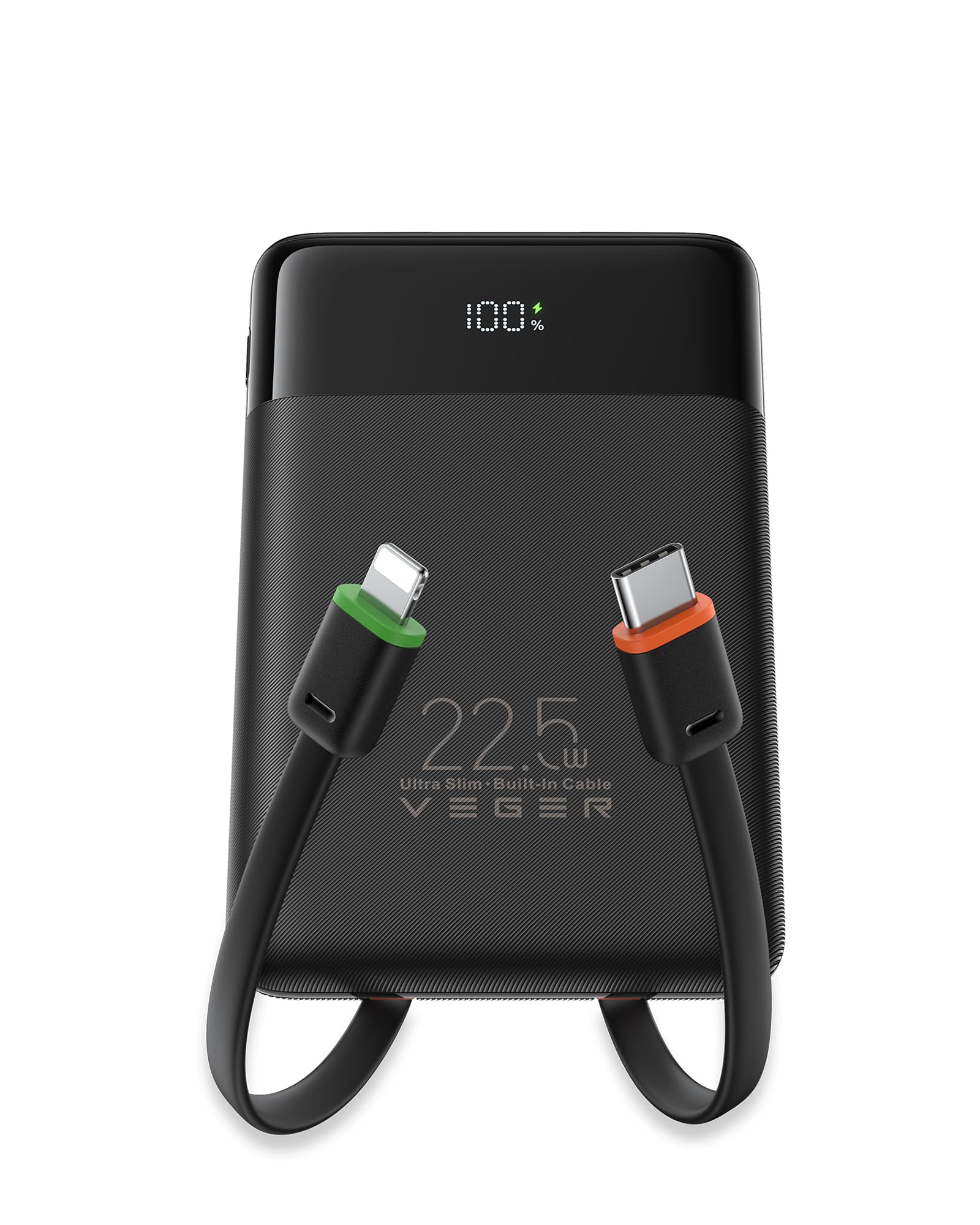
The VEGER 22.5W power bank solves a specific travel headache: cable management. It integrates both a USB-C cable and a Lightning cable directly into the chassis, so you never need to carry a separate cord for your iPhone or Android device. The bank itself measures just 4.57 x 2.83 x 0.66 inches and weighs 180 grams—lighter than a typical iPhone 17 Pro Max—making it one of the most travel-friendly 10,000mAh options available.
Charging performance is respectable though not class-leading: 22.5W from the USB-A port, and 20W from either the built-in USB-C or Lightning cables. That is enough to take an iPhone 16 Pro Max from 20% to roughly 60% in 30 minutes. The bank charges four devices simultaneously, and the smart temperature control prevents overheating during extended use. The built-in digital LED display shows exact remaining capacity, so you never wonder whether you have enough juice for the next day.
One quirk: the built-in cables are short, which can be inconvenient when the bank is in a bag pocket. Additionally, the bank is slightly too wide to fit into some luggage charging ports. For day-trippers, theme park visitors, and anyone who wants zero cable fuss, the VEGER is a thoughtful, well-executed design. The 24-month support and included travel pouch add further value.
Why it’s great
- Dual built-in cables (USB-C and Lightning) eliminate need for separate cords
- Slim 180g design with LED display makes travel simple
- Charges up to four devices simultaneously during group trips
Good to know
- Built-in cables are very short, limiting placement options during charging
- Bank is too wide to fit into many luggage-mounted charging ports
4. Miady 2-Pack 10000mAh Power Bank

The Miady 2-pack offers exceptional value by providing two 10,000mAh lithium-polymer power banks at a combined price that undercuts most single-unit competitors. Each bank measures 5.5 x 2.6 x 0.6 inches and weighs 218 grams—slightly bulkier than premium options, but the presence of two units means you can charge one while using the other, or keep separate banks for different bags. The packs come in black and white, making it easy to distinguish charged from depleted units.
Output is limited to 5V/2.4A per port (three total: two USB-A and one USB-C), so charging is slower than modern Power Delivery banks. Expect roughly 2.5 hours to fully charge a drained iPhone 15 Pro Max. The USB-C port is input-only for recharging the bank itself, which is a notable limitation for users who want to charge their phone via USB-C. The bank takes about 5 hours to fully recharge via the Micro USB or USB-C input.
Long-term reliability appears solid from user reports—some units remain functional after five years with minimal capacity fade. However, a minority of early units developed slow-charging issues after 1-2 months; the seller replaces those promptly. For families, car glove boxes, or emergency kits where backup charging is more important than speed, this 2-pack is hard to beat on cost-per-mAh.
Why it’s great
- Two banks for the price of one, excellent for sharing or backup kits
- Lithium-polymer cells provide safer operation than older Li-ion packs
- Long-term capacity retention reported over multiple years of use
Good to know
- USB-C port is input-only, limiting charging versatility
- 5V/2.4A output is slow for modern flagship phones
- Some units may require replacement due to early charging issues
5. Anker 313 Wireless Charger Pad

The Anker 313 PowerWave Pad takes a completely different approach—no cables, no batteries, just a Qi-certified wireless charging pad for home or office use. It delivers up to 10W for Samsung Galaxy devices, 7.5W for iPhones, and 5W for other Qi-compatible devices including AirPods. The rubberized top surface prevents phones from sliding off, and the slim 0.5-inch profile blends into any desk or nightstand setup.
A major advantage is through-case charging: the pad works with protective cases up to 5mm thick, as long as there are no magnetic or metal attachments. Users report reliable charging even when the phone is placed slightly off-center, an area where many budget wireless chargers struggle. The 4-foot Micro USB cable is included, though you must supply your own wall adapter—Anker recommends a Quick Charge 2.0/3.0 or Power Delivery adapter for full 10W speeds.
Notably, this is not a MagSafe magnetic charger, so iPhones will not snap into alignment. If you need magnetic alignment, look elsewhere. The 313 is strictly a place-and-charge pad. For users who want a permanent dock for their nightstand or desk, the Anker 313 offers proven long-term durability—reviewers report flawless operation after five years of daily use—at a very accessible price point.
Why it’s great
- Five years of proven daily durability with no performance degradation
- Wide charging surface tolerates off-center placement
- Compact low-profile design with non-slip rubberized surface
Good to know
- Not MagSafe magnetic compatible—no magnetic snap alignment for iPhones
- Wall adapter not included; requires separate QC/PD charger for fast speeds
- Micro USB input may feel dated for users with USB-C-only cable kits
FAQ
Can I take a 10,000mAh power bank on a plane?
Why does my power bank claim 10,000mAh but only charge my phone 1.5 times?
What does 30W bi-directional charging mean for a power bank?
Is a wireless charging pad better than a portable power bank for daily use?
Final Thoughts: The Verdict
For most users, the battery charger for phone winner is the Anker Zolo 10K 30W because it balances 30W bi-directional speed, a built-in cable, and compact dimensions into a single reliable package that handles daily carry without compromise. If you want the absolute fastest charging in the smallest footprint, grab the INIU 45W Power Bank. And for cable-free home convenience, nothing beats the Anker 313 Wireless Pad.

Mo Maruf
I created WellFizz to bridge the gap between vague wellness advice and actionable solutions. My mission is simple: to decode the research and give you practical tools you can actually use.
Beyond the data, I am a passionate traveler. I believe that stepping away from the screen to explore new environments is essential for mental clarity and physical vitality.