Our readers keep the lights on and my smoothie glass nicely filled. As an Amazon Associate, I earn from qualifying purchases.
Finding a pastime that genuinely challenges your cognitive abilities without feeling like a chore can be difficult. Many activities claim to boost your brainpower, but they often end up being repetitive or too simplistic to provide any real mental resistance. You need an option that strikes the perfect balance between fun and mental rigor, one that keeps your neural pathways firing long after the box is closed.
I’m Mohammad Maruf — the founder and writer behind WellFizz. I’ve spent years analyzing the market for logic puzzles, strategy games, and cognitive skill-builders, focusing on what separates a one-time novelty from a tool you’ll return to again and again.
Whether you are looking for a solo challenge or a family activity that sharpens everyone’s wits, this guide covers the top contenders on the market to help you find the best brain games.
How To Choose The Best Brain Games
Selecting the right mental workout requires more than just picking the most popular title. You need to consider whether the game exercises the specific skills you want to improve, from critical thinking and pattern recognition to memory recall and spatial awareness. A good match will keep you engaged while pushing your cognitive limits.
Determine Your Primary Cognitive Goal
Are you looking to improve logical sequencing, or do you want to test your general knowledge? Games like number-based tile games or deduction puzzles are excellent for pattern recognition and planning. Trivia games, on the other hand, focus more on memory retrieval and general knowledge recall. Define your goal first.
Evaluate the Difficulty Curve and Replayability
A game with a shallow learning curve can lose its appeal quickly. Look for titles that offer a progressive challenge, such as a large number of puzzles with increasing complexity or variable tactics that change how you play each round. The potential for replayability is a key factor in long-term value.
Consider the Format and Player Count
Think about where and with whom you will play. Solo puzzle boxes are perfect for quiet evenings, while strategy games with a higher player count are better for group gatherings. The portability of the box and the ease of setup are also practical considerations that affect how often you will actually pull the game off the shelf.
Quick Comparison
On smaller screens, swipe sideways to see the full table.
| Model | Category | Best For | Key Spec | Amazon |
|---|---|---|---|---|
| ThinkFun Gravity Maze | Logic / STEM | Spatial reasoning & planning | 60 Progressive Challenges | Amazon |
| Pressman Rummikub | Strategy / Tile | Pattern recognition & strategy | 106 High-Quality Tiles | Amazon |
| Jax SEQUENCE | Strategy / Card | Team-based strategic play | Folding Board 19.75″ x 15.25″ | Amazon |
| MindWare Logic Links | Puzzle / Deduction | Deductive reasoning solo play | 166 Puzzles Included | Amazon |
| Hygge Games Trivia Game | Trivia / Party | General knowledge group fun | 400+ Questions | Amazon |
In‑Depth Reviews
1. ThinkFun Gravity Maze

ThinkFun Gravity Maze is a standout fusion of a marble run and a logic puzzle. It requires you to place colored towers on a grid so that a marble drops from a starting point and lands exactly in the target, navigating through a series of paths. This type of construction requires deep spatial reasoning, sequential planning, and an understanding of gravitational physics that other games do not demand.
The game includes 60 challenge cards that range from beginner to expert, providing a steep but fair difficulty curve. The physical pieces are robust, and the instant visual feedback of the marble successfully completing the run is incredibly satisfying. It is a screen-free activity that feels modern and engaging.
This is an award-winning STEM toy that has proven its value in classrooms and living rooms alike. It is excellent for independent play, but it also creates a collaborative dynamic when parents and kids try to solve a tricky challenge together. The genuine difficulty of the advanced puzzles ensures it won’t be solved in one sitting.
Why it’s great
- Combines physics with logic for a unique challenge.
- Excellent difficulty progression across 60 puzzles.
- High-quality, durable pieces that feel substantial.
Good to know
- The marble and towers are small, a potential hazard for very young children.
- Some players might find the beginner levels too simple for their age range.
2. Pressman Rummikub

Pressman Rummikub is a classic that has remained relevant for decades precisely because it stretches the brain without feeling like homework. The goal is to be the first to empty your rack of numbered tiles by forming them into sequential runs or groups, similar to a rummy card game. The tactile nature of moving the plastic tiles adds a satisfying physical dimension to the mental math.
The game constantly forces you to manipulate existing sets on the table, requiring you to rearrange and re-plan your combinations. This “table manipulation” is the main cognitive workout, demanding you think several steps ahead and calculate multiple possible outcomes from a single move. It sharpens pattern recognition and strategic planning under pressure.
Its accessibility is a major strength; the rules are simple enough for an eight-year-old to grasp, yet the strategic depth keeps adults fully engaged. It is a fantastic tool for bridging generational gaps during family game night, promoting math skills and social interaction in a natural, competitive environment.
Why it’s great
- Excellent for developing sequencing and pattern recognition.
- High replayability due to randomized tile draws.
- Portable and easy to set up in any setting.
Good to know
- Can take a while to learn the rules of tile manipulation.
- The plastic tile racks can be a bit flimsy for frequent travel.
3. Jax SEQUENCE
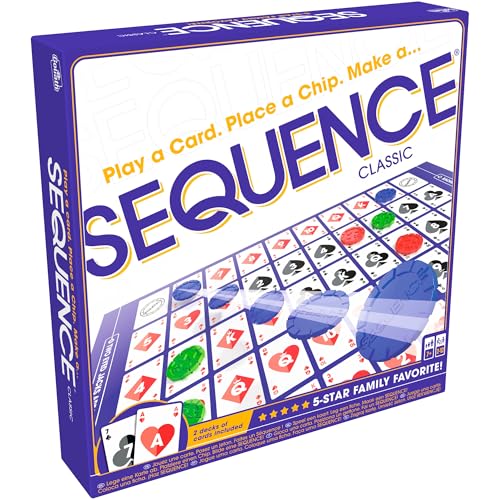
Jax SEQUENCE blends the simplicity of a card game with the spatial strategy of a board game. You play a card from your hand and place a chip on the corresponding space on the board, aiming to get five in a row. This mechanic forces players to actively manage risk, reading the board and anticipating opponents’ moves while planning their own path.
The game is excellent for large groups, supporting up to 12 players in teams. This team dynamic adds a layer of communication and cooperative strategy, as you must coordinate chip placement and block opponents without revealing your hand. It is a social workout as much as a cognitive one, testing your ability to think several moves ahead.
The included components are built for repeated use, with a thick folding board and durable chips that withstand frequent handling. It takes only minutes to learn, making it accessible for a wide range of ages, but mastering the art of the block and the setup requires real tactical thinking.
Why it’s great
- Great for large group dynamics and team strategy.
- Quick to learn but offers deep strategic play.
- High-quality components designed for longevity.
Good to know
- The luck of the card draw can sometimes outweigh pure strategy.
- Some reports indicate chips for one color may be slightly fewer than others.
4. MindWare Logic Links

MindWare Logic Links is a pure, unadulterated test of deductive reasoning. The game presents you with a set of clues, and you must use a grid and colored chips to determine the exact position of each chip. There is no luck, no speed component, and no opponent to blame — just your ability to process conditional statements and eliminate possibilities.
This format is excellent for building focus and patience. The puzzles force you to work through a mental hierarchy of “if this, then that” statements, training the brain to hold multiple variables in mind simultaneously. It is a highly effective tool for cognitive rehabilitation and academic skill-building, as noted by users using it for neuroplasticity training.
The compact box is perfect for travel, and the single-player nature makes it a great choice for quiet afternoons or waiting rooms. It includes 166 puzzles with increasing difficulty, offering a substantial amount of content for the price. The simplicity of the components (chips and puzzle cards) is part of its enduring charm.
Why it’s great
- Excellent for improving focus and deductive logic.
- Portable design ideal for travel and solo play.
- Large number of puzzles ensures long-term engagement.
Good to know
- The chips are small and can be easy to misplace.
- Best suited for solitary play, not a social group activity.
5. Hygge Games Trivia Game
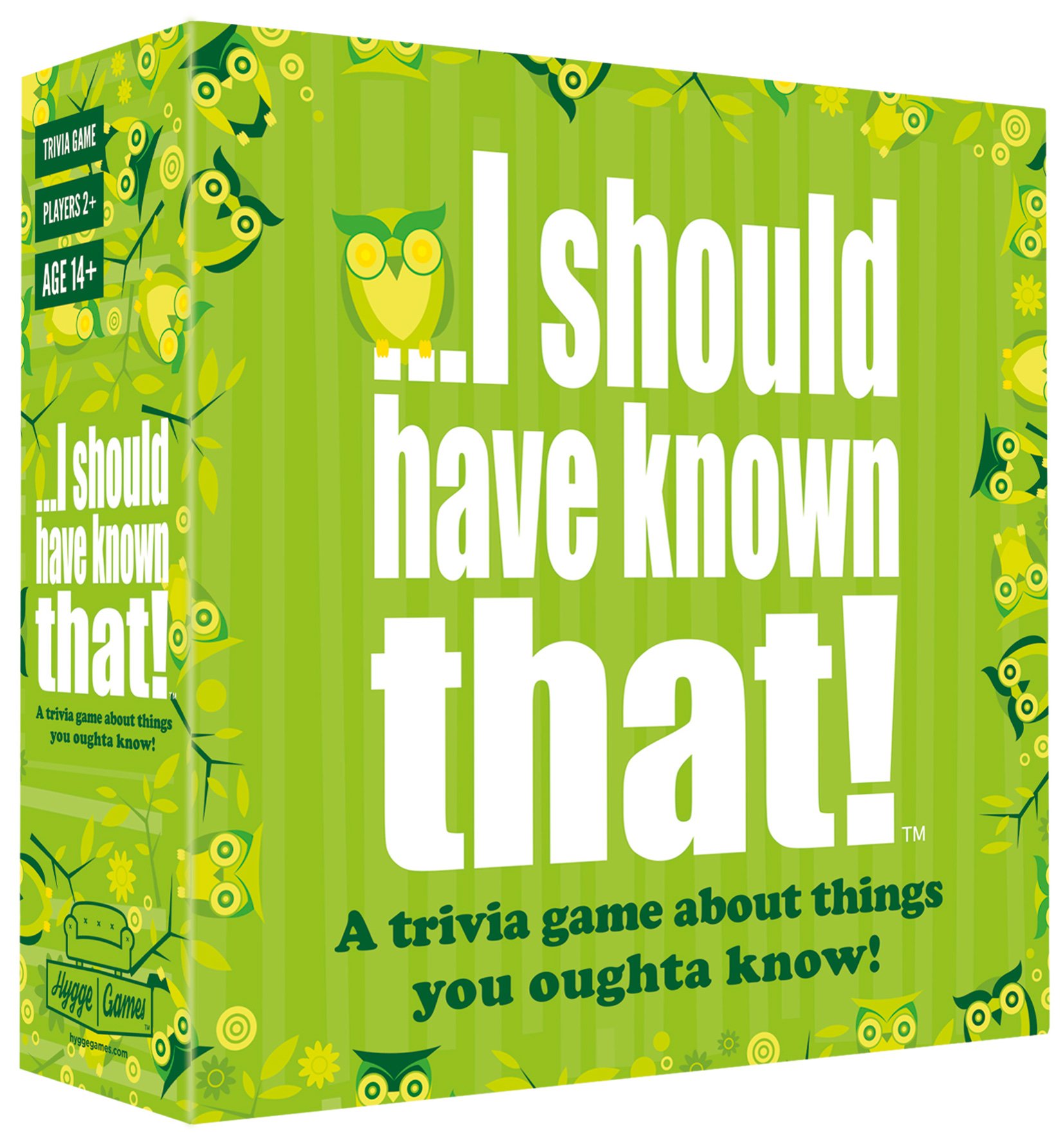
The “I Should Have Known That!” trivia game from Hygge Games takes a refreshing twist on traditional trivia by subtracting points for wrong answers. This mechanic creates a more strategic atmosphere, as players are incentivized to only answer when they are confident. It turns a simple recall test into a game of risk management and humility.
The questions focus on common knowledge that you *should* know, covering topics like history, pop culture, and science. This avoids the frustration of obscure facts and creates the satisfying “aha!” moment when the answer is revealed. It is a fantastic icebreaker for parties and a light way to keep your memory active.
The compact box contains 110 cards with over 400 questions, providing a solid amount of content for several game nights. It is an entry-level brain game that prioritizes fun and social bonding over intense mental strain. It is the perfect choice for a casual group setting where laughter is the primary goal.
Why it’s great
- Unique scoring system adds a strategic layer to trivia.
- Focus on common knowledge avoids discouraging obscure facts.
- Portable and quick to set up for immediate fun.
Good to know
- Some questions may feel too simple for trivia veterans.
- Best as a party game, not a serious cognitive training tool.
FAQ
What is the best brain game for improving memory?
Are number games like Rummikub good for the brain?
How many puzzles should a good brain game include?
Final Thoughts: The Verdict
For most users, the best brain games winner is the ThinkFun Gravity Maze because it merges hands-on construction with genuine logical problem-solving, offering a unique challenge that scales from beginner to expert. If you want a social, family-focused experience that builds pattern recognition, grab the Pressman Rummikub. And for a quiet, portable logic workout perfect for solo travel, nothing beats the MindWare Logic Links.

Mo Maruf
I created WellFizz to bridge the gap between vague wellness advice and actionable solutions. My mission is simple: to decode the research and give you practical tools you can actually use.
Beyond the data, I am a passionate traveler. I believe that stepping away from the screen to explore new environments is essential for mental clarity and physical vitality.