Our readers keep the lights on and my smoothie glass nicely filled. As an Amazon Associate, I earn from qualifying purchases.
Bananas are heavy feeders—they gulp potassium like no other plant in your garden. When that macronutrient runs low, the leaves yellow, fruiting stalls, and the stalk weakens long before you ever see a hand of bananas. The right fertilizer swing prevents all of that.
I’m Mohammad Maruf — the founder and writer behind WellFizz. I track fertilizer chemistry across hundreds of soil tests and grower reports to match specific N-P-K ratios to specific fruiting cycles.
Whether you are growing a dwarf Cavendish in a container or a mat of Orinoco in the ground, picking the best banana fertilizer means prioritizing potassium content, solubility, and chloride sensitivity for your specific setup.
How To Choose The Best Banana Fertilizer
Bananas demand more potassium than any other nutrient. The label you need to focus on is the third number in the N-P-K ratio—that is the potassium (K) content. A general-purpose 10-10-10 won’t cut it; you want a ratio that is potassium-dominant, such as 0-0-60 or 3-1-6. The form of that potassium and the presence of sulfur or chloride are what separate casual results from a serious harvest.
Potassium Source: Muriate of Potash vs. Sulfate of Potash
Muriate of Potash (MOP, 0-0-60) is the most concentrated potassium source and works well in soils not already high in chlorides. Sulfate of Potash (SOP, 0-0-50) costs more per pound but delivers sulfur alongside potassium and is safer for chloride-sensitive soils and organic production. If your banana leaves show tip burn on MOP, switch to an SOP formula.
Liquid Concentrate vs. Granular
Liquid fertilizers feed the roots immediately and are ideal for container bananas where the root zone is confined. Granular options (MOP or SOP) release slowly and work best for in-ground mats that need sustained feeding across an entire growing season. For potted dwarf varieties, a liquid concentrate at every watering works well. For a mature grove, a granular top-dress in spring and mid-summer is the practical choice.
Quick Comparison
On smaller screens, swipe sideways to see the full table.
| Model | Category | Best For | Key Spec | Amazon |
|---|---|---|---|---|
| Wellspring Gardens Banana Fuel | Liquid | Fruiting & leaf health | 3-1-6 N-P-K ratio | Amazon |
| TPS Nutrients Banana Tree Fertilizer | Liquid | Container banana growth | 2 tsp per gallon | Amazon |
| Down To Earth SOP 0-0-50 | Powder | Organic & chloride-sensitive soil | 200-mesh soluble powder | Amazon |
| Cz Garden MOP 0-0-60 | Granular | High-potassium boosts | 0-0-60 granular | Amazon |
| Espoma Potash 0-0-60 | Granular | In-ground garden mats | 6 lb. bag, no mixing | Amazon |
In‑Depth Reviews
1. Wellspring Gardens Banana Fuel Liquid Fertilizer
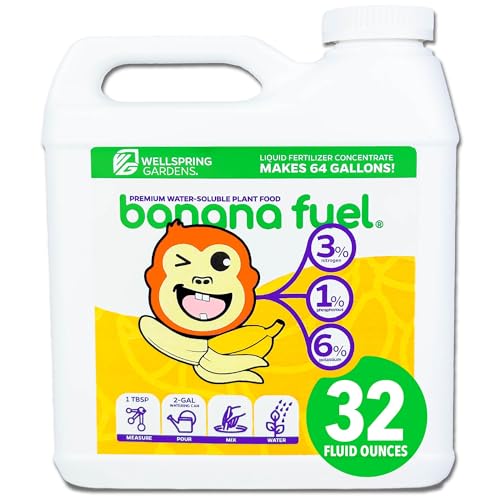
Wellspring Gardens Banana Fuel is the only fertilizer on this list specifically formulated to match the University of Florida’s recommended 3-1-6 N-P-K ratio for bananas. That 6 on the label means potassium content dominates—exactly what a developing bunch needs to size up and sweeten. Users report rapid recovery in heat-stressed plants and lush new growth within a week of first application.
The liquid concentrate dilutes at just one tablespoon per two gallons of water, making a 32-ounce bottle last many feedings. It works equally well in containers and in-ground plantings, and the University-backed ratio takes the guesswork out of mixing your own potassium booster.
Several growers note that the same 3-1-6 formula works on other fruiting trees—figs, citrus, avocados—so if you have a mixed orchard, this bottle serves more than just your banana mat. It is truly a “fuel” for the entire fruiting season.
Why it’s great
- Research-backed N-P-K ratio specific to bananas
- Immediate liquid feed for fast leaf and fruit response
- Versatile enough for other tropical fruit trees
Good to know
- Requires measuring and mixing each watering
- Premium cost per ounce compared to raw potash
2. TPS Nutrients Banana Tree Fertilizer
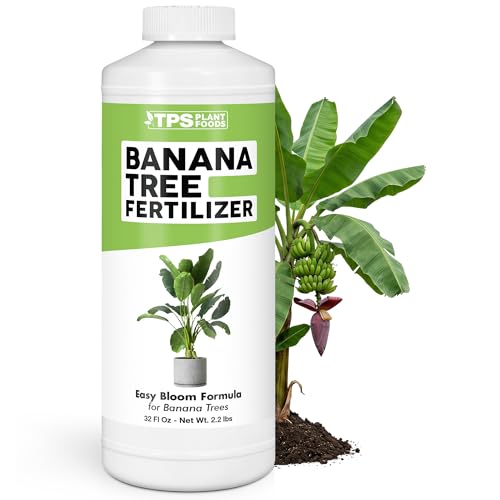
TPS Nutrients built this liquid fertilizer specifically for banana trees, and the mixer ratios are precise: two teaspoons per gallon for soil drench, one teaspoon per quart for foliar misting. That micronized dosing makes it an excellent choice for dwarf Cavendish and other container varieties where root volume is limited.
Buyers consistently report faster leaf unfurling and stronger pseudostems within weeks of switching to this formula. The blend supports root strength as much as top growth, which matters for container plants that can become top-heavy without a solid root anchor.
One caveat: the 32-ounce bottle goes through feedings quickly if you are watering multiple pots every week. For a single large mat in the ground, a granular option may be more convenient. For containers, this is the most direct path to vigorous growth.
Why it’s great
- Dual mixing ratios for soil and foliar feeding
- Fast visible results on container-grown bananas
- Supports both leaf expansion and root development
Good to know
- Small bottle may need frequent repurchase for multiple plants
- Not the most budget-friendly option per ounce
3. Down To Earth Organic Solution Grade Potassium Sulfate

Down To Earth’s SOP powder is the go-to for growers who need certified organic inputs and chloride-free potassium. At 0-0-50, it provides 50 percent soluble potash in a 200-mesh powder that dissolves fully for fertigation, hydroponic systems, or foliar sprays. If your soil is high in chlorides or you are building a living soil bed, this avoids the salt buildup that MOP can leave behind.
Reviewers specifically mention that this formula sweetens and enlarges berries and tropical fruit—including bananas grown in acidic soil blends. The sulfur component also supports flavonoid production, improving aroma profiles in edible crops.
For small-scale organic growers who prioritize soil biology, the trade-off for clean potassium is worth it.
Why it’s great
- OMRI certified for organic production
- Chloride-free, safe for sensitive soil biology
- Dissolves completely for spray or drip applications
Good to know
- Small package size for the price
- Not fully soluble if stirred too quickly—needs agitation
4. Cz Garden Supply Muriate of Potash 0-0-60

Cz Garden’s MOP is the highest-concentration potassium option here at 0-0-60. For banana growers who want to push maximum fruit density and stalk thickness, this granular formula delivers pure potash with no fillers. The 5-pound resealable bag stores easily and pours cleanly for top-dressing around the drip line of in-ground mats.
Users report significant increases in flower vibrancy and fruit set on lychee, coffee, pineapple, and banana after applying this supplement. Because MOP is water-soluble, it moves into the root zone with the next rain or irrigation cycle.
The catch: MOP is chloride-based. If your soil already runs salty or you are growing in a container with limited drainage, the chloride content can cause leaf tip burn over time. Use this one for outdoor groves with good drainage.
Why it’s great
- Highest potassium concentration (60% K₂O)
- Resealable bag with easy-pour spout
- Fast visible results on flowering and fruiting
Good to know
- Chloride content can burn sensitive plants in containers
- Not certified for organic production
5. Espoma Potash 0-0-60

Espoma’s 0-0-60 potash is the most straightforward entry-level granular option. It comes in a 6-pound bag ready to sprinkle around the drip line with zero mixing—just apply and water in. The analysis contains no sludges or fillers, making it a clean potassium supplement for gardens with multiple banana plants or fruit trees.
Growers use it to boost flowering and fruiting on peppers, tomatoes, sweet potatoes, and blueberries, and several note that it improved the vigor of slow-growing gourds and ornamentals within days. Because it is pure granule, it releases steadily rather than hitting the roots all at once.
The main drawback is inconsistency: one reviewer saw no difference after a year compared to untreated soil, and the bag has a notable fishy odor. For the price per pound, it is the value leader, but user results vary based on baseline soil potassium levels.
Why it’s great
- Lowest cost per pound among all options
- No mixing—broadcast and water in
- Works on many fruiting and flowering crops
Good to know
- Fishy smell on application
- Results depend heavily on existing soil K levels
FAQ
Can I use a balanced 10-10-10 fertilizer on my banana plants?
How often should I fertilize a banana plant in a container?
What does the 0-0-60 number actually mean?
Final Thoughts: The Verdict
For most users, the best banana fertilizer winner is the Wellspring Gardens Banana Fuel because its 3-1-6 ratio is backed by university research and delivers immediate results in both containers and ground plantings. If you want a dry, mix-into-water organic option for sensitive soil, grab the Down To Earth SOP 0-0-50. And for large in-ground mats that need high-concentration potassium on a budget, nothing beats the Cz Garden MOP 0-0-60.

Mo Maruf
I created WellFizz to bridge the gap between vague wellness advice and actionable solutions. My mission is simple: to decode the research and give you practical tools you can actually use.
Beyond the data, I am a passionate traveler. I believe that stepping away from the screen to explore new environments is essential for mental clarity and physical vitality.