Our readers keep the lights on and my smoothie glass nicely filled. As an Amazon Associate, I earn from qualifying purchases.
Moving from a desktop-sized FDM printer to a large-format machine changes what you can make. A build volume over 300mm in any axis allows full-size helmet parts, functional brackets, and production batches that would otherwise require splitting and gluing. The main challenge shifts from “will it fit” to “will the bed stay level at 70°C across a 16-inch surface.”
I’m Mohammad Maruf — the founder and writer behind WellFizz. I research mechanical tolerances, extrusion systems, and firmware compensation algorithms to find which large-frame printers actually deliver flat first layers across their full surface area.
Moving to a big machine means committing to a larger footprint, heavier frame, and often more involved calibration. The right big 3d printer balances speed, reliability, and material support for the size you need.
How To Choose The Best Big 3D Printer
Large-format printers require stronger frames, more robust leveling systems, and often a heated chamber to keep tall or wide prints from warping. The right choice balances build size with the print quality you need for your specific materials.
Build Volume vs. Machine Footprint
A 400x400x400mm build volume produces much larger one-piece models than a standard 250x250mm plate, but the printer itself may need a dedicated table. Check the machine’s outer dimensions—some CoreXY models have a smaller footprint than their build volume suggests, while bedslingers extend further front and back.
Frame Rigidity and Motion System
Tall prints amplify frame wobble. Linear rails on X/Y axes reduce vibration, and a stiff all-metal frame prevents ringing at high speeds. CoreXY kinematics keep the bed stationary, which improves stability for heavy or tall prints compared to moving-bed designs.
Heated Chamber and Material Range
If you plan to print ABS, PC, or Nylon, an active heated chamber (65°C or higher) prevents warping and layer delamination. For PLA or PETG-only users, an open-frame design works fine, but adding a chamber enclosure later is an option on some models.
Quick Comparison
On smaller screens, swipe sideways to see the full table.
| Model | Category | Best For | Key Spec | Amazon |
|---|---|---|---|---|
| Creality Ender 3 V3 Plus | FDM CoreXZ | Entry-level large format | 300x300x330mm | Amazon |
| ELEGOO Neptune 4 Max | FDM Bedslinger | Massive volume on budget | 420x420x480mm | Amazon |
| Anycubic Kobra 3 Max | FDM CoreXY | Tall jumbo prints (with ACE Pro) | 420x420x500mm | Amazon |
| ELEGOO Saturn 4 Ultra 16K | Resin MSLA | High-detail resin prints | 8.33×4.66×8.66in | Amazon |
| SainSmart WonderMaker ZR | FDM CoreXY | Multicolor value pick | 300x300x300mm | Amazon |
| Anycubic Kobra 3 Max Combo | FDM CoreXY | Multicolor jumbo builds | 420x420x500mm | Amazon |
| Creality Ender 5 Max | FDM CoreXY | Print farm throughput | 400x400x400mm | Amazon |
| QIDI PLUS4 | FDM CoreXY | Engineering materials | 12x12x11in (305x305x279mm) | Amazon |
| QIDI Max4 Combo | FDM CoreXY | Industrial large format | 390x390x340mm | Amazon |
| Original Prusa CORE One | FDM CoreXY | Reliable open-source workhorse | 250x220x270mm | Amazon |
| Original Prusa XL 5-Tool | FDM CoreXY | Multi-material professional | 360x360x360mm | Amazon |
In‑Depth Reviews
1. Anycubic Kobra 3 Max

The Kobra 3 Max offers one of the largest build volumes at its price point without sacrificing speed. Its CoreXY design keeps the bed stationary, which helps maintain accuracy when printing tall parts like full-scale helmets or sand table frames. The 600mm/s maximum speed with 10000mm/s² acceleration is backed by G-sensor vibration compensation.
Auto leveling and a dual-sided PEI spring steel plate simplify first-layer adhesion. The all-metal hotend reaches 300°C, supporting PLA through Nylon. If you add the ACE Pro unit, the printer handles 4-color prints; two ACE Pro units enable up to 8 colors. The AI spaghetti detection pauses automatically when it detects failed layers.
Assembly takes under an hour, and the removable magnetic bed makes part removal easy. Some users report the AI detection is inconsistent, and the ACE Pro requires separate purchase. For the size, the build quality feels solid, and customer support resolves hardware issues promptly.
Why it’s great
- Massive 420x420x500mm build volume handles full-size projects
- Auto leveling and PEI plate ensure reliable first layers
- Expandable to 8-color printing with ACE Pro
Good to know
- AI spaghetti detection can trigger false positives
- ACE Pro multicolor unit sold separately
- Requires sturdy table for stability at high speeds
2. QIDI PLUS4

The PLUS4 stands out for its active chamber heating system that reaches 65°C, allowing reliable printing of high-temperature filaments like PPS-CF and PPA-CF without warping. The 400W heating element with dual-layer insulation ensures temperature consistency across long prints. Its 12x12x11-inch build volume suits engineering prototypes and production parts.
The all-metal integrated nozzle reaches 370°C, paired with an 80W hotend that maintains high flow rates for abrasive composites. The independent dual Z-axis with 10mm leadscrews and a 6mm thick aluminum bed keeps the gantry rigid. Klipper firmware enables remote monitoring through the QIDI app or Fluidd interface.
One reviewer reported over 4000 hours with zero maintenance beyond hotend swaps. The initial QC has been inconsistent—some units arrive with bed leveling issues that require support intervention. QIDI support generally resolves problems quickly, but the experience is more involved than a fully closed ecosystem. The PLUS4 is best for users who need engineering-grade materials and are comfortable with minor tuning.
Why it’s great
- Active 65°C chamber prints engineering filaments reliably
- 370°C hotend handles PPS-CF, PPA-CF, PC
- Open-source Klipper firmware with remote monitoring
Good to know
- Factory QC can be inconsistent on early units
- Not beginner-friendly due to manual tuning needs
- No integrated multicolor system (QIDI BOX sold separately)
3. QIDI Max4 Combo
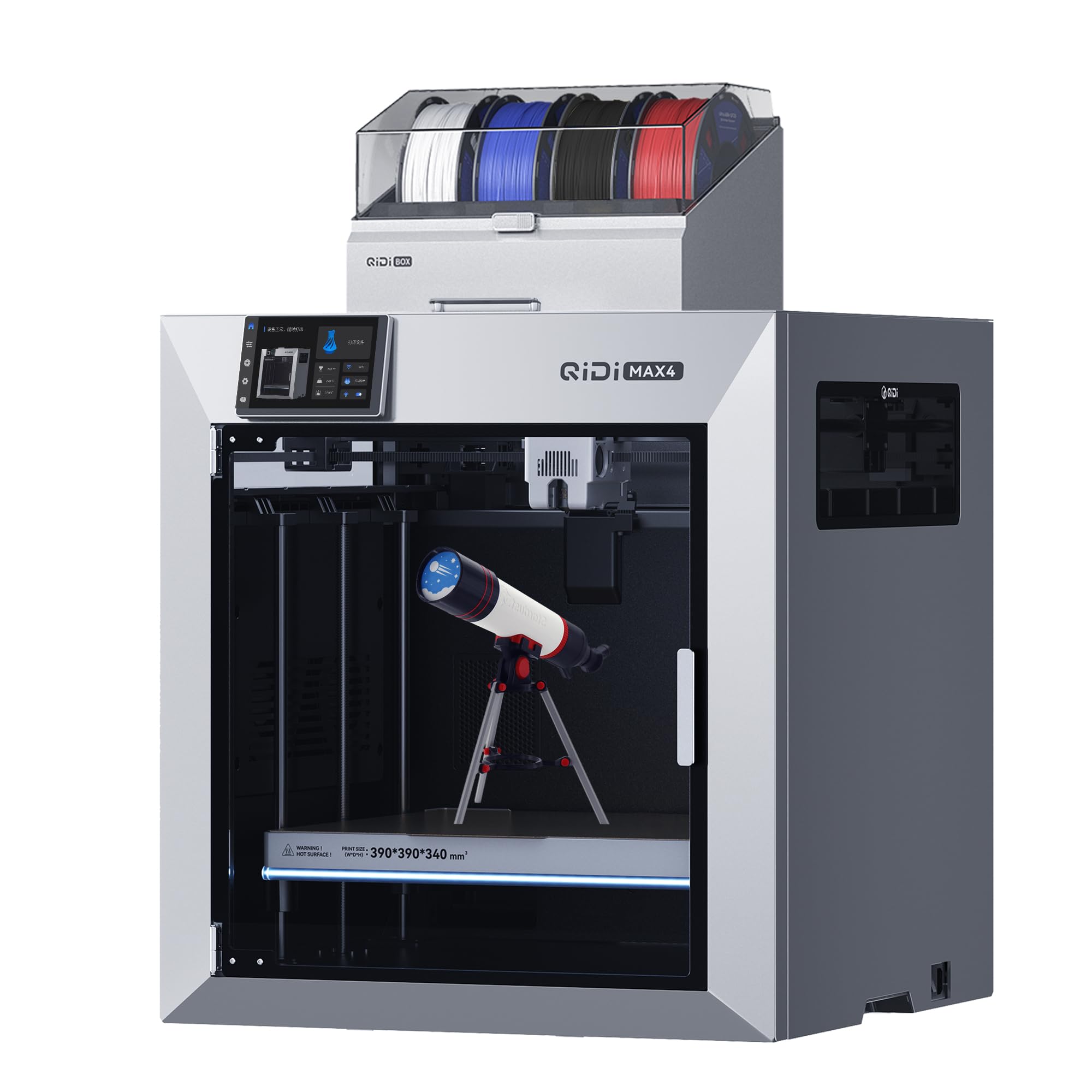
The Max4 Combo jumps to a 390x390x340mm build volume with closed-loop motors on X/Y axes, reaching 800mm/s and 30,000mm/s² acceleration. The 2mm leadscrew and anti-backlash nut on Z reduce vertical play, producing clean surfaces on tall parts. The 65°C active chamber and 40mm³/s high-flow hotend support standard and industrial-grade abrasive materials.
The bundled QIDI BOX enables up to 16-color multi-material printing with intelligent filament management. The built-in AI camera detects print failures and pauses automatically. The full-surface silicone heated bed maintains even temperature distribution across the large area, reducing warping on ABS and PC-based filaments.
Build quality surpasses the PLUS4 with a stainless steel exoskeleton and 120-pound weight that dampens vibrations. The included Polar Cooler (purchased separately on Max4) improves overhang performance. Some users report long pre-print heat-up times and high filament purge during color changes, but the print quality and material flexibility justify the premium.
Why it’s great
- Closed-loop motors maintain precision at high speeds
- 16-color multi-material with QIDI BOX
- Heated chamber enables engineering and abrasive filaments
Good to know
- 120-pound weight requires dedicated furniture
- Polar Cooler sold separately for overhang support
- High filament purge during color transitions
4. ELEGOO Saturn 4 Ultra 16K
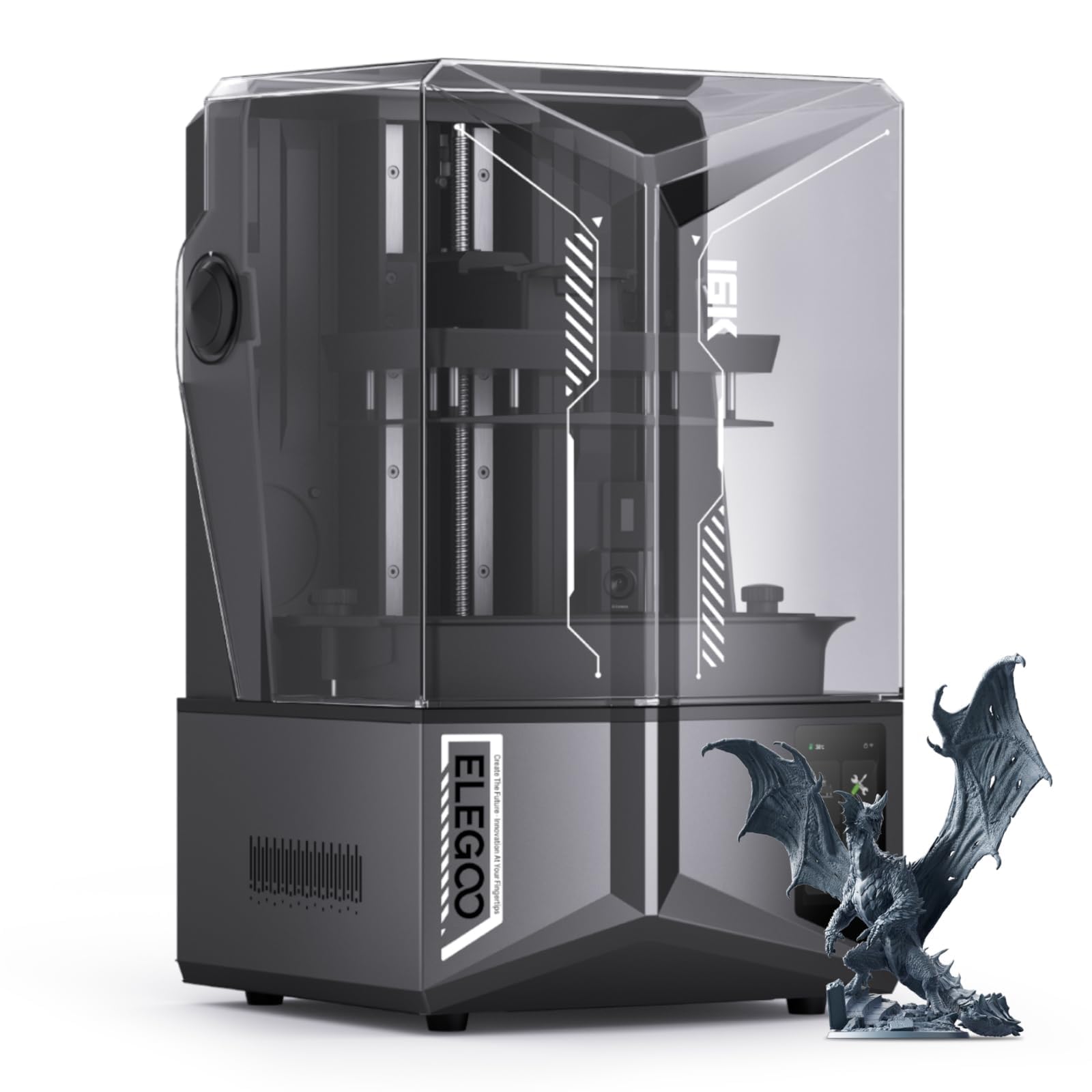
The Saturn 4 Ultra 16K brings a massive 8.33×4.66×8.66-inch build plate to resin printing, enabling large detailed models without splitting. The 16K monochrome LCD delivers 28μm resolution for smooth surfaces and fine textures. Its tilt-release peeling mechanism reduces suction forces, allowing faster print speeds up to 150mm/h.
Intelligent tank heating maintains resin at 30°C for consistent fluidity and layer adhesion, reducing defects like bubbles and delamination. The built-in AI camera monitors prints and alerts for failures, creating time-lapse videos automatically. Auto leveling removes the need for manual bed adjustment.
The flip-up lid makes accessing the build plate easy, and the integrated carbon filter reduces odor. Some users note resin pooling on the build plate after printing, requiring a drip solution. The Saturn 4 Ultra is quiet during operation, making it suitable for home or office environments. This is a resin printer, so post-processing and ventilation are still required.
Why it’s great
- 16K resolution produces ultra-detailed surfaces
- Heated tank ensures reliable resin flow in cool environments
- Quiet tilt-release mechanism enables faster prints
Good to know
- Resin pooling on build plate needs management
- Requires ventilation and post-processing equipment
- AI detection accuracy varies with environment
5. SainSmart WonderMaker ZR
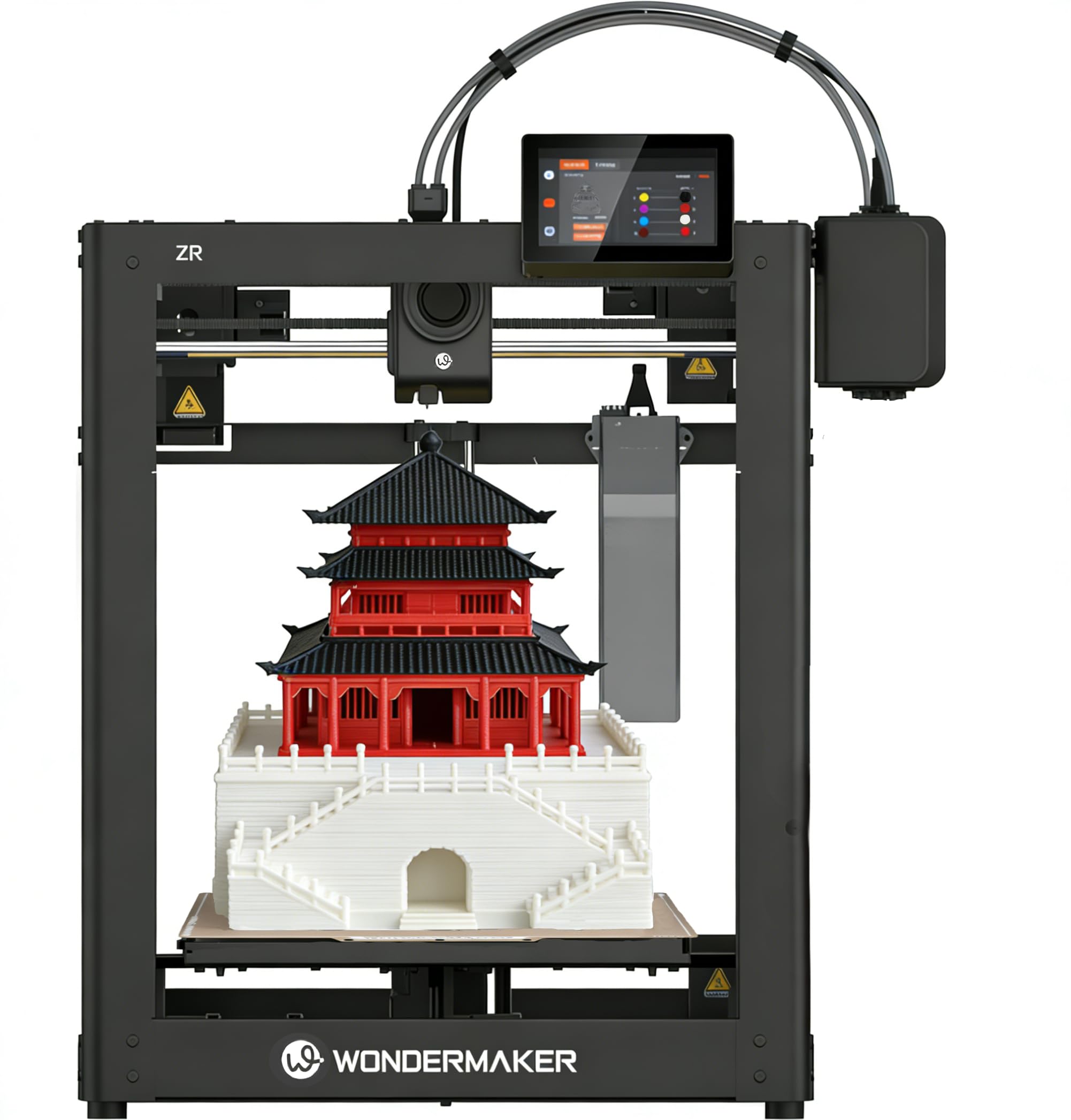
The WonderMaker ZR delivers 4-color printing out of the box with its Multicolor Integrated Filament System (MIFS) at a mid-range price. The 300x300x300mm build volume is comparable to premium machines, while the CoreXY architecture reaches 600mm/s with 20,000mm/s² acceleration. The all-metal extruder reaches 300°C for PLA through PEEK-compatible filaments.
Klipper firmware and ORCA Slicer integration provide Wi-Fi connectivity and a centralized dashboard for managing multiple printers. The dual-sided PEI plate combined with real-time flow calibration ensures first-layer adhesion. The 48dB silent mode makes it office-friendly.
Setup takes under 20 minutes, and the printer includes a hardened steel nozzle for abrasive composites. The filament feed path can be awkward for some spool sizes, and there is no included camera or enclosure. The multicolor system works reliably for most users, though one reviewer reported filament module issues quickly resolved by support.
Why it’s great
- 4-color MIFS multicolor system included in base price
- Klipper firmware enables remote printer management
- 48dB quiet operation suitable for shared spaces
Good to know
- Filament feed path can be awkward for tall spools
- No integrated camera or enclosure included
- Some early units needed replacement filament module
6. Anycubic Kobra 3 Max Combo

This bundle pairs the Kobra 3 Max with the ACE Pro multicolor unit, giving you 4-color printing on the same 420x420x500mm build volume. The CoreXY design and 600mm/s speed remain identical to the standalone Kobra 3 Max, but the ACE Pro adds filament drying, automatic refilling, and seamless color switching.
The dual-sided PEI spring steel plate provides reliable adhesion even for large parts. The all-metal hotend with 300°C ceiling supports PLA, PETG, and TPU. G-sensor vibration compensation reduces layer shifts at high speeds. The filament runout sensor pauses automatically when the spool ends.
Users appreciate the value of getting the ACE Pro bundled, but some report frequent clogs at high speed and random setting defaults that ruin overnight prints. One reviewer bought a second unit, while another advises avoiding the brand entirely due to support delays. The Combo is best suited for those committed to the Anycubic ecosystem and willing to dial in settings.
Why it’s great
- Includes ACE Pro for multicolor printing out of the box
- Massive build volume handles oversized models in one piece
- G-sensor compensation reduces layer shifts
Good to know
- Clogs reported at high speed with certain filaments
- Customer support response can be slow
- No enclosure for temperature-sensitive materials
7. Creality Ender 5 Max
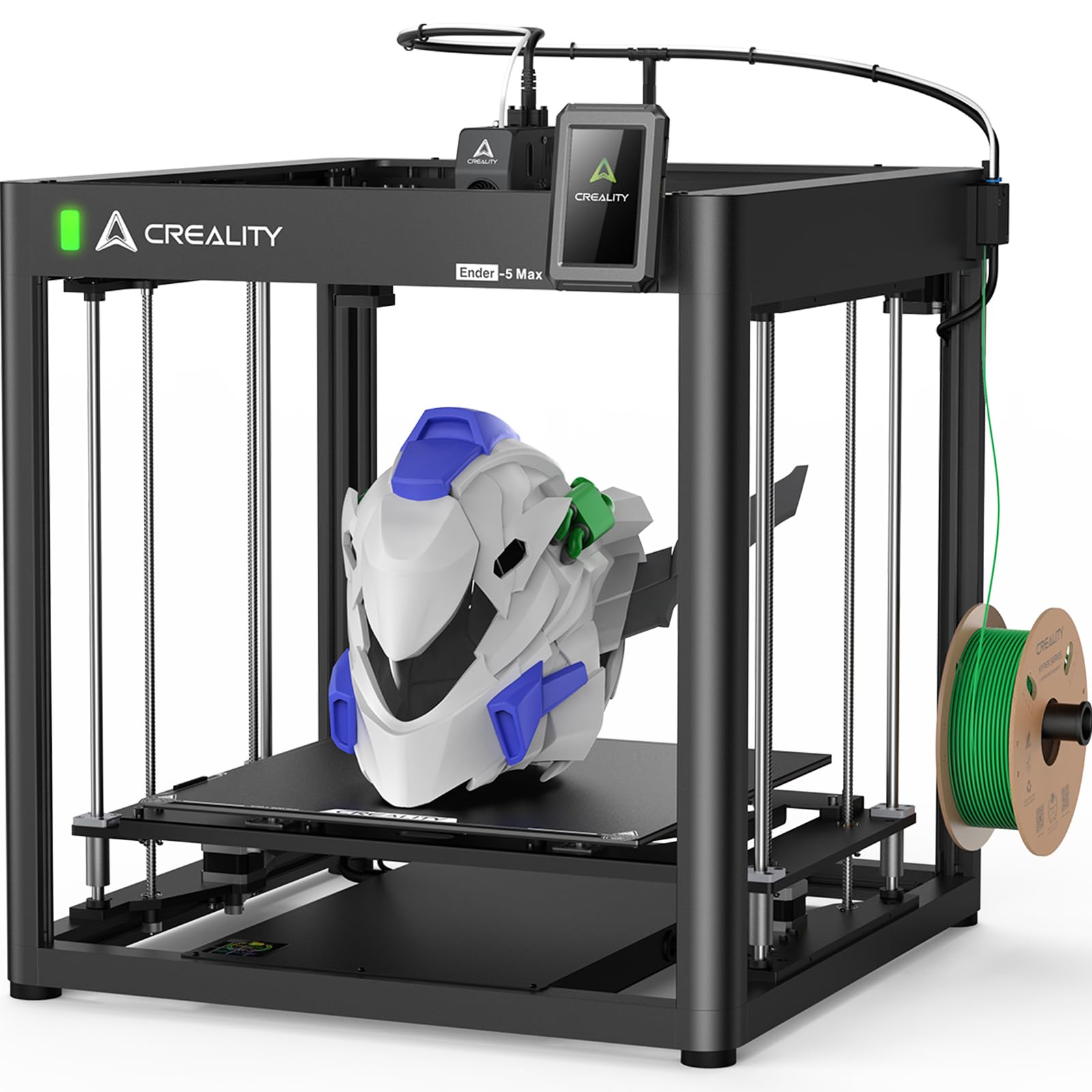
The Ender 5 Max uses a CoreXY system with a rigid die-cast aluminum frame and precision linear rail on X, supporting 700mm/s printing speeds. The 400mm³ build volume handles oversized prototypes and batch production. The 1000W rapid-heating bed reaches working temperature quickly, supporting PLA through PA and ASA.
The 64-point auto leveling system and automatic Z-offset ensure consistent first-layer adhesion without manual calibration. WLAN multi-printer control allows group management from a single dashboard, with a tri-color status indicator for at-a-glance monitoring. The dual-gear direct drive extruder with hardened gears minimizes clogging during long runs.
Assembly is manageable solo but easier with a second person. Some users report bed adhesion issues and shaking at high speeds that loosen components over time. Creality support is inconsistent, with replacement parts sometimes hard to source. The Ender 5 Max is a solid choice for production environments where uptime and scale matter, but expect some tuning.
Why it’s great
- 400mm³ build volume with fast 1000W heated bed
- 64-point auto leveling eliminates manual calibration
- WLAN multi-printer control for print farm management
Good to know
- Bed adhesion issues reported on early units
- Vibration at high speed can loosen components
- Creality support and parts availability inconsistent
8. Creality Ender 3 V3 Plus

The Ender 3 V3 Plus expands the popular Ender 3 platform to 300x300x330mm, making it an accessible entry point into larger prints. Its CoreXZ motion system with Y-axis dual motors reaches 600mm/s and 20,000mm/s² acceleration. The direct drive extruder uses a bolster spring and ball plunger to grip filament securely at high speeds.
Auto calibration handles leveling, Z-offset, and input shaping in one tap. The tri-metal “Unicorn” nozzle integrates throat and tip into a single part using hardened steel at the tip for durability. Two support rods connect base to gantry top, forming a rigid triangle that reduces Z-axis shaking during fast prints.
Assembly takes under an hour, and the machine comes highly pre-assembled. The 30.9-pound weight means it’s portable enough to move between spaces. Some users note the touch screen holder lacks screw guides, making attachment fiddly. The V3 Plus is a solid choice for beginners wanting large prints without jumping to premium pricing.
Why it’s great
- Budget-friendly entry into large-format printing
- 600mm/s high speed with auto calibration
- Tri-metal nozzle for long service life
Good to know
- Touch screen holder assembly can be frustrating
- Loud fans out of the box; silent board upgrade helps
- No heated chamber or enclosure
9. ELEGOO Neptune 4 Max

The Neptune 4 Max offers a huge 420x420x480mm build volume at a mid-range price point, making it a popular choice for large props, furniture components, and batch printing. The Klipper firmware pushes default speeds of 250mm/s with bursts up to 500mm/s and 8000mm/s² acceleration. Input shaping and pressure advance reduce ringing on detailed models.
The direct drive extruder uses a 5.2:1 reduction ratio for powerful extrusion, paired with a 60W ceramic heater that reaches 300°C for PLA through Nylon. Dual-sided cooling fans and a model cooling blower prevent warping. WiFi, U-disk, or LAN connectivity offer flexible file transfer options.
Calibration is critical—many users recommend replacing stock springs with silicone bushings and heat soaking the bed for 30 minutes before leveling. First-layer adhesion can be finicky, with Z-offset varying between prints. The Neptune 4 Max is not beginner-friendly but delivers exceptional value for those willing to invest setup time.
Why it’s great
- Massive 420x420x480mm build volume at a competitive price
- Klipper firmware with input shaping for high quality
- 300°C hotend supports a wide material range
Good to know
- First-layer calibration is time-consuming and finicky
- Z-offset can shift between prints, causing adhesion failures
- No enclosure; requires temperature-stable environment
10. Original Prusa CORE One
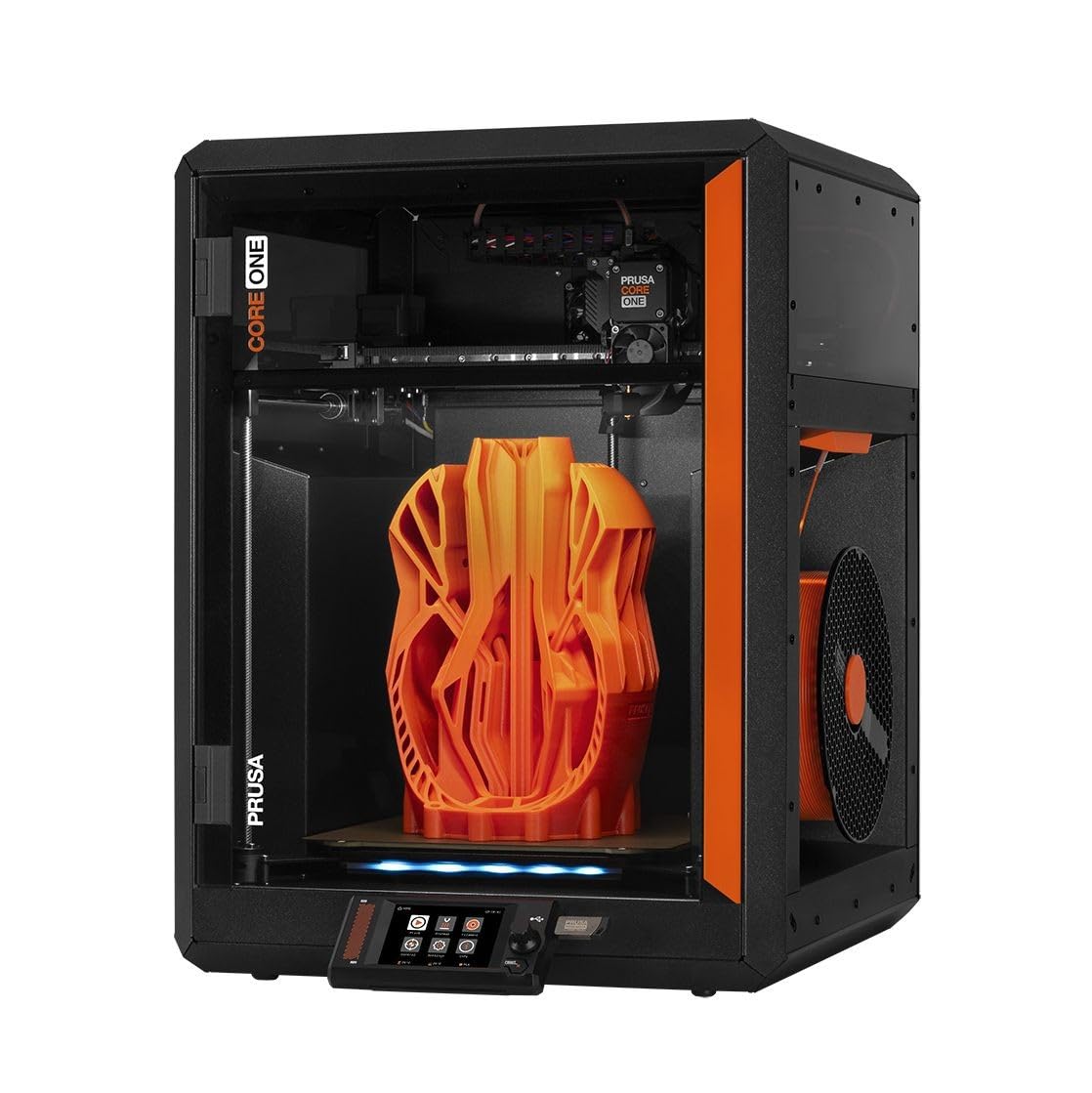
The CORE One represents Prusa’s first CoreXY machine, built on a stainless steel exoskeleton for rigidity. Its 250x220x270mm build volume is smaller than many dedicated large-format printers, but the enclosed chamber with active temperature control reaching 55°C supports PLA, PETG, ASA, PC, and Nylon. The printer arrives fully assembled and tested, with a 1kg spool of Prusament PLA included.
Print quality is exceptional out of the box thanks to Prusa’s proven slicer profiles and one-click printing. The open-source philosophy means no cloud lock-in, full user control, and a strong community ecosystem. The CORE One supports multicolor via the MMU3 add-on, though the system is expensive and somewhat cumbersome.
Some early units had tight Z screws or loose XY motor set screws requiring support intervention. Prusa’s lifetime technical assistance generally resolves issues, though response times can be slow during peak periods. The CORE One is a dependable workhorse for users who value reliability and openness over maximum build volume.
Why it’s great
- Prusa print quality and reliability out of the box
- Fully open source with no cloud lock-in
- Heated chamber supports engineering materials
Good to know
- Build volume smaller than dedicated large-format competitors
- MMU3 multicolor system is expensive and finicky
- Occasional QC issues on early production units
11. Original Prusa XL 5-Toolhead
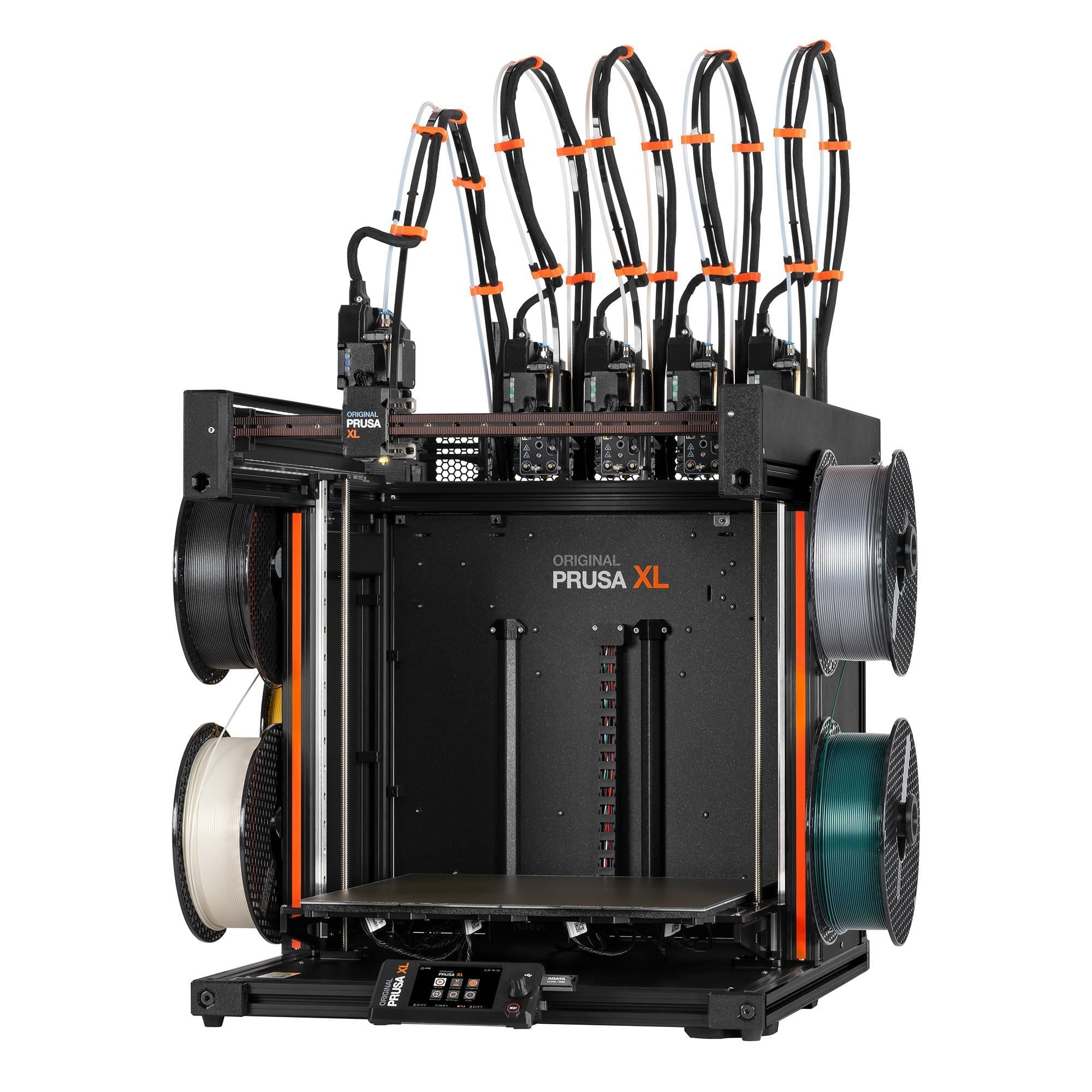
The Prusa XL with 5-toolheads is a professional-grade machine built for multi-material and full-color prints up to 360x360x360mm. Each toolhead can independently switch between materials, enabling complex assemblies with soluble supports, flexible interfaces, and rigid structural components in a single job. The segmented heated bed with intelligent heating zones reduces energy use and warping.
The CoreXY platform maintains speed and precision during frequent tool changes, and smart material management minimizes waste. Prusa Connect provides remote monitoring with the optional Buddy Camera. The XL includes one Satin print sheet and a 1kg Prusament PLA spool ready to print.
Delivery can require some assembly of fragile parts, and the XL is not for casual users—troubleshooting skills are essential. The XL represents a significant investment, but for professionals needing functional prototypes, end-use parts, or full-color visual models without splitting, it is the most capable integrated system available.
Why it’s great
- 5 independent toolheads for true multi-material printing
- Segmented heated bed reduces warping and energy use
- Open ecosystem with Prusa Connect and Printables
Good to know
- Requires significant investment and troubleshooting skill
- Delivery requires partial assembly of fragile parts
- Not beginner-friendly; best for professionals
FAQ
Why does my large printer need a more rigid frame than a small one?
Can I print PLA on a printer with a heated chamber?
How do I prevent warping on a 400mm ABS print?
Final Thoughts: The Verdict
For most users, the big 3d printer winner is the Anycubic Kobra 3 Max because it balances a massive 420x420x500mm build volume with CoreXY speed, auto leveling, and expandable multicolor support at a mid-range price. If you need engineering-grade materials like PPS-CF or PPA-CF, grab the QIDI PLUS4 with its active 65°C chamber and 370°C hotend. And for professional multi-material production without splitting models, nothing beats the Original Prusa XL 5-Toolhead.

Mo Maruf
I created WellFizz to bridge the gap between vague wellness advice and actionable solutions. My mission is simple: to decode the research and give you practical tools you can actually use.
Beyond the data, I am a passionate traveler. I believe that stepping away from the screen to explore new environments is essential for mental clarity and physical vitality.