Our readers keep the lights on and my smoothie glass nicely filled. As an Amazon Associate, I earn from qualifying purchases.
Choosing a 35mm camera means deciding between mechanical reliability, autofocus convenience, and the kind of image character no phone can replicate. Whether you are a beginner loading your first roll or a film veteran looking for a specific vintage body, the lens quality, metering accuracy, and build durability define whether your shots come out sharp or disappointing.
I’m Mohammad Maruf — the founder and writer behind WellFizz. I research camera hardware specifications daily, analyzing lens elements, shutter mechanisms, and film transport systems to separate reliable workhorses from overpriced collectibles.
From compact point-and-shoots to full-featured SLRs, finding the best 35mm camera depends on matching your skill level with the right balance of automation, lens ecosystem, and build quality that will last through hundreds of rolls.
How To Choose The Best 35mm Camera
Every 35mm camera forces a trade-off between automation, build quality, and the lens system you lock into. Knowing which priority matters most for your style cuts through the noise.
Lens Mount and Ecosystem
Interchangeable-lens cameras live or die by their mount. Canon EF and FD, Pentax K, and Nikon F each offer different price points for used glass. If you want to experiment with multiple lenses over time, choose a mount with abundant, affordable second-hand options. Fixed-lens point-and-shoots simplify your kit but lock you into one focal length forever.
Metering and Exposure Control
Every roll of film costs time and money, so accurate metering is non-negotiable. Automatic exposure modes (aperture priority, shutter priority, program) reduce waste for beginners. Fully manual cameras like the Pentax K1000 force you to learn exposure fundamentals but fail completely if the light meter is inaccurate or dead on arrival with a renewed unit.
Build Quality and Reliability
Plastic-bodied cameras are lighter and cheaper but wear faster. Metal-bodied SLRs (Canon AE-1, Pentax K1000) handle decades of use if maintained. Renewed cameras vary wildly in condition — check for honest reviews about shutter jams, mirror damage, and light meter failure before buying a vintage body online.
Quick Comparison
On smaller screens, swipe sideways to see the full table.
| Model | Category | Best For | Key Spec | Amazon |
|---|---|---|---|---|
| FUJIFILM X100VI | Premium Compact | Everyday walkaround with film simulations | 40.2MP X-Trans CMOS 5 HR sensor | Amazon |
| FUJIFILM X-M5 | Mirrorless Digital | Video, vlogging, and hybrid shooting | 6K video recording capability | Amazon |
| Panasonic LUMIX ZS99 | Digital Zoom Compact | Travel and concert photography | 30x optical zoom (24-720mm) | Amazon |
| Pentax 17 | Half-Frame Film | Saving film with 72 shots per roll | 25mm F3.5 HD-coated lens | Amazon |
| Canon AE-1 | Vintage SLR | Classic aesthetics with manual control | Shutter speed 1/1000 to 2 seconds | Amazon |
| Pentax K1000 | Manual SLR | Learning photography fundamentals | Fully mechanical, battery-free operation | Amazon |
| Canon New EOS Kiss | AF SLR | Reliable autofocus on a budget | ISO range 100-3200 | Amazon |
| Canon Rebel 2000 | AF SLR | Everyday automatic film shooting | 7-point autofocus system | Amazon |
| KODAK Snapic A1 | Entry-Level Film | Simple point-and-shoot for beginners | 3-element glass lens | Amazon |
In‑Depth Reviews
1. FUJIFILM X100VI Digital Camera – Black

The X100VI is the culmination of everything Fujifilm has refined over years — a 40.2MP X-Trans CMOS 5 HR sensor packed into a body barely larger than a lens cap. The 23mm F2 lens delivers edge-to-edge sharpness with character that digital zooms cannot touch, and the six-stop in-body image stabilization makes handheld low-light shooting viable at absurdly slow shutter speeds.
Twenty film simulation modes, including the new REALA ACE, let you bake the look directly into JPEGs so you rarely need post-processing. The hybrid viewfinder switches between optical and electronic instantly, giving you a rangefinder-style experience with modern exposure feedback. It is expensive, and supply constraints mean paying above retail on the secondary market, but the image output justifies every cent for serious shooters.
Battery life sits around 350 shots per charge, which is typical for a mirrorless compact. The fixed-lens design means you cannot switch to a wider or longer focal length, so you have to love the 35mm full-frame equivalent field of view. For an everyday camera that produces print-ready images straight out of the box, this is the standard.
Why it’s great
- In-body stabilization enables handheld shooting in near-dark conditions
- Film simulations eliminate the need for editing software
- Hybrid viewfinder combines optical clarity with digital exposure data
Good to know
- Prices often exceed retail due to limited stock
- Fixed 23mm lens means no zoom flexibility
2. FUJIFILM X-M5 Mirrorless Digital Camera with XC15-45mm Lens Kit

The X-M5 packs the same 26.1MP X-Trans 4 sensor found in the X100V into the smallest X-series body ever made at just 12.5 ounces. The XC 15-45mm power zoom lens gives you a flexible wide-to-standard range for vlogging, travel, and everyday shooting while keeping the overall kit compact enough to slide into a jacket pocket.
Six-kilometer video recording at 30p makes this a legitimate tool for content creators who want Fujifilm color science without investing in a cinema camera. The 20 film simulations are accessible via a dedicated top dial, and the X-Processor 5 ensures autofocus is snappy and reliable for both video and stills. The flip screen is useful for self-recording but feels slightly flimsy compared to the solid chassis.
Bundled kit lens quality is decent but not exceptional — expect to upgrade to a prime lens if you want the full Fujifilm sharpness experience. The body lacks a built-in flash and the electronic viewfinder, which matters less for video but limits still shooting in bright outdoor conditions. For hybrid shooters prioritizing video, this is the best entry point into the system.
Why it’s great
- Ultra-light body perfect for travel and all-day carry
- 6K video with Fujifilm color science at a mid-range price point
- Dedicated film simulation dial for instant creative switching
Good to know
- Kit lens is functional but not optically excellent
- No electronic viewfinder or built-in flash
3. Panasonic LUMIX ZS99 Point and Shoot Camera

The ZS99 is the pocket camera you bring when a phone zoom will not cut it. The 30x optical Leica lens covers 24mm wide-angle to 720mm telephoto in a body that fits in a jeans pocket, making it uniquely suited for concerts, sporting events, and wildlife encounters where you cannot swap lenses or move closer. The 1,840k-dot tiltable touchscreen helps frame shots at awkward angles.
Five-axis Hybrid OIS stabilizes the long end of the zoom better than most compacts, though you still need steady hands or a support above 400mm. Bluetooth 5.0 and a dedicated Send Image button make transferring photos to your phone painless. The 4K photo burst mode at 30fps captures fleeting moments that regular single-shot mode would miss.
The small 1/2.3-inch sensor cannot match the low-light performance of larger APS-C or full-frame cameras, and video recording caps at 15 minutes in 4K. Some units have reported blurry edges on the left side of the frame, so test the lens immediately upon arrival. If your priority is reach in a compact body, nothing else at this size competes.
Why it’s great
- 30x optical zoom in a true pocket-size body
- Bluetooth and dedicated send button for fast phone transfers
- 4K photo burst capture for action shots
Good to know
- Small sensor struggles in low light vs. larger cameras
- 4K video limited to 15-minute recording segments
4. Pentax 17 Half-Frame Film Camera

The Pentax 17 is a modern half-frame camera that captures two 17mm x 24mm images on every standard 35mm frame, yielding 72 shots from a 36-exposure roll. The retro magnesium alloy body feels substantial without weighing you down, and the 25mm F3.5 lens — equivalent to 37mm in full-frame — produces sharp images with the HD coating borrowed from Pentax SLR lenses.
The zone-focus system divides distance into six marks, which takes a few rolls to internalize but becomes intuitive. The manual film advance lever recreates the tactile ritual that autowind cameras skip, and the shutter is quiet enough for candid street photography. Auto-exposure keeps things simple while giving you control over decisions that matter.
Half-frame images are smaller than standard 35mm frames, so prints larger than 5×7 may show grain depending on the film stock. The price tags feels steep against used half-frame cameras, but you pay for guaranteed reliability and a modern lens coating that prevents flare. For anyone who wants to shoot more rolls without bankrupting themselves on film, this is the smart buy.
Why it’s great
- 72 shots per roll dramatically reduces film cost per image
- Modern HD lens coating delivers sharp, flare-free images
- Quiet shutter perfect for candid and street photography
Good to know
- Zone focus requires practice to master quickly
- Half-frame limits maximum print size without visible grain
5. Canon AE-1 35mm SLR Camera with 50mm 1:1.8 Lens (Renewed)

The Canon AE-1 is the camera that taught millions of people photography. Its shutter-priority automatic mode lets you set the speed while the camera selects the aperture — a sweet spot between full manual control and point-and-shoot simplicity. The 50mm f/1.8 lens is sharp, fast, and affordable, making it a perfect walkaround kit for any street or portrait scenario.
The bright viewfinder shows shutter speed, aperture, and a metering scale that guides adjustments without leaving your eye. The metal body has held up across decades, and the FD lens ecosystem is deep and cheap compared to modern mirrorless mounts. The mechanical shutter sound is satisfyingly solid, adding to the ritual of film shooting.
Renewed units vary wildly. Some arrive looking mint and work perfectly; others have sticky shutter blades, dead meters, or scratched mirrors. The first unit I used had a slow shutter at low speeds that took fixing. Buy from a seller with a good return policy and test every shutter speed on the first roll. When it works, it is one of the most rewarding cameras ever made.
Why it’s great
- Shutter-priority auto mode simplifies exposure without removing control
- Massive FD lens ecosystem with abundant cheap glass
- Classic metal build that feels premium in the hand
Good to know
- Renewed condition is inconsistent — test every function immediately
- Low-light metering can be inaccurate with aged internal components
6. Pentax K1000 Manual Focus SLR Film Camera with 50mm Lens (Renewed)

The Pentax K1000 is the gold standard for learning photography because it forces you to set aperture, shutter speed, and focus yourself — no batteries required for anything except the light meter. The 50mm f/2 lens is sharp and bright, and the match-needle metering system in the viewfinder is simple enough for a complete beginner to understand on the first roll.
The all-mechanical build means this camera will still fire in fifty years if nothing breaks. The K-mount lens system is one of the most extensive in existence, with quality glass available for very little money. The meter battery lasts years, not months, so you are not constantly replacing LR44s.
The light meter is the weak point on renewed units. Multiple reviews report dead or wildly inaccurate meters, which defeats the purpose of this camera for a beginner who needs exposure guidance. If the meter works, this is an unbeatable tool. If it does not, you are paying for a paperweight. Buy from a seller who explicitly warrants the meter function, or budget for a CLA (clean, lubricate, adjust) service.
Why it’s great
- Fully mechanical operation works without any batteries except the meter
- Simple match-needle metering is perfect for learning exposure
- Pentax K-mount gives access to decades of affordable lenses
Good to know
- Light meter failures are common on renewed units — verify before buying
- No auto modes or built-in flash limits versatility
7. Canon New EOS Kiss (Rebel G) SLR AF Film Camera With 35-80mm Lens (Renewed)

The Canon EOS Kiss (sold as the Rebel G in North America) gives you autofocus, auto exposure, and compatibility with the entire Canon EF lens lineup — including modern lenses — at a fraction of the cost of a digital body. The 35-80mm zoom lens covers standard focal lengths, and the wide-area autofocus point locks on subjects quickly for a film-era camera.
The interface is intuitive: a mode dial switches between full auto, program, aperture priority, shutter priority, and manual. The built-in flash works well for fill light, and the film transport system loads, advances, and rewinds automatically. It takes the friction out of film shooting for someone who wants to focus on composition rather than exposure math.
The plastic body feels less durable than the metal cameras of the 1970s, and the kit lens is optically mediocre — soft in the corners and prone to flare. Plan to replace the 35-80mm with a 50mm f/1.8 STM for dramatically better image quality at minimal cost. For under renewed, this is the cheapest entry into a serious interchangeable-lens film system.
Why it’s great
- Full compatibility with modern Canon EF lenses
- Automatic film loading, advance, and rewind simplify the process
- Multiple exposure modes suit beginner to intermediate skill levels
Good to know
- Included kit zoom lens is optically soft
- Plastic build feels less premium than vintage metal SLRs
8. Canon Rebel 2000 SLR Film Camera with 28-80mm EF Auto Focus Lens (Renewed)
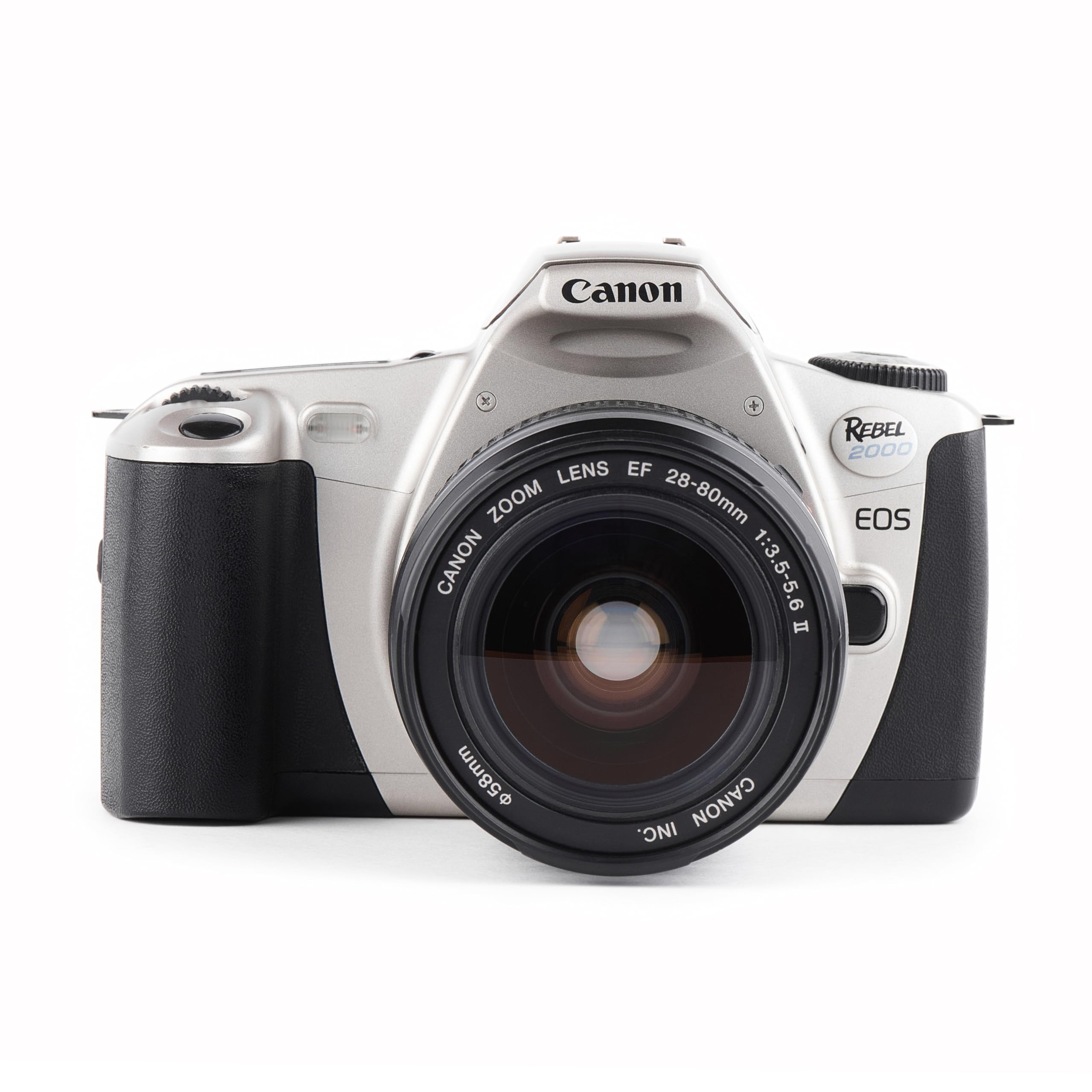
The Rebel 2000 takes everything functional about the EOS film system and packages it in a body that is easy to use right out of the box. The seven-point autofocus system covers enough of the frame to track moving subjects, and the four exposure modes — program, aperture priority, shutter priority, and manual — cover every situation a hobbyist needs.
The 28-80mm lens provides a slightly wider field of view than the 35-80mm kit lens, making it marginally better for group shots and landscape compositions. The built-in flash includes red-eye reduction, and the pop-up mechanism feels solid enough for regular use. The body is lightweight, making it a good choice for carrying all day on a walk.
The plastic construction and noisy autofocus motor remind you this is a consumer-tier camera from the late 1990s. Some renewed units may arrive with cosmetic wear, missing accessories, or — in the worst cases — not powering on at all. The separate QR code manual is a nice touch, but confirm the camera functions before the return window closes. For the price, it is the most reliable auto-everything film camera you can buy new-old-stock.
Why it’s great
- Seven-point autofocus handles moving subjects well
- Lightweight design easy to carry for extended shooting sessions
- Full exposure mode selection for creative flexibility
Good to know
- Consumer plastic build and loud autofocus motor
- Condition varies significantly between renewed units
9. KODAK Snapic A1 35mm Film Camera (Rhino Grey)
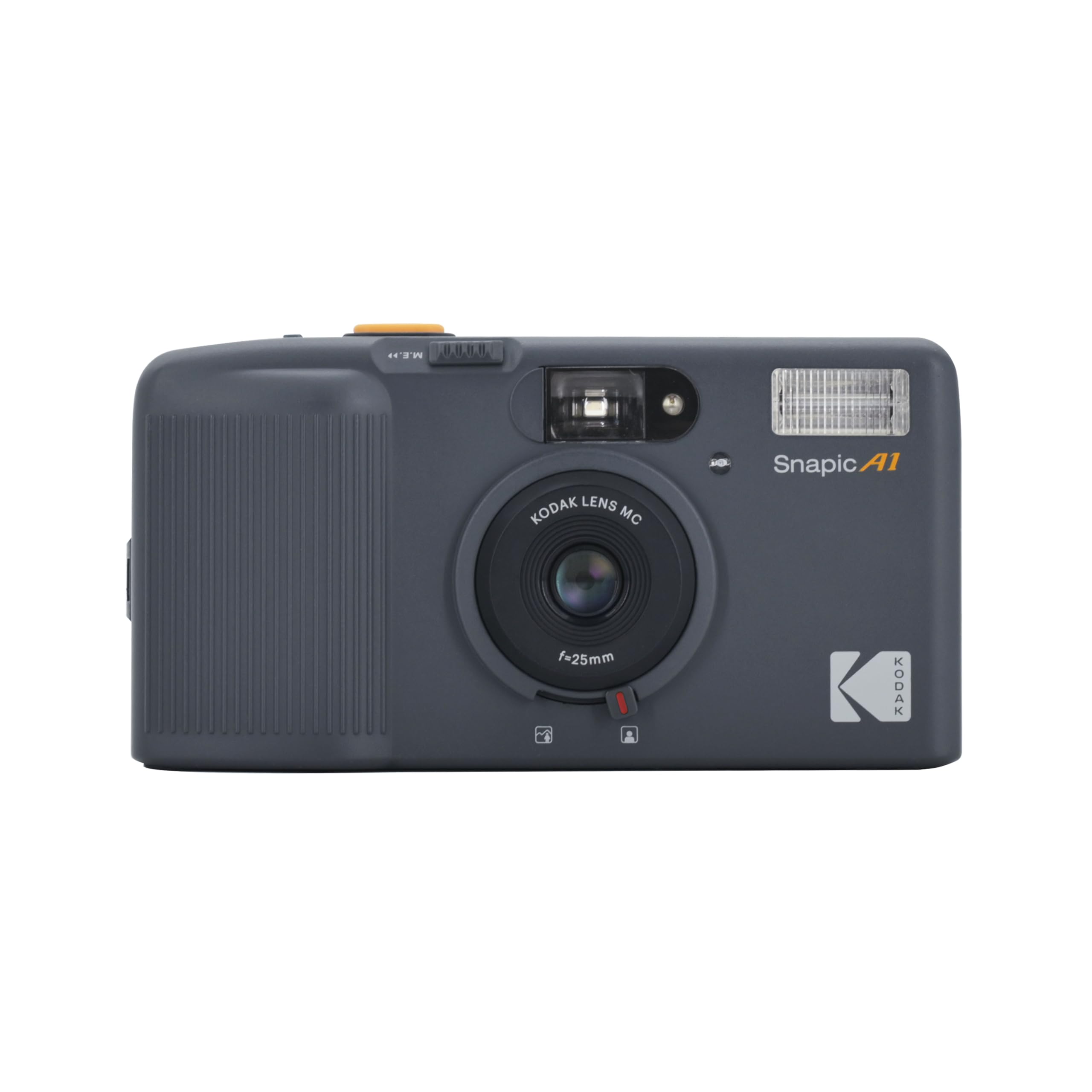
The KODAK Snapic A1 is a modern point-and-shoot designed for the beginner market, with auto-everything operation: auto film loading, auto advance, auto rewind, and auto flash detection with red-eye reduction. The three-element glass lens produces noticeably sharper images than the plastic-lens disposable cameras most beginners are upgrading from, and the multiple exposure mode adds a creative layer that cheap cameras omit entirely.
The two-zone focus system lets you switch between landscape (roughly 3 feet to infinity) and portrait (closer subjects) with a simple flip, taking the guesswork out of manual focus for someone who just wants to shoot. The built-in LCD shot counter and on/off switch help preserve battery life so you are not swapping alkalines every weekend.
Rechargeable NiMH batteries like Eneloop or IKEA Ladda do not work because the voltage is too low — you must use standard alkaline batteries. The flash button is easy to press accidentally, which wastes power and annoys subjects. Compared to used 35mm point-and-shoots, the Snapic costs more but guarantees that nothing is broken or corroded inside. For someone who wants to shoot film without fussing with eBay condition issues, this is the sensible buy.
Why it’s great
- Glass lens delivers sharper images than plastic disposable models
- Auto-loading, advance, and rewind simplify the entire process
- Multiple exposure mode for creative double shots
Good to know
- Only accepts alkaline batteries — NiMH rechargeables are incompatible
- Flash button position makes accidental presses common
FAQ
Should I buy a renewed film camera or a new production model like the Pentax 17?
What is the real difference between half-frame and full-frame 35mm shooting?
How do I test a renewed film camera when it arrives?
Can I use modern digital lenses on film cameras?
Why do some 35mm cameras need batteries and others do not?
Final Thoughts: The Verdict
For most users, the best 35mm camera winner is the FUJIFILM X100VI because it delivers professional-grade image quality with film simulation modes that eliminate editing, all in a compact body with best-in-class stabilization. If you want a dedicated film camera that saves money on film, grab the Pentax 17. And for the most reliable autofocus experience on a budget, nothing beats the Canon Rebel 2000.

Mo Maruf
I created WellFizz to bridge the gap between vague wellness advice and actionable solutions. My mission is simple: to decode the research and give you practical tools you can actually use.
Beyond the data, I am a passionate traveler. I believe that stepping away from the screen to explore new environments is essential for mental clarity and physical vitality.