Our readers keep the lights on and my smoothie glass nicely filled. As an Amazon Associate, I earn from qualifying purchases.
Tomato plants are magnets for pests — aphids, hornworms, whiteflies, and spider mites can turn a thriving harvest into a sad, yellowing mess in days. The difference between a successful season and a frustrating one often comes down to one choice: which spray you trust to protect your plants without ruining your fruit.
I’m Mohammad Maruf — the founder and writer behind WellFizz. I’ve spent years analyzing pesticide labels, organic certifications, active ingredient efficacy data, and thousands of real gardener reviews to separate marketing hype from what actually works.
After analyzing dozens of formulas and real customer feedback, I’ve found the top performers to help you choose the best bug spray for tomato plants.
How To Choose The Best Bug Spray For Tomato Plants
Tomatoes are sensitive — the wrong spray can burn leaves, linger on fruit, or miss the pest entirely. Focus on three pillars: active ingredient safety for edibles, application convenience for your garden size, and whether organic or synthetic better fits your growing philosophy.
Active Ingredients That Work on Tomatoes
Spinosad, derived from a naturally occurring soil bacterium, is one of the most effective options for caterpillars, thrips, and leafminers without harming the plant. Potassium salts of fatty acids (insecticidal soap) dehydrate soft-bodied insects like aphids and whiteflies on contact. Mineral oil smothers eggs and small pests year-round. Avoid broad-spectrum synthetics unless you have a severe infestation that organic options can’t touch — they can kill beneficial insects too.
Formulation and Application Fit
Ready-to-use sprays are ideal for small gardens and quick spot treatments — no mixing, no measuring. Concentrates save money over time if you have multiple beds or a long growing season. Hose-end sprayers cover large areas fast but can be harder to calibrate. For tomatoes, you want a product labeled safe for vegetables and one that can be applied up to the day of harvest if needed.
Organic vs. Conventional: What Matters Most
OMRI-listed products are verified for organic production and break down quickly in sunlight and soil, making them a strong first line of defense. Conventional options like malathion are powerful but require careful handling, protective gear, and strict adherence to pre-harvest intervals. For most home gardeners, starting with an organic spinosad or insecticidal soap gives you efficacy without compromise.
Quick Comparison
On smaller screens, swipe sideways to see the full table.
| Model | Type | Best For | Key Feature | Amazon |
|---|---|---|---|---|
| Monterey Garden Insect Spray | Spinosad | Overall tomato protection | OMRI-listed, odorless, fast-acting | Amazon |
| BioAdvanced Tomato & Vegetable | Ready-to-Use | Targeted tomato pest control | Harvest-ready, fast-acting formula | Amazon |
| Bonide All Seasons Spray Oil | Mineral Oil | Year-round disease & insect prevention | 3-in-1 insecticide, miticide, fungicide | Amazon |
| Ferti-lome Triple Action | Neem Oil | Insect, mite & fungus control | Triple-action formula, OMRI-listed | Amazon |
| Safer Insect Killing Soap | Insecticidal Soap | Soft-bodied insects like aphids | OMRI-listed, gentle on plants | Amazon |
| Ferti-lome Spinosad Insecticide | Spinosad | Caterpillars and chewing insects | Concentrate, OMRI-listed | Amazon |
| Bonide Eight Insect Control | Broad-Spectrum | 130+ pest species | Water-based, low odor, ready-to-use | Amazon |
| Natural Guard Spinosad Soap | Spinosad + Soap | Organic dual-action control | Kills pests + controls powdery mildew | Amazon |
| BioAdvanced 3-in-1 Fruit Tree Spray | Triple-Action | Fruit trees and vine crops | Insect, disease & mite control | Amazon |
| Kate’s Garden Plant Spray | Peppermint Oil | Indoor & outdoor gnat control | Pet-safe, natural peppermint formula | Amazon |
| Hi-Yield 55% Malathion Spray | Malathion | Heavy-duty pest elimination | Powerful broad-spectrum concentrate | Amazon |
In‑Depth Reviews
1. Monterey Garden Insect Spray Bundled with Measuring Spoon
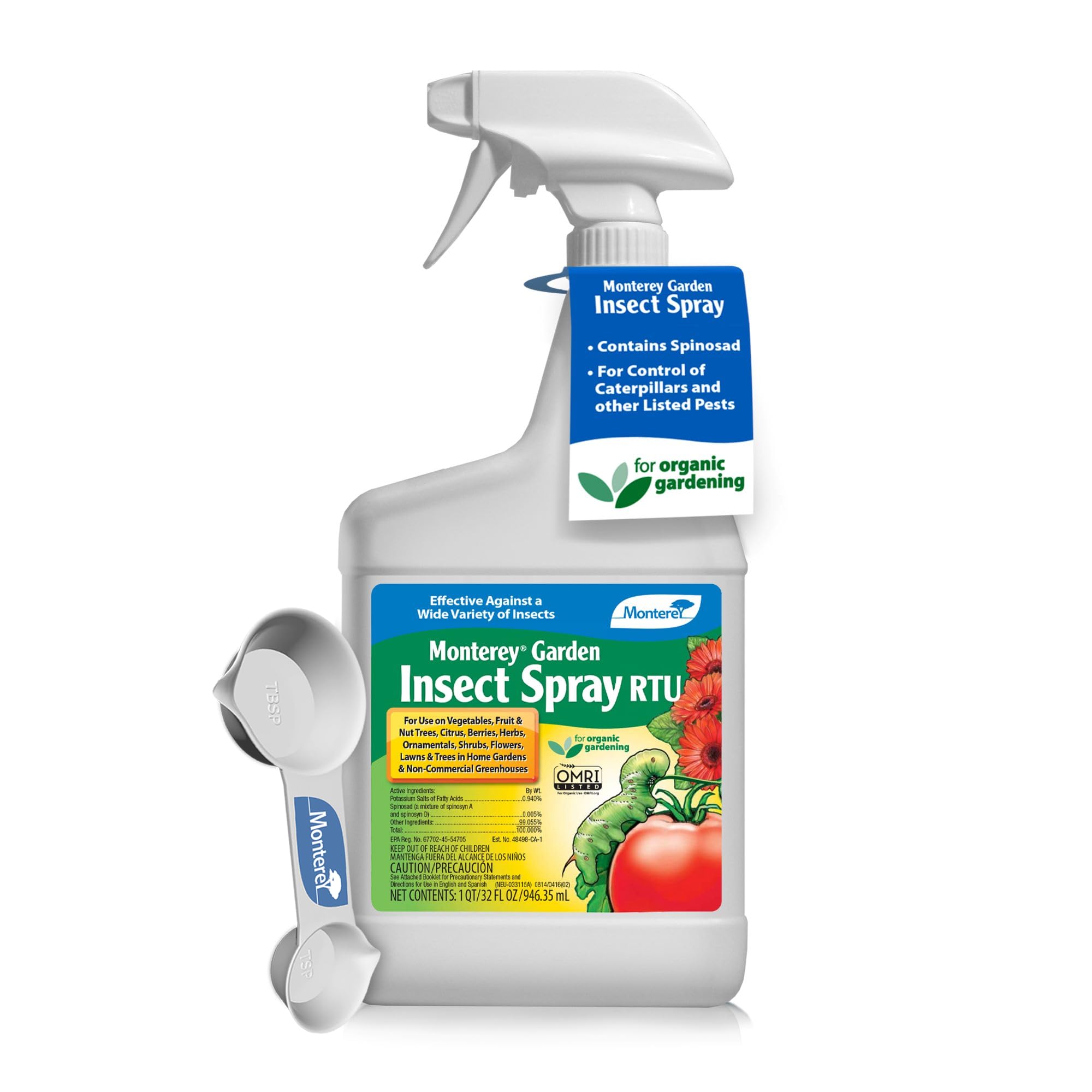
Monterey Garden Insect Spray earns the top spot because it hits the sweet spot between organic integrity and real-world efficacy. The active ingredient is Spinosad, a naturally occurring bacterium byproduct that targets caterpillars, leafminers, thrips, and even fire ants without leaving harsh residues on your tomatoes. It’s OMRI-listed, odorless, and the included measuring spoon takes the guesswork out of dilution.
Gardeners report seeing results within hours of application, with persistent control that holds up through rain and heat. The 32 oz ready-to-use format covers a surprising amount of foliage, and the trigger sprayer delivers a fine mist that coats both tops and undersides of leaves where pests hide. Users specifically mention it saved citrus from leafminers and knocked out persistent thrips that other products couldn’t touch.
One minor drawback: a small number of bottles arrived with leaking caps during shipping. But the formula itself consistently delivers, and the brand’s customer service is responsive. If you want one spray that handles the vast majority of tomato pests while keeping your garden organic, this is the bottle to keep on the shelf.
Why it’s great
- OMRI-listed organic control with proven efficacy
- Odorless and fast-acting within hours
- Includes measuring spoon for accurate mixing
Good to know
- Occasional shipping leakage reported
- Best for caterpillars and chewing insects, less effective on sap-suckers
2. BioAdvanced Tomato & Vegetable Pest Control

BioAdvanced formulated this spray specifically with tomato and vegetable gardeners in mind, and it shows. The ready-to-use bottle works straight out of the box — no mixing, no measuring — and targets the pests that plague tomatoes most: aphids, cutworms, and hornworms. The fast-acting formula starts working immediately, and you can spray right up until the day of harvest without worrying about lingering residues.
Users consistently highlight how easy it is to cover large raised beds quickly. The spray nozzle delivers a solid stream that reaches deep into dense foliage. One gardener described how tomato hornworms were destroying their plants until a single application eliminated the problem for the entire season, with zero damage to the fruit or leaves.
The main trade-off is that some users found the effect on whiteflies to be temporary — they returned after a few days, requiring reapplication. It’s also a smaller 24 oz bottle, so if you have a large garden, you’ll go through it fast. But for targeted, no-fuss protection that’s built for tomatoes, this is a standout choice.
Why it’s great
- Specifically formulated for tomatoes and vegetables
- Harvest-ready — spray up to day of picking
- Easy ready-to-use bottle with good nozzle reach
Good to know
- Small 24 oz bottle may not last for large gardens
- Whitefly control may require repeat applications
3. Bonide All Seasons Horticultural & Dormant Spray Oil

Bonide’s All Seasons Spray Oil is the closest thing to a garden multitool you’ll find. It works as an insecticide, miticide, and fungicide all in one, using mineral oil to smother pests and disease spores. Unlike harsh chemicals, it leaves no toxic residues and is approved for organic gardening — safe for people, pets, and the environment. The year-round formula means you can use it during dormancy, green tip, and the full growing season.
Users report dramatic turnarounds: azaleas saved from bark scale, cannas freed from leaf rollers, and holly bushes rescued from spider mites and scale insects that nothing else could touch. The hose-end sprayer attachment makes coverage fast and even, though some users note the sprayer can be finicky and recommend using it with a standard pump sprayer for better control.
One reviewer called it “the only pesticide a small yard needs,” citing its ability to control insects, fungus, and even apple worms. The 32 oz bottle goes a long way, and the versatility means you’re buying one product instead of three. Just be aware the hose-end sprayer isn’t perfectly calibrated — using a dedicated pump sprayer gives you more precise application.
Why it’s great
- Triple-action: insecticide, miticide, and fungicide
- Approved for organic gardening, safe around people and pets
- Year-round use from dormancy through growing season
Good to know
- Hose-end sprayer can be poorly calibrated
- Oily residue may require careful rinsing
4. Fertilome (12245) Triple Action

Fertilome Triple Action brings the power of neem oil in a ready-to-use formula that tackles insects, mites, and fungal diseases simultaneously. It’s designed for fruits, herbs, vegetables, roses, and ornamentals — making it a strong all-purpose option for tomato growers who also deal with powdery mildew, rust, or leaf spot. The 16 oz concentrate mixes to make gallons of spray, giving you excellent coverage for the investment.
Long-time users swear by it for apple trees and azaleas, noting that two applications brought lacewing-damaged azaleas back to full health. The neem oil base is OMRI-listed and biodegradable, so it fits organic growing practices. Gardeners appreciate that it doesn’t kill beneficial insects when applied carefully in the evening, though you still want to avoid spraying open flowers to protect pollinators.
The main downside is that it doesn’t work instantly — users note it takes a few days to see full results. It’s also getting more expensive, with some loyal customers feeling the price pinch. But for a proven, triple-threat product that prevents and controls both pests and disease, Fertilome Triple Action is a trusted staple.
Why it’s great
- Controls insects, mites, and fungal diseases with one product
- OMRI-listed neem oil base, biodegradable
- Proven performer on fruit trees, vegetables, and ornamentals
Good to know
- Works slowly — results take a few days
- Price has been increasing steadily
5. Safer 5118-6 Insect Killing Soap Concentrate

Safer Insect Killing Soap is the gold standard for controlling soft-bodied pests like aphids, whiteflies, thrips, and spider mites. The active ingredient — potassium salts of fatty acids — works by breaking down the
Gardeners who switch to this concentrate notice two things immediately: it’s remarkably gentle on plants while being ruthless on pests. Mix it at roughly 50:1 water to concentrate, and you’ll have weeks of spray that you can reuse. One user reported 90% of aphids dead by day one and complete elimination by day three, with zero plant burn — even on tender pepper seedlings. The fact that bugs don’t develop immunity to the mechanical action of the soap is a huge long-term advantage.
The concentrate format means you get far more applications per bottle than a ready-to-use spray, making it a budget-friendly choice for serious gardeners. A few users note the strong initial odor, but it dissipates quickly. It’s also OMRI-listed and safe to use up until the day of harvest. If aphids or whiteflies are your primary tomato nemesis, this is the most effective and economical solution available.
Why it’s great
- Extremely effective on aphids, whiteflies, and spider mites
- Concentrate format provides exceptional value per application
- OMRI-listed, safe up to harvest, no plant burn
Good to know
- Strong initial odor that fades quickly
- Not effective on larger pests like caterpillars or beetles
6. Natural Guard Spinosad Soap

Natural Guard Spinosad Soap combines two powerhouse active ingredients — spinosad and insecticidal soap — into one ready-to-spray formula. This dual-action approach means it kills foliage-feeding insects on contact while also providing some control against powdery mildew when sprayed directly. It starts working within minutes of application, making it one of the fastest-acting organic options available.
Users report dramatic results against cactus beetles, aphids, and whiteflies. One gardener described a cactus beetle infestation that vanished after a single spray, with no beetles returning after days of daily checks. Another user who sprayed fruit trees noted that after two days, hosing the trees down produced zero flying bugs — a testament to how thoroughly the product eliminates pests.
The 32 oz bottle is ready-to-use, so there’s no mixing required. Some users note it tends to chase pests away rather than deliver an immediate kill, meaning you may need to reapply every 7-10 days during active infestations. It’s also on the pricier side compared to concentrates. But for gardeners who want the convenience of a pre-mixed organic spray that handles both insects and mildew, this is a smart pick.
Why it’s great
- Dual-action: spinosad kills insects + soap controls mildew
- Starts working within minutes of application
- Ready-to-use, no mixing required
Good to know
- Can be expensive compared to concentrates
- May chase pests away rather than killing them immediately
7. Bonide 428 Eight Insect Control Garden & Home

Bonide Eight Insect Control is the heavy hitter of the lineup, controlling over 130 different insect species including ants, beetles, aphids, cockroaches, spiders, fleas, ticks, and mites. The water-based formula won’t stain siding or produce an off-putting odor, and the ready-to-use bottle with attached spray wand makes application straightforward. It’s designed for outdoor use on vegetables, roses, lawns, flowers, shrubs, and trees.
Users consistently praise its effectiveness against stubborn pests. One gardener whose bougainvillea was constantly under attack found that regular spraying kept the plant thriving. Another user with a beetle-infested garden tried multiple products before Bonide finally made the difference. The product kills on contact, so pests need to be directly sprayed — coverage is key.
The main caution is that this is a synthetic insecticide and should only be used outdoors. Some users felt the labeling could be clearer about its outdoor-only restriction and toxicity level. It’s not ideal for organic gardeners, and you should avoid spraying open flowers to protect pollinators. But when you need a broad-spectrum solution that handles almost any pest, Bonide Eight delivers.
Why it’s great
- Controls over 130 insect species in one product
- Water-based, low odor, won’t stain
- Ready-to-use with attached spray wand
Good to know
- Outdoor use only — not safe for indoor application
- Synthetic formula, not suitable for organic gardening
8. Fertilome (16062) Spinosad Insecticide

Fertilome’s Spinosad Insecticide is a concentrated powerhouse designed for gardeners who need to tackle caterpillars, leafminers, borers, thrips, and other chewing insects on vegetables, trees, shrubs, and citrus. As an OMRI-listed organic option, it’s approved for certified organic production. The concentrate format means a 16 oz bottle goes a long way — mix 4 tablespoons per gallon of water and you’ll cover a substantial garden area.
Users report excellent results against armyworms, bagworms, and general caterpillar infestations that were destroying harvests. One gardener noted that after the first application, they observed significant pest reduction and planned to use it weekly to keep their vegetable garden protected. Another user specifically credits it with saving their harvest from bugs that had been decimating their plants.
The main consideration is that spinosad is non-selective — it kills beneficial insects too, so it’s best used in the evening when pollinators aren’t active, or limited to indoor use if you’re treating houseplants. Some users also note it’s primarily effective on chewing insects rather than sap-suckers like aphids. But for targeted caterpillar and beetle control in an organic garden, this concentrate is hard to beat.
Why it’s great
- Highly effective on caterpillars, leafminers, and borers
- OMRI-listed organic concentrate — great value per application
- Saved harvests for many gardeners dealing with severe infestations
Good to know
- Non-selective — kills beneficial insects too
- Best for chewing insects, less effective on aphids and mites
9. BioAdvanced 3-in-1 Fruit, Citrus & Nut Tree Spray

BioAdvanced 3-in-1 Fruit Tree Spray is designed for gardeners with fruit trees, citrus, nut trees, and vine crops. One application kills listed insects (caterpillars, aphids, mites), controls diseases (black spot, powdery mildew, rust), and manages mites — all in one go. The ready-to-spray hose-end design makes covering tall trees and large areas simple: just attach the bottle to your garden hose and spray.
Users with plum trees, lime trees, and citrus report noticeable improvements after application. One gardener in Las Vegas found it extremely easy to use — spray the entire tree, wait 10 days, and reapply. Another user noted that leaf miner damage on their lime trees significantly reduced after a couple of weeks, though some heavily infested leaves required separate spot treatment.
The main drawback is that the spray head can be challenging with lower water pressure, and the hose-end design means you can’t mix it separately for spot treatments. It’s also best used when temperatures are below 85°F to avoid leaf burn. But for comprehensive fruit tree care with minimal effort, this 3-in-1 spray is a time-saver that delivers results.
Why it’s great
- Triple protection: insects, diseases, and mites in one application
- Hose-end sprayer covers tall trees easily
- Use up to day before harvest on fruit and vegetables
Good to know
- Spray head can struggle with low water pressure
- Best applied when temperatures are below 85°F
10. Kate’s Garden Plant Spray for Insects

Kate’s Garden Plant Spray offers a completely different approach — it uses natural peppermint and rosemary oils to repel and kill fungus gnats, spider mites, and fruit flies. This is a fantastic option for indoor tomato starts, greenhouse plants, or outdoor containers where you want a non-toxic solution that’s safe around children and pets. The 16 oz bottle delivers up to 1,500 sprays, making it surprisingly long-lasting.
Users who followed the directions carefully — spraying the soil rather than the leaves, and reapplying every 1-2 weeks — reported complete gnat elimination without harming their plants. One user with 25 pots treated their entire collection and had more than half the bottle remaining after the infestation was gone. The peppermint scent is pleasant but can be very strong if overapplied.
The key warning from experienced users is that more is not better. Over-spraying can cause leaf droop, especially on sensitive plants like succulents. The strong peppermint and citronella odor can linger indoors for hours, so ventilation is important. For indoor gnat control and light pest management on tomatoes, this is a gentle but effective natural alternative to chemical sprays.
Why it’s great
- Natural peppermint and rosemary oils, safe for pets and kids
- Excellent for indoor fungus gnat and spider mite control
- Long-lasting — up to 1,500 sprays per bottle
Good to know
- Strong peppermint scent can be overwhelming if overused
- Can damage sensitive plants like succulents if overapplied
11. Hi-Yield (32029) 55% Malathion Spray

Hi-Yield 55% Malathion Spray is the nuclear option in this guide — a powerful broad-spectrum insecticide that’s reserved for serious infestations where organic options have failed. It controls aphids, thrips, spider mites, lace bugs, and more on herbaceous plants, vegetables, and fruit trees. The 32 oz concentrate mixes with water for a hose-end or tank sprayer application, and it’s widely regarded as one of the most effective products for mosquitoes and spider mites.
Users who turned to Malathion did so as a last resort — and it delivered. One gardener with a severe spider mite infestation on their dahlias tried everything else before this product finally got things under control. Another user called it “kryptonite for mosquitoes,” noting that after spraying, the area remained mosquito-free for days. The formula is potent and fast-acting.
This is not a casual product. Malathion is a suspected carcinogen and requires careful handling: wear a respirator, gloves, and protective clothing. It indiscriminately kills beneficial insects, so spray only the affected plants in the evening. A licensed arborist who uses it says it’s only for “last resort” situations. For most home tomato gardeners, start with organic options first — but if you need raw power, Malathion delivers.
Why it’s great
- Fast-acting and long-lasting residual control
- Concentrate format covers large areas
Good to know
- Suspected carcinogen — requires respirator and protective gear
- Kills beneficial insects indiscriminately
- Only use as a last resort for severe infestations
Understanding the Specs
Active Ingredients Matter
The active ingredient determines what the spray kills and how it works. Spinosad targets chewing insects like caterpillars and thrips by disrupting their nervous system. Potassium salts of fatty acids (insecticidal soap) break down the outer shell of soft-bodied insects like aphids and whiteflies, causing dehydration. Mineral oil smothers eggs, larvae, and fungal spores. Malathion is a broad-spectrum organophosphate that affects the nervous system of many insects but also harms beneficials. Always match the active ingredient to your specific pest.
Formulation: Concentrate vs. Ready-to-Use
Concentrates require mixing with water but provide more applications per bottle, making them more economical for large gardens. Ready-to-use sprays are pre-diluted and convenient for small gardens or spot treatments, but you pay for the water. Hose-end sprayers attach to your garden hose for fast coverage of large areas, but calibration can be inconsistent. For most tomato growers with a few beds, a ready-to-use spray or a small concentrate that you mix in a pump sprayer offers the best balance of convenience and control.
OMRI Listing and Organic Certification
OMRI (Organic Materials Review Institute) listing means the product is approved for use in certified organic production. This doesn’t necessarily mean it’s “safer” — some OMRI-listed products like spinosad are still toxic to bees if applied incorrectly. However, they generally break down faster in the environment and leave fewer persistent residues. For home gardeners, OMRI-listed products are a good benchmark for choosing a spray that aligns with organic principles.
Pre-Harvest Interval (PHI)
The pre-harvest interval is the minimum number of days you must wait between the last spray and harvesting your tomatoes. Some products like insecticidal soap and spinosad allow spraying up to the day of harvest (0-day PHI), while others like malathion require 7–14 days. Always check the label — ignoring PHI means you could be consuming pesticide residues. For indeterminate tomatoes that fruit continuously, choose a product with a short or zero PHI.
FAQ
What is the safest bug spray for tomato plants?
How often should I spray my tomato plants for bugs?
Can I use dish soap as a bug spray on tomatoes?
Will bug spray harm my tomato fruit?
What kills tomato hornworms naturally?
Final Thoughts: The Verdict
For most people, the best bug spray for tomato plants winner is the Monterey Garden Insect Spray because it combines OMRI-listed organic certification, fast-acting spinosad efficacy against the most common tomato pests, and an easy ready-to-use format that includes a measuring spoon. If you want targeted control for aphids and whiteflies, grab the Safer Insect Killing Soap. And for heavy-duty, last-resort infestations, nothing beats the Hi-Yield 55% Malathion Spray — but use it with extreme caution and full protective gear.

Mo Maruf
I created WellFizz to bridge the gap between vague wellness advice and actionable solutions. My mission is simple: to decode the research and give you practical tools you can actually use.
Beyond the data, I am a passionate traveler. I believe that stepping away from the screen to explore new environments is essential for mental clarity and physical vitality.